ACCOUNTING EQUATION
AND ACCOUNT
CLASSIFICATION
05 June 2013
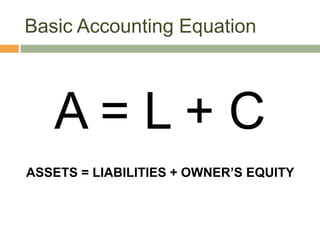
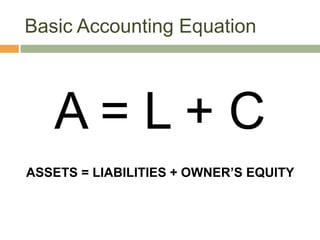
Basic Accounting Equation
A = L + C
ASSETS = LIABILITIES + OWNER’S EQUITY
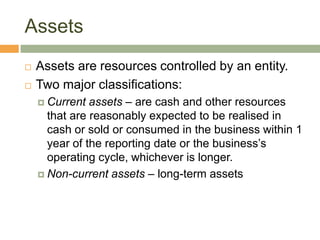
Assets
 Assets are resources controlled by an entity.
 Two major classifications:
 Current assets – are cash and other resources
that are reasonably expected to be realised in
cash or sold or consumed in the business within 1
year of the reporting date or the business’s
operating cycle, whichever is longer.
 Non-current assets – long-term assets
Assets
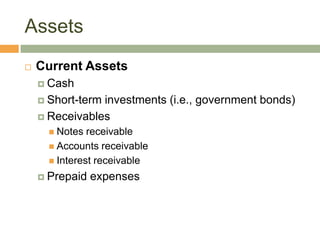
 Current Assets
 Cash
 Short-term investments (i.e., government bonds)
 Receivables
 Notes receivable
 Accounts receivable
 Interest receivable
 Prepaid expenses
Assets
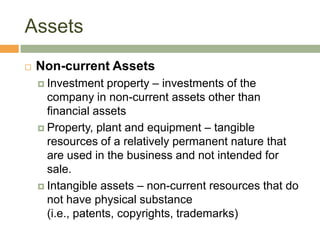
 Non-current Assets
 Investment property – investments of the
company in non-current assets other than
financial assets
 Property, plant and equipment – tangible
resources of a relatively permanent nature that
are used in the business and not intended for
sale.
 Intangible assets – non-current resources that do
not have physical substance
(i.e., patents, copyrights, trademarks)
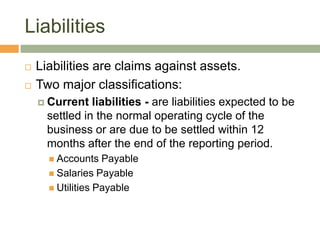
Liabilities
 Liabilities are claims against assets.
 Two major classifications:
 Current liabilities - are liabilities expected to be
settled in the normal operating cycle of the
business or are due to be settled within 12
months after the end of the reporting period.
 Accounts Payable
 Salaries Payable
 Utilities Payable
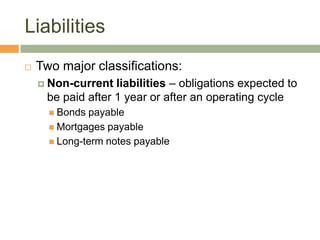
Liabilities
 Two major classifications:
 Non-current liabilities – obligations expected to
be paid after 1 year or after an operating cycle
 Bonds payable
 Mortgages payable
 Long-term notes payable
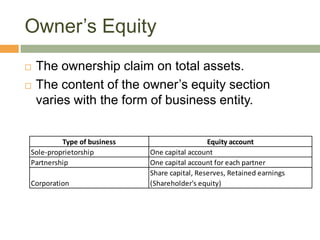
Owner’s Equity
 The ownership claim on total assets.
 The content of the owner’s equity section
varies with the form of business entity.
Type of business Equity account
Sole-proprietorship One capital account
Partnership One capital account for each partner
Corporation
Share capital, Reserves, Retained earnings
(Shareholder's equity)
Increases in Owner’s Equity
 Investments by owner are the assets the
owner puts into the business.
 Income is the gross increase in owner’s equity
resulting from business activities entered into
for the purpose of earning profit.
 Revenue arises in the course of ordinary activities
of the business.
 Gain arises from events that are not part of a
businesses ordinary course of activities.
Decreases in Owner’s Equity
 Drawings are withdrawals by the owner of
cash or other assets for personal use.
 Expenses are the costs of assets consumed or
services used un the process of earning
income.
 Salaries expense
 Utilities expense
 Rent expense
 Depreciation expense
 Interest expense
Owner’s Equity
 Profit results when revenue exceeds
expenses.
 Loss occurs when expenses exceed revenue.
Basic Accounting Equation
A = L + C
ASSETS = LIABILITIES + OWNER’S EQUITY
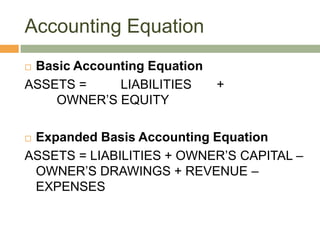
Accounting Equation
 Basic Accounting Equation
ASSETS = LIABILITIES +
OWNER’S EQUITY
 Expanded Basis Accounting Equation
ASSETS = LIABILITIES + OWNER’S CAPITAL –
OWNER’S DRAWINGS + REVENUE –
EXPENSES
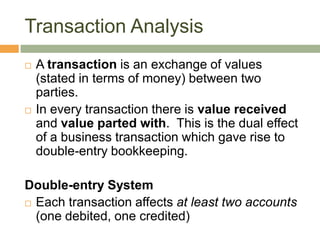
 A transaction is an exchange of values
(stated in terms of money) between two
parties.
 In every transaction there is value received
and value parted with. This is the dual effect
of a business transaction which gave rise to
double-entry bookkeeping.
Double-entry System
 Each transaction affects at least two accounts
(one debited, one credited)
Transaction Analysis
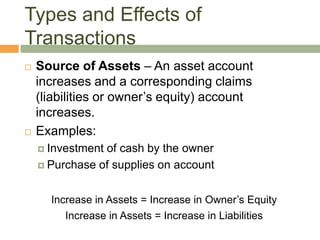
 Source of Assets – An asset account
increases and a corresponding claims
(liabilities or owner’s equity) account
increases.
 Examples:
 Investment of cash by the owner
 Purchase of supplies on account
Increase in Assets = Increase in Owner’s Equity
Increase in Assets = Increase in Liabilities
Types and Effects of
Transactions
 Exchange of Assets – One asset account
increases and another asset account
decreases.
 Examples:
 Equipment purchased on cash
 Collection of Accounts Receivable
Increase in One asset = Decrease in another Asset
Types and Effects of
Transactions
 Use of Assets – An asset account decreases
and a corresponding claims (liabilities or
equity) account decreases.
 Examples:
 Withdrawal of cash by the owner
 Payment of Accounts Payable
Decrease in Assets = Decrease in Owner’s Equity
Decrease in Assets = Decrease in Liabilities
Types and Effects of
Transactions
 Exchange of claims – One claims (liabilities
or owner’s equity) account increases and
another claims (liabilities or owner’s equity)
account decreases.
 Examples:
 Received bill for utilities but the owner did not pay
yet
Increase in Liabilities = Decrease in Owner’s Equity
Increase in Owner’s Equity = Decrease in liabilities
Increase in one Liability = Decrease in another Liability
Increase in one Owner’s Equity = Decrease in another Owner’s Equity
Types and Effects of
Transactions
Analyzing Business
Transactions
 Account – is an individual accounting record
of increases and decreases in a specific
asset, liability or owner’s equity item.
 Consists of three parts:
 The title of the account
 Left or debit side
 Right or credit side
Analyzing Business
Transactions
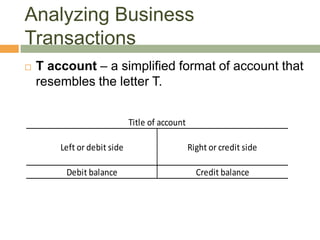
 T account – a simplified format of account that
resembles the letter T.
Left or debit side Right or credit side
Debit balance Credit balance
Title of account
Debits and Credits
 Debit
 Indicates left
 Abbreviated as Dr
 Came from the Latin word debere which originally
meant ‘debtor’
 Credit
 Indicates right
 Abbreviated as Cr
 Came from the Latin word credere which
originally meant ‘creditor’
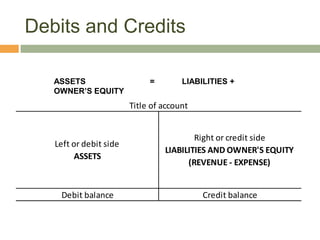
Debits and Credits
ASSETS = LIABILITIES +
OWNER’S EQUITY
Left or debit side
ASSETS
Right or credit side
LIABILITIES AND OWNER'S EQUITY
(REVENUE - EXPENSE)
Debit balance Credit balance
Title of account

Accounting equation and account classification 06052013

  • 1.
  • 2.
    Basic Accounting Equation A= L + C ASSETS = LIABILITIES + OWNER’S EQUITY
  • 3.
    Assets  Assets areresources controlled by an entity.  Two major classifications:  Current assets – are cash and other resources that are reasonably expected to be realised in cash or sold or consumed in the business within 1 year of the reporting date or the business’s operating cycle, whichever is longer.  Non-current assets – long-term assets
  • 4.
    Assets  Current Assets Cash  Short-term investments (i.e., government bonds)  Receivables  Notes receivable  Accounts receivable  Interest receivable  Prepaid expenses
  • 5.
    Assets  Non-current Assets Investment property – investments of the company in non-current assets other than financial assets  Property, plant and equipment – tangible resources of a relatively permanent nature that are used in the business and not intended for sale.  Intangible assets – non-current resources that do not have physical substance (i.e., patents, copyrights, trademarks)
  • 6.
    Liabilities  Liabilities areclaims against assets.  Two major classifications:  Current liabilities - are liabilities expected to be settled in the normal operating cycle of the business or are due to be settled within 12 months after the end of the reporting period.  Accounts Payable  Salaries Payable  Utilities Payable
  • 7.
    Liabilities  Two majorclassifications:  Non-current liabilities – obligations expected to be paid after 1 year or after an operating cycle  Bonds payable  Mortgages payable  Long-term notes payable
  • 8.
    Owner’s Equity  Theownership claim on total assets.  The content of the owner’s equity section varies with the form of business entity. Type of business Equity account Sole-proprietorship One capital account Partnership One capital account for each partner Corporation Share capital, Reserves, Retained earnings (Shareholder's equity)
  • 9.
    Increases in Owner’sEquity  Investments by owner are the assets the owner puts into the business.  Income is the gross increase in owner’s equity resulting from business activities entered into for the purpose of earning profit.  Revenue arises in the course of ordinary activities of the business.  Gain arises from events that are not part of a businesses ordinary course of activities.
  • 10.
    Decreases in Owner’sEquity  Drawings are withdrawals by the owner of cash or other assets for personal use.  Expenses are the costs of assets consumed or services used un the process of earning income.  Salaries expense  Utilities expense  Rent expense  Depreciation expense  Interest expense
  • 11.
    Owner’s Equity  Profitresults when revenue exceeds expenses.  Loss occurs when expenses exceed revenue.
  • 12.
    Basic Accounting Equation A= L + C ASSETS = LIABILITIES + OWNER’S EQUITY
  • 13.
    Accounting Equation  BasicAccounting Equation ASSETS = LIABILITIES + OWNER’S EQUITY  Expanded Basis Accounting Equation ASSETS = LIABILITIES + OWNER’S CAPITAL – OWNER’S DRAWINGS + REVENUE – EXPENSES
  • 14.
     A transactionis an exchange of values (stated in terms of money) between two parties.  In every transaction there is value received and value parted with. This is the dual effect of a business transaction which gave rise to double-entry bookkeeping. Double-entry System  Each transaction affects at least two accounts (one debited, one credited) Transaction Analysis
  • 15.
     Source ofAssets – An asset account increases and a corresponding claims (liabilities or owner’s equity) account increases.  Examples:  Investment of cash by the owner  Purchase of supplies on account Increase in Assets = Increase in Owner’s Equity Increase in Assets = Increase in Liabilities Types and Effects of Transactions
  • 16.
     Exchange ofAssets – One asset account increases and another asset account decreases.  Examples:  Equipment purchased on cash  Collection of Accounts Receivable Increase in One asset = Decrease in another Asset Types and Effects of Transactions
  • 17.
     Use ofAssets – An asset account decreases and a corresponding claims (liabilities or equity) account decreases.  Examples:  Withdrawal of cash by the owner  Payment of Accounts Payable Decrease in Assets = Decrease in Owner’s Equity Decrease in Assets = Decrease in Liabilities Types and Effects of Transactions
  • 18.
     Exchange ofclaims – One claims (liabilities or owner’s equity) account increases and another claims (liabilities or owner’s equity) account decreases.  Examples:  Received bill for utilities but the owner did not pay yet Increase in Liabilities = Decrease in Owner’s Equity Increase in Owner’s Equity = Decrease in liabilities Increase in one Liability = Decrease in another Liability Increase in one Owner’s Equity = Decrease in another Owner’s Equity Types and Effects of Transactions
  • 19.
    Analyzing Business Transactions  Account– is an individual accounting record of increases and decreases in a specific asset, liability or owner’s equity item.  Consists of three parts:  The title of the account  Left or debit side  Right or credit side
  • 20.
    Analyzing Business Transactions  Taccount – a simplified format of account that resembles the letter T. Left or debit side Right or credit side Debit balance Credit balance Title of account
  • 21.
    Debits and Credits Debit  Indicates left  Abbreviated as Dr  Came from the Latin word debere which originally meant ‘debtor’  Credit  Indicates right  Abbreviated as Cr  Came from the Latin word credere which originally meant ‘creditor’
  • 22.
    Debits and Credits ASSETS= LIABILITIES + OWNER’S EQUITY Left or debit side ASSETS Right or credit side LIABILITIES AND OWNER'S EQUITY (REVENUE - EXPENSE) Debit balance Credit balance Title of account