Contents 
ď‚—Reporting cash in the balance sheet 
ď‚—Definition of BRS 
ď‚—The purpose of the BRS 
ď‚—Nature of the cash book and the bank statement 
ď‚—Reasons for difference between the CB and the BS 
ď‚—Rules of debit and credit in BRS 
ď‚—Steps in preparing BRS 
ď‚—Illustration
Reporting cash in the balance sheet 
• Cash is listed first in balance sheet 
• The term Liquid Assets. 
• Current asset section of balance sheet. 
•Purpose of balance sheet.
CASH EQUIVALENTS 
• Short term investments. 
• Similar items in the balance sheet. 
• First asset shown in balance sheet.
Non considered Cash 
Equivalents 
ď‚—Cash equivalent investment in stocks, bonds. 
ď‚—Marketable Securities.
Evaluating Solvency 
ď‚—Study of Balance Sheet. 
ď‚—Users of a company financial statement. 
ď‚—Creditors need to know the amount of liquid 
resources.
Line of Credit 
ď‚—Arrangements of the Line of Credit. 
ď‚—The meanings of Line of Credit. 
ď‚—Borrow Money. 
ď‚—Liability to the Bank.
11..TTHHEE DDEEFFIINNIITTIIOONN OOFF TTHHEE BBAANNKK 
RREECCOONNCCIILLIIAATTIIOONN SSTTAATTEEMMEENNTT 
ď‚—A bank reconciliation is a schedule 
explaining any differences between the 
balance shown in bank statement and 
the balance shown in Cash book.
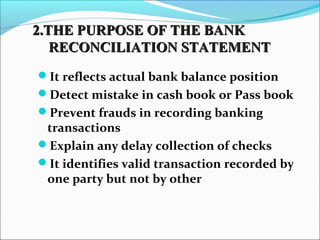
22..TTHHEE PPUURRPPOOSSEE OOFF TTHHEE BBAANNKK 
RREECCOONNCCIILLIIAATTIIOONN SSTTAATTEEMMEENNTT 
ď‚—It reflects actual bank balance position 
ď‚—Detect mistake in cash book or Pass book 
ď‚—Prevent frauds in recording banking 
transactions 
ď‚—Explain any delay collection of checks 
ď‚—It identifies valid transaction recorded by 
one party but not by other
WWhhaatt iiss CCaasshh 
bbooookk aanndd bbaannkk 
ssttaatteemmeenntt
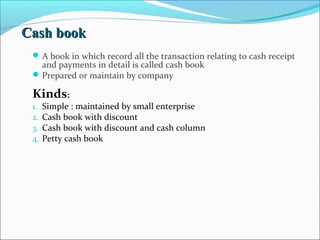
CCaasshh bbooookk 
ď‚—A book in which record all the transaction relating to cash receipt 
and payments in detail is called cash book 
ď‚—Prepared or maintain by company 
Kinds: 
1. Simple : maintained by small enterprise 
2. Cash book with discount 
3. Cash book with discount and cash column 
4. Petty cash book
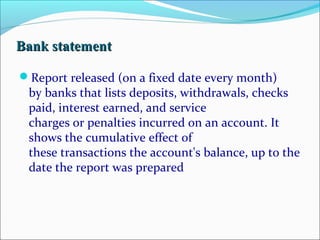
BBaannkk ssttaatteemmeenntt 
ď‚—Report released (on a fixed date every month) 
by banks that lists deposits, withdrawals, checks 
paid, interest earned, and service 
charges or penalties incurred on an account. It 
shows the cumulative effect of 
these transactions the account's balance, up to the 
date the report was prepared
44.. NNAATTUURREE OOFF TTHHEE CCAASSHH BBOOOOKK AANNDD 
TTHHEE BBAANNKK SSTTAATTEEMMEENNTT.. 
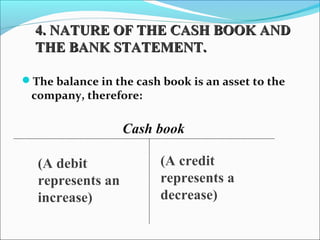
ď‚—The balance in the cash book is an asset to the 
company, therefore: 
Cash book 
(A credit 
represents a 
decrease) 
(A debit 
represents an 
increase)
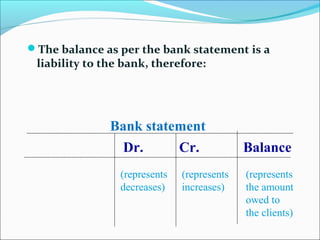
ď‚—The balance as per the bank statement is a 
liability to the bank, therefore: 
(represents 
the amount 
owed to 
the clients) 
Bank statement 
Cr. 
(represents 
increases) 
Dr. 
(represents 
decreases) 
Balance
33.. RREEAASSOONNSS FFOORR DDIIFFFFEERREENNCCEESS 
BBEETTWWEEEENN TTHHEE CCAASSHH BBOOOOKK AANNDD TTHHEE 
BBAANNKK SSTTAATTEEMMEENNTT.. 
ď‚—The bank balances as shown in the cash book and 
the bank statement seldom agree. There are 
various reasons for this. A statement is used to 
reconcile the two balances. 
ď‚—There are some transactions recorded by the depositor but 
missed by the bank. 
ď‚—Similarly, there are transactions appearing on the bank 
statement and not recorded by the company.
o Unpresented cheques 
• They are cheques issued by the firm that have 
not yet been presented to its bank for payment. 
o Deposit transit/uncredited cheques 
• Cash receipts recorded by the depositor but not 
included in bank statement.
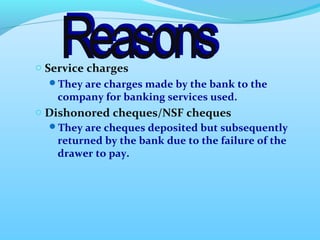
o Service charges 
ď‚—They are charges made by the bank to the 
company for banking services used. 
o Dishonored cheques/NSF cheques 
ď‚—They are cheques deposited but subsequently 
returned by the bank due to the failure of the 
drawer to pay.
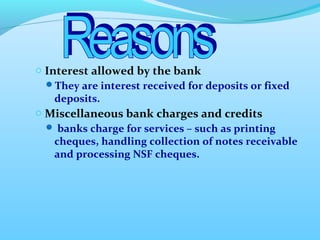
o Interest allowed by the bank 
ď‚—They are interest received for deposits or fixed 
deposits. 
o Miscellaneous bank charges and credits 
 banks charge for services – such as printing 
cheques, handling collection of notes receivable 
and processing NSF cheques.
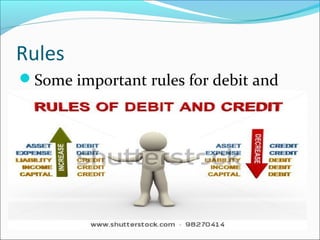
Rules 
ď‚—Some important rules for debit and 
credit in bank reconciliation statement
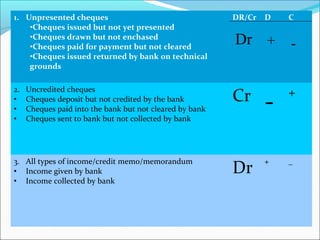
1. Unpresented cheques 
•Cheques issued but not yet presented 
•Cheques drawn but not enchased 
•Cheques paid for payment but not cleared 
•Cheques issued returned by bank on technical 
grounds 
DR/Cr D C 
2. Uncredited cheques 
• Cheques deposit but not credited by the bank 
• Cheques paid into the bank but not cleared by bank 
• Cheques sent to bank but not collected by bank 
Dr + - 
Cr - + 
3. All types of income/credit memo/memorandum 
• Income given by bank 
• Income collected by bank 
Dr + _
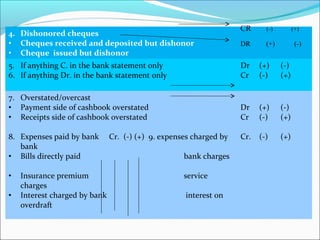
4. Dishonored cheques 
• Cheques received and deposited but dishonor 
• Cheque issued but dishonor 
5. If anything C. in the bank statement only 
6. If anything Dr. in the bank statement only 
CR (-) (+) 
DR (+) (-) 
Dr 
Cr 
(+) 
(-) 
(-) 
(+) 
7. Overstated/overcast 
• Payment side of cashbook overstated 
• Receipts side of cashbook overstated 
8. Expenses paid by bank Cr. (-) (+) 9. expenses charged by 
bank 
• Bills directly paid bank charges 
• Insurance premium service 
charges 
• Interest charged by bank interest on 
overdraft 
Dr 
Cr 
Cr. 
(+) 
(-) 
(-) 
(-) 
(+) 
(+)
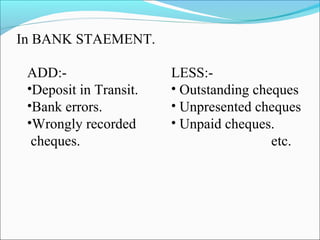
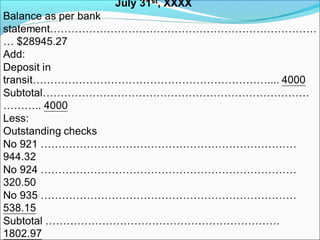
In BANK STAEMENT. 
ADD:- 
•Deposit in Transit. 
•Bank errors. 
•Wrongly recorded 
cheques. 
LESS:- 
• Outstanding cheques 
• Unpresented cheques 
• Unpaid cheques. 
etc.
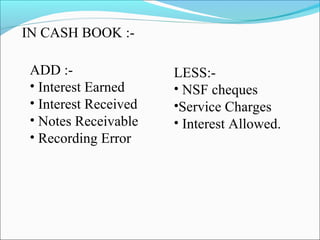
IN CASH BOOK :- 
ADD :- 
• Interest Earned 
• Interest Received 
• Notes Receivable 
• Recording Error 
LESS:- 
• NSF cheques 
•Service Charges 
• Interest Allowed.
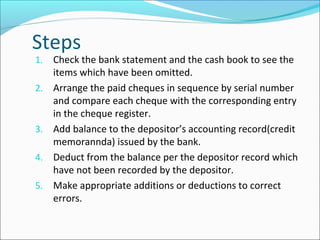
Steps 
1. Check the bank statement and the cash book to see the 
items which have been omitted. 
2. Arrange the paid cheques in sequence by serial number 
and compare each cheque with the corresponding entry 
in the cheque register. 
3. Add balance to the depositor’s accounting record(credit 
memorannda) issued by the bank. 
4. Deduct from the balance per the depositor record which 
have not been recorded by the depositor. 
5. Make appropriate additions or deductions to correct 
errors.
Continued ... 
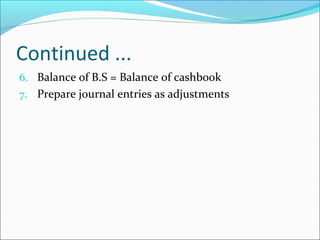
6. Balance of B.S = Balance of cashbook 
7. Prepare journal entries as adjustments
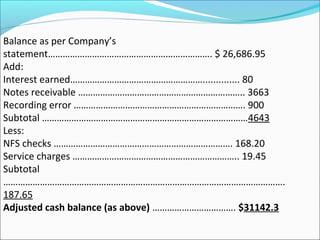
Balance as per Company’s 
statement…………………………………………………………. $ 26,686.95 
Add: 
Interest earned……………………………………………….............. 80 
Notes receivable ………………………………………………………….. 3663 
Recording error ……………………………………………………………. 900 
Subtotal …………………………………………………………………………4643 
Less: 
NFS checks ………………………………………………………………. 168.20 
Service charges ………………………………………………………….. 19.45 
Subtotal 
……………………………………………………………………………………………………. 
187.65 
Adjusted cash balance (as above) ……………………………. $31142.3
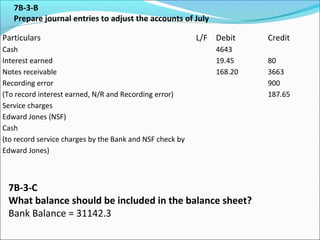
Particulars L/F Debit Credit 
Cash 
4643 
Interest earned 
19.45 
Notes receivable 
168.20 
Recording error 
(To record interest earned, N/R and Recording error) 
Service charges 
Edward Jones (NSF) 
Cash 
(to record service charges by the Bank and NSF check by 
Edward Jones) 
80 
3663 
900 
187.65 
7B-3-B 
Prepare journal entries to adjust the accounts of July 
7B-3-C 
What balance should be included in the balance sheet? 
Bank Balance = 31142.3
Bank Reconciliation Statement

Bank Reconciliation Statement

  • 2.
    Contents ď‚—Reporting cashin the balance sheet ď‚—Definition of BRS ď‚—The purpose of the BRS ď‚—Nature of the cash book and the bank statement ď‚—Reasons for difference between the CB and the BS ď‚—Rules of debit and credit in BRS ď‚—Steps in preparing BRS ď‚—Illustration
  • 3.
    Reporting cash inthe balance sheet • Cash is listed first in balance sheet • The term Liquid Assets. • Current asset section of balance sheet. •Purpose of balance sheet.
  • 4.
    CASH EQUIVALENTS •Short term investments. • Similar items in the balance sheet. • First asset shown in balance sheet.
  • 5.
    Non considered Cash Equivalents ď‚—Cash equivalent investment in stocks, bonds. ď‚—Marketable Securities.
  • 6.
    Evaluating Solvency ď‚—Studyof Balance Sheet. ď‚—Users of a company financial statement. ď‚—Creditors need to know the amount of liquid resources.
  • 7.
    Line of Credit ď‚—Arrangements of the Line of Credit. ď‚—The meanings of Line of Credit. ď‚—Borrow Money. ď‚—Liability to the Bank.
  • 8.
    11..TTHHEE DDEEFFIINNIITTIIOONN OOFFTTHHEE BBAANNKK RREECCOONNCCIILLIIAATTIIOONN SSTTAATTEEMMEENNTT ď‚—A bank reconciliation is a schedule explaining any differences between the balance shown in bank statement and the balance shown in Cash book.
  • 9.
    22..TTHHEE PPUURRPPOOSSEE OOFFTTHHEE BBAANNKK RREECCOONNCCIILLIIAATTIIOONN SSTTAATTEEMMEENNTT ď‚—It reflects actual bank balance position ď‚—Detect mistake in cash book or Pass book ď‚—Prevent frauds in recording banking transactions ď‚—Explain any delay collection of checks ď‚—It identifies valid transaction recorded by one party but not by other
  • 10.
    WWhhaatt iiss CCaasshh bbooookk aanndd bbaannkk ssttaatteemmeenntt
  • 11.
    CCaasshh bbooookk ď‚—Abook in which record all the transaction relating to cash receipt and payments in detail is called cash book ď‚—Prepared or maintain by company Kinds: 1. Simple : maintained by small enterprise 2. Cash book with discount 3. Cash book with discount and cash column 4. Petty cash book
  • 12.
    BBaannkk ssttaatteemmeenntt ď‚—Reportreleased (on a fixed date every month) by banks that lists deposits, withdrawals, checks paid, interest earned, and service charges or penalties incurred on an account. It shows the cumulative effect of these transactions the account's balance, up to the date the report was prepared
  • 13.
    44.. NNAATTUURREE OOFFTTHHEE CCAASSHH BBOOOOKK AANNDD TTHHEE BBAANNKK SSTTAATTEEMMEENNTT.. ď‚—The balance in the cash book is an asset to the company, therefore: Cash book (A credit represents a decrease) (A debit represents an increase)
  • 14.
    ď‚—The balance asper the bank statement is a liability to the bank, therefore: (represents the amount owed to the clients) Bank statement Cr. (represents increases) Dr. (represents decreases) Balance
  • 15.
    33.. RREEAASSOONNSS FFOORRDDIIFFFFEERREENNCCEESS BBEETTWWEEEENN TTHHEE CCAASSHH BBOOOOKK AANNDD TTHHEE BBAANNKK SSTTAATTEEMMEENNTT.. ď‚—The bank balances as shown in the cash book and the bank statement seldom agree. There are various reasons for this. A statement is used to reconcile the two balances. ď‚—There are some transactions recorded by the depositor but missed by the bank. ď‚—Similarly, there are transactions appearing on the bank statement and not recorded by the company.
  • 16.
    o Unpresented cheques • They are cheques issued by the firm that have not yet been presented to its bank for payment. o Deposit transit/uncredited cheques • Cash receipts recorded by the depositor but not included in bank statement.
  • 17.
    o Service charges ď‚—They are charges made by the bank to the company for banking services used. o Dishonored cheques/NSF cheques ď‚—They are cheques deposited but subsequently returned by the bank due to the failure of the drawer to pay.
  • 18.
    o Interest allowedby the bank They are interest received for deposits or fixed deposits. o Miscellaneous bank charges and credits  banks charge for services – such as printing cheques, handling collection of notes receivable and processing NSF cheques.
  • 19.
    Rules ď‚—Some importantrules for debit and credit in bank reconciliation statement
  • 20.
    1. Unpresented cheques •Cheques issued but not yet presented •Cheques drawn but not enchased •Cheques paid for payment but not cleared •Cheques issued returned by bank on technical grounds DR/Cr D C 2. Uncredited cheques • Cheques deposit but not credited by the bank • Cheques paid into the bank but not cleared by bank • Cheques sent to bank but not collected by bank Dr + - Cr - + 3. All types of income/credit memo/memorandum • Income given by bank • Income collected by bank Dr + _
  • 21.
    4. Dishonored cheques • Cheques received and deposited but dishonor • Cheque issued but dishonor 5. If anything C. in the bank statement only 6. If anything Dr. in the bank statement only CR (-) (+) DR (+) (-) Dr Cr (+) (-) (-) (+) 7. Overstated/overcast • Payment side of cashbook overstated • Receipts side of cashbook overstated 8. Expenses paid by bank Cr. (-) (+) 9. expenses charged by bank • Bills directly paid bank charges • Insurance premium service charges • Interest charged by bank interest on overdraft Dr Cr Cr. (+) (-) (-) (-) (+) (+)
  • 22.
    In BANK STAEMENT. ADD:- •Deposit in Transit. •Bank errors. •Wrongly recorded cheques. LESS:- • Outstanding cheques • Unpresented cheques • Unpaid cheques. etc.
  • 23.
    IN CASH BOOK:- ADD :- • Interest Earned • Interest Received • Notes Receivable • Recording Error LESS:- • NSF cheques •Service Charges • Interest Allowed.
  • 24.
    Steps 1. Checkthe bank statement and the cash book to see the items which have been omitted. 2. Arrange the paid cheques in sequence by serial number and compare each cheque with the corresponding entry in the cheque register. 3. Add balance to the depositor’s accounting record(credit memorannda) issued by the bank. 4. Deduct from the balance per the depositor record which have not been recorded by the depositor. 5. Make appropriate additions or deductions to correct errors.
  • 25.
    Continued ... 6.Balance of B.S = Balance of cashbook 7. Prepare journal entries as adjustments
  • 27.
    Balance as perCompany’s statement…………………………………………………………. $ 26,686.95 Add: Interest earned……………………………………………….............. 80 Notes receivable ………………………………………………………….. 3663 Recording error ……………………………………………………………. 900 Subtotal …………………………………………………………………………4643 Less: NFS checks ………………………………………………………………. 168.20 Service charges ………………………………………………………….. 19.45 Subtotal ……………………………………………………………………………………………………. 187.65 Adjusted cash balance (as above) ……………………………. $31142.3
  • 28.
    Particulars L/F DebitCredit Cash 4643 Interest earned 19.45 Notes receivable 168.20 Recording error (To record interest earned, N/R and Recording error) Service charges Edward Jones (NSF) Cash (to record service charges by the Bank and NSF check by Edward Jones) 80 3663 900 187.65 7B-3-B Prepare journal entries to adjust the accounts of July 7B-3-C What balance should be included in the balance sheet? Bank Balance = 31142.3