




Recording of Transaction
Assistant professor -Mr. Swapnil S. Patil
M. Pharm (Pharmaceutics)
Drug Store Business Management
Contents
 Introduction
 Book keeping
 Double entry book keeping system
 Principle
 Types of account
 Books of original entry
 Journal
 Ledger
Introduction
 An external event that affects assets,
liabilities or capital is called a ‘transaction’.
 The documents on the basis of which entries are
recorded in the books of account are known as source
document.eg. Vouchers, invoice, bills, cash memos etc.
 These document provide information about the nature
of the transaction and the amount involved in it.
Book keeping
 Book keeping is defined as the science and
art of systematically and correctly recording
of all transactions which involve the transfer of money
or money’s worth.
 The systematic book keeping enables us to find out
accurately the result of business transactions during a
particular period.
Double entry book keeping system
 The double entry book keeping system is based on the
principle that every transaction has two fold aspects, a
giving aspect and a receiving aspects.
 Both the aspects must be recorded in the books of the
both parties.
1) Left hand side known as ‘Debit side’ denoted by ‘Dr’
2) Right hand side known as ‘Credit side’ denoted by ‘Cr’
 Principle- basic principle are-
1) The receiver is debited with the monetary value of
whatever he receives.
2) The giver is credited with the monetary value of
whatever he gives.
3) Every debit requires a credit and vice versa.
Types of account
 Three types account
1) Personal Account
2) Real account
3) Nominal account
Books of original account
 The following are the main books of original entry-
1) Journal
2) Cash book
a)Simple cash book
b) Two columnar cash book
c) Three columnar cash book
d) Petty cash book
3) Other day book
a) Purchase book
b) Sales book
c) Purchase return book
b) Sales returns book
Journal
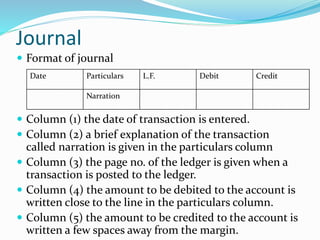
 Format of journal
 Column (1) the date of transaction is entered.
 Column (2) a brief explanation of the transaction
called narration is given in the particulars column
 Column (3) the page no. of the ledger is given when a
transaction is posted to the ledger.
 Column (4) the amount to be debited to the account is
written close to the line in the particulars column.
 Column (5) the amount to be credited to the account is
written a few spaces away from the margin.
Date Particulars L.F. Debit Credit
Narration
Ledger
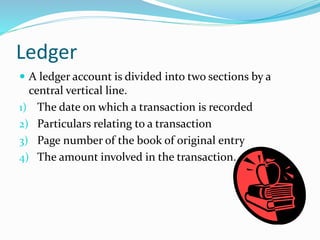
 A ledger account is divided into two sections by a
central vertical line.
1) The date on which a transaction is recorded
2) Particulars relating to a transaction
3) Page number of the book of original entry
4) The amount involved in the transaction.
- Posting of ledger from journal.
- Posting of ledger from cashbook
- Balancing of accounts
References
 R. M. Mehta, Drug store business management,
Vallabh Prakashan, fifth edition 2015( reprint), page
no. 168-207.
 V. N. Raje, Drug store business management, Nirali
Prakashan, edition, page no.
Recording of transction

Recording of transction

  • 1.
    Recording of Transaction Assistantprofessor -Mr. Swapnil S. Patil M. Pharm (Pharmaceutics) Drug Store Business Management
  • 2.
    Contents  Introduction  Bookkeeping  Double entry book keeping system  Principle  Types of account  Books of original entry  Journal  Ledger
  • 3.
    Introduction  An externalevent that affects assets, liabilities or capital is called a ‘transaction’.  The documents on the basis of which entries are recorded in the books of account are known as source document.eg. Vouchers, invoice, bills, cash memos etc.  These document provide information about the nature of the transaction and the amount involved in it.
  • 4.
    Book keeping  Bookkeeping is defined as the science and art of systematically and correctly recording of all transactions which involve the transfer of money or money’s worth.  The systematic book keeping enables us to find out accurately the result of business transactions during a particular period.
  • 5.
    Double entry bookkeeping system  The double entry book keeping system is based on the principle that every transaction has two fold aspects, a giving aspect and a receiving aspects.  Both the aspects must be recorded in the books of the both parties. 1) Left hand side known as ‘Debit side’ denoted by ‘Dr’ 2) Right hand side known as ‘Credit side’ denoted by ‘Cr’
  • 6.
     Principle- basicprinciple are- 1) The receiver is debited with the monetary value of whatever he receives. 2) The giver is credited with the monetary value of whatever he gives. 3) Every debit requires a credit and vice versa.
  • 7.
    Types of account Three types account 1) Personal Account 2) Real account 3) Nominal account
  • 8.
    Books of originalaccount  The following are the main books of original entry- 1) Journal 2) Cash book a)Simple cash book b) Two columnar cash book c) Three columnar cash book d) Petty cash book 3) Other day book a) Purchase book b) Sales book c) Purchase return book b) Sales returns book
  • 9.
    Journal  Format ofjournal  Column (1) the date of transaction is entered.  Column (2) a brief explanation of the transaction called narration is given in the particulars column  Column (3) the page no. of the ledger is given when a transaction is posted to the ledger.  Column (4) the amount to be debited to the account is written close to the line in the particulars column.  Column (5) the amount to be credited to the account is written a few spaces away from the margin. Date Particulars L.F. Debit Credit Narration
  • 10.
    Ledger  A ledgeraccount is divided into two sections by a central vertical line. 1) The date on which a transaction is recorded 2) Particulars relating to a transaction 3) Page number of the book of original entry 4) The amount involved in the transaction.
  • 11.
    - Posting ofledger from journal. - Posting of ledger from cashbook - Balancing of accounts
  • 12.
    References  R. M.Mehta, Drug store business management, Vallabh Prakashan, fifth edition 2015( reprint), page no. 168-207.  V. N. Raje, Drug store business management, Nirali Prakashan, edition, page no.