





Accounting
Cycle
1607045 1607044 1607054
1607020 1607053 1607058
About Accounting Cycle
Actually what is it &&&
Why this accounting
cycle is necessary..
About Accounting Cycle
An accounting cycle is the collective process of
identifying, analyzing, and recording the accounting
events of a company.
The accounting cycle is a series of steps starting
with recording business transaction and leading up to
the preparation of financial statements.
About Accounting Cycle
In addition
1.The accounting cycle is the process of accepting,
recording, sorting, and crediting payments made and
received within a business during a particular accounting
period
2.Companies make their books, financial statements
such as cash flow reports, profit and loss statements,
and balance sheets can be prepared
Steps of Accounting Cycle
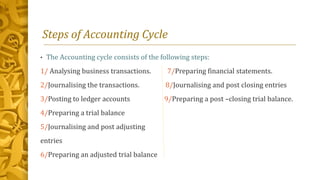
• The Accounting cycle consists of the following steps:
1/ Analysing business transactions. 7/Preparing financial statements.
2/Journalising the transactions. 8/Journalising and post closing entries
3/Posting to ledger accounts 9/Preparing a post –closing trial balance.
4/Preparing a trial balance
5/Journalising and post adjusting
entries
6/Preparing an adjusted trial balance
Details of Accounting Cycle
(1)Analysing business transactions
Various transaction can occur in an enterprise .And this are documented
by noting on business forms.
The procedure for analysing transaction are to-
(i)analyse the effect of the transactions on assets.
(ii) apply the appropriate double entry rule
(iii)make entry.
Details of Accounting Cycle
(2)Journalising the transactions
It is the place where transactions are first listed in a formal manner.
It is also called the chronological record of all transactions. The journal
Record shows-
(a)Transaction dates
(b)Names of accounts
(c)A reference column
**** some journals are also used to facilitate division of labour.
Details of Accounting Cycle
(3)Posting to Ledger Accounts
It is a way of summering the information so that people can easily find
the information. In another way ,it is called a group of accounts. And the
Process of transferring information from journal to ledger is called posting.
Finally another thing is that the balance of each account in the ledger is
determined.
Details of Accounting Cycle
(4)Preparing a Trial Balance
It is used for testing the equality of debit and credit balance in ledger.
A trial balance is prepared by listing each account with its balance in
the appropriate debit or credit column.
**But the major limitation of trial balance is that the equality of debit and
Credit column does not mean that transaction were analysed correctly.
Details of Accounting Cycle
(5)Journalising and post Adjusting Entries
Adjusting entries are a means of implementing accrual accounting .
Adjusting entries are required –
(a) When recorded expenses are to be apportioned between two or more
Accounting periods;
(b)When recorded revenues are to be apportioned between two or more
Accounting periods;
(c) When unrecorded expenses exist and
(d) When unrecorded revenues exist.
Details of Accounting Cycle
(6)Preparing an Adjusted Trial Balance
An Adjusted Trial balance is a trial balance that is prepared after adjusting
entries have been posted to the accounting in the ledger. Its purpose is to test
the balance of the ledger after the adjusting entries are posted and before the
Preparation of financial statements.
Details of Accounting Cycle
(7 )preparing Financial Statements
This is the reporting function of accounting. After the complimentation of
necessary adjustment to be made in accounts, steps are taken to prepare
Income statement. Owner’s equity statement And Balance sheet.
Details of Accounting Cycle
(8)Journalising and post-closing Entrties
Temporary accounts must be cleared out or closed at the end of each
Accounting period. This is done by closing entries. Closing entries may
Be made directly by debating Revenue accounts and crediting Expense
Accounts and transferring the balance to Owner’s equity Accounts.
Details of Accounting Cycle
(9)Preparing a post-closing trial Balance
A trial balance is prepared, after entries have been posted ,is called
a post-closing Trial balance. The permanent accounts are the only ones
With balances that carry into the new accounting period. The account in
Post- closing Trial balance are carried forward to new accounts of
Revenues and Expenses.
The Trouble with Balancing
The accounting cycle’s purpose is to ensure that all the money
coming into or going out of a business is accounted for. That’s why
balancing is so critical.
However, errors are frequently made when recording entries,
leading to an incorrect trial balance that needs to be adjusted
so that debits and credits match.
The Trouble with Balancing
The most common reasons for an account imbalance include:
Forgetting a transaction
Posting a transaction to the wrong account
Posting a transaction as a debit instead of a credit, or vice versa
Duplicate postings
Posting the wrong amount
Accounting Cycle

Accounting Cycle

  • 1.
  • 2.
    About Accounting Cycle Actuallywhat is it &&& Why this accounting cycle is necessary..
  • 3.
    About Accounting Cycle Anaccounting cycle is the collective process of identifying, analyzing, and recording the accounting events of a company. The accounting cycle is a series of steps starting with recording business transaction and leading up to the preparation of financial statements.
  • 4.
    About Accounting Cycle Inaddition 1.The accounting cycle is the process of accepting, recording, sorting, and crediting payments made and received within a business during a particular accounting period 2.Companies make their books, financial statements such as cash flow reports, profit and loss statements, and balance sheets can be prepared
  • 5.
    Steps of AccountingCycle • The Accounting cycle consists of the following steps: 1/ Analysing business transactions. 7/Preparing financial statements. 2/Journalising the transactions. 8/Journalising and post closing entries 3/Posting to ledger accounts 9/Preparing a post –closing trial balance. 4/Preparing a trial balance 5/Journalising and post adjusting entries 6/Preparing an adjusted trial balance
  • 6.
    Details of AccountingCycle (1)Analysing business transactions Various transaction can occur in an enterprise .And this are documented by noting on business forms. The procedure for analysing transaction are to- (i)analyse the effect of the transactions on assets. (ii) apply the appropriate double entry rule (iii)make entry.
  • 7.
    Details of AccountingCycle (2)Journalising the transactions It is the place where transactions are first listed in a formal manner. It is also called the chronological record of all transactions. The journal Record shows- (a)Transaction dates (b)Names of accounts (c)A reference column **** some journals are also used to facilitate division of labour.
  • 8.
    Details of AccountingCycle (3)Posting to Ledger Accounts It is a way of summering the information so that people can easily find the information. In another way ,it is called a group of accounts. And the Process of transferring information from journal to ledger is called posting. Finally another thing is that the balance of each account in the ledger is determined.
  • 9.
    Details of AccountingCycle (4)Preparing a Trial Balance It is used for testing the equality of debit and credit balance in ledger. A trial balance is prepared by listing each account with its balance in the appropriate debit or credit column. **But the major limitation of trial balance is that the equality of debit and Credit column does not mean that transaction were analysed correctly.
  • 10.
    Details of AccountingCycle (5)Journalising and post Adjusting Entries Adjusting entries are a means of implementing accrual accounting . Adjusting entries are required – (a) When recorded expenses are to be apportioned between two or more Accounting periods; (b)When recorded revenues are to be apportioned between two or more Accounting periods; (c) When unrecorded expenses exist and (d) When unrecorded revenues exist.
  • 11.
    Details of AccountingCycle (6)Preparing an Adjusted Trial Balance An Adjusted Trial balance is a trial balance that is prepared after adjusting entries have been posted to the accounting in the ledger. Its purpose is to test the balance of the ledger after the adjusting entries are posted and before the Preparation of financial statements.
  • 12.
    Details of AccountingCycle (7 )preparing Financial Statements This is the reporting function of accounting. After the complimentation of necessary adjustment to be made in accounts, steps are taken to prepare Income statement. Owner’s equity statement And Balance sheet.
  • 13.
    Details of AccountingCycle (8)Journalising and post-closing Entrties Temporary accounts must be cleared out or closed at the end of each Accounting period. This is done by closing entries. Closing entries may Be made directly by debating Revenue accounts and crediting Expense Accounts and transferring the balance to Owner’s equity Accounts.
  • 14.
    Details of AccountingCycle (9)Preparing a post-closing trial Balance A trial balance is prepared, after entries have been posted ,is called a post-closing Trial balance. The permanent accounts are the only ones With balances that carry into the new accounting period. The account in Post- closing Trial balance are carried forward to new accounts of Revenues and Expenses.
  • 15.
    The Trouble withBalancing The accounting cycle’s purpose is to ensure that all the money coming into or going out of a business is accounted for. That’s why balancing is so critical. However, errors are frequently made when recording entries, leading to an incorrect trial balance that needs to be adjusted so that debits and credits match.
  • 16.
    The Trouble withBalancing The most common reasons for an account imbalance include: Forgetting a transaction Posting a transaction to the wrong account Posting a transaction as a debit instead of a credit, or vice versa Duplicate postings Posting the wrong amount