RADHIKA GUPTA
32 - MBA
SCOPE OF COST ACCOUNTANCY
SCOPE OF COST ACCOUNTANCY:
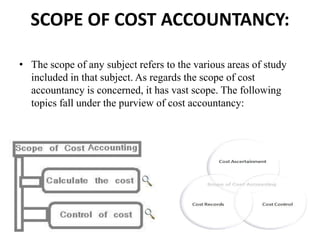
• The scope of any subject refers to the various areas of study
included in that subject. As regards the scope of cost
accountancy is concerned, it has vast scope. The following
topics fall under the purview of cost accountancy:
1. Costing:
• According to the terminology of ICMA, London, “Costing is
the process of determining the costs of products, services or
activities.”
(a) The technique and process of
costing:
The technique of costing involves two distinct steps, namely
(i) collection and classification of costs according to various
elements
(ii) allocation and apportionment of the expenses which cannot
be directly charged to production.
(b) Ascertainment of cost:
It involves three steps:
(i) collection and analysis of expenses
(ii) measurement of production at different stages
(iii) linking up of production with the expenses.
• For example, continuous type of industries may use process
costing as a method, using actual cost as a system, under
Standard Costing Technique.
2. Cost Accounting:
It is “that branch of accounting dealing with the classification,
recording, allocation, summarization and reporting of current
and prospective costs.”
Following aspects included:
(a) Cost classification
(b) Cost recording
(c) Cost allocation
(d) Cost determination or cost finding
(e) Cost reporting
3. Cost Control:
• It is “The guidance and regulation by executive action of the
cost of operating an undertaking.”
Steps:
The steps involved are :
(a) Fixation of targets in terms of cost and production
performance.
(b) Ascertaining the actual cost and production performance.
(c) Comparison of actuals with the targets.
(d) Analysing the variance by causes and the person
responsible for it.
(e) Taking remedial steps to set right unfavourable
variations.
Advantages :
The advantages of cost control are as follows:
(a) It helps in utilizing the resources to the full extent.
(b) It helps in reduction of prices which are benefited by
customers.
(c) It helps in competing successfully in the market.
(d) It increases the profit earning capacity of the business.
(e) It increases the goodwill of the business.
4. Budgeting:
• Budgeting as “an overall blue print of a comprehensive plan of
operations and actions expressed in financial terms. According
to him budgeting process involves the preparation of a budget
and its fullest use not only as a devise for planning and co-
ordinating but also for control.”
5. Cost Audit:
• The terminology of ICMA, London, defines cost audit, as “the
verification of the correctness of cost accounts and of the
adherence to the cost accounting plan.”

Scope of cost accounting

  • 1.
    RADHIKA GUPTA 32 -MBA SCOPE OF COST ACCOUNTANCY
  • 2.
    SCOPE OF COSTACCOUNTANCY: • The scope of any subject refers to the various areas of study included in that subject. As regards the scope of cost accountancy is concerned, it has vast scope. The following topics fall under the purview of cost accountancy:
  • 3.
    1. Costing: • Accordingto the terminology of ICMA, London, “Costing is the process of determining the costs of products, services or activities.”
  • 4.
    (a) The techniqueand process of costing: The technique of costing involves two distinct steps, namely (i) collection and classification of costs according to various elements (ii) allocation and apportionment of the expenses which cannot be directly charged to production.
  • 5.
    (b) Ascertainment ofcost: It involves three steps: (i) collection and analysis of expenses (ii) measurement of production at different stages (iii) linking up of production with the expenses. • For example, continuous type of industries may use process costing as a method, using actual cost as a system, under Standard Costing Technique.
  • 6.
    2. Cost Accounting: Itis “that branch of accounting dealing with the classification, recording, allocation, summarization and reporting of current and prospective costs.”
  • 7.
    Following aspects included: (a)Cost classification (b) Cost recording (c) Cost allocation (d) Cost determination or cost finding (e) Cost reporting
  • 8.
    3. Cost Control: •It is “The guidance and regulation by executive action of the cost of operating an undertaking.”
  • 9.
    Steps: The steps involvedare : (a) Fixation of targets in terms of cost and production performance. (b) Ascertaining the actual cost and production performance. (c) Comparison of actuals with the targets. (d) Analysing the variance by causes and the person responsible for it. (e) Taking remedial steps to set right unfavourable variations.
  • 10.
    Advantages : The advantagesof cost control are as follows: (a) It helps in utilizing the resources to the full extent. (b) It helps in reduction of prices which are benefited by customers. (c) It helps in competing successfully in the market. (d) It increases the profit earning capacity of the business. (e) It increases the goodwill of the business.
  • 11.
    4. Budgeting: • Budgetingas “an overall blue print of a comprehensive plan of operations and actions expressed in financial terms. According to him budgeting process involves the preparation of a budget and its fullest use not only as a devise for planning and co- ordinating but also for control.”
  • 12.
    5. Cost Audit: •The terminology of ICMA, London, defines cost audit, as “the verification of the correctness of cost accounts and of the adherence to the cost accounting plan.”