The Accounting Cycle
A systematic step-by-step process that transforms daily business
transactions into accurate financial statements, ensuring transparency
and accountability in financial reporting.
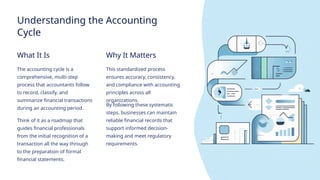
Understanding the Accounting
Cycle
What It Is
The accounting cycle is a
comprehensive, multi-step
process that accountants follow
to record, classify, and
summarize financial transactions
during an accounting period.
Think of it as a roadmap that
guides financial professionals
from the initial recognition of a
transaction all the way through
to the preparation of formal
financial statements.
Why It Matters
This standardized process
ensures accuracy, consistency,
and compliance with accounting
principles across all
organizations.
By following these systematic
steps, businesses can maintain
reliable financial records that
support informed decision-
making and meet regulatory
requirements.
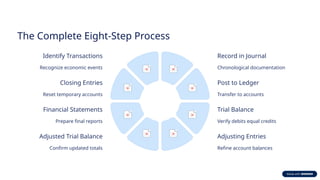
The Complete Eight-Step Process
Identify Transactions
Recognize economic events
Record in Journal
Chronological documentation
Post to Ledger
Transfer to accounts
Trial Balance
Verify debits equal credits
Adjusting Entries
Refine account balances
Adjusted Trial Balance
Confirm updated totals
Financial Statements
Prepare final reports
Closing Entries
Reset temporary accounts
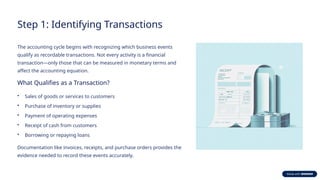
Step 1: Identifying Transactions
The accounting cycle begins with recognizing which business events
qualify as recordable transactions. Not every activity is a financial
transaction—only those that can be measured in monetary terms and
affect the accounting equation.
What Qualifies as a Transaction?
• Sales of goods or services to customers
• Purchase of inventory or supplies
• Payment of operating expenses
• Receipt of cash from customers
• Borrowing or repaying loans
Documentation like invoices, receipts, and purchase orders provides the
evidence needed to record these events accurately.
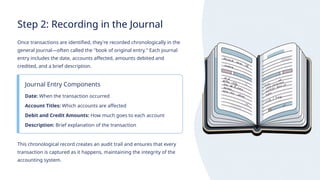
Step 2: Recording in the Journal
Once transactions are identified, they're recorded chronologically in the
general journal—often called the "book of original entry." Each journal
entry includes the date, accounts affected, amounts debited and
credited, and a brief description.
Journal Entry Components
Date: When the transaction occurred
Account Titles: Which accounts are affected
Debit and Credit Amounts: How much goes to each account
Description: Brief explanation of the transaction
This chronological record creates an audit trail and ensures that every
transaction is captured as it happens, maintaining the integrity of the
accounting system.
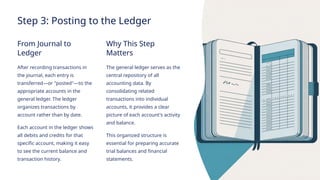
Step 3: Posting to the Ledger
From Journal to
Ledger
After recording transactions in
the journal, each entry is
transferred—or "posted"—to the
appropriate accounts in the
general ledger. The ledger
organizes transactions by
account rather than by date.
Each account in the ledger shows
all debits and credits for that
specific account, making it easy
to see the current balance and
transaction history.
Why This Step
Matters
The general ledger serves as the
central repository of all
accounting data. By
consolidating related
transactions into individual
accounts, it provides a clear
picture of each account's activity
and balance.
This organized structure is
essential for preparing accurate
trial balances and financial
statements.
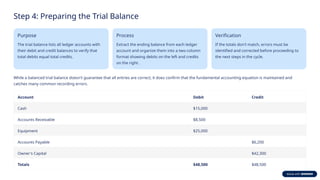
Step 4: Preparing the Trial Balance
Purpose
The trial balance lists all ledger accounts with
their debit and credit balances to verify that
total debits equal total credits.
Process
Extract the ending balance from each ledger
account and organize them into a two-column
format showing debits on the left and credits
on the right.
Verification
If the totals don't match, errors must be
identified and corrected before proceeding to
the next steps in the cycle.
While a balanced trial balance doesn't guarantee that all entries are correct, it does confirm that the fundamental accounting equation is maintained and
catches many common recording errors.
Account Debit Credit
Cash $15,000
Accounts Receivable $8,500
Equipment $25,000
Accounts Payable $6,200
Owner's Capital $42,300
Totals $48,500 $48,500
Steps 5 & 6: Adjustments and Adjusted Trial Balance
Step 5: Adjusting Entries Step 6: Adjusted Trial Balance
After posting all adjusting entries, a new trial balance is prepared to verify that debits still equal credits with the updated
account balances.
This adjusted trial balance serves as the foundation for preparing the financial statements, ensuring all accounts reflect
accurate, up-to-date information for the reporting period.
Key Point: The adjusted trial balance incorporates all adjustments and provides the final account balances used in
financial statement preparation.
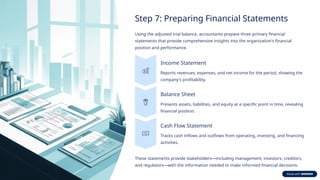
Step 7: Preparing Financial Statements
Using the adjusted trial balance, accountants prepare three primary financial
statements that provide comprehensive insights into the organization's financial
position and performance.
Income Statement
Reports revenues, expenses, and net income for the period, showing the
company's profitability.
Balance Sheet
Presents assets, liabilities, and equity at a specific point in time, revealing
financial position.
Cash Flow Statement
Tracks cash inflows and outflows from operating, investing, and financing
activities.
These statements provide stakeholders—including management, investors, creditors,
and regulators—with the information needed to make informed financial decisions.
Step 8: Closing the Books
The final step in the accounting cycle involves closing temporary accounts to prepare for the
next accounting period. This process transfers balances from revenue, expense, and dividend
accounts into retained earnings.
The Closing Process
1. Close revenue accounts to Income Summary
2. Close expense accounts to Income Summary
3. Close Income Summary to Retained Earnings
4. Close Dividends to Retained Earnings
After closing entries are complete, only permanent accounts (assets, liabilities, and equity)
carry balances forward to the next period. Temporary accounts start fresh at zero, ready to
accumulate data for the new accounting cycle.
Remember: The cycle then repeats, beginning again with
identifying new transactions for the next accounting period.

The-Accounting-Cycle in commerce - commerce

  • 2.
    The Accounting Cycle Asystematic step-by-step process that transforms daily business transactions into accurate financial statements, ensuring transparency and accountability in financial reporting.
  • 3.
    Understanding the Accounting Cycle WhatIt Is The accounting cycle is a comprehensive, multi-step process that accountants follow to record, classify, and summarize financial transactions during an accounting period. Think of it as a roadmap that guides financial professionals from the initial recognition of a transaction all the way through to the preparation of formal financial statements. Why It Matters This standardized process ensures accuracy, consistency, and compliance with accounting principles across all organizations. By following these systematic steps, businesses can maintain reliable financial records that support informed decision- making and meet regulatory requirements.
  • 4.
    The Complete Eight-StepProcess Identify Transactions Recognize economic events Record in Journal Chronological documentation Post to Ledger Transfer to accounts Trial Balance Verify debits equal credits Adjusting Entries Refine account balances Adjusted Trial Balance Confirm updated totals Financial Statements Prepare final reports Closing Entries Reset temporary accounts
  • 5.
    Step 1: IdentifyingTransactions The accounting cycle begins with recognizing which business events qualify as recordable transactions. Not every activity is a financial transaction—only those that can be measured in monetary terms and affect the accounting equation. What Qualifies as a Transaction? • Sales of goods or services to customers • Purchase of inventory or supplies • Payment of operating expenses • Receipt of cash from customers • Borrowing or repaying loans Documentation like invoices, receipts, and purchase orders provides the evidence needed to record these events accurately.
  • 6.
    Step 2: Recordingin the Journal Once transactions are identified, they're recorded chronologically in the general journal—often called the "book of original entry." Each journal entry includes the date, accounts affected, amounts debited and credited, and a brief description. Journal Entry Components Date: When the transaction occurred Account Titles: Which accounts are affected Debit and Credit Amounts: How much goes to each account Description: Brief explanation of the transaction This chronological record creates an audit trail and ensures that every transaction is captured as it happens, maintaining the integrity of the accounting system.
  • 7.
    Step 3: Postingto the Ledger From Journal to Ledger After recording transactions in the journal, each entry is transferred—or "posted"—to the appropriate accounts in the general ledger. The ledger organizes transactions by account rather than by date. Each account in the ledger shows all debits and credits for that specific account, making it easy to see the current balance and transaction history. Why This Step Matters The general ledger serves as the central repository of all accounting data. By consolidating related transactions into individual accounts, it provides a clear picture of each account's activity and balance. This organized structure is essential for preparing accurate trial balances and financial statements.
  • 8.
    Step 4: Preparingthe Trial Balance Purpose The trial balance lists all ledger accounts with their debit and credit balances to verify that total debits equal total credits. Process Extract the ending balance from each ledger account and organize them into a two-column format showing debits on the left and credits on the right. Verification If the totals don't match, errors must be identified and corrected before proceeding to the next steps in the cycle. While a balanced trial balance doesn't guarantee that all entries are correct, it does confirm that the fundamental accounting equation is maintained and catches many common recording errors. Account Debit Credit Cash $15,000 Accounts Receivable $8,500 Equipment $25,000 Accounts Payable $6,200 Owner's Capital $42,300 Totals $48,500 $48,500
  • 9.
    Steps 5 &6: Adjustments and Adjusted Trial Balance Step 5: Adjusting Entries Step 6: Adjusted Trial Balance After posting all adjusting entries, a new trial balance is prepared to verify that debits still equal credits with the updated account balances. This adjusted trial balance serves as the foundation for preparing the financial statements, ensuring all accounts reflect accurate, up-to-date information for the reporting period. Key Point: The adjusted trial balance incorporates all adjustments and provides the final account balances used in financial statement preparation.
  • 10.
    Step 7: PreparingFinancial Statements Using the adjusted trial balance, accountants prepare three primary financial statements that provide comprehensive insights into the organization's financial position and performance. Income Statement Reports revenues, expenses, and net income for the period, showing the company's profitability. Balance Sheet Presents assets, liabilities, and equity at a specific point in time, revealing financial position. Cash Flow Statement Tracks cash inflows and outflows from operating, investing, and financing activities. These statements provide stakeholders—including management, investors, creditors, and regulators—with the information needed to make informed financial decisions.
  • 11.
    Step 8: Closingthe Books The final step in the accounting cycle involves closing temporary accounts to prepare for the next accounting period. This process transfers balances from revenue, expense, and dividend accounts into retained earnings. The Closing Process 1. Close revenue accounts to Income Summary 2. Close expense accounts to Income Summary 3. Close Income Summary to Retained Earnings 4. Close Dividends to Retained Earnings After closing entries are complete, only permanent accounts (assets, liabilities, and equity) carry balances forward to the next period. Temporary accounts start fresh at zero, ready to accumulate data for the new accounting cycle. Remember: The cycle then repeats, beginning again with identifying new transactions for the next accounting period.