Accounting Cycle
Outline:
• Introduction
• Objective
• Methods
• Accounting Cycle
 Transactions
 Journal Entries
 Posting
 Trial Balance
 Adjusting Journal Entries
 Worksheet
 Financial Statement
 Closing
• Conclusion
• Reference
Objective
Correct errors in general journal
entries in Accounting Cycle.
Methods
 Collecting data
The source of data in Accounting Cycle is from internet.
 Solving Problem
The problem in Errors in general jurnal entries can be
corrected at the end of period Accounting cycle and
continue the next step of Accounting Cycle.
Accounting Cycle
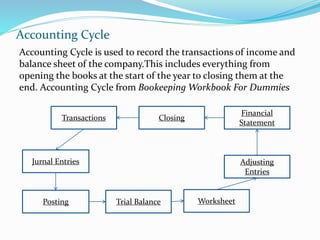
Accounting Cycle is used to record the transactions of income and
balance sheet of the company.This includes everything from
opening the books at the start of the year to closing them at the
end. Accounting Cycle from Bookeeping Workbook For Dummies
Jurnal Entries
Posting Trial Balance Worksheet
Adjusting
Entries
Financial
Statement
ClosingTransactions
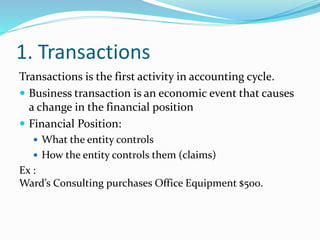
1. Transactions
Transactions is the first activity in accounting cycle.
 Business transaction is an economic event that causes
a change in the financial position
 Financial Position:
 What the entity controls
 How the entity controls them (claims)
Ex :
Ward’s Consulting purchases Office Equipment $500.
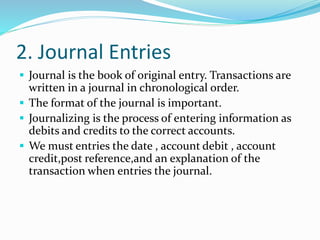
2. Journal Entries
 Journal is the book of original entry. Transactions are
written in a journal in chronological order.
 The format of the journal is important.
 Journalizing is the process of entering information as
debits and credits to the correct accounts.
 We must entries the date , account debit , account
credit,post reference,and an explanation of the
transaction when entries the journal.
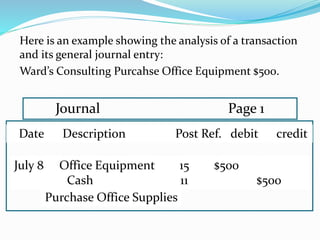
Here is an example showing the analysis of a transaction
and its general journal entry:
Ward’s Consulting Purcahse Office Equipment $500.
Journal Page 1
Date Description Post Ref. debit credit
Purchase Office Supplies
July 8 Office Equipment 15 $500
Cash 11 $500
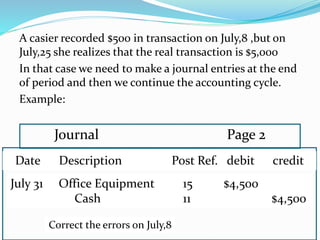
A casier recorded $500 in transaction on July,8 ,but on
July,25 she realizes that the real transaction is $5,000
In that case we need to make a journal entries at the end
of period and then we continue the accounting cycle.
Example:
Journal Page 2
Date Description Post Ref. debit credit
Correct the errors on July,8
July 31 Office Equipment 15 $4,500
Cash 11 $4,500
3. Posting
 All transactions are recorded in the journal, then
amounts are copied to the ledger accounts.
 Ledger Account
 Listing of the transactions for an individual account
 General Ledger
 A book containing all the Ledger Accounts
 Once the amounts are entered into the accounts, a
posting reference (PR) must be entered in the journal.
 New balances are computed in the running ledger
accounts.
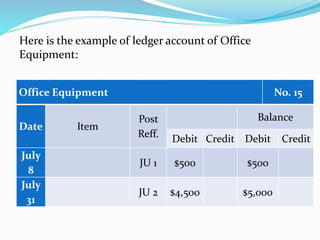
Here is the example of ledger account of Office
Equipment:
Office Equipment No. 15
Date Item
Post
Reff.
Balance
Debit Credit Debit Credit
July
8
JU 1 $500 $500
July
31
JU 2 $4,500 $5,000
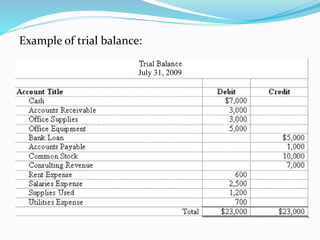
4. Trial Balance
Trial balance lists all account that have the same balance
between account debit and account credit.
Trial balance will show some mistake if debit and credit
are not balance
Example of trial balance:
July 31, 2009
5. Worksheet
An accounting worksheet is large table of data which
may be prepared by accountants as an optional
intermediate step in an accounting cycle.
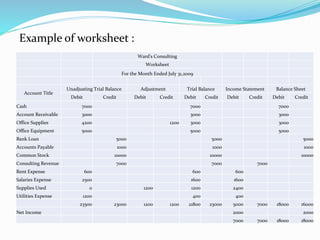
Example of worksheet :
Ward's Consulting
Worksheet
For the Month Ended July 31,2009
Account Title
Unadjusting Trial Balance Adjustment Trial Balance Income Statement Balance Sheet
Debit Credit Debit Credit Debit Credit Debit Credit Debit Credit
Cash 7000 7000 7000
Account Receivable 3000 3000 3000
Office Supplies 4200 1200 3000 3000
Office Equipment 5000 5000 5000
Bank Loan 5000 5000 5000
Accounts Payable 1000 1000 1000
Common Stock 10000 10000 10000
Consulting Revenue 7000 7000 7000
Rent Expense 600 600 600
Salaries Expense 2500 1600 1600
Supplies Used 0 1200 1200 2400
Utilities Expense 1200 400 400
23500 23000 1200 1200 21800 23000 5000 7000 18000 16000
Net Income 2000 2000
7000 7000 18000 18000
6. Adjusting Jurnal Entries
At this step, we find something wrong and post the
correction where needed
Adjustment are also made for prepaid , Acrued revenue
or expense ,and depreciation
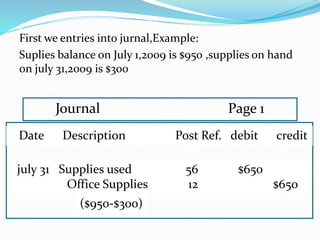
First we entries into jurnal,Example:
Suplies balance on July 1,2009 is $950 ,supplies on hand
on july 31,2009 is $300
Journal Page 1
Date Description Post Ref. debit credit
($950-$300)
july 31 Supplies used 56 $650
Office Supplies 12 $650
7. Financial Statements
 After worksheet is in balance , we prepare income
statement ,statement of owner equity , and balance
sheet.
 The income statement is prepared using the revenue
and expense accounts from the trial balance.
 The Statement Of Owner’s Equity is prepared using
Owner’s Equity and Net Income Accounts.
 the balance sheet can be prepared using the asset and
liability accounts by including the net income with the
other equity accounts.
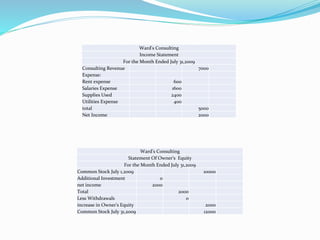
Ward's Consulting
Income Statement
For the Month Ended July 31,2009
Consulting Revenue 7000
Expense:
Rent expense 600
Salaries Expense 1600
Supplies Used 2400
Utilities Expense 400
total 5000
Net Income 2000
Ward's Consulting
Statement Of Owner's Equity
For the Month Ended July 31,2009
Common Stock July 1,2009 10000
Additional Investment 0
net income 2000
Total 2000
Less Withdrawals 0
increase in Owner's Equity 2000
Common Stock July 31,2009 12000
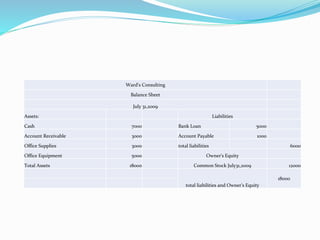
Ward's Consulting
Balance Sheet
July 31,2009
Assets: Liabilities
Cash 7000 Bank Loan 5000
Account Receivable 3000 Account Payable 1000
Office Supplies 3000 total liabilities 6000
Office Equipment 5000 Owner's Equity
Total Assets 18000 Common Stock July31,2009 12000
total liabilities and Owner's Equity
18000
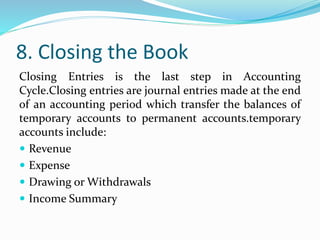
8. Closing the Book
Closing Entries is the last step in Accounting
Cycle.Closing entries are journal entries made at the end
of an accounting period which transfer the balances of
temporary accounts to permanent accounts.temporary
accounts include:
 Revenue
 Expense
 Drawing or Withdrawals
 Income Summary
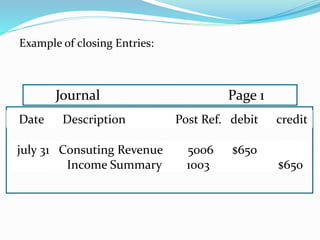
Example of closing Entries:
Journal Page 1
Date Description Post Ref. debit credit
july 31 Consuting Revenue 5006 $650
Income Summary 1003 $650
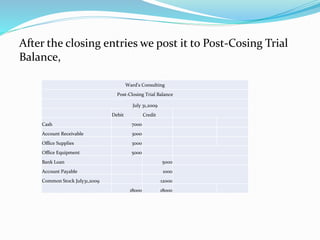
After the closing entries we post it to Post-Cosing Trial
Balance,
Ward's Consulting
Post-Closing Trial Balance
July 31,2009
Debit Credit
Cash 7000
Account Receivable 3000
Office Supplies 3000
Office Equipment 5000
Bank Loan 5000
Account Payable 1000
Common Stock July31,2009 12000
18000 18000
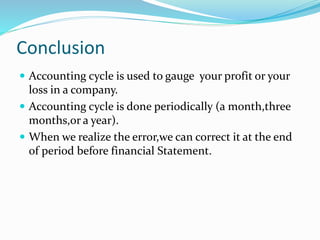
Conclusion
 Accounting cycle is used to gauge your profit or your
loss in a company.
 Accounting cycle is done periodically (a month,three
months,or a year).
 When we realize the error,we can correct it at the end
of period before financial Statement.
Reference
Epstein, Lita.2007. Bookkeeping Workbook For Dummies.
Wiley Publishing:Indiana.
http://accountingexplained.com/ accessed on December
14,2014
http://content.moneyinstructor.com/1499/trialbalance.html
accessed on January 7,2015
https://learning.uonbi.ac.ke accessed on December 14,2014
vrpacioli.loyola.edu/ accessed on December 14,2014
Warren, Carl.S, Reeve, James.M, & Duchac, Jonathan.E.
2009. Principle of Accounting, edition 23. South-
Western Cengage Learning : USA.
www.houstonisd.org/ accessed on December 14,2014
Thank You for Yuor Attention

Acc cycle

  • 1.
  • 2.
    Outline: • Introduction • Objective •Methods • Accounting Cycle  Transactions  Journal Entries  Posting  Trial Balance  Adjusting Journal Entries  Worksheet  Financial Statement  Closing • Conclusion • Reference
  • 3.
    Objective Correct errors ingeneral journal entries in Accounting Cycle.
  • 4.
    Methods  Collecting data Thesource of data in Accounting Cycle is from internet.  Solving Problem The problem in Errors in general jurnal entries can be corrected at the end of period Accounting cycle and continue the next step of Accounting Cycle.
  • 5.
    Accounting Cycle Accounting Cycleis used to record the transactions of income and balance sheet of the company.This includes everything from opening the books at the start of the year to closing them at the end. Accounting Cycle from Bookeeping Workbook For Dummies Jurnal Entries Posting Trial Balance Worksheet Adjusting Entries Financial Statement ClosingTransactions
  • 6.
    1. Transactions Transactions isthe first activity in accounting cycle.  Business transaction is an economic event that causes a change in the financial position  Financial Position:  What the entity controls  How the entity controls them (claims) Ex : Ward’s Consulting purchases Office Equipment $500.
  • 7.
    2. Journal Entries Journal is the book of original entry. Transactions are written in a journal in chronological order.  The format of the journal is important.  Journalizing is the process of entering information as debits and credits to the correct accounts.  We must entries the date , account debit , account credit,post reference,and an explanation of the transaction when entries the journal.
  • 8.
    Here is anexample showing the analysis of a transaction and its general journal entry: Ward’s Consulting Purcahse Office Equipment $500. Journal Page 1 Date Description Post Ref. debit credit Purchase Office Supplies July 8 Office Equipment 15 $500 Cash 11 $500
  • 9.
    A casier recorded$500 in transaction on July,8 ,but on July,25 she realizes that the real transaction is $5,000 In that case we need to make a journal entries at the end of period and then we continue the accounting cycle. Example: Journal Page 2 Date Description Post Ref. debit credit Correct the errors on July,8 July 31 Office Equipment 15 $4,500 Cash 11 $4,500
  • 10.
    3. Posting  Alltransactions are recorded in the journal, then amounts are copied to the ledger accounts.  Ledger Account  Listing of the transactions for an individual account  General Ledger  A book containing all the Ledger Accounts  Once the amounts are entered into the accounts, a posting reference (PR) must be entered in the journal.  New balances are computed in the running ledger accounts.
  • 11.
    Here is theexample of ledger account of Office Equipment: Office Equipment No. 15 Date Item Post Reff. Balance Debit Credit Debit Credit July 8 JU 1 $500 $500 July 31 JU 2 $4,500 $5,000
  • 12.
    4. Trial Balance Trialbalance lists all account that have the same balance between account debit and account credit. Trial balance will show some mistake if debit and credit are not balance
  • 13.
    Example of trialbalance: July 31, 2009
  • 14.
    5. Worksheet An accountingworksheet is large table of data which may be prepared by accountants as an optional intermediate step in an accounting cycle.
  • 15.
    Example of worksheet: Ward's Consulting Worksheet For the Month Ended July 31,2009 Account Title Unadjusting Trial Balance Adjustment Trial Balance Income Statement Balance Sheet Debit Credit Debit Credit Debit Credit Debit Credit Debit Credit Cash 7000 7000 7000 Account Receivable 3000 3000 3000 Office Supplies 4200 1200 3000 3000 Office Equipment 5000 5000 5000 Bank Loan 5000 5000 5000 Accounts Payable 1000 1000 1000 Common Stock 10000 10000 10000 Consulting Revenue 7000 7000 7000 Rent Expense 600 600 600 Salaries Expense 2500 1600 1600 Supplies Used 0 1200 1200 2400 Utilities Expense 1200 400 400 23500 23000 1200 1200 21800 23000 5000 7000 18000 16000 Net Income 2000 2000 7000 7000 18000 18000
  • 16.
    6. Adjusting JurnalEntries At this step, we find something wrong and post the correction where needed Adjustment are also made for prepaid , Acrued revenue or expense ,and depreciation
  • 17.
    First we entriesinto jurnal,Example: Suplies balance on July 1,2009 is $950 ,supplies on hand on july 31,2009 is $300 Journal Page 1 Date Description Post Ref. debit credit ($950-$300) july 31 Supplies used 56 $650 Office Supplies 12 $650
  • 18.
    7. Financial Statements After worksheet is in balance , we prepare income statement ,statement of owner equity , and balance sheet.  The income statement is prepared using the revenue and expense accounts from the trial balance.  The Statement Of Owner’s Equity is prepared using Owner’s Equity and Net Income Accounts.  the balance sheet can be prepared using the asset and liability accounts by including the net income with the other equity accounts.
  • 19.
    Ward's Consulting Income Statement Forthe Month Ended July 31,2009 Consulting Revenue 7000 Expense: Rent expense 600 Salaries Expense 1600 Supplies Used 2400 Utilities Expense 400 total 5000 Net Income 2000 Ward's Consulting Statement Of Owner's Equity For the Month Ended July 31,2009 Common Stock July 1,2009 10000 Additional Investment 0 net income 2000 Total 2000 Less Withdrawals 0 increase in Owner's Equity 2000 Common Stock July 31,2009 12000
  • 20.
    Ward's Consulting Balance Sheet July31,2009 Assets: Liabilities Cash 7000 Bank Loan 5000 Account Receivable 3000 Account Payable 1000 Office Supplies 3000 total liabilities 6000 Office Equipment 5000 Owner's Equity Total Assets 18000 Common Stock July31,2009 12000 total liabilities and Owner's Equity 18000
  • 21.
    8. Closing theBook Closing Entries is the last step in Accounting Cycle.Closing entries are journal entries made at the end of an accounting period which transfer the balances of temporary accounts to permanent accounts.temporary accounts include:  Revenue  Expense  Drawing or Withdrawals  Income Summary
  • 22.
    Example of closingEntries: Journal Page 1 Date Description Post Ref. debit credit july 31 Consuting Revenue 5006 $650 Income Summary 1003 $650
  • 23.
    After the closingentries we post it to Post-Cosing Trial Balance, Ward's Consulting Post-Closing Trial Balance July 31,2009 Debit Credit Cash 7000 Account Receivable 3000 Office Supplies 3000 Office Equipment 5000 Bank Loan 5000 Account Payable 1000 Common Stock July31,2009 12000 18000 18000
  • 24.
    Conclusion  Accounting cycleis used to gauge your profit or your loss in a company.  Accounting cycle is done periodically (a month,three months,or a year).  When we realize the error,we can correct it at the end of period before financial Statement.
  • 25.
    Reference Epstein, Lita.2007. BookkeepingWorkbook For Dummies. Wiley Publishing:Indiana. http://accountingexplained.com/ accessed on December 14,2014 http://content.moneyinstructor.com/1499/trialbalance.html accessed on January 7,2015 https://learning.uonbi.ac.ke accessed on December 14,2014 vrpacioli.loyola.edu/ accessed on December 14,2014 Warren, Carl.S, Reeve, James.M, & Duchac, Jonathan.E. 2009. Principle of Accounting, edition 23. South- Western Cengage Learning : USA. www.houstonisd.org/ accessed on December 14,2014
  • 26.
    Thank You forYuor Attention