 Borish’s clinical refraction
 Duke-Elder’s practice of refraction
 Principal of optics and refraction by Lalit P.
Agrawal
 Binocular vision and ocular motility-Gunter
K Von noorden
 Clinical management of strabismus-
Elizabeth
 Optics and refraction by A.K khurana
 Anatomy physiology by A.K khuran
 Internet
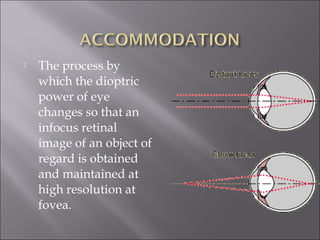
 The process by
which the dioptric
power of eye
changes so that an
infocus retinal
image of an object of
regard is obtained
and maintained at
high resolution at
fovea.
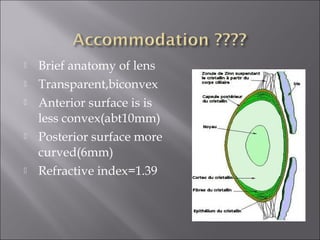
 Brief anatomy of lens
 Transparent,biconvex
 Anterior surface is is
less convex(abt10mm)
 Posterior surface more
curved(6mm)
 Refractive index=1.39
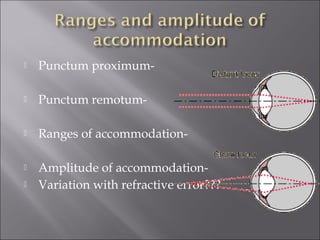
 Punctum proximum-
 Punctum remotum-
 Ranges of accommodation-
 Amplitude of accommodation-
 Variation with refractive error???
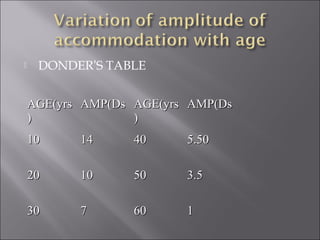
 DONDER’S TABLE
AGE(yrsAGE(yrs
))
AMP(DsAMP(Ds AGE(yrsAGE(yrs
))
AMP(DsAMP(Ds
1010 1414 4040 5.505.50
2020 1010 5050 3.53.5
3030 77 6060 11
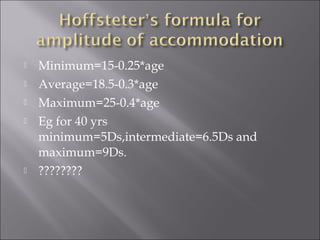
 Minimum=15-0.25*age
 Average=18.5-0.3*age
 Maximum=25-0.4*age
 Eg for 40 yrs
minimum=5Ds,intermediate=6.5Ds and
maximum=9Ds.
 ????????
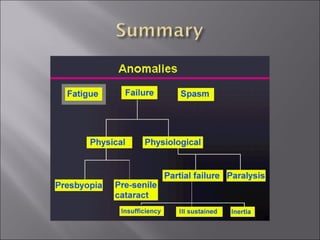
 Insuffeciency of accommodation
 Excess or spasm of accommodation
 Physiological anomaly
 Pharmacological anomaly
 Pathological anomaly
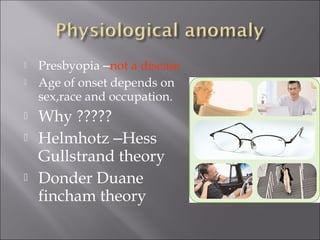
 Presbyopia –not a disease
 Age of onset depends on
sex,race and occupation.
 Why ?????
 Helmhotz –Hess
Gullstrand theory
 Donder Duane
fincham theory
 Incipient presbyopia
 Functional presbyopia
 Absolute presbyopia
 Premature presbyopia
 Nocturnal presbyopia
 Symptoms –
 Small print become indistinct in dim
illumination.
 Hand short for reading
 Glass..near glass,bifocal glass.progressive
addition lens,monovision glasses
 Contact lens option
 Distance single vision CL and near glasses
 Monovision CL
 Bifocal /multifocal CL
 Non refractive bifocal
 Weakest glass which are compatible with good
vision????
 A general rule an individual require 1D at 40 and in
every 5 yrs ,increases by 1D until 55 then stabilizes.
 Considering amplitude of accommodation
-RAF ruler
-Donder's table
-hoffsteter’s formula
-Dynamic retinoscopy
 Binocular cross cylinder test-
 Negative relative accommodation (NRA)and
positive relative accommodation(PRA)-
 Addition-NRA+1/2 relative amplitude of
accommodation
 Eg if PRA is –0.50 Ds and NRA is +2.00
 Amplitude of accommodation=+2.50
 Addition==2.00-1/2*2.50=+0.75Ds
 Surgical procedure
 Made artificially anisometropic
 New advancement in surgical process
 Ciliary body is supplied by both sympathetic
and parasympathetic supply.
 Sympathetic receptor include alpha and beta
 Parasympathetic include muscarinic receptor
M1,M2,M3
 Parasympatho mimetic
 Parasympatholytics
 Sympathomimetics
 sympatholytics
 Alcohol
 Phenothiazine
 Antihistamine
 Marijuana
 Digitalis
 Insuffeciency of accommodation-
 Accommodative power is consistently poor
than what may be considered as normal at that
age.
 Etiology…..
 ·        General debility
 ·        Malnutrition
 ·        Anaemia
 Glaucoma (?)
 Cause is treated
 If not treatable,symptom relieving majors…
 Optical treatment-1st
choice
 Accommodation therapy…
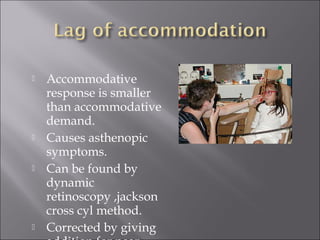
 Accommodative
response is smaller
than accommodative
demand.
 Causes asthenopic
symptoms.
 Can be found by
dynamic
retinoscopy ,jackson
cross cyl method.
 Corrected by giving
 Normal accommodative lag in Nepalese
population-Dhungana Purushottam
 151 patient were examined out of which
88(58%) were female,63(42%)male.
 He found normal accommodative lag increase
with age and ranges from 1.004-1.33(16-
35yrs)in monocular fixation and 0.915-1.116(16-
35yrs)in binocular condition.
 Accommodation lag in entire Nepalese
population found to be increase with age
 Myope showed lag towards higher
side,hyperope towards lower side.
 Normal lag 1.174(+/-0.17) monocular
fixation,0.998(+/-0.003)binocular condition.
 Accommodation is normal initially but can not
be maintained over length of time.
 Initial stage of true insufficiency
 Convalescent period from debilitating illness
 Tiredness
 ·        refractive status
 relationship with convergence
 Correct significant ametropia
 High astigmatism ? - check near cyl axes
 Advise on lighting and length of time 
accommodation 
 
 Difficulty is experienced in altering the range
of accommodation .
 Measurement of quality of the eye ability to
smoothly and efficiently change the amount of
accommodation
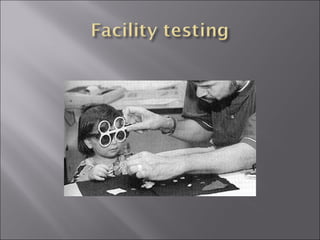
 Cycles per minute by flipper
 Monocular distribution of monocular
accommodative measurement using +/-2 Ds
for 100 eyes,12-14 cycles constitute about 50
eyes.(asymptomatic)
 Binocular accommodative facility measurement
using +/-2Ds,8-14 constitute about 50 percent
total screened(asymptomatic)
 Disease affecting cranium and oculomotor
nerve
 Paralytical mydriasis
 If accommodation paralysis is isolated cause,-it
is cortical in origin
 Other cause include encephalitis,anterior
poliomyelitis,TB,syphilis etc
 May be partial or total, unilateral or bilateral
 Signs and symptoms
 ·        Blurred vision
 Micropsia 
 ·        Congenital defects e.g., no ciliary muscle 
 ·        Cycloplegic drugs 
 ·        topical eye drops  intentional or 
unintentional 
 Systemic drugs 
 ·        Degenerative conditions e.g. 
Parkinson’s 
 ·        Exogenous poisons e.g., snake bites, 
bee stings
 ·        III N lesion (tumour, aneurysm, 
haemorrhage) 
 ·        Ocular disease (anterior uveitis, 
glaucoma) 
 ·        Trauma to head or eye (temporary or 
permanent paralysis) 
 ·        If recent onset and not previously 
investigated then refer and, if of sudden onset, 
urgently
 Subsequent intervention will include spectacles 
and management of any diplopia
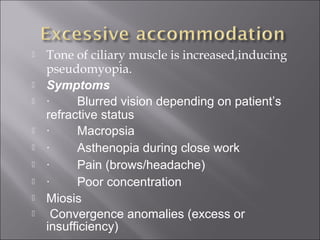
 Tone of ciliary muscle is increased,inducing
pseudomyopia.
 Symptoms
 ·        Blurred vision depending on patient’s 
refractive status
 ·        Macropsia
 ·        Asthenopia during close work
 ·        Pain (brows/headache)
 ·        Poor concentration 
 Miosis
  Convergence anomalies (excess or 
insufficiency) 
 Cycloplegic refraction used to determine true 
refraction
 Functional cause
 Organic cause
  
 Functional spasm
 A response to over fatigue and "eye strain". 
Precipitated by 3 factors:
 ·        Bad visual hygiene e.g., poor lighting, 
glare unaccustomed work
 ·        Optical or ocular motor difficulties e.g., 
anisometropia, early presbyopia, 
convergence anomalies
 psychological factors 
 Irritation of parasympathetic system
 Aetiology
 ·        Ciliary spasm 
 - drug induced e.g., physostigmine, pilocarpine, 
morphine, digitalis
 - lesions of brain stem 
 ·        Inflammation 
 e.g., anterior uveitis
 Trigeminal neuralgia
 Reversible or irreversible….
 Reversible then + lens
 Irreversible than – lenses
 Can be due to ciliary muscle weakness or
decrease in elasticity of lens capsule..
 Other causes include amblyopia,unilateral
sclerosis..
 Accommodative esotropia……
 Refractive accommodative esotropia..(AC/A
normal)
 Non refractive accommodative esotropia(high
AC/A ratio)
 Mixed
 AC/A=ipd+ N. phoria-D.phoria/D
 To improve accommodative amplitude
,facility ..
 Principle is to alter the stimulus for
accommodation by glasses or changing
distance
 Initially therapy is performed monocularly so
that vergence system does not influence.
 Hart chat push up(push up paddle)
 Hart chat distance near facility
 Lens flippers
 Loose minus lens rock
 Split pupil rock
 Accommodative anomaly is one of the most
common cause of asthenopic symptom
presenting to optometrist.
 So all patient should undergo tests for
refractive error,muscle imbalance and
convergence and accommodation anomaly
should not be forgotten.
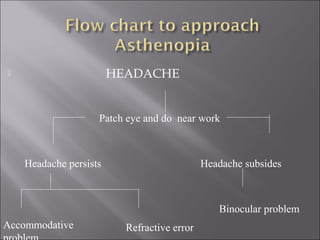
 HEADACHE
Patch eye and do near work
Headache persists Headache subsides
Binocular problem
Accommodative Refractive error

Accommodative anomalies

  • 2.
     Borish’s clinicalrefraction  Duke-Elder’s practice of refraction  Principal of optics and refraction by Lalit P. Agrawal  Binocular vision and ocular motility-Gunter K Von noorden  Clinical management of strabismus- Elizabeth  Optics and refraction by A.K khurana  Anatomy physiology by A.K khuran  Internet
  • 3.
     The processby which the dioptric power of eye changes so that an infocus retinal image of an object of regard is obtained and maintained at high resolution at fovea.
  • 4.
     Brief anatomyof lens  Transparent,biconvex  Anterior surface is is less convex(abt10mm)  Posterior surface more curved(6mm)  Refractive index=1.39
  • 7.
     Punctum proximum- Punctum remotum-  Ranges of accommodation-  Amplitude of accommodation-  Variation with refractive error???
  • 8.
     DONDER’S TABLE AGE(yrsAGE(yrs )) AMP(DsAMP(DsAGE(yrsAGE(yrs )) AMP(DsAMP(Ds 1010 1414 4040 5.505.50 2020 1010 5050 3.53.5 3030 77 6060 11
  • 9.
     Minimum=15-0.25*age  Average=18.5-0.3*age Maximum=25-0.4*age  Eg for 40 yrs minimum=5Ds,intermediate=6.5Ds and maximum=9Ds.  ????????
  • 10.
     Insuffeciency ofaccommodation  Excess or spasm of accommodation
  • 11.
     Physiological anomaly Pharmacological anomaly  Pathological anomaly
  • 12.
     Presbyopia –nota disease  Age of onset depends on sex,race and occupation.  Why ?????  Helmhotz –Hess Gullstrand theory  Donder Duane fincham theory
  • 13.
     Incipient presbyopia Functional presbyopia  Absolute presbyopia  Premature presbyopia  Nocturnal presbyopia
  • 14.
     Symptoms – Small print become indistinct in dim illumination.  Hand short for reading
  • 15.
     Glass..near glass,bifocalglass.progressive addition lens,monovision glasses  Contact lens option  Distance single vision CL and near glasses  Monovision CL  Bifocal /multifocal CL  Non refractive bifocal  Weakest glass which are compatible with good vision????
  • 16.
     A generalrule an individual require 1D at 40 and in every 5 yrs ,increases by 1D until 55 then stabilizes.  Considering amplitude of accommodation -RAF ruler -Donder's table -hoffsteter’s formula -Dynamic retinoscopy  Binocular cross cylinder test-
  • 17.
     Negative relativeaccommodation (NRA)and positive relative accommodation(PRA)-  Addition-NRA+1/2 relative amplitude of accommodation  Eg if PRA is –0.50 Ds and NRA is +2.00  Amplitude of accommodation=+2.50  Addition==2.00-1/2*2.50=+0.75Ds
  • 18.
     Surgical procedure Made artificially anisometropic  New advancement in surgical process
  • 19.
     Ciliary bodyis supplied by both sympathetic and parasympathetic supply.  Sympathetic receptor include alpha and beta  Parasympathetic include muscarinic receptor M1,M2,M3
  • 20.
     Parasympatho mimetic Parasympatholytics  Sympathomimetics  sympatholytics
  • 21.
     Alcohol  Phenothiazine Antihistamine  Marijuana  Digitalis
  • 22.
     Insuffeciency ofaccommodation-  Accommodative power is consistently poor than what may be considered as normal at that age.  Etiology…..  ·        General debility  ·        Malnutrition  ·        Anaemia  Glaucoma (?)
  • 23.
     Cause istreated  If not treatable,symptom relieving majors…  Optical treatment-1st choice  Accommodation therapy…
  • 24.
     Accommodative response issmaller than accommodative demand.  Causes asthenopic symptoms.  Can be found by dynamic retinoscopy ,jackson cross cyl method.  Corrected by giving
  • 25.
     Normal accommodativelag in Nepalese population-Dhungana Purushottam  151 patient were examined out of which 88(58%) were female,63(42%)male.  He found normal accommodative lag increase with age and ranges from 1.004-1.33(16- 35yrs)in monocular fixation and 0.915-1.116(16- 35yrs)in binocular condition.
  • 26.
     Accommodation lagin entire Nepalese population found to be increase with age  Myope showed lag towards higher side,hyperope towards lower side.  Normal lag 1.174(+/-0.17) monocular fixation,0.998(+/-0.003)binocular condition.
  • 27.
     Accommodation isnormal initially but can not be maintained over length of time.  Initial stage of true insufficiency  Convalescent period from debilitating illness  Tiredness  ·        refractive status  relationship with convergence
  • 28.
     Correct significant ametropia  High astigmatism ? - check near cyl axes Advise on lighting and length of time  accommodation   
  • 29.
     Difficulty isexperienced in altering the range of accommodation .  Measurement of quality of the eye ability to smoothly and efficiently change the amount of accommodation  Cycles per minute by flipper
  • 31.
     Monocular distributionof monocular accommodative measurement using +/-2 Ds for 100 eyes,12-14 cycles constitute about 50 eyes.(asymptomatic)  Binocular accommodative facility measurement using +/-2Ds,8-14 constitute about 50 percent total screened(asymptomatic)
  • 32.
     Disease affectingcranium and oculomotor nerve  Paralytical mydriasis  If accommodation paralysis is isolated cause,-it is cortical in origin  Other cause include encephalitis,anterior poliomyelitis,TB,syphilis etc
  • 33.
     May be partial or total, unilateral or bilateral  Signsand symptoms  ·        Blurred vision  Micropsia 
  • 34.
     ·        Congenital defects e.g., no ciliary muscle  ·        Cycloplegic drugs   ·        topical eye drops  intentional or  unintentional   Systemic drugs 
  • 35.
     ·        Degenerative conditions e.g.  Parkinson’s  ·        Exogenous poisons e.g., snake bites,  bee stings  ·        III N lesion (tumour, aneurysm,  haemorrhage)   ·        Ocular disease (anterior uveitis,  glaucoma)   ·        Trauma to head or eye (temporary or  permanent paralysis) 
  • 36.
     ·        If recent onset and not previously  investigated then refer and, if of sudden onset,  urgently Subsequent intervention will include spectacles  and management of any diplopia
  • 37.
     Tone ofciliary muscle is increased,inducing pseudomyopia.  Symptoms  ·        Blurred vision depending on patient’s  refractive status  ·        Macropsia  ·        Asthenopia during close work  ·        Pain (brows/headache)  ·        Poor concentration   Miosis   Convergence anomalies (excess or  insufficiency) 
  • 38.
  • 39.
  • 40.
        Functional spasm A response to over fatigue and "eye strain".  Precipitated by 3 factors:  ·        Bad visual hygiene e.g., poor lighting,  glare unaccustomed work  ·        Optical or ocular motor difficulties e.g.,  anisometropia, early presbyopia,  convergence anomalies  psychological factors 
  • 41.
     Irritation of parasympathetic system  Aetiology ·        Ciliary spasm   - drug induced e.g., physostigmine, pilocarpine,  morphine, digitalis  - lesions of brain stem   ·        Inflammation   e.g., anterior uveitis  Trigeminal neuralgia
  • 42.
     Reversible orirreversible….  Reversible then + lens  Irreversible than – lenses
  • 43.
     Can bedue to ciliary muscle weakness or decrease in elasticity of lens capsule..  Other causes include amblyopia,unilateral sclerosis..
  • 44.
     Accommodative esotropia…… Refractive accommodative esotropia..(AC/A normal)  Non refractive accommodative esotropia(high AC/A ratio)  Mixed  AC/A=ipd+ N. phoria-D.phoria/D
  • 45.
     To improveaccommodative amplitude ,facility ..  Principle is to alter the stimulus for accommodation by glasses or changing distance  Initially therapy is performed monocularly so that vergence system does not influence.
  • 46.
     Hart chatpush up(push up paddle)  Hart chat distance near facility  Lens flippers  Loose minus lens rock  Split pupil rock
  • 48.
     Accommodative anomalyis one of the most common cause of asthenopic symptom presenting to optometrist.  So all patient should undergo tests for refractive error,muscle imbalance and convergence and accommodation anomaly should not be forgotten.
  • 49.
     HEADACHE Patch eyeand do near work Headache persists Headache subsides Binocular problem Accommodative Refractive error