Course: Strabismus
Course code: OD-130
MZ
Department of Optometry
KEMU
BSV
Learning Objectives
Students will learn about
• What is BSV
• Grades of BSV
• Mechanism of Binocular single vision
• Evaluating different grades of BSV
BSV
CONTENTS
• BSV & components of BSV
• Requirements for BSV
• Fixation disparity
• Horopter & Panum’s area
• References
Basics of Binocular Vision
.
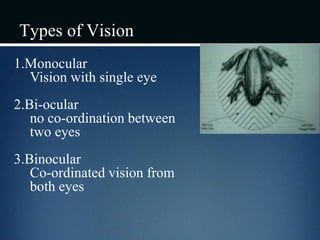
Types of Vision
1.Monocular
Vision with single eye
2.Bi-ocular
no co-ordination between
two eyes
3.Binocular
Co-ordinated vision from
both eyes
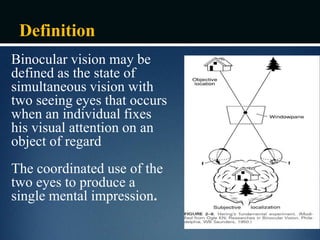
Definition
Binocular vision may be
defined as the state of
simultaneous vision with
two seeing eyes that occurs
when an individual fixes
his visual attention on an
object of regard
The coordinated use of the
two eyes to produce a
single mental impression.
Pre-requisites for development of BSV
Motor Mechanism:
•Correct neuromuscular development so that the
visual axes are directed at the object
•Overlap of visual fields
Sensory Mechanism:
•Approximately equal image clarity and size in
the two eyes
Cont,,,
• Corresponding retinal areas so that the eyes
are cyclopean
• Normal visual pathways
Mental Process:
• Ability of visual cortex to promote binocular
single vision
Neurophysiology of binocular vision
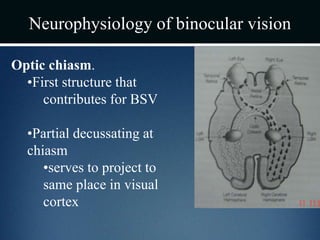
Optic chiasm.
•First structure that
contributes for BSV
•Partial decussating at
chiasm
•serves to project to
same place in visual
cortex
Mechanisms and terminologies in
BSV
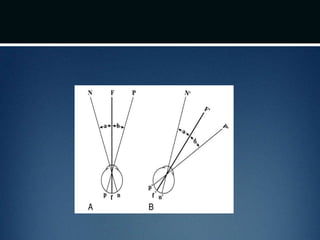
Visual Directions
A visual direction is defined as a line that connects
an object point with its image on the retina.
Types
Principal
Fovea – area of highest VA -carries principal
visual direction.
Secondary
Other retinal elements-secondary VD
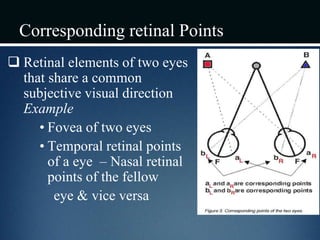
Corresponding retinal Points
 Retinal elements of two eyes
that share a common
subjective visual direction
Example
• Fovea of two eyes
• Temporal retinal points
of a eye – Nasal retinal
points of the fellow
eye & vice versa
Contd.....
Rest other retinal points
– Non corresponding /disparate
Significance:
– Corresponding retinal elements are principal
elements of the two retinas that give rise in
binocular vision
– Single vision is mainly because of retinal
correspondence
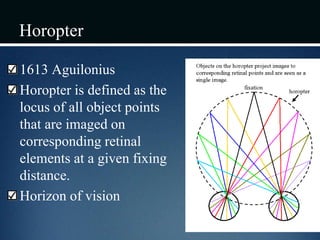
Horopter
1613 Aguilonius
Horopter is defined as the
locus of all object points
that are imaged on
corresponding retinal
elements at a given fixing
distance.
Horizon of vision
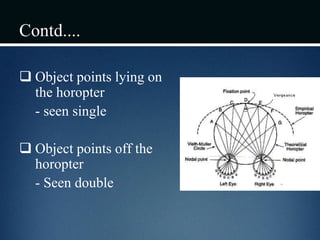
Contd....
 Object points lying on
the horopter
- seen single
 Object points off the
horopter
- Seen double
Panum’s fusional area & space
In reality a retinal point of a eye is not only
corresponding to a point but to a retinal area of
another eye
Panums area- the retinal area surrounding the
corresponding retinal points within which BSV
can be maintained.
Cont,,,
Panums space: A narrow band around the
horopter within which objects gives rise to
BSV
So objects located slightly off the horopter
can remain single
• Object stimulates slightly non-
corresponding points
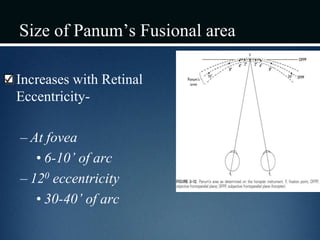
Size of Panum’s Fusional area
Increases with Retinal
Eccentricity-
– At fovea
• 6-10’ of arc
– 120 eccentricity
• 30-40’ of arc
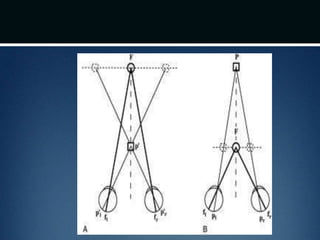
Physiological Diplopia
The Diplopia elicited by an object point off the
Panum’s fusional area
Types
A.Crossed (Heteronymous) Diplopia
Temporal (crossed) disparity
B.Uncrossed (homonymous) Diplopia
Nasal (uncrossed) Disparity
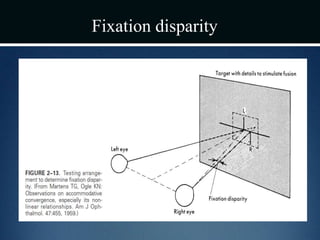
Fixation Disparity
It is the minute image displacement, rarely
exceeding several minutes of arc of angle,
occurs within Panum’s space while fusion is
maintained.
• Due to presence of pannum’s fusional area
Cont,,,
– A physiological variation in placement of
retinal image displacement from
corresponding retinal points
• Even Allow fusion
• Displacement of retinal images in two
eyes
–Retinal disparity
Fixation disparity
Grades of Binocular Vision
There are three grades of binocular vision as given
by Worth's classification:
Grade I : Simultaneous perception
Grade II : Fusion
Grade III : Stereopsis
1.Simultaneous Macular Perception
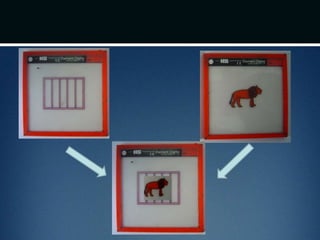
 Simultaneous perception exists when signals
transmitted from the two eyes to the visual cortex
are perceived at the same time.
 It consists of the ability to see two dissimilar
objects simultaneously.
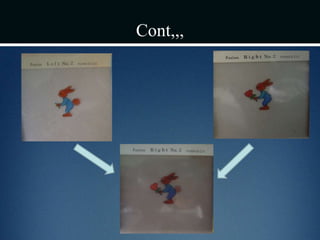
2. Fusion
Defined as the cortical unification of visual objects
into a single percept that is made possible by the
simultaneous stimulation of corresponding retinal
areas.
In simple words,
It is the ability of the two eyes to produce a
composite picture from two similar pictures each of
which is incomplete in one small detail
Cont,,,
Components of fusion
Sensory Fusion
 unification of visual excitations from
corresponding retinal images into a single
visual percept, a single visual image
 Ability to unify images falling on
corresponding retinal areas.
Cont,,,
Motor Fusion
• It is a vergence movement that causes similar
retinal images to fall and be maintained on
corresponding retinal areas.
• Ability to align the eyes in such a manner
that sensory fusion can be maintained
• Diplopia preventing mechanism
Cont…
• The normal fusional range is 35/40 PD base
out and 16 PD base in on near reading.
• 16PD base out and 8PD base in on distance
testing.
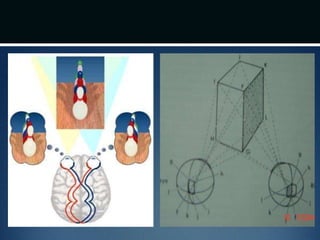
3. Stereopsis
It is the ability to fuse images that stimulate
horizontally disparate retinal elements within
Panum’s fusional area resulting in binocular
appreciation of visual object in depth i.e., in
3D
Cont,,,
 Retinal disparity (Fixation disparity) is the
basis of 3 D perception
 Stereopsis occurs when
• Retinal disparity is large enough to simple
fusion but small enough to cause diplopia
Normal stereoacuity is considered to be
40 sec of arc
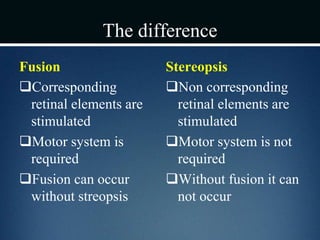
The difference
Corresponding
retinal elements are
stimulated
Motor system is
required
Fusion can occur
without streopsis
Stereopsis
Non corresponding
retinal elements are
stimulated
Motor system is not
required
Without fusion it can
not occur
Fusion
References
• Clinical Orthoptics by Fiona J. Rowe
• Diagnosis & management of ocular motility
disorders
• Google
Learning Outcomes
Students have learnt
 BSV & its grades
• Tests used for BSV
Binocular Single Vision

Binocular Single Vision

  • 2.
    Course: Strabismus Course code:OD-130 MZ Department of Optometry KEMU
  • 3.
    BSV Learning Objectives Students willlearn about • What is BSV • Grades of BSV • Mechanism of Binocular single vision • Evaluating different grades of BSV
  • 4.
    BSV CONTENTS • BSV &components of BSV • Requirements for BSV • Fixation disparity • Horopter & Panum’s area • References
  • 5.
  • 6.
    Types of Vision 1.Monocular Visionwith single eye 2.Bi-ocular no co-ordination between two eyes 3.Binocular Co-ordinated vision from both eyes
  • 7.
    Definition Binocular vision maybe defined as the state of simultaneous vision with two seeing eyes that occurs when an individual fixes his visual attention on an object of regard The coordinated use of the two eyes to produce a single mental impression.
  • 8.
    Pre-requisites for developmentof BSV Motor Mechanism: •Correct neuromuscular development so that the visual axes are directed at the object •Overlap of visual fields Sensory Mechanism: •Approximately equal image clarity and size in the two eyes
  • 9.
    Cont,,, • Corresponding retinalareas so that the eyes are cyclopean • Normal visual pathways Mental Process: • Ability of visual cortex to promote binocular single vision
  • 10.
    Neurophysiology of binocularvision Optic chiasm. •First structure that contributes for BSV •Partial decussating at chiasm •serves to project to same place in visual cortex
  • 11.
  • 12.
    Visual Directions A visualdirection is defined as a line that connects an object point with its image on the retina. Types Principal Fovea – area of highest VA -carries principal visual direction. Secondary Other retinal elements-secondary VD
  • 14.
    Corresponding retinal Points Retinal elements of two eyes that share a common subjective visual direction Example • Fovea of two eyes • Temporal retinal points of a eye – Nasal retinal points of the fellow eye & vice versa
  • 15.
    Contd..... Rest other retinalpoints – Non corresponding /disparate Significance: – Corresponding retinal elements are principal elements of the two retinas that give rise in binocular vision – Single vision is mainly because of retinal correspondence
  • 16.
    Horopter 1613 Aguilonius Horopter isdefined as the locus of all object points that are imaged on corresponding retinal elements at a given fixing distance. Horizon of vision
  • 17.
    Contd....  Object pointslying on the horopter - seen single  Object points off the horopter - Seen double
  • 18.
    Panum’s fusional area& space In reality a retinal point of a eye is not only corresponding to a point but to a retinal area of another eye Panums area- the retinal area surrounding the corresponding retinal points within which BSV can be maintained.
  • 19.
    Cont,,, Panums space: Anarrow band around the horopter within which objects gives rise to BSV So objects located slightly off the horopter can remain single • Object stimulates slightly non- corresponding points
  • 20.
    Size of Panum’sFusional area Increases with Retinal Eccentricity- – At fovea • 6-10’ of arc – 120 eccentricity • 30-40’ of arc
  • 21.
    Physiological Diplopia The Diplopiaelicited by an object point off the Panum’s fusional area Types A.Crossed (Heteronymous) Diplopia Temporal (crossed) disparity B.Uncrossed (homonymous) Diplopia Nasal (uncrossed) Disparity
  • 23.
    Fixation Disparity It isthe minute image displacement, rarely exceeding several minutes of arc of angle, occurs within Panum’s space while fusion is maintained. • Due to presence of pannum’s fusional area
  • 24.
    Cont,,, – A physiologicalvariation in placement of retinal image displacement from corresponding retinal points • Even Allow fusion • Displacement of retinal images in two eyes –Retinal disparity
  • 25.
  • 26.
    Grades of BinocularVision There are three grades of binocular vision as given by Worth's classification: Grade I : Simultaneous perception Grade II : Fusion Grade III : Stereopsis
  • 27.
    1.Simultaneous Macular Perception Simultaneous perception exists when signals transmitted from the two eyes to the visual cortex are perceived at the same time.  It consists of the ability to see two dissimilar objects simultaneously.
  • 29.
    2. Fusion Defined asthe cortical unification of visual objects into a single percept that is made possible by the simultaneous stimulation of corresponding retinal areas. In simple words, It is the ability of the two eyes to produce a composite picture from two similar pictures each of which is incomplete in one small detail
  • 30.
  • 31.
    Components of fusion SensoryFusion  unification of visual excitations from corresponding retinal images into a single visual percept, a single visual image  Ability to unify images falling on corresponding retinal areas.
  • 32.
    Cont,,, Motor Fusion • Itis a vergence movement that causes similar retinal images to fall and be maintained on corresponding retinal areas. • Ability to align the eyes in such a manner that sensory fusion can be maintained • Diplopia preventing mechanism
  • 33.
    Cont… • The normalfusional range is 35/40 PD base out and 16 PD base in on near reading. • 16PD base out and 8PD base in on distance testing.
  • 34.
    3. Stereopsis It isthe ability to fuse images that stimulate horizontally disparate retinal elements within Panum’s fusional area resulting in binocular appreciation of visual object in depth i.e., in 3D
  • 35.
    Cont,,,  Retinal disparity(Fixation disparity) is the basis of 3 D perception  Stereopsis occurs when • Retinal disparity is large enough to simple fusion but small enough to cause diplopia Normal stereoacuity is considered to be 40 sec of arc
  • 37.
    The difference Corresponding retinal elementsare stimulated Motor system is required Fusion can occur without streopsis Stereopsis Non corresponding retinal elements are stimulated Motor system is not required Without fusion it can not occur Fusion
  • 38.
    References • Clinical Orthopticsby Fiona J. Rowe • Diagnosis & management of ocular motility disorders • Google
  • 39.
    Learning Outcomes Students havelearnt  BSV & its grades • Tests used for BSV