Power Electronics
AC-AC Converters
1
Dr. Firas Obeidat
E-mail: firasobeidat@gmail.com
fobeidat@philadelphia.edu.jo
2
Table of contents
1
• Introduction
2
• The Single Phase AC Voltage Controller
3
• The Single Phase AC Voltage Controller - Resistive
Load
4
• The Single Phase AC Voltage Controller - RL Load
5
• The Three Phase AC Voltage Controller – Y
Connected Resistive Load
6
• The Three Phase AC Voltage Controller – Δ
Connected Resistive Load
Dr. Firas Obeidat Faculty of Engineering Philadelphia University
3
Dr. Firas Obeidat Faculty of Engineering Philadelphia University
Introduction
An ac voltage controller is a converter that controls the
voltage, current, and average power delivered to an ac
load from an ac source.
The phase-controlled ac voltage controller has several
practical uses including light-dimmer circuits and speed
control of induction motors.
In a switching scheme called phase control, switching
takes place during every cycle of the source, in effect
removing some of the source waveform before it reaches
the load.
Integral-cycle control, the source is connected and
disconnected for several cycles at a time.
4
Dr. Firas Obeidat Faculty of Engineering Philadelphia University
The Single Phase AC Voltage Controller
Basic Operation
For the single phase AC voltage controller
shown, electronic switches are shown as parallel
thyristors (SCRs). This SCR arrangement
makes it possible to have current in either
direction in the load. This SCR connection is
called antiparallel or inverse parallel because
the SCRs carry current in opposite directions. A
triac is equivalent to the antiparallel SCRs.
Other controlled switching devices can be used
instead of SCRs.
 Load current contains both positive and negative half-cycles. An analysis
identical to that done for the controlled half-wave rectifier can be done on a
half cycle for the voltage controller. Then, by symmetry, the result can be
extrapolated to describe the operation for the entire period.
 S1 conducts if a gate signal is applied during the positive half-cycle of the
source. S1 conducts until the current in it reaches zero.
 A gate signal is applied to S2 during the negative half-cycle of the source,
providing a path for negative load current.
vs
L
o
a
d
+ -vsw
S1
S2
+
-
+
-
io
vo
5
Dr. Firas Obeidat Faculty of Engineering Philadelphia University
The Single Phase AC Voltage Controller
Basic Operation
Basic observations about this controller
The SCRs cannot conduct simultaneously.
The load voltage is the same as the source voltage when either SCR
is on. The load voltage is zero when both SCRs are OFF.
The switch voltage vsw is zero when either SCR is ON and is equal to
the source voltage when neither is ON.
The average current in the source and load is zero if the SCRs are
on for equal time intervals. The average current in each SCR is not
zero because of unidirectional SCR current.
The rms current in each SCR is 1/√2 times the rms load current if
the SCRs are on for equal time intervals.
6
Dr. Firas Obeidat Faculty of Engineering Philadelphia University
vs
+ -vsw
S1
S2
+
-
+
-
io
voR
The Single Phase AC Voltage Controller - Resistive Load
𝑣𝑠 𝜔𝑡 = 𝑉𝑚 𝑠𝑖𝑛𝜔𝑡
𝑣𝑠 𝜔𝑡 =
𝑉𝑚 𝑠𝑖𝑛𝜔𝑡 𝛼 < 𝜔𝑡 < 𝜋 𝑎𝑛𝑑 𝜋 + 𝛼 < 𝜔𝑡 < 2𝜋
0 𝑜𝑡ℎ𝑒𝑟𝑤𝑖𝑠𝑒
Let the voltage source be
Output voltage is
The rms load voltage is
𝑉𝑜,𝑟𝑚𝑠 =
1
𝜋
(𝑉𝑚 𝑠𝑖𝑛𝜔𝑡)2 𝑑𝜔𝑡
𝜋
α
=
𝑉𝑚
2
1 −
𝛼
𝜋
+
𝑠𝑖𝑛2𝛼
2𝜋
7
Dr. Firas Obeidat Faculty of Engineering Philadelphia University
The Single Phase AC Voltage Controller - Resistive Load
The power factor of the load is
The rms current in the load and the source is
𝐼 𝑜,𝑟𝑚𝑠 =
𝑉𝑜,𝑟𝑚𝑠
𝑅
=
𝑉𝑚
𝑅 2
1 −
𝛼
𝜋
+
𝑠𝑖𝑛2𝛼
2𝜋
𝑝𝑓 =
𝑃
𝑆
=
𝑉𝑜,𝑟𝑚𝑠
2
𝑅
𝑉𝑠,𝑟𝑚𝑠 𝐼𝑠,𝑟𝑚𝑠
=
𝑉𝑜,𝑟𝑚𝑠
2
𝑅
𝑉𝑠,𝑟𝑚𝑠(𝑉𝑜,𝑟𝑚𝑠 𝑅)
=
𝑉𝑜,𝑟𝑚𝑠
𝑉𝑠,𝑟𝑚𝑠
=
𝑉𝑚
2
1 −
𝛼
𝜋 +
𝑠𝑖𝑛2𝛼
2𝜋
𝑉𝑚 2
𝑝𝑓 = 1 −
𝛼
𝜋
+
𝑠𝑖𝑛2𝛼
2𝜋
The pf=1 for α=0, which is the same as for an uncontrolled resistive load, and
the power factor for α>0 is less than 1.
The average source current is zero because of half-wave symmetry.
𝐼𝑠,𝐴𝑣𝑔 = 𝐼 𝑜,𝐴𝑣𝑔 = 0
8
Dr. Firas Obeidat Faculty of Engineering Philadelphia University
The Single Phase AC Voltage Controller - Resistive Load
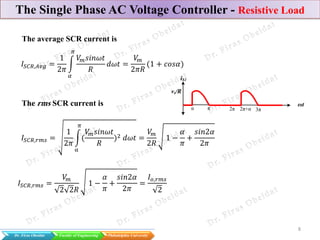
The average SCR current is
𝐼𝑆𝐶𝑅,𝐴𝑣𝑔 =
1
2𝜋
𝑉𝑚 𝑠𝑖𝑛𝜔𝑡
𝑅
𝑑𝜔𝑡
𝜋
𝛼
=
𝑉𝑚
2𝜋𝑅
(1 + 𝑐𝑜𝑠𝛼)
𝐼𝑆𝐶𝑅,𝑟𝑚𝑠 =
1
2𝜋
(
𝑉𝑚 𝑠𝑖𝑛𝜔𝑡
𝑅
)2 𝑑𝜔𝑡
𝜋
α
=
𝑉𝑚
2𝑅
1 −
𝛼
𝜋
+
𝑠𝑖𝑛2𝛼
2𝜋
The rms SCR current is
𝐼𝑆𝐶𝑅,𝑟𝑚𝑠 =
𝑉𝑚
2 2𝑅
1 −
𝛼
𝜋
+
𝑠𝑖𝑛2𝛼
2𝜋
=
𝐼 𝑜,𝑟𝑚𝑠
2
πα 2π 2π+α 3π
ωt
iS1
vs/R
9
Dr. Firas Obeidat Faculty of Engineering Philadelphia University
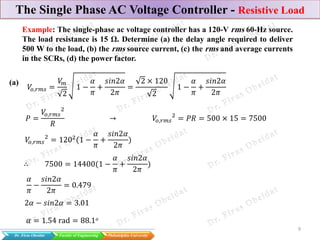
Example: The single-phase ac voltage controller has a 120-V rms 60-Hz source.
The load resistance is 15 Ω. Determine (a) the delay angle required to deliver
500 W to the load, (b) the rms source current, (c) the rms and average currents
in the SCRs, (d) the power factor.
𝑉𝑜,𝑟𝑚𝑠 =
𝑉𝑚
2
1 −
𝛼
𝜋
+
𝑠𝑖𝑛2𝛼
2𝜋
=
2 × 120
2
1 −
𝛼
𝜋
+
𝑠𝑖𝑛2𝛼
2𝜋
𝑃 =
𝑉𝑜,𝑟𝑚𝑠
2
𝑅
→ 𝑉𝑜,𝑟𝑚𝑠
2
= 𝑃𝑅 = 500 × 15 = 7500
𝑉𝑜,𝑟𝑚𝑠
2
= 1202
(1 −
𝛼
𝜋
+
𝑠𝑖𝑛2𝛼
2𝜋
)
∴ 7500 = 14400(1 −
𝛼
𝜋
+
𝑠𝑖𝑛2𝛼
2𝜋
)
𝛼
𝜋
−
𝑠𝑖𝑛2𝛼
2𝜋
= 0.479
2𝛼 − 𝑠𝑖𝑛2𝛼 = 3.01
𝛼 = 1.54 rad = 88.1 𝑜
(a)
The Single Phase AC Voltage Controller - Resistive Load
10
Dr. Firas Obeidat Faculty of Engineering Philadelphia University
The Single Phase AC Voltage Controller - Resistive Load
(b)
𝐼 𝑜,𝑟𝑚𝑠 =
𝑉𝑜,𝑟𝑚𝑠
𝑅
=
86.6
15
= 5.77 A
𝑉𝑜,𝑟𝑚𝑠
2
= 7500 → 𝑉𝑜,𝑟𝑚𝑠 = 86.6From (a)
𝐼𝑆𝐶𝑅,𝐴𝑣𝑔 =
𝑉𝑚
2𝜋𝑅
1 + 𝑐𝑜𝑠𝛼 =
2 × 120
2𝜋15
1 + 𝑐𝑜𝑠88.1 = 1.86 A
𝐼𝑆𝐶𝑅,𝑟𝑚𝑠 =
𝐼 𝑜,𝑟𝑚𝑠
2
=
5.77
2
= 4.08 A
(c)
𝑝𝑓 =
𝑃
𝑆
=
𝑃
𝑉𝑠,𝑟𝑚𝑠 𝐼𝑠,𝑟𝑚𝑠
= 1 −
𝛼
𝜋
+
𝑠𝑖𝑛2𝛼
2𝜋
=
500
120 × 5.77
= 0.722(d)
11
Dr. Firas Obeidat Faculty of Engineering Philadelphia University
The Single Phase AC Voltage Controller - RL Load
vs
+ -vsw
S1
S2
+
-
+
-
io
vo
R
L
When a gate signal is applied to S1 at 𝜔t=α
in single phase AC voltage controller with
RL load, Kirchhoff’s voltage law for the
circuit is expressed as.
𝑉𝑚 𝑠𝑖𝑛𝜔𝑡 = 𝑅𝑖 𝑜 𝑡 + 𝐿
𝑑𝑖 𝑜 𝑡
𝑑𝑡
The solution for current in this equation
(as obtained in the controlled half wave
rectifier section) is
𝑖 𝑜 𝜔𝑡 =
𝑉𝑚
𝑍
sin 𝜔𝑡 − 𝜃 − sin(𝛼 − 𝜃)𝑒(𝛼−𝜔𝑡) 𝜔𝜏
𝛼 ≤ 𝜔𝑡 ≤ 𝛽
0 𝑜𝑡ℎ𝑒𝑟𝑤𝑖𝑠𝑒
where
𝑍 = 𝑅2 + (𝜔𝐿)2 𝜃 = 𝑡𝑎𝑛−1
(
𝜔𝐿
𝑅
)
The extinction angle 𝛽 is the angle at which the current returns to zero, when
𝜔𝑡= 𝛽,
𝑖 𝑜 𝛽 =
𝑉𝑚
𝑍
sin 𝛽 − 𝜃 − sin(𝛼 − 𝜃)𝑒(𝛼−𝛽) 𝜔𝜏
(1)
(2)
12
Dr. Firas Obeidat Faculty of Engineering Philadelphia University
The Single Phase AC Voltage Controller - RL Load
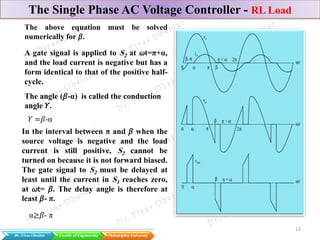
A gate signal is applied to S2 at 𝜔t=π+α,
and the load current is negative but has a
form identical to that of the positive half-
cycle.
The above equation must be solved
numerically for 𝛽.
The angle (𝛽-α) is called the conduction
angle 𝛶.
𝛶 =𝛽-α
In the interval between π and 𝛽 when the
source voltage is negative and the load
current is still positive, S2 cannot be
turned on because it is not forward biased.
The gate signal to S2 must be delayed at
least until the current in S1 reaches zero,
at 𝜔t= 𝛽. The delay angle is therefore at
least 𝛽- π.
α≥𝛽- π
13
Dr. Firas Obeidat Faculty of Engineering Philadelphia University
The Single Phase AC Voltage Controller - RL Load
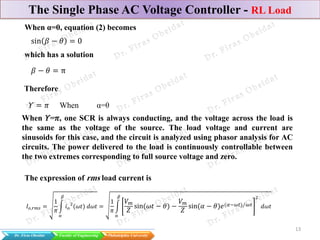
When α=θ, equation (2) becomes
sin 𝛽 − 𝜃 = 0
which has a solution
𝛽 − 𝜃 = π
Therefore
𝛶 = 𝜋 When α=θ
When 𝛶=𝜋, one SCR is always conducting, and the voltage across the load is
the same as the voltage of the source. The load voltage and current are
sinusoids for this case, and the circuit is analyzed using phasor analysis for AC
circuits. The power delivered to the load is continuously controllable between
the two extremes corresponding to full source voltage and zero.
The expression of rms load current is
𝐼 𝑜,𝑟𝑚𝑠 =
1
𝜋
𝑖 𝑜
2
(𝜔𝑡) 𝑑𝜔𝑡
𝛽
α
=
1
𝜋
𝑉 𝑚
𝑍
sin 𝜔𝑡 − 𝜃 −
𝑉 𝑚
𝑍
sin(𝛼 − 𝜃)𝑒(𝛼−𝜔𝑡) 𝜔𝜏
2
𝑑𝜔𝑡
𝛽
α
14
Dr. Firas Obeidat Faculty of Engineering Philadelphia University
The Single Phase AC Voltage Controller - RL Load
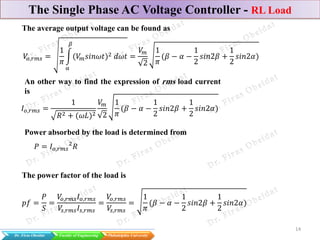
The average output voltage can be found as
An other way to find the expression of rms load current
is
𝐼 𝑜,𝑟𝑚𝑠 =
1
𝑅2 + (𝜔𝐿)2
𝑉𝑚
2
1
𝜋
(𝛽 − 𝛼 −
1
2
𝑠𝑖𝑛2𝛽 +
1
2
𝑠𝑖𝑛2𝛼)
Power absorbed by the load is determined from
𝑃 = 𝐼 𝑜,𝑟𝑚𝑠
2
𝑅
The power factor of the load is
𝑝𝑓 =
𝑃
𝑆
=
𝑉𝑜,𝑟𝑚𝑠 𝐼 𝑜,𝑟𝑚𝑠
𝑉𝑠,𝑟𝑚𝑠 𝐼𝑠,𝑟𝑚𝑠
=
𝑉𝑜,𝑟𝑚𝑠
𝑉𝑠,𝑟𝑚𝑠
=
1
𝜋
(𝛽 − 𝛼 −
1
2
𝑠𝑖𝑛2𝛽 +
1
2
𝑠𝑖𝑛2𝛼)
𝑉𝑜,𝑟𝑚𝑠 =
1
𝜋
(𝑉𝑚 𝑠𝑖𝑛𝜔𝑡)2 𝑑𝜔𝑡
𝛽
α
=
𝑉𝑚
2
1
𝜋
(𝛽 − 𝛼 −
1
2
𝑠𝑖𝑛2𝛽 +
1
2
𝑠𝑖𝑛2𝛼)
15
Dr. Firas Obeidat Faculty of Engineering Philadelphia University
The Single Phase AC Voltage Controller - RL Load
Each SCR carries one-half of the current waveform, making the average SCR
current
𝐼𝑆𝐶𝑅,𝐴𝑣𝑔 =
1
2𝜋
𝑖 𝑜(𝜔𝑡) 𝑑𝜔𝑡
𝛽
α
=
1
2𝜋
𝑉𝑚
𝑍
sin 𝜔𝑡 − 𝜃 − sin(𝛼 − 𝜃)𝑒(𝛼−𝜔𝑡) 𝜔𝜏 𝑑𝜔𝑡
𝛽
α
The rms current in each SCR is
𝐼𝑆𝐶𝑅,𝑟𝑚𝑠 =
𝐼 𝑜,𝑟𝑚𝑠
2
The average load current is zero,
𝐼 𝑜,𝐴𝑣𝑔 = 0
16
Dr. Firas Obeidat Faculty of Engineering Philadelphia University
Example: For the single-phase voltage controller with RL load, the source is
120Vrms at 60 Hz, and the load is a series RL combination with R=20Ω and
L=50mH. The delay angle α is 90. Determine (a) an expression for load current
for the first half-period, (b) the rms load current, (c) the rms SCR current, (d)
the average SCR current, (e) the power delivered to the load, and (f) the power
factor.
(a)
The Single Phase AC Voltage Controller - RL Load
The extinction angle is determined from the numerical solution of i(β)=0 in the
above equation.
17
Dr. Firas Obeidat Faculty of Engineering Philadelphia University
The Single Phase AC Voltage Controller - RL Load
(b)
(c)
(d)
(e)
(f)
𝐼 𝑜,𝑟𝑚𝑠 =
1
27.5
× 120 ×
1
𝜋
(3.83 − 1.57 −
1
2
𝑠𝑖𝑛440 + 0) = 3.27 A
𝐼 𝑜,𝑟𝑚𝑠 =
1
𝑅2 + (𝜔𝐿)2
𝑉𝑚
2
1
𝜋
(𝛽 − 𝛼 −
1
2
𝑠𝑖𝑛2𝛽 −
1
2
𝑠𝑖𝑛2𝛼)
Or
18
Dr. Firas Obeidat Faculty of Engineering Philadelphia University
The Three Phase AC Voltage Controller – Y Connected Resistive Load
 The power delivered to the load in
three phase AC voltage controller
with Y-connected resistive load is
controlled by the delay angle α on
each thyristor. The six thyristors
are turned on in the sequence 1-2-
3-4-5-6, at 60 intervals. Gate
signals are maintained
throughout the possible
conduction angle.
+ -
S4
S1
+ -
S6
S3
+ -
S2
S5
A B
C
ab
c
R
RR
n
N
 The instantaneous voltage across each phase of the load is determined by
which thyristors are conducting. At any instant, three thyristors , two
thyristors , or no thyristors are ON.
 The instantaneous load voltages are either a line-to-neutral voltage (three
thyristors ON), one-half of a line-to-line voltage (two thyristors ON), or
zero (none on).
 Which thyristors are conducting depends on the delay angle α and on the
source voltages at a particular instant. The ranges of α that produce
particular types of load voltages are 0< α<60o, 60o< α<90o and 90o< α<150o.
19
Dr. Firas Obeidat Faculty of Engineering Philadelphia University
The Three Phase AC Voltage Controller – Y Connected Resistive Load
When 0 ≤ α<60o
 To study the output voltage Van, Vbn and Vcn, triggering angle α must be
determined first.
 Suppose that the triggering angle α equal to 30o.
 The output voltage Van will be studies when α= 30o, and the same procedure
can be applied to get the output voltages Vbn and Vcn at any triggering angle
from 0 to 60o.
𝑉𝐴𝑁 = 𝑉𝑚sin𝜔t
𝑉𝐵𝑁 = 𝑉𝑚sin(𝜔t-2π/3)
𝑉𝐶𝑁 = 𝑉𝑚sin(𝜔t-4π/3)
Let
𝑉𝐴𝐵 = 3𝑉𝑚sin(𝜔t+π/6)
𝑉𝐵𝐶 = 3𝑉𝑚sin(𝜔t-π/2)
𝑉𝐶𝐴 = 3𝑉𝑚sin(𝜔t-7π/6)
VAN VBN VCN
30o
60o
90o
120o
150o
180o
210o
240o
270o
300o
330o
360o
20
Dr. Firas Obeidat Faculty of Engineering Philadelphia University
The Three Phase AC Voltage Controller – Y Connected Resistive Load
When 0 ≤ α<60o
1. Determine the triggering angle α (for example α= 30o).
2. Determine the conducting period for each thyristor.
• As seen from the input phase voltages VAN, VBN and VCN, every 30o there is
a change that affect on the conduction of each thyristor.
VAN VBN VCN
30o
60o
90o
120o
150o
180o
210o
240o
270o
300o
330o
360o
VAN=VCN
VCN=0 VBN=0
VAN=VBN
VAN=0 VCN=0
VBN=VCN
VBN=0 VAN=0
VAN=VBNVAN=VCNVBN=VCN
21
Dr. Firas Obeidat Faculty of Engineering Philadelphia University
The Three Phase AC Voltage Controller – Y Connected Resistive Load
When 0 ≤ α<60o
VAN VBN VCN
iG1
iG6
iG5
iG4
iG3
iG2
30o
60o
90o
120o
150o
180o
210o
240o
270o
300o
330o
360o
• Because α=30o, S1 will be
triggered at 30o, S3 will be
triggered at 150o (120o+α), S5
will be triggered at 270o
(240o+α).
• S4 will be triggered after S1
by 180o, S6 will be triggered
after S3 by 180o S2 will be
triggered after S5 by 180o.
• The six SCRs are turned on
in the sequence 1-2-3-4-5-6,
at 60o intervals.
+ -
S4
S1
+ -
S6
S3
+ -
S2
S5
A B
C
ab
c
R
RR
n
N
22
Dr. Firas Obeidat Faculty of Engineering Philadelphia University
The Three Phase AC Voltage Controller – Y Connected Resistive Load
When 0 ≤ α<60o
3. Study the conduction period for each thyristor.
• Each thyristor will be studied at each angle that affect on the conduction of
each thyristor to determine if the thyristor will conduct or not.
• The conduction period will be studied for S1.
• At 30o, VAN=VCN, VAN and VCN are positive, while VBN is negative. So, the
current will flow from phase A and C to phase B. S1 will be on from 30o to
60o.
VAN VBN VCN
iG1
30o
60o
90o
120o
150o
180o
210o
240o
270o
300o
330o
360o
+ -
S4
S1
+ -
S6
S3
+ -
S2
S5
A B
C
a
b
c
R
RR
n
N
+
+
-
23
Dr. Firas Obeidat Faculty of Engineering Philadelphia University
The Three Phase AC Voltage Controller – Y Connected Resistive Load
When 0 ≤ α<60o
• At 60o, VCN=0, VAN is positive, while VBN is negative. So, the current will
flow from phase Ato phase B. S1 will be ON from 60o to 90o.
VAN VBN VCN
iG1
30o
60o
90o
120o
150o
180o
210o
240o
270o
300o
330o
360o
+ -
S4
S1
+ -
S6
S3
+ -
S2
S5
A B
C
a
b
c
R
RR
n
N
+
0
-
24
Dr. Firas Obeidat Faculty of Engineering Philadelphia University
The Three Phase AC Voltage Controller – Y Connected Resistive Load
When 0 ≤ α<60o
• At 90o, VBN=VCN, VAN is positive, while VBN and VCN are negative. So, the
current will flow from phase Ato phase B and phase C. S1 will be ON from
90o to 120o.
+ -
S4
+ -
S6
S3
+ -
S2
S5
A B
C
a
b
c
R
RR
n
N
+
-
-
VAN VBN VCN
iG1
30o
60o
90o
120o
150o
180o
210o
240o
270o
300o
330o
360o
25
Dr. Firas Obeidat Faculty of Engineering Philadelphia University
The Three Phase AC Voltage Controller – Y Connected Resistive Load
When 0 ≤ α<60o
• At 120o, VBN=0, VAN is positive, while VCN is negative. So, the current will
flow from phase Ato phase C. S1 will be ON from 120o to 150o.
+ -
S4
S1
+ -
S6
S3
+ -
S2
S5
A B
C
a
b
c
R
RR
n
N
+
0
-
VAN VBN VCN
iG1
30o
60o
90o
120o
150o
180o
210o
240o
270o
300o
330o
360o
26
Dr. Firas Obeidat Faculty of Engineering Philadelphia University
The Three Phase AC Voltage Controller – Y Connected Resistive Load
When 0 ≤ α<60o
• At 150o, VAN=VBN, VAN and VBN are positive, VCN is negative. So, the current
will flow from phase A and B to phase C. S1 will be ON from 150o to 180o.
+ -
S4
S1
+ -
S6
S3
+ -
S2
S5
A B
C
a
b
c
R
RR
n
N
+
+
-
VAN VBN VCN
iG1
30o
60o
90o
120o
150o
180o
210o
240o
270o
300o
330o
360o
27
Dr. Firas Obeidat Faculty of Engineering Philadelphia University
The Three Phase AC Voltage Controller – Y Connected Resistive Load
When 0 ≤ α<60o
• At 180o, VAN=0, VBN is positive, VCN is negative. So, the current will flow
from phase B to phase C and the current will not flow in phase A. S1 will be
OFF from 180o to 210o.
• At 210o, VAN= VCN, VBN is positive, VAN and VCN are negative. So, the
current will flow from phase B to phase A and C. S1 will be OFF from 210o
to 240o.
• At 240o, VCN= 0, VBN is positive, VAN is negative. So, the current will flow
from phase B to phase A. S1 will be OFF from 240o to 270o.
• At 270o, VBN=VCN, VBN and VCN are positive, VAN is negative. So, the current
will flow from phase B and C to phase A. S1 will be OFF from 270o to 300o.
• At 300o, VBN=0, VCN is positive, VAN is negative. So, the current will flow
from phase C to phase A. S1 will be OFF from 300o to 330o.
• At 330o, VAN=VBN, VCN is positive, VAN and VBN are negative. So, the current
will flow from phase C to phase A and B. S1 will be OFF from 330o to 360o.
28
Dr. Firas Obeidat Faculty of Engineering Philadelphia University
• The same procedure can be
done for other thyristors to
determine the conduction
period for each thyristor.
4. Determine the thyristors
that will be conducted for
each period. For example,
when 0<ωt<30o, S5 and S6
will be conducted, when
30o<ωt<60o, S5, S6 and S1
will be conducted, ect…
VAN VBN VCN
iG1
iG6
iG5
iG4
iG3
iG2
6,1,2 2,3,41,2,36,1 2,31,2 3,4 3,4,5 4,5 4,5,65,6 5,6,1
30o
60o
90o
120o
150o
180o
210o
240o
270o
300o
330o
360o
The Three Phase AC Voltage Controller – Y Connected Resistive Load
When 0 ≤ α<60o
29
Dr. Firas Obeidat Faculty of Engineering Philadelphia University
5. Determine the output voltages (Van,
Vbn and Vcn) at each period.
• The output voltage Van can be
found by applying the thyristors
that will be conducted at each
period.
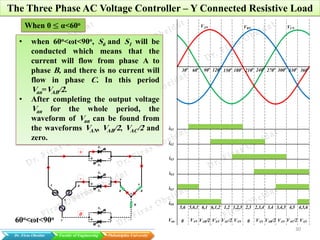
• when 0<ωt<30o, S5 and S6 will be
conducted which means that the
current will flow from phase C to
phase B, and there is no current
will flow in phase A. In this period
Van=0.
• when 30o<ωt<60o, S5, S6 and S1 will
be conducted which means that the
current will flow from phase A and
C to phase B. In this period
Van=VAN.
The Three Phase AC Voltage Controller – Y Connected Resistive Load
When 0 ≤ α<60o
+ -
S4
S1
+ -
S6
S3
+ -
S2
S5
A B
C
a
b
c
R
RR
n
N
0
+
-
+ -
S4
S1
+ -
S6
S3
+ -
S2
S5
A B
C
a
b
c
R
RR
n
N
+
+
-
0<ωt<30o
30o<ωt<60o
30
Dr. Firas Obeidat Faculty of Engineering Philadelphia University
• when 60o<ωt<90o, S6 and S1 will be
conducted which means that the
current will flow from phase A to
phase B, and there is no current will
flow in phase C. In this period
Van=VAB/2.
• After completing the output voltage
Van for the whole period, the
waveform of Van can be found from
the waveforms VAN, VAB/2, VAC/2 and
zero.
The Three Phase AC Voltage Controller – Y Connected Resistive Load
When 0 ≤ α<60o
+ -
S4
S1
+ -
S6
S3
+ -
S2
S5
A B
C
a
b
c
R
RR
n
N
+
0
-
60o<ωt<90o
VAN VBN VCN
iG1
iG6
iG5
iG4
iG3
iG2
6,1,2 2,3,41,2,36,1 2,31,2 3,4 3,4,5 4,5 4,5,65,6 5,6,1
30o
60o
90o
120o
150o
180o
210o
240o
270o
300o
330o
360o
0 VAN VAB/2 VAN VAC/2 VAN 0 VAN VAB/2 VAN VAC/2 VANVan
31
Dr. Firas Obeidat Faculty of Engineering Philadelphia University
The Three Phase AC Voltage Controller – Y Connected Resistive Load
When 0 ≤ α<60o VAN VBN VCN
iG1
iG6
iG5
iG4
iG3
iG2
6,1,2 2,3,41,2,36,1 2,31,2 3,4 3,4,5 4,5 4,5,65,6 5,6,1
30o
60o
90o
120o
150o
180o
210o
240o
270o
300o
330o
360o
0 VAN VAB/2 VAN VAC/2 VAN 0 VAN VAB/2 VAN VAC/2 VANVan
VAB/2
VAN
VAC/2
Van
 The figure below shows the
final shape for the output
voltage Van. The rms voltage
for this waveform will be
less than the rms voltage for
the input voltages VAN, VBN
and VCN.
30o
60o
90o
120o
150o
180o
210o
240o
270o
300o
330o
Van
360o
32
Dr. Firas Obeidat Faculty of Engineering Philadelphia University
The Three Phase AC Voltage Controller – Y Connected Resistive Load
When 0 ≤ α<60o
 The other output waveforms (Vbn
and Vcn) can be found by the
same way, and the resulting
waveform of Vbn will be the same
as the waveform of Van shifted by
120o, and the waveform of Vbn
will be the same as the waveform
of Van shifted by 240o.
 At any instant, three thyristors
or two thyristors are ON. The
instantaneous load voltages are
either a line-to-neutral voltage
(three thyristors ON), one-half of
a line-to-line voltage (two
thyristors ON), or zero (none
ON)
 Because the load is resistive load,
the shape of the output current is
similar to the shape of the output
voltage.
33
Dr. Firas Obeidat Faculty of Engineering Philadelphia University
The Three Phase AC Voltage Controller – Y Connected Resistive Load
When 60o ≤ α<90o
 Only two thyristors conduct at any one time when the delay angle is
between 60o and 90o.
 For α=75o
, prior to 75o, S5 and S6 are conducting, and Van=0. When S1 is
turned on at 75o, S6 continues to conduct, but S5 must turn off because VCN
is negative. Voltage Van is then VAB/2. When S2 is turned on at 135 , S6 is
forced off, and Van= VAC/2. The next thyristor to turn on is S3, which forces
S1 off, and Van=0. One thyristor is always forced off when thyristor is
turned on for α in this range. Load voltages are one-half line-to-line
voltages or zero.
34
Dr. Firas Obeidat Faculty of Engineering Philadelphia University
The Three Phase AC Voltage Controller – Y Connected Resistive Load
When 90o ≤ α<150o
 Only two thyristors conduct
at any one time when the
delay angle is between 90o and
150o.
 For α=120o
, prior to 120o, no
thyristors are on, and Van=0.
At α=120o, S1 is turned on at
120o, S6 still has a gate signal
applied. Since VAB is positive,
both S1 and S6 are forward-
biased and begin to conduct,
and Van=VAB/2. Both S1 and S6
turn off when VAB becomes
negative. When a gate signal
is applied to S2, it turns on,
and S1 turns on again.
For α>150o, there is no time interval when thyristor is forward-biased
while a gate signal is applied. Output voltage is zero for this condition.
35
Dr. Firas Obeidat Faculty of Engineering Philadelphia University
The Three Phase AC Voltage Controller – Y Connected Resistive Load
The rms output voltage for a Y– connection loads are found to be:
 For 0o≤ α<60o
𝑽 𝒐,𝒓𝒎𝒔 = 𝟑𝑽 𝒎
𝟏
𝝅
𝝅
𝟔
−
𝜶
𝟒
+
𝒔𝒊𝒏𝟐𝜶
𝟖
𝑽 𝒐,𝒓𝒎𝒔 =
𝟏
𝟐𝝅
𝑽 𝒂𝒏
𝟐
𝒅𝝎𝒕
𝟐𝝅
𝟎
𝑽 𝒐,𝒓𝒎𝒔 =
𝟏
𝝅
𝑽 𝑨𝑵
𝟐
𝒅𝝎𝒕
𝝅 𝟑
𝜶
+ (
𝑽 𝑨𝑩
𝟐
) 𝟐 𝒅𝝎𝒕
𝝅 𝟑+𝜶
𝝅 𝟑
+ 𝑽 𝑨𝑵
𝟐
𝒅𝝎𝒕
𝟐𝝅 𝟑
𝝅 𝟑+𝜶
+ (
𝑽 𝑨𝑪
𝟐
) 𝟐 𝒅𝝎𝒕
𝟐𝝅 𝟑+𝜶
𝟐𝝅 𝟑
+ 𝑽 𝑨𝑵
𝟐
𝒅𝝎𝒕
𝝅
𝟐𝝅 𝟑+𝜶
𝑽 𝒐,𝒓𝒎𝒔 =
𝟏
𝝅
(𝑽 𝒎sin𝜔t ) 𝟐 𝒅𝝎𝒕
𝝅 𝟑
𝜶
+ (
𝟑𝑽 𝒎sin(𝜔t+π/6)
𝟐
) 𝟐 𝒅𝝎𝒕
𝝅 𝟑+𝜶
𝝅 𝟑
+ (𝑽 𝒎sin𝜔t ) 𝟐 𝒅𝝎𝒕
𝟐𝝅 𝟑
𝝅 𝟑+𝜶
+ (
𝟑𝑽 𝒎sin(𝜔t−π/6)
𝟐
) 𝟐 𝒅𝝎𝒕
𝟐𝝅 𝟑+𝜶
𝟐𝝅 𝟑
+ (𝑽 𝒎sin𝜔t ) 𝟐 𝒅𝝎𝒕
𝝅
𝟐𝝅 𝟑+𝜶
36
Dr. Firas Obeidat Faculty of Engineering Philadelphia University
The Three Phase AC Voltage Controller – Y Connected Resistive Load
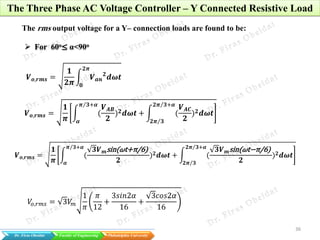
The rms output voltage for a Y– connection loads are found to be:
 For 60o≤ α<90o
𝑽 𝒐,𝒓𝒎𝒔 =
𝟏
𝟐𝝅
𝑽 𝒂𝒏
𝟐
𝒅𝝎𝒕
𝟐𝝅
𝟎
𝑽 𝒐,𝒓𝒎𝒔 =
𝟏
𝝅
(
𝑽 𝑨𝑩
𝟐
) 𝟐 𝒅𝝎𝒕
𝝅 𝟑+𝜶
𝜶
+ (
𝑽 𝑨𝑪
𝟐
) 𝟐 𝒅𝝎𝒕
𝟐𝝅 𝟑+𝜶
𝟐𝝅 𝟑
𝑽 𝒐,𝒓𝒎𝒔 =
𝟏
𝝅
(
𝟑𝑽 𝒎sin(𝜔t+π/6)
𝟐
) 𝟐 𝒅𝝎𝒕
𝝅 𝟑+𝜶
𝜶
+ (
𝟑𝑽 𝒎sin(𝜔t−π/6)
𝟐
) 𝟐 𝒅𝝎𝒕
𝟐𝝅 𝟑+𝜶
𝟐𝝅 𝟑
𝑉𝑜,𝑟𝑚𝑠 = 3𝑉𝑚
1
𝜋
𝜋
12
+
3𝑠𝑖𝑛2𝛼
16
+
3𝑐𝑜𝑠2𝛼
16
37
Dr. Firas Obeidat Faculty of Engineering Philadelphia University
The Three Phase AC Voltage Controller – Y Connected Resistive Load
The rms output voltage for a Y– connection loads are found to be:
 For 90o≤ α<150o
𝑽 𝒐,𝒓𝒎𝒔 =
𝟏
𝟐𝝅
𝑽 𝒂𝒏
𝟐
𝒅𝝎𝒕
𝟐𝝅
𝟎
𝑽 𝒐,𝒓𝒎𝒔 =
𝟏
𝝅
(
𝑽 𝑨𝑩
𝟐
) 𝟐 𝒅𝝎𝒕
𝟓𝝅 𝟔
𝜶
+ (
𝑽 𝑨𝑪
𝟐
) 𝟐 𝒅𝝎𝒕
𝟕𝝅 𝟔
𝝅 𝟑+𝜶
𝑽 𝒐,𝒓𝒎𝒔 =
𝟏
𝝅
(
𝟑𝑽 𝒎sin(𝜔t+π/6)
𝟐
) 𝟐 𝒅𝝎𝒕
𝟓𝝅 𝟔
𝜶
+ (
𝟑𝑽 𝒎sin(𝜔t−π/6)
𝟐
) 𝟐 𝒅𝝎𝒕
𝟕𝝅 𝟔
𝝅 𝟑+𝜶
𝑽 𝒐,𝒓𝒎𝒔 = 𝟑𝑽 𝒎
𝟏
𝝅
𝟓𝝅
𝟐𝟒
−
𝜶
𝟒
+
𝒔𝒊𝒏𝟐𝜶
𝟏𝟔
−
𝟑𝒄𝒐𝒔𝟐𝜶
𝟏𝟔
38
Dr. Firas Obeidat Faculty of Engineering Philadelphia University
The Three Phase AC Voltage Controller – Y Connected Resistive Load
Example: a three phase bidirectional AC voltage controller Y-connected
connected to resistive load (R=10Ω). The supply voltage VL-L=208V, f=60Hz. If
α=π/6, find the output voltage rms value and the input power factor.
𝑉𝑜,𝑟𝑚𝑠 = 3𝑉𝑚
1
𝜋
𝜋
6
−
𝛼
4
+
𝑠𝑖𝑛2𝛼
8
= 208
1
𝜋
𝜋
6
−
π/6
4
+
𝑠𝑖𝑛2π/6
8
= 83𝑉
𝐼 𝑜,𝑟𝑚𝑠 =
𝑉𝑜,𝑟𝑚𝑠
𝑅
=
83
10
= 8.3𝐴
𝑃𝑜,𝑎𝑐 = 3𝐼 𝑜,𝑟𝑚𝑠
2
𝑅 = 3 × 8.32
× 10 = 2066.7𝑊
𝑆 = 3𝐼 𝑜,𝑟𝑚𝑠 𝑉𝑖𝑛𝑝𝑢𝑡,𝑟𝑚𝑠 = 3 × 8.3 × 84.9 = 2114.4𝑉𝐴
𝑉𝑖𝑛𝑝𝑢𝑡,𝑟𝑚𝑠 =
208
2 3
= 84.9𝑉
𝑝𝑓 =
𝑃𝑜,𝑎𝑐
𝑆
=
2066.7
2114.4
= 0.977
39
Dr. Firas Obeidat Faculty of Engineering Philadelphia University
The Three Phase AC Voltage Controller – Δ Connected Resistive Load
 The voltage across a load resistor is the corresponding line-to-line voltage
when a thyristor in the phase is on. The delay angle is referenced to the
zero crossing of the line-to-line voltage. thyristors are turned on in the
sequence 1-2-3-4-5-6.
The line current in each
phase is the sum of two of
the delta currents:
40
Dr. Firas Obeidat Faculty of Engineering Philadelphia University
The Three Phase AC Voltage Controller – Δ Connected Resistive Load
The relationship between rms line
and delta currents depends on the
conduction angle of the thyristors.
For small conduction angles (large α),
the delta currents do not overlap, and
the rms line currents are
Current waveforms for α=130o
For large conduction angles (small α),
the delta currents overlap, and the
rms line current is larger than √2IΔ.
In the limit when γ (α=0), the delta
currents and line currents are
sinusoids. The rms line current is
determined from ordinary three-
phase analysis.
Current waveforms for α=90o
The range of rms line current is
therefore
depending on α
41

AC AC converters

  • 1.
    Power Electronics AC-AC Converters 1 Dr.Firas Obeidat E-mail: firasobeidat@gmail.com fobeidat@philadelphia.edu.jo
  • 2.
    2 Table of contents 1 •Introduction 2 • The Single Phase AC Voltage Controller 3 • The Single Phase AC Voltage Controller - Resistive Load 4 • The Single Phase AC Voltage Controller - RL Load 5 • The Three Phase AC Voltage Controller – Y Connected Resistive Load 6 • The Three Phase AC Voltage Controller – Δ Connected Resistive Load Dr. Firas Obeidat Faculty of Engineering Philadelphia University
  • 3.
    3 Dr. Firas ObeidatFaculty of Engineering Philadelphia University Introduction An ac voltage controller is a converter that controls the voltage, current, and average power delivered to an ac load from an ac source. The phase-controlled ac voltage controller has several practical uses including light-dimmer circuits and speed control of induction motors. In a switching scheme called phase control, switching takes place during every cycle of the source, in effect removing some of the source waveform before it reaches the load. Integral-cycle control, the source is connected and disconnected for several cycles at a time.
  • 4.
    4 Dr. Firas ObeidatFaculty of Engineering Philadelphia University The Single Phase AC Voltage Controller Basic Operation For the single phase AC voltage controller shown, electronic switches are shown as parallel thyristors (SCRs). This SCR arrangement makes it possible to have current in either direction in the load. This SCR connection is called antiparallel or inverse parallel because the SCRs carry current in opposite directions. A triac is equivalent to the antiparallel SCRs. Other controlled switching devices can be used instead of SCRs.  Load current contains both positive and negative half-cycles. An analysis identical to that done for the controlled half-wave rectifier can be done on a half cycle for the voltage controller. Then, by symmetry, the result can be extrapolated to describe the operation for the entire period.  S1 conducts if a gate signal is applied during the positive half-cycle of the source. S1 conducts until the current in it reaches zero.  A gate signal is applied to S2 during the negative half-cycle of the source, providing a path for negative load current. vs L o a d + -vsw S1 S2 + - + - io vo
  • 5.
    5 Dr. Firas ObeidatFaculty of Engineering Philadelphia University The Single Phase AC Voltage Controller Basic Operation Basic observations about this controller The SCRs cannot conduct simultaneously. The load voltage is the same as the source voltage when either SCR is on. The load voltage is zero when both SCRs are OFF. The switch voltage vsw is zero when either SCR is ON and is equal to the source voltage when neither is ON. The average current in the source and load is zero if the SCRs are on for equal time intervals. The average current in each SCR is not zero because of unidirectional SCR current. The rms current in each SCR is 1/√2 times the rms load current if the SCRs are on for equal time intervals.
  • 6.
    6 Dr. Firas ObeidatFaculty of Engineering Philadelphia University vs + -vsw S1 S2 + - + - io voR The Single Phase AC Voltage Controller - Resistive Load 𝑣𝑠 𝜔𝑡 = 𝑉𝑚 𝑠𝑖𝑛𝜔𝑡 𝑣𝑠 𝜔𝑡 = 𝑉𝑚 𝑠𝑖𝑛𝜔𝑡 𝛼 < 𝜔𝑡 < 𝜋 𝑎𝑛𝑑 𝜋 + 𝛼 < 𝜔𝑡 < 2𝜋 0 𝑜𝑡ℎ𝑒𝑟𝑤𝑖𝑠𝑒 Let the voltage source be Output voltage is The rms load voltage is 𝑉𝑜,𝑟𝑚𝑠 = 1 𝜋 (𝑉𝑚 𝑠𝑖𝑛𝜔𝑡)2 𝑑𝜔𝑡 𝜋 α = 𝑉𝑚 2 1 − 𝛼 𝜋 + 𝑠𝑖𝑛2𝛼 2𝜋
  • 7.
    7 Dr. Firas ObeidatFaculty of Engineering Philadelphia University The Single Phase AC Voltage Controller - Resistive Load The power factor of the load is The rms current in the load and the source is 𝐼 𝑜,𝑟𝑚𝑠 = 𝑉𝑜,𝑟𝑚𝑠 𝑅 = 𝑉𝑚 𝑅 2 1 − 𝛼 𝜋 + 𝑠𝑖𝑛2𝛼 2𝜋 𝑝𝑓 = 𝑃 𝑆 = 𝑉𝑜,𝑟𝑚𝑠 2 𝑅 𝑉𝑠,𝑟𝑚𝑠 𝐼𝑠,𝑟𝑚𝑠 = 𝑉𝑜,𝑟𝑚𝑠 2 𝑅 𝑉𝑠,𝑟𝑚𝑠(𝑉𝑜,𝑟𝑚𝑠 𝑅) = 𝑉𝑜,𝑟𝑚𝑠 𝑉𝑠,𝑟𝑚𝑠 = 𝑉𝑚 2 1 − 𝛼 𝜋 + 𝑠𝑖𝑛2𝛼 2𝜋 𝑉𝑚 2 𝑝𝑓 = 1 − 𝛼 𝜋 + 𝑠𝑖𝑛2𝛼 2𝜋 The pf=1 for α=0, which is the same as for an uncontrolled resistive load, and the power factor for α>0 is less than 1. The average source current is zero because of half-wave symmetry. 𝐼𝑠,𝐴𝑣𝑔 = 𝐼 𝑜,𝐴𝑣𝑔 = 0
  • 8.
    8 Dr. Firas ObeidatFaculty of Engineering Philadelphia University The Single Phase AC Voltage Controller - Resistive Load The average SCR current is 𝐼𝑆𝐶𝑅,𝐴𝑣𝑔 = 1 2𝜋 𝑉𝑚 𝑠𝑖𝑛𝜔𝑡 𝑅 𝑑𝜔𝑡 𝜋 𝛼 = 𝑉𝑚 2𝜋𝑅 (1 + 𝑐𝑜𝑠𝛼) 𝐼𝑆𝐶𝑅,𝑟𝑚𝑠 = 1 2𝜋 ( 𝑉𝑚 𝑠𝑖𝑛𝜔𝑡 𝑅 )2 𝑑𝜔𝑡 𝜋 α = 𝑉𝑚 2𝑅 1 − 𝛼 𝜋 + 𝑠𝑖𝑛2𝛼 2𝜋 The rms SCR current is 𝐼𝑆𝐶𝑅,𝑟𝑚𝑠 = 𝑉𝑚 2 2𝑅 1 − 𝛼 𝜋 + 𝑠𝑖𝑛2𝛼 2𝜋 = 𝐼 𝑜,𝑟𝑚𝑠 2 πα 2π 2π+α 3π ωt iS1 vs/R
  • 9.
    9 Dr. Firas ObeidatFaculty of Engineering Philadelphia University Example: The single-phase ac voltage controller has a 120-V rms 60-Hz source. The load resistance is 15 Ω. Determine (a) the delay angle required to deliver 500 W to the load, (b) the rms source current, (c) the rms and average currents in the SCRs, (d) the power factor. 𝑉𝑜,𝑟𝑚𝑠 = 𝑉𝑚 2 1 − 𝛼 𝜋 + 𝑠𝑖𝑛2𝛼 2𝜋 = 2 × 120 2 1 − 𝛼 𝜋 + 𝑠𝑖𝑛2𝛼 2𝜋 𝑃 = 𝑉𝑜,𝑟𝑚𝑠 2 𝑅 → 𝑉𝑜,𝑟𝑚𝑠 2 = 𝑃𝑅 = 500 × 15 = 7500 𝑉𝑜,𝑟𝑚𝑠 2 = 1202 (1 − 𝛼 𝜋 + 𝑠𝑖𝑛2𝛼 2𝜋 ) ∴ 7500 = 14400(1 − 𝛼 𝜋 + 𝑠𝑖𝑛2𝛼 2𝜋 ) 𝛼 𝜋 − 𝑠𝑖𝑛2𝛼 2𝜋 = 0.479 2𝛼 − 𝑠𝑖𝑛2𝛼 = 3.01 𝛼 = 1.54 rad = 88.1 𝑜 (a) The Single Phase AC Voltage Controller - Resistive Load
  • 10.
    10 Dr. Firas ObeidatFaculty of Engineering Philadelphia University The Single Phase AC Voltage Controller - Resistive Load (b) 𝐼 𝑜,𝑟𝑚𝑠 = 𝑉𝑜,𝑟𝑚𝑠 𝑅 = 86.6 15 = 5.77 A 𝑉𝑜,𝑟𝑚𝑠 2 = 7500 → 𝑉𝑜,𝑟𝑚𝑠 = 86.6From (a) 𝐼𝑆𝐶𝑅,𝐴𝑣𝑔 = 𝑉𝑚 2𝜋𝑅 1 + 𝑐𝑜𝑠𝛼 = 2 × 120 2𝜋15 1 + 𝑐𝑜𝑠88.1 = 1.86 A 𝐼𝑆𝐶𝑅,𝑟𝑚𝑠 = 𝐼 𝑜,𝑟𝑚𝑠 2 = 5.77 2 = 4.08 A (c) 𝑝𝑓 = 𝑃 𝑆 = 𝑃 𝑉𝑠,𝑟𝑚𝑠 𝐼𝑠,𝑟𝑚𝑠 = 1 − 𝛼 𝜋 + 𝑠𝑖𝑛2𝛼 2𝜋 = 500 120 × 5.77 = 0.722(d)
  • 11.
    11 Dr. Firas ObeidatFaculty of Engineering Philadelphia University The Single Phase AC Voltage Controller - RL Load vs + -vsw S1 S2 + - + - io vo R L When a gate signal is applied to S1 at 𝜔t=α in single phase AC voltage controller with RL load, Kirchhoff’s voltage law for the circuit is expressed as. 𝑉𝑚 𝑠𝑖𝑛𝜔𝑡 = 𝑅𝑖 𝑜 𝑡 + 𝐿 𝑑𝑖 𝑜 𝑡 𝑑𝑡 The solution for current in this equation (as obtained in the controlled half wave rectifier section) is 𝑖 𝑜 𝜔𝑡 = 𝑉𝑚 𝑍 sin 𝜔𝑡 − 𝜃 − sin(𝛼 − 𝜃)𝑒(𝛼−𝜔𝑡) 𝜔𝜏 𝛼 ≤ 𝜔𝑡 ≤ 𝛽 0 𝑜𝑡ℎ𝑒𝑟𝑤𝑖𝑠𝑒 where 𝑍 = 𝑅2 + (𝜔𝐿)2 𝜃 = 𝑡𝑎𝑛−1 ( 𝜔𝐿 𝑅 ) The extinction angle 𝛽 is the angle at which the current returns to zero, when 𝜔𝑡= 𝛽, 𝑖 𝑜 𝛽 = 𝑉𝑚 𝑍 sin 𝛽 − 𝜃 − sin(𝛼 − 𝜃)𝑒(𝛼−𝛽) 𝜔𝜏 (1) (2)
  • 12.
    12 Dr. Firas ObeidatFaculty of Engineering Philadelphia University The Single Phase AC Voltage Controller - RL Load A gate signal is applied to S2 at 𝜔t=π+α, and the load current is negative but has a form identical to that of the positive half- cycle. The above equation must be solved numerically for 𝛽. The angle (𝛽-α) is called the conduction angle 𝛶. 𝛶 =𝛽-α In the interval between π and 𝛽 when the source voltage is negative and the load current is still positive, S2 cannot be turned on because it is not forward biased. The gate signal to S2 must be delayed at least until the current in S1 reaches zero, at 𝜔t= 𝛽. The delay angle is therefore at least 𝛽- π. α≥𝛽- π
  • 13.
    13 Dr. Firas ObeidatFaculty of Engineering Philadelphia University The Single Phase AC Voltage Controller - RL Load When α=θ, equation (2) becomes sin 𝛽 − 𝜃 = 0 which has a solution 𝛽 − 𝜃 = π Therefore 𝛶 = 𝜋 When α=θ When 𝛶=𝜋, one SCR is always conducting, and the voltage across the load is the same as the voltage of the source. The load voltage and current are sinusoids for this case, and the circuit is analyzed using phasor analysis for AC circuits. The power delivered to the load is continuously controllable between the two extremes corresponding to full source voltage and zero. The expression of rms load current is 𝐼 𝑜,𝑟𝑚𝑠 = 1 𝜋 𝑖 𝑜 2 (𝜔𝑡) 𝑑𝜔𝑡 𝛽 α = 1 𝜋 𝑉 𝑚 𝑍 sin 𝜔𝑡 − 𝜃 − 𝑉 𝑚 𝑍 sin(𝛼 − 𝜃)𝑒(𝛼−𝜔𝑡) 𝜔𝜏 2 𝑑𝜔𝑡 𝛽 α
  • 14.
    14 Dr. Firas ObeidatFaculty of Engineering Philadelphia University The Single Phase AC Voltage Controller - RL Load The average output voltage can be found as An other way to find the expression of rms load current is 𝐼 𝑜,𝑟𝑚𝑠 = 1 𝑅2 + (𝜔𝐿)2 𝑉𝑚 2 1 𝜋 (𝛽 − 𝛼 − 1 2 𝑠𝑖𝑛2𝛽 + 1 2 𝑠𝑖𝑛2𝛼) Power absorbed by the load is determined from 𝑃 = 𝐼 𝑜,𝑟𝑚𝑠 2 𝑅 The power factor of the load is 𝑝𝑓 = 𝑃 𝑆 = 𝑉𝑜,𝑟𝑚𝑠 𝐼 𝑜,𝑟𝑚𝑠 𝑉𝑠,𝑟𝑚𝑠 𝐼𝑠,𝑟𝑚𝑠 = 𝑉𝑜,𝑟𝑚𝑠 𝑉𝑠,𝑟𝑚𝑠 = 1 𝜋 (𝛽 − 𝛼 − 1 2 𝑠𝑖𝑛2𝛽 + 1 2 𝑠𝑖𝑛2𝛼) 𝑉𝑜,𝑟𝑚𝑠 = 1 𝜋 (𝑉𝑚 𝑠𝑖𝑛𝜔𝑡)2 𝑑𝜔𝑡 𝛽 α = 𝑉𝑚 2 1 𝜋 (𝛽 − 𝛼 − 1 2 𝑠𝑖𝑛2𝛽 + 1 2 𝑠𝑖𝑛2𝛼)
  • 15.
    15 Dr. Firas ObeidatFaculty of Engineering Philadelphia University The Single Phase AC Voltage Controller - RL Load Each SCR carries one-half of the current waveform, making the average SCR current 𝐼𝑆𝐶𝑅,𝐴𝑣𝑔 = 1 2𝜋 𝑖 𝑜(𝜔𝑡) 𝑑𝜔𝑡 𝛽 α = 1 2𝜋 𝑉𝑚 𝑍 sin 𝜔𝑡 − 𝜃 − sin(𝛼 − 𝜃)𝑒(𝛼−𝜔𝑡) 𝜔𝜏 𝑑𝜔𝑡 𝛽 α The rms current in each SCR is 𝐼𝑆𝐶𝑅,𝑟𝑚𝑠 = 𝐼 𝑜,𝑟𝑚𝑠 2 The average load current is zero, 𝐼 𝑜,𝐴𝑣𝑔 = 0
  • 16.
    16 Dr. Firas ObeidatFaculty of Engineering Philadelphia University Example: For the single-phase voltage controller with RL load, the source is 120Vrms at 60 Hz, and the load is a series RL combination with R=20Ω and L=50mH. The delay angle α is 90. Determine (a) an expression for load current for the first half-period, (b) the rms load current, (c) the rms SCR current, (d) the average SCR current, (e) the power delivered to the load, and (f) the power factor. (a) The Single Phase AC Voltage Controller - RL Load The extinction angle is determined from the numerical solution of i(β)=0 in the above equation.
  • 17.
    17 Dr. Firas ObeidatFaculty of Engineering Philadelphia University The Single Phase AC Voltage Controller - RL Load (b) (c) (d) (e) (f) 𝐼 𝑜,𝑟𝑚𝑠 = 1 27.5 × 120 × 1 𝜋 (3.83 − 1.57 − 1 2 𝑠𝑖𝑛440 + 0) = 3.27 A 𝐼 𝑜,𝑟𝑚𝑠 = 1 𝑅2 + (𝜔𝐿)2 𝑉𝑚 2 1 𝜋 (𝛽 − 𝛼 − 1 2 𝑠𝑖𝑛2𝛽 − 1 2 𝑠𝑖𝑛2𝛼) Or
  • 18.
    18 Dr. Firas ObeidatFaculty of Engineering Philadelphia University The Three Phase AC Voltage Controller – Y Connected Resistive Load  The power delivered to the load in three phase AC voltage controller with Y-connected resistive load is controlled by the delay angle α on each thyristor. The six thyristors are turned on in the sequence 1-2- 3-4-5-6, at 60 intervals. Gate signals are maintained throughout the possible conduction angle. + - S4 S1 + - S6 S3 + - S2 S5 A B C ab c R RR n N  The instantaneous voltage across each phase of the load is determined by which thyristors are conducting. At any instant, three thyristors , two thyristors , or no thyristors are ON.  The instantaneous load voltages are either a line-to-neutral voltage (three thyristors ON), one-half of a line-to-line voltage (two thyristors ON), or zero (none on).  Which thyristors are conducting depends on the delay angle α and on the source voltages at a particular instant. The ranges of α that produce particular types of load voltages are 0< α<60o, 60o< α<90o and 90o< α<150o.
  • 19.
    19 Dr. Firas ObeidatFaculty of Engineering Philadelphia University The Three Phase AC Voltage Controller – Y Connected Resistive Load When 0 ≤ α<60o  To study the output voltage Van, Vbn and Vcn, triggering angle α must be determined first.  Suppose that the triggering angle α equal to 30o.  The output voltage Van will be studies when α= 30o, and the same procedure can be applied to get the output voltages Vbn and Vcn at any triggering angle from 0 to 60o. 𝑉𝐴𝑁 = 𝑉𝑚sin𝜔t 𝑉𝐵𝑁 = 𝑉𝑚sin(𝜔t-2π/3) 𝑉𝐶𝑁 = 𝑉𝑚sin(𝜔t-4π/3) Let 𝑉𝐴𝐵 = 3𝑉𝑚sin(𝜔t+π/6) 𝑉𝐵𝐶 = 3𝑉𝑚sin(𝜔t-π/2) 𝑉𝐶𝐴 = 3𝑉𝑚sin(𝜔t-7π/6) VAN VBN VCN 30o 60o 90o 120o 150o 180o 210o 240o 270o 300o 330o 360o
  • 20.
    20 Dr. Firas ObeidatFaculty of Engineering Philadelphia University The Three Phase AC Voltage Controller – Y Connected Resistive Load When 0 ≤ α<60o 1. Determine the triggering angle α (for example α= 30o). 2. Determine the conducting period for each thyristor. • As seen from the input phase voltages VAN, VBN and VCN, every 30o there is a change that affect on the conduction of each thyristor. VAN VBN VCN 30o 60o 90o 120o 150o 180o 210o 240o 270o 300o 330o 360o VAN=VCN VCN=0 VBN=0 VAN=VBN VAN=0 VCN=0 VBN=VCN VBN=0 VAN=0 VAN=VBNVAN=VCNVBN=VCN
  • 21.
    21 Dr. Firas ObeidatFaculty of Engineering Philadelphia University The Three Phase AC Voltage Controller – Y Connected Resistive Load When 0 ≤ α<60o VAN VBN VCN iG1 iG6 iG5 iG4 iG3 iG2 30o 60o 90o 120o 150o 180o 210o 240o 270o 300o 330o 360o • Because α=30o, S1 will be triggered at 30o, S3 will be triggered at 150o (120o+α), S5 will be triggered at 270o (240o+α). • S4 will be triggered after S1 by 180o, S6 will be triggered after S3 by 180o S2 will be triggered after S5 by 180o. • The six SCRs are turned on in the sequence 1-2-3-4-5-6, at 60o intervals. + - S4 S1 + - S6 S3 + - S2 S5 A B C ab c R RR n N
  • 22.
    22 Dr. Firas ObeidatFaculty of Engineering Philadelphia University The Three Phase AC Voltage Controller – Y Connected Resistive Load When 0 ≤ α<60o 3. Study the conduction period for each thyristor. • Each thyristor will be studied at each angle that affect on the conduction of each thyristor to determine if the thyristor will conduct or not. • The conduction period will be studied for S1. • At 30o, VAN=VCN, VAN and VCN are positive, while VBN is negative. So, the current will flow from phase A and C to phase B. S1 will be on from 30o to 60o. VAN VBN VCN iG1 30o 60o 90o 120o 150o 180o 210o 240o 270o 300o 330o 360o + - S4 S1 + - S6 S3 + - S2 S5 A B C a b c R RR n N + + -
  • 23.
    23 Dr. Firas ObeidatFaculty of Engineering Philadelphia University The Three Phase AC Voltage Controller – Y Connected Resistive Load When 0 ≤ α<60o • At 60o, VCN=0, VAN is positive, while VBN is negative. So, the current will flow from phase Ato phase B. S1 will be ON from 60o to 90o. VAN VBN VCN iG1 30o 60o 90o 120o 150o 180o 210o 240o 270o 300o 330o 360o + - S4 S1 + - S6 S3 + - S2 S5 A B C a b c R RR n N + 0 -
  • 24.
    24 Dr. Firas ObeidatFaculty of Engineering Philadelphia University The Three Phase AC Voltage Controller – Y Connected Resistive Load When 0 ≤ α<60o • At 90o, VBN=VCN, VAN is positive, while VBN and VCN are negative. So, the current will flow from phase Ato phase B and phase C. S1 will be ON from 90o to 120o. + - S4 + - S6 S3 + - S2 S5 A B C a b c R RR n N + - - VAN VBN VCN iG1 30o 60o 90o 120o 150o 180o 210o 240o 270o 300o 330o 360o
  • 25.
    25 Dr. Firas ObeidatFaculty of Engineering Philadelphia University The Three Phase AC Voltage Controller – Y Connected Resistive Load When 0 ≤ α<60o • At 120o, VBN=0, VAN is positive, while VCN is negative. So, the current will flow from phase Ato phase C. S1 will be ON from 120o to 150o. + - S4 S1 + - S6 S3 + - S2 S5 A B C a b c R RR n N + 0 - VAN VBN VCN iG1 30o 60o 90o 120o 150o 180o 210o 240o 270o 300o 330o 360o
  • 26.
    26 Dr. Firas ObeidatFaculty of Engineering Philadelphia University The Three Phase AC Voltage Controller – Y Connected Resistive Load When 0 ≤ α<60o • At 150o, VAN=VBN, VAN and VBN are positive, VCN is negative. So, the current will flow from phase A and B to phase C. S1 will be ON from 150o to 180o. + - S4 S1 + - S6 S3 + - S2 S5 A B C a b c R RR n N + + - VAN VBN VCN iG1 30o 60o 90o 120o 150o 180o 210o 240o 270o 300o 330o 360o
  • 27.
    27 Dr. Firas ObeidatFaculty of Engineering Philadelphia University The Three Phase AC Voltage Controller – Y Connected Resistive Load When 0 ≤ α<60o • At 180o, VAN=0, VBN is positive, VCN is negative. So, the current will flow from phase B to phase C and the current will not flow in phase A. S1 will be OFF from 180o to 210o. • At 210o, VAN= VCN, VBN is positive, VAN and VCN are negative. So, the current will flow from phase B to phase A and C. S1 will be OFF from 210o to 240o. • At 240o, VCN= 0, VBN is positive, VAN is negative. So, the current will flow from phase B to phase A. S1 will be OFF from 240o to 270o. • At 270o, VBN=VCN, VBN and VCN are positive, VAN is negative. So, the current will flow from phase B and C to phase A. S1 will be OFF from 270o to 300o. • At 300o, VBN=0, VCN is positive, VAN is negative. So, the current will flow from phase C to phase A. S1 will be OFF from 300o to 330o. • At 330o, VAN=VBN, VCN is positive, VAN and VBN are negative. So, the current will flow from phase C to phase A and B. S1 will be OFF from 330o to 360o.
  • 28.
    28 Dr. Firas ObeidatFaculty of Engineering Philadelphia University • The same procedure can be done for other thyristors to determine the conduction period for each thyristor. 4. Determine the thyristors that will be conducted for each period. For example, when 0<ωt<30o, S5 and S6 will be conducted, when 30o<ωt<60o, S5, S6 and S1 will be conducted, ect… VAN VBN VCN iG1 iG6 iG5 iG4 iG3 iG2 6,1,2 2,3,41,2,36,1 2,31,2 3,4 3,4,5 4,5 4,5,65,6 5,6,1 30o 60o 90o 120o 150o 180o 210o 240o 270o 300o 330o 360o The Three Phase AC Voltage Controller – Y Connected Resistive Load When 0 ≤ α<60o
  • 29.
    29 Dr. Firas ObeidatFaculty of Engineering Philadelphia University 5. Determine the output voltages (Van, Vbn and Vcn) at each period. • The output voltage Van can be found by applying the thyristors that will be conducted at each period. • when 0<ωt<30o, S5 and S6 will be conducted which means that the current will flow from phase C to phase B, and there is no current will flow in phase A. In this period Van=0. • when 30o<ωt<60o, S5, S6 and S1 will be conducted which means that the current will flow from phase A and C to phase B. In this period Van=VAN. The Three Phase AC Voltage Controller – Y Connected Resistive Load When 0 ≤ α<60o + - S4 S1 + - S6 S3 + - S2 S5 A B C a b c R RR n N 0 + - + - S4 S1 + - S6 S3 + - S2 S5 A B C a b c R RR n N + + - 0<ωt<30o 30o<ωt<60o
  • 30.
    30 Dr. Firas ObeidatFaculty of Engineering Philadelphia University • when 60o<ωt<90o, S6 and S1 will be conducted which means that the current will flow from phase A to phase B, and there is no current will flow in phase C. In this period Van=VAB/2. • After completing the output voltage Van for the whole period, the waveform of Van can be found from the waveforms VAN, VAB/2, VAC/2 and zero. The Three Phase AC Voltage Controller – Y Connected Resistive Load When 0 ≤ α<60o + - S4 S1 + - S6 S3 + - S2 S5 A B C a b c R RR n N + 0 - 60o<ωt<90o VAN VBN VCN iG1 iG6 iG5 iG4 iG3 iG2 6,1,2 2,3,41,2,36,1 2,31,2 3,4 3,4,5 4,5 4,5,65,6 5,6,1 30o 60o 90o 120o 150o 180o 210o 240o 270o 300o 330o 360o 0 VAN VAB/2 VAN VAC/2 VAN 0 VAN VAB/2 VAN VAC/2 VANVan
  • 31.
    31 Dr. Firas ObeidatFaculty of Engineering Philadelphia University The Three Phase AC Voltage Controller – Y Connected Resistive Load When 0 ≤ α<60o VAN VBN VCN iG1 iG6 iG5 iG4 iG3 iG2 6,1,2 2,3,41,2,36,1 2,31,2 3,4 3,4,5 4,5 4,5,65,6 5,6,1 30o 60o 90o 120o 150o 180o 210o 240o 270o 300o 330o 360o 0 VAN VAB/2 VAN VAC/2 VAN 0 VAN VAB/2 VAN VAC/2 VANVan VAB/2 VAN VAC/2 Van  The figure below shows the final shape for the output voltage Van. The rms voltage for this waveform will be less than the rms voltage for the input voltages VAN, VBN and VCN. 30o 60o 90o 120o 150o 180o 210o 240o 270o 300o 330o Van 360o
  • 32.
    32 Dr. Firas ObeidatFaculty of Engineering Philadelphia University The Three Phase AC Voltage Controller – Y Connected Resistive Load When 0 ≤ α<60o  The other output waveforms (Vbn and Vcn) can be found by the same way, and the resulting waveform of Vbn will be the same as the waveform of Van shifted by 120o, and the waveform of Vbn will be the same as the waveform of Van shifted by 240o.  At any instant, three thyristors or two thyristors are ON. The instantaneous load voltages are either a line-to-neutral voltage (three thyristors ON), one-half of a line-to-line voltage (two thyristors ON), or zero (none ON)  Because the load is resistive load, the shape of the output current is similar to the shape of the output voltage.
  • 33.
    33 Dr. Firas ObeidatFaculty of Engineering Philadelphia University The Three Phase AC Voltage Controller – Y Connected Resistive Load When 60o ≤ α<90o  Only two thyristors conduct at any one time when the delay angle is between 60o and 90o.  For α=75o , prior to 75o, S5 and S6 are conducting, and Van=0. When S1 is turned on at 75o, S6 continues to conduct, but S5 must turn off because VCN is negative. Voltage Van is then VAB/2. When S2 is turned on at 135 , S6 is forced off, and Van= VAC/2. The next thyristor to turn on is S3, which forces S1 off, and Van=0. One thyristor is always forced off when thyristor is turned on for α in this range. Load voltages are one-half line-to-line voltages or zero.
  • 34.
    34 Dr. Firas ObeidatFaculty of Engineering Philadelphia University The Three Phase AC Voltage Controller – Y Connected Resistive Load When 90o ≤ α<150o  Only two thyristors conduct at any one time when the delay angle is between 90o and 150o.  For α=120o , prior to 120o, no thyristors are on, and Van=0. At α=120o, S1 is turned on at 120o, S6 still has a gate signal applied. Since VAB is positive, both S1 and S6 are forward- biased and begin to conduct, and Van=VAB/2. Both S1 and S6 turn off when VAB becomes negative. When a gate signal is applied to S2, it turns on, and S1 turns on again. For α>150o, there is no time interval when thyristor is forward-biased while a gate signal is applied. Output voltage is zero for this condition.
  • 35.
    35 Dr. Firas ObeidatFaculty of Engineering Philadelphia University The Three Phase AC Voltage Controller – Y Connected Resistive Load The rms output voltage for a Y– connection loads are found to be:  For 0o≤ α<60o 𝑽 𝒐,𝒓𝒎𝒔 = 𝟑𝑽 𝒎 𝟏 𝝅 𝝅 𝟔 − 𝜶 𝟒 + 𝒔𝒊𝒏𝟐𝜶 𝟖 𝑽 𝒐,𝒓𝒎𝒔 = 𝟏 𝟐𝝅 𝑽 𝒂𝒏 𝟐 𝒅𝝎𝒕 𝟐𝝅 𝟎 𝑽 𝒐,𝒓𝒎𝒔 = 𝟏 𝝅 𝑽 𝑨𝑵 𝟐 𝒅𝝎𝒕 𝝅 𝟑 𝜶 + ( 𝑽 𝑨𝑩 𝟐 ) 𝟐 𝒅𝝎𝒕 𝝅 𝟑+𝜶 𝝅 𝟑 + 𝑽 𝑨𝑵 𝟐 𝒅𝝎𝒕 𝟐𝝅 𝟑 𝝅 𝟑+𝜶 + ( 𝑽 𝑨𝑪 𝟐 ) 𝟐 𝒅𝝎𝒕 𝟐𝝅 𝟑+𝜶 𝟐𝝅 𝟑 + 𝑽 𝑨𝑵 𝟐 𝒅𝝎𝒕 𝝅 𝟐𝝅 𝟑+𝜶 𝑽 𝒐,𝒓𝒎𝒔 = 𝟏 𝝅 (𝑽 𝒎sin𝜔t ) 𝟐 𝒅𝝎𝒕 𝝅 𝟑 𝜶 + ( 𝟑𝑽 𝒎sin(𝜔t+π/6) 𝟐 ) 𝟐 𝒅𝝎𝒕 𝝅 𝟑+𝜶 𝝅 𝟑 + (𝑽 𝒎sin𝜔t ) 𝟐 𝒅𝝎𝒕 𝟐𝝅 𝟑 𝝅 𝟑+𝜶 + ( 𝟑𝑽 𝒎sin(𝜔t−π/6) 𝟐 ) 𝟐 𝒅𝝎𝒕 𝟐𝝅 𝟑+𝜶 𝟐𝝅 𝟑 + (𝑽 𝒎sin𝜔t ) 𝟐 𝒅𝝎𝒕 𝝅 𝟐𝝅 𝟑+𝜶
  • 36.
    36 Dr. Firas ObeidatFaculty of Engineering Philadelphia University The Three Phase AC Voltage Controller – Y Connected Resistive Load The rms output voltage for a Y– connection loads are found to be:  For 60o≤ α<90o 𝑽 𝒐,𝒓𝒎𝒔 = 𝟏 𝟐𝝅 𝑽 𝒂𝒏 𝟐 𝒅𝝎𝒕 𝟐𝝅 𝟎 𝑽 𝒐,𝒓𝒎𝒔 = 𝟏 𝝅 ( 𝑽 𝑨𝑩 𝟐 ) 𝟐 𝒅𝝎𝒕 𝝅 𝟑+𝜶 𝜶 + ( 𝑽 𝑨𝑪 𝟐 ) 𝟐 𝒅𝝎𝒕 𝟐𝝅 𝟑+𝜶 𝟐𝝅 𝟑 𝑽 𝒐,𝒓𝒎𝒔 = 𝟏 𝝅 ( 𝟑𝑽 𝒎sin(𝜔t+π/6) 𝟐 ) 𝟐 𝒅𝝎𝒕 𝝅 𝟑+𝜶 𝜶 + ( 𝟑𝑽 𝒎sin(𝜔t−π/6) 𝟐 ) 𝟐 𝒅𝝎𝒕 𝟐𝝅 𝟑+𝜶 𝟐𝝅 𝟑 𝑉𝑜,𝑟𝑚𝑠 = 3𝑉𝑚 1 𝜋 𝜋 12 + 3𝑠𝑖𝑛2𝛼 16 + 3𝑐𝑜𝑠2𝛼 16
  • 37.
    37 Dr. Firas ObeidatFaculty of Engineering Philadelphia University The Three Phase AC Voltage Controller – Y Connected Resistive Load The rms output voltage for a Y– connection loads are found to be:  For 90o≤ α<150o 𝑽 𝒐,𝒓𝒎𝒔 = 𝟏 𝟐𝝅 𝑽 𝒂𝒏 𝟐 𝒅𝝎𝒕 𝟐𝝅 𝟎 𝑽 𝒐,𝒓𝒎𝒔 = 𝟏 𝝅 ( 𝑽 𝑨𝑩 𝟐 ) 𝟐 𝒅𝝎𝒕 𝟓𝝅 𝟔 𝜶 + ( 𝑽 𝑨𝑪 𝟐 ) 𝟐 𝒅𝝎𝒕 𝟕𝝅 𝟔 𝝅 𝟑+𝜶 𝑽 𝒐,𝒓𝒎𝒔 = 𝟏 𝝅 ( 𝟑𝑽 𝒎sin(𝜔t+π/6) 𝟐 ) 𝟐 𝒅𝝎𝒕 𝟓𝝅 𝟔 𝜶 + ( 𝟑𝑽 𝒎sin(𝜔t−π/6) 𝟐 ) 𝟐 𝒅𝝎𝒕 𝟕𝝅 𝟔 𝝅 𝟑+𝜶 𝑽 𝒐,𝒓𝒎𝒔 = 𝟑𝑽 𝒎 𝟏 𝝅 𝟓𝝅 𝟐𝟒 − 𝜶 𝟒 + 𝒔𝒊𝒏𝟐𝜶 𝟏𝟔 − 𝟑𝒄𝒐𝒔𝟐𝜶 𝟏𝟔
  • 38.
    38 Dr. Firas ObeidatFaculty of Engineering Philadelphia University The Three Phase AC Voltage Controller – Y Connected Resistive Load Example: a three phase bidirectional AC voltage controller Y-connected connected to resistive load (R=10Ω). The supply voltage VL-L=208V, f=60Hz. If α=π/6, find the output voltage rms value and the input power factor. 𝑉𝑜,𝑟𝑚𝑠 = 3𝑉𝑚 1 𝜋 𝜋 6 − 𝛼 4 + 𝑠𝑖𝑛2𝛼 8 = 208 1 𝜋 𝜋 6 − π/6 4 + 𝑠𝑖𝑛2π/6 8 = 83𝑉 𝐼 𝑜,𝑟𝑚𝑠 = 𝑉𝑜,𝑟𝑚𝑠 𝑅 = 83 10 = 8.3𝐴 𝑃𝑜,𝑎𝑐 = 3𝐼 𝑜,𝑟𝑚𝑠 2 𝑅 = 3 × 8.32 × 10 = 2066.7𝑊 𝑆 = 3𝐼 𝑜,𝑟𝑚𝑠 𝑉𝑖𝑛𝑝𝑢𝑡,𝑟𝑚𝑠 = 3 × 8.3 × 84.9 = 2114.4𝑉𝐴 𝑉𝑖𝑛𝑝𝑢𝑡,𝑟𝑚𝑠 = 208 2 3 = 84.9𝑉 𝑝𝑓 = 𝑃𝑜,𝑎𝑐 𝑆 = 2066.7 2114.4 = 0.977
  • 39.
    39 Dr. Firas ObeidatFaculty of Engineering Philadelphia University The Three Phase AC Voltage Controller – Δ Connected Resistive Load  The voltage across a load resistor is the corresponding line-to-line voltage when a thyristor in the phase is on. The delay angle is referenced to the zero crossing of the line-to-line voltage. thyristors are turned on in the sequence 1-2-3-4-5-6. The line current in each phase is the sum of two of the delta currents:
  • 40.
    40 Dr. Firas ObeidatFaculty of Engineering Philadelphia University The Three Phase AC Voltage Controller – Δ Connected Resistive Load The relationship between rms line and delta currents depends on the conduction angle of the thyristors. For small conduction angles (large α), the delta currents do not overlap, and the rms line currents are Current waveforms for α=130o For large conduction angles (small α), the delta currents overlap, and the rms line current is larger than √2IΔ. In the limit when γ (α=0), the delta currents and line currents are sinusoids. The rms line current is determined from ordinary three- phase analysis. Current waveforms for α=90o The range of rms line current is therefore depending on α
  • 41.