Phase Controlled Rectifier
Dr. Bishnu Prasad Muni
Vasavi College of Engineering, Hyderabad
The phase controlled rectifier is classified into two types based on the type of i/p power supply. And each kind
includes a semi, full and dual converter.
Single-phase Controlled Rectifier
This type of rectifier which works from single phase AC i/p power supplySingle Phase Controlled
Rectifiers are classified into different types
Half wave Controlled Rectifier: This type of rectifier uses a single Thyristor device to provide o/pcontrol only in one half
cycle of input AC supply, and it offers low DC output.
Full wave Controlled Rectifier: This type of rectifier provides higher DC output
 Full wave controlled rectifier with a center tapped transformer requires two Thyristors.
 Full wave bridge controlled rectifiers do not need a center tapped transformer
Three-phase Controlled Rectifier
This type of rectifier which works from three phase AC i/p power supply
 A semi converter is a one quadrant converter that has one polarity of o/p voltage and current.
 A full converter is a a two quadrants converter that has polarity of o/p voltage can be either +ve or –vebut, the current can have
only one polarity that is either +ve or -ve.
 Dual converter works in four quadrants – both o/p voltage and o/p current can have both the polarities.
Single Phase Half-Wave Thyristor Converter with a Resistive Load
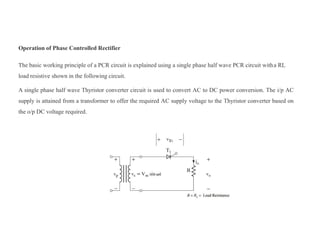
Operation of Phase Controlled Rectifier
The basic working principle of a PCR circuit is explained using a single phase half wave PCR circuit witha RL
load resistive shown in the following circuit.
A single phase half wave Thyristor converter circuit is used to convert AC to DC power conversion. The i/p AC
supply is attained from a transformer to offer the required AC supply voltage to the Thyristor converter based on
the o/p DC voltage required.
During the +ve half cycle of i/p supply when the upper end of the transformer secondary winding is at a
+ve potential with respect to the lower end, the Thyristor is in a forward biased state.
The thyristor is activated at a delay angle of ωt =α, by applying an appropriate gate trigger pulse to the gate
terminal of thyristor. When the thyristor is fired at a delay angle of ωt = α, assuming a perfect thyristor, the
thyristor acts as a closed switch and the i/p supply voltage acts across the load when it conducts from ωt =α to π
radians
radians
Supply Voltage Supply Voltage
Thyristor Voltage
Output Voltage
Load Current
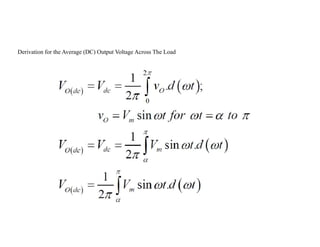
Derivation for the Average (DC) Output Voltage Across The Load
Maximum average (dc) o/p voltage is obtained when α = 0
Maximum dc output voltage =
The average dc output voltage can be varied by varying the trigger angle α from 0 to a maximum of 180 radians.
We can obtain the control characteristic by plotting the expression for the dc output voltage as a function of trigger
angle α.
The load current i0 flows through ‘R’. As load is resistive, Output current is given as,
The wave shape of output current is same as output voltage.
As T1 conducts only in positive half cycle as it is reversed bias in negative cycle, the ripple frequency of
output voltage is- 50 Hz (supply frequency)
Average output voltage is given as, are under load voltage waveform, i.e. input voltage from α to π and rest of
the period is 0.
Power transferred to load,
Derivation for RMS Value of Output Voltage of a Single Phase Half Wave Controlled Rectifier With Resistive Load
The RMS output voltage is given by
Output voltage For
Single Phase Half Wave Controlled Rectifier with RL Load
Single Phase Half Wave Controlled Rectifier with ‘RL’ load
 In positive half cycle, SCR starts conduction at firing angle “α”.
 Drop across SCR is small & neglected so output voltage is equal to supply voltage.
 Due to inductive load, current through SCR increases slowly.
 At ‘π’, supply voltage is at zero where load current is at its max value.
 In positive half cycle, inductor stores energy & that generates the voltage.
 In negative half cycle, the voltage developed across inductor, forward biases SCR & maintains itsconduction.
 Basically with the property of inductance it opposes change in current.
 Output current & supply current flows in same loop, so all the time io=is.
 After π the energy of inductor is given to mains & there is flow of ‘io’. The energy reduces as if gets
consumed by circuit so current also reduces.
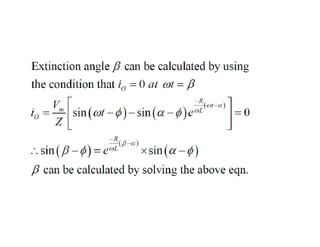
 At angle ‘β’ energy stored in inductance is finished, hence ‘io’ becomes zero & ‘T1’ turns off.
 ‘io’becomes zero from ‘β’ to ‘2π+α’ hence it is discontinuous conduction.
Load voltage waveform
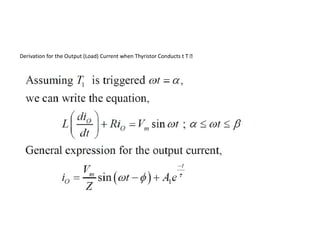
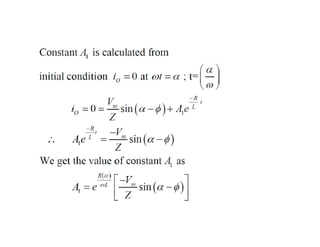
Derivation for the Output (Load) Current when Thyristor Conducts t T 
Derivation for Average (DC) Load Voltage of a Single Half Wave Controlled Rectifier with RL Load
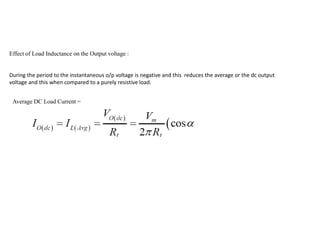
Effect of Load Inductance on the Output voltage :
During the period to the instantaneous o/p voltage is negative and this reduces the average or the dc output
voltage and this when compared to a purely resistive load.
Average DC Load Current =

AC-DC Converter_a.pdf

  • 1.
    Phase Controlled Rectifier Dr.Bishnu Prasad Muni Vasavi College of Engineering, Hyderabad
  • 2.
    The phase controlledrectifier is classified into two types based on the type of i/p power supply. And each kind includes a semi, full and dual converter.
  • 3.
    Single-phase Controlled Rectifier Thistype of rectifier which works from single phase AC i/p power supplySingle Phase Controlled Rectifiers are classified into different types Half wave Controlled Rectifier: This type of rectifier uses a single Thyristor device to provide o/pcontrol only in one half cycle of input AC supply, and it offers low DC output. Full wave Controlled Rectifier: This type of rectifier provides higher DC output  Full wave controlled rectifier with a center tapped transformer requires two Thyristors.  Full wave bridge controlled rectifiers do not need a center tapped transformer Three-phase Controlled Rectifier This type of rectifier which works from three phase AC i/p power supply  A semi converter is a one quadrant converter that has one polarity of o/p voltage and current.  A full converter is a a two quadrants converter that has polarity of o/p voltage can be either +ve or –vebut, the current can have only one polarity that is either +ve or -ve.  Dual converter works in four quadrants – both o/p voltage and o/p current can have both the polarities.
  • 4.
    Single Phase Half-WaveThyristor Converter with a Resistive Load
  • 5.
    Operation of PhaseControlled Rectifier The basic working principle of a PCR circuit is explained using a single phase half wave PCR circuit witha RL load resistive shown in the following circuit. A single phase half wave Thyristor converter circuit is used to convert AC to DC power conversion. The i/p AC supply is attained from a transformer to offer the required AC supply voltage to the Thyristor converter based on the o/p DC voltage required.
  • 6.
    During the +vehalf cycle of i/p supply when the upper end of the transformer secondary winding is at a +ve potential with respect to the lower end, the Thyristor is in a forward biased state. The thyristor is activated at a delay angle of ωt =α, by applying an appropriate gate trigger pulse to the gate terminal of thyristor. When the thyristor is fired at a delay angle of ωt = α, assuming a perfect thyristor, the thyristor acts as a closed switch and the i/p supply voltage acts across the load when it conducts from ωt =α to π radians radians
  • 7.
    Supply Voltage SupplyVoltage Thyristor Voltage Output Voltage Load Current
  • 8.
    Derivation for theAverage (DC) Output Voltage Across The Load
  • 10.
    Maximum average (dc)o/p voltage is obtained when α = 0 Maximum dc output voltage =
  • 11.
    The average dcoutput voltage can be varied by varying the trigger angle α from 0 to a maximum of 180 radians. We can obtain the control characteristic by plotting the expression for the dc output voltage as a function of trigger angle α.
  • 13.
    The load currenti0 flows through ‘R’. As load is resistive, Output current is given as, The wave shape of output current is same as output voltage. As T1 conducts only in positive half cycle as it is reversed bias in negative cycle, the ripple frequency of output voltage is- 50 Hz (supply frequency) Average output voltage is given as, are under load voltage waveform, i.e. input voltage from α to π and rest of the period is 0.
  • 14.
  • 15.
    Derivation for RMSValue of Output Voltage of a Single Phase Half Wave Controlled Rectifier With Resistive Load The RMS output voltage is given by Output voltage For
  • 18.
    Single Phase HalfWave Controlled Rectifier with RL Load
  • 19.
    Single Phase HalfWave Controlled Rectifier with ‘RL’ load
  • 20.
     In positivehalf cycle, SCR starts conduction at firing angle “α”.  Drop across SCR is small & neglected so output voltage is equal to supply voltage.  Due to inductive load, current through SCR increases slowly.  At ‘π’, supply voltage is at zero where load current is at its max value.  In positive half cycle, inductor stores energy & that generates the voltage.  In negative half cycle, the voltage developed across inductor, forward biases SCR & maintains itsconduction.  Basically with the property of inductance it opposes change in current.  Output current & supply current flows in same loop, so all the time io=is.  After π the energy of inductor is given to mains & there is flow of ‘io’. The energy reduces as if gets consumed by circuit so current also reduces.  At angle ‘β’ energy stored in inductance is finished, hence ‘io’ becomes zero & ‘T1’ turns off.  ‘io’becomes zero from ‘β’ to ‘2π+α’ hence it is discontinuous conduction.
  • 22.
  • 23.
    Derivation for theOutput (Load) Current when Thyristor Conducts t T 
  • 28.
    Derivation for Average(DC) Load Voltage of a Single Half Wave Controlled Rectifier with RL Load
  • 30.
    Effect of LoadInductance on the Output voltage : During the period to the instantaneous o/p voltage is negative and this reduces the average or the dc output voltage and this when compared to a purely resistive load. Average DC Load Current =