Objectives

  •   Describe the empire that Charles V inherited.
  •   Analyze how Spanish power increased under
      Philip II.
  •   Explain how the arts flourished during Spain’s
      golden age.
LEQ: How did Philip II extend Spain’s
power and help establish a golden age?
Background:


Spain emerged as the first modern European
power during the 1500s.

After Queen Isabella and King Ferdinand unified
the country, Philip II expanded Spanish
influence and helped foster a Spanish golden
age by supporting the arts.
•   Hapsburg empire – Central European empire that in the 1500s
    included the Holy Roman Empire and the Netherlands
•   Charles V – ruler of the Hapsburg empire beginning in 1519


      Charles I became king of Spain in 1516 and
      heir to the Hapsburg empire in 1519.

      • He took the name Charles V and began the
        difficult task of ruling two empires.
      • Charles, a devout Catholic, engaged in constant
        war to suppress Protestantism in Germany and
        push back the Muslim Ottomans advancing into
        Europe from Turkey.
•   Philip II – son of Charles V, who began his
    42-year reign in 1556 and made Spain the
    foremost power in Europe


      The task of ruling two scattered empires
          proved impossible for Charles V.


    He gave up his crown, divided his sizable empire,
           and entered a monastery in 1556.


       Charles gave Spain, the Netherlands, and
     Spain’s overseas empire to his son Philip, who
              became known as Philip II.
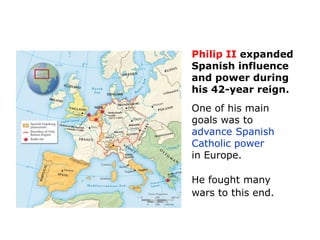
Philip II expanded
Spanish influence
and power during
his 42-year reign.
One of his main
goals was to
advance Spanish
Catholic power
in Europe.

He fought many
wars to this end.
•   absolute monarch – a ruler with complete authority over the
    government and the lives of the people
•   divine right – the belief that a ruler’s authority comes
    directly from God

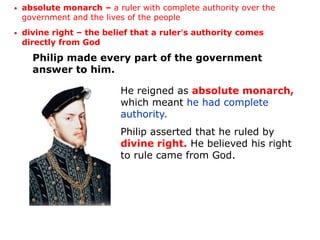
      Philip made every part of the government
      answer to him.

                          He reigned as absolute monarch,
                          which meant he had complete
                          authority.
                          Philip asserted that he ruled by
                          divine right. He believed his right
                          to rule came from God.
Philip fought wars in the Mediterranean
          and the Netherlands.
 His goal was to keep the Ottomans at bay.
In 1571, Spain defeated an Ottoman fleet off
            the coast of Greece.


 Philip also            Protestants there
 battled rebels in      opposed Philip’s
 the Netherlands        efforts to crush
 for many years.        their faith.
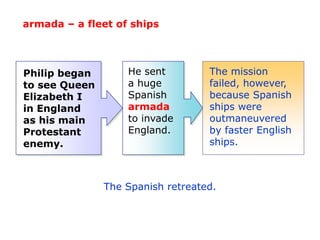
armada – a fleet of ships


Philip began       He sent         The mission
to see Queen       a huge          failed, however,
Elizabeth I        Spanish         because Spanish
in England         armada          ships were
as his main        to invade       outmaneuvered
Protestant         England.        by faster English
enemy.                             ships.


               The Spanish retreated.
The armada’s defeat marked the beginning
of the end of Spain’s glory.

• Philip’s successors did not rule as well as he did.
• There were also economic problems, such as
  costly foreign wars and over-reliance on treasure
  from the Americas.
• In the 1600s and 1700s, other European fleets
  arose and surpassed Spain’s power.
El Greco – a famous painter during Spain’s
   golden age
Miguel de Cervantes – the most important writer of Spain’s
  golden age, author of Don Quixote

  Prior to the sunset of Spain’s power, however,
  a golden age of culture occurred.

  • This golden age, fostered by Philip’s patronage of
    the arts, lasted from 1550 to 1650.
  • During this time, El Greco painted beautiful works
    of religious imagery.
  • Miguel de Cervantes completed Don Quixote,
    considered Europe’s first modern novel.

(16.1) absolutism spanish power grows

  • 1.
    Objectives • Describe the empire that Charles V inherited. • Analyze how Spanish power increased under Philip II. • Explain how the arts flourished during Spain’s golden age.
  • 2.
    LEQ: How didPhilip II extend Spain’s power and help establish a golden age?
  • 3.
    Background: Spain emerged asthe first modern European power during the 1500s. After Queen Isabella and King Ferdinand unified the country, Philip II expanded Spanish influence and helped foster a Spanish golden age by supporting the arts.
  • 4.
    Hapsburg empire – Central European empire that in the 1500s included the Holy Roman Empire and the Netherlands • Charles V – ruler of the Hapsburg empire beginning in 1519 Charles I became king of Spain in 1516 and heir to the Hapsburg empire in 1519. • He took the name Charles V and began the difficult task of ruling two empires. • Charles, a devout Catholic, engaged in constant war to suppress Protestantism in Germany and push back the Muslim Ottomans advancing into Europe from Turkey.
  • 5.
    Philip II – son of Charles V, who began his 42-year reign in 1556 and made Spain the foremost power in Europe The task of ruling two scattered empires proved impossible for Charles V. He gave up his crown, divided his sizable empire, and entered a monastery in 1556. Charles gave Spain, the Netherlands, and Spain’s overseas empire to his son Philip, who became known as Philip II.
  • 6.
    Philip II expanded Spanishinfluence and power during his 42-year reign. One of his main goals was to advance Spanish Catholic power in Europe. He fought many wars to this end.
  • 7.
    absolute monarch – a ruler with complete authority over the government and the lives of the people • divine right – the belief that a ruler’s authority comes directly from God Philip made every part of the government answer to him. He reigned as absolute monarch, which meant he had complete authority. Philip asserted that he ruled by divine right. He believed his right to rule came from God.
  • 8.
    Philip fought warsin the Mediterranean and the Netherlands. His goal was to keep the Ottomans at bay. In 1571, Spain defeated an Ottoman fleet off the coast of Greece. Philip also Protestants there battled rebels in opposed Philip’s the Netherlands efforts to crush for many years. their faith.
  • 9.
    armada – afleet of ships Philip began He sent The mission to see Queen a huge failed, however, Elizabeth I Spanish because Spanish in England armada ships were as his main to invade outmaneuvered Protestant England. by faster English enemy. ships. The Spanish retreated.
  • 10.
    The armada’s defeatmarked the beginning of the end of Spain’s glory. • Philip’s successors did not rule as well as he did. • There were also economic problems, such as costly foreign wars and over-reliance on treasure from the Americas. • In the 1600s and 1700s, other European fleets arose and surpassed Spain’s power.
  • 11.
    El Greco –a famous painter during Spain’s golden age Miguel de Cervantes – the most important writer of Spain’s golden age, author of Don Quixote Prior to the sunset of Spain’s power, however, a golden age of culture occurred. • This golden age, fostered by Philip’s patronage of the arts, lasted from 1550 to 1650. • During this time, El Greco painted beautiful works of religious imagery. • Miguel de Cervantes completed Don Quixote, considered Europe’s first modern novel.