Monarchy
Government
Etymology
• The word monarch comes from
the Greek monos "one/singular",
and archon "leader/ruler/chief”.
What is a monarchy?
• Undivided rule or absolute sovereignty by a single person
• Forms of monarchy: level of legal autonomy the monarch holds in
governance, the method of selection of the monarch and any
predetermined limits on the length of their tenure.
• Absolute monarchy, constitutional monarchy, hereditary monarchy and
elective monarchy
• 44 sovereign nations have monarchs, 16 of which are
Commonwealth realms
Characteristics
• Monarchies are associated with political or sociocultural hereditary
rule
• Dynasty
• Queen regnant and queen consort
• Elective monarchy
• Self-proclaimed monarchy
History
• According to the history the monarchy government started in pre-
historic times when people were living in large family groups or tribes.
These people became natural leaders of their group. They passed
down their knowledge and skills to the next generation. So
knowledge, which also meant power, was passed down within
families. Later on, when the hunter and gatherer societies turned to
farming and settled down, land, which also meant power and wealth,
was added to the assets of leadership. Over time this concept of
leadership became formalized, titles and rules for the succession
were invented. In the beginning, leadership had a lot to do with
priesthood. Like in Egypt, where the first Pharaohs were able to
predict the yearly floods because of their astronomical knowledge.
Power in Monrachy
• Absolute monarchy: the monarch rules as an autocrat, with absolute
power over the state and government.
• Constitutional monarchy: the monarch is subject to a constitution.
The monarch serves as a ceremonial figurehead symbol of national
unity and state continuity. The monarch is nominally sovereign but
the electorate, through their parliament/legislature, exercise usually
limited political sovereignty.
Titles of Monarchy
• King
• Queen
• Prince or princess
• Emperor or empress
• Duke, grand duke or duchess
• Caliph
• Sultan
• Emir
• Sheikh
• Khan or Khagan
• Monarchs also are distinguished
by styles, such as "Majesty", "Royal
Highness" or "By the Grace of
God".
British monarchy
• It is the constitutional
monarchy of the United
Kingdom and its overseas
territories
• The monarch's title is
"King" (male) or "Queen"
(female). The current
monarch, Queen
Elizabeth II, ascended the
throne on the death of
her father, King George
VI, on 6 February 1952.
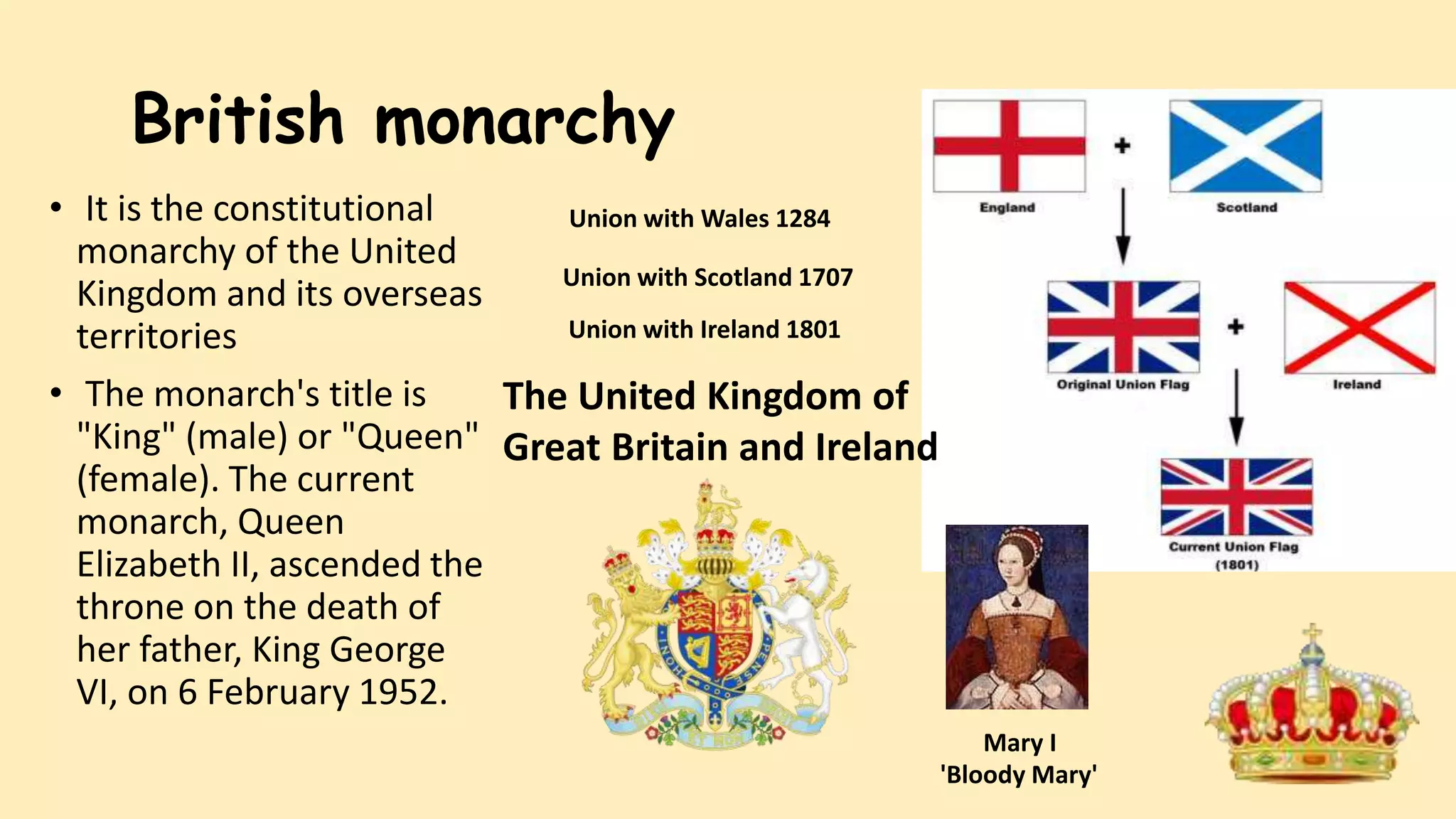
Union with Wales 1284
Union with Scotland 1707
Union with Ireland 1801
The United Kingdom of
Great Britain and Ireland
Mary I
'Bloody Mary'
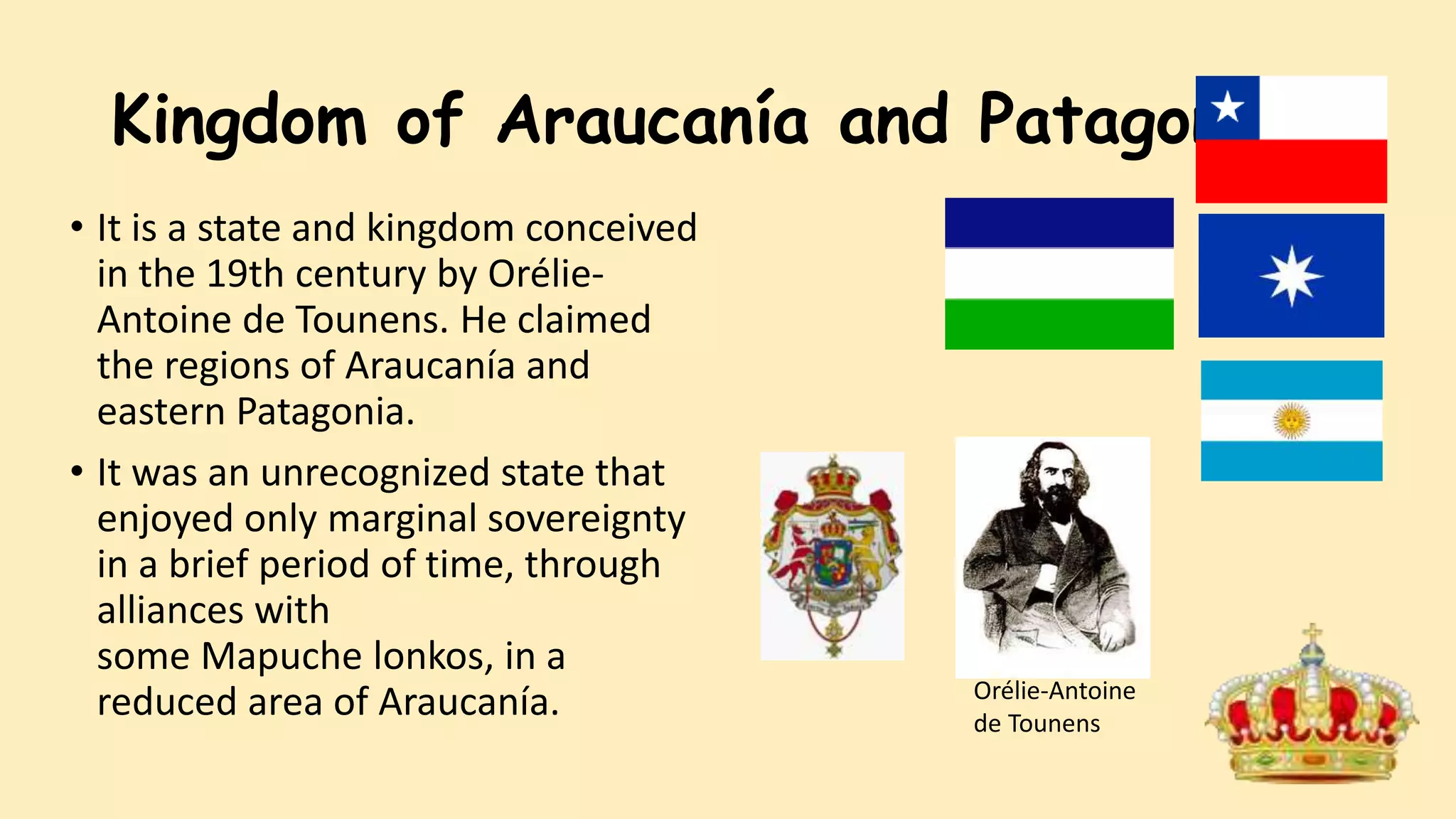
Kingdom of Araucanía and Patagonia
• It is a state and kingdom conceived
in the 19th century by Orélie-
Antoine de Tounens. He claimed
the regions of Araucanía and
eastern Patagonia.
• It was an unrecognized state that
enjoyed only marginal sovereignty
in a brief period of time, through
alliances with
some Mapuche lonkos, in a
reduced area of Araucanía. Orélie-Antoine
de Tounens
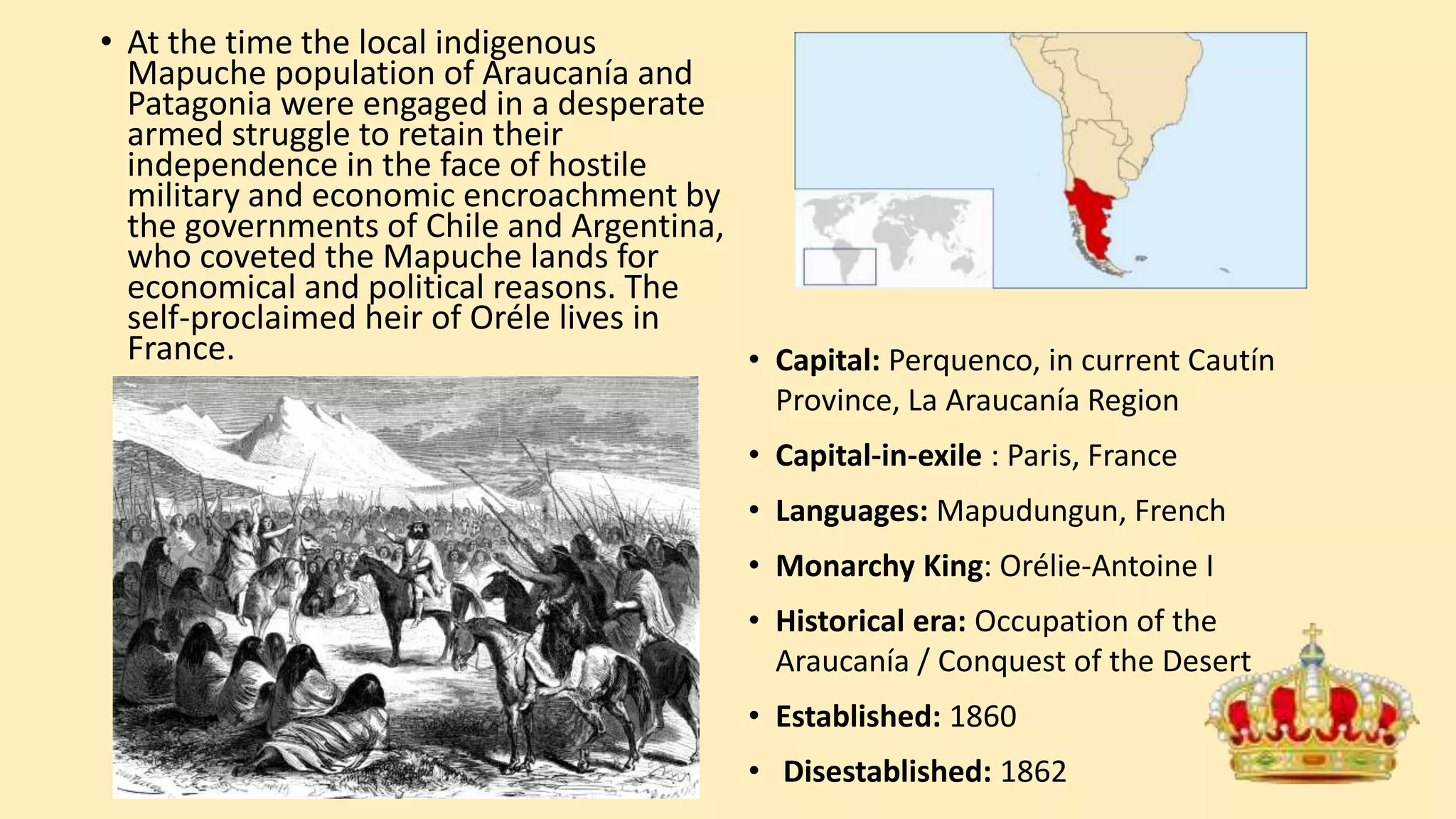
• At the time the local indigenous
Mapuche population of Araucanía and
Patagonia were engaged in a desperate
armed struggle to retain their
independence in the face of hostile
military and economic encroachment by
the governments of Chile and Argentina,
who coveted the Mapuche lands for
economical and political reasons. The
self-proclaimed heir of Oréle lives in
France. • Capital: Perquenco, in current Cautín
Province, La Araucanía Region
• Capital-in-exile : Paris, France
• Languages: Mapudungun, French
• Monarchy King: Orélie-Antoine I
• Historical era: Occupation of the
Araucanía / Conquest of the Desert
• Established: 1860
• Disestablished: 1862
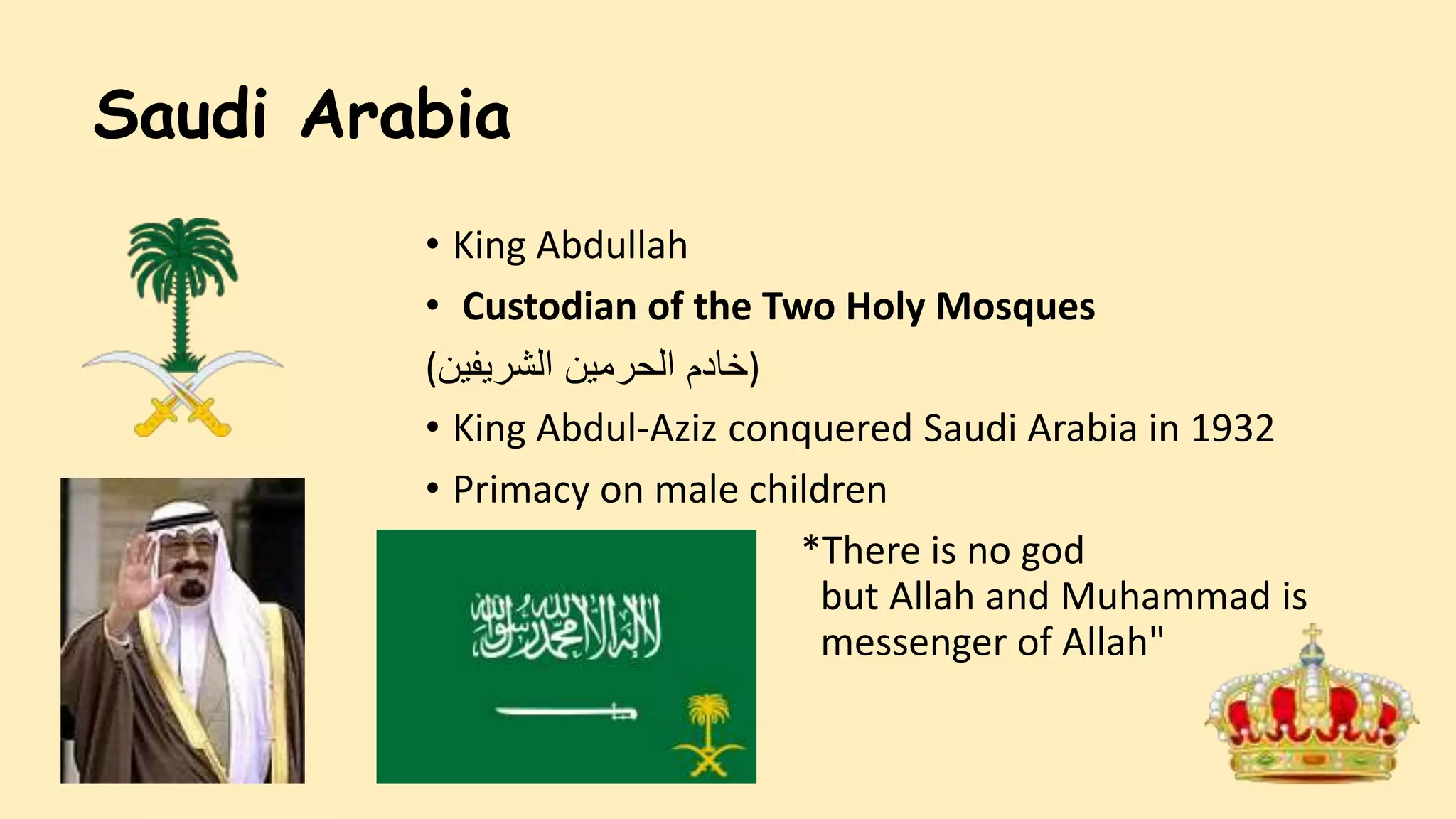
Saudi Arabia
• King Abdullah
• Custodian of the Two Holy Mosques
( ‫خادم‬‫الشريفين‬ ‫الحرمين‬ )
• King Abdul-Aziz conquered Saudi Arabia in 1932
• Primacy on male children
• *There is no god
but Allah and Muhammad is
the messenger of Allah"
Questions
•Do you think that a monarchy could impact the
world nowadays as they used to do it in the past?
• Should European monarchies be abolished?
•What are the pros and cons of a monarchy government?
Bibliography
•Princeton University, Absolute Monarchy:
http://www.princeton.edu/~achaney/tmve/wiki100k/docs/Absolute_monarchy.html
•EHOW, types of monarchy: http://www.ehow.com/info_8135802_monarchy-
government-types.html
•BBC, Mary I Queen: http://www.bbc.co.uk/history/historic_figures/mary_i_queen.shtml
•Times of India: http://timesofindia.indiatimes.com/india/Learning-with-the-Times-7-nations-still-
under-absolute-monarchy/articleshow/3692953.cms
•Wallmapu oficial page: http://paismapuche.org/

What is Monarchy?

  • 1.
  • 2.
    Etymology • The wordmonarch comes from the Greek monos "one/singular", and archon "leader/ruler/chief”.
  • 3.
    What is amonarchy? • Undivided rule or absolute sovereignty by a single person • Forms of monarchy: level of legal autonomy the monarch holds in governance, the method of selection of the monarch and any predetermined limits on the length of their tenure. • Absolute monarchy, constitutional monarchy, hereditary monarchy and elective monarchy • 44 sovereign nations have monarchs, 16 of which are Commonwealth realms
  • 4.
    Characteristics • Monarchies areassociated with political or sociocultural hereditary rule • Dynasty • Queen regnant and queen consort • Elective monarchy • Self-proclaimed monarchy
  • 5.
    History • According tothe history the monarchy government started in pre- historic times when people were living in large family groups or tribes. These people became natural leaders of their group. They passed down their knowledge and skills to the next generation. So knowledge, which also meant power, was passed down within families. Later on, when the hunter and gatherer societies turned to farming and settled down, land, which also meant power and wealth, was added to the assets of leadership. Over time this concept of leadership became formalized, titles and rules for the succession were invented. In the beginning, leadership had a lot to do with priesthood. Like in Egypt, where the first Pharaohs were able to predict the yearly floods because of their astronomical knowledge.
  • 6.
    Power in Monrachy •Absolute monarchy: the monarch rules as an autocrat, with absolute power over the state and government. • Constitutional monarchy: the monarch is subject to a constitution. The monarch serves as a ceremonial figurehead symbol of national unity and state continuity. The monarch is nominally sovereign but the electorate, through their parliament/legislature, exercise usually limited political sovereignty.
  • 7.
    Titles of Monarchy •King • Queen • Prince or princess • Emperor or empress • Duke, grand duke or duchess • Caliph • Sultan • Emir • Sheikh • Khan or Khagan • Monarchs also are distinguished by styles, such as "Majesty", "Royal Highness" or "By the Grace of God".
  • 8.
    British monarchy • Itis the constitutional monarchy of the United Kingdom and its overseas territories • The monarch's title is "King" (male) or "Queen" (female). The current monarch, Queen Elizabeth II, ascended the throne on the death of her father, King George VI, on 6 February 1952. Union with Wales 1284 Union with Scotland 1707 Union with Ireland 1801 The United Kingdom of Great Britain and Ireland Mary I 'Bloody Mary'
  • 9.
    Kingdom of Araucaníaand Patagonia • It is a state and kingdom conceived in the 19th century by Orélie- Antoine de Tounens. He claimed the regions of Araucanía and eastern Patagonia. • It was an unrecognized state that enjoyed only marginal sovereignty in a brief period of time, through alliances with some Mapuche lonkos, in a reduced area of Araucanía. Orélie-Antoine de Tounens
  • 10.
    • At thetime the local indigenous Mapuche population of Araucanía and Patagonia were engaged in a desperate armed struggle to retain their independence in the face of hostile military and economic encroachment by the governments of Chile and Argentina, who coveted the Mapuche lands for economical and political reasons. The self-proclaimed heir of Oréle lives in France. • Capital: Perquenco, in current Cautín Province, La Araucanía Region • Capital-in-exile : Paris, France • Languages: Mapudungun, French • Monarchy King: Orélie-Antoine I • Historical era: Occupation of the Araucanía / Conquest of the Desert • Established: 1860 • Disestablished: 1862
  • 11.
    Saudi Arabia • KingAbdullah • Custodian of the Two Holy Mosques ( ‫خادم‬‫الشريفين‬ ‫الحرمين‬ ) • King Abdul-Aziz conquered Saudi Arabia in 1932 • Primacy on male children • *There is no god but Allah and Muhammad is the messenger of Allah"
  • 12.
    Questions •Do you thinkthat a monarchy could impact the world nowadays as they used to do it in the past? • Should European monarchies be abolished? •What are the pros and cons of a monarchy government?
  • 13.
    Bibliography •Princeton University, AbsoluteMonarchy: http://www.princeton.edu/~achaney/tmve/wiki100k/docs/Absolute_monarchy.html •EHOW, types of monarchy: http://www.ehow.com/info_8135802_monarchy- government-types.html •BBC, Mary I Queen: http://www.bbc.co.uk/history/historic_figures/mary_i_queen.shtml •Times of India: http://timesofindia.indiatimes.com/india/Learning-with-the-Times-7-nations-still- under-absolute-monarchy/articleshow/3692953.cms •Wallmapu oficial page: http://paismapuche.org/