The Spanish Empire Hist 140 Theme 3 Part 2 Summer 2011 By: Le Thi My Ho
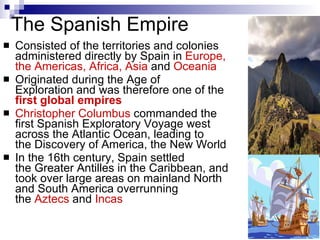
The Spanish Empire Consisted of the territories and colonies administered directly by Spain in  Europe, the Americas, Africa, Asia  and  Oceania   Originated during the Age of Exploration and was therefore one of the  first global empires Christopher Columbus  commanded the first Spanish Exploratory Voyage west across the Atlantic Ocean, leading to the Discovery of America, the New World In the 16th century, Spain settled the Greater Antilles in the Caribbean, and took over large areas on mainland North and South America overrunning the  Aztecs  and  Incas
The Spanish Empire   In 1741, a massive victory over Britain at the  Battle of Cartagena de Indies  in modern day Colombia prolonged Spain's hegemony in the Americas until the 19th century.  During the late 18th century, Spanish expeditions to the Pacific Northwest reached  Canada  and  Alaska , resulting in a settlement on Vancouver Island and the  discovery  of several  archipelagos  and  glaciers  The remainder of Spain's empire, namely  Cuba, Puerto Rico,  and the  Spanish East Indies , continued under Spanish control until the end of the 19th century, when most of these territories were annexed by the United States after the Spanish-American War
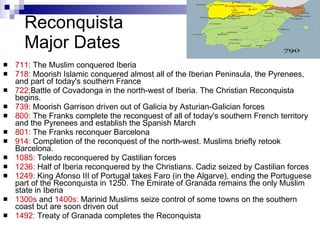
Reconquista Major Dates 711:  The Muslim conquered Iberia 718:  Moorish Islamic conquered almost all of the Iberian Peninsula, the Pyrenees, and part of today's southern France 722: Battle of Covadonga in the north-west of Iberia. The Christian Reconquista begins. 739:  Moorish Garrison driven out of Galicia by Asturian-Galician forces 800:  The Franks complete the reconquest of all of today's southern French territory and the Pyrenees and establish the Spanish March 801:  The Franks reconquer Barcelona 914:  Completion of the reconquest of the north-west. Muslims briefly retook Barcelona. 1085:  Toledo reconquered by Castilian forces 1236:  Half of Iberia reconquered by the Christians. Cadiz seized by Castilian forces 1249:  King Afonso III of Portugal takes Faro (in the Algarve), ending the Portuguese part of the Reconquista in 1250. The Emirate of Granada remains the only Muslim state in Iberia 1300s  and  1400s:  Marinid Muslims seize control of some towns on the southern coast but are soon driven out 1492:  Treaty of Granada completes the Reconquista
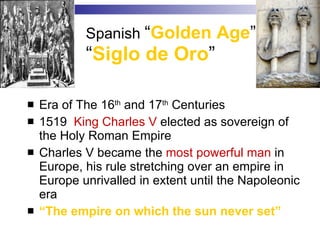
Spanish  “ Golden Age ”  “ Siglo de Oro ” Era of The 16 th  and 17 th  Centuries 1519  King Charles V  elected as sovereign of the Holy Roman Empire Charles V became the  most powerful man  in Europe, his rule stretching over an empire in Europe unrivalled in extent until the Napoleonic era  “ The empire on which the sun never set”
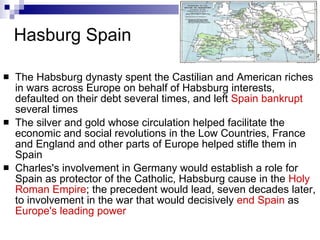
Hasburg Spain The Habsburg dynasty spent the Castilian and American riches in wars across Europe on behalf of Habsburg interests, defaulted on their debt several times, and left  Spain bankrupt  several times  The silver and gold whose circulation helped facilitate the economic and social revolutions in the Low Countries, France and England and other parts of Europe helped stifle them in Spain  Charles's involvement in Germany would establish a role for Spain as protector of the Catholic, Habsburg cause in the  Holy Roman Empire ; the precedent would lead, seven decades later, to involvement in the war that would decisively  end Spain  as  Europe's leading power
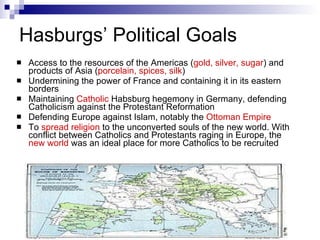
Hasburgs’ Political Goals Access to the resources of the Americas ( gold, silver, sugar ) and products of Asia ( porcelain, spices, silk ) Undermining the power of France and containing it in its eastern borders Maintaining  Catholic   Habsburg hegemony in Germany, defending Catholicism against the Protestant Reformation  Defending Europe against Islam, notably the  Ottoman Empire To  spread religion  to the unconverted souls of the new world. With conflict between Catholics and Protestants raging in Europe, the  new world  was an ideal place for more Catholics to be recruited

The Spanish Empire

  • 1.
    The Spanish EmpireHist 140 Theme 3 Part 2 Summer 2011 By: Le Thi My Ho
  • 2.
    The Spanish EmpireConsisted of the territories and colonies administered directly by Spain in Europe, the Americas, Africa, Asia and Oceania Originated during the Age of Exploration and was therefore one of the first global empires Christopher Columbus  commanded the first Spanish Exploratory Voyage west across the Atlantic Ocean, leading to the Discovery of America, the New World In the 16th century, Spain settled the Greater Antilles in the Caribbean, and took over large areas on mainland North and South America overrunning the  Aztecs and Incas
  • 3.
    The Spanish Empire  In 1741, a massive victory over Britain at the Battle of Cartagena de Indies  in modern day Colombia prolonged Spain's hegemony in the Americas until the 19th century. During the late 18th century, Spanish expeditions to the Pacific Northwest reached Canada and Alaska , resulting in a settlement on Vancouver Island and the discovery of several archipelagos and glaciers The remainder of Spain's empire, namely  Cuba, Puerto Rico, and the Spanish East Indies , continued under Spanish control until the end of the 19th century, when most of these territories were annexed by the United States after the Spanish-American War
  • 4.
    Reconquista Major Dates711: The Muslim conquered Iberia 718: Moorish Islamic conquered almost all of the Iberian Peninsula, the Pyrenees, and part of today's southern France 722: Battle of Covadonga in the north-west of Iberia. The Christian Reconquista begins. 739: Moorish Garrison driven out of Galicia by Asturian-Galician forces 800: The Franks complete the reconquest of all of today's southern French territory and the Pyrenees and establish the Spanish March 801: The Franks reconquer Barcelona 914: Completion of the reconquest of the north-west. Muslims briefly retook Barcelona. 1085: Toledo reconquered by Castilian forces 1236: Half of Iberia reconquered by the Christians. Cadiz seized by Castilian forces 1249: King Afonso III of Portugal takes Faro (in the Algarve), ending the Portuguese part of the Reconquista in 1250. The Emirate of Granada remains the only Muslim state in Iberia 1300s and 1400s: Marinid Muslims seize control of some towns on the southern coast but are soon driven out 1492:  Treaty of Granada completes the Reconquista
  • 5.
    Spanish “Golden Age ” “ Siglo de Oro ” Era of The 16 th and 17 th Centuries 1519 King Charles V elected as sovereign of the Holy Roman Empire Charles V became the most powerful man in Europe, his rule stretching over an empire in Europe unrivalled in extent until the Napoleonic era “ The empire on which the sun never set”
  • 6.
    Hasburg Spain TheHabsburg dynasty spent the Castilian and American riches in wars across Europe on behalf of Habsburg interests, defaulted on their debt several times, and left Spain bankrupt several times The silver and gold whose circulation helped facilitate the economic and social revolutions in the Low Countries, France and England and other parts of Europe helped stifle them in Spain Charles's involvement in Germany would establish a role for Spain as protector of the Catholic, Habsburg cause in the Holy Roman Empire ; the precedent would lead, seven decades later, to involvement in the war that would decisively end Spain as Europe's leading power
  • 7.
    Hasburgs’ Political GoalsAccess to the resources of the Americas ( gold, silver, sugar ) and products of Asia ( porcelain, spices, silk ) Undermining the power of France and containing it in its eastern borders Maintaining  Catholic Habsburg hegemony in Germany, defending Catholicism against the Protestant Reformation Defending Europe against Islam, notably the  Ottoman Empire To spread religion to the unconverted souls of the new world. With conflict between Catholics and Protestants raging in Europe, the new world was an ideal place for more Catholics to be recruited