TOXOCARİASİSTOXOCARİASİS
Toxocariasis is the clinical term applied toToxocariasis is the clinical term applied to
infection in the human host with eitherinfection in the human host with either ToxocaraToxocara
caniscanis ororToxocara cati.Toxocara cati.
Their definitive hosts are the domestic dogs andTheir definitive hosts are the domestic dogs and
cats.cats.
They lives hosts lumen of the small intestine.They lives hosts lumen of the small intestine.
►Order :Order : AscarididaAscaridida
►Superfamily:Superfamily:AscaridiodeaAscaridiodea
►Family :Family : ToxocaridaeToxocaridae
Infection can occur :Infection can occur :
1-) By the host ingesting viable , embryonated1-) By the host ingesting viable , embryonated
eggs from cantaminated sources.eggs from cantaminated sources.
2-) They can acquire the infection in utero from2-) They can acquire the infection in utero from
the infected mother when she ingest morethe infected mother when she ingest more
infective eggs.infective eggs.
The dominant clinical manifestations associatedThe dominant clinical manifestations associated
classified according to the organs affected.classified according to the organs affected.
There are two main syndromes :There are two main syndromes :
1-) Visceral Larva Migrans (VLM):1-) Visceral Larva Migrans (VLM): WhichWhich
diseases associated with the major organs.diseases associated with the major organs.
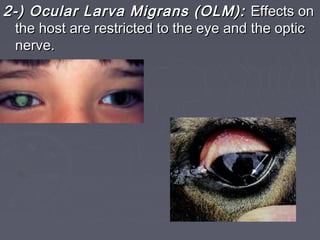
2-) Ocular Larva Migrans (OLM):2-) Ocular Larva Migrans (OLM): Effects onEffects on
the host are restricted to the eye and the opticthe host are restricted to the eye and the optic
nerve.nerve.
►1-) Visceral Larva Migrans (VLM):1-) Visceral Larva Migrans (VLM): WhichWhich
diseases associated with the major organs.diseases associated with the major organs.
2-) Ocular Larva Migrans (OLM):2-) Ocular Larva Migrans (OLM): Effects onEffects on
the host are restricted to the eye and the opticthe host are restricted to the eye and the optic
nerve.nerve.
Human infection with Toxocara was firstHuman infection with Toxocara was first
described by Wilder in 1950.described by Wilder in 1950.
Life Cycle of ToxocariasisLife Cycle of Toxocariasis
►Ingestion of embryonated eggs ofIngestion of embryonated eggs of ToxocaraToxocara
start the infeection in host.start the infeection in host.
►Children accidentally come into contact withChildren accidentally come into contact with
them when they play sandboxes and onthem when they play sandboxes and on
playgrounds contaminated withplaygrounds contaminated with ToxocaraToxocara
eggs. (This situation exist from indiscriminateeggs. (This situation exist from indiscriminate
defecation on these sites by cats and dogs thatdefecation on these sites by cats and dogs that
include the adult worms.)include the adult worms.)
►After ingestion, the eggs hatch to releaseAfter ingestion, the eggs hatch to release
larvae that penetrate the small intestine enterlarvae that penetrate the small intestine enter
the circulation and then are free to wanderthe circulation and then are free to wander
throughout the body.throughout the body.
►In the definitive host the juvenile (releaseIn the definitive host the juvenile (release
larvae) parasites go on to complete the lifelarvae) parasites go on to complete the life
cycle , which , in many ways , resembles that ofcycle , which , in many ways , resembles that of
Ascaris lumbricoidesAscaris lumbricoides , the ascarid infecting, the ascarid infecting
humans.humans.
►We can see transplacental infection in dogsWe can see transplacental infection in dogs
and cats.and cats.
►In addition , the definitive host can becomeIn addition , the definitive host can become
infected by ingesting embryonated eggs carriedinfected by ingesting embryonated eggs carried
by paratenic hosts. Human can developby paratenic hosts. Human can develop
unusual infections by ingesting these animals.unusual infections by ingesting these animals.
►Worms develop to the adult stageWorms develop to the adult stage
►Worms develop to the adult stage in the smallWorms develop to the adult stage in the small
intestine aboout 60 to 90 days after the larvaeintestine aboout 60 to 90 days after the larvae
hatch.hatch.
T. Canis T.catiT. Canis T.cati
Photo of Adult Toxocariasis FromPhoto of Adult Toxocariasis From
Small IntestineSmall Intestine
►Embryonation occurs in the soil within a weekEmbryonation occurs in the soil within a week
or so after deposition.or so after deposition.
►Incubation periods of longer duration are due toIncubation periods of longer duration are due to
lower temperatures.lower temperatures.
►In northern ; eggs can lie dormant(likeIn northern ; eggs can lie dormant(like
hipobiozy) until the temperature rises in spring.hipobiozy) until the temperature rises in spring.
Clinical AspectsClinical Aspects
►To understand the degree of host damage weTo understand the degree of host damage we
have two important way :have two important way :
►1-) The number of migrating juveniles.1-) The number of migrating juveniles.
►2-) Age of the host.2-) Age of the host.
They are two additional Factors about the degreeThey are two additional Factors about the degree
of host damage.of host damage.
►The immediate hypersensitivity responses toThe immediate hypersensitivity responses to
dying and dead larvae in the viscera , includingdying and dead larvae in the viscera , including
the lungs , liver , and brain , produce symptomsthe lungs , liver , and brain , produce symptoms
character istic ofcharacter istic of VLM.VLM.
►In the eye , migrating third stage larvae canIn the eye , migrating third stage larvae can
damage the retina , inducing granulomatusdamage the retina , inducing granulomatus
reactions leading to impaired sight.reactions leading to impaired sight.
DiagnosisDiagnosis
►Diagnostic tests forDiagnostic tests for VLMVLM are primarilyare primarily
immunological and the secondlyimmunological and the secondly ELİISA.ELİISA.
►OLMOLM is diagnosed primarily on the basis ofis diagnosed primarily on the basis of
clinical criteria during an ophthal mologicclinical criteria during an ophthal mologic
examinationexamination
►The immunodiagnostic tests used forThe immunodiagnostic tests used for VLMVLM areare
not as reliable fornot as reliable for OLM.OLM.
TreatmentTreatment
►AlbendazoleAlbendazole is the treatment of choice foris the treatment of choice for
toxocariasis.toxocariasis.
A dose of 400mg of albendazole twice a day for 5
days is the currently recommended therapy.

About ToToxocari̇asi̇s

  • 1.
    TOXOCARİASİSTOXOCARİASİS Toxocariasis is theclinical term applied toToxocariasis is the clinical term applied to infection in the human host with eitherinfection in the human host with either ToxocaraToxocara caniscanis ororToxocara cati.Toxocara cati. Their definitive hosts are the domestic dogs andTheir definitive hosts are the domestic dogs and cats.cats. They lives hosts lumen of the small intestine.They lives hosts lumen of the small intestine.
  • 2.
    ►Order :Order :AscarididaAscaridida ►Superfamily:Superfamily:AscaridiodeaAscaridiodea ►Family :Family : ToxocaridaeToxocaridae
  • 3.
    Infection can occur:Infection can occur : 1-) By the host ingesting viable , embryonated1-) By the host ingesting viable , embryonated eggs from cantaminated sources.eggs from cantaminated sources. 2-) They can acquire the infection in utero from2-) They can acquire the infection in utero from the infected mother when she ingest morethe infected mother when she ingest more infective eggs.infective eggs.
  • 4.
    The dominant clinicalmanifestations associatedThe dominant clinical manifestations associated classified according to the organs affected.classified according to the organs affected. There are two main syndromes :There are two main syndromes : 1-) Visceral Larva Migrans (VLM):1-) Visceral Larva Migrans (VLM): WhichWhich diseases associated with the major organs.diseases associated with the major organs. 2-) Ocular Larva Migrans (OLM):2-) Ocular Larva Migrans (OLM): Effects onEffects on the host are restricted to the eye and the opticthe host are restricted to the eye and the optic nerve.nerve.
  • 5.
    ►1-) Visceral LarvaMigrans (VLM):1-) Visceral Larva Migrans (VLM): WhichWhich diseases associated with the major organs.diseases associated with the major organs.
  • 6.
    2-) Ocular LarvaMigrans (OLM):2-) Ocular Larva Migrans (OLM): Effects onEffects on the host are restricted to the eye and the opticthe host are restricted to the eye and the optic nerve.nerve.
  • 7.
    Human infection withToxocara was firstHuman infection with Toxocara was first described by Wilder in 1950.described by Wilder in 1950.
  • 8.
    Life Cycle ofToxocariasisLife Cycle of Toxocariasis
  • 9.
    ►Ingestion of embryonatedeggs ofIngestion of embryonated eggs of ToxocaraToxocara start the infeection in host.start the infeection in host. ►Children accidentally come into contact withChildren accidentally come into contact with them when they play sandboxes and onthem when they play sandboxes and on playgrounds contaminated withplaygrounds contaminated with ToxocaraToxocara eggs. (This situation exist from indiscriminateeggs. (This situation exist from indiscriminate defecation on these sites by cats and dogs thatdefecation on these sites by cats and dogs that include the adult worms.)include the adult worms.)
  • 10.
    ►After ingestion, theeggs hatch to releaseAfter ingestion, the eggs hatch to release larvae that penetrate the small intestine enterlarvae that penetrate the small intestine enter the circulation and then are free to wanderthe circulation and then are free to wander throughout the body.throughout the body. ►In the definitive host the juvenile (releaseIn the definitive host the juvenile (release larvae) parasites go on to complete the lifelarvae) parasites go on to complete the life cycle , which , in many ways , resembles that ofcycle , which , in many ways , resembles that of Ascaris lumbricoidesAscaris lumbricoides , the ascarid infecting, the ascarid infecting humans.humans.
  • 11.
    ►We can seetransplacental infection in dogsWe can see transplacental infection in dogs and cats.and cats. ►In addition , the definitive host can becomeIn addition , the definitive host can become infected by ingesting embryonated eggs carriedinfected by ingesting embryonated eggs carried by paratenic hosts. Human can developby paratenic hosts. Human can develop unusual infections by ingesting these animals.unusual infections by ingesting these animals. ►Worms develop to the adult stageWorms develop to the adult stage
  • 12.
    ►Worms develop tothe adult stage in the smallWorms develop to the adult stage in the small intestine aboout 60 to 90 days after the larvaeintestine aboout 60 to 90 days after the larvae hatch.hatch. T. Canis T.catiT. Canis T.cati
  • 13.
    Photo of AdultToxocariasis FromPhoto of Adult Toxocariasis From Small IntestineSmall Intestine
  • 14.
    ►Embryonation occurs inthe soil within a weekEmbryonation occurs in the soil within a week or so after deposition.or so after deposition. ►Incubation periods of longer duration are due toIncubation periods of longer duration are due to lower temperatures.lower temperatures. ►In northern ; eggs can lie dormant(likeIn northern ; eggs can lie dormant(like hipobiozy) until the temperature rises in spring.hipobiozy) until the temperature rises in spring.
  • 15.
    Clinical AspectsClinical Aspects ►Tounderstand the degree of host damage weTo understand the degree of host damage we have two important way :have two important way : ►1-) The number of migrating juveniles.1-) The number of migrating juveniles. ►2-) Age of the host.2-) Age of the host. They are two additional Factors about the degreeThey are two additional Factors about the degree of host damage.of host damage.
  • 16.
    ►The immediate hypersensitivityresponses toThe immediate hypersensitivity responses to dying and dead larvae in the viscera , includingdying and dead larvae in the viscera , including the lungs , liver , and brain , produce symptomsthe lungs , liver , and brain , produce symptoms character istic ofcharacter istic of VLM.VLM. ►In the eye , migrating third stage larvae canIn the eye , migrating third stage larvae can damage the retina , inducing granulomatusdamage the retina , inducing granulomatus reactions leading to impaired sight.reactions leading to impaired sight.
  • 17.
    DiagnosisDiagnosis ►Diagnostic tests forDiagnostictests for VLMVLM are primarilyare primarily immunological and the secondlyimmunological and the secondly ELİISA.ELİISA. ►OLMOLM is diagnosed primarily on the basis ofis diagnosed primarily on the basis of clinical criteria during an ophthal mologicclinical criteria during an ophthal mologic examinationexamination ►The immunodiagnostic tests used forThe immunodiagnostic tests used for VLMVLM areare not as reliable fornot as reliable for OLM.OLM.
  • 18.
    TreatmentTreatment ►AlbendazoleAlbendazole is thetreatment of choice foris the treatment of choice for toxocariasis.toxocariasis. A dose of 400mg of albendazole twice a day for 5 days is the currently recommended therapy.