Training Module 1Fecal FlotationBy Jacquelyn H. Burns,  DVMCopyright  Jacquelyn H.  Burns 2011
Fecal FlotationTHE most important laboratory test in veterinary medicine
What Exactly Does a “Fecal” test for?Parasite ova (eggs) are detected by the fecalThe feces is mixed in a salt or sugar solutionThe eggs are lightweight and the solution is supersaturated (heavy), so the eggs “float” to the topThe ova cling to the coverslip that is on the meniscusThe coverslip is put on a slide and a tech or the vet read the slide under a microscope
Why do we do it?Fecal flotations detectRoundwormsHookwormsWhipwormsCoccidiaSometimes tapewormsSometimes lungwormsFecal flotations do not always detect:TapewormsWhipwormsImmature roundworms and hookwormsGiardia, Trichomonas, Spirochete bacteriaFecal flotations never detect:Heartworms.  They require a blood test
So why do we want a fecal on all first puppy & kitten visits when it is standard for us to give Pyrantel Pamoate (“Strongid”)?“Strongid” is a great product for mild to moderate cases of hookworms and roundworms!The vet wants to screen for Coccidia, which require an additional medicine, Albon, for 10 daysThe vet wants to see relative numbers of parasite ovaHeavier infestations of hookworms may be better treated with Panacur daily for 3 days.If tapeworms are seen, the vet will likely choose Virbantel for puppies or Drontal for kittens
Some Vets Don’t Do It!At some vet hospitals, they don’t routinely check fecals, they just deworm routinely with a general purpose dewormerWe think they risk missing some things or risk failing to assess how serious the situation is!
It’s VERY importantExample:  Last week we saw a first puppy visit from a breeder.  The breeder paperwork gave 7 dates the puppy had been dewormed with Pyrantel Pamoate, basically once a week from the time it was two weeks old.  Guess what?  It still had hookworms!  In a case like this, the vet is very likely to choose a different deworming strategy for this puppy and to explain worm life cycles to the client
Some vets do an even more accurate version of the fecalFecal centrifugation test	Feces is mixed in a fecal solution and put in a centrifuge and spun for a certain amount of time before the cover slip is put on and the sample is readIt is more accurate—especially with regard to whipwormsWorm ova rise to the top from both the spinning and the concentration of the solution
We routinely check fecals on many different types of patientsSick adult pets VomitingDiarrheaVague symptoms or no identified symptoms, especially dogs that are not on heartworm preventativeTypically, we would not do a fecal on a pet presented for a respiratory complaint such as coughing or sneezing, skin or ear problems and injuriesAnnual Wellness ChecksAll puppy and kitten visits, whether sick or wellnessAll initial visits for Strays—they almost always have worms
Ask owner if they brought a fecal specimenAsk early in the visit so that the fecal may be running while you are doing other things to prepare the patient“Mrs. Smith, did you bring a fecal specimen from Fluffy today?”Ask this question even if you know Mrs. Smith brought a specimen.  Why?  Because saying it reinforces in the clients  the importance of bringing the specimenIt’s also a good idea to ask the owner if they’ve seen any worms.  Sometimes they may have seen tapeworms, and our specimen may read negative for them.
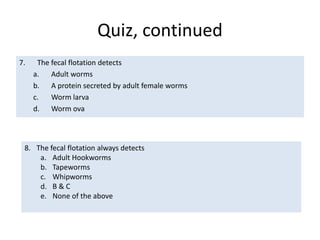
Obtaining the Fecal SpecimenPresented  by ownerCollected from floor or yard hereObtained by probing the patientCalm, easygoing patient, may be done without restraint or minimal restraintMore energetic patient, a second person is needed to restrain the petFractious patient – may ask owner to bring specimen back Best if they pre-pay to assure that they comply
Patients that should not be probedManx cats and kittens—NEVER PROBE A MANXPets where the presenting complaint is rectal pain.Pets with rectal traumaPets with rectal swellings or soresPets with rectums that are scalded from diarrheaPets with rectal foreign bodiesPets with rectal tumors
Rare Patients that we Probe LastPatients known to become very agitated when their temperature is taken, tail is handled or fecal probing is doneWe do everything else to these patients and take the fecal specimen lastThat way, the easy things are done first and the thing most likely to make the patient angry is done last.
We don’t want to probe any patients if we don’t have to!We are trying to train our clients to bring specimensAll pets poop, usually more than once a daySome Clients don’t see where they poopProbing is uncomfortable for many patients. Probing is unpredictable—sometimes patients are “empty” and we don’t get our specimenProbing a resisting patient risks injury to the patient as well as veterinary assistant/techs and even the owner if they won’t stay out of the way.
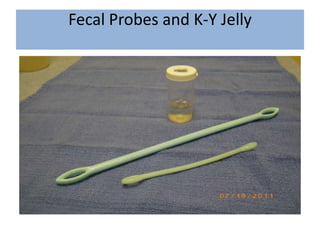
To probeExplain to owner what you are doing and that it may be a little bit uncomfortableSome owners actually may prefer to bring a specimen back laterLubricate the probe with K-Y jellyLift the tail partially and gently insert the probe as far as needed to obtain fecesStop if you meet resistance or if the patient becomes agitated!Sometimes gently rotating the probe helps
Fecal Probes and K-Y Jelly
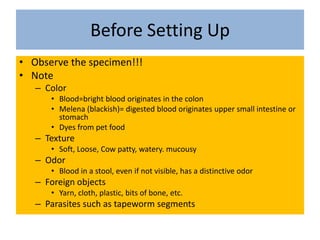
Before Setting UpObserve the specimen!!!NoteColorBlood=bright blood originates in the colonMelena (blackish)= digested blood originates upper small intestine or stomachDyes from pet foodTextureSoft, Loose, Cow patty, watery. mucousyOdorBlood in a stool, even if not visible, has a distinctive odorForeign objectsYarn, cloth, plastic, bits of bone, etc.Parasites such as tapeworm segments
Scant?In our clinic, we note on the record if the fecal quantity is “scant” meaning very little feces was obtained/available for testingFecal flotations are most reliable on quantities of 1 gram of fecesSmaller amounts are usually tested:	If positive, we know we have parasitesIf negative, we still could have parasites
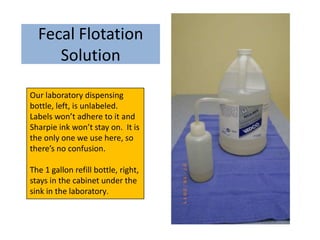
Fecal Flotation SolutionOur laboratory dispensing bottle, left, is unlabeled.  Labels won’t adhere to it and Sharpie ink won’t stay on.  It is the only one we use here, so there’s no confusion.The 1 gallon refill bottle, right, stays in the cabinet under the sink in the laboratory.
Setting up in test tubeFill the test tube halfway with Fecasol (aka Fecamix)Dip the feces-containing end of the probe into the test tube and agitate it to mix the feces into the Fecasol solutionFinish filling the tube with Fecasol until it is brimming but almost overflowing.  The rounded surface of the liquid is called the meniscusPlace a single cover slip on top of the meniscusSet timer for 5 to 10 minutesThe vet or a trained tech will read the test
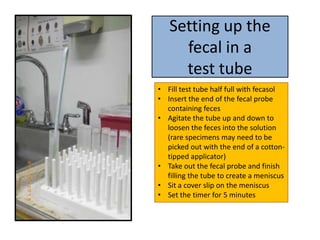
Setting up the fecal in a test tubeFill test tube half full with fecasol
Insert the end of the fecal probe containing feces
Agitate the tube up and down to loosen the feces into the solution (rare specimens may need to be picked out with the end of a cotton-tipped applicator)
Take out the fecal probe and finish filling the tube to create a meniscus
Sit a cover slip on the meniscus
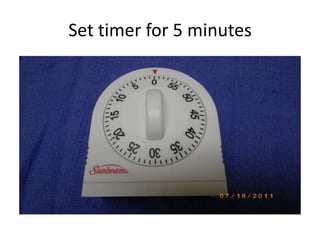
Set the timer for 5 minutesSet timer for 5 minutes
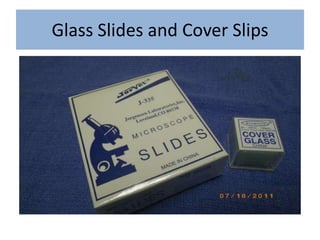
Glass Slides and Cover Slips
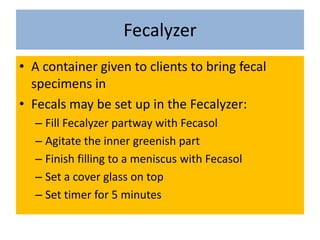
FecalyzerA container given to clients to bring fecal specimens inFecals may be set up in the Fecalyzer:Fill Fecalyzer partway with FecasolAgitate the inner greenish partFinish filling to a meniscus with FecasolSet a cover glass on topSet timer for 5 minutes
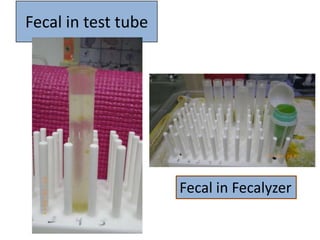
Fecal in test tubeFecal in Fecalyzer
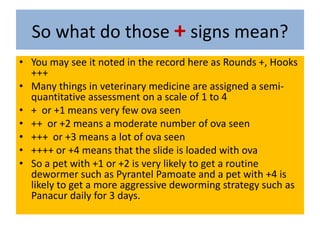
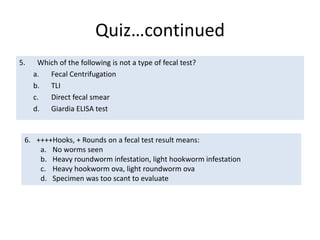
So what do those + signs mean?You may see it noted in the record here as Rounds +, Hooks +++Many things in veterinary medicine are assigned a semi-quantitative assessment on a scale of 1 to 4+  or +1 means very few ova seen++  or +2 means a moderate number of ova seen+++  or +3 means a lot of ova seen++++ or +4 means that the slide is loaded with ovaSo a pet with +1 or +2 is very likely to get a routine dewormer such as Pyrantel Pamoate and a pet with +4 is likely to get a more aggressive deworming strategy such as Panacur daily for 3 days.
What does AOTBF mean?You may see this abbreviation on a chart or on the appointment screen at our hospitalIt means Asked Owner To Bring FecalOften owners forget, but sometimes they will tell you that nobody asked them to bring a fecalOften the person bringing the pet in is not the person who called and was told to bring a specimenSome owners are just plain lazy; some are squeamishThey should be gently reminded to bring a fecal, but don’t make them feel like a criminal if they forgetDNAOTBF means Did Not Ask Owner To Bring Fecal
For next time…Puppy and kitten owners need to be given a fecal container for their next visitAgain, reinforces the need to bring oneFecals may be submitted in non-official containersAluminum foil, baggies, paper cups, tupperwaresFecals should be relatively freshOK if they have some cat litter on them but if the specimen is covered it litter and has been for several hours, it may be desiccated and too dry to use
Direct Fecal SmearsTo look for motile one-celled parasites and bacteriaGiardiaTrichomonasSpirochete bacteriaDone on many pets from “puppy mills”	Jockey Lot or swap meetBreedersPet storesRescues and sheltersA very small amount of feces is smeared onto a glass slideAdd a drop of tap water and mix into the feces to make it wateryTop with a cover slipThe cover slip should easily be flattened out over the sampleIf not, there is too much feces under it!
Other Tests Using FecesParvo Elisa Test -  10 minute test run hereGiardia Elisa Test – 10 minute test sometimes run here (alternative is to send out the test to the lab)Tests sent to Antech LaboratoriesFecal Centrifugation testsParasite identificationDiarrhea PanelsPCR test = a DNA type test for multiple agents such as bacteria, one-celled parasitesRequire a Copan swab and at least a gram of fresh feces
Tests we vets don’t often run on fecesTrypsin digestion testsTests for Exocrine Pancreatic InsufficiencyNo longer used because TLI blood tests are easier and more accurateFecal Occult BloodA common test in humans to screen for colon polyps and cancerNot accurate in our patients because they are carnivores
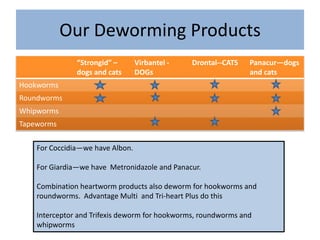
Our Deworming ProductsFor Coccidia—we have Albon.For Giardia—we have  Metronidazole and Panacur.  Combination heartworm products also deworm for hookworms and roundworms.  Advantage Multi  and Tri-heart Plus do thisInterceptor and Trifexis deworm for hookworms, roundworms and whipworms
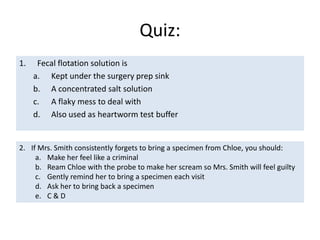
Quiz:Fecal flotation solution is Kept under the surgery prep sinkA concentrated salt solutionA flaky mess to deal withAlso used as heartworm test bufferIf Mrs. Smith consistently forgets to bring a specimen from Chloe, you should:Make her feel like a criminalReam Chloe with the probe to make her scream so Mrs. Smith will feel guiltyGently remind her to bring a specimen each visitAsk her to bring back a specimenC & D
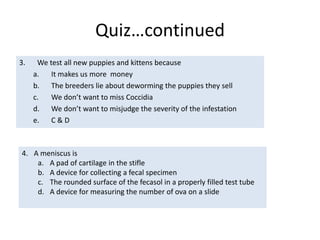
Quiz…continuedWe test all new puppies and kittens becauseIt makes us more  moneyThe breeders lie about deworming the puppies they sellWe don’t want to miss CoccidiaWe don’t want to misjudge the severity of the infestationC & DA meniscus isA pad of cartilage in the stifleA device for collecting a fecal specimenThe rounded surface of the fecasol in a properly filled test tubeA device for measuring the number of ova on a slide

Training module 1- Fecal Testing

  • 1.
    Training Module 1FecalFlotationBy Jacquelyn H. Burns, DVMCopyright Jacquelyn H. Burns 2011
  • 2.
    Fecal FlotationTHE mostimportant laboratory test in veterinary medicine
  • 3.
    What Exactly Doesa “Fecal” test for?Parasite ova (eggs) are detected by the fecalThe feces is mixed in a salt or sugar solutionThe eggs are lightweight and the solution is supersaturated (heavy), so the eggs “float” to the topThe ova cling to the coverslip that is on the meniscusThe coverslip is put on a slide and a tech or the vet read the slide under a microscope
  • 4.
    Why do wedo it?Fecal flotations detectRoundwormsHookwormsWhipwormsCoccidiaSometimes tapewormsSometimes lungwormsFecal flotations do not always detect:TapewormsWhipwormsImmature roundworms and hookwormsGiardia, Trichomonas, Spirochete bacteriaFecal flotations never detect:Heartworms. They require a blood test
  • 5.
    So why dowe want a fecal on all first puppy & kitten visits when it is standard for us to give Pyrantel Pamoate (“Strongid”)?“Strongid” is a great product for mild to moderate cases of hookworms and roundworms!The vet wants to screen for Coccidia, which require an additional medicine, Albon, for 10 daysThe vet wants to see relative numbers of parasite ovaHeavier infestations of hookworms may be better treated with Panacur daily for 3 days.If tapeworms are seen, the vet will likely choose Virbantel for puppies or Drontal for kittens
  • 6.
    Some Vets Don’tDo It!At some vet hospitals, they don’t routinely check fecals, they just deworm routinely with a general purpose dewormerWe think they risk missing some things or risk failing to assess how serious the situation is!
  • 7.
    It’s VERY importantExample: Last week we saw a first puppy visit from a breeder. The breeder paperwork gave 7 dates the puppy had been dewormed with Pyrantel Pamoate, basically once a week from the time it was two weeks old. Guess what? It still had hookworms! In a case like this, the vet is very likely to choose a different deworming strategy for this puppy and to explain worm life cycles to the client
  • 8.
    Some vets doan even more accurate version of the fecalFecal centrifugation test Feces is mixed in a fecal solution and put in a centrifuge and spun for a certain amount of time before the cover slip is put on and the sample is readIt is more accurate—especially with regard to whipwormsWorm ova rise to the top from both the spinning and the concentration of the solution
  • 9.
    We routinely checkfecals on many different types of patientsSick adult pets VomitingDiarrheaVague symptoms or no identified symptoms, especially dogs that are not on heartworm preventativeTypically, we would not do a fecal on a pet presented for a respiratory complaint such as coughing or sneezing, skin or ear problems and injuriesAnnual Wellness ChecksAll puppy and kitten visits, whether sick or wellnessAll initial visits for Strays—they almost always have worms
  • 10.
    Ask owner ifthey brought a fecal specimenAsk early in the visit so that the fecal may be running while you are doing other things to prepare the patient“Mrs. Smith, did you bring a fecal specimen from Fluffy today?”Ask this question even if you know Mrs. Smith brought a specimen. Why? Because saying it reinforces in the clients the importance of bringing the specimenIt’s also a good idea to ask the owner if they’ve seen any worms. Sometimes they may have seen tapeworms, and our specimen may read negative for them.
  • 11.
    Obtaining the FecalSpecimenPresented by ownerCollected from floor or yard hereObtained by probing the patientCalm, easygoing patient, may be done without restraint or minimal restraintMore energetic patient, a second person is needed to restrain the petFractious patient – may ask owner to bring specimen back Best if they pre-pay to assure that they comply
  • 12.
    Patients that shouldnot be probedManx cats and kittens—NEVER PROBE A MANXPets where the presenting complaint is rectal pain.Pets with rectal traumaPets with rectal swellings or soresPets with rectums that are scalded from diarrheaPets with rectal foreign bodiesPets with rectal tumors
  • 13.
    Rare Patients thatwe Probe LastPatients known to become very agitated when their temperature is taken, tail is handled or fecal probing is doneWe do everything else to these patients and take the fecal specimen lastThat way, the easy things are done first and the thing most likely to make the patient angry is done last.
  • 14.
    We don’t wantto probe any patients if we don’t have to!We are trying to train our clients to bring specimensAll pets poop, usually more than once a daySome Clients don’t see where they poopProbing is uncomfortable for many patients. Probing is unpredictable—sometimes patients are “empty” and we don’t get our specimenProbing a resisting patient risks injury to the patient as well as veterinary assistant/techs and even the owner if they won’t stay out of the way.
  • 15.
    To probeExplain toowner what you are doing and that it may be a little bit uncomfortableSome owners actually may prefer to bring a specimen back laterLubricate the probe with K-Y jellyLift the tail partially and gently insert the probe as far as needed to obtain fecesStop if you meet resistance or if the patient becomes agitated!Sometimes gently rotating the probe helps
  • 16.
  • 17.
    Before Setting UpObservethe specimen!!!NoteColorBlood=bright blood originates in the colonMelena (blackish)= digested blood originates upper small intestine or stomachDyes from pet foodTextureSoft, Loose, Cow patty, watery. mucousyOdorBlood in a stool, even if not visible, has a distinctive odorForeign objectsYarn, cloth, plastic, bits of bone, etc.Parasites such as tapeworm segments
  • 18.
    Scant?In our clinic,we note on the record if the fecal quantity is “scant” meaning very little feces was obtained/available for testingFecal flotations are most reliable on quantities of 1 gram of fecesSmaller amounts are usually tested: If positive, we know we have parasitesIf negative, we still could have parasites
  • 19.
    Fecal Flotation SolutionOurlaboratory dispensing bottle, left, is unlabeled. Labels won’t adhere to it and Sharpie ink won’t stay on. It is the only one we use here, so there’s no confusion.The 1 gallon refill bottle, right, stays in the cabinet under the sink in the laboratory.
  • 20.
    Setting up intest tubeFill the test tube halfway with Fecasol (aka Fecamix)Dip the feces-containing end of the probe into the test tube and agitate it to mix the feces into the Fecasol solutionFinish filling the tube with Fecasol until it is brimming but almost overflowing. The rounded surface of the liquid is called the meniscusPlace a single cover slip on top of the meniscusSet timer for 5 to 10 minutesThe vet or a trained tech will read the test
  • 21.
    Setting up thefecal in a test tubeFill test tube half full with fecasol
  • 22.
    Insert the endof the fecal probe containing feces
  • 23.
    Agitate the tubeup and down to loosen the feces into the solution (rare specimens may need to be picked out with the end of a cotton-tipped applicator)
  • 24.
    Take out thefecal probe and finish filling the tube to create a meniscus
  • 25.
    Sit a coverslip on the meniscus
  • 26.
    Set the timerfor 5 minutesSet timer for 5 minutes
  • 27.
    Glass Slides andCover Slips
  • 28.
    FecalyzerA container givento clients to bring fecal specimens inFecals may be set up in the Fecalyzer:Fill Fecalyzer partway with FecasolAgitate the inner greenish partFinish filling to a meniscus with FecasolSet a cover glass on topSet timer for 5 minutes
  • 29.
    Fecal in testtubeFecal in Fecalyzer
  • 30.
    So what dothose + signs mean?You may see it noted in the record here as Rounds +, Hooks +++Many things in veterinary medicine are assigned a semi-quantitative assessment on a scale of 1 to 4+ or +1 means very few ova seen++ or +2 means a moderate number of ova seen+++ or +3 means a lot of ova seen++++ or +4 means that the slide is loaded with ovaSo a pet with +1 or +2 is very likely to get a routine dewormer such as Pyrantel Pamoate and a pet with +4 is likely to get a more aggressive deworming strategy such as Panacur daily for 3 days.
  • 31.
    What does AOTBFmean?You may see this abbreviation on a chart or on the appointment screen at our hospitalIt means Asked Owner To Bring FecalOften owners forget, but sometimes they will tell you that nobody asked them to bring a fecalOften the person bringing the pet in is not the person who called and was told to bring a specimenSome owners are just plain lazy; some are squeamishThey should be gently reminded to bring a fecal, but don’t make them feel like a criminal if they forgetDNAOTBF means Did Not Ask Owner To Bring Fecal
  • 32.
    For next time…Puppyand kitten owners need to be given a fecal container for their next visitAgain, reinforces the need to bring oneFecals may be submitted in non-official containersAluminum foil, baggies, paper cups, tupperwaresFecals should be relatively freshOK if they have some cat litter on them but if the specimen is covered it litter and has been for several hours, it may be desiccated and too dry to use
  • 33.
    Direct Fecal SmearsTolook for motile one-celled parasites and bacteriaGiardiaTrichomonasSpirochete bacteriaDone on many pets from “puppy mills” Jockey Lot or swap meetBreedersPet storesRescues and sheltersA very small amount of feces is smeared onto a glass slideAdd a drop of tap water and mix into the feces to make it wateryTop with a cover slipThe cover slip should easily be flattened out over the sampleIf not, there is too much feces under it!
  • 34.
    Other Tests UsingFecesParvo Elisa Test - 10 minute test run hereGiardia Elisa Test – 10 minute test sometimes run here (alternative is to send out the test to the lab)Tests sent to Antech LaboratoriesFecal Centrifugation testsParasite identificationDiarrhea PanelsPCR test = a DNA type test for multiple agents such as bacteria, one-celled parasitesRequire a Copan swab and at least a gram of fresh feces
  • 35.
    Tests we vetsdon’t often run on fecesTrypsin digestion testsTests for Exocrine Pancreatic InsufficiencyNo longer used because TLI blood tests are easier and more accurateFecal Occult BloodA common test in humans to screen for colon polyps and cancerNot accurate in our patients because they are carnivores
  • 36.
    Our Deworming ProductsForCoccidia—we have Albon.For Giardia—we have Metronidazole and Panacur. Combination heartworm products also deworm for hookworms and roundworms. Advantage Multi and Tri-heart Plus do thisInterceptor and Trifexis deworm for hookworms, roundworms and whipworms
  • 37.
    Quiz:Fecal flotation solutionis Kept under the surgery prep sinkA concentrated salt solutionA flaky mess to deal withAlso used as heartworm test bufferIf Mrs. Smith consistently forgets to bring a specimen from Chloe, you should:Make her feel like a criminalReam Chloe with the probe to make her scream so Mrs. Smith will feel guiltyGently remind her to bring a specimen each visitAsk her to bring back a specimenC & D
  • 38.
    Quiz…continuedWe test allnew puppies and kittens becauseIt makes us more moneyThe breeders lie about deworming the puppies they sellWe don’t want to miss CoccidiaWe don’t want to misjudge the severity of the infestationC & DA meniscus isA pad of cartilage in the stifleA device for collecting a fecal specimenThe rounded surface of the fecasol in a properly filled test tubeA device for measuring the number of ova on a slide