PARAFILARIA & DIROFILARIA IMMITIS  HEARTWORM
  body-unsegmented--the bilateral symmetry covered by a typical cuticle which is formed by a hypodermis.    pseudocoelomatic body cavity contains a complete digestive tract, the anus subterminally situated. food of various kinds (blood, body fluid, intestinal contents, mucus etc.) taken up by the species-specific mouth .  the excretory system, if present, empties through an anterior, ventromedial porus.  respiratory and circulatory systems are lacking. movements by contractions of the typically longitudinally oriented muscle cells with the fluid of the pseudocoel and the pressure of the cuticle working together as a hydrostatic skeleton.  General morphology of  Dirofilaria family -- 1
General morphology of  Dirofilaria family-- 2  Male---- 12 to 16 cm long  Slender , white in color 1.25 to 1.5 mm long esophagus Spirally coiled hind end bears small lateral alae 4 to 6 pairs of ovoid alae 1 pair—post cloacal 2 pairs ---  lateral & posterior to cloacal opening 3 to 4 pairs –  near the tip of tail Left spicule 0.342 to 0.375 mm long pointed Right spicule 0.19 to 0.229 mm long ends bluntly. Males are reffered as  “pigtail ”.
General morphology of  Dirofilaria family -- 3 Female-- 25 to 30 cm long Ovoviviparous – lay microfilaria Longer than male. Shows genital organs…vulva, vagina ,uterus etc. Microfilaria-- Accurately larvae are described on the basis of fixed points like  NR nerve ring ; Ex.P excretory pore ; Ex C excretory cell ; G1 ; G2 ;  G3 ; G4 genital cell 1, 2 , 3, 4 resp. ; A P anal pore ; L T C last tail cell FOR  D. immitis [found in dog & % Distance from the  Ant. End] 82 92.9 79.4 75.4 74.1 67.9 38.6 32.5 23.8 AP LTC G4 G3 G2 G1 EC EP NR
Morphology of  D. immitis :
Dirofilaria immitis microfilaria. (From Soulsby, E.J.L. 1969).  Dirofilaria immitis microfilaria morphology
Dirofilaria immitis   - microfilaria   Note the tapered anterior end. In most specimens you will see  a straight body and straight  or slightly curved) tail.  The width is > 6 um.
Microfilaria Microfilarial stage  as seen @  400X magnification [wiki-image] 1 st  stage microfilaria  in blood smear.
Scanning electron micrograph of tail of  D. immitis  showing alae. Under electron microscope
Kingdom  Animalia  (animals)  Eumetazoa  (metazoans) Bilateria  (bilaterally symmetrical animals)        Protostomia  (protostomes)  Ecdysozoa          Phylum  Nematoda  (nematodes)                   Class  Secernentea                   Order  Spirurida               Superfamily  Filarioidea                Family  Filariidae                  Genus  Dirofilaria                  Species  Dirofilaria immitis   Systemic classification of   D. immitis Kingdom:  Animalia Phylum:  Nematoda Class:  Secernentea Order:  Spirurida Family:  Filariidae Genus:  Dirofilaria Species:  Dirofilaria immitis
Different species of  Dirofilaria: Black bears Yamaguti [1941] D.Urci Subcut recoons Chandler[1942] D.Tenuis Subcut, IM CT, Pelvic region of wallabies & kangroo Linstow[1605] D. romeri Human Addario[1885] D. Conjuctivae Monkey Linstow[1899] D.Corynods Subcut tissues of dogs Railliet & Henry [1911] D. repens
Development ….1 The  mosquito  ingests  microfilariae after a blood meal  from a infected dog. The microfilariae develop into L2 in the malpighian tubes. Then L3 develop and enter the body cavity, the hemoceol. Development from the microfilariae to the L3 takes 15-16 days. The L3 escape in a pool of hemolymph as the mosquito inserts its labium into the definitive host, which is usually a dog. If its stylets are withdrawn, the L3 enter through the puncture wound made by the mosquito.  The L3 will then molt into the L4 in the definitive host 0-14 days after infection.  The L4 migrate to sub muscular membranes and subcutaneous tissue and remain dormant.
They molt into the L5 and migrate through venule walls and end up in the pulmonary arterioles and right heart of the definitive host.  The L5 will mature into adults that will further migrate to the right ventricle or pulmonary artery 85-120 days after infection.  The adult will reach maturity in a further 2-month period and shed microfilariae in the blood to begin the cycle all over again. The adults can remain in the heart or artery for up to 7 years. Microfilariae can remain in the circulation of the mosquito for up to 2 years.  (Muro et al., September 1999; Soulsby, 1968) Development ….2
Life Cycle  pattern of  D.   immitis Mosquito bites dogs with microfilaria in its blood After 24 hrs microfilariae in stomach of insect Next 24 hrs microfilaria migrate to malpighian tubules. Here they develop over next 15 – 16 days. This  16 days maturation process  is as follows: 1 st  6 to 7 days – larvae inside the cells of tubules by 4 th  day – infection in  sausage stage  i. e.  2 nd  stage  220 µm x 20 to 25  µm   sausage stage ultimately  produce  elongated sausage form  where they  measure 500 µm x 20 µm. Excretory & intestinal cells increase in this  stage. This stage feeds on malphigian cells if insect & enters body cavity  through haematophagus activity
Life Cycle of  D.   immitis
The  male  mosquito  does not  bite The  female  mosquito  bites Male & female mosquito responsible for Heartworm Entomological sketches
A female mosquito blood feeding. Mosquitoes serve as intermediate hosts of other parasites such as Dirofilaria immitis the dog and cat heartworm and  Plasmodium species causing malaria in humans and birds. They are also vectors of  viruses  causing yellow fever and  encephalitis. Mosquito responsible for Dirofilariosis feeding on skin …..
PATHOGENESIS Circulatory distress , progressive endarteritis Cardiac dysfunction  Pulmonatory hypertension --- narrowing of small peripheral pulmonary arteries Similar lesions in hepatic veins Compensatory hypertrophy of rt. Ventricle This leads to chronic passive congestion --- liver enlargement --- ascites ---  --- peripheral edema Deep , dry cough Haemoptysis Decreased stamina , rib cage remains expanded , extra inspiratory efforts Emaciation In X-ray --------  main pulmonary artery – dilated In ECG ------ inverted T wave after exercise
THE ADVANCED SOROLOGICAL TESTS FOR HEARTWORM DISEASE 1) IFA for microfilarial antibody 2) ELISA for adult antibody 3) Adult antigen detection by ELISA and colloid gold. Diagnosis……1 Electrocardiogram   Radiography   Echocardiogram   Tracheal Cytology
Diagnosis……2 SIMPLE BLOOD SMEAR TESTING WITH  CONCENTRAION TECHNIQUES Clinical Signs of Heartworm Disease    Acute Signs   Convulsions  Vomiting/Diarrhea  Collapse  Blindness   Anorexia   Tachycardia   Syncope   Chronic Signs   Coughing  *   Dyspnea  *   Vomiting  *    Lethargy   Weight loss
A, Thoracic radiograph from a cat with mild radiographic signs of heartworm disease. Note the right caudal pulmonary artery (arrow). The arrow is located in the ninth intercostal space, the site for comparison of the ninth rib with the pulmonary artery (right or left side).  If the pulmonary artery is greater than 1.6 times the size of the rib, it is suggestive of heartworm disease  (Schafer and Berry, 1995). B, Thoracic radiograph obtained from a more severely affected cat. Note the alveolar infiltrate in the caudal lung lobes. (From Schafer M, Berry CR: Cardiac and pulmonary artery mensuration in feline heartworm disease. Vet Radio Ultrasound 36:499, 1995.)   Diagnosis from X-ray….[feline]
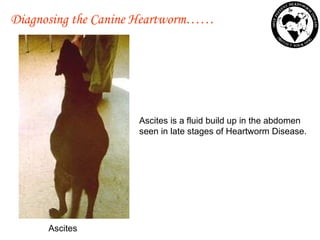
Ascites is a fluid build up in the abdomen  seen in late stages of Heartworm Disease.  Ascites  Diagnosing the Canine Heartworm……
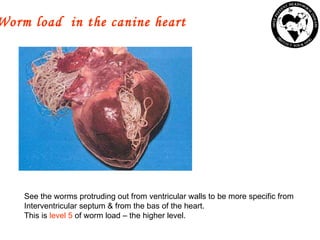
Worm load  in the canine heart See the worms protruding out from ventricular walls to be more specific from Interventricular septum & from the bas of the heart. This is  level 5  of worm load – the higher level.
Canine heart ….cut open See the length of worms. These are oriented from apex to the base. It gives idea about the morphology of worm.  University of Kansas
ECG of  Normal  & Inverted T-wave Inverted   T wave Normal T wave                     
 
Treatment Heart , liver , kidneys , lungs are assessed before treatment  Infected dog is treated with adulticide anthelmintic 6 weeks later micrifilaricidal treatment is used Adiltcide Arsenical thiacetarsamide I/V dose  0.1 ml/0.45 kg twice a day for 2-3 days ( This is potential nephrotoxin , hepatotoxin ) Melasoprol 100 mg/kg adultcide Surgical ways  ventricular puncture arteriotomy main trunk of pulmonary artery Microfilariacidal – dithiazanine iodide  2 mg/ .45 kg for 7 days in persistant cases ;  dose is increased to 5 mg/ 0.45 kg (not to be used if case is having hepatoportal diseases ) Levamisole  10 mg/kg  15-20 days
Control Animals s/b indoors @ night & evening. Prophylactic medicine – thiacetarsamide Rx after every 6 months Regular checkup after 6 months DEC & styrylpyridinium DEC 5.5 mg/kg daily 2 months afer mosquito season  ( dewarming is essential) Menbendazole  80 mg/kg daily for 30 days Avermactin B1a 0.2 mg/kg/day OR Melarsoprol  100 mg/kg/day (Menbendazole s/n/b used with this)
Zoonotic aspects of  D.immitis D.immitis  is not important from zoonotic point of view.  However in some cases signs of respiratory infections are seen. But in most of such cases the parasite dies shortly as it enters  the lung of the human being. The granuloma is formed  around dead worms as it is being killed & absobed.  Many times this granuloma resembles with lung cancer on X-ray & biopsy is done for confirmation.  D. Tenuis ---- raccoons ---- eye infections D. Repens ---- dogs [Italy] ---- subcutaneous infections
PARAFILARIA Parafilaria multipapillosa   (Condamne & Drouilly ; 1878)   Found in equines Male 28mm  Female 40-70mm Ant. End ----- large no of papilliform thickenings Found in sub-cut & IM CT -----Produce sub-cut nodules I/M host  Haematobia atripalpis Parafilaria bovicola  (de Jesus ; 1934) Haemorrhagic nodules on cattle & buffalo Adults ---- 13 rows of cuticular elevations @ ant. end. Remaining cuticule is transversely striated. Parafilaria antipini  (Rukhiadev ; 1947)   Indofilairia patabiramani  (Alwar ,  Seneviratna , Gopal   1959)  show same symptoms as  Parafilaria bovicola  (de Jesus ; 1934).
Life Cycle  pattern of  Parafilaria Dev. In musca spp. i. e. M. lusoia M. xanthomelas These feed on lesions  Land on lacrimal glands or wound to infect host Treatment Nitroxynil  20 mg/kg  repeated after 72 hrs High doses of levamisol , fenbendazole  4-5 days
References :- Helminthes of Domesticated Animals.  [7 th  edition]  E J L Soulsby www.yahoo.com www.google.com www.wikipedia.com www.wikimapia..org Thank you… Sarang S. Desai V/05/0170 Guided by- Dr. Parampalle Department of Parasitology

1003127 heart-worm

  • 1.
    PARAFILARIA & DIROFILARIAIMMITIS HEARTWORM
  • 2.
    body-unsegmented--thebilateral symmetry covered by a typical cuticle which is formed by a hypodermis. pseudocoelomatic body cavity contains a complete digestive tract, the anus subterminally situated. food of various kinds (blood, body fluid, intestinal contents, mucus etc.) taken up by the species-specific mouth . the excretory system, if present, empties through an anterior, ventromedial porus. respiratory and circulatory systems are lacking. movements by contractions of the typically longitudinally oriented muscle cells with the fluid of the pseudocoel and the pressure of the cuticle working together as a hydrostatic skeleton. General morphology of Dirofilaria family -- 1
  • 3.
    General morphology of Dirofilaria family-- 2 Male---- 12 to 16 cm long Slender , white in color 1.25 to 1.5 mm long esophagus Spirally coiled hind end bears small lateral alae 4 to 6 pairs of ovoid alae 1 pair—post cloacal 2 pairs --- lateral & posterior to cloacal opening 3 to 4 pairs – near the tip of tail Left spicule 0.342 to 0.375 mm long pointed Right spicule 0.19 to 0.229 mm long ends bluntly. Males are reffered as “pigtail ”.
  • 4.
    General morphology of Dirofilaria family -- 3 Female-- 25 to 30 cm long Ovoviviparous – lay microfilaria Longer than male. Shows genital organs…vulva, vagina ,uterus etc. Microfilaria-- Accurately larvae are described on the basis of fixed points like NR nerve ring ; Ex.P excretory pore ; Ex C excretory cell ; G1 ; G2 ; G3 ; G4 genital cell 1, 2 , 3, 4 resp. ; A P anal pore ; L T C last tail cell FOR D. immitis [found in dog & % Distance from the Ant. End] 82 92.9 79.4 75.4 74.1 67.9 38.6 32.5 23.8 AP LTC G4 G3 G2 G1 EC EP NR
  • 5.
    Morphology of D. immitis :
  • 6.
    Dirofilaria immitis microfilaria.(From Soulsby, E.J.L. 1969). Dirofilaria immitis microfilaria morphology
  • 7.
    Dirofilaria immitis  - microfilaria Note the tapered anterior end. In most specimens you will see a straight body and straight or slightly curved) tail. The width is > 6 um.
  • 8.
    Microfilaria Microfilarial stage as seen @ 400X magnification [wiki-image] 1 st stage microfilaria in blood smear.
  • 9.
    Scanning electron micrographof tail of D. immitis showing alae. Under electron microscope
  • 10.
    Kingdom Animalia (animals) Eumetazoa (metazoans) Bilateria (bilaterally symmetrical animals)       Protostomia (protostomes) Ecdysozoa        Phylum Nematoda (nematodes)               Class Secernentea               Order Spirurida            Superfamily Filarioidea              Family Filariidae              Genus Dirofilaria              Species Dirofilaria immitis Systemic classification of D. immitis Kingdom: Animalia Phylum: Nematoda Class: Secernentea Order: Spirurida Family: Filariidae Genus: Dirofilaria Species: Dirofilaria immitis
  • 11.
    Different species of Dirofilaria: Black bears Yamaguti [1941] D.Urci Subcut recoons Chandler[1942] D.Tenuis Subcut, IM CT, Pelvic region of wallabies & kangroo Linstow[1605] D. romeri Human Addario[1885] D. Conjuctivae Monkey Linstow[1899] D.Corynods Subcut tissues of dogs Railliet & Henry [1911] D. repens
  • 12.
    Development ….1 The mosquito ingests microfilariae after a blood meal from a infected dog. The microfilariae develop into L2 in the malpighian tubes. Then L3 develop and enter the body cavity, the hemoceol. Development from the microfilariae to the L3 takes 15-16 days. The L3 escape in a pool of hemolymph as the mosquito inserts its labium into the definitive host, which is usually a dog. If its stylets are withdrawn, the L3 enter through the puncture wound made by the mosquito. The L3 will then molt into the L4 in the definitive host 0-14 days after infection. The L4 migrate to sub muscular membranes and subcutaneous tissue and remain dormant.
  • 13.
    They molt intothe L5 and migrate through venule walls and end up in the pulmonary arterioles and right heart of the definitive host. The L5 will mature into adults that will further migrate to the right ventricle or pulmonary artery 85-120 days after infection. The adult will reach maturity in a further 2-month period and shed microfilariae in the blood to begin the cycle all over again. The adults can remain in the heart or artery for up to 7 years. Microfilariae can remain in the circulation of the mosquito for up to 2 years. (Muro et al., September 1999; Soulsby, 1968) Development ….2
  • 14.
    Life Cycle pattern of D. immitis Mosquito bites dogs with microfilaria in its blood After 24 hrs microfilariae in stomach of insect Next 24 hrs microfilaria migrate to malpighian tubules. Here they develop over next 15 – 16 days. This 16 days maturation process is as follows: 1 st 6 to 7 days – larvae inside the cells of tubules by 4 th day – infection in sausage stage i. e. 2 nd stage 220 µm x 20 to 25 µm sausage stage ultimately produce elongated sausage form where they measure 500 µm x 20 µm. Excretory & intestinal cells increase in this stage. This stage feeds on malphigian cells if insect & enters body cavity through haematophagus activity
  • 15.
    Life Cycle of D. immitis
  • 16.
    The male mosquito does not bite The female mosquito bites Male & female mosquito responsible for Heartworm Entomological sketches
  • 17.
    A female mosquitoblood feeding. Mosquitoes serve as intermediate hosts of other parasites such as Dirofilaria immitis the dog and cat heartworm and Plasmodium species causing malaria in humans and birds. They are also vectors of viruses causing yellow fever and encephalitis. Mosquito responsible for Dirofilariosis feeding on skin …..
  • 18.
    PATHOGENESIS Circulatory distress, progressive endarteritis Cardiac dysfunction Pulmonatory hypertension --- narrowing of small peripheral pulmonary arteries Similar lesions in hepatic veins Compensatory hypertrophy of rt. Ventricle This leads to chronic passive congestion --- liver enlargement --- ascites --- --- peripheral edema Deep , dry cough Haemoptysis Decreased stamina , rib cage remains expanded , extra inspiratory efforts Emaciation In X-ray -------- main pulmonary artery – dilated In ECG ------ inverted T wave after exercise
  • 19.
    THE ADVANCED SOROLOGICALTESTS FOR HEARTWORM DISEASE 1) IFA for microfilarial antibody 2) ELISA for adult antibody 3) Adult antigen detection by ELISA and colloid gold. Diagnosis……1 Electrocardiogram Radiography Echocardiogram Tracheal Cytology
  • 20.
    Diagnosis……2 SIMPLE BLOODSMEAR TESTING WITH CONCENTRAION TECHNIQUES Clinical Signs of Heartworm Disease   Acute Signs Convulsions Vomiting/Diarrhea Collapse Blindness  Anorexia  Tachycardia Syncope Chronic Signs Coughing * Dyspnea * Vomiting *  Lethargy  Weight loss
  • 21.
    A, Thoracic radiographfrom a cat with mild radiographic signs of heartworm disease. Note the right caudal pulmonary artery (arrow). The arrow is located in the ninth intercostal space, the site for comparison of the ninth rib with the pulmonary artery (right or left side). If the pulmonary artery is greater than 1.6 times the size of the rib, it is suggestive of heartworm disease (Schafer and Berry, 1995). B, Thoracic radiograph obtained from a more severely affected cat. Note the alveolar infiltrate in the caudal lung lobes. (From Schafer M, Berry CR: Cardiac and pulmonary artery mensuration in feline heartworm disease. Vet Radio Ultrasound 36:499, 1995.) Diagnosis from X-ray….[feline]
  • 22.
    Ascites is afluid build up in the abdomen seen in late stages of Heartworm Disease. Ascites Diagnosing the Canine Heartworm……
  • 23.
    Worm load in the canine heart See the worms protruding out from ventricular walls to be more specific from Interventricular septum & from the bas of the heart. This is level 5 of worm load – the higher level.
  • 24.
    Canine heart ….cutopen See the length of worms. These are oriented from apex to the base. It gives idea about the morphology of worm. University of Kansas
  • 25.
    ECG of Normal & Inverted T-wave Inverted T wave Normal T wave                    
  • 26.
  • 27.
    Treatment Heart ,liver , kidneys , lungs are assessed before treatment Infected dog is treated with adulticide anthelmintic 6 weeks later micrifilaricidal treatment is used Adiltcide Arsenical thiacetarsamide I/V dose 0.1 ml/0.45 kg twice a day for 2-3 days ( This is potential nephrotoxin , hepatotoxin ) Melasoprol 100 mg/kg adultcide Surgical ways ventricular puncture arteriotomy main trunk of pulmonary artery Microfilariacidal – dithiazanine iodide 2 mg/ .45 kg for 7 days in persistant cases ; dose is increased to 5 mg/ 0.45 kg (not to be used if case is having hepatoportal diseases ) Levamisole 10 mg/kg 15-20 days
  • 28.
    Control Animals s/bindoors @ night & evening. Prophylactic medicine – thiacetarsamide Rx after every 6 months Regular checkup after 6 months DEC & styrylpyridinium DEC 5.5 mg/kg daily 2 months afer mosquito season ( dewarming is essential) Menbendazole 80 mg/kg daily for 30 days Avermactin B1a 0.2 mg/kg/day OR Melarsoprol 100 mg/kg/day (Menbendazole s/n/b used with this)
  • 29.
    Zoonotic aspects of D.immitis D.immitis is not important from zoonotic point of view. However in some cases signs of respiratory infections are seen. But in most of such cases the parasite dies shortly as it enters the lung of the human being. The granuloma is formed around dead worms as it is being killed & absobed. Many times this granuloma resembles with lung cancer on X-ray & biopsy is done for confirmation. D. Tenuis ---- raccoons ---- eye infections D. Repens ---- dogs [Italy] ---- subcutaneous infections
  • 30.
    PARAFILARIA Parafilaria multipapillosa (Condamne & Drouilly ; 1878) Found in equines Male 28mm Female 40-70mm Ant. End ----- large no of papilliform thickenings Found in sub-cut & IM CT -----Produce sub-cut nodules I/M host Haematobia atripalpis Parafilaria bovicola (de Jesus ; 1934) Haemorrhagic nodules on cattle & buffalo Adults ---- 13 rows of cuticular elevations @ ant. end. Remaining cuticule is transversely striated. Parafilaria antipini (Rukhiadev ; 1947) Indofilairia patabiramani (Alwar , Seneviratna , Gopal 1959) show same symptoms as Parafilaria bovicola (de Jesus ; 1934).
  • 31.
    Life Cycle pattern of Parafilaria Dev. In musca spp. i. e. M. lusoia M. xanthomelas These feed on lesions Land on lacrimal glands or wound to infect host Treatment Nitroxynil 20 mg/kg repeated after 72 hrs High doses of levamisol , fenbendazole 4-5 days
  • 32.
    References :- Helminthesof Domesticated Animals. [7 th edition] E J L Soulsby www.yahoo.com www.google.com www.wikipedia.com www.wikimapia..org Thank you… Sarang S. Desai V/05/0170 Guided by- Dr. Parampalle Department of Parasitology