Shibu Chacko
abdominal aortic aneurysms
• Definition
• Diameter > 1.5 times normal vessel diameter (Aorta>3cm)
• Sex
• 1.2% male deaths, 0.6% female deaths
• Age
• men start at 50 yrs, peak incidence 80 yrs
• female start at 70 yrs, peak incidence 90 yrs
aortic aneurysms 1
aortic aneurysms 2
• Family history
• 15-20% of patients with AAA have a first degree relative
with AAA: compared to 2% of controls
• Incidence
• increasing death rate from rupture over last 30yrs
(increasingly elderly popln, [65+yrs to double by 2025])
• 5% men over 65yrs have AAA (screening)
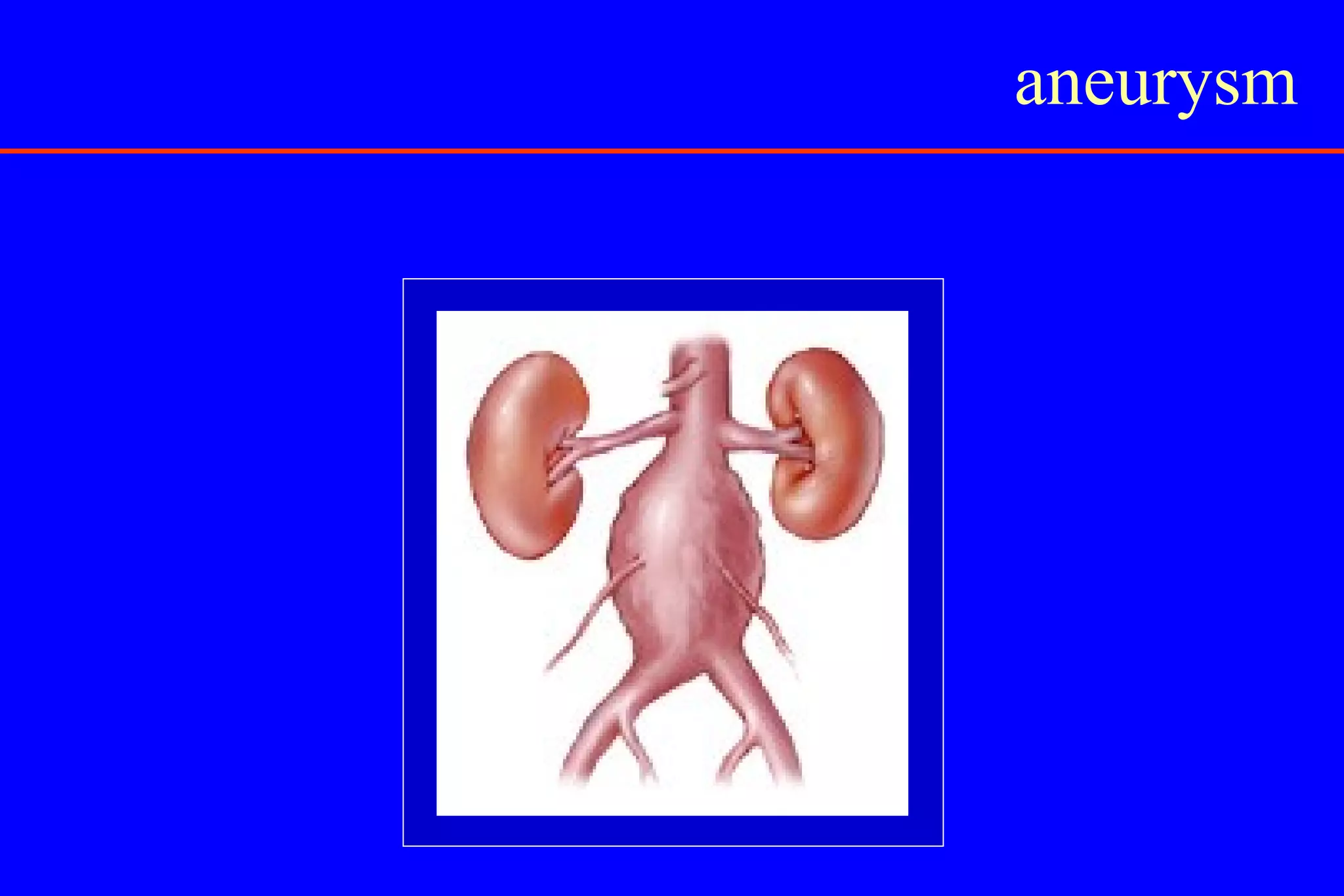
aneurysm
aneurysm histology
Lumen
Thrombus
Lumen
Intima atherosclerotic
Media thin
fibrous replacement of SMC
disrupted elastic fibres
reduced elastin content
increase in collagen
Adventitia thickened
increase in collagen
inflammation
Normal
Aneurysm
Endothelium/Intima
Media
Adventitia
Aneurysm
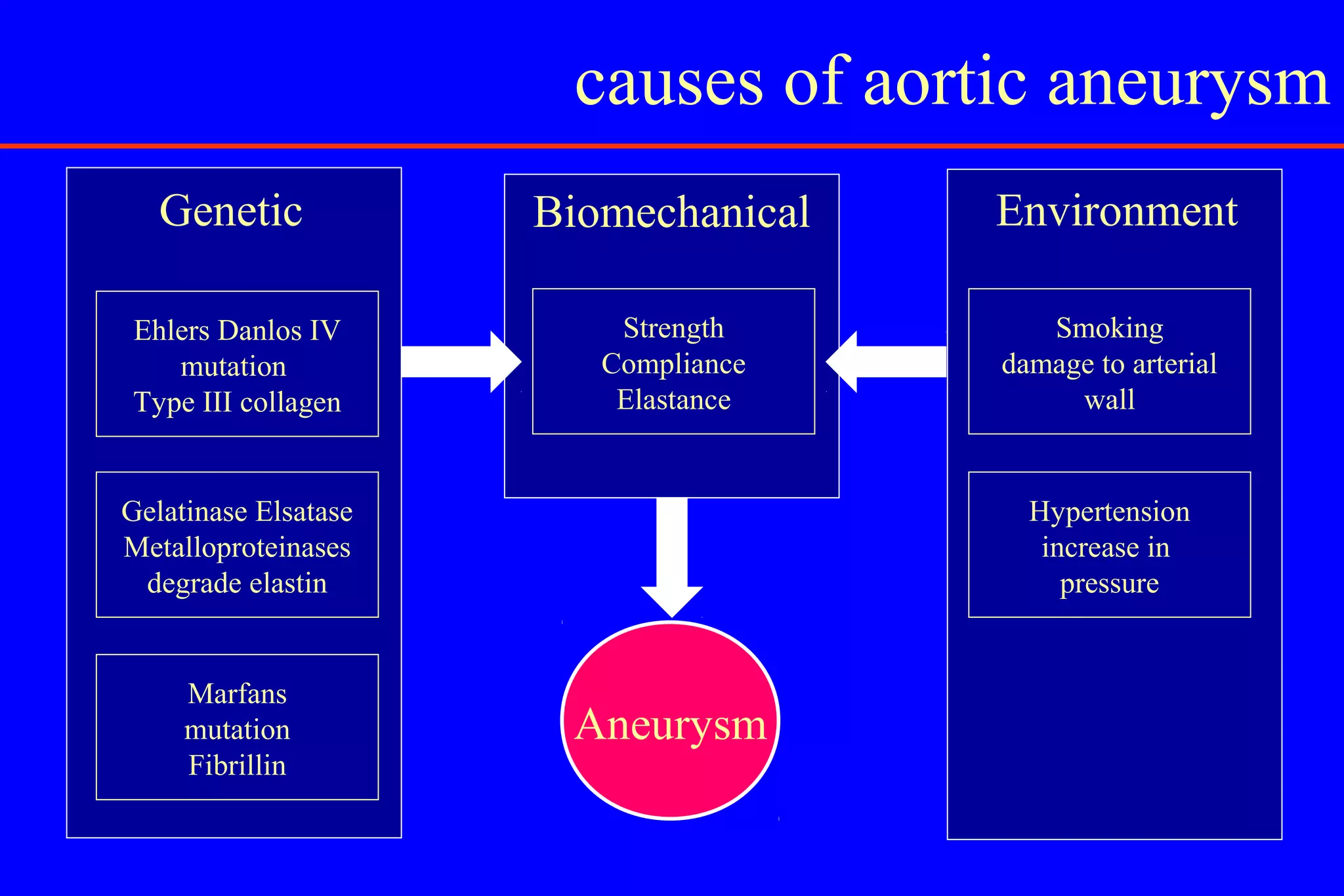
Ehlers Danlos IV
mutation
Type III collagen
Marfans
mutation
Fibrillin
Hypertension
increase in
pressure
Smoking
damage to arterial
wall
Gelatinase Elsatase
Metalloproteinases
degrade elastin
Genetic EnvironmentBiomechanical
Strength
Compliance
Elastance
causes of aortic aneurysm
aneurysm rupture
• Occurs when the tension in the aneurysm wall
exceeds the tensile strength of the aneurysm wall
• Depends on :
– size diameter, wall thickness (Laplace)
– shape symmetric, asymmetric
– pressure hypertension, Bernouilli
– material loss of elastin, increase in collagen
aneurysm rupture
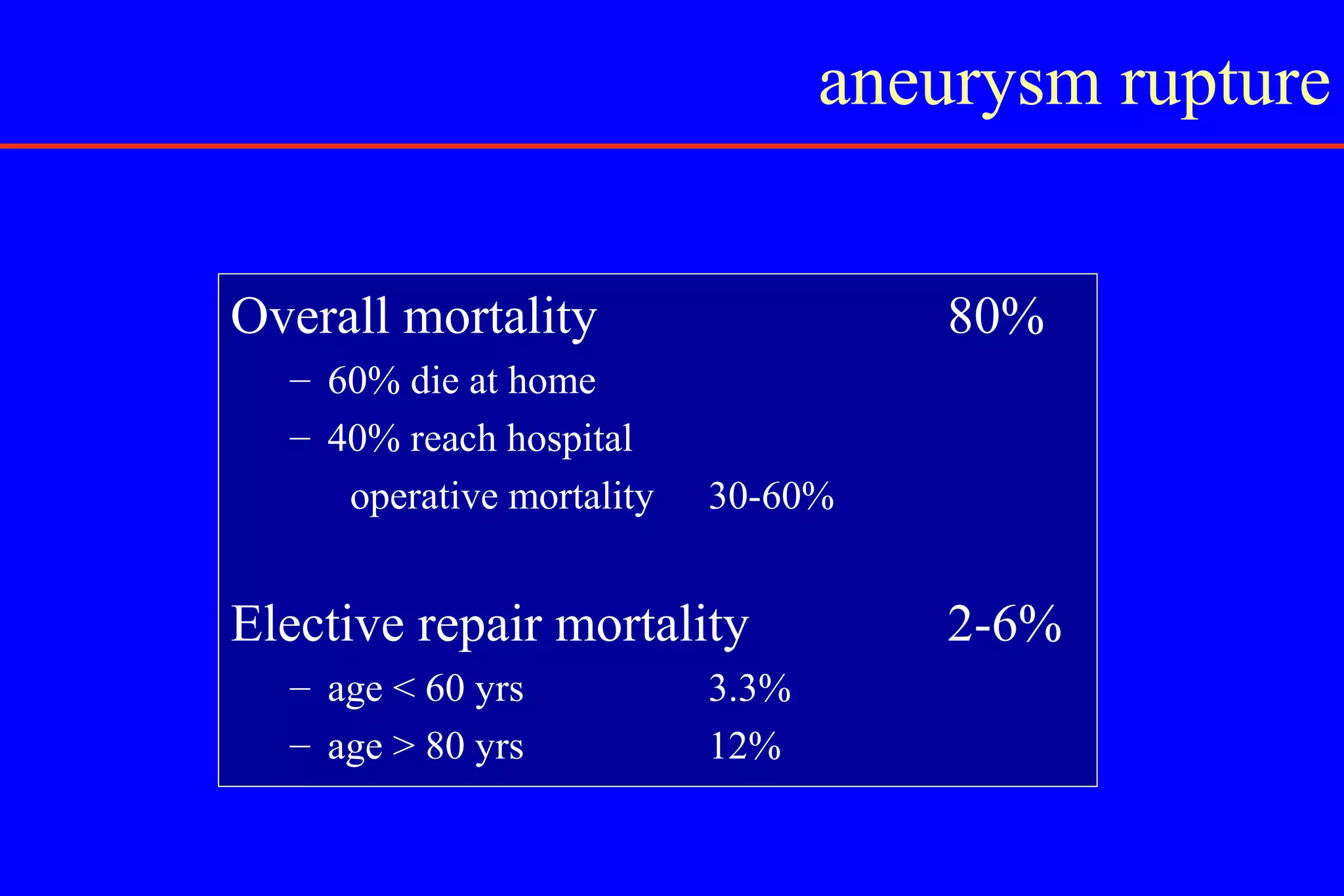
Overall mortality 80%
– 60% die at home
– 40% reach hospital
operative mortality 30-60%
Elective repair mortality 2-6%
– age < 60 yrs 3.3%
– age > 80 yrs 12%
annual risk of rupture
Size matters
– < 5.5cm: low risk 1% per year
– 5-6cm: 5-10% per year
– >7cm: 20%
indications for repair
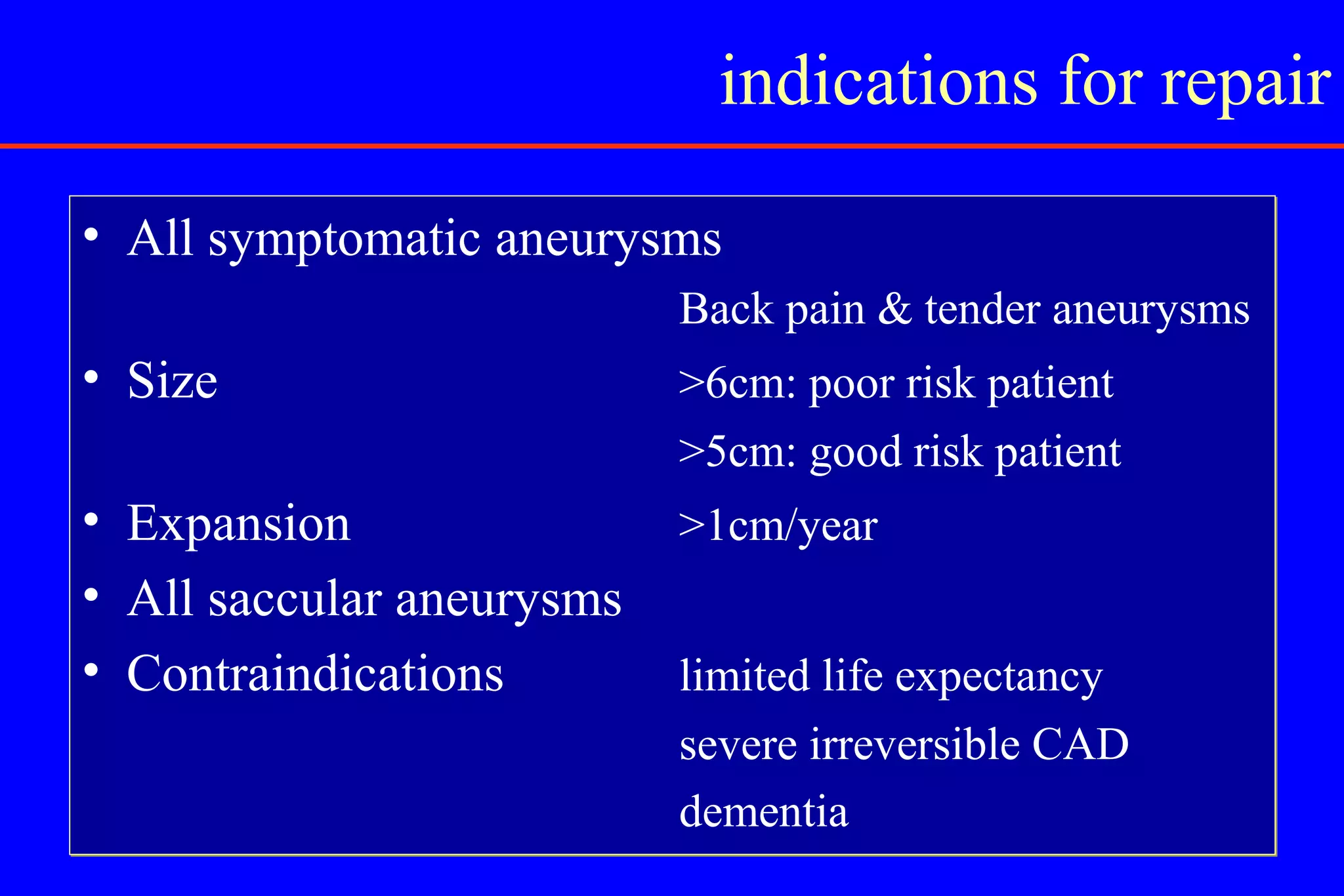
• All symptomatic aneurysms
Back pain & tender aneurysms
• Size >6cm: poor risk patient
>5cm: good risk patient
• Expansion >1cm/year
• All saccular aneurysms
• Contraindications limited life expectancy
severe irreversible CAD
dementia
• All symptomatic aneurysms
Back pain & tender aneurysms
• Size >6cm: poor risk patient
>5cm: good risk patient
• Expansion >1cm/year
• All saccular aneurysms
• Contraindications limited life expectancy
severe irreversible CAD
dementia
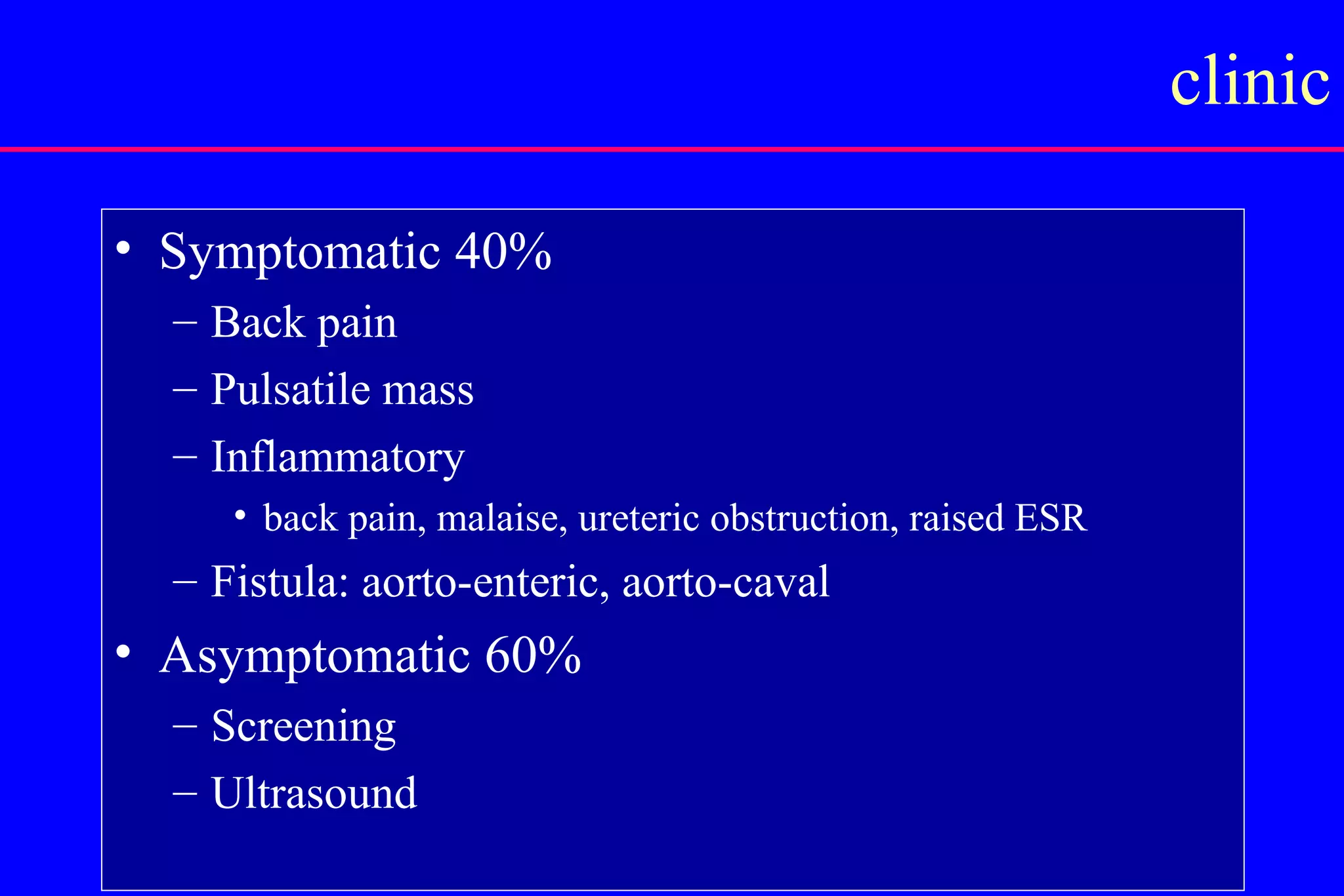
clinic
• Symptomatic 40%
– Back pain
– Pulsatile mass
– Inflammatory
• back pain, malaise, ureteric obstruction, raised ESR
– Fistula: aorto-enteric, aorto-caval
• Asymptomatic 60%
– Screening
– Ultrasound
preoperative tests
• Ultrasound
– measures size
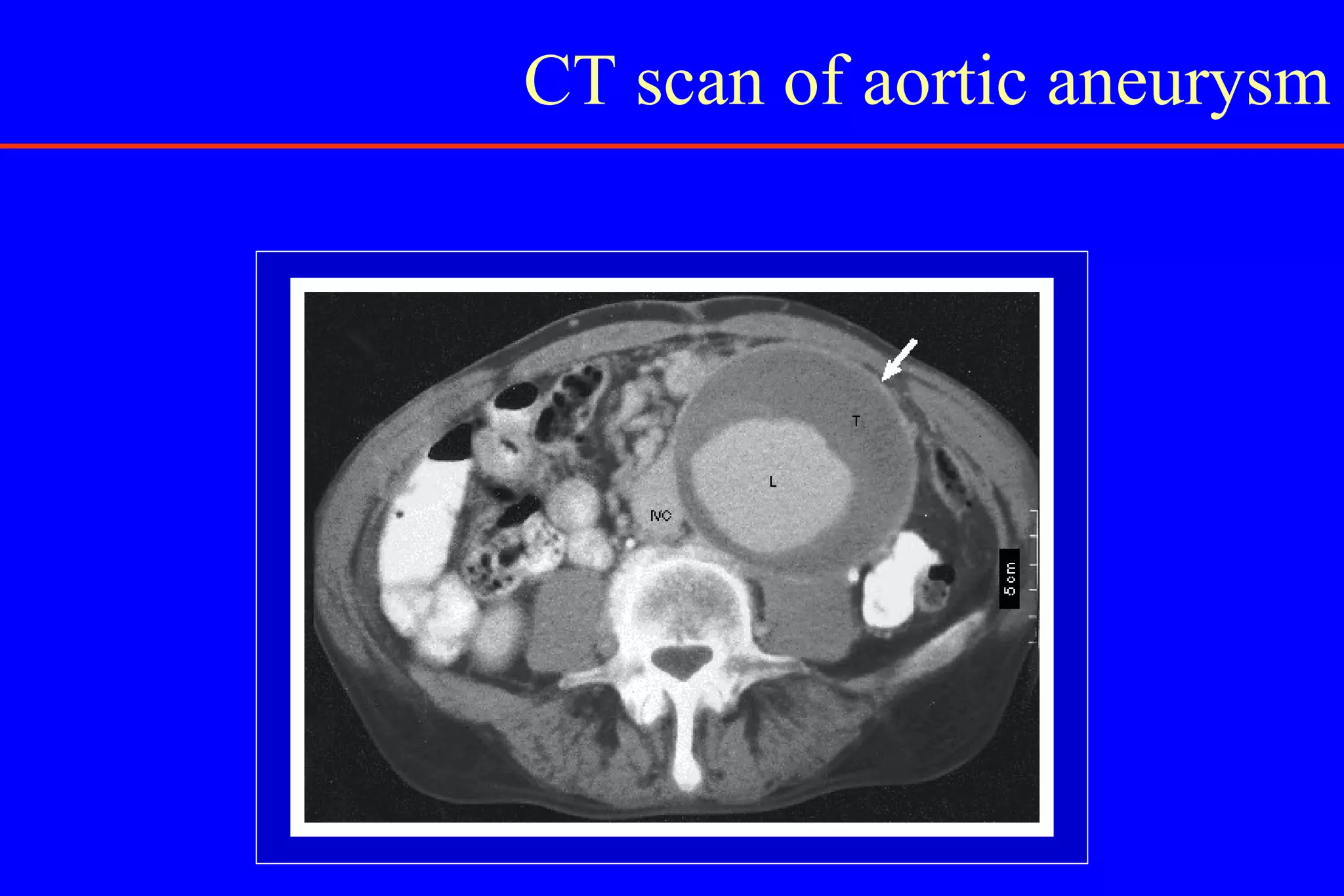
• CT scan
– defines anatomy and extent
• 95% infrarenal; 5% suprarenal
• 12% also have thoracic aortic aneurysm
• Cardiac, lung and renal function
CT scan of aortic aneurysm
3D reconstruction from CT scan
3D reconstruction
preoperative evaluation 1
Risk factors
Age > 70
Cardiac
Diuretics / CCF
P.H. ventricular arrythmia
Q waves on ECG
Angina
Diabetes
Renal failure
operative management 1
• Epidural catheter improves pulmonary function
• Feel pulses
• DVT prophylaxis Heparin , compression boots
• Drape Nipples-Femorals
• Incision Midline
Transverse
Oblique retroperitoneal
incision
operative management 2
• Laparotomy
• Expose aneurysm neck ( ? ligate L renal vein)
• Expose iliacs
• Administer heparin
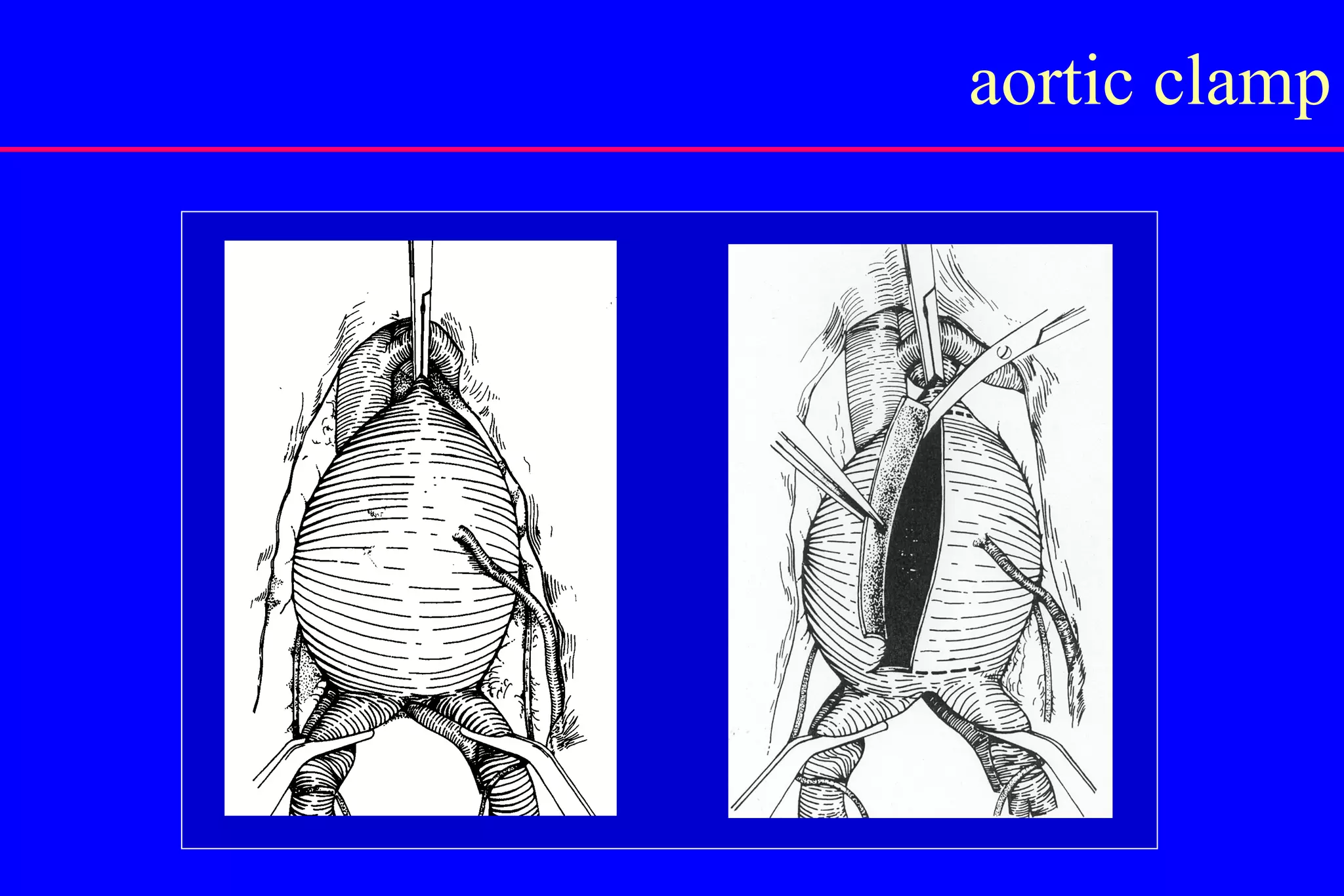
• Clamp iliac arteries avoiding iliac veins
• Clamp aorta slot the neck
laparotomy
operative management 3
• Open aneurysm sac kit ready
• Remove thrombus
• Ligate lumbar arteries, clamp IMA 2/0 silk
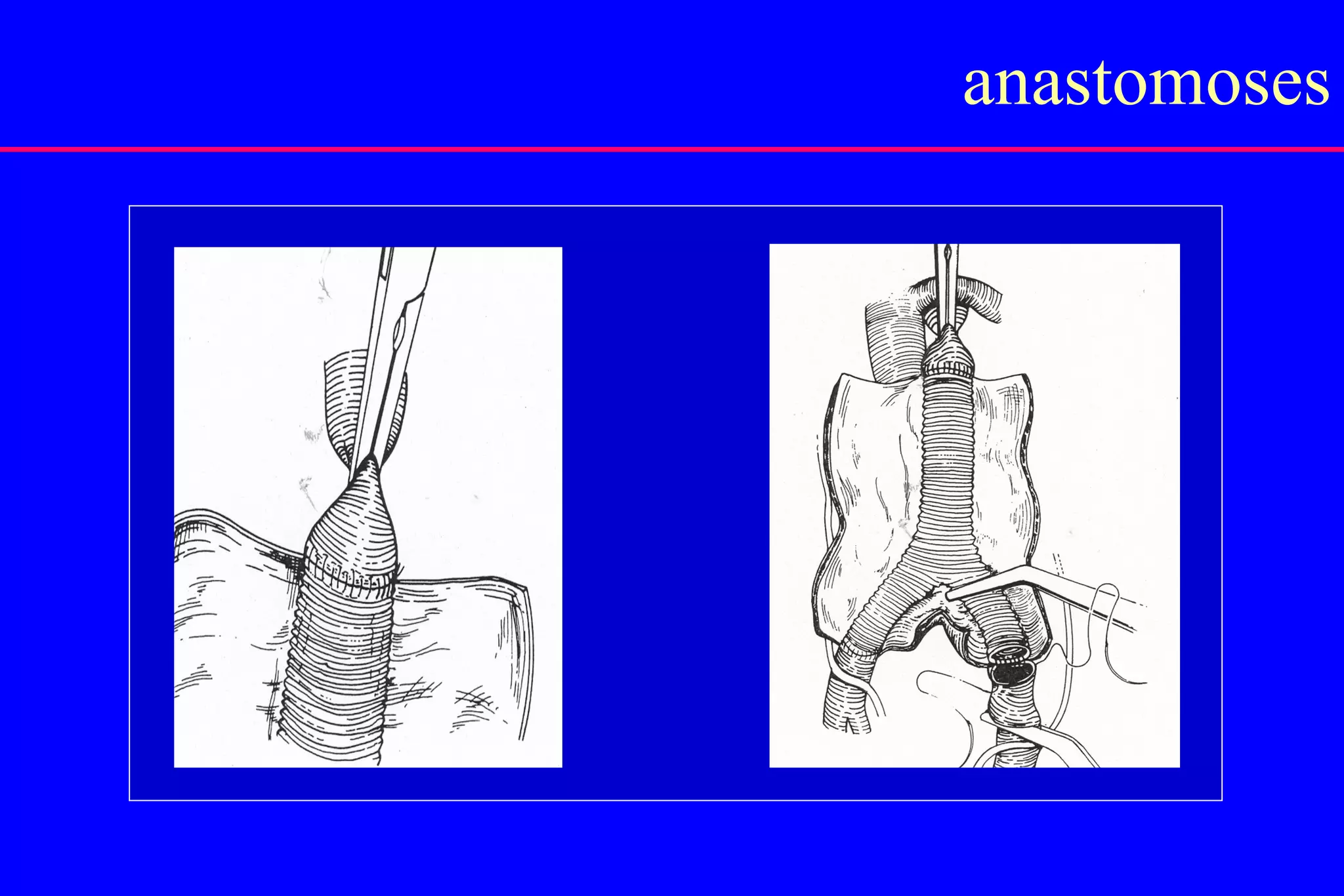
• Proximal anastomosis cont Surgilene
• Check integrity of anastomosis pledget sutures
• Distal anastomosis flush & check
• Blood flow to one internal iliac maintain BP
aortic clamp
lumbar vessels
anastomoses
operative management 4
• Check perfusion of colon IMA Carrell patch
• Check femoral pulses
• Check for haemorrhage
• Cover prosthesis with sac & peritoneum
tube graft
closing the sac
complications of aneurysm repair 1
Cardiac 15% (MI 2-8%)
Pulmonary 8-12 % (Pneumonia 5%)
Renal function 5-12% (Dialysis1-6%)
DVT 8%
Bleeding 2-5%
Stroke 1%
complications of aneurysm repair 2
Ureteric injury <1%
Leg ischaemia 1-4%
Colon ischaemia 1%
Wound infection 5%
Spinal cord ischaemia 1%
late complications of aneurysm repair
Anastomotic false aneurysm 0.2% aorta
1.2% iliac
3% femoral
Graft infection 0.5% aortoiliac
Aortoenteric fistula 0.9%
Graft Thrombosis Rare
Other aneurysms 5%
prognosis after aneurysm repair
5 year survival 70%
10 year survival 40%
Late deaths: cardiac 44%
cancer 15%
rupture another aneurysm 11%
stroke 9%
pulmonary 6%
endovascular repair
endovascular repair
2 small groin incisions
endovascular suite
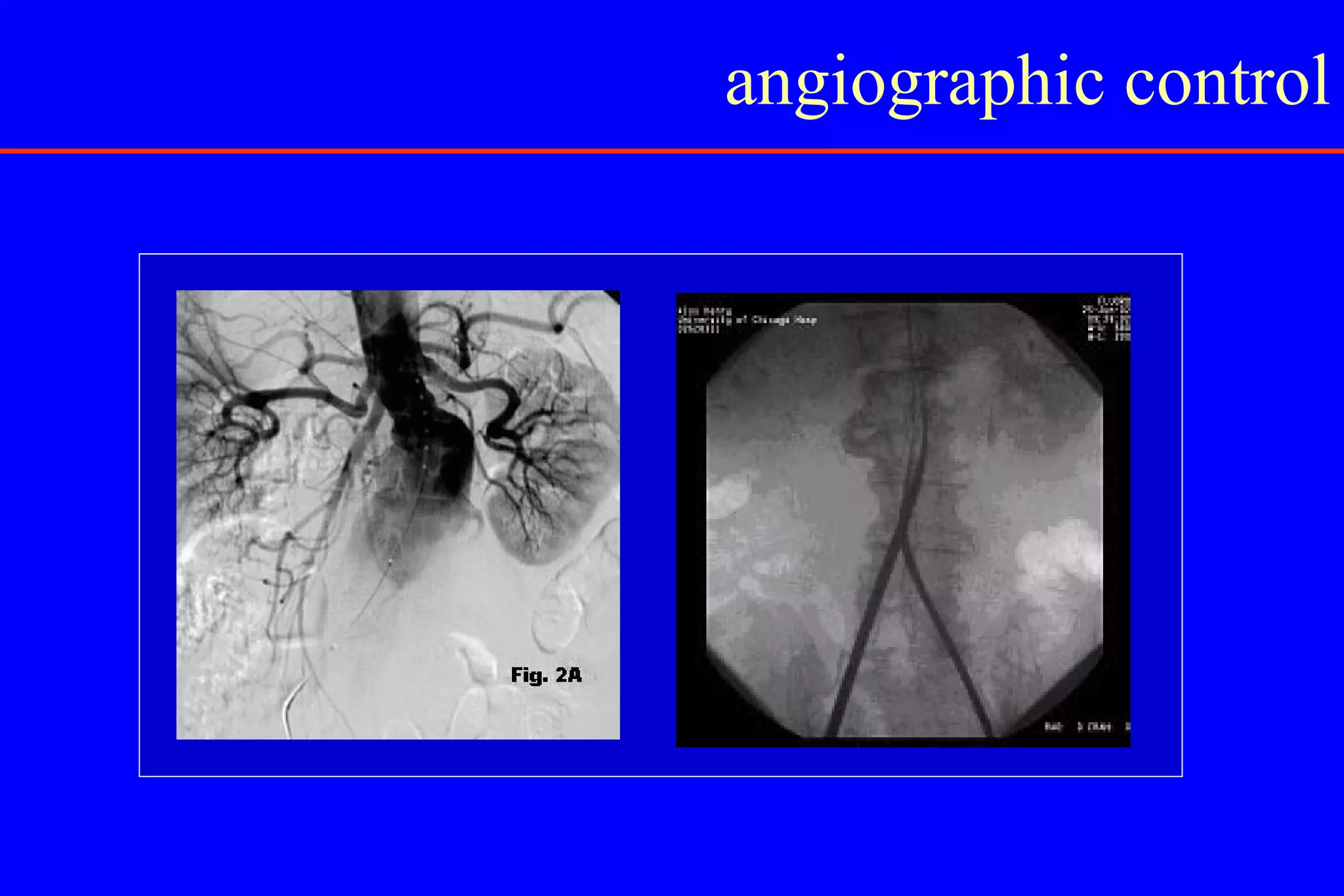
angiographic control
stents deployed
thanks for listening
aneurysm formation
• Failure of elastin (age, BP, genetic)
• Aneurysm formation
• Tensile load taken by collagen
• Biomechanical properties of collagen/fibrillin
vary with genotype
• Influence on expansion and rupture
30 day mortality
Cause Elective Rupture
Cardiac 58% 20%
Pulmonary 6% 3%
Renal 4% 9%
Colon infarction 1% 9%
Haemorrhage 0% 18%
MSOF 1% 35%
Other 24% 6%
preoperative evaluation 2
Risk factor Cardiac Investigation
complication
Low risk 0 0% None
Intermediate 1-2 3% Non invasive negative
30% Non invasive positive
High 3+ 50% Coronary angiogram
physics
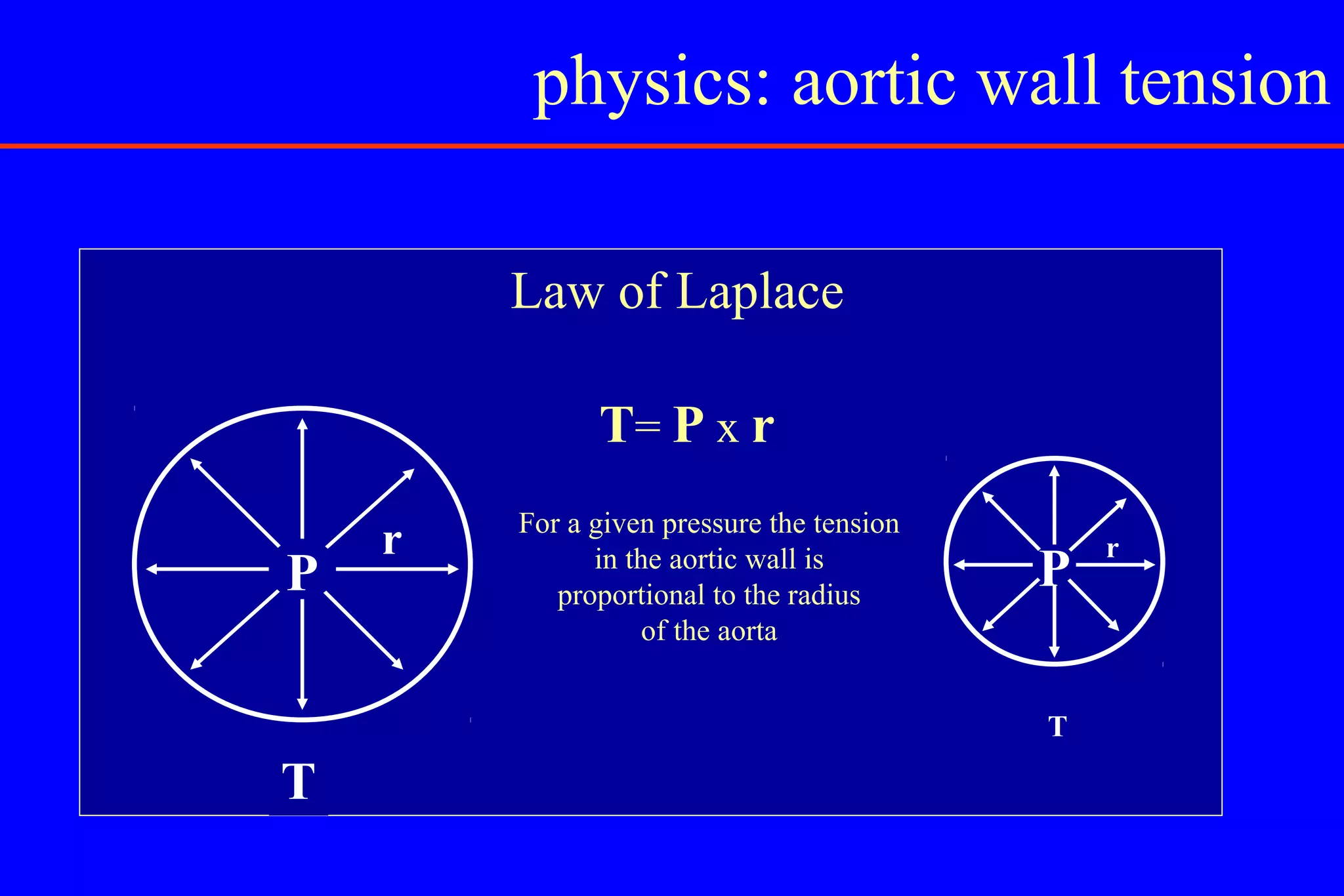
physics: aortic wall tension
Law of Laplace
T= P x r
For a given pressure the tension
in the aortic wall is
proportional to the radius
of the aorta
P
r
T
P
r
T
physics: blood flow
If blood flow (mls/min) is constant, the velocity of
blood must increase in a narrower vessel
A B
A B
1s
1s
physics:energy in blood 1
Bernouilli’s equation
The total fluid energy =
kinetic energy + potential energy
velocity pressure
Conservation of energy
physics:energy in blood 2
Aorta Aneurysm
Pressure
Velocity
Slower flowing blood in the aneurysm exerts a greater pressure

Abdominal Aortic Aneurysm

  • 1.
  • 2.
    • Definition • Diameter> 1.5 times normal vessel diameter (Aorta>3cm) • Sex • 1.2% male deaths, 0.6% female deaths • Age • men start at 50 yrs, peak incidence 80 yrs • female start at 70 yrs, peak incidence 90 yrs aortic aneurysms 1
  • 3.
    aortic aneurysms 2 •Family history • 15-20% of patients with AAA have a first degree relative with AAA: compared to 2% of controls • Incidence • increasing death rate from rupture over last 30yrs (increasingly elderly popln, [65+yrs to double by 2025]) • 5% men over 65yrs have AAA (screening)
  • 4.
  • 5.
    aneurysm histology Lumen Thrombus Lumen Intima atherosclerotic Mediathin fibrous replacement of SMC disrupted elastic fibres reduced elastin content increase in collagen Adventitia thickened increase in collagen inflammation Normal Aneurysm Endothelium/Intima Media Adventitia
  • 6.
    Aneurysm Ehlers Danlos IV mutation TypeIII collagen Marfans mutation Fibrillin Hypertension increase in pressure Smoking damage to arterial wall Gelatinase Elsatase Metalloproteinases degrade elastin Genetic EnvironmentBiomechanical Strength Compliance Elastance causes of aortic aneurysm
  • 7.
    aneurysm rupture • Occurswhen the tension in the aneurysm wall exceeds the tensile strength of the aneurysm wall • Depends on : – size diameter, wall thickness (Laplace) – shape symmetric, asymmetric – pressure hypertension, Bernouilli – material loss of elastin, increase in collagen
  • 8.
    aneurysm rupture Overall mortality80% – 60% die at home – 40% reach hospital operative mortality 30-60% Elective repair mortality 2-6% – age < 60 yrs 3.3% – age > 80 yrs 12%
  • 9.
    annual risk ofrupture Size matters – < 5.5cm: low risk 1% per year – 5-6cm: 5-10% per year – >7cm: 20%
  • 10.
    indications for repair •All symptomatic aneurysms Back pain & tender aneurysms • Size >6cm: poor risk patient >5cm: good risk patient • Expansion >1cm/year • All saccular aneurysms • Contraindications limited life expectancy severe irreversible CAD dementia • All symptomatic aneurysms Back pain & tender aneurysms • Size >6cm: poor risk patient >5cm: good risk patient • Expansion >1cm/year • All saccular aneurysms • Contraindications limited life expectancy severe irreversible CAD dementia
  • 11.
    clinic • Symptomatic 40% –Back pain – Pulsatile mass – Inflammatory • back pain, malaise, ureteric obstruction, raised ESR – Fistula: aorto-enteric, aorto-caval • Asymptomatic 60% – Screening – Ultrasound
  • 12.
    preoperative tests • Ultrasound –measures size • CT scan – defines anatomy and extent • 95% infrarenal; 5% suprarenal • 12% also have thoracic aortic aneurysm • Cardiac, lung and renal function
  • 13.
    CT scan ofaortic aneurysm
  • 14.
  • 15.
  • 16.
    preoperative evaluation 1 Riskfactors Age > 70 Cardiac Diuretics / CCF P.H. ventricular arrythmia Q waves on ECG Angina Diabetes Renal failure
  • 17.
    operative management 1 •Epidural catheter improves pulmonary function • Feel pulses • DVT prophylaxis Heparin , compression boots • Drape Nipples-Femorals • Incision Midline Transverse Oblique retroperitoneal
  • 18.
  • 19.
    operative management 2 •Laparotomy • Expose aneurysm neck ( ? ligate L renal vein) • Expose iliacs • Administer heparin • Clamp iliac arteries avoiding iliac veins • Clamp aorta slot the neck
  • 20.
  • 21.
    operative management 3 •Open aneurysm sac kit ready • Remove thrombus • Ligate lumbar arteries, clamp IMA 2/0 silk • Proximal anastomosis cont Surgilene • Check integrity of anastomosis pledget sutures • Distal anastomosis flush & check • Blood flow to one internal iliac maintain BP
  • 22.
  • 23.
  • 24.
  • 25.
    operative management 4 •Check perfusion of colon IMA Carrell patch • Check femoral pulses • Check for haemorrhage • Cover prosthesis with sac & peritoneum
  • 26.
  • 27.
  • 28.
    complications of aneurysmrepair 1 Cardiac 15% (MI 2-8%) Pulmonary 8-12 % (Pneumonia 5%) Renal function 5-12% (Dialysis1-6%) DVT 8% Bleeding 2-5% Stroke 1%
  • 29.
    complications of aneurysmrepair 2 Ureteric injury <1% Leg ischaemia 1-4% Colon ischaemia 1% Wound infection 5% Spinal cord ischaemia 1%
  • 30.
    late complications ofaneurysm repair Anastomotic false aneurysm 0.2% aorta 1.2% iliac 3% femoral Graft infection 0.5% aortoiliac Aortoenteric fistula 0.9% Graft Thrombosis Rare Other aneurysms 5%
  • 31.
    prognosis after aneurysmrepair 5 year survival 70% 10 year survival 40% Late deaths: cardiac 44% cancer 15% rupture another aneurysm 11% stroke 9% pulmonary 6%
  • 32.
  • 33.
  • 34.
  • 35.
  • 36.
  • 37.
  • 40.
    aneurysm formation • Failureof elastin (age, BP, genetic) • Aneurysm formation • Tensile load taken by collagen • Biomechanical properties of collagen/fibrillin vary with genotype • Influence on expansion and rupture
  • 41.
    30 day mortality CauseElective Rupture Cardiac 58% 20% Pulmonary 6% 3% Renal 4% 9% Colon infarction 1% 9% Haemorrhage 0% 18% MSOF 1% 35% Other 24% 6%
  • 42.
    preoperative evaluation 2 Riskfactor Cardiac Investigation complication Low risk 0 0% None Intermediate 1-2 3% Non invasive negative 30% Non invasive positive High 3+ 50% Coronary angiogram
  • 43.
  • 44.
    physics: aortic walltension Law of Laplace T= P x r For a given pressure the tension in the aortic wall is proportional to the radius of the aorta P r T P r T
  • 45.
    physics: blood flow Ifblood flow (mls/min) is constant, the velocity of blood must increase in a narrower vessel A B A B 1s 1s
  • 46.
    physics:energy in blood1 Bernouilli’s equation The total fluid energy = kinetic energy + potential energy velocity pressure
  • 47.
    Conservation of energy physics:energyin blood 2 Aorta Aneurysm Pressure Velocity Slower flowing blood in the aneurysm exerts a greater pressure