Organ & Tissue donation
Clinical Update
Dr Shibu Chacko MBE
Specialist Nurse Organ Donation
ODT South East of England
NHS Blood and Transplant, UK
Email: shibu.chacko@nhs.net
Aims of the session
• Background to Organ Donation
• Statistics
• DBD Vs DCD , Brain Stem Death
• Consent, Screening , Offering process
• Organ Donation process inc Theatre
• Tissue Donation
Introduction to the topic
Facts & Figures
Definition
• Organ donation is the donation of biological
tissue or an organ of human body from a living
or deceased person to a living recipient in
need of transplantation.
Common Jargon’s used
• SNOD - Specialist Nurse for Organ Donation
• CLOD - Clinical Lead for Organ Donation
• Donor - Those patients that donate
• Recipient - Those that receive an organ
• Retrieval - Banishes the use of ‘harvesting’
• ODR - Organ Donor Register
ODT - It’s a modern day success story!
• ODT is the most realistic and sometimes only option for end
stage organ failure
• For donor and relatives – There is something good has emerged
from a disaster
• For the recipient – There is a new opportunity for an independent
life
• For medical profession – There is an opportunity for cure for a
chronic condition
• For the wider society as a whole – An excellent cost effective
solution
Organ Donation in the 21st Century
• “Healthy organs..........are cremated or buried –
not because the deceased objected to donation
but simply because relatives were not given the
opportunity to consider donation”.
BMA report June 2000
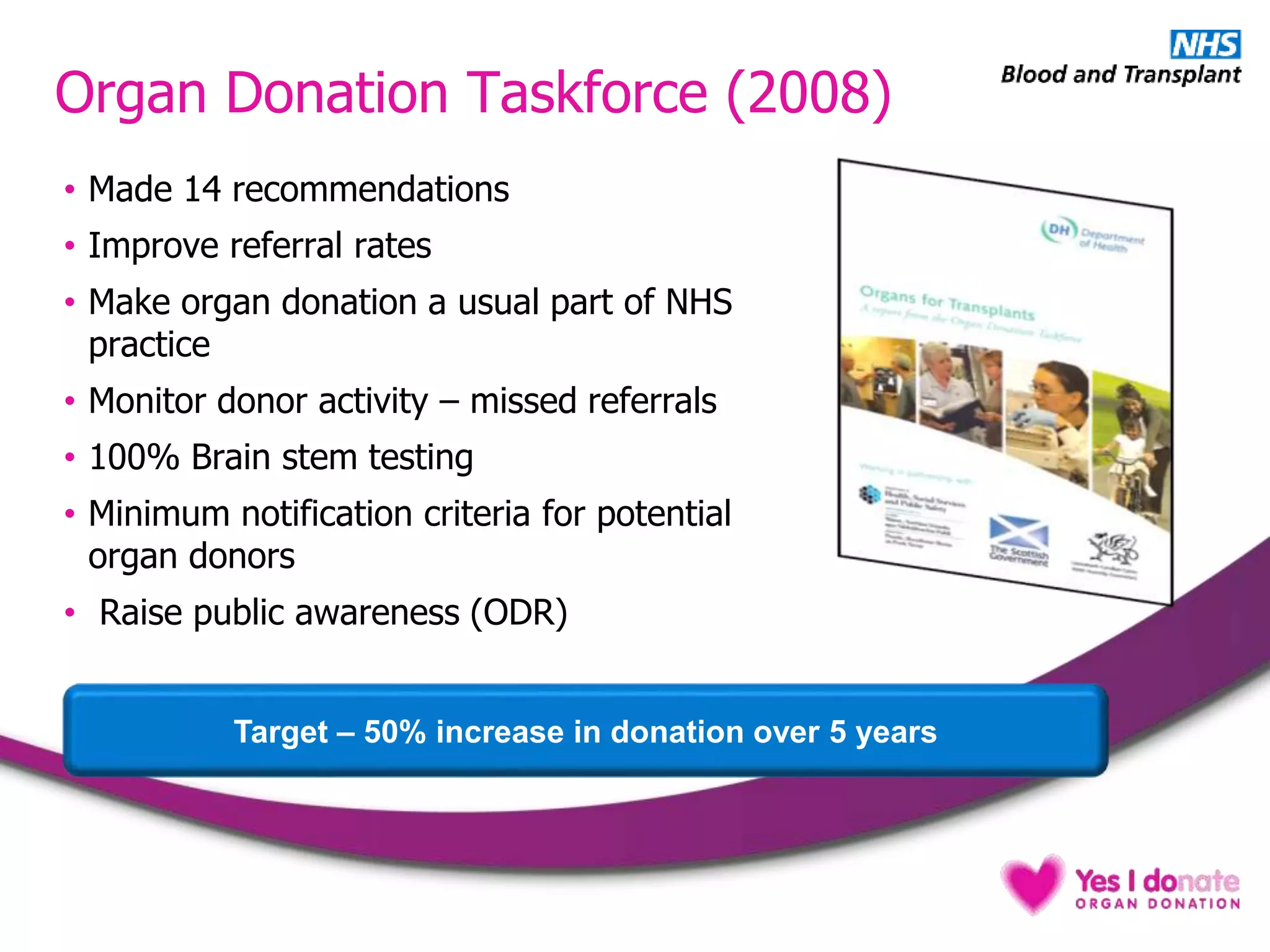
Organ Donation Taskforce (2008)
• Made 14 recommendations
• Improve referral rates
• Make organ donation a usual part of NHS
practice
• Monitor donor activity – missed referrals
• 100% Brain stem testing
• Minimum notification criteria for potential
organ donors
• Raise public awareness (ODR)
Target – 50% increase in donation over 5 years
NICE Guidelines
To promote the identification and fulfilment of those
that wish to donate organs
More effective and expedient identification of
potential organ donors
A more informed and timely approach to consent for
donation that is based primarily on identifying the
wishes of the individual whenever known and
however recorded
To improve:
– identification and referral of potential donors
– approach to consent for donation
– consideration of donation as part of
standard ‘end-of-life care’ planning
Why bother?
Renal Costs per patient per annum
• Dialysis £28,967
• Cost over 10 years - £ 289, 677 + Other costs
Transplantation costs per patient
• Assessment & transplant £52, 443
• After 1st year £35, 430
• Costs per year £7,274
• Cost over 10 years - £ 102, 716
Counting the cost
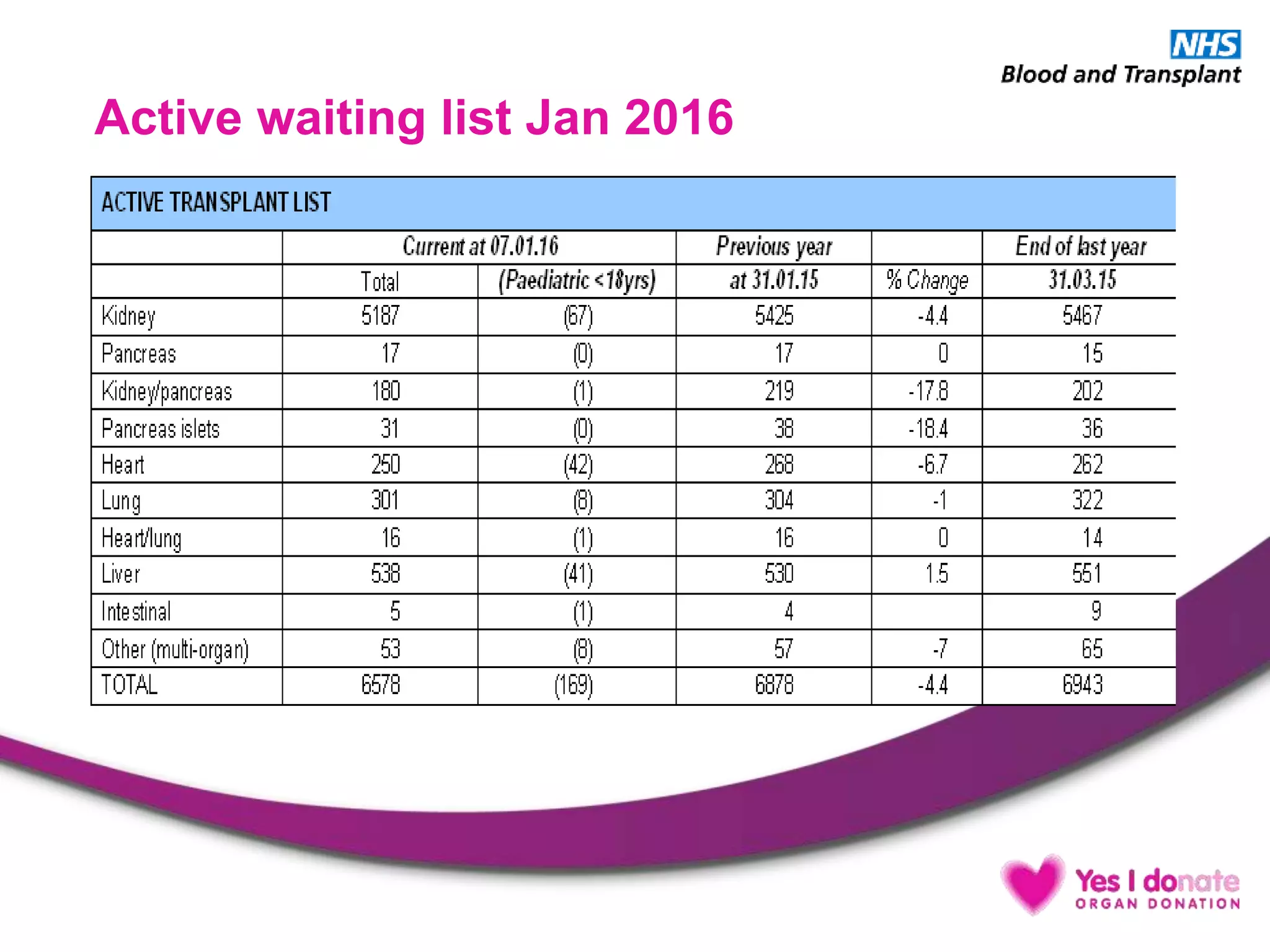
• Currently over 6500 people waiting
• Average 3-4 patients die every day while waiting
for a transplant
• Last year 466 patients died waiting and 881 were
removed from the waiting list
• Many of them died shortly afterwards
Ad campaigns from Brazil
What is UK Organ Donation potential?
• Approx. half a million people die in UK every year
• Only 1% die in circumstances where OD possible
• Only possible if die on a ventilator; so death must
occur in ICU or ED.
• Small potential donors Vs high number of people
WL
Donation at 2006 and 2012
0 5 10 15 20 25 30 35
donors pmp
Greece
Sweden
Switzerland
Denmark
Poland
The Netherlands
Latvia
Germany
Hungary
Slovakia
Finland
UK
Norway
Italy
France
USA
Portugal
Croatia
Spain
0 5 10 15 20 25 30 35
donors pmp
Greece
Switzerland
Denmark
Slovak Republic
The Netherlands
Croatia
UK
Poland
Sweden
Germany
Norway
Hungary
Latvia
Portugal
Finland
Italy
France
USA
Spain
Number of donors and Transplants
Active waiting list Jan 2016
NHS Organ Donor Register
• Confidential database which records peoples organ
donation wishes
• Total UK population = 66 million (2011 census)
• Only 22 million people on NHS ODR (33%)
• Opt out system in Wales since Dec 2015
• Nearly all would receive an organ if needed
• Your loved one, nearest and dearest MUST be aware of
your wishes
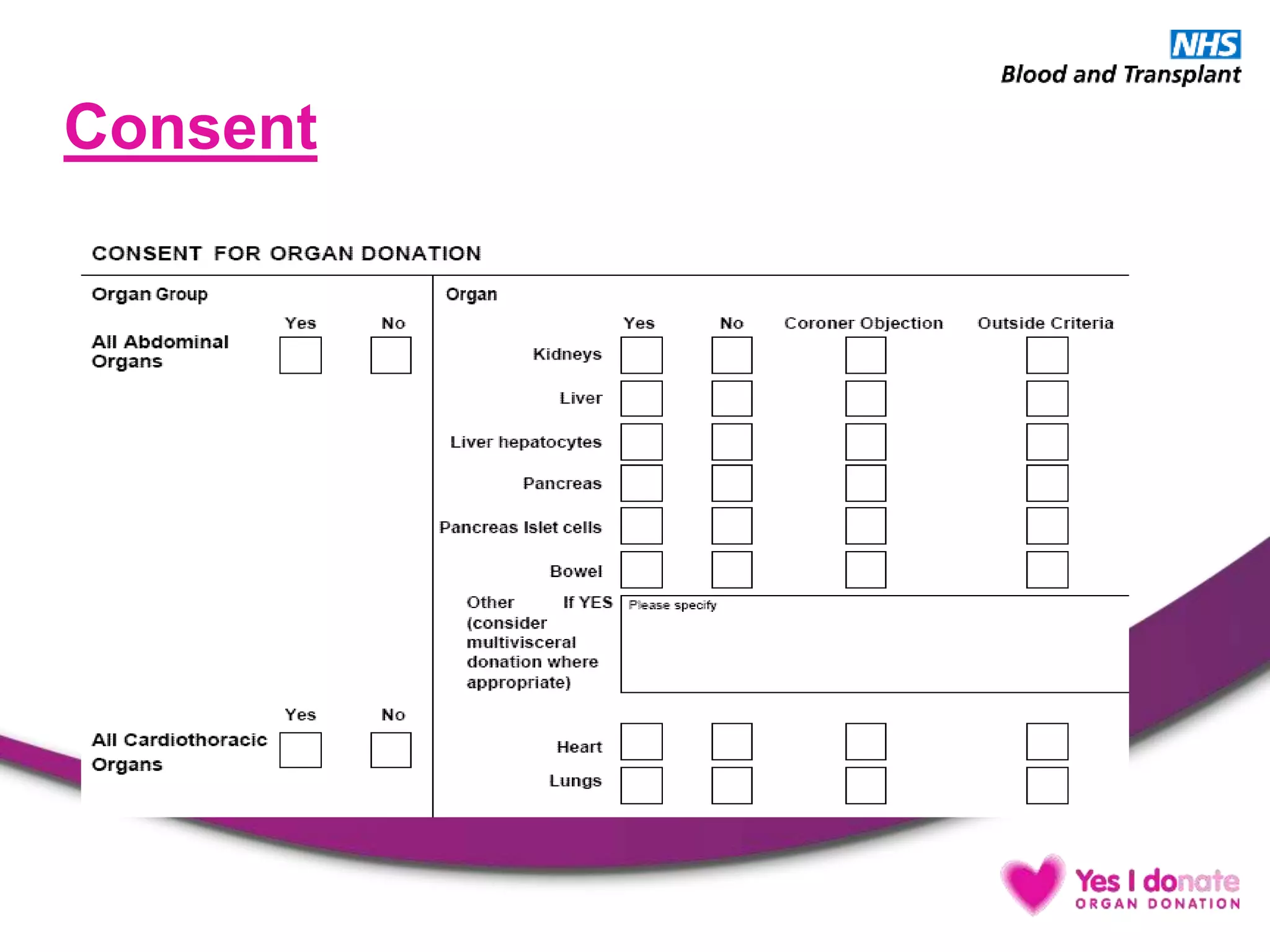
Consent & Authorisation for donation
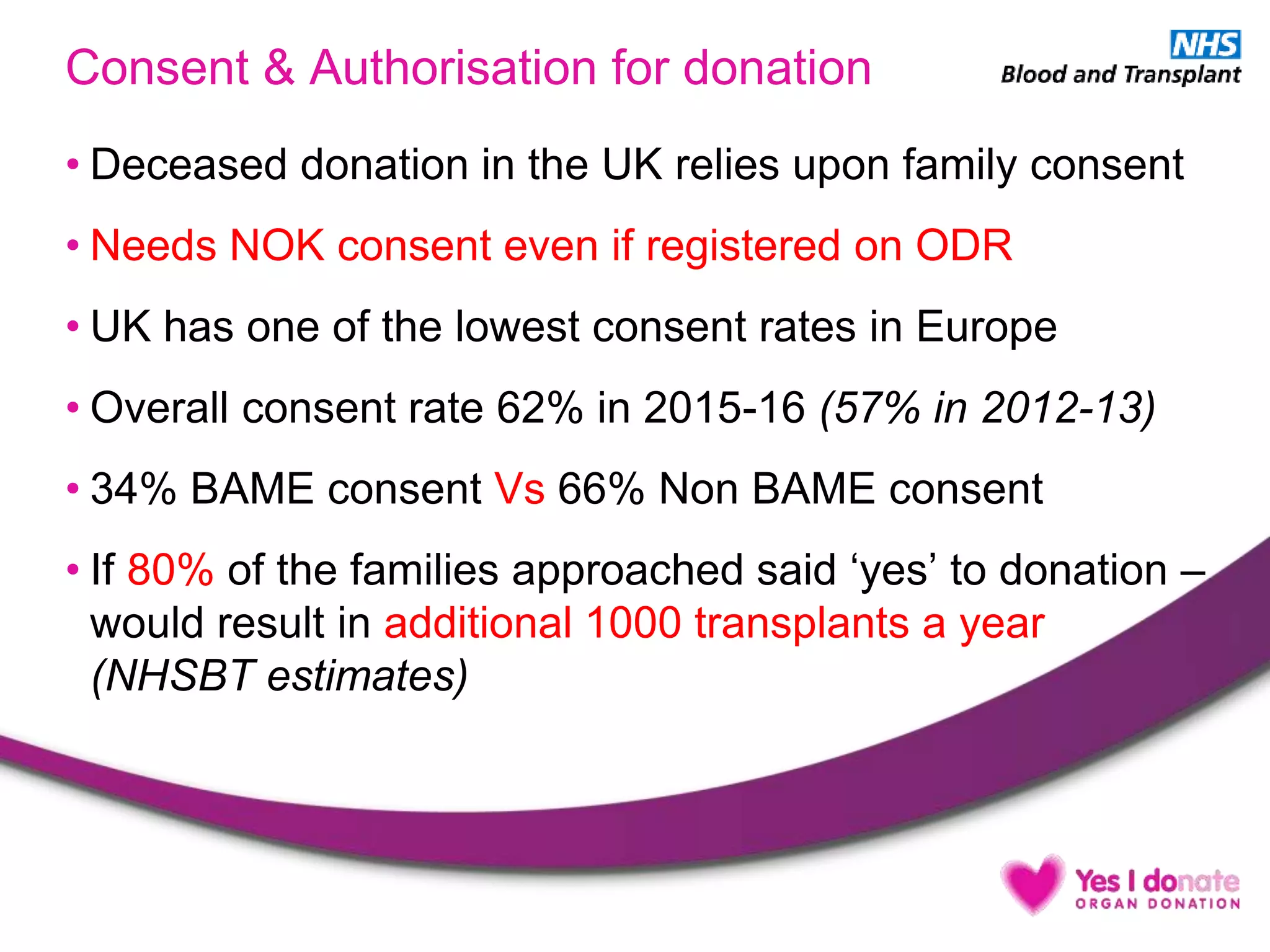
• Deceased donation in the UK relies upon family consent
• Needs NOK consent even if registered on ODR
• UK has one of the lowest consent rates in Europe
• Overall consent rate 62% in 2015-16 (57% in 2012-13)
• 34% BAME consent Vs 66% Non BAME consent
• If 80% of the families approached said ‘yes’ to donation –
would result in additional 1000 transplants a year
(NHSBT estimates)
European Refusal rates
0
5
10
15
20
25
30
35
40
45
familyrefusalrate
UK Italy Romania Rep
Ireland
Croatia Spain Poland Slovakia Hungary Czech
Republic
Donation in Ethnic Minorities
• More likely to need a transplant due to HTN, DM and hepatitis
• More successful and likely if donor from the same ethnicity
• 14% of the UK population is BAME, Only 3.5% on ODR
• Only 5% of the actual deceased donors (67 last year)
• Less than 30% consent rates
• 26% of the waiting list are BAME (1686 patients in Aug 2016)
• BAME recipients wait a year longer for a transplant
Absolute Contraindications
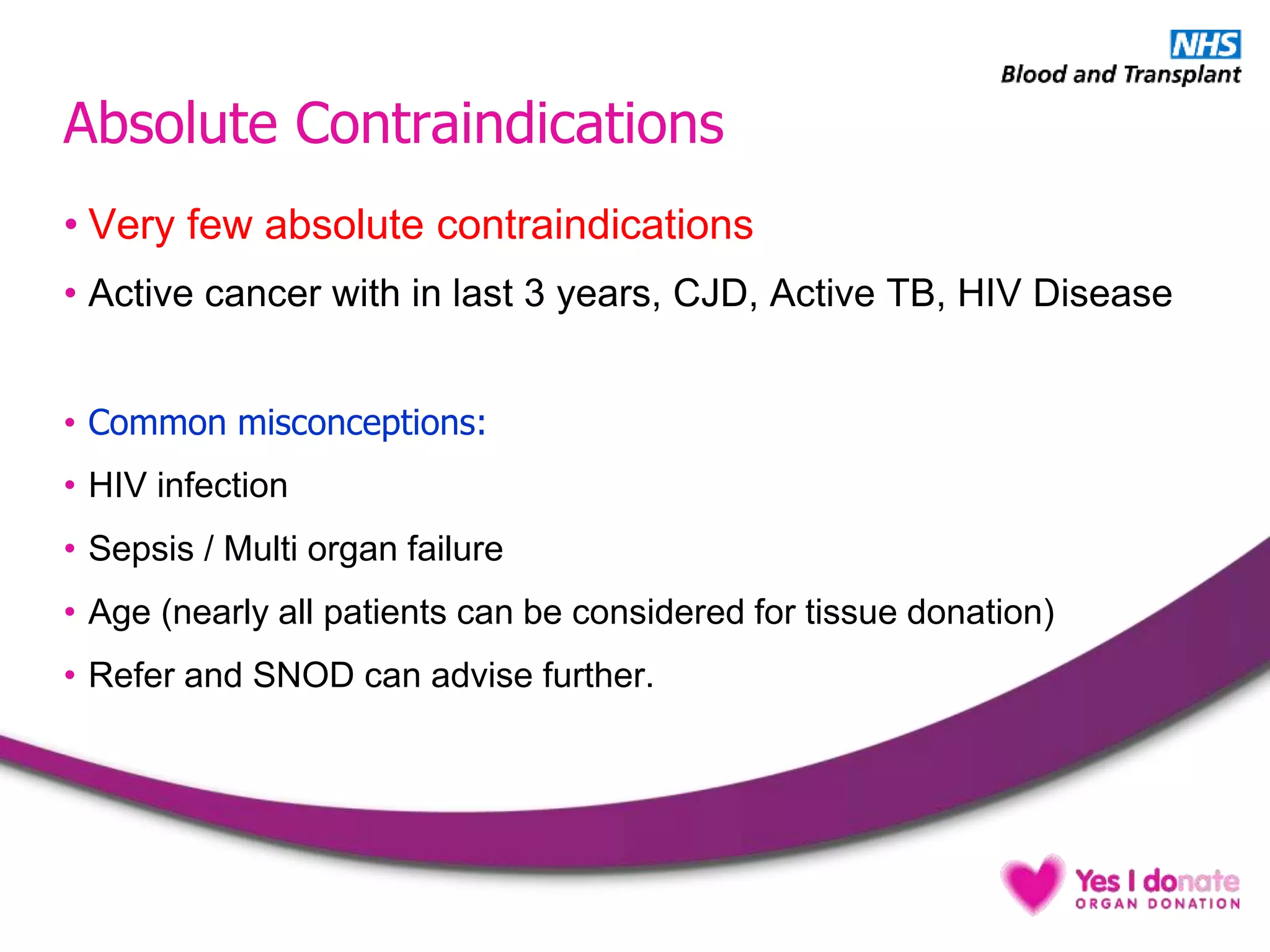
• Very few absolute contraindications
• Active cancer with in last 3 years, CJD, Active TB, HIV Disease
• Common misconceptions:
• HIV infection
• Sepsis / Multi organ failure
• Age (nearly all patients can be considered for tissue donation)
• Refer and SNOD can advise further.
Barriers to Donation
• Age (85 and above)
• Organ specific contraindications – COPD, Emphysema,
MI, CKD stage 3 with eGFR <35, ALT 10000, Liver cirrhosis etc
• Family consent & Coroner consent
• Non referral or late referral
• Health professionals beliefs
Donor Identification
All potential donors should be identified and
referred as early as possible to the SNOD. This
will facilitate donor screening and donor
management.
South East Region
A Day In The Life
• Directorate of ODT – NHS Blood and Transplant
• 12 SNOD Teams in the UK
• The South East SNOD Team are responsible for
providing 24hr cover for the facilitation of organ
donation from 53 Trusts
• There are 14 of us
• On call shifts are 24 hours
• We have all been embedded into individual trusts
One of the most complicated process in the
And One of the Most
Rewarding
‘I have heard people say how brave we were to
donate Mya’s organs. I don’t feel that it was that
difficult at all.
Mya was so full of zest, verve, drive, compassion
and life; I knew we had to allow her to live on.
Mya’s life gave hope and
an opportunity to 6
families’
‘… it was about not letting Ashton die in vain and
keeping his memory alive. We were trying to create
something positive out of something so tragic…’
‘We sent Luca’s organs with love to all those people
who received them’
Referral to SNOD
• PAGER: 07659590529 – WE WILL RESPOND WITHIN
20 MINUTES
• We will ask for patient details Name, DOB, NHS Number
• Pt history, current status and Consultant’s plan
• If potential for donation, we will mobilise asap if not on
site.
• Do not approach family’s about donation, we are aiming
for a Collaborative approach between Consultant and
SNOD
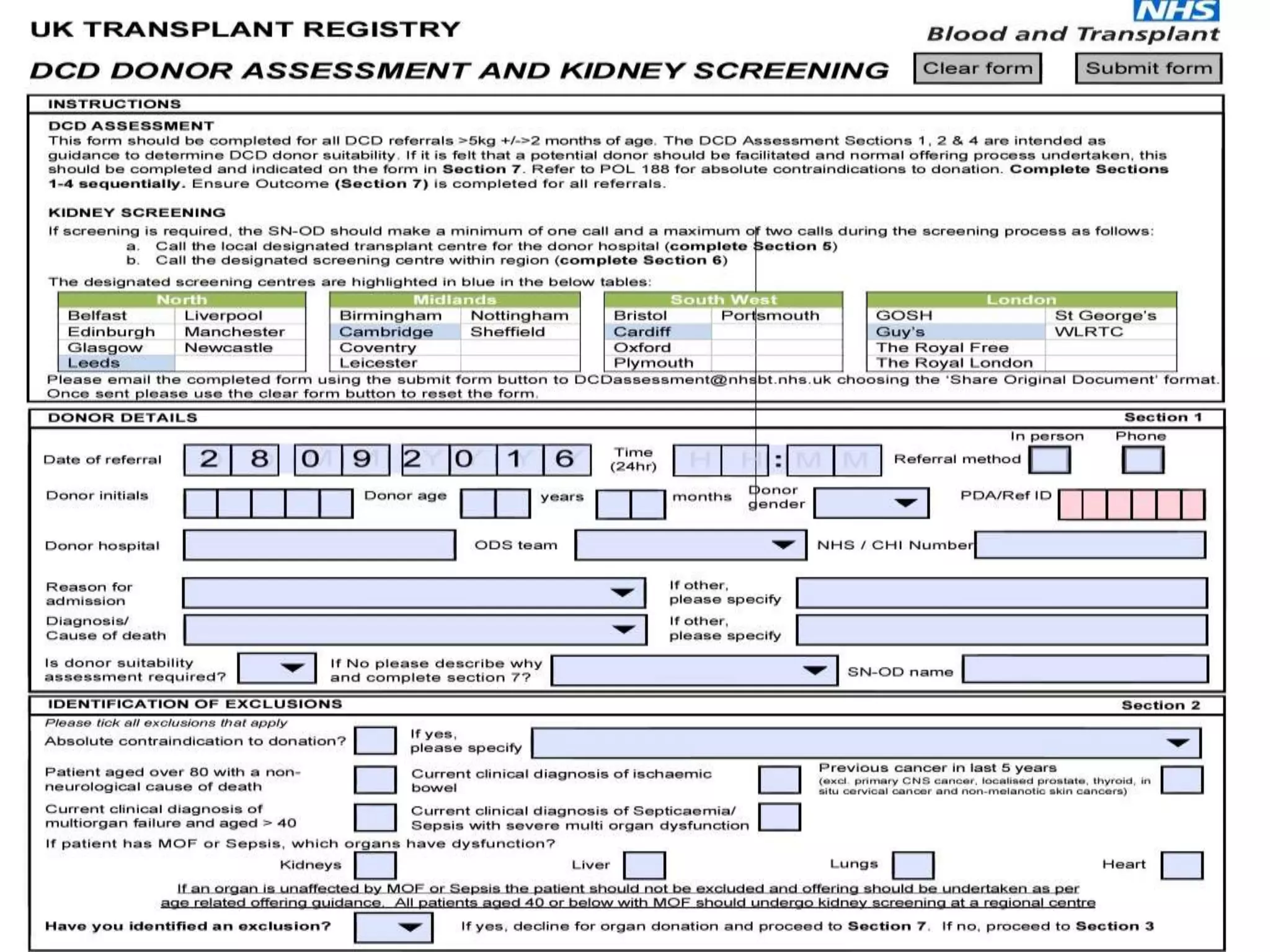
Potential Donor Screening
If the potential donor is ‘marginal’ screening tools
will be used by SNOD to ensure their suitability.
This can be DCD assessment tool, Screening
calls with Transplant centres and Surgeons,
Tissue establishments etc.
Types of Donation
• Living Donation
• Deceased Donation
1. Donation after Brain Stem Death (DBD) <85 years
Patient is confirmed brain stem dead prior to retrieval
2. Donation after Circulatory Death (DCD) <85 years
Treatment is withdrawn and donation occurs post asystole
3. Tissue Donation
With in 24-48 hours of some passed away.
Donation after Brain Stem Death (DBD)
• Mechanically ventilated
patient where death has been
confirmed using neurological
criteria.
• Organ quality following DBD
remains superior- less need
for dialysis, less Biliary
complications.
• Kidneys
• Liver
• Pancreas
• Lungs
• Heart
• Small Intestine (Only source
of organs currently)
Donation after Circulatory Death (DCD)
• Mechanically ventilated patient with
a devastating injury, usually brain,
where the decision has been made
to WLST. The expectation that the
circulation will cease imminently
upon the WLST.
• Kidneys
• Liver
• Pancreas
• Lungs
• Heart
Which organs can be donated?
•Heart <65 years
•Lungs <70 years
•Kidneys <85 years
•Liver <85 years
•Pancreas <65 years
•Small Bowel <65 years
Possible for 1 person to help save
the lives of 9 people
BREAK
Donor Management and Brain
Stem Death Testing
When to shift the focus of care?
Clear diagnosis with evidence of catastrophic brain injury on CT scan
Potential DBD patient
• Ventilated with no respiratory effort
• Fixed and dilated pupils
• No cough or gag reflex
• No corneal reflex
• No reaction to painful stimuli
A definition of human death should not be related to organ
donation & transplantation A Code Of Practice For The Diagnosis
And Confirmation Of Death 2008
Donation after Brain Stem Death (DBD)
• Mechanically ventilated
patient where death has
been confirmed using
neurological criteria.
• Organ quality following
DBD remains superior-
less need for dialysis,
less Biliary complications.
• Kidneys
• Liver
• Pancreas
• Lungs
• Heart
• Small Intestine (Only source
of organs currently)
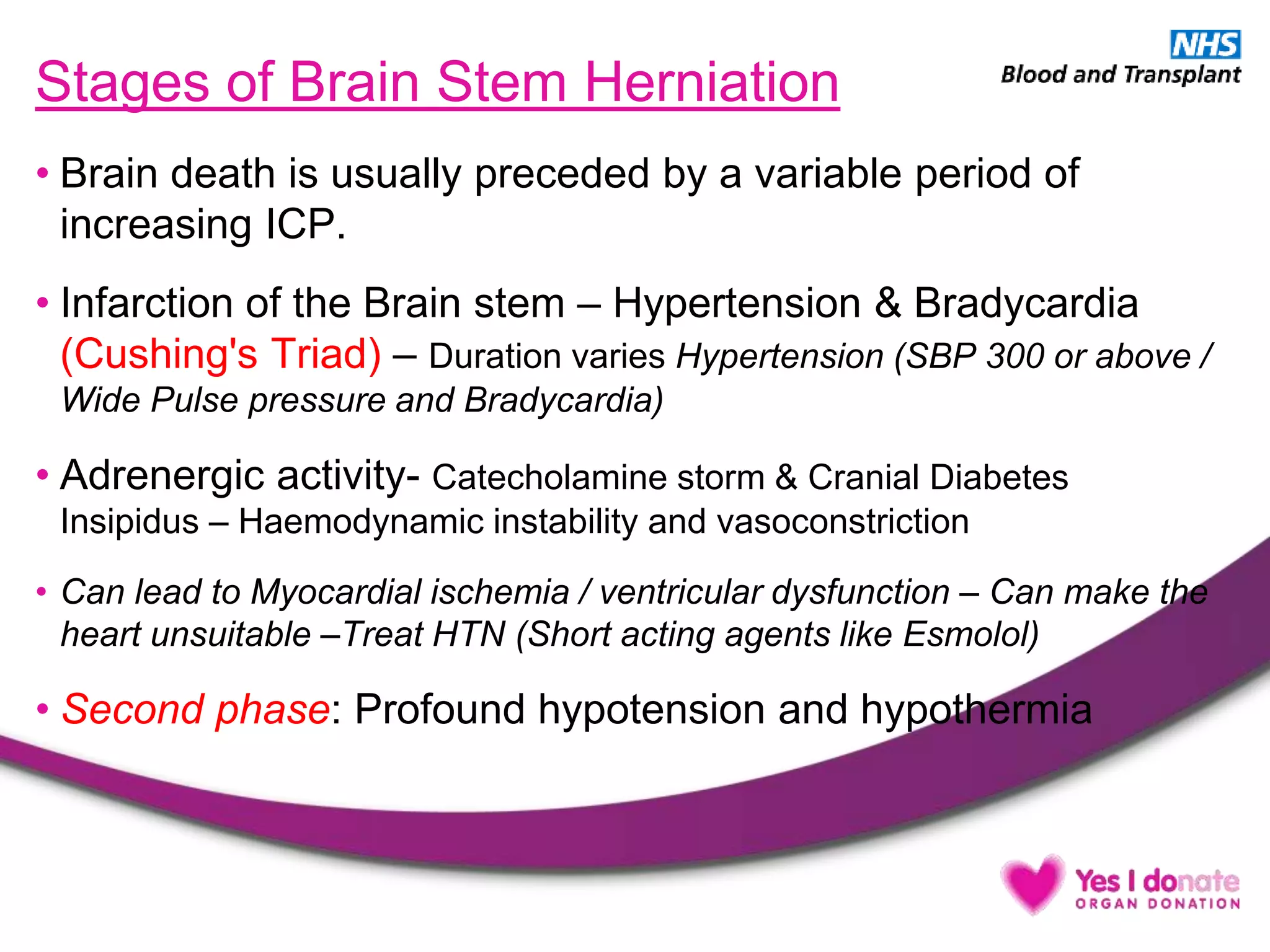
Stages of Brain Stem Herniation
• Brain death is usually preceded by a variable period of
increasing ICP.
• Infarction of the Brain stem – Hypertension & Bradycardia
(Cushing's Triad) – Duration varies Hypertension (SBP 300 or above /
Wide Pulse pressure and Bradycardia)
• Adrenergic activity- Catecholamine storm & Cranial Diabetes
Insipidus – Haemodynamic instability and vasoconstriction
• Can lead to Myocardial ischemia / ventricular dysfunction – Can make the
heart unsuitable –Treat HTN (Short acting agents like Esmolol)
• Second phase: Profound hypotension and hypothermia
Signs of coning
• GCS 3 – off sedation
• Fixed dilated pupils
• Stops breathing
• Cushing’s triad -
– High Systolic BP (up to 300 or more)
– Widening Pulse Pressure
– Bradycardia
Incidence of common physiological derangements
in brain-dead patients
Derangement Cause Incidence
Hypothermia Hypothalamic damage, reduced
metabolic rate, vasodilation and heat
loss.
Invariable if not
prevented
Hypotension Vasoplegia, hypovolaemia, reduced
coronary blood flow, myocardial
dysfunction.
81-97%
DI Posterior pituitary damage 46-78%
DIC Tissue factor release, coagulopathy 29-55%
Arrhythmias Catecholamine storm, myocardial
damage, reduced coronary blood flow
25-32%
Pulmonary
Oedema
Acute blood flow diversion, capillary
damage
13-18%
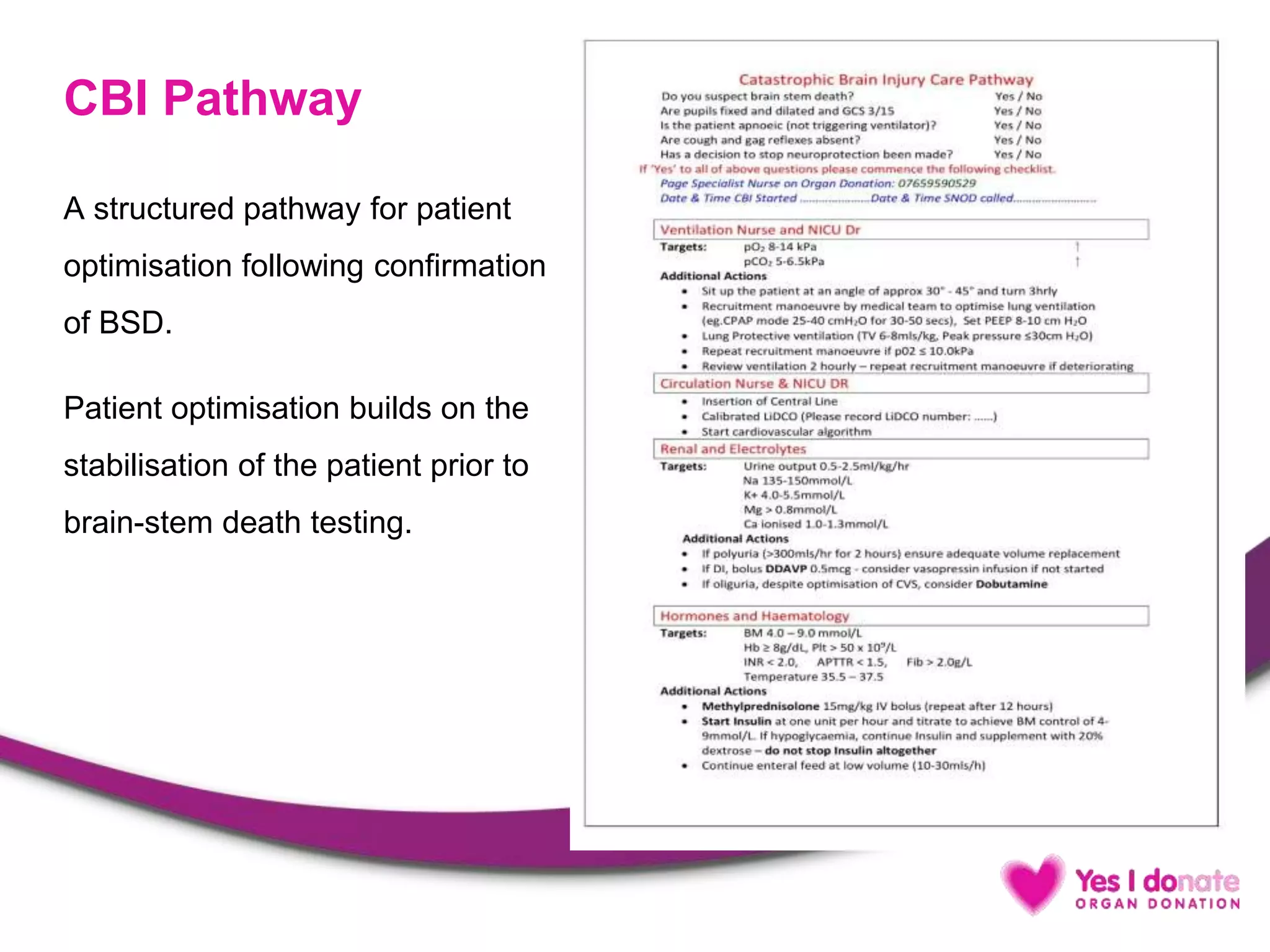
CBI Pathway
A structured pathway for patient
optimisation following confirmation
of BSD.
Patient optimisation builds on the
stabilisation of the patient prior to
brain-stem death testing.
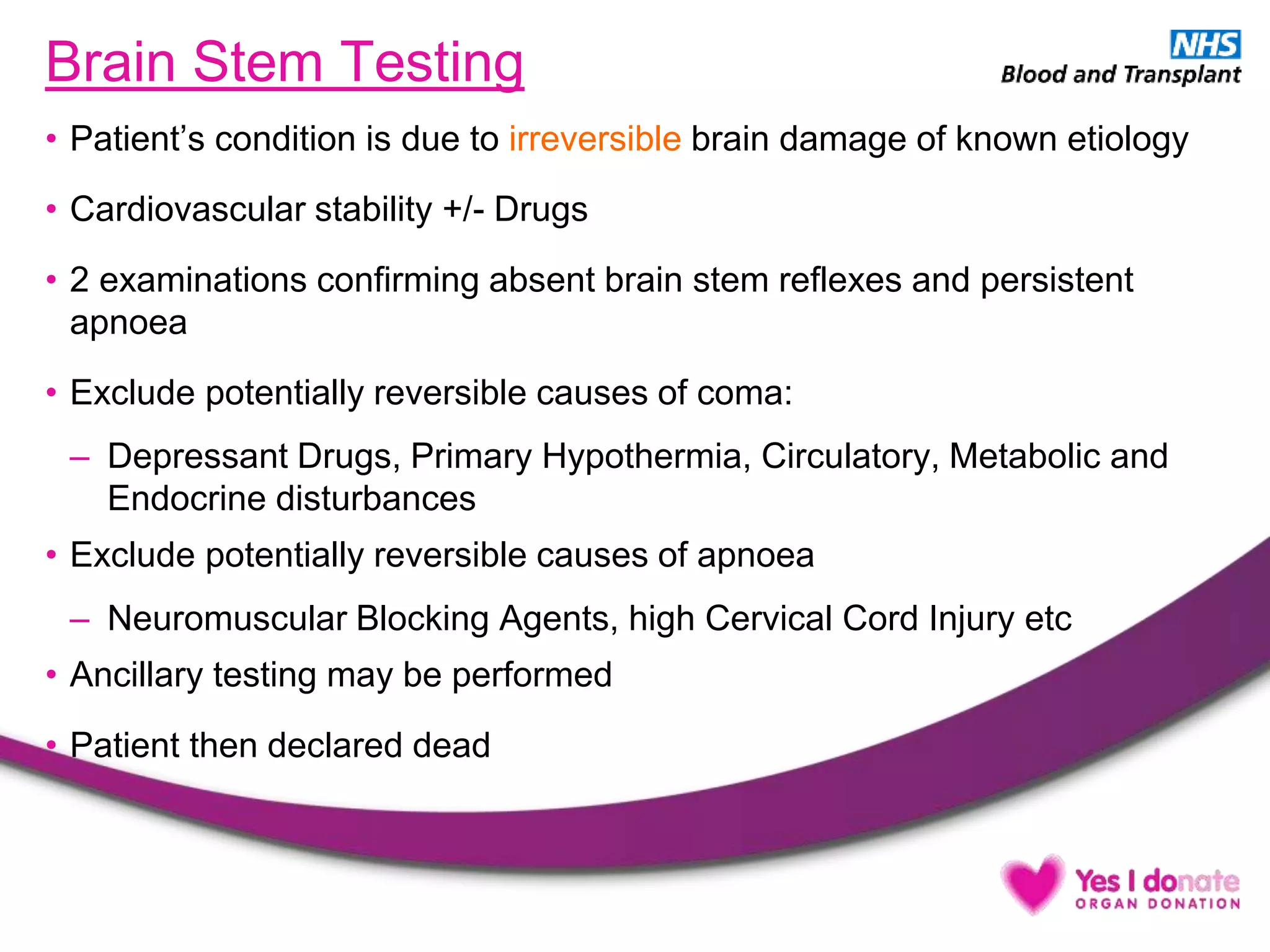
Brain Stem Testing
• Patient’s condition is due to irreversible brain damage of known etiology
• Cardiovascular stability +/- Drugs
• 2 examinations confirming absent brain stem reflexes and persistent
apnoea
• Exclude potentially reversible causes of coma:
– Depressant Drugs, Primary Hypothermia, Circulatory, Metabolic and
Endocrine disturbances
• Exclude potentially reversible causes of apnoea
– Neuromuscular Blocking Agents, high Cervical Cord Injury etc
• Ancillary testing may be performed
• Patient then declared dead
Testing for Brain-stem Death
48
“This form is consistent with and should be used in conjunction with, the
AoMRC (2008) A Code of Practice for the Diagnosis and Confirmation of Death
and has been endorsed for use by the following institutions: Faculty of
Intensive Care Medicine, Intensive Care Society and the National Organ
Donation Committee.”
Full
Abbreviated
Tests
• 2 doctors - Consultant or senior SPR
• Must conduct the tests together
• Tests repeated (2 full sets of tests, including apnoea test)
• Tests examine brain stem function by testing cranial nerve
reflexes and respiratory drive
• The time of death will be the time of completion of the
first set of tests but both sets of tests should be
completed
PUPILS FIXED AND DILATED, NOT
RESPONDING TO LIGHT
Cranial nerves 2,3 (Midbrain)
NO BLINKING TO
TOUCH OR CORNEAL
REFLEX
Cranial nerves 5,7 (Midbrain)
NO MOTOR RESPONSES TO
SUPRAORBITAL PRESSURE
Cranial nerves 5,7 (Pons)
NO GAG OR COUGH REFLEX TO
BRONCHIAL STIMULATION
Cranial nerves 9, 10, 11, 12
(Medulla)
VESTIBULO-OCULAR
REFLEXES ARE ABSENT - NO
EYE MOVEMENTS ARE SEEN
DURING THE SLOW
INJECTION OF 50MLS OF ICE
COLD WATER.
Cranial nerves 3,6,8 (Midbrain, Pons &
Medulla)
6th Nerve Palsy: Opthalmoplegia
APNOEA TEST -
NO RESPIRATORY
MOVEMENT WHEN
THE PATIENT IS
DISCONNECTED
FROM
MECHANICAL
VENTILATION
(Medulla)
Apnoea testing
• Do a baseline ABG
• Pre-oxygenate with 100%
• Arterial Blood Gas taken to confirm PaCO2 and
SaO2 correlation with EtCO2 and SpO2 levels
• Reduce MV / rate to allow slow increase in EtCo2
to 6.0kPa or just above
• Recheck ABG to confirm PaCO2 >6.0 and pH
<7.40
• As long as cardiovascularly stable, disconnect
from ventilator
Apnoea Testing
• Maintain oxygenation by 6 l/min via tracheal
catheter or water circuit.
• Observe for respiratory movements for 5 min - No
respiratory effort seen
• Repeat ABG after 5 mins and reconnect to
ventilator – Do not wait for ABG results
• ABGs : observe if CO2 risen by 0.5KPa
• Ventilate, allow PaCO2 to normalise
• Repeat test (Allow time between sets to allow
PaCO2 to return to baseline)
TWO TESTS
• ALIVE
• ALIVE
• DECEASED
TEST
1
TEST 2
TIME OF
DEATH
Continuation of CBI following BSD
• BSD is followed by a predictable pattern of physiological
instability and complex MOF
• Support before and after brain death can improve the
number and quality of organs
• If instability is not managed, can lead to deterioration in
organ function before retrieval.
• In some cases the instability prevents organ donation
occurring (approx 10-20%)
Spinal Reflexes in BSD Patients
• Movement in BSD subjects
• Spontaneous body movement may occur
• Generated by spinal cord
• May be caused by a variety of stimuli
• Occurs in 40% of patients
• Ranges from finger twitching to waist flexion!!
Donation after circulatory Death (DCD)
• DCD describes the retrieval of organs for the purpose of
transplantation after death is confirmed using circulatory
criteria.
• Who is a potential DCD patient?
The intention to withdraw life sustaining treatment in patients
with a life-threatening or life-limiting condition which will, or is
expected to, result in circulatory death.
•Futility established with plan to withdraw active
treatment.
Donation after Circulatory Death (DCD)
• Mechanically ventilated patient with
a devastating injury, usually brain,
where the decision has been made
to WLST. The expectation that the
circulation will cease imminently
upon the WLST.
• Kidneys
• Liver
• Pancreas
• Lungs
• Heart
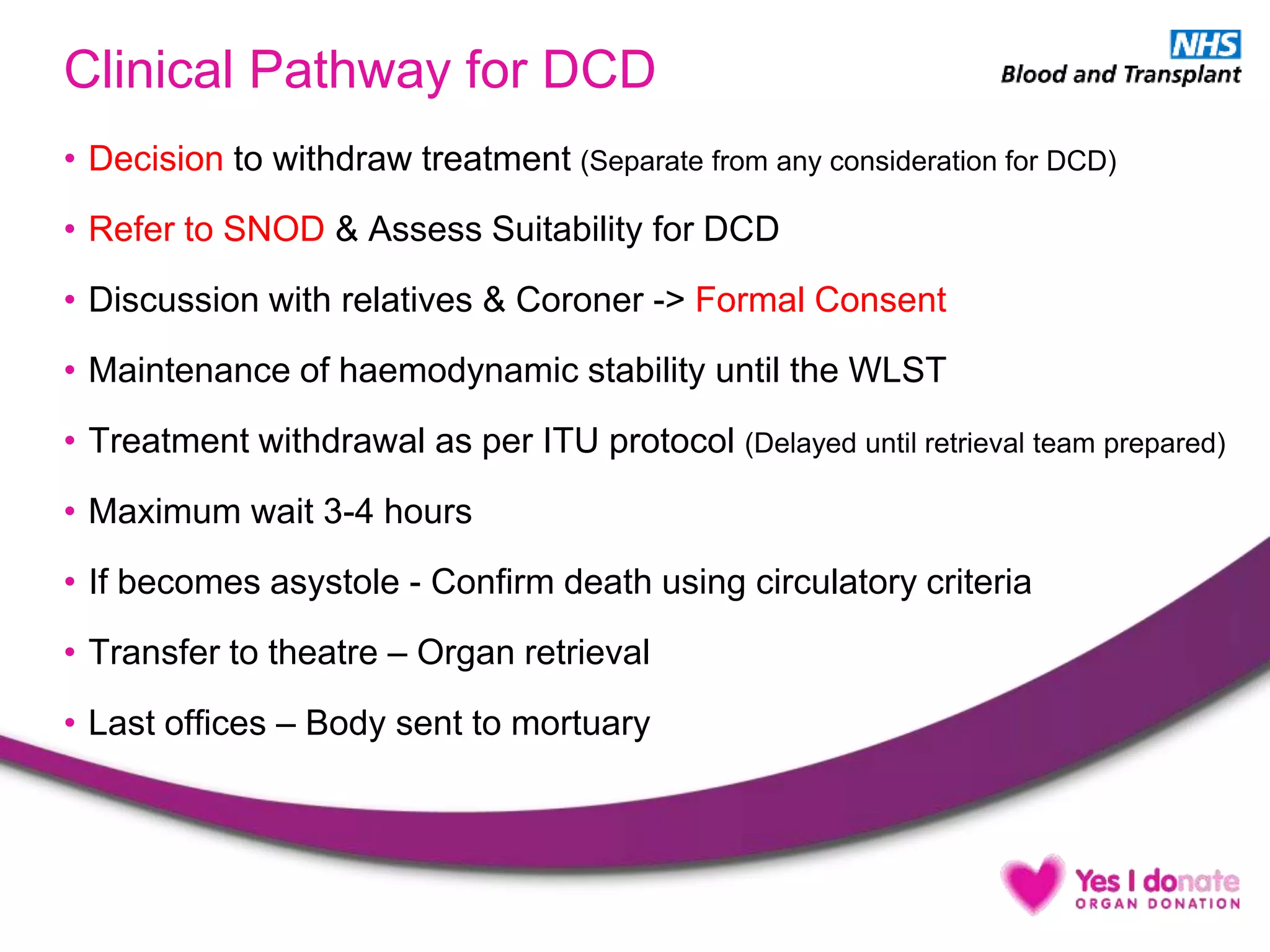
Clinical Pathway for DCD
• Decision to withdraw treatment (Separate from any consideration for DCD)
• Refer to SNOD & Assess Suitability for DCD
• Discussion with relatives & Coroner -> Formal Consent
• Maintenance of haemodynamic stability until the WLST
• Treatment withdrawal as per ITU protocol (Delayed until retrieval team prepared)
• Maximum wait 3-4 hours
• If becomes asystole - Confirm death using circulatory criteria
• Transfer to theatre – Organ retrieval
• Last offices – Body sent to mortuary
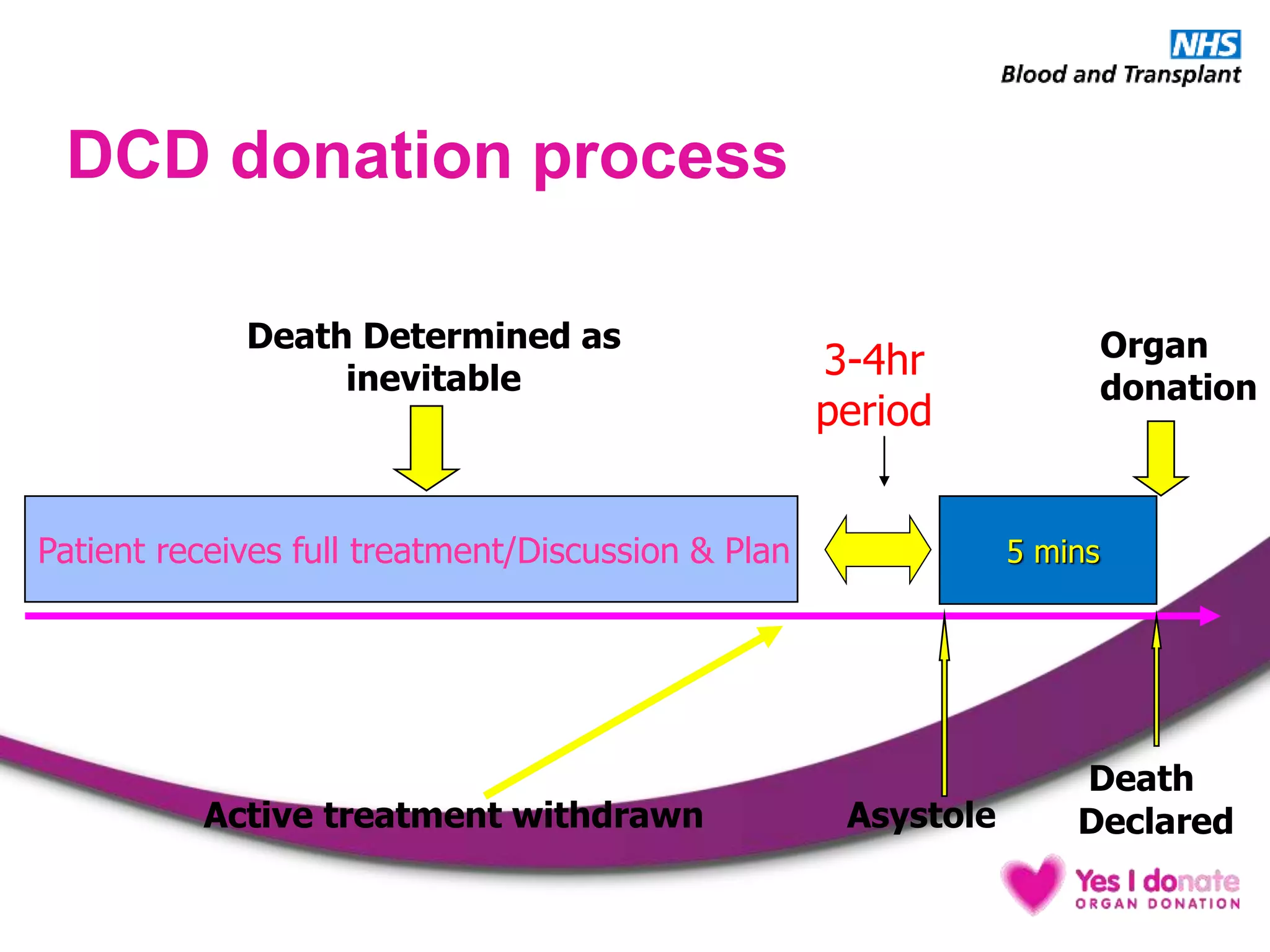
DCD donation process
Patient receives full treatment/Discussion & Plan 5 mins
Death Determined as
inevitable
Active treatment withdrawn Asystole
Organ
donation
3-4hr
period
Death
Declared
Consent / Authorisation
Patient assessment
Organ Donation Past, Present and Future
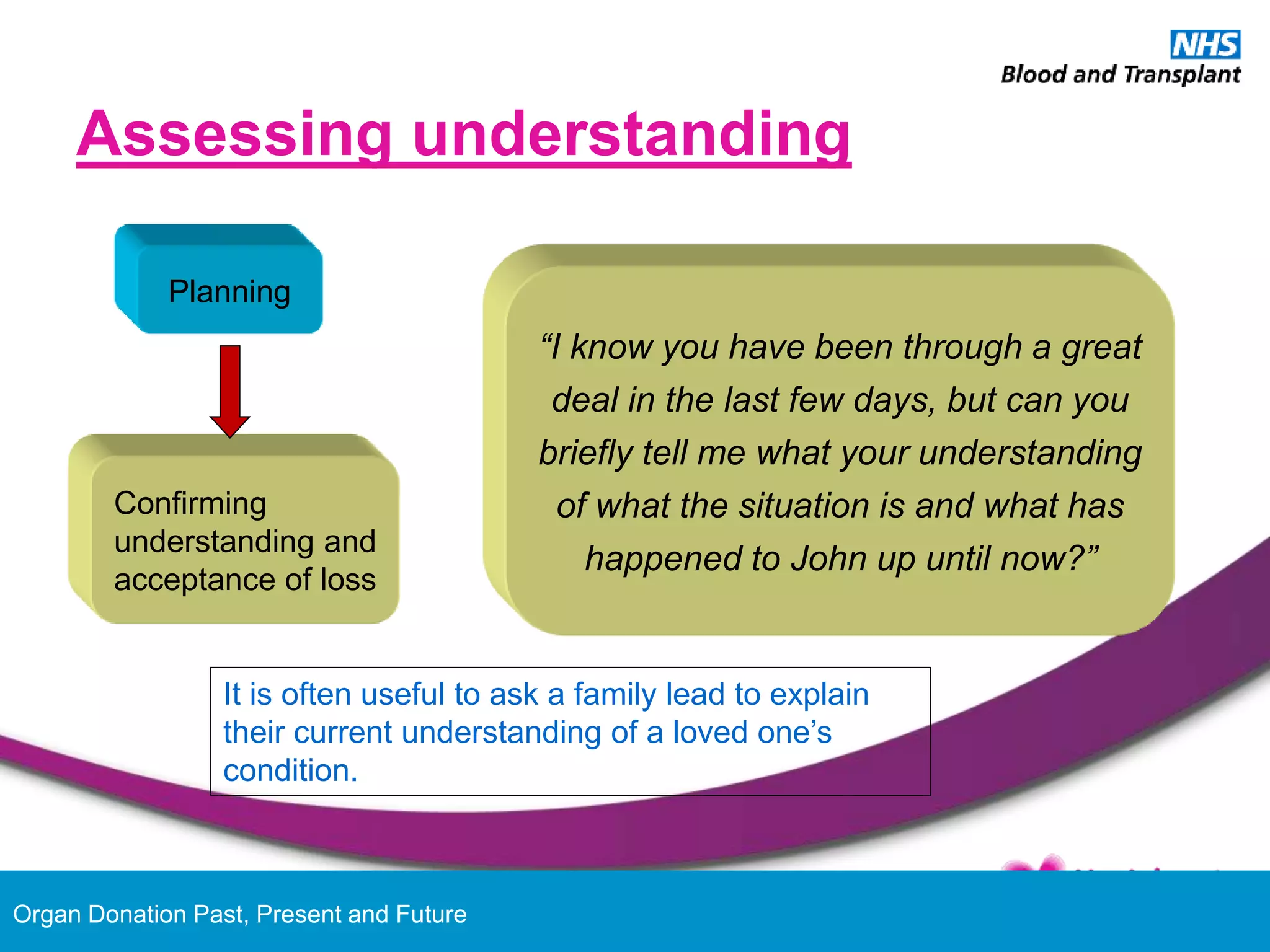
Assessing understanding
Planning
Confirming
understanding and
acceptance of loss
It is often useful to ask a family lead to explain
their current understanding of a loved one’s
condition.
“I know you have been through a great
deal in the last few days, but can you
briefly tell me what your understanding
of what the situation is and what has
happened to John up until now?”
Organ Donation Past, Present and Future
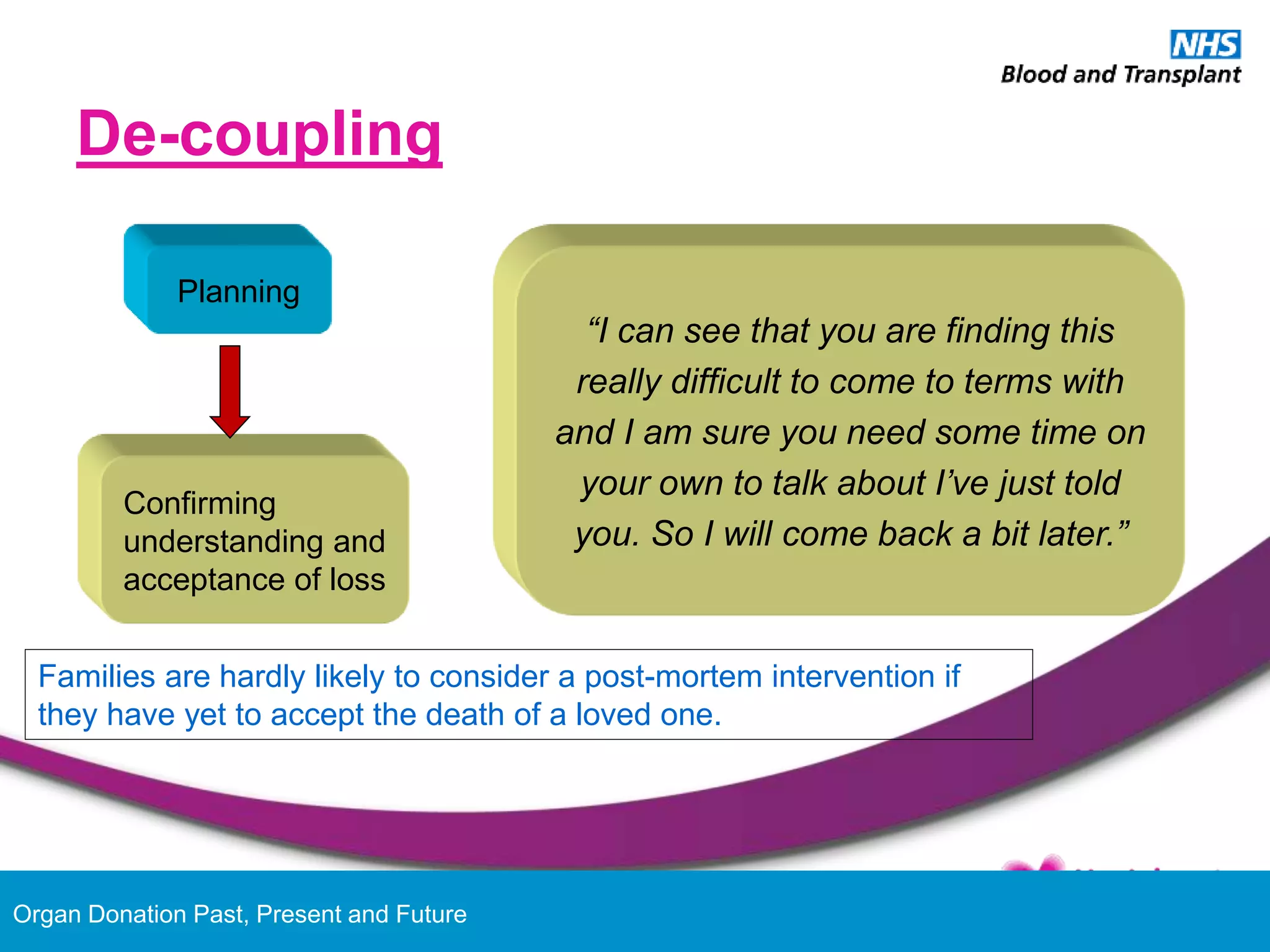
De-coupling
Planning
Confirming
understanding and
acceptance of loss
Families are hardly likely to consider a post-mortem intervention if
they have yet to accept the death of a loved one.
“I can see that you are finding this
really difficult to come to terms with
and I am sure you need some time on
your own to talk about I’ve just told
you. So I will come back a bit later.”
If no-one can give consent
tissue retrieval or research is
not possible due to storage
Removal of any organs and tissues
Storage of any organs and tissues
Transplantation and investigations
Research
Organ Donor register is valid consent for removal and transplantation
Only a UK Trained SNOD
can obtain Consent
Consent
HTA Licence
Consent
Patient Assessment Questions
• Has your relative visited his/her general practitioner in the last two
years? Was he/she currently seeing or waiting to see their general
practitioner or any other healthcare professional?
• Did your relative ever undergo any investigations for cancer or have
they ever been diagnosed with cancer?
• Did your relative ever have hepatitis, jaundice or liver disease?
• Was your relative ever told never to donate blood?
• In the last twelve months has your relative been in close contact with
a bat anywhere in the world or been bitten by an animal whilst
abroad?
• Did your relative ever have a sexually transmitted infection e.g.
syphilis, gonorrhoea, genital herpes, genital warts?
Patient Assessment Questions
• Is it possible that any of the following apply to your relative:
• is, or may be infected with HTLV, HIV or hepatitis B or C?
• has ever injected or been injected with non-prescriptive drugs, including
body building drugs, even if it was a long time ago or only once?
• has ever been given payment for sex with money or drugs?
• (for male patients only) ever had sex with another man with or without
a condom?
• (for female patients only) had sex in the last 12 months with a man who
has had sex with another man with or without a condom?
• been in prison or a juvenile detention centre for more than three
consecutive days within the last 12 months?
The full picture Begins
Assessment
• The SNOD undertakes a detailed assessment of
past and current history
• From family & friends
• From any medical notes
• From unit staff
• From GP
• From Observation & Examination
• Social & sexual history also required
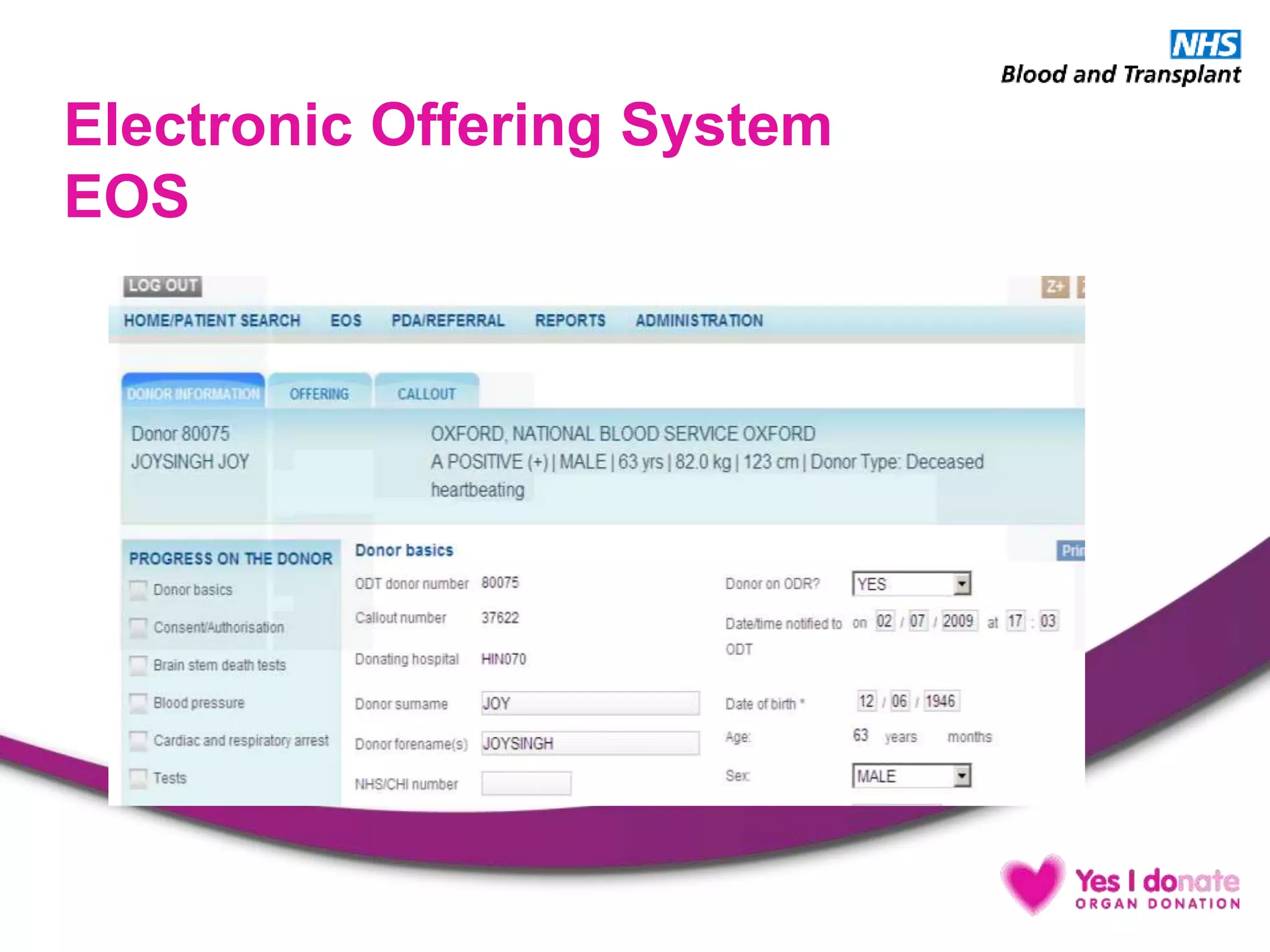
• EOS
ODR consent valid but
without adequate history/GP the
suitability for donation may be
questioned
Electronic Offering System
EOS
Offering and Allocation
• Donor registration with NHSBT (UKT)
• National Allocation System
• All organs are matched on blood group, size and distance (Zonal)
• Super-urgent Registration - highest priority regardless of location
• The lead surgeon & recipient Point of Contact informed of offer (view
EOS)
• Accept or decline (45 minutes)
• Fast Track used very little
• Kidneys are allocated on Tissue Typing at a later stage
Meanwhile…..
• The SNOD will continue to offer advice and support to the staff
• Donor Management
• Negotiate theatre with runner & anaesthetist
• Support theatre staff and ensure equipment is available
• Do endless photocopying & sort notes
• Keep family informed of progress
• Await blood results
• Await Transplant centres decisions
• Discuss plans with recipient point of contact
• Liaise with transport & Activate the NORS team
• Keep everyone happy!
• Vital part of transplantation pathway
• Provides a national 24 hour service for retrieving organs from UK deceased donors
• Based at major transplant units and usually able to reach donors in <3 hours
The National Organ Retrieval
Service (NORS)
Abdominal retrieval team
Cardiothoracic organ retrieval team
Multi-organ retrieval team
8 Abdominal teams:
Birmingham
Cardiff
Cambridge
King’s College
Leeds + Manchester
Newcastle
Oxford
Royal Free
5 Cardiothoracic teams:
Birmingham
Harefield
Manchester
Newcastle
Papworth
1 multi-organ team:
Scotland
2:1 rota
1:1 rota
When the teams arrive…..
• The SNOD will aim to meet them
• Introduce to theatre staff
• Handover, WHO checklist
• Check Theatres
• Prepare patient for transfer
• Ensure notes and relevant documentation available
• Good-bye’s
• Transfer patient
BREAK
Theatre Process
Theatre Process
• The SNOD will act as patients advocate
• Ensure staff are respected & supported
• Maintain professional environment
• Handover, WHO checklist
• Ensure equipment’s are available
Diathermy, Suction, Resus equipment's, Intubation Kit,
Biopsy kit, Weighing scale)
• Arrange transport (Air / Road)
• Drugs (Paralytic agents, Inotropes, Fluids etc)
• Perfusion fluid and Drip stand
• Organ packing boxes and labels
• Documentation
• HTA Form, Medical Notes, Anaesthetic record, Last office docs
• Constant communication with Recipient centres
• Record of timings – KTS, Out, Box, Close
• Unusual findings – Biopsy, arrange histopathologist
• Anatomy to UKT and accepting surgeons
• OCS / Organox – Cross matched blood
• Labelling and packing of organ – Blood, Blood group, HTA form,
Lymph, Spleen, Vessels
• Organ handover, Coroner docs – Witness 9
• Last offices
• Family requests – Footwear, clothes, Keep sakes
• Debrief Theatre staff
• Complete any referrals for tissues or biopsies
• Handover any outstanding work to SNOD colleagues
• Continue with the case file for ........
Organ donation Process
Beginning of the on call shift
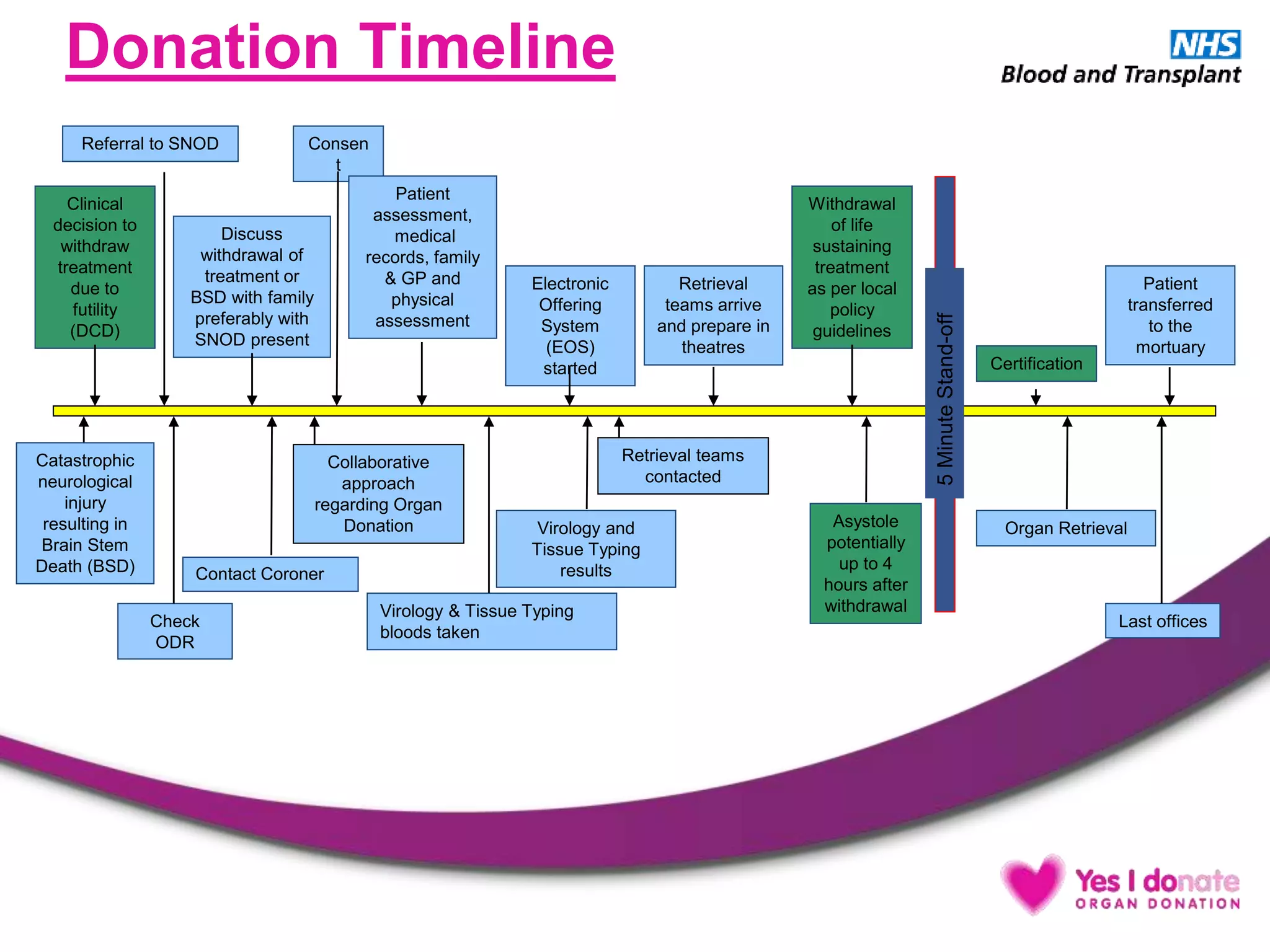
Donation Timeline
Catastrophic
neurological
injury
resulting in
Brain Stem
Death (BSD)
Referral to SNOD
Check
ODR
Discuss
withdrawal of
treatment or
BSD with family
preferably with
SNOD present
Contact Coroner
Collaborative
approach
regarding Organ
Donation
Consen
t
Patient
assessment,
medical
records, family
& GP and
physical
assessment
5MinuteStand-off
Organ Retrieval
Electronic
Offering
System
(EOS)
started
Clinical
decision to
withdraw
treatment
due to
futility
(DCD)
Retrieval teams
contacted
Retrieval
teams arrive
and prepare in
theatres
Certification
Last offices
Patient
transferred
to the
mortuary
Withdrawal
of life
sustaining
treatment
as per local
policy
guidelines
Virology & Tissue Typing
bloods taken
Virology and
Tissue Typing
results
Asystole
potentially
up to 4
hours after
withdrawal
And it continues…..
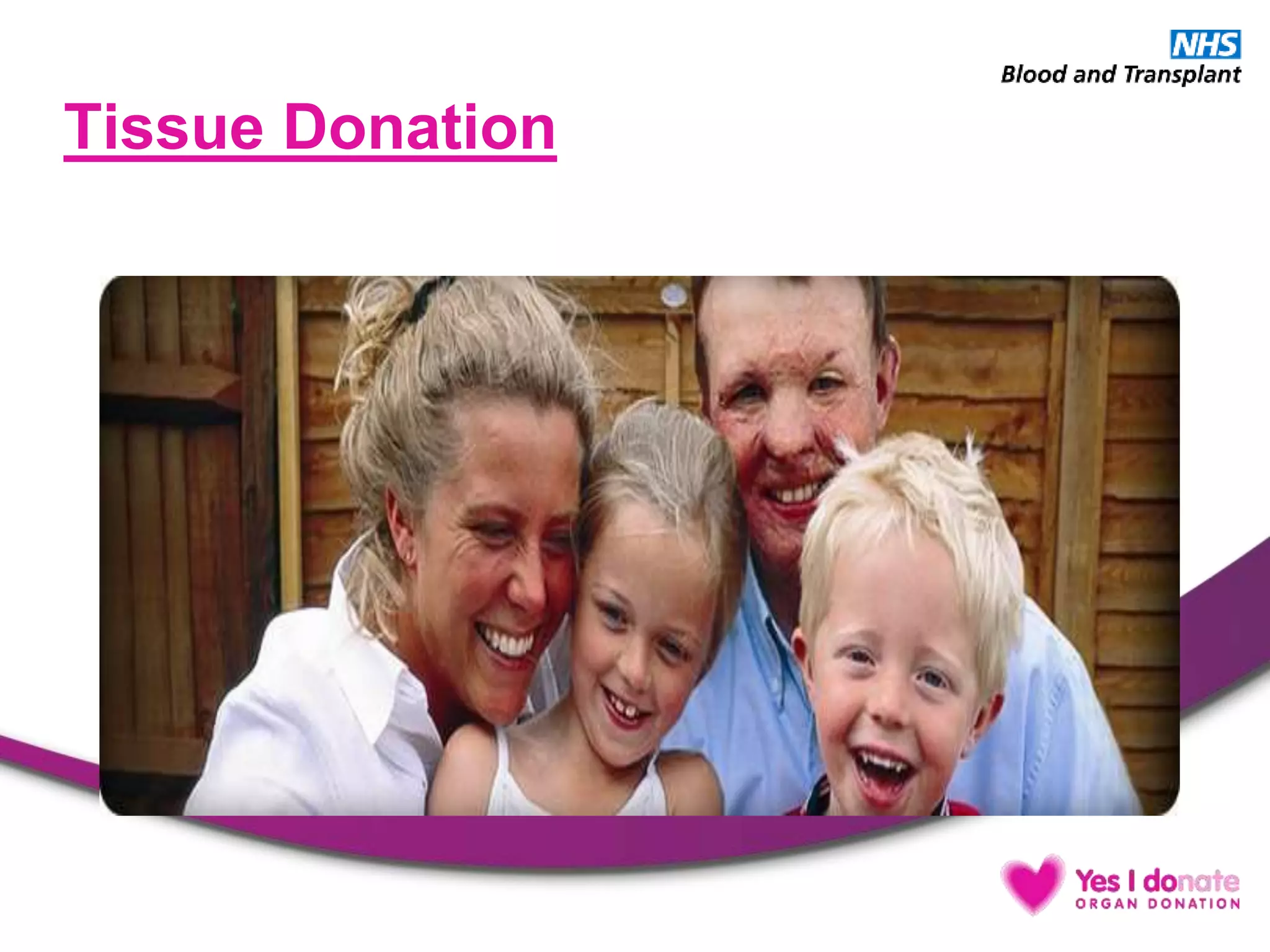
Tissue Donation
NHSBT Tissue Services
• Largest tissue bank in Europe
• Sole supplier of skin within the UK
• Licensed by the Human Tissue Authority
• National Referral Centre and Tissue bank
in Liverpool
• East Grinstead and Moorfields Eye Banks
What tissues can be donated?
Eyes <90 years
Heart Valves <65 years
Skin >57kg
Bone <55 years
Tendons <60 years
Femoral arteries 17-60 years
Meniscus 18-45 years
As many as 50 people can be
helped from the donation of one
person
Tissue Donation Timeframes
• Within 24 hours after someone has died
• May be possible up to 48 hours
• Performed in the mortuary
Other areas of donation
• Living donation
• Increased perfusion techniques
• Bridge to donation
• Creating organs
Live liver donation
• Reduces the risk of deterioration and death for patients
waiting for a transplant
• A better quality organ than from a deceased donor
• Possible as the liver is much larger than we need
• Liver can regenerate in weeks
• Risk attached to donor as surgery required
• Donors must generally be over 18 and in excellent health
Organox
• Started in 2008 from the University of Oxford
• Commercial use from 2015
• New liver perfusion system set to increase number and quality of
livers for transplant surgery
• System that keeps a liver ‘alive’ outside the human body prior to
transplantation
• Perfuse liver for up to 24 hours compared with 8 hours in cold
solution
• Minimise damage to the organ, both before and during transplant
surgery.
Organ Care System
• Transmedics
OCS for hearts
• First in Sydney
October 2014
LVAD - A Bridge to Transplant
• Connected to left ventricle and aorta
• Back up battery that can be charged
anywhere, battery last 4-6 hours
• Can be worn as a backpack
• 100 people in UK with LVAD
• Longest is 5 ½ years with LVAD
• The future sees wireless devices with
batteries inside the patient and charged
through a coil on the surface of the skin
Stem Cell Technology
•2013 first kidneys from stem cells
•Liver cells in mice
•The future?
Summary of Key Points
• Every patient when there is a decision to withdraw
life sustaining treatment should be referred to a
SNOD
• Every patient may potentially be able to donate
tissues
• Remember to make ‘Organ and Tissue donation
usual not unusual as part of end of life care’
Donation changes lives.
You are 5 times more
likely to need an organ
than you will be required
to donate one!!!
www.odt.nhs.uk
Organ and Tissue Donation Clinical Teaching

Organ and Tissue Donation Clinical Teaching

  • 1.
    Organ & Tissuedonation Clinical Update Dr Shibu Chacko MBE Specialist Nurse Organ Donation ODT South East of England NHS Blood and Transplant, UK Email: shibu.chacko@nhs.net
  • 2.
    Aims of thesession • Background to Organ Donation • Statistics • DBD Vs DCD , Brain Stem Death • Consent, Screening , Offering process • Organ Donation process inc Theatre • Tissue Donation
  • 3.
    Introduction to thetopic Facts & Figures
  • 4.
    Definition • Organ donationis the donation of biological tissue or an organ of human body from a living or deceased person to a living recipient in need of transplantation.
  • 5.
    Common Jargon’s used •SNOD - Specialist Nurse for Organ Donation • CLOD - Clinical Lead for Organ Donation • Donor - Those patients that donate • Recipient - Those that receive an organ • Retrieval - Banishes the use of ‘harvesting’ • ODR - Organ Donor Register
  • 6.
    ODT - It’sa modern day success story! • ODT is the most realistic and sometimes only option for end stage organ failure • For donor and relatives – There is something good has emerged from a disaster • For the recipient – There is a new opportunity for an independent life • For medical profession – There is an opportunity for cure for a chronic condition • For the wider society as a whole – An excellent cost effective solution
  • 7.
    Organ Donation inthe 21st Century • “Healthy organs..........are cremated or buried – not because the deceased objected to donation but simply because relatives were not given the opportunity to consider donation”. BMA report June 2000
  • 9.
    Organ Donation Taskforce(2008) • Made 14 recommendations • Improve referral rates • Make organ donation a usual part of NHS practice • Monitor donor activity – missed referrals • 100% Brain stem testing • Minimum notification criteria for potential organ donors • Raise public awareness (ODR) Target – 50% increase in donation over 5 years
  • 10.
    NICE Guidelines To promotethe identification and fulfilment of those that wish to donate organs More effective and expedient identification of potential organ donors A more informed and timely approach to consent for donation that is based primarily on identifying the wishes of the individual whenever known and however recorded To improve: – identification and referral of potential donors – approach to consent for donation – consideration of donation as part of standard ‘end-of-life care’ planning
  • 13.
    Why bother? Renal Costsper patient per annum • Dialysis £28,967 • Cost over 10 years - £ 289, 677 + Other costs Transplantation costs per patient • Assessment & transplant £52, 443 • After 1st year £35, 430 • Costs per year £7,274 • Cost over 10 years - £ 102, 716
  • 14.
    Counting the cost •Currently over 6500 people waiting • Average 3-4 patients die every day while waiting for a transplant • Last year 466 patients died waiting and 881 were removed from the waiting list • Many of them died shortly afterwards
  • 15.
  • 17.
    What is UKOrgan Donation potential? • Approx. half a million people die in UK every year • Only 1% die in circumstances where OD possible • Only possible if die on a ventilator; so death must occur in ICU or ED. • Small potential donors Vs high number of people WL
  • 18.
    Donation at 2006and 2012 0 5 10 15 20 25 30 35 donors pmp Greece Sweden Switzerland Denmark Poland The Netherlands Latvia Germany Hungary Slovakia Finland UK Norway Italy France USA Portugal Croatia Spain 0 5 10 15 20 25 30 35 donors pmp Greece Switzerland Denmark Slovak Republic The Netherlands Croatia UK Poland Sweden Germany Norway Hungary Latvia Portugal Finland Italy France USA Spain
  • 19.
    Number of donorsand Transplants
  • 20.
  • 21.
    NHS Organ DonorRegister • Confidential database which records peoples organ donation wishes • Total UK population = 66 million (2011 census) • Only 22 million people on NHS ODR (33%) • Opt out system in Wales since Dec 2015 • Nearly all would receive an organ if needed • Your loved one, nearest and dearest MUST be aware of your wishes
  • 22.
    Consent & Authorisationfor donation • Deceased donation in the UK relies upon family consent • Needs NOK consent even if registered on ODR • UK has one of the lowest consent rates in Europe • Overall consent rate 62% in 2015-16 (57% in 2012-13) • 34% BAME consent Vs 66% Non BAME consent • If 80% of the families approached said ‘yes’ to donation – would result in additional 1000 transplants a year (NHSBT estimates)
  • 23.
    European Refusal rates 0 5 10 15 20 25 30 35 40 45 familyrefusalrate UKItaly Romania Rep Ireland Croatia Spain Poland Slovakia Hungary Czech Republic
  • 24.
    Donation in EthnicMinorities • More likely to need a transplant due to HTN, DM and hepatitis • More successful and likely if donor from the same ethnicity • 14% of the UK population is BAME, Only 3.5% on ODR • Only 5% of the actual deceased donors (67 last year) • Less than 30% consent rates • 26% of the waiting list are BAME (1686 patients in Aug 2016) • BAME recipients wait a year longer for a transplant
  • 25.
    Absolute Contraindications • Veryfew absolute contraindications • Active cancer with in last 3 years, CJD, Active TB, HIV Disease • Common misconceptions: • HIV infection • Sepsis / Multi organ failure • Age (nearly all patients can be considered for tissue donation) • Refer and SNOD can advise further.
  • 26.
    Barriers to Donation •Age (85 and above) • Organ specific contraindications – COPD, Emphysema, MI, CKD stage 3 with eGFR <35, ALT 10000, Liver cirrhosis etc • Family consent & Coroner consent • Non referral or late referral • Health professionals beliefs
  • 27.
    Donor Identification All potentialdonors should be identified and referred as early as possible to the SNOD. This will facilitate donor screening and donor management.
  • 28.
  • 29.
    A Day InThe Life • Directorate of ODT – NHS Blood and Transplant • 12 SNOD Teams in the UK • The South East SNOD Team are responsible for providing 24hr cover for the facilitation of organ donation from 53 Trusts • There are 14 of us • On call shifts are 24 hours • We have all been embedded into individual trusts
  • 30.
    One of themost complicated process in the
  • 31.
    And One ofthe Most Rewarding ‘I have heard people say how brave we were to donate Mya’s organs. I don’t feel that it was that difficult at all. Mya was so full of zest, verve, drive, compassion and life; I knew we had to allow her to live on. Mya’s life gave hope and an opportunity to 6 families’ ‘… it was about not letting Ashton die in vain and keeping his memory alive. We were trying to create something positive out of something so tragic…’ ‘We sent Luca’s organs with love to all those people who received them’
  • 32.
    Referral to SNOD •PAGER: 07659590529 – WE WILL RESPOND WITHIN 20 MINUTES • We will ask for patient details Name, DOB, NHS Number • Pt history, current status and Consultant’s plan • If potential for donation, we will mobilise asap if not on site. • Do not approach family’s about donation, we are aiming for a Collaborative approach between Consultant and SNOD
  • 33.
    Potential Donor Screening Ifthe potential donor is ‘marginal’ screening tools will be used by SNOD to ensure their suitability. This can be DCD assessment tool, Screening calls with Transplant centres and Surgeons, Tissue establishments etc.
  • 35.
    Types of Donation •Living Donation • Deceased Donation 1. Donation after Brain Stem Death (DBD) <85 years Patient is confirmed brain stem dead prior to retrieval 2. Donation after Circulatory Death (DCD) <85 years Treatment is withdrawn and donation occurs post asystole 3. Tissue Donation With in 24-48 hours of some passed away.
  • 36.
    Donation after BrainStem Death (DBD) • Mechanically ventilated patient where death has been confirmed using neurological criteria. • Organ quality following DBD remains superior- less need for dialysis, less Biliary complications. • Kidneys • Liver • Pancreas • Lungs • Heart • Small Intestine (Only source of organs currently)
  • 37.
    Donation after CirculatoryDeath (DCD) • Mechanically ventilated patient with a devastating injury, usually brain, where the decision has been made to WLST. The expectation that the circulation will cease imminently upon the WLST. • Kidneys • Liver • Pancreas • Lungs • Heart
  • 38.
    Which organs canbe donated? •Heart <65 years •Lungs <70 years •Kidneys <85 years •Liver <85 years •Pancreas <65 years •Small Bowel <65 years Possible for 1 person to help save the lives of 9 people
  • 39.
  • 40.
    Donor Management andBrain Stem Death Testing
  • 41.
    When to shiftthe focus of care? Clear diagnosis with evidence of catastrophic brain injury on CT scan Potential DBD patient • Ventilated with no respiratory effort • Fixed and dilated pupils • No cough or gag reflex • No corneal reflex • No reaction to painful stimuli A definition of human death should not be related to organ donation & transplantation A Code Of Practice For The Diagnosis And Confirmation Of Death 2008
  • 42.
    Donation after BrainStem Death (DBD) • Mechanically ventilated patient where death has been confirmed using neurological criteria. • Organ quality following DBD remains superior- less need for dialysis, less Biliary complications. • Kidneys • Liver • Pancreas • Lungs • Heart • Small Intestine (Only source of organs currently)
  • 43.
    Stages of BrainStem Herniation • Brain death is usually preceded by a variable period of increasing ICP. • Infarction of the Brain stem – Hypertension & Bradycardia (Cushing's Triad) – Duration varies Hypertension (SBP 300 or above / Wide Pulse pressure and Bradycardia) • Adrenergic activity- Catecholamine storm & Cranial Diabetes Insipidus – Haemodynamic instability and vasoconstriction • Can lead to Myocardial ischemia / ventricular dysfunction – Can make the heart unsuitable –Treat HTN (Short acting agents like Esmolol) • Second phase: Profound hypotension and hypothermia
  • 44.
    Signs of coning •GCS 3 – off sedation • Fixed dilated pupils • Stops breathing • Cushing’s triad - – High Systolic BP (up to 300 or more) – Widening Pulse Pressure – Bradycardia
  • 45.
    Incidence of commonphysiological derangements in brain-dead patients Derangement Cause Incidence Hypothermia Hypothalamic damage, reduced metabolic rate, vasodilation and heat loss. Invariable if not prevented Hypotension Vasoplegia, hypovolaemia, reduced coronary blood flow, myocardial dysfunction. 81-97% DI Posterior pituitary damage 46-78% DIC Tissue factor release, coagulopathy 29-55% Arrhythmias Catecholamine storm, myocardial damage, reduced coronary blood flow 25-32% Pulmonary Oedema Acute blood flow diversion, capillary damage 13-18%
  • 46.
    CBI Pathway A structuredpathway for patient optimisation following confirmation of BSD. Patient optimisation builds on the stabilisation of the patient prior to brain-stem death testing.
  • 47.
    Brain Stem Testing •Patient’s condition is due to irreversible brain damage of known etiology • Cardiovascular stability +/- Drugs • 2 examinations confirming absent brain stem reflexes and persistent apnoea • Exclude potentially reversible causes of coma: – Depressant Drugs, Primary Hypothermia, Circulatory, Metabolic and Endocrine disturbances • Exclude potentially reversible causes of apnoea – Neuromuscular Blocking Agents, high Cervical Cord Injury etc • Ancillary testing may be performed • Patient then declared dead
  • 48.
    Testing for Brain-stemDeath 48 “This form is consistent with and should be used in conjunction with, the AoMRC (2008) A Code of Practice for the Diagnosis and Confirmation of Death and has been endorsed for use by the following institutions: Faculty of Intensive Care Medicine, Intensive Care Society and the National Organ Donation Committee.” Full Abbreviated
  • 49.
    Tests • 2 doctors- Consultant or senior SPR • Must conduct the tests together • Tests repeated (2 full sets of tests, including apnoea test) • Tests examine brain stem function by testing cranial nerve reflexes and respiratory drive • The time of death will be the time of completion of the first set of tests but both sets of tests should be completed
  • 50.
    PUPILS FIXED ANDDILATED, NOT RESPONDING TO LIGHT Cranial nerves 2,3 (Midbrain)
  • 51.
    NO BLINKING TO TOUCHOR CORNEAL REFLEX Cranial nerves 5,7 (Midbrain)
  • 52.
    NO MOTOR RESPONSESTO SUPRAORBITAL PRESSURE Cranial nerves 5,7 (Pons)
  • 53.
    NO GAG ORCOUGH REFLEX TO BRONCHIAL STIMULATION Cranial nerves 9, 10, 11, 12 (Medulla)
  • 54.
    VESTIBULO-OCULAR REFLEXES ARE ABSENT- NO EYE MOVEMENTS ARE SEEN DURING THE SLOW INJECTION OF 50MLS OF ICE COLD WATER. Cranial nerves 3,6,8 (Midbrain, Pons & Medulla) 6th Nerve Palsy: Opthalmoplegia
  • 55.
    APNOEA TEST - NORESPIRATORY MOVEMENT WHEN THE PATIENT IS DISCONNECTED FROM MECHANICAL VENTILATION (Medulla)
  • 56.
    Apnoea testing • Doa baseline ABG • Pre-oxygenate with 100% • Arterial Blood Gas taken to confirm PaCO2 and SaO2 correlation with EtCO2 and SpO2 levels • Reduce MV / rate to allow slow increase in EtCo2 to 6.0kPa or just above • Recheck ABG to confirm PaCO2 >6.0 and pH <7.40 • As long as cardiovascularly stable, disconnect from ventilator
  • 57.
    Apnoea Testing • Maintainoxygenation by 6 l/min via tracheal catheter or water circuit. • Observe for respiratory movements for 5 min - No respiratory effort seen • Repeat ABG after 5 mins and reconnect to ventilator – Do not wait for ABG results • ABGs : observe if CO2 risen by 0.5KPa • Ventilate, allow PaCO2 to normalise • Repeat test (Allow time between sets to allow PaCO2 to return to baseline)
  • 58.
    TWO TESTS • ALIVE •ALIVE • DECEASED TEST 1 TEST 2 TIME OF DEATH
  • 59.
    Continuation of CBIfollowing BSD • BSD is followed by a predictable pattern of physiological instability and complex MOF • Support before and after brain death can improve the number and quality of organs • If instability is not managed, can lead to deterioration in organ function before retrieval. • In some cases the instability prevents organ donation occurring (approx 10-20%)
  • 61.
    Spinal Reflexes inBSD Patients • Movement in BSD subjects • Spontaneous body movement may occur • Generated by spinal cord • May be caused by a variety of stimuli • Occurs in 40% of patients • Ranges from finger twitching to waist flexion!!
  • 62.
    Donation after circulatoryDeath (DCD) • DCD describes the retrieval of organs for the purpose of transplantation after death is confirmed using circulatory criteria. • Who is a potential DCD patient? The intention to withdraw life sustaining treatment in patients with a life-threatening or life-limiting condition which will, or is expected to, result in circulatory death. •Futility established with plan to withdraw active treatment.
  • 63.
    Donation after CirculatoryDeath (DCD) • Mechanically ventilated patient with a devastating injury, usually brain, where the decision has been made to WLST. The expectation that the circulation will cease imminently upon the WLST. • Kidneys • Liver • Pancreas • Lungs • Heart
  • 64.
    Clinical Pathway forDCD • Decision to withdraw treatment (Separate from any consideration for DCD) • Refer to SNOD & Assess Suitability for DCD • Discussion with relatives & Coroner -> Formal Consent • Maintenance of haemodynamic stability until the WLST • Treatment withdrawal as per ITU protocol (Delayed until retrieval team prepared) • Maximum wait 3-4 hours • If becomes asystole - Confirm death using circulatory criteria • Transfer to theatre – Organ retrieval • Last offices – Body sent to mortuary
  • 65.
    DCD donation process Patientreceives full treatment/Discussion & Plan 5 mins Death Determined as inevitable Active treatment withdrawn Asystole Organ donation 3-4hr period Death Declared
  • 66.
  • 67.
    Organ Donation Past,Present and Future Assessing understanding Planning Confirming understanding and acceptance of loss It is often useful to ask a family lead to explain their current understanding of a loved one’s condition. “I know you have been through a great deal in the last few days, but can you briefly tell me what your understanding of what the situation is and what has happened to John up until now?”
  • 68.
    Organ Donation Past,Present and Future De-coupling Planning Confirming understanding and acceptance of loss Families are hardly likely to consider a post-mortem intervention if they have yet to accept the death of a loved one. “I can see that you are finding this really difficult to come to terms with and I am sure you need some time on your own to talk about I’ve just told you. So I will come back a bit later.”
  • 69.
    If no-one cangive consent tissue retrieval or research is not possible due to storage Removal of any organs and tissues Storage of any organs and tissues Transplantation and investigations Research Organ Donor register is valid consent for removal and transplantation Only a UK Trained SNOD can obtain Consent Consent HTA Licence
  • 70.
  • 71.
    Patient Assessment Questions •Has your relative visited his/her general practitioner in the last two years? Was he/she currently seeing or waiting to see their general practitioner or any other healthcare professional? • Did your relative ever undergo any investigations for cancer or have they ever been diagnosed with cancer? • Did your relative ever have hepatitis, jaundice or liver disease? • Was your relative ever told never to donate blood? • In the last twelve months has your relative been in close contact with a bat anywhere in the world or been bitten by an animal whilst abroad? • Did your relative ever have a sexually transmitted infection e.g. syphilis, gonorrhoea, genital herpes, genital warts?
  • 72.
    Patient Assessment Questions •Is it possible that any of the following apply to your relative: • is, or may be infected with HTLV, HIV or hepatitis B or C? • has ever injected or been injected with non-prescriptive drugs, including body building drugs, even if it was a long time ago or only once? • has ever been given payment for sex with money or drugs? • (for male patients only) ever had sex with another man with or without a condom? • (for female patients only) had sex in the last 12 months with a man who has had sex with another man with or without a condom? • been in prison or a juvenile detention centre for more than three consecutive days within the last 12 months?
  • 73.
    The full pictureBegins Assessment • The SNOD undertakes a detailed assessment of past and current history • From family & friends • From any medical notes • From unit staff • From GP • From Observation & Examination • Social & sexual history also required • EOS ODR consent valid but without adequate history/GP the suitability for donation may be questioned
  • 74.
  • 75.
    Offering and Allocation •Donor registration with NHSBT (UKT) • National Allocation System • All organs are matched on blood group, size and distance (Zonal) • Super-urgent Registration - highest priority regardless of location • The lead surgeon & recipient Point of Contact informed of offer (view EOS) • Accept or decline (45 minutes) • Fast Track used very little • Kidneys are allocated on Tissue Typing at a later stage
  • 76.
    Meanwhile….. • The SNODwill continue to offer advice and support to the staff • Donor Management • Negotiate theatre with runner & anaesthetist • Support theatre staff and ensure equipment is available • Do endless photocopying & sort notes • Keep family informed of progress • Await blood results • Await Transplant centres decisions • Discuss plans with recipient point of contact • Liaise with transport & Activate the NORS team • Keep everyone happy!
  • 77.
    • Vital partof transplantation pathway • Provides a national 24 hour service for retrieving organs from UK deceased donors • Based at major transplant units and usually able to reach donors in <3 hours The National Organ Retrieval Service (NORS) Abdominal retrieval team Cardiothoracic organ retrieval team Multi-organ retrieval team 8 Abdominal teams: Birmingham Cardiff Cambridge King’s College Leeds + Manchester Newcastle Oxford Royal Free 5 Cardiothoracic teams: Birmingham Harefield Manchester Newcastle Papworth 1 multi-organ team: Scotland 2:1 rota 1:1 rota
  • 78.
    When the teamsarrive….. • The SNOD will aim to meet them • Introduce to theatre staff • Handover, WHO checklist • Check Theatres • Prepare patient for transfer • Ensure notes and relevant documentation available • Good-bye’s • Transfer patient
  • 79.
  • 80.
  • 81.
    Theatre Process • TheSNOD will act as patients advocate • Ensure staff are respected & supported • Maintain professional environment • Handover, WHO checklist • Ensure equipment’s are available Diathermy, Suction, Resus equipment's, Intubation Kit, Biopsy kit, Weighing scale) • Arrange transport (Air / Road)
  • 82.
    • Drugs (Paralyticagents, Inotropes, Fluids etc) • Perfusion fluid and Drip stand • Organ packing boxes and labels • Documentation • HTA Form, Medical Notes, Anaesthetic record, Last office docs • Constant communication with Recipient centres • Record of timings – KTS, Out, Box, Close • Unusual findings – Biopsy, arrange histopathologist • Anatomy to UKT and accepting surgeons
  • 83.
    • OCS /Organox – Cross matched blood • Labelling and packing of organ – Blood, Blood group, HTA form, Lymph, Spleen, Vessels • Organ handover, Coroner docs – Witness 9 • Last offices • Family requests – Footwear, clothes, Keep sakes • Debrief Theatre staff • Complete any referrals for tissues or biopsies • Handover any outstanding work to SNOD colleagues • Continue with the case file for ........
  • 84.
  • 85.
    Beginning of theon call shift
  • 86.
    Donation Timeline Catastrophic neurological injury resulting in BrainStem Death (BSD) Referral to SNOD Check ODR Discuss withdrawal of treatment or BSD with family preferably with SNOD present Contact Coroner Collaborative approach regarding Organ Donation Consen t Patient assessment, medical records, family & GP and physical assessment 5MinuteStand-off Organ Retrieval Electronic Offering System (EOS) started Clinical decision to withdraw treatment due to futility (DCD) Retrieval teams contacted Retrieval teams arrive and prepare in theatres Certification Last offices Patient transferred to the mortuary Withdrawal of life sustaining treatment as per local policy guidelines Virology & Tissue Typing bloods taken Virology and Tissue Typing results Asystole potentially up to 4 hours after withdrawal
  • 87.
  • 88.
  • 89.
    NHSBT Tissue Services •Largest tissue bank in Europe • Sole supplier of skin within the UK • Licensed by the Human Tissue Authority • National Referral Centre and Tissue bank in Liverpool • East Grinstead and Moorfields Eye Banks
  • 90.
    What tissues canbe donated? Eyes <90 years Heart Valves <65 years Skin >57kg Bone <55 years Tendons <60 years Femoral arteries 17-60 years Meniscus 18-45 years As many as 50 people can be helped from the donation of one person
  • 91.
    Tissue Donation Timeframes •Within 24 hours after someone has died • May be possible up to 48 hours • Performed in the mortuary
  • 92.
    Other areas ofdonation • Living donation • Increased perfusion techniques • Bridge to donation • Creating organs
  • 93.
    Live liver donation •Reduces the risk of deterioration and death for patients waiting for a transplant • A better quality organ than from a deceased donor • Possible as the liver is much larger than we need • Liver can regenerate in weeks • Risk attached to donor as surgery required • Donors must generally be over 18 and in excellent health
  • 94.
    Organox • Started in2008 from the University of Oxford • Commercial use from 2015 • New liver perfusion system set to increase number and quality of livers for transplant surgery • System that keeps a liver ‘alive’ outside the human body prior to transplantation • Perfuse liver for up to 24 hours compared with 8 hours in cold solution • Minimise damage to the organ, both before and during transplant surgery.
  • 96.
    Organ Care System •Transmedics OCS for hearts • First in Sydney October 2014
  • 97.
    LVAD - ABridge to Transplant • Connected to left ventricle and aorta • Back up battery that can be charged anywhere, battery last 4-6 hours • Can be worn as a backpack • 100 people in UK with LVAD • Longest is 5 ½ years with LVAD • The future sees wireless devices with batteries inside the patient and charged through a coil on the surface of the skin
  • 99.
    Stem Cell Technology •2013first kidneys from stem cells •Liver cells in mice •The future?
  • 100.
    Summary of KeyPoints • Every patient when there is a decision to withdraw life sustaining treatment should be referred to a SNOD • Every patient may potentially be able to donate tissues • Remember to make ‘Organ and Tissue donation usual not unusual as part of end of life care’
  • 101.
    Donation changes lives. Youare 5 times more likely to need an organ than you will be required to donate one!!!
  • 102.