 Hammad Shafiq
 Roll Number 17656
 Mushtaq Ahmad
 Roll Number 17670
 Shernawaz Khan
 Roll Number 15401
 Umair Pervaiz
 Roll Number 15385
 Mr. Mohammad Asad Khan
Tuesday, June 04, 2013GSM Cell Analysis
Department of I.T and
Telecommunication
Finding cell parameters and calculating path loss by using
HATA and Free Space Path Loss Model
Tuesday, June 04, 2013GSM Cell Analysis
 Telecommunication means communication over distance via electronic equipment.
 Wired and Wireless communication are the fundamental modes of transmission in
telecommunication.
 Mobile communication is the most widely used type of wireless communication.
 GSM is the most commonly used mobile communication standard in the world.
Tuesday, June 04, 2013GSM Cell Analysis
 GSM stands for Global System for Mobile Communication.
 GSM is the first digital cellular mobile communication system.
 Initially GSM was only used for voice communication over circuit switched network.
 Data services like SMS, WAP, Internet over GPRS and EDGE were added later on.
Tuesday, June 04, 2013GSM Cell Analysis
 In GSM the communication was made secure by using encryption.
 Encryption / Decryption is done by means of SIM card by using encryption keys.
 Frequency is the most scarce resource in wireless communication.
 GSM uses the concept of cells, sectors and frequency reuse to overcome the problem
of limited frequency range.
 In GSM each user is assigned 2 channels of 200 kHz, one is used for uplink and the
other for downlink.
Tuesday, June 04, 2013GSM Cell Analysis
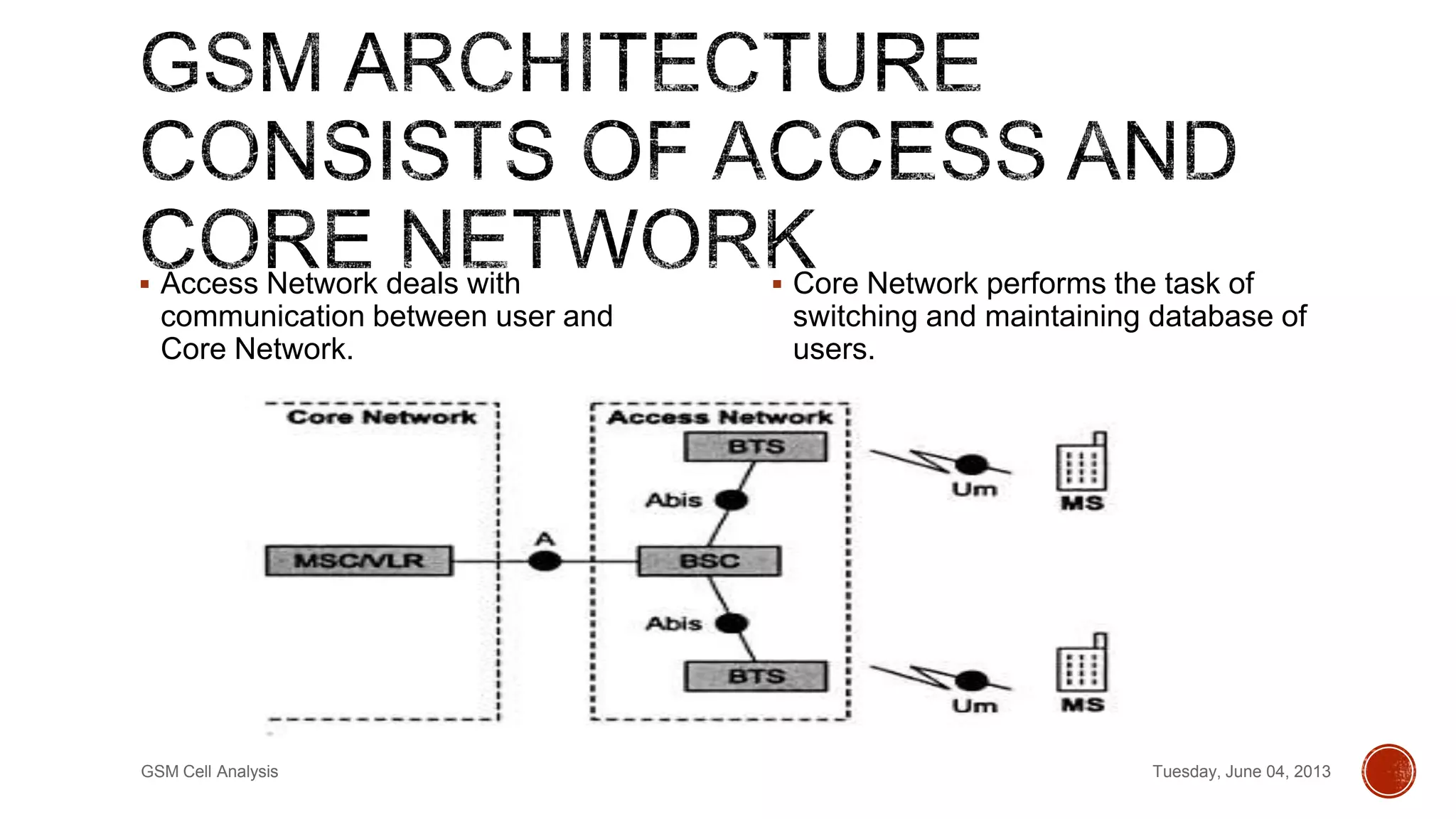
 Access Network deals with
communication between user and
Core Network.
 Core Network performs the task of
switching and maintaining database of
users.
Tuesday, June 04, 2013GSM Cell Analysis
 Cell Global Identity
 Mobile Country Code
 Indicates home country of user
 Range 000-999
 Mobile Network Code
 To identify network
 Range 00-99
 LAC
 To identify location areas
 Range 0001H - FFFEH
 Cell Identity
 To identify each cell uniquely
 Range 0 - 65535
 Base Station Identity Code
 Network Color Code
 BTS Color Code
 T3212
 Period of location update
 Default value is 20
 Unit is 6 Mins
Tuesday, June 04, 2013GSM Cell Analysis
 For finding cell parameters android smartphone was used.
 Net Monitor was used to find GPS coordinates.
 GSM Signal Monitoring was used to find LAC, CI, Handover, RSSI.
 Google Maps was used to mark the path of drive test.
Tuesday, June 04, 2013GSM Cell Analysis
 Drive Testing is the process of monitoring
and analyzing cell’s parameters and
performance.
 Drive Testing was performed in
 Rural Area (Telenor site in Dhodial)
 Urban Area (Warid site in Abbottabad)
 Collected data included
 Cell Identity
 Cell Sectors
 Location Area Code
 Serving Cell and Neighboring Cells
 GPS Coordinates
 ARFCN
Tuesday, June 04, 2013GSM Cell Analysis
 HATA Model is the most widely used
RF propagation model
 It is best for predicting the behavior of
radio propagation in cluttered areas
 It calculates path loss by taking into
account
 Percentage of buildings in a path
 Natural terrain features
 It is valid for frequency range 150 –
1500 MHz
 Free Space Path Loss Model is the
fundamental prediction tool.
 It is best for predicting radio
propagation in ideal environment
 It takes into account only distance and
frequency
Tuesday, June 04, 2013GSM Cell Analysis
Rural Area
 The base station under observation in
rural area had the following cell sectors
 Sector 1 – 1551
 Sector 2 – 1552
 Sector 3 – 1553
Urban Area
 The base station under observation in
urban area had the following cell sectors
 Sector 1 – 50521
 Sector 2 – 50522
 Sector 3 – 50523
Tuesday, June 04, 2013GSM Cell Analysis

Gsm cell analysis

  • 1.
     Hammad Shafiq Roll Number 17656  Mushtaq Ahmad  Roll Number 17670  Shernawaz Khan  Roll Number 15401  Umair Pervaiz  Roll Number 15385  Mr. Mohammad Asad Khan Tuesday, June 04, 2013GSM Cell Analysis Department of I.T and Telecommunication
  • 2.
    Finding cell parametersand calculating path loss by using HATA and Free Space Path Loss Model Tuesday, June 04, 2013GSM Cell Analysis
  • 3.
     Telecommunication meanscommunication over distance via electronic equipment.  Wired and Wireless communication are the fundamental modes of transmission in telecommunication.  Mobile communication is the most widely used type of wireless communication.  GSM is the most commonly used mobile communication standard in the world. Tuesday, June 04, 2013GSM Cell Analysis
  • 4.
     GSM standsfor Global System for Mobile Communication.  GSM is the first digital cellular mobile communication system.  Initially GSM was only used for voice communication over circuit switched network.  Data services like SMS, WAP, Internet over GPRS and EDGE were added later on. Tuesday, June 04, 2013GSM Cell Analysis
  • 5.
     In GSMthe communication was made secure by using encryption.  Encryption / Decryption is done by means of SIM card by using encryption keys.  Frequency is the most scarce resource in wireless communication.  GSM uses the concept of cells, sectors and frequency reuse to overcome the problem of limited frequency range.  In GSM each user is assigned 2 channels of 200 kHz, one is used for uplink and the other for downlink. Tuesday, June 04, 2013GSM Cell Analysis
  • 6.
     Access Networkdeals with communication between user and Core Network.  Core Network performs the task of switching and maintaining database of users. Tuesday, June 04, 2013GSM Cell Analysis
  • 7.
     Cell GlobalIdentity  Mobile Country Code  Indicates home country of user  Range 000-999  Mobile Network Code  To identify network  Range 00-99  LAC  To identify location areas  Range 0001H - FFFEH  Cell Identity  To identify each cell uniquely  Range 0 - 65535  Base Station Identity Code  Network Color Code  BTS Color Code  T3212  Period of location update  Default value is 20  Unit is 6 Mins Tuesday, June 04, 2013GSM Cell Analysis
  • 8.
     For findingcell parameters android smartphone was used.  Net Monitor was used to find GPS coordinates.  GSM Signal Monitoring was used to find LAC, CI, Handover, RSSI.  Google Maps was used to mark the path of drive test. Tuesday, June 04, 2013GSM Cell Analysis
  • 9.
     Drive Testingis the process of monitoring and analyzing cell’s parameters and performance.  Drive Testing was performed in  Rural Area (Telenor site in Dhodial)  Urban Area (Warid site in Abbottabad)  Collected data included  Cell Identity  Cell Sectors  Location Area Code  Serving Cell and Neighboring Cells  GPS Coordinates  ARFCN Tuesday, June 04, 2013GSM Cell Analysis
  • 10.
     HATA Modelis the most widely used RF propagation model  It is best for predicting the behavior of radio propagation in cluttered areas  It calculates path loss by taking into account  Percentage of buildings in a path  Natural terrain features  It is valid for frequency range 150 – 1500 MHz  Free Space Path Loss Model is the fundamental prediction tool.  It is best for predicting radio propagation in ideal environment  It takes into account only distance and frequency Tuesday, June 04, 2013GSM Cell Analysis
  • 11.
    Rural Area  Thebase station under observation in rural area had the following cell sectors  Sector 1 – 1551  Sector 2 – 1552  Sector 3 – 1553 Urban Area  The base station under observation in urban area had the following cell sectors  Sector 1 – 50521  Sector 2 – 50522  Sector 3 – 50523 Tuesday, June 04, 2013GSM Cell Analysis
  • 12.
    Tuesday, June 04,2013GSM Cell Analysis
  • 13.
    Tuesday, June 04,2013GSM Cell Analysis