MOBILE DATA
NETWORKS
RAVIKIRAN S. ANANDE
rvanande21@gmail.com
Contents
 Introduction
 Data oriented CDPD Networks
 GPRS
 EDGE
 SMS
 HSCSD
Cellular Digital Packet Data(CDPD)
 CDPD is a data service for first and second generation US
cellular systems and uses a full 30 kHz AMPS channel on a
shared basis.
 CDPD provides mobile packet data connectivity to existing
data networks and other cellular systems without any
additional bandwidth requirements.
 It also capitalizes on the unused air time which occurs
between successive radio channel assignments by the MSC.
 CDPD directly overlays with existing cellular architecture and
uses existing base station equipment, making it simple and
inexpensive to install.
 CDPD occupies voice channels purely on a secondary,
noninterfering basis and packet channels are dynamically
assigned.
 Each CDPD channel is duplex in nature.
 Each CDPD simplex link occupies a 30 kHz RF channel, and
data is sent at 19.2 kbps.
 0.5 GMSK modulation is used.
 CDPD transmissions are carried out using fixed-length
blocks.
 User data is protected using a Reed-Solomon block code
with 6-bit symbols. For each packet 282 user bits are coded
into 378 bits.
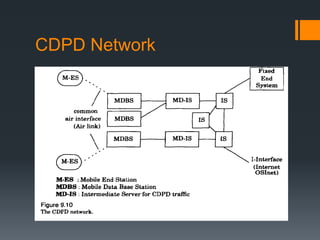
CDPD Network
 Subscribers(M-ES) are able to connect through the MDBS to
the internet via intermediate systems(MD-IS), which act as
servers and routers.
 Through the I-interface, CDPD can carry either Internet
Protocol(IP) or OSI connectionless protocol traffic.
 Two lower layer protocols are used in CDPD.
 The Mobile Data Link Protocol(MDLP) is used to convey
information between data link layer entities across CDPD air
interface.
 MDLP provides logical data link connections on a radio
channel by using an address contained in each packet.
 MDLP also provides sequence control, as well as error
detection and flow control.
 The Radio Resource Management Protocol (RRMP) is a
higher, layer 3 protocol used to manage radio channel
resources of the CDPD system.
 It enables an M-ES to find and utilize a duplex radio channel
without interfering with standard voice services.
 RRMP handles base station identification and configuration
messages for all M-ES stations.
 It also handles channel hopping commands, cell handoff’s
and M-ES change of power commands.
General Packet Radio
Service(GPRS)
 The general packet radio service (GPRS) provides packet
mode transfer for applications that exhibit traffic patterns
such as frequent transmission of small volumes (e.g., typical
web requests) or infrequent transmissions of small or
medium volumes (e.g., typical web responses).
 Compared to existing data transfer services, GPRS should
use the existing network resources more efficiently for packet
mode applications.
 GPRS also allows broadcast, multicast, and unicast services.
 Network providers typically support this model by charging on
volume and not on connection time as is usual for traditional
GSM data services.
Main Concept of GPRS
 For the new GPRS radio channels, the GSM system can
allocate between one and eight time slots within a TDMA
frame.
 Time slots are not allocated in a fixed, pre-determined
manner but on demand.
 All time slots can be shared by the active users; up- and
downlink are allocated separately.
 Allocation of the slots is based on current load and operator
preferences.
 Depending on the coding, a transfer rate of up to 170 kbit/s is
possible.
 For GPRS, operators often reserve at least a time slot per
cell to guarantee a minimum data rate.
GPRS Architecture
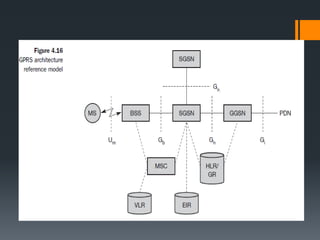
 The GPRS architecture introduces two new network
elements, which are called GPRS support nodes (GSN).
 All GSNs are integrated into the standard GSM architecture,
and many new interfaces have been defined.
 The gateway GPRS support node (GGSN) is the
interworking unit between the GPRS network and external
packet data networks (PDN).
 This node contains routing information for GPRS users,
performs address conversion, and tunnels data to a user via
encapsulation.
 The GGSN is connected to external networks (e.g., IP or
X.25) via the Gi interface and transfers packets to the SGSN
via an IP-based GPRS backbone network (Gn interface).
 The other new element is the serving GPRS support node
(SGSN) which supports the MS via the Gb interface.
 The SGSN, for example, requests user addresses from the
GPRS register (GR), keeps track of the individual MSs’
location, is responsible for collecting billing information (e.g.,
counting bytes), and performs several security functions.
 The GR, which is typically a part of the HLR, stores all
GPRS-relevant data.
 Before sending any data over the GPRS network, an MS
must attach to it, following the procedures of the Mobility
Management.
 The attachment procedure includes assigning a temporal
identifier, called a temporary logical link identity (TLLI),
and a ciphering key sequence number (CKSN) for data
encryption.
 For each MS, a GPRS context is set up and stored in the
MS and in the corresponding SGSN.
 This context comprises the status of the MS (which can be
ready, idle, or standby), the CKSN, a flag indicating if
compression is used, and routing data.
 Besides attaching and detaching, mobility management also
comprises functions for authentication, location management,
and ciphering.
 In idle mode an MS is not reachable and all context is
deleted.
 In the standby state only movement across routing areas is
updated to the SGSN but not changes of the cell. Only in the
ready state every movement of the MS is indicated to the
SGSN.
EDGE
 EDGE means Enhanced Data rates for GSM Evolution.
 Enhanced Data rates for GSM Evolution (EDGE) (also
known as Enhanced GPRS (EGPRS), or IMT Single
Carrier (IMT-SC), or Enhanced Data rates for Global
Evolution) is a digital mobile phone technology that allows
improved data transmission rates as a backward-
compatible extension of GSM.
 EDGE was deployed on GSM networks beginning in 2003 –
initially by Cingular (now AT&T) in the United States.
 Through the introduction of sophisticated methods of coding
and transmitting data, EDGE delivers higher bit-rates per
radio channel, resulting in a threefold increase in capacity
and performance compared with an ordinary GSM/GPRS
connection.
 EDGE can be used for any packet switched application, such
as an Internet connection.
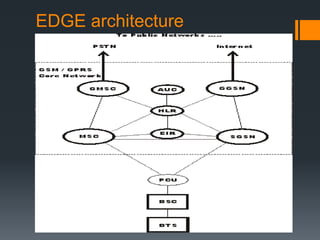
 EDGE is a superset to GPRS and can function on any
network with GPRS deployed on it, provided the carrier
implements the necessary upgrade.
 EDGE requires no hardware or software changes to be
made in GSM core networks.
 EDGE-compatible transceiver units must be installed and the
base station subsystem needs to be upgraded to support
EDGE.
 If the operator already has this in place, the network can be
upgraded to EDGE by activating an optional software
feature.
 In addition to Gaussian minimum-shift keying (GMSK), EDGE
uses higher-order PSK/8 phase shift keying (8PSK).
 EDGE can carry a bandwidth up to 500 kbps for
4 timeslots in packet mode. This means it can handle four
times as much traffic as standard GPRS.
EDGE architecture
Short Message Service ( SMS)
 The GSM SMS provides a connectionless transfer of
messages with low-capacity.
 In December 1992, the first short message, sent from a PC to
MS, was delivered in the Vodafone GSM network in the
United Kingdom.
 Every GSM short message can contain up to 140 octets, or
160 characters. To allow messages longer than 160
characters, SMS concatenation and SMS compression have
been defined and incorporated.
 The short messages are transported on the GSM - SDCCH
signalling channel.
 Two types of GSM short message services have been
defined:
 Cell broadcast service, which periodically delivers short
messages all subscribers in a given area.
 Point to Point service, which sends short messages to a
specific user.
GSM SMS Network architecture
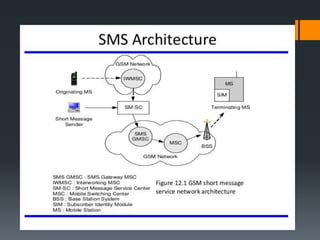
 In this architecture, the short message is first delivered from
the message sender to a short message service center
(SM-SC).
 The SM-SC is connected to GSM network through a specific
GSM GMSC.
 The SM-SC may connect to several GSM networks and to
several SMS GMSCs in a GSM network.
 The SMS GMSC locates the current MSC of the message
receiver and forward the message to that MSC.
 The MSC broadcasts the message to the base station
systems and the base transceiver stations (BTSs) page the
destination MS.
 The MS used for short message services must contain
special software to enable the messages to be decoded and
stored.
 Messages can be stored either in the SIM or in the memory
of the mobile equipment for display on the standard screen of
the MS.
 An MS may send or reply to a short message. The message
is delivered to a short message service interworking
MSC(IWMSC) and then to SM-SC.
 The recipient of the short message can be MS, a fax
machine or a PC connected to the Internet.
 Short message cannot be sent directly from the sender to the
recipient without passing through the SM-SC.
 To simplify generation of short message in MS Predictive text
input algorithms installed in MS reduce the number of input
keystrokes by predicting the next word the user will generate.
 There are three types of short messages: User-Specific, ME-
Specific and SIM-specific.
 A User-specific message is displayed to user.
 ME- specific message is processed by the mobile equipment
instead of showing to the user. Special function created by
the handset vendor can be triggered by this message.
 SIM specific message is processed at SIM card. If a GSM
operator designs a special function in the SIM card, the SIM-
specific message can trigger this function.
HSCSD
 HSCSD means High-Speed Circuit-Switched Data.
 HSCSD is a circuit switched protocol for large file transfer
and multimedia applications.
 The data rate of HSCSD has been increased by using
multiple TDMA time slots instead of one time slot in the
current data applications.
 The data rate can also be increased by data compression
techniques.

Mobile data networks

  • 1.
    MOBILE DATA NETWORKS RAVIKIRAN S.ANANDE rvanande21@gmail.com
  • 2.
    Contents  Introduction  Dataoriented CDPD Networks  GPRS  EDGE  SMS  HSCSD
  • 3.
    Cellular Digital PacketData(CDPD)  CDPD is a data service for first and second generation US cellular systems and uses a full 30 kHz AMPS channel on a shared basis.  CDPD provides mobile packet data connectivity to existing data networks and other cellular systems without any additional bandwidth requirements.  It also capitalizes on the unused air time which occurs between successive radio channel assignments by the MSC.
  • 4.
     CDPD directlyoverlays with existing cellular architecture and uses existing base station equipment, making it simple and inexpensive to install.  CDPD occupies voice channels purely on a secondary, noninterfering basis and packet channels are dynamically assigned.  Each CDPD channel is duplex in nature.
  • 5.
     Each CDPDsimplex link occupies a 30 kHz RF channel, and data is sent at 19.2 kbps.  0.5 GMSK modulation is used.  CDPD transmissions are carried out using fixed-length blocks.  User data is protected using a Reed-Solomon block code with 6-bit symbols. For each packet 282 user bits are coded into 378 bits.
  • 6.
  • 7.
     Subscribers(M-ES) areable to connect through the MDBS to the internet via intermediate systems(MD-IS), which act as servers and routers.  Through the I-interface, CDPD can carry either Internet Protocol(IP) or OSI connectionless protocol traffic.
  • 8.
     Two lowerlayer protocols are used in CDPD.  The Mobile Data Link Protocol(MDLP) is used to convey information between data link layer entities across CDPD air interface.  MDLP provides logical data link connections on a radio channel by using an address contained in each packet.  MDLP also provides sequence control, as well as error detection and flow control.
  • 9.
     The RadioResource Management Protocol (RRMP) is a higher, layer 3 protocol used to manage radio channel resources of the CDPD system.  It enables an M-ES to find and utilize a duplex radio channel without interfering with standard voice services.  RRMP handles base station identification and configuration messages for all M-ES stations.  It also handles channel hopping commands, cell handoff’s and M-ES change of power commands.
  • 10.
    General Packet Radio Service(GPRS) The general packet radio service (GPRS) provides packet mode transfer for applications that exhibit traffic patterns such as frequent transmission of small volumes (e.g., typical web requests) or infrequent transmissions of small or medium volumes (e.g., typical web responses).  Compared to existing data transfer services, GPRS should use the existing network resources more efficiently for packet mode applications.  GPRS also allows broadcast, multicast, and unicast services.
  • 11.
     Network providerstypically support this model by charging on volume and not on connection time as is usual for traditional GSM data services.
  • 12.
    Main Concept ofGPRS  For the new GPRS radio channels, the GSM system can allocate between one and eight time slots within a TDMA frame.  Time slots are not allocated in a fixed, pre-determined manner but on demand.  All time slots can be shared by the active users; up- and downlink are allocated separately.  Allocation of the slots is based on current load and operator preferences.
  • 13.
     Depending onthe coding, a transfer rate of up to 170 kbit/s is possible.  For GPRS, operators often reserve at least a time slot per cell to guarantee a minimum data rate.
  • 14.
    GPRS Architecture  TheGPRS architecture introduces two new network elements, which are called GPRS support nodes (GSN).  All GSNs are integrated into the standard GSM architecture, and many new interfaces have been defined.  The gateway GPRS support node (GGSN) is the interworking unit between the GPRS network and external packet data networks (PDN).  This node contains routing information for GPRS users, performs address conversion, and tunnels data to a user via encapsulation.
  • 16.
     The GGSNis connected to external networks (e.g., IP or X.25) via the Gi interface and transfers packets to the SGSN via an IP-based GPRS backbone network (Gn interface).  The other new element is the serving GPRS support node (SGSN) which supports the MS via the Gb interface.  The SGSN, for example, requests user addresses from the GPRS register (GR), keeps track of the individual MSs’ location, is responsible for collecting billing information (e.g., counting bytes), and performs several security functions.  The GR, which is typically a part of the HLR, stores all GPRS-relevant data.
  • 17.
     Before sendingany data over the GPRS network, an MS must attach to it, following the procedures of the Mobility Management.  The attachment procedure includes assigning a temporal identifier, called a temporary logical link identity (TLLI), and a ciphering key sequence number (CKSN) for data encryption.  For each MS, a GPRS context is set up and stored in the MS and in the corresponding SGSN.
  • 18.
     This contextcomprises the status of the MS (which can be ready, idle, or standby), the CKSN, a flag indicating if compression is used, and routing data.  Besides attaching and detaching, mobility management also comprises functions for authentication, location management, and ciphering.  In idle mode an MS is not reachable and all context is deleted.  In the standby state only movement across routing areas is updated to the SGSN but not changes of the cell. Only in the ready state every movement of the MS is indicated to the SGSN.
  • 19.
    EDGE  EDGE meansEnhanced Data rates for GSM Evolution.  Enhanced Data rates for GSM Evolution (EDGE) (also known as Enhanced GPRS (EGPRS), or IMT Single Carrier (IMT-SC), or Enhanced Data rates for Global Evolution) is a digital mobile phone technology that allows improved data transmission rates as a backward- compatible extension of GSM.  EDGE was deployed on GSM networks beginning in 2003 – initially by Cingular (now AT&T) in the United States.
  • 20.
     Through theintroduction of sophisticated methods of coding and transmitting data, EDGE delivers higher bit-rates per radio channel, resulting in a threefold increase in capacity and performance compared with an ordinary GSM/GPRS connection.  EDGE can be used for any packet switched application, such as an Internet connection.  EDGE is a superset to GPRS and can function on any network with GPRS deployed on it, provided the carrier implements the necessary upgrade.
  • 21.
     EDGE requiresno hardware or software changes to be made in GSM core networks.  EDGE-compatible transceiver units must be installed and the base station subsystem needs to be upgraded to support EDGE.  If the operator already has this in place, the network can be upgraded to EDGE by activating an optional software feature.  In addition to Gaussian minimum-shift keying (GMSK), EDGE uses higher-order PSK/8 phase shift keying (8PSK).
  • 22.
     EDGE cancarry a bandwidth up to 500 kbps for 4 timeslots in packet mode. This means it can handle four times as much traffic as standard GPRS.
  • 23.
  • 24.
    Short Message Service( SMS)  The GSM SMS provides a connectionless transfer of messages with low-capacity.  In December 1992, the first short message, sent from a PC to MS, was delivered in the Vodafone GSM network in the United Kingdom.  Every GSM short message can contain up to 140 octets, or 160 characters. To allow messages longer than 160 characters, SMS concatenation and SMS compression have been defined and incorporated.
  • 25.
     The shortmessages are transported on the GSM - SDCCH signalling channel.  Two types of GSM short message services have been defined:  Cell broadcast service, which periodically delivers short messages all subscribers in a given area.  Point to Point service, which sends short messages to a specific user.
  • 26.
    GSM SMS Networkarchitecture  In this architecture, the short message is first delivered from the message sender to a short message service center (SM-SC).  The SM-SC is connected to GSM network through a specific GSM GMSC.  The SM-SC may connect to several GSM networks and to several SMS GMSCs in a GSM network.  The SMS GMSC locates the current MSC of the message receiver and forward the message to that MSC.
  • 28.
     The MSCbroadcasts the message to the base station systems and the base transceiver stations (BTSs) page the destination MS.  The MS used for short message services must contain special software to enable the messages to be decoded and stored.  Messages can be stored either in the SIM or in the memory of the mobile equipment for display on the standard screen of the MS.
  • 29.
     An MSmay send or reply to a short message. The message is delivered to a short message service interworking MSC(IWMSC) and then to SM-SC.  The recipient of the short message can be MS, a fax machine or a PC connected to the Internet.  Short message cannot be sent directly from the sender to the recipient without passing through the SM-SC.  To simplify generation of short message in MS Predictive text input algorithms installed in MS reduce the number of input keystrokes by predicting the next word the user will generate.
  • 30.
     There arethree types of short messages: User-Specific, ME- Specific and SIM-specific.  A User-specific message is displayed to user.  ME- specific message is processed by the mobile equipment instead of showing to the user. Special function created by the handset vendor can be triggered by this message.  SIM specific message is processed at SIM card. If a GSM operator designs a special function in the SIM card, the SIM- specific message can trigger this function.
  • 31.
    HSCSD  HSCSD meansHigh-Speed Circuit-Switched Data.  HSCSD is a circuit switched protocol for large file transfer and multimedia applications.  The data rate of HSCSD has been increased by using multiple TDMA time slots instead of one time slot in the current data applications.  The data rate can also be increased by data compression techniques.