“W-CDMA”
      PRESENTED BY-GYANENDRA PRASAD PANIGRAHI
                  REGD.NO-0901304190
        GUIDED BY- Mr. SHAKTI NARAYANA MISHRA


  DEPT.-ELECTRONICS AND COMMUNICATION ENGINEERING
GANDHI INSTITUTE OF TECHNOLOGY AND MANAGEMENT
                  BHUBANESWAR
CONTENTS
1.    Introduction
2.    History
3.    Duplexing
4.    Multiple Access Techniques
5.    Spread Spectrum Techniques
6.    WCDMA Coding & Decoding
7.    WCDMA Technology
8.    WCDMA Applications
9.    Conclusion
10.   References
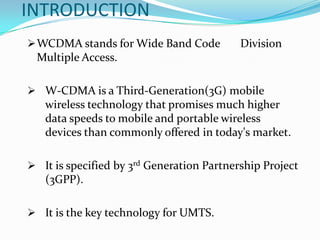
INTRODUCTION
 WCDMA stands for Wide Band Code          Division
 Multiple Access.

 W-CDMA is a Third-Generation(3G) mobile
   wireless technology that promises much higher
   data speeds to mobile and portable wireless
   devices than commonly offered in today's market.

 It is specified by 3rd Generation Partnership Project
   (3GPP).

 It is the key technology for UMTS.
HISTORY
QUALCOMM , the first company to succeed in
 developing a practical and cost effective CDMA
 implementation for consumer cell phones.

The world's first commercial W-CDMA service
 was launched by NTT DoCoMo in Japan.
DUPLEXING
 It means to allow the Subscriber to send simultaneously
  information to the base station while receiving information
  from the base station.
 It is of two types.
               (a) FDD
               (b) TDD
 In FDD ,
    (1) Forward Band :- Traffic from base station to mobile
    (2) Reverse Band :- Traffic from mobile to base station
DUPLEXING(cont…)
 In FDD Duplexer is used.
 The frequency separation between each forward &
  reverse channel is constant through out the system.

 In TDD , Time is used to provide both a forward &
  reverse link.
 Each duplex channel has forward & reverse time slots.
 Duplexer is not required.
 It is effective when all the users are stationary.
MULTIPLE ACCESS TECHNIQUES
 These are used to allow many mobile users to share a
  finite amount of radio spectrum simultaneously.
 The sharing of spectrum is required to achieve high
  capacity by simultaneously allocating the available
  bandwidth (or) available amount of channels to
  multiple users.

 Multiple access techniques are of three types.
1) FDMA
2) TDMA
3) CDMA
MULTIPLE ACCESS
TECHNIQUES(cont…)
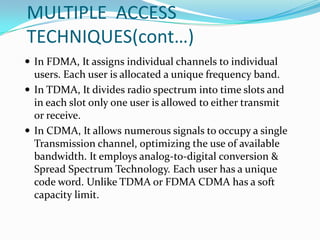
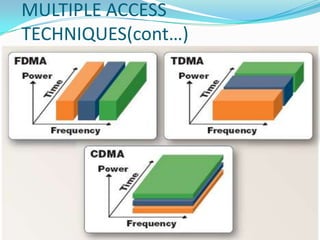
 In FDMA, It assigns individual channels to individual
  users. Each user is allocated a unique frequency band.
 In TDMA, It divides radio spectrum into time slots and
  in each slot only one user is allowed to either transmit
  or receive.
 In CDMA, It allows numerous signals to occupy a single
  Transmission channel, optimizing the use of available
  bandwidth. It employs analog-to-digital conversion &
  Spread Spectrum Technology. Each user has a unique
  code word. Unlike TDMA or FDMA CDMA has a soft
  capacity limit.
MULTIPLE ACCESS
TECHNIQUES(cont…)
SPREAD SPECTRUM TECHNIQUE-I
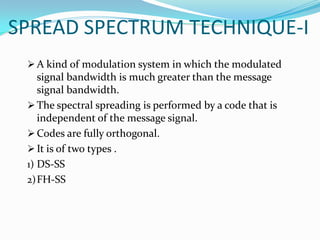
  A kind of modulation system in which the modulated
    signal bandwidth is much greater than the message
    signal bandwidth.
  The spectral spreading is performed by a code that is
    independent of the message signal.
  Codes are fully orthogonal.
  It is of two types .
 1) DS-SS
 2) FH-SS
SPREAD SPECTRUM TECHNIQUE-II
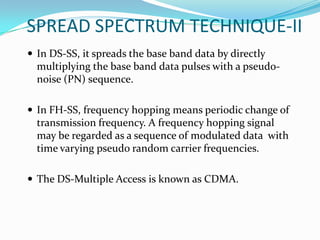
 In DS-SS, it spreads the base band data by directly
  multiplying the base band data pulses with a pseudo-
  noise (PN) sequence.

 In FH-SS, frequency hopping means periodic change of
  transmission frequency. A frequency hopping signal
  may be regarded as a sequence of modulated data with
  time varying pseudo random carrier frequencies.

 The DS-Multiple Access is known as CDMA.
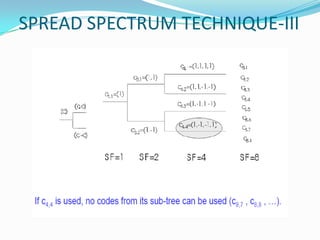
SPREAD SPECTRUM TECHNIQUE-III
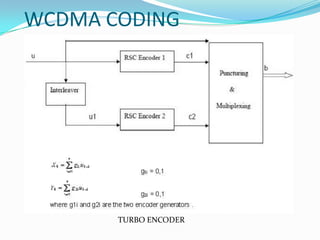
WCDMA CODING


       TURBO ENCODER
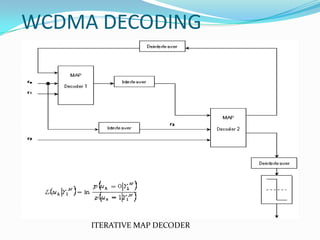
WCDMA DECODING


     ITERATIVE MAP DECODER
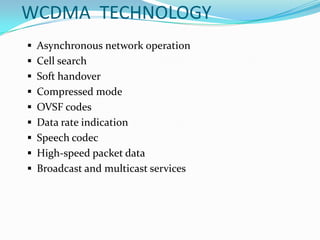
WCDMA TECHNOLOGY
 Asynchronous network operation
 Cell search
 Soft handover
 Compressed mode
 OVSF codes
 Data rate indication
 Speech codec
 High-speed packet data
 Broadcast and multicast services
WCDMA APPLICATIONS
For the consumer
   Video streaming, TV broadcast
   Video calls, video clips – news, music, sports
   Enhanced gaming, chat, location services…
For business
   High speed teleworking
   Sales force automation
   Video conferencing
   Real time financial information
CONCLUSION
 WCDMA has many advantages like much higher B.W
  (5 MHz),high chip rate(3.84Mcps),high data rate(up
  to 2 Mbps),enhanced security and so on…
            Thus it is the growing technology for
 mobile generations.
REFERENCES
 T.S.Rappaport “ Wireless Communications”
 Forouzan “Data Communication And Networking”
 http://www.google.com
 http://www.google.com/wikipedia
W cdma

W cdma

  • 1.
    “W-CDMA” PRESENTED BY-GYANENDRA PRASAD PANIGRAHI REGD.NO-0901304190 GUIDED BY- Mr. SHAKTI NARAYANA MISHRA DEPT.-ELECTRONICS AND COMMUNICATION ENGINEERING GANDHI INSTITUTE OF TECHNOLOGY AND MANAGEMENT BHUBANESWAR
  • 2.
    CONTENTS 1. Introduction 2. History 3. Duplexing 4. Multiple Access Techniques 5. Spread Spectrum Techniques 6. WCDMA Coding & Decoding 7. WCDMA Technology 8. WCDMA Applications 9. Conclusion 10. References
  • 3.
    INTRODUCTION  WCDMA standsfor Wide Band Code Division Multiple Access.  W-CDMA is a Third-Generation(3G) mobile wireless technology that promises much higher data speeds to mobile and portable wireless devices than commonly offered in today's market.  It is specified by 3rd Generation Partnership Project (3GPP).  It is the key technology for UMTS.
  • 4.
    HISTORY QUALCOMM , thefirst company to succeed in developing a practical and cost effective CDMA implementation for consumer cell phones. The world's first commercial W-CDMA service was launched by NTT DoCoMo in Japan.
  • 5.
    DUPLEXING  It meansto allow the Subscriber to send simultaneously information to the base station while receiving information from the base station.  It is of two types. (a) FDD (b) TDD  In FDD , (1) Forward Band :- Traffic from base station to mobile (2) Reverse Band :- Traffic from mobile to base station
  • 6.
    DUPLEXING(cont…)  In FDDDuplexer is used.  The frequency separation between each forward & reverse channel is constant through out the system.  In TDD , Time is used to provide both a forward & reverse link.  Each duplex channel has forward & reverse time slots.  Duplexer is not required.  It is effective when all the users are stationary.
  • 7.
    MULTIPLE ACCESS TECHNIQUES These are used to allow many mobile users to share a finite amount of radio spectrum simultaneously.  The sharing of spectrum is required to achieve high capacity by simultaneously allocating the available bandwidth (or) available amount of channels to multiple users.  Multiple access techniques are of three types. 1) FDMA 2) TDMA 3) CDMA
  • 8.
    MULTIPLE ACCESS TECHNIQUES(cont…)  InFDMA, It assigns individual channels to individual users. Each user is allocated a unique frequency band.  In TDMA, It divides radio spectrum into time slots and in each slot only one user is allowed to either transmit or receive.  In CDMA, It allows numerous signals to occupy a single Transmission channel, optimizing the use of available bandwidth. It employs analog-to-digital conversion & Spread Spectrum Technology. Each user has a unique code word. Unlike TDMA or FDMA CDMA has a soft capacity limit.
  • 9.
  • 10.
    SPREAD SPECTRUM TECHNIQUE-I  A kind of modulation system in which the modulated signal bandwidth is much greater than the message signal bandwidth.  The spectral spreading is performed by a code that is independent of the message signal.  Codes are fully orthogonal.  It is of two types . 1) DS-SS 2) FH-SS
  • 11.
    SPREAD SPECTRUM TECHNIQUE-II In DS-SS, it spreads the base band data by directly multiplying the base band data pulses with a pseudo- noise (PN) sequence.  In FH-SS, frequency hopping means periodic change of transmission frequency. A frequency hopping signal may be regarded as a sequence of modulated data with time varying pseudo random carrier frequencies.  The DS-Multiple Access is known as CDMA.
  • 12.
  • 13.
    WCDMA CODING TURBO ENCODER
  • 14.
    WCDMA DECODING ITERATIVE MAP DECODER
  • 15.
    WCDMA TECHNOLOGY  Asynchronousnetwork operation  Cell search  Soft handover  Compressed mode  OVSF codes  Data rate indication  Speech codec  High-speed packet data  Broadcast and multicast services
  • 16.
    WCDMA APPLICATIONS For theconsumer  Video streaming, TV broadcast  Video calls, video clips – news, music, sports  Enhanced gaming, chat, location services… For business  High speed teleworking  Sales force automation  Video conferencing  Real time financial information
  • 17.
    CONCLUSION  WCDMA hasmany advantages like much higher B.W (5 MHz),high chip rate(3.84Mcps),high data rate(up to 2 Mbps),enhanced security and so on… Thus it is the growing technology for mobile generations.
  • 18.
    REFERENCES  T.S.Rappaport “Wireless Communications”  Forouzan “Data Communication And Networking”  http://www.google.com  http://www.google.com/wikipedia