The Nexus Explored:  A Generalised Model of Learning Styles Damian Gordon, Gordon Bull e-Learning Research Group,  School of Computing, Dublin Institute of Technology,  Kevin Street, Dublin 8, Ireland.
Overview What is a Learning Style ? Criticisms of Learning Styles Equivalence of Martinez and MBTI The Four-Dimensional Leaning Style Gordon-Bull MetaModel Addressing the Criticisms Questions ???
Introduction Looking at learning styles  a strength or preference Build into a Virtual Learning Environment Which model of Learning Styles to use ? Are there ‘core’ or fundamental dimensions of all of these models ?
What is Learning Style ? the composite of characteristic cognitive, affective, and physiological factors that serve as relatively stable indicators of how a learner perceives, interacts with, and responds to the learning environment Keefe (1979) a consistent pattern of behaviour within a range of individual variability (Cornet, 1983);  a student's consistent way of responding to and using stimuli in a learning environment (Claxton & Ralston, 1978);  how individuals process information and prefer to learn (Garity, 1985);  the way individuals organise information and experiences (Laschinger & Boss, 1984) and;  an expression of psychological differentiation within characteristic modes of information processing (Witkin & Goodenough, 1971, 1981).
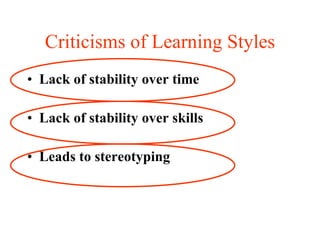
Criticisms of Learning Styles Lack of stability over time Lack of stability over skills Leads to stereotyping
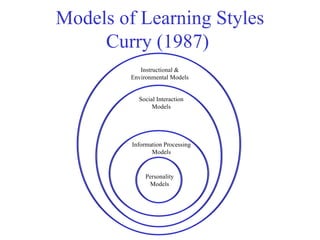
Models of Learning Styles Curry (1987)  Personality Models Information Processing Models Social Interaction Models Instructional & Environmental Models
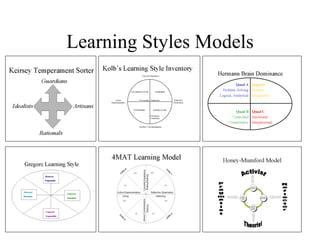
Learning Styles Models
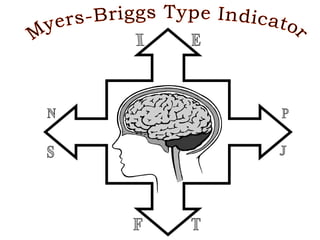
Myers-Briggs Type Indicator  I E N S F T P J
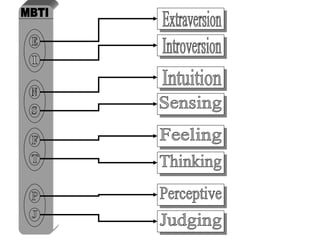
MBTI I E N S F T P J Introversion Extraversion Intuition Sensing Feeling Thinking Perceptive Judging
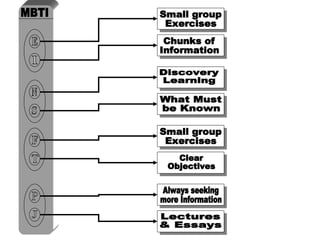
MBTI I E N S F T P J Chunks of  Information Small group Exercises Discovery Learning Small group Exercises Clear Objectives Always seeking  more Information Lectures & Essays What Must be Known
Gordon-Bull Algorithm
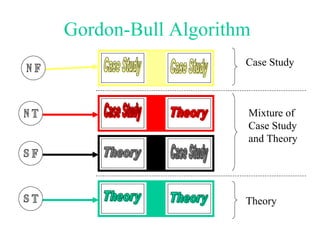
Gordon-Bull Algorithm Case Study Mixture of Case Study and Theory Theory
Gordon-Bull Algorithm Case Study Mixture of Case Study and Theory Theory Conforming Learner Performing Learner Transforming Learner Martinez Resistant Learner
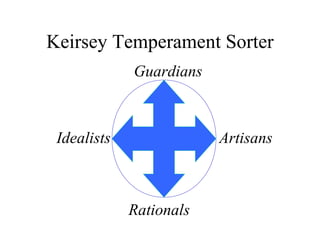
Keirsey Temperament Sorter Guardians (SJ) Idealists (NF) Artisans (SP)  Rationals (NT)
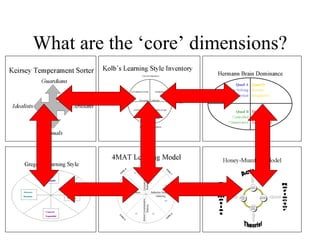
What are the ‘core’ dimensions?
Keirsey Temperament Sorter Guardians Idealists Artisans Rationals
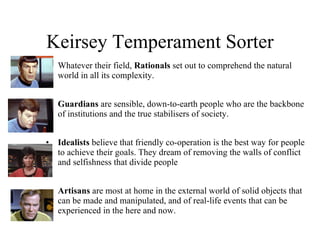
Keirsey Temperament Sorter Whatever their field,  Rationals  set out to comprehend the natural world in all its complexity. Guardians  are sensible, down-to-earth people who are the backbone of institutions and the true stabilisers of society.  Idealists  believe that friendly co-operation is the best way for people to achieve their goals. They dream of removing the walls of conflict and selfishness that divide people Artisans  are most at home in the external world of solid objects that can be made and manipulated, and of real-life events that can be experienced in the here and now.
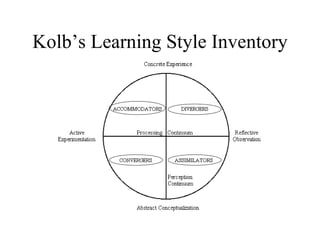
Kolb’s Learning Style Inventory
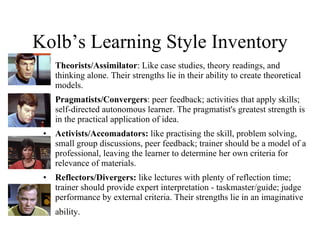
Kolb’s Learning Style Inventory Theorists/Assimilator : Like case studies, theory readings, and thinking alone. Their strengths lie in their ability to create theoretical models.  Pragmatists/Convergers : peer feedback; activities that apply skills; self-directed autonomous learner. The pragmatist's greatest strength is in the practical application of idea. Activists/Accomadators:  like practising the skill, problem solving, small group discussions, peer feedback; trainer should be a model of a professional, leaving the learner to determine her own criteria for relevance of materials.  Reflectors/Divergers:  like lectures with plenty of reflection time; trainer should provide expert interpretation - taskmaster/guide; judge performance by external criteria. Their strengths lie in an imaginative ability.
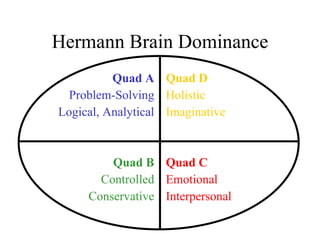
Hermann Brain Dominance Quad A Problem-Solving Logical, Analytical Quad B Controlled Conservative Quad D Holistic Imaginative Quad C Emotional Interpersonal
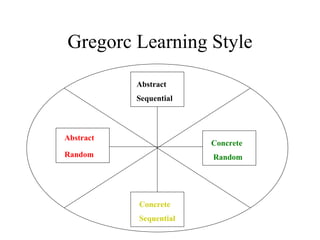
Gregorc Learning Style Concrete  Sequential   Concrete Random Abstract  Sequential Abstract  Random
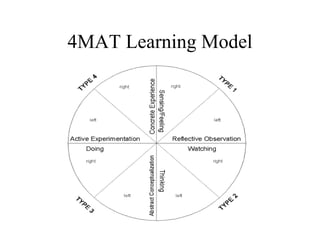
4MAT Learning Model
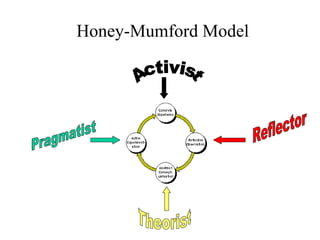
Honey-Mumford Model Activist Theorist Pragmatist Reflector
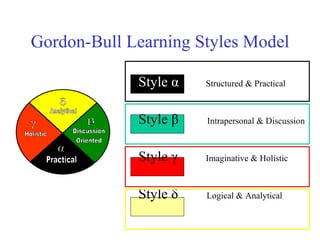
Gordon-Bull Learning Styles Model Style α   Structured & Practical Style β  Intrapersonal & Discussion Style γ  Imaginative & Holistic Style δ  Logical & Analytical
What’s the Added Value ? Resistant Learners
Resistant Learners (Like the  Avoidant  dimension in the Grasha-Riechmann Model) 1. they may lack the ICT skills to interact effectively with e-Learning materials, 2. they may lack the self-confidence to use ICTs effectively, or 3. they may not wish to participate in the learning experience because they are apathetic, frustrated, unable, discouraged or disobedient.
What Else ?  Evolutionary Learning Style Models Resistant Learners
Evolutionary Models Lewin's Cycle Saljo's Conceptions of Learning Bloom's Taxonomy  Gagne’s Conditions of Learning
Criticisms of Learning Styles Lack of stability over time Lack of stability over skills  Leads to stereotyping
Criticisms of Learning Styles Lack of stability over time Need to retest: Evolutionary Models Lack of stability over skills  Leads to stereotyping
Criticisms of Learning Styles Lack of stability over time Need to retest: Evolutionary Models Lack of stability over skills  Need to retest: With different tests Leads to stereotyping
Criticisms of Learning Styles Lack of stability over time Need to retest: Evolutionary Models Lack of stability over skills  Need to retest: With different tests Leads to stereotyping Technological Solution ?? Educate Learners and teachers
Coming Soon...
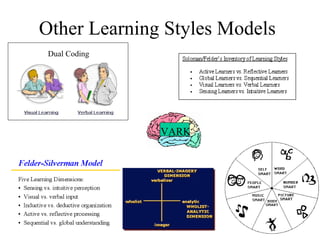
Other Learning Styles Models VARK Dual Coding
??? Questions ???

A Unified Model of Learning Styles

  • 1.
    The Nexus Explored: A Generalised Model of Learning Styles Damian Gordon, Gordon Bull e-Learning Research Group, School of Computing, Dublin Institute of Technology, Kevin Street, Dublin 8, Ireland.
  • 2.
    Overview What isa Learning Style ? Criticisms of Learning Styles Equivalence of Martinez and MBTI The Four-Dimensional Leaning Style Gordon-Bull MetaModel Addressing the Criticisms Questions ???
  • 3.
    Introduction Looking atlearning styles a strength or preference Build into a Virtual Learning Environment Which model of Learning Styles to use ? Are there ‘core’ or fundamental dimensions of all of these models ?
  • 4.
    What is LearningStyle ? the composite of characteristic cognitive, affective, and physiological factors that serve as relatively stable indicators of how a learner perceives, interacts with, and responds to the learning environment Keefe (1979) a consistent pattern of behaviour within a range of individual variability (Cornet, 1983); a student's consistent way of responding to and using stimuli in a learning environment (Claxton & Ralston, 1978); how individuals process information and prefer to learn (Garity, 1985); the way individuals organise information and experiences (Laschinger & Boss, 1984) and; an expression of psychological differentiation within characteristic modes of information processing (Witkin & Goodenough, 1971, 1981).
  • 5.
    Criticisms of LearningStyles Lack of stability over time Lack of stability over skills Leads to stereotyping
  • 6.
    Models of LearningStyles Curry (1987) Personality Models Information Processing Models Social Interaction Models Instructional & Environmental Models
  • 7.
  • 8.
  • 9.
    MBTI I EN S F T P J Introversion Extraversion Intuition Sensing Feeling Thinking Perceptive Judging
  • 10.
    MBTI I EN S F T P J Chunks of Information Small group Exercises Discovery Learning Small group Exercises Clear Objectives Always seeking more Information Lectures & Essays What Must be Known
  • 11.
  • 12.
  • 13.
    Gordon-Bull Algorithm CaseStudy Mixture of Case Study and Theory Theory
  • 14.
    Gordon-Bull Algorithm CaseStudy Mixture of Case Study and Theory Theory Conforming Learner Performing Learner Transforming Learner Martinez Resistant Learner
  • 15.
    Keirsey Temperament SorterGuardians (SJ) Idealists (NF) Artisans (SP) Rationals (NT)
  • 16.
    What are the‘core’ dimensions?
  • 17.
    Keirsey Temperament SorterGuardians Idealists Artisans Rationals
  • 18.
    Keirsey Temperament SorterWhatever their field, Rationals set out to comprehend the natural world in all its complexity. Guardians are sensible, down-to-earth people who are the backbone of institutions and the true stabilisers of society. Idealists believe that friendly co-operation is the best way for people to achieve their goals. They dream of removing the walls of conflict and selfishness that divide people Artisans are most at home in the external world of solid objects that can be made and manipulated, and of real-life events that can be experienced in the here and now.
  • 19.
  • 20.
    Kolb’s Learning StyleInventory Theorists/Assimilator : Like case studies, theory readings, and thinking alone. Their strengths lie in their ability to create theoretical models. Pragmatists/Convergers : peer feedback; activities that apply skills; self-directed autonomous learner. The pragmatist's greatest strength is in the practical application of idea. Activists/Accomadators: like practising the skill, problem solving, small group discussions, peer feedback; trainer should be a model of a professional, leaving the learner to determine her own criteria for relevance of materials. Reflectors/Divergers: like lectures with plenty of reflection time; trainer should provide expert interpretation - taskmaster/guide; judge performance by external criteria. Their strengths lie in an imaginative ability.
  • 21.
    Hermann Brain DominanceQuad A Problem-Solving Logical, Analytical Quad B Controlled Conservative Quad D Holistic Imaginative Quad C Emotional Interpersonal
  • 22.
    Gregorc Learning StyleConcrete Sequential Concrete Random Abstract Sequential Abstract Random
  • 23.
  • 24.
    Honey-Mumford Model ActivistTheorist Pragmatist Reflector
  • 25.
    Gordon-Bull Learning StylesModel Style α Structured & Practical Style β Intrapersonal & Discussion Style γ Imaginative & Holistic Style δ Logical & Analytical
  • 26.
    What’s the AddedValue ? Resistant Learners
  • 27.
    Resistant Learners (Likethe Avoidant dimension in the Grasha-Riechmann Model) 1. they may lack the ICT skills to interact effectively with e-Learning materials, 2. they may lack the self-confidence to use ICTs effectively, or 3. they may not wish to participate in the learning experience because they are apathetic, frustrated, unable, discouraged or disobedient.
  • 28.
    What Else ? Evolutionary Learning Style Models Resistant Learners
  • 29.
    Evolutionary Models Lewin'sCycle Saljo's Conceptions of Learning Bloom's Taxonomy Gagne’s Conditions of Learning
  • 30.
    Criticisms of LearningStyles Lack of stability over time Lack of stability over skills Leads to stereotyping
  • 31.
    Criticisms of LearningStyles Lack of stability over time Need to retest: Evolutionary Models Lack of stability over skills Leads to stereotyping
  • 32.
    Criticisms of LearningStyles Lack of stability over time Need to retest: Evolutionary Models Lack of stability over skills Need to retest: With different tests Leads to stereotyping
  • 33.
    Criticisms of LearningStyles Lack of stability over time Need to retest: Evolutionary Models Lack of stability over skills Need to retest: With different tests Leads to stereotyping Technological Solution ?? Educate Learners and teachers
  • 34.
  • 35.
    Other Learning StylesModels VARK Dual Coding
  • 36.