Study Skills & Learning Styles
Objectives Thinking about how you will study Knowing your own preferred way of learning Give you some starting points for your own research and study into learning for your assignments.
Study: Starting Out Be Regular Make study a habit Same time, same place Accept responsibility for your own learning Plan your time Long term & short term To do lists Keep the end in mind (remember why you are doing this) Location, Location, Location
Study: Keep Going Look after yourself Reward yourself to maintain motivation Study to your strengths Break the work down into parts focus on one task at a time Recognise when you need help and ask for it
The Assignments Make sure you have all the resources before you start Get something down, anything will do You can always edit out the bad stuff Answer the question Check with your tutor that you are taking the right approach Write with the assessment criteria in mind
Summary Be positive Remember why you are doing this Plan your study Plan your assignment Remember people are a great resource
Learning Styles Do you know your own learning style? Do you know what methods of learning work best for you? Are you: visual (VAKT), musical (multiple intelligences), activist (Honey & Mumford)…? Do you work in short bursts or long sessions?
Module 1 Assignments Ask you to consider a learning experience, reflect on it and explain it using theory. Two-fold aim of presentation To get you thinking about how to maximise you time studying To introduce you to some ideas about learning that might feed into your assignment.
What is learning? Saljo classified respondents ideas of learning into five groups. Learning as a  quantitative increase in knowledge . Learning is acquiring information or “knowing a lot”   Learning as  memorising.  Learning is storing information that can be reproduced.  Learning as acquiring facts, skills and methods that can be  retained and used  as necessary.  Learning as  making sense  or abstracting meaning. Learning involves relating parts of the subject matter to each other and to the real world.  Learning as interpreting and  understanding reality in a different way . Learning involves comprehending the world by re-interpreting knowledge.
Some Schools of learning theories Behaviourism – Stimulus & Response Skinner, Pavlov Cognitivism – Mental processes Piaget Humanism – Learner centred Carl Rogers, Knowles’ Andragogy Social / Situated – informal occupational learning. Communities of practice Lave & Wenger Constructivism – Personal constructs Kelly
Learning to learn – why bother? Lifelong learning is becoming an important issue in society as a whole. Manufacturing and now service industries are cheaper and often better abroad. Western Europe needs to develop knowledge workers to keep their place as economic powers. We need to learn smarter and faster.
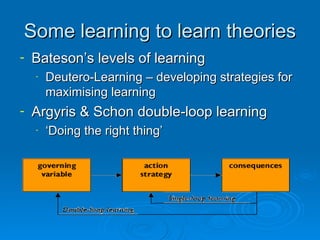
Some learning to learn theories Bateson’s levels of learning Deutero-Learning – developing strategies for maximising learning Argyris & Schon double-loop learning ‘ Doing the right thing’
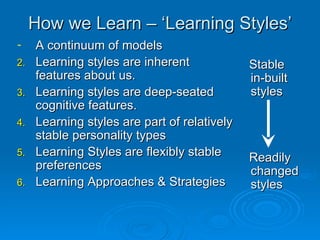
How we Learn – ‘Learning Styles’ A continuum of models Learning styles are inherent features about us. Learning styles are deep-seated cognitive features. Learning styles are part of relatively stable personality types Learning Styles are flexibly stable preferences Learning Approaches & Strategies Stable in-built styles Readily changed styles
Type 1: Largely born with certain preferences that can’t be changed VAKT (Visual, Auditory, Kinaesthetic, Tactile)  Gregorc’s 4 channel learning styles model
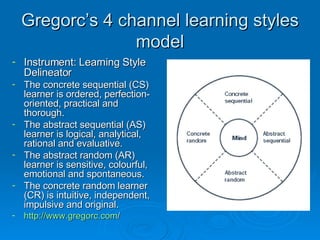
Gregorc’s 4 channel learning styles model Instrument: Learning Style Delineator The concrete sequential (CS) learner is ordered, perfection-oriented, practical and thorough. The abstract sequential (AS) learner is logical, analytical, rational and evaluative. The abstract random (AR) learner is sensitive, colourful, emotional and spontaneous. The concrete random learner (CR) is intuitive, independent, impulsive and original. http:// www.gregorc.com /
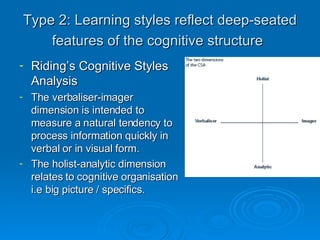
Type 2:  Learning styles reflect deep-seated features of the cognitive structure   Riding’s Cognitive Styles Analysis The verbaliser-imager dimension is intended to measure a natural tendency to process information quickly in verbal or in visual form. The holist-analytic dimension relates to cognitive organisation i.e big picture / specifics.
Type 3:  Learning styles are one component of a relatively stable personality type MBTI (Myers-Briggs Type Indicator) 4 Dimensions:  Extrovert (E) – Introvert (I),  Intuiting (N)– sensing (S),  Thinking (T)– Feeling (F),  Judging (J)– Perceiving (P). So there are 16 personality types e.g. INTJ Jackson’s Learning Styles Profiler.  http://www.cymeon.com/lss2.asp
Jackson’s LSP Conscious learning, 4 scales (low to high): Goal Oriented Achiever:  Planning, Assertiveness, Decisiveness, Adaptability, Resilience, Achievement motivation . Emotionally Intelligent Achiever:  Analysis, Decision making, Interpersonal sensitivity.   Conscientious Achiever:  Practical, Realistic Deep Learning Achiever:  Strategic perspective, open to new ideas. Instinctive learning, 1 scale (low to high): Sensation seeker:  Energy and Initiative .
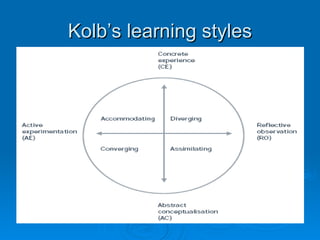
Type 4:  Flexibly stable learning preferences  Kolb’s Learning Styles Inventory  Honey & Mumford’s Learning Styles Questionnaire Activist, Reflector, Theorist, Pragmatist  (closely linked to Kolb’s learning cycle) Herrmann’s ‘whole brain’ model
Kolb’s learning styles
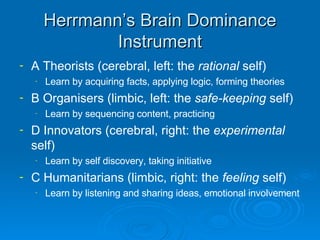
Herrmann’s Brain Dominance Instrument A Theorists (cerebral, left: the  rational  self) Learn by acquiring facts, applying logic, forming theories B Organisers (limbic, left: the  safe-keeping  self) Learn by sequencing content, practicing D Innovators (cerebral, right: the  experimental  self) Learn by self discovery, taking initiative C Humanitarians (limbic, right: the  feeling  self) Learn by listening and sharing ideas, emotional involvement
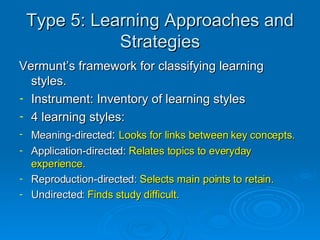
Type 5: Learning Approaches and Strategies Vermunt’s framework for classifying learning styles. Instrument: Inventory of learning styles 4 learning styles: Meaning-directed :  Looks for links between key concepts. Application-directed:  Relates topics to everyday experience. Reproduction-directed:  Selects main points to retain. Undirected:  Finds   study difficult.
A word of warning about learning styles There is limited research into the validity and reliability of learning styles and their instruments. The field is a bit of a mess because there is little collaboration. Selling a product has become more important than trying to make sense of learning styles.
At the end of the day They are useful tools to get you thinking about how you learn best. In most cases, they are well intentioned efforts to help people learn to learn Use those that suit you. But take it all with a ‘pinch of salt’.
Bibliography ARGYRIS M & SCHON D (1974)  Theory in Practice. Increasing professional effectiveness , San Francisco: Jossey-Bass.  BATESON G (1973)  Steps to an Ecology of Mind  London, Paladin COFFIELD F et.al. (2004)  Learning Styles and Pedagogy in post-16 learning: A Systematic and Critical Review , London, LSRC GARDNER H (1993)  Frames of Mind: the theory of multiple intelligences  (2nd edition) London, Fontana  HERRMANN N (1996)  The whole brain business book . New York: McGraw-Hill. HONEY P & MUMFORD A (1982)  Manual of Learning Styles  London: P Honey  KELLY G (1955) T he Psychology of Personal Constructs  New York: W W Norton  KNOWLES M et al (2005)  The Adult Learner: The Definitive Classic in Adult Education and Human Resource Development  London: Butterworth Heinemann KOLB D A (1984)  Experiential Learning: experience as the source of learning and development  New Jersey: Prentice-Hall  LAVE J and WENGER E (1991)  Situated Learning: legitimate peripheral participation  Cambridge: Cambridge University Press
Bibliography MYERS IB & McCAULLEY MH (1998)  Manual: a guide to the development and use of the Myers-Briggs Type Indicator  Palo Alto, CA: Consulting Psychologists Press. PAVLOV I P (1928)  Lectures on Conditioned Reflexes, Vol. I  London: Lawrence and Wishart  PIAGET J & INHELDER B (1969)  The Psychology of the Child  London, Routledge and Kegan Paul  RIDING R (1994)  Personal style awareness and personal development  Birmingham: Learning and Training Technology. ROGERS C R (1980)  Freedom to learn for the 80s  New York: Free Press  RYLATT A (2003)  Winning the Knowledge Game: Smarter Learning for Business Excellence   London, Butterworth Heinemann  SÄLJÖ R (1979) "Learning in the Learner's Perspective: some commonplace misconceptions"  Reports from the Institute of Education , University of Gothenburg, 76. SKINNER B F (1973)  Beyond Freedom and Dignit y Harmondsworth: Penguin  VERMUNT JD (1994)  Inventory of Learning Styles (ILS) in higher education  Tilburg: University of Tlburg.

Study Skills

  • 1.
    Study Skills &Learning Styles
  • 2.
    Objectives Thinking abouthow you will study Knowing your own preferred way of learning Give you some starting points for your own research and study into learning for your assignments.
  • 3.
    Study: Starting OutBe Regular Make study a habit Same time, same place Accept responsibility for your own learning Plan your time Long term & short term To do lists Keep the end in mind (remember why you are doing this) Location, Location, Location
  • 4.
    Study: Keep GoingLook after yourself Reward yourself to maintain motivation Study to your strengths Break the work down into parts focus on one task at a time Recognise when you need help and ask for it
  • 5.
    The Assignments Makesure you have all the resources before you start Get something down, anything will do You can always edit out the bad stuff Answer the question Check with your tutor that you are taking the right approach Write with the assessment criteria in mind
  • 6.
    Summary Be positiveRemember why you are doing this Plan your study Plan your assignment Remember people are a great resource
  • 7.
    Learning Styles Doyou know your own learning style? Do you know what methods of learning work best for you? Are you: visual (VAKT), musical (multiple intelligences), activist (Honey & Mumford)…? Do you work in short bursts or long sessions?
  • 8.
    Module 1 AssignmentsAsk you to consider a learning experience, reflect on it and explain it using theory. Two-fold aim of presentation To get you thinking about how to maximise you time studying To introduce you to some ideas about learning that might feed into your assignment.
  • 9.
    What is learning?Saljo classified respondents ideas of learning into five groups. Learning as a quantitative increase in knowledge . Learning is acquiring information or “knowing a lot”  Learning as memorising. Learning is storing information that can be reproduced. Learning as acquiring facts, skills and methods that can be retained and used as necessary. Learning as making sense or abstracting meaning. Learning involves relating parts of the subject matter to each other and to the real world. Learning as interpreting and understanding reality in a different way . Learning involves comprehending the world by re-interpreting knowledge.
  • 10.
    Some Schools oflearning theories Behaviourism – Stimulus & Response Skinner, Pavlov Cognitivism – Mental processes Piaget Humanism – Learner centred Carl Rogers, Knowles’ Andragogy Social / Situated – informal occupational learning. Communities of practice Lave & Wenger Constructivism – Personal constructs Kelly
  • 11.
    Learning to learn– why bother? Lifelong learning is becoming an important issue in society as a whole. Manufacturing and now service industries are cheaper and often better abroad. Western Europe needs to develop knowledge workers to keep their place as economic powers. We need to learn smarter and faster.
  • 12.
    Some learning tolearn theories Bateson’s levels of learning Deutero-Learning – developing strategies for maximising learning Argyris & Schon double-loop learning ‘ Doing the right thing’
  • 13.
    How we Learn– ‘Learning Styles’ A continuum of models Learning styles are inherent features about us. Learning styles are deep-seated cognitive features. Learning styles are part of relatively stable personality types Learning Styles are flexibly stable preferences Learning Approaches & Strategies Stable in-built styles Readily changed styles
  • 14.
    Type 1: Largelyborn with certain preferences that can’t be changed VAKT (Visual, Auditory, Kinaesthetic, Tactile) Gregorc’s 4 channel learning styles model
  • 15.
    Gregorc’s 4 channellearning styles model Instrument: Learning Style Delineator The concrete sequential (CS) learner is ordered, perfection-oriented, practical and thorough. The abstract sequential (AS) learner is logical, analytical, rational and evaluative. The abstract random (AR) learner is sensitive, colourful, emotional and spontaneous. The concrete random learner (CR) is intuitive, independent, impulsive and original. http:// www.gregorc.com /
  • 16.
    Type 2: Learning styles reflect deep-seated features of the cognitive structure Riding’s Cognitive Styles Analysis The verbaliser-imager dimension is intended to measure a natural tendency to process information quickly in verbal or in visual form. The holist-analytic dimension relates to cognitive organisation i.e big picture / specifics.
  • 17.
    Type 3: Learning styles are one component of a relatively stable personality type MBTI (Myers-Briggs Type Indicator) 4 Dimensions: Extrovert (E) – Introvert (I), Intuiting (N)– sensing (S), Thinking (T)– Feeling (F), Judging (J)– Perceiving (P). So there are 16 personality types e.g. INTJ Jackson’s Learning Styles Profiler. http://www.cymeon.com/lss2.asp
  • 18.
    Jackson’s LSP Consciouslearning, 4 scales (low to high): Goal Oriented Achiever: Planning, Assertiveness, Decisiveness, Adaptability, Resilience, Achievement motivation . Emotionally Intelligent Achiever: Analysis, Decision making, Interpersonal sensitivity. Conscientious Achiever: Practical, Realistic Deep Learning Achiever: Strategic perspective, open to new ideas. Instinctive learning, 1 scale (low to high): Sensation seeker: Energy and Initiative .
  • 19.
    Type 4: Flexibly stable learning preferences Kolb’s Learning Styles Inventory Honey & Mumford’s Learning Styles Questionnaire Activist, Reflector, Theorist, Pragmatist (closely linked to Kolb’s learning cycle) Herrmann’s ‘whole brain’ model
  • 20.
  • 21.
    Herrmann’s Brain DominanceInstrument A Theorists (cerebral, left: the rational self) Learn by acquiring facts, applying logic, forming theories B Organisers (limbic, left: the safe-keeping self) Learn by sequencing content, practicing D Innovators (cerebral, right: the experimental self) Learn by self discovery, taking initiative C Humanitarians (limbic, right: the feeling self) Learn by listening and sharing ideas, emotional involvement
  • 22.
    Type 5: LearningApproaches and Strategies Vermunt’s framework for classifying learning styles. Instrument: Inventory of learning styles 4 learning styles: Meaning-directed : Looks for links between key concepts. Application-directed: Relates topics to everyday experience. Reproduction-directed: Selects main points to retain. Undirected: Finds study difficult.
  • 23.
    A word ofwarning about learning styles There is limited research into the validity and reliability of learning styles and their instruments. The field is a bit of a mess because there is little collaboration. Selling a product has become more important than trying to make sense of learning styles.
  • 24.
    At the endof the day They are useful tools to get you thinking about how you learn best. In most cases, they are well intentioned efforts to help people learn to learn Use those that suit you. But take it all with a ‘pinch of salt’.
  • 25.
    Bibliography ARGYRIS M& SCHON D (1974) Theory in Practice. Increasing professional effectiveness , San Francisco: Jossey-Bass. BATESON G (1973) Steps to an Ecology of Mind London, Paladin COFFIELD F et.al. (2004) Learning Styles and Pedagogy in post-16 learning: A Systematic and Critical Review , London, LSRC GARDNER H (1993) Frames of Mind: the theory of multiple intelligences (2nd edition) London, Fontana HERRMANN N (1996) The whole brain business book . New York: McGraw-Hill. HONEY P & MUMFORD A (1982) Manual of Learning Styles London: P Honey  KELLY G (1955) T he Psychology of Personal Constructs New York: W W Norton KNOWLES M et al (2005) The Adult Learner: The Definitive Classic in Adult Education and Human Resource Development London: Butterworth Heinemann KOLB D A (1984) Experiential Learning: experience as the source of learning and development New Jersey: Prentice-Hall LAVE J and WENGER E (1991) Situated Learning: legitimate peripheral participation Cambridge: Cambridge University Press
  • 26.
    Bibliography MYERS IB& McCAULLEY MH (1998) Manual: a guide to the development and use of the Myers-Briggs Type Indicator Palo Alto, CA: Consulting Psychologists Press. PAVLOV I P (1928) Lectures on Conditioned Reflexes, Vol. I London: Lawrence and Wishart  PIAGET J & INHELDER B (1969) The Psychology of the Child London, Routledge and Kegan Paul RIDING R (1994) Personal style awareness and personal development Birmingham: Learning and Training Technology. ROGERS C R (1980) Freedom to learn for the 80s New York: Free Press RYLATT A (2003) Winning the Knowledge Game: Smarter Learning for Business Excellence   London, Butterworth Heinemann SÄLJÖ R (1979) "Learning in the Learner's Perspective: some commonplace misconceptions" Reports from the Institute of Education , University of Gothenburg, 76. SKINNER B F (1973) Beyond Freedom and Dignit y Harmondsworth: Penguin VERMUNT JD (1994) Inventory of Learning Styles (ILS) in higher education Tilburg: University of Tlburg.