LEARNINGLEARNING
STYLESSTYLES
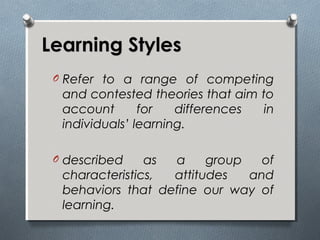
Learning StylesLearning Styles
O Refer to a range of competing
and contested theories that aim to
account for differences in
individuals’ learning.
O described as a group of
characteristics, attitudes and
behaviors that define our way of
learning.
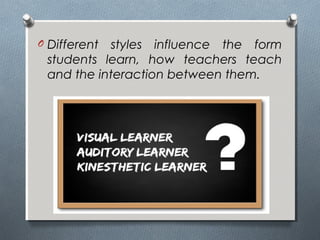
O Different styles influence the form
students learn, how teachers teach
and the interaction between them.
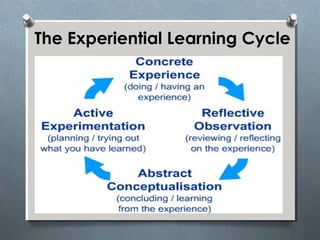
DAVID KOLB’S MODELDAVID KOLB’S MODEL
O Based on his experiential learning
model which applies two related
approaches toward grasping
experience: CONCRETE EXPERIENCE
and ABSTRACT CONCEPTUALIZATION
as well as two approaches towards
transforming experience: REFLECTIVE
OBSERVATION and ACTIVE
EXPERIMENTATION.
The Experiential Learning Cycle
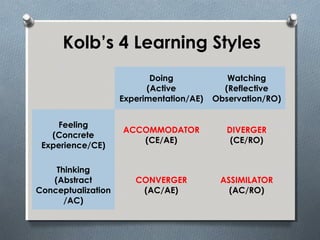
Kolb’s 4 Learning Styles
Doing
(Active
Experimentation/AE)
Watching
(Reflective
Observation/RO)
Feeling
(Concrete
Experience/CE)
ACCOMMODATOR
(CE/AE)
DIVERGER
(CE/RO)
Thinking
(Abstract
Conceptualization
/AC)
CONVERGER
(AC/AE)
ASSIMILATOR
(AC/RO)
Learning Styles’ DescriptionsLearning Styles’ Descriptions
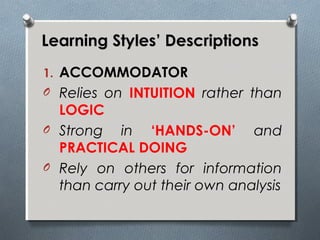
1. ACCOMMODATOR
O Relies on INTUITION rather than
LOGIC
O Strong in ‘HANDS-ON’ and
PRACTICAL DOING
O Rely on others for information
than carry out their own analysis
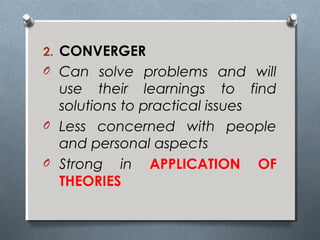
2. CONVERGER
O Can solve problems and will
use their learnings to find
solutions to practical issues
O Less concerned with people
and personal aspects
O Strong in APPLICATION OF
THEORIES
3. DIVERGER
O Able to look at things from
different perspectives
O Perform better in situations that
require ‘IDEAS GENERATION’ or
‘BRAINSTORMING’
O Have broad cultural interest and
like to gather information
O Strong imaginative ability
O Interested in people
4. ASSIMILATOR
O Ideas and concepts are more
important than people
O Attracted to logically sound
theories than approaches
based on practical value
O Strong in INDUCTIVE REASONING
and CREATION OF THEORIES
“Learning is the process whereby
knowledge is created through
the transformation of
experience.”
(Kolb, 1984, p.38)
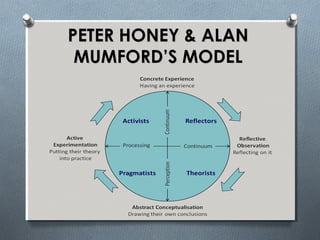
PETER HONEY & ALANPETER HONEY & ALAN
MUMFORD’S MODELMUMFORD’S MODEL
Honey and Mumford’s 4
Learning Styles
1. Activist
2. Reflector
3. Theorist
4. Pragmatist
1. ACTIVIST
O Learns by doing
O Preferred activities:
 Brainstorming
 Problem solving
 Group discussion
 Puzzles
 Competitions
 Role Play
2. REFLECTOR
O Learns by observing
and thinking about
what happened
O Preferred activities:
 Self analysis
questionnaires
 Personality
questionnaires
 Observing activities
 Interviews
3. THEORIST
O Learns by
understanding the
theory behind actions
O Preferred activities:
 Models
 Statistics
 Stories
 Quotes
 Background information
 Applying theories
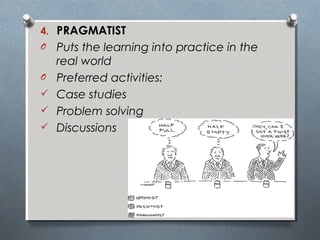
4. PRAGMATIST
O Puts the learning into practice in the
real world
O Preferred activities:
 Case studies
 Problem solving
 Discussions
WALTER BURKE BARBE’SWALTER BURKE BARBE’S
LEARNING MODALITIES/VAKLEARNING MODALITIES/VAK
MODELMODEL
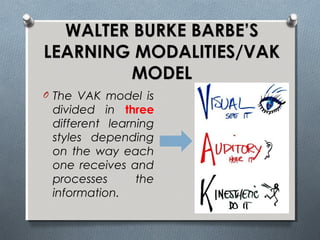
O The VAK model is
divided in three
different learning
styles depending
on the way each
one receives and
processes the
information.
1. VISUAL
O Prefer to see information such as
pictures, diagrams, cartoons,
demonstrations
O Picture words and concepts they hear
as images
O Easily distracted in lecture with no visual
aids
O Overwhelmed with intense visuals
accompanied by lecture
O Benefit from using charts, maps, notes,
and flash cards when studying
2. AUDITORY
O Prefer to hear information spoken
O Can absorb a lecture with little
effort
O May not need careful notes to learn
O Often avoid eye contact in order to
concentrate
O May read aloud to themselves
O Like background music when they
study
3. KINESTHETIC/TACTILE
O Prefer touch as their primary mode for
taking in information
O In traditional lecture situations, they
should write out important facts
O Create study sheets connected to
vivid examples
O Role-playing can help them learn
and remember important ideas
O May benefit by using manipulatives
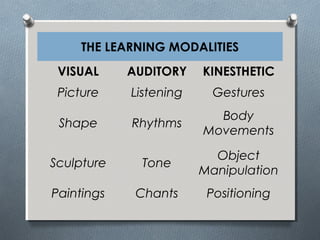
THE LEARNING MODALITIES
VISUAL AUDITORY KINESTHETIC
Picture Listening Gestures
Shape Rhythms
Body
Movements
Sculpture Tone
Object
Manipulation
Paintings Chants Positioning
ANTHONY GREGORC &ANTHONY GREGORC &
KATHLEEN BUTLER’S MODELKATHLEEN BUTLER’S MODEL
O Posits that an individual’s perceptive
abilities are the foundation of his or
her specific learning strengths or
styles
O In this model, there are two
perceptual qualities: CONCRETE and
ABSTRACT and two ordering abilities:
RANDOM and SEQUENTIAL
2 PERCEPTUAL QUALITIES
1.CONCRETE
OInvolves registering information
through the five senses
2.ABSTRACT
OInvolves the understanding of ideas,
qualities, and concepts which cannot
be seen
2 ORDERING ABILITIES
1.SEQUENTIAL
OInvolves the organization of
information in a linear, logical way
2.RANDOM
OInvolves the organization of
information in chunks and no specific
order
GREGORC & BUTLER’S 4 LEARNING
STYLES:
1.Concrete Sequential
2.Abstract Random
3.Abstract Sequential
4.Concrete Random
NASSP MODELNASSP MODEL
O Formed by the National Association
of Secondary School Principals in the
1980s
O Identified three broad categories of
style and 31 variables
3 CATEGORIESOF LEARNING STYLES
1.COGNITIVE
OAre preferred ways of
perception, organization and
retention.
2. AFFECTIVE
O Represent the motivational
dimensions of the learning
personality; each learner has
a personal motivational
approach.
3. PHYSIOLOGICAL
O Are bodily states or
predispositions, including sex-
related differences, health and
nutrition, and reaction to
physical surroundings such as
preferences for levels of light,
sound and temperature
EDUCATIONAL IMPLICATIONSEDUCATIONAL IMPLICATIONS
O Educators should ensure that the activities
are designed and carried out in ways that
offer each learner the chance to engage in
the manner that suits them best.
O Individuals can be helped to learn more
effectively by the identification of their lesser
preferred learning style and through the
strengthening of these.
O Teachers should assess the learning style of
their students and adapt their classroom
methods to best fit each student’s learning
style.
Different Models of Learning Styles

Different Models of Learning Styles

  • 1.
  • 2.
    Learning StylesLearning Styles ORefer to a range of competing and contested theories that aim to account for differences in individuals’ learning. O described as a group of characteristics, attitudes and behaviors that define our way of learning.
  • 3.
    O Different stylesinfluence the form students learn, how teachers teach and the interaction between them.
  • 4.
    DAVID KOLB’S MODELDAVIDKOLB’S MODEL O Based on his experiential learning model which applies two related approaches toward grasping experience: CONCRETE EXPERIENCE and ABSTRACT CONCEPTUALIZATION as well as two approaches towards transforming experience: REFLECTIVE OBSERVATION and ACTIVE EXPERIMENTATION.
  • 5.
  • 6.
    Kolb’s 4 LearningStyles Doing (Active Experimentation/AE) Watching (Reflective Observation/RO) Feeling (Concrete Experience/CE) ACCOMMODATOR (CE/AE) DIVERGER (CE/RO) Thinking (Abstract Conceptualization /AC) CONVERGER (AC/AE) ASSIMILATOR (AC/RO)
  • 7.
    Learning Styles’ DescriptionsLearningStyles’ Descriptions 1. ACCOMMODATOR O Relies on INTUITION rather than LOGIC O Strong in ‘HANDS-ON’ and PRACTICAL DOING O Rely on others for information than carry out their own analysis
  • 8.
    2. CONVERGER O Cansolve problems and will use their learnings to find solutions to practical issues O Less concerned with people and personal aspects O Strong in APPLICATION OF THEORIES
  • 9.
    3. DIVERGER O Ableto look at things from different perspectives O Perform better in situations that require ‘IDEAS GENERATION’ or ‘BRAINSTORMING’ O Have broad cultural interest and like to gather information O Strong imaginative ability O Interested in people
  • 10.
    4. ASSIMILATOR O Ideasand concepts are more important than people O Attracted to logically sound theories than approaches based on practical value O Strong in INDUCTIVE REASONING and CREATION OF THEORIES
  • 11.
    “Learning is theprocess whereby knowledge is created through the transformation of experience.” (Kolb, 1984, p.38)
  • 12.
    PETER HONEY &ALANPETER HONEY & ALAN MUMFORD’S MODELMUMFORD’S MODEL
  • 13.
    Honey and Mumford’s4 Learning Styles 1. Activist 2. Reflector 3. Theorist 4. Pragmatist
  • 14.
    1. ACTIVIST O Learnsby doing O Preferred activities:  Brainstorming  Problem solving  Group discussion  Puzzles  Competitions  Role Play
  • 15.
    2. REFLECTOR O Learnsby observing and thinking about what happened O Preferred activities:  Self analysis questionnaires  Personality questionnaires  Observing activities  Interviews
  • 16.
    3. THEORIST O Learnsby understanding the theory behind actions O Preferred activities:  Models  Statistics  Stories  Quotes  Background information  Applying theories
  • 17.
    4. PRAGMATIST O Putsthe learning into practice in the real world O Preferred activities:  Case studies  Problem solving  Discussions
  • 18.
    WALTER BURKE BARBE’SWALTERBURKE BARBE’S LEARNING MODALITIES/VAKLEARNING MODALITIES/VAK MODELMODEL O The VAK model is divided in three different learning styles depending on the way each one receives and processes the information.
  • 19.
    1. VISUAL O Preferto see information such as pictures, diagrams, cartoons, demonstrations O Picture words and concepts they hear as images O Easily distracted in lecture with no visual aids O Overwhelmed with intense visuals accompanied by lecture O Benefit from using charts, maps, notes, and flash cards when studying
  • 20.
    2. AUDITORY O Preferto hear information spoken O Can absorb a lecture with little effort O May not need careful notes to learn O Often avoid eye contact in order to concentrate O May read aloud to themselves O Like background music when they study
  • 21.
    3. KINESTHETIC/TACTILE O Prefertouch as their primary mode for taking in information O In traditional lecture situations, they should write out important facts O Create study sheets connected to vivid examples O Role-playing can help them learn and remember important ideas O May benefit by using manipulatives
  • 22.
    THE LEARNING MODALITIES VISUALAUDITORY KINESTHETIC Picture Listening Gestures Shape Rhythms Body Movements Sculpture Tone Object Manipulation Paintings Chants Positioning
  • 23.
    ANTHONY GREGORC &ANTHONYGREGORC & KATHLEEN BUTLER’S MODELKATHLEEN BUTLER’S MODEL O Posits that an individual’s perceptive abilities are the foundation of his or her specific learning strengths or styles O In this model, there are two perceptual qualities: CONCRETE and ABSTRACT and two ordering abilities: RANDOM and SEQUENTIAL
  • 24.
    2 PERCEPTUAL QUALITIES 1.CONCRETE OInvolvesregistering information through the five senses 2.ABSTRACT OInvolves the understanding of ideas, qualities, and concepts which cannot be seen
  • 25.
    2 ORDERING ABILITIES 1.SEQUENTIAL OInvolvesthe organization of information in a linear, logical way 2.RANDOM OInvolves the organization of information in chunks and no specific order
  • 26.
    GREGORC & BUTLER’S4 LEARNING STYLES: 1.Concrete Sequential 2.Abstract Random 3.Abstract Sequential 4.Concrete Random
  • 28.
    NASSP MODELNASSP MODEL OFormed by the National Association of Secondary School Principals in the 1980s O Identified three broad categories of style and 31 variables
  • 29.
    3 CATEGORIESOF LEARNINGSTYLES 1.COGNITIVE OAre preferred ways of perception, organization and retention.
  • 30.
    2. AFFECTIVE O Representthe motivational dimensions of the learning personality; each learner has a personal motivational approach.
  • 31.
    3. PHYSIOLOGICAL O Arebodily states or predispositions, including sex- related differences, health and nutrition, and reaction to physical surroundings such as preferences for levels of light, sound and temperature
  • 32.
    EDUCATIONAL IMPLICATIONSEDUCATIONAL IMPLICATIONS OEducators should ensure that the activities are designed and carried out in ways that offer each learner the chance to engage in the manner that suits them best. O Individuals can be helped to learn more effectively by the identification of their lesser preferred learning style and through the strengthening of these. O Teachers should assess the learning style of their students and adapt their classroom methods to best fit each student’s learning style.