CONTROL SCHEME FOR A STAND ALONE
WIND ENERGY
CONVERSION SYSTEM
MAHESH MARAMRAJU
13BR1D4311
: Need of wind energy :
• Present energy need heavily relies on the
conventional sources.
• But the limited availability and steady increase in
the price of conventional sources has shifted the
focus toward renewable sources of energy.
• Of the available alternative sources of energy,
wind energy is considered to be one of the
proven technologies With a competitive cost for
electricity generation.
INTRODUCTION
 wind energy conversion system (WECS) is nowadays
deployed for meeting both grid-connected and stand-
alone load demands.
 wind flow by nature is intermittent. In order to ensure
continuous supply of power suitable storage
technology is used as backup.
 The study of WECS and the associated controllers are,
thus, becoming more and more significant with each
passing day.
 Many stand-alone loads are powered by renewable
source of energy.
HYBRID WIND-BATTERY SYSTEM FOR AN ISOLATED DC
LOAD
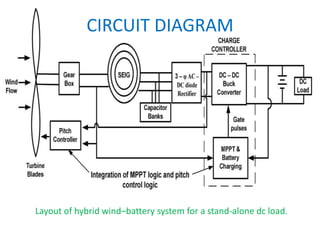
The proposed hybrid system comprises of a 4-kWWECS and 400 Ah, C/10 lead
acid battery bank. The system is designed for a 3-kW stand-alone dc load. The
layout of the entire system along with the control strategy is shown in Fig. 1. The
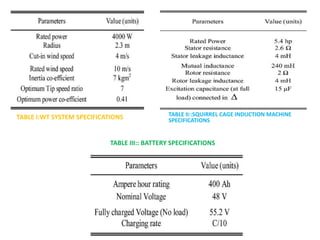
specifications of the WT, SEIG, and battery bank are tabulated in the Appendix. The
WECS consists of a 4.2-kW horizontal axis WT, gear box with a gear ratio of 1:8 and
a 5.4 hp SEIG as the WTG.
The battery bank connected to the system can either act as a source or load
depending on whether it is charging or discharging.
The charging of the battery bank is achieved by MPPT logic, while the pitch
controller limits the mechanical and electrical parameters within the rated value.
The charging of the battery bank is achieved by MPPT logic, while the pitch
controller limits the mechanical and electrical parameters within the rated value.
CONTROL STRATEGY FOR STAND-ALONE HYBRID
WIND-BATTERY SYSTEM
The wind flow is erratic in nature. Therefore, a WECS is integrated with the load by means of
an ac–dc–dc converter to avoid voltage flicker and harmonic generation.
The control scheme for a stand-alone hybrid wind-battery system includes the charge
controller circuit for battery banks and pitch control logic to ensure WT operation within the
rated value.
The control scheme for a stand-alone hybrid wind-battery system includes the charge
controller circuit for battery banks and pitch control logic to ensure WT operation within the
rated value.
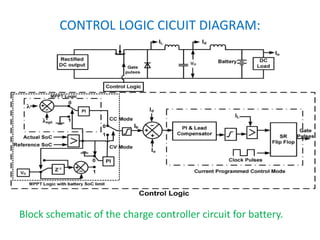
A. Charge Controller for the Battery Bank : The CC mode charges the battery as fast as possible.
Beyond this So C, the battery is charged at a constant voltage (CV) which is denoted as CV
mode of battery charging in order to maintain the battery terminal voltage.
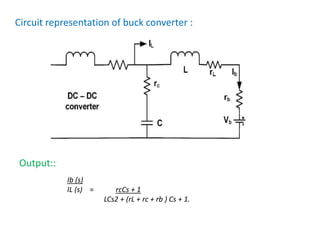
B. Control Strategy: The buck converter inductor current command is generated in the
intermediate control loop. To design the controller, it is essential to model the response of
the battery current (Ib ) with respect to the inductor current (IL ).
CIRCUIT DIAGRAM
Layout of hybrid wind–battery system for a stand-alone dc load.
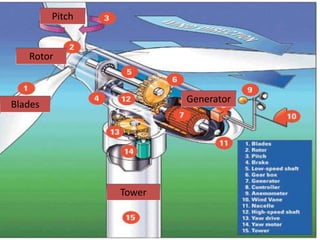
Pitch
Rotor
Blades
Generator
Tower
CONTROL LOGIC CICUIT DIAGRAM:
Block schematic of the charge controller circuit for battery.
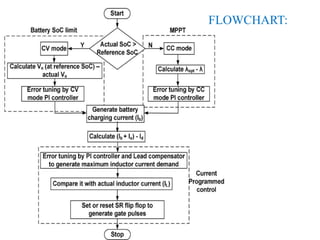
FLOWCHART:
Circuit representation of buck converter :
Output::
Ib (s)
IL (s) = rcCs + 1
LCs2 + (rL + rc + rb ) Cs + 1.
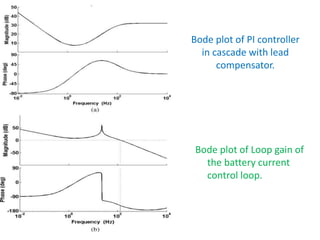
Bode plot of PI controller
in cascade with lead
compensator.
Bode plot of Loop gain of
the battery current
control loop.
MODES OF BATTERY CHARGING
CC Mode of Battery Charging :
 In CC mode, the battery charging current demand is determined from the
MPPT logic.
 MPPT is implemented by comparing the actual and optimum TSR (λopt).
The error is tuned by a PI controller to generate the battery charging
current as per the wind speed.
 In this mode, the converter output voltage rises with time while the MPPT
logic tries to transfer as much power as possible to charge the batteries.
 In case the wind speed is insufficient to supply the load even with zero
battery charging current the inductor current reference is frozen at that
particular value and the balance load current is supplied by the battery.
CV Mode of Battery Charging :
• In the CC mode, the battery voltage and SoC rise fast with time. However,
the charge controller should not overcharge the batteries to avoid
gasification of electrolyte . As a result, once the battery SoC becomes
equal to the reference SoC the controller must switch over from CC mode
to CV mode. In CV mode, the battery charging voltage is determined from
the buck converter output voltage (Vo ).
• In this mode, the converter output voltage is maintained at a constant
value by the controller action.
• The battery charging current slowly decreases with time, since the
potential difference between the buck converter output and battery
terminal gradually reduces.
• Thus, in CC mode the buck converter output current is regulated while the
output voltage keeps on increasing with time. On the contrary in CV mode
the output voltage is regulated, while the current in the circuit reduces
gradually.
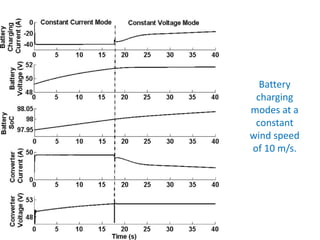
Battery
charging
modes at a
constant
wind speed
of 10 m/s.
FROM THE RESULTANT WAVEFORM :
The battery is charged both in CC mode and CV mode. The transition from
CC to CV mode takes place when the battery SoC reaches 98%.
This is because in the present design, the threshold SoC for switch over in
the control logic is set at 98%.
As the battery reaches the threshold SoC level, the buck converter voltage
is regulated by the controller action at a constant value of 53 V while the
converter current gradually reduces from 40 A at 17 s to 10 A at 40 s.
In CC mode much of the available power from primary source is injected
into the battery whereas in CV mode the battery is charged slowly to avoid
gasification and heating issue.
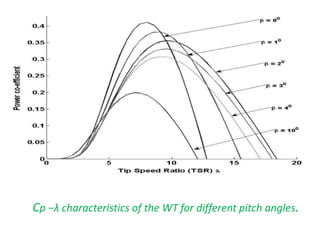
Cp −λ characteristics of the WT for different pitch angles.
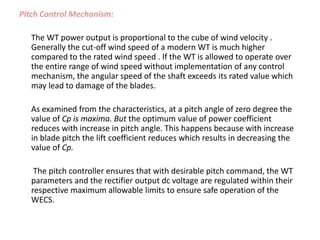
Pitch Control Mechanism:
The WT power output is proportional to the cube of wind velocity .
Generally the cut-off wind speed of a modern WT is much higher
compared to the rated wind speed . If the WT is allowed to operate over
the entire range of wind speed without implementation of any control
mechanism, the angular speed of the shaft exceeds its rated value which
may lead to damage of the blades.
As examined from the characteristics, at a pitch angle of zero degree the
value of Cp is maxima. But the optimum value of power coefficient
reduces with increase in pitch angle. This happens because with increase
in blade pitch the lift coefficient reduces which results in decreasing the
value of Cp.
The pitch controller ensures that with desirable pitch command, the WT
parameters and the rectifier output dc voltage are regulated within their
respective maximum allowable limits to ensure safe operation of the
WECS.
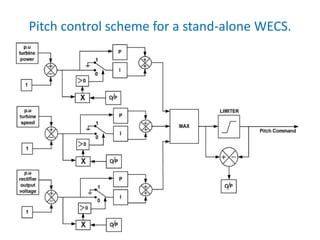
Pitch control scheme for a stand-alone WECS.
Pitch Control Scheme:
As seen the p.u. value of each input is compared with 1 to calculate the
error. The errors are tuned by PI controller. The “MAX” block chooses the
maximum output from each PI controller which is then passed on to a
limiter to generate the pitch command for the WT.
The product is compared with zero to determine the switching logic for
integrator. This technique is carried out to avoid integrator saturation.
The pitch controller changes the pitch command owing to variation in
turbine rotation speed, power, and output voltage of rectifier, which
ensures safe operation of the WECS.
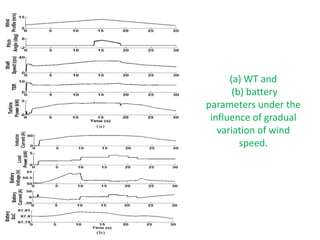
(a) WT and
(b) battery
parameters under the
influence of gradual
variation of wind
speed.
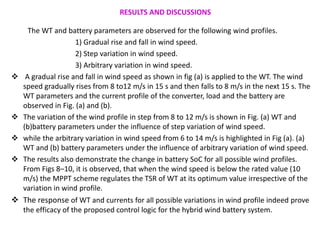
RESULTS AND DISCUSSIONS
The WT and battery parameters are observed for the following wind profiles.
1) Gradual rise and fall in wind speed.
2) Step variation in wind speed.
3) Arbitrary variation in wind speed.
 A gradual rise and fall in wind speed as shown in fig (a) is applied to the WT. The wind
speed gradually rises from 8 to12 m/s in 15 s and then falls to 8 m/s in the next 15 s. The
WT parameters and the current profile of the converter, load and the battery are
observed in Fig. (a) and (b).
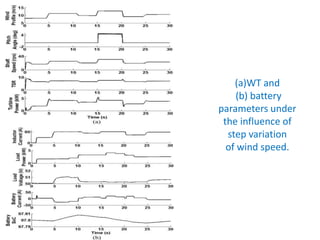
 The variation of the wind profile in step from 8 to 12 m/s is shown in Fig. (a) WT and
(b)battery parameters under the influence of step variation of wind speed.
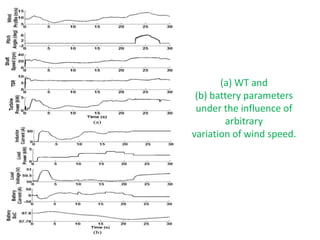
 while the arbitrary variation in wind speed from 6 to 14 m/s is highlighted in Fig (a). (a)
WT and (b) battery parameters under the influence of arbitrary variation of wind speed.
 The results also demonstrate the change in battery SoC for all possible wind profiles.
From Figs 8–10, it is observed, that when the wind speed is below the rated value (10
m/s) the MPPT scheme regulates the TSR of WT at its optimum value irrespective of the
variation in wind profile.
 The response of WT and currents for all possible variations in wind profile indeed prove
the efficacy of the proposed control logic for the hybrid wind battery system.
(a)WT and
(b) battery
parameters under
the influence of
step variation
of wind speed.
(a) WT and
(b) battery parameters
under the influence of
arbitrary
variation of wind speed.
ADVANTAGES
DISADVANTAGES
CONCLUSION
 The power available from a WECS is very
unreliable in nature So, a WECS cannot ensure
uninterrupted power flow to the load.
 In order to meet the load requirement at all
instances, suitable storage device is needed.
 Therefore a hybrid wind-battery system is
chosen to supply the desired load power.
 The hybrid wind-battery system along with its
control logic is developed in
MATLAB/SIMULINK and is tested with various
wind profiles.
 The outcome of the simulation experiments
validates the improved performance of the
system.
TABLE III:: BATTERY SPECIFICATIONS
TABLE I:WT SYSTEM SPECIFICATIONS TABLE II::SQUIRREL CAGE INDUCTION MACHINE
SPECIFICATIONS
QURIES
?
YOU
THANK

A STAND A

  • 1.
    CONTROL SCHEME FORA STAND ALONE WIND ENERGY CONVERSION SYSTEM MAHESH MARAMRAJU 13BR1D4311
  • 2.
    : Need ofwind energy : • Present energy need heavily relies on the conventional sources. • But the limited availability and steady increase in the price of conventional sources has shifted the focus toward renewable sources of energy. • Of the available alternative sources of energy, wind energy is considered to be one of the proven technologies With a competitive cost for electricity generation.
  • 3.
    INTRODUCTION  wind energyconversion system (WECS) is nowadays deployed for meeting both grid-connected and stand- alone load demands.  wind flow by nature is intermittent. In order to ensure continuous supply of power suitable storage technology is used as backup.  The study of WECS and the associated controllers are, thus, becoming more and more significant with each passing day.  Many stand-alone loads are powered by renewable source of energy.
  • 4.
    HYBRID WIND-BATTERY SYSTEMFOR AN ISOLATED DC LOAD The proposed hybrid system comprises of a 4-kWWECS and 400 Ah, C/10 lead acid battery bank. The system is designed for a 3-kW stand-alone dc load. The layout of the entire system along with the control strategy is shown in Fig. 1. The specifications of the WT, SEIG, and battery bank are tabulated in the Appendix. The WECS consists of a 4.2-kW horizontal axis WT, gear box with a gear ratio of 1:8 and a 5.4 hp SEIG as the WTG. The battery bank connected to the system can either act as a source or load depending on whether it is charging or discharging. The charging of the battery bank is achieved by MPPT logic, while the pitch controller limits the mechanical and electrical parameters within the rated value. The charging of the battery bank is achieved by MPPT logic, while the pitch controller limits the mechanical and electrical parameters within the rated value.
  • 5.
    CONTROL STRATEGY FORSTAND-ALONE HYBRID WIND-BATTERY SYSTEM The wind flow is erratic in nature. Therefore, a WECS is integrated with the load by means of an ac–dc–dc converter to avoid voltage flicker and harmonic generation. The control scheme for a stand-alone hybrid wind-battery system includes the charge controller circuit for battery banks and pitch control logic to ensure WT operation within the rated value. The control scheme for a stand-alone hybrid wind-battery system includes the charge controller circuit for battery banks and pitch control logic to ensure WT operation within the rated value. A. Charge Controller for the Battery Bank : The CC mode charges the battery as fast as possible. Beyond this So C, the battery is charged at a constant voltage (CV) which is denoted as CV mode of battery charging in order to maintain the battery terminal voltage. B. Control Strategy: The buck converter inductor current command is generated in the intermediate control loop. To design the controller, it is essential to model the response of the battery current (Ib ) with respect to the inductor current (IL ).
  • 6.
    CIRCUIT DIAGRAM Layout ofhybrid wind–battery system for a stand-alone dc load.
  • 7.
  • 8.
    CONTROL LOGIC CICUITDIAGRAM: Block schematic of the charge controller circuit for battery.
  • 9.
  • 10.
    Circuit representation ofbuck converter : Output:: Ib (s) IL (s) = rcCs + 1 LCs2 + (rL + rc + rb ) Cs + 1.
  • 11.
    Bode plot ofPI controller in cascade with lead compensator. Bode plot of Loop gain of the battery current control loop.
  • 12.
    MODES OF BATTERYCHARGING CC Mode of Battery Charging :  In CC mode, the battery charging current demand is determined from the MPPT logic.  MPPT is implemented by comparing the actual and optimum TSR (λopt). The error is tuned by a PI controller to generate the battery charging current as per the wind speed.  In this mode, the converter output voltage rises with time while the MPPT logic tries to transfer as much power as possible to charge the batteries.  In case the wind speed is insufficient to supply the load even with zero battery charging current the inductor current reference is frozen at that particular value and the balance load current is supplied by the battery.
  • 13.
    CV Mode ofBattery Charging : • In the CC mode, the battery voltage and SoC rise fast with time. However, the charge controller should not overcharge the batteries to avoid gasification of electrolyte . As a result, once the battery SoC becomes equal to the reference SoC the controller must switch over from CC mode to CV mode. In CV mode, the battery charging voltage is determined from the buck converter output voltage (Vo ). • In this mode, the converter output voltage is maintained at a constant value by the controller action. • The battery charging current slowly decreases with time, since the potential difference between the buck converter output and battery terminal gradually reduces. • Thus, in CC mode the buck converter output current is regulated while the output voltage keeps on increasing with time. On the contrary in CV mode the output voltage is regulated, while the current in the circuit reduces gradually.
  • 14.
  • 15.
    FROM THE RESULTANTWAVEFORM : The battery is charged both in CC mode and CV mode. The transition from CC to CV mode takes place when the battery SoC reaches 98%. This is because in the present design, the threshold SoC for switch over in the control logic is set at 98%. As the battery reaches the threshold SoC level, the buck converter voltage is regulated by the controller action at a constant value of 53 V while the converter current gradually reduces from 40 A at 17 s to 10 A at 40 s. In CC mode much of the available power from primary source is injected into the battery whereas in CV mode the battery is charged slowly to avoid gasification and heating issue.
  • 16.
    Cp −λ characteristicsof the WT for different pitch angles.
  • 17.
    Pitch Control Mechanism: TheWT power output is proportional to the cube of wind velocity . Generally the cut-off wind speed of a modern WT is much higher compared to the rated wind speed . If the WT is allowed to operate over the entire range of wind speed without implementation of any control mechanism, the angular speed of the shaft exceeds its rated value which may lead to damage of the blades. As examined from the characteristics, at a pitch angle of zero degree the value of Cp is maxima. But the optimum value of power coefficient reduces with increase in pitch angle. This happens because with increase in blade pitch the lift coefficient reduces which results in decreasing the value of Cp. The pitch controller ensures that with desirable pitch command, the WT parameters and the rectifier output dc voltage are regulated within their respective maximum allowable limits to ensure safe operation of the WECS.
  • 18.
    Pitch control schemefor a stand-alone WECS.
  • 19.
    Pitch Control Scheme: Asseen the p.u. value of each input is compared with 1 to calculate the error. The errors are tuned by PI controller. The “MAX” block chooses the maximum output from each PI controller which is then passed on to a limiter to generate the pitch command for the WT. The product is compared with zero to determine the switching logic for integrator. This technique is carried out to avoid integrator saturation. The pitch controller changes the pitch command owing to variation in turbine rotation speed, power, and output voltage of rectifier, which ensures safe operation of the WECS.
  • 20.
    (a) WT and (b)battery parameters under the influence of gradual variation of wind speed.
  • 21.
    RESULTS AND DISCUSSIONS TheWT and battery parameters are observed for the following wind profiles. 1) Gradual rise and fall in wind speed. 2) Step variation in wind speed. 3) Arbitrary variation in wind speed.  A gradual rise and fall in wind speed as shown in fig (a) is applied to the WT. The wind speed gradually rises from 8 to12 m/s in 15 s and then falls to 8 m/s in the next 15 s. The WT parameters and the current profile of the converter, load and the battery are observed in Fig. (a) and (b).  The variation of the wind profile in step from 8 to 12 m/s is shown in Fig. (a) WT and (b)battery parameters under the influence of step variation of wind speed.  while the arbitrary variation in wind speed from 6 to 14 m/s is highlighted in Fig (a). (a) WT and (b) battery parameters under the influence of arbitrary variation of wind speed.  The results also demonstrate the change in battery SoC for all possible wind profiles. From Figs 8–10, it is observed, that when the wind speed is below the rated value (10 m/s) the MPPT scheme regulates the TSR of WT at its optimum value irrespective of the variation in wind profile.  The response of WT and currents for all possible variations in wind profile indeed prove the efficacy of the proposed control logic for the hybrid wind battery system.
  • 22.
    (a)WT and (b) battery parametersunder the influence of step variation of wind speed.
  • 23.
    (a) WT and (b)battery parameters under the influence of arbitrary variation of wind speed.
  • 24.
  • 25.
  • 26.
    CONCLUSION  The poweravailable from a WECS is very unreliable in nature So, a WECS cannot ensure uninterrupted power flow to the load.  In order to meet the load requirement at all instances, suitable storage device is needed.  Therefore a hybrid wind-battery system is chosen to supply the desired load power.  The hybrid wind-battery system along with its control logic is developed in MATLAB/SIMULINK and is tested with various wind profiles.  The outcome of the simulation experiments validates the improved performance of the system.
  • 27.
    TABLE III:: BATTERYSPECIFICATIONS TABLE I:WT SYSTEM SPECIFICATIONS TABLE II::SQUIRREL CAGE INDUCTION MACHINE SPECIFICATIONS
  • 28.
  • 29.