UNDER THE GUIDENCE OF

Mrs. M. KIRAN JYOTHI
BY
B.BALA KRISHNA
P.VARSHINI
P.N.S.V.MADHAV

P.SRINIVAS
Injection of the wind power into an electric grid affects the power quality.
The performance of the wind turbine and thereby power quality are determined on
the basis of measurements and the norms followed according to the guideline
specified in International Electro-technical Commission standard,IEC-61400. The
influence of the wind turbine in the grid system concerning the power quality
measurements are measured according to national/international guidelines.
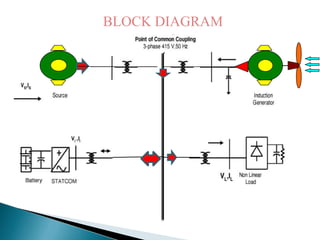
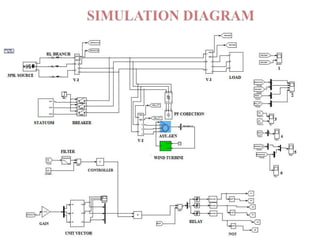
In this proposed scheme Static Compensator (STATCOM) is connected at a
point of common coupling with a battery energy storage system (BESS) to
mitigate the power quality issues. The battery energy storage is integrated to
sustain the real power source under fluctuating wind power.


Injecting Wind Power into Grid & Improve the

Power Quality.
BLOCK DIAGRAM


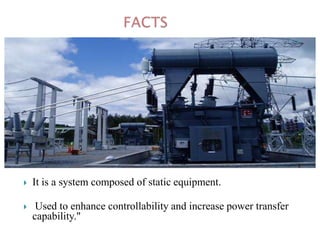
FACTS



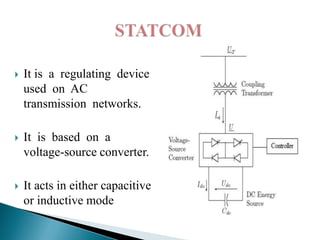
STATCOM



BESS.



WIND ENERGY GENERATING SYSTEM


It is a system composed of static equipment.



Used to enhance controllability and increase power transfer
capability."


It is a regulating device
used on AC
transmission networks.



It is based on a
voltage-source converter.



It acts in either capacitive
or inductive mode
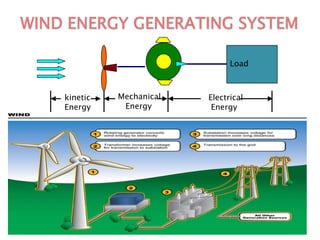
WIND ENERGY GENERATING SYSTEM
Load

kinetic
Energy

Mechanical
Energy

Electrical
Energy
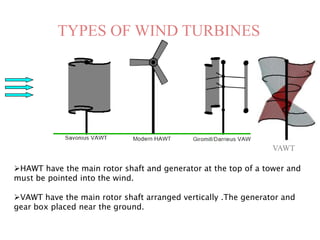
TYPES OF WIND TURBINES

VAWT
HAWT have the main rotor shaft and generator at the top of a tower and
must be pointed into the wind.
VAWT have the main rotor shaft arranged vertically .The generator and
gear box placed near the ground.


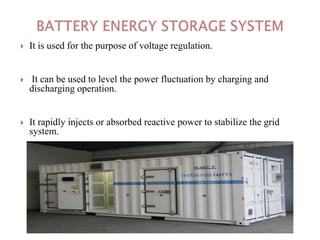
It is used for the purpose of voltage regulation.



It can be used to level the power fluctuation by charging and
discharging operation.



It rapidly injects or absorbed reactive power to stabilize the grid
system.


Without the proper power, an electrical device may
malfunction, not operate at all.



Power quality determines the fitness of electrical
power to consumer devices.



Synchronization of the voltage frequency and phase
allows electrical systems to function properly.


Voltage variation



Harmonics



Reactive power



Wind turbine location in power system.


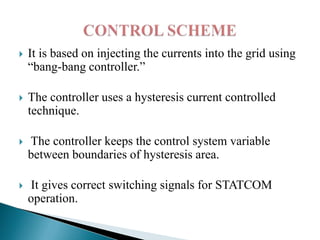
It is based on injecting the currents into the grid using
“bang-bang controller.”



The controller uses a hysteresis current controlled
technique.



The controller keeps the control system variable
between boundaries of hysteresis area.



It gives correct switching signals for STATCOM
operation.
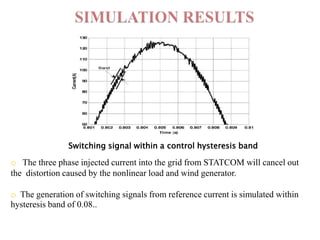
Switching signal within a control hysteresis band

o The three phase injected current into the grid from STATCOM will cancel out
the distortion caused by the nonlinear load and wind generator.
o The generation of switching signals from reference current is simulated within
hysteresis band of 0.08..
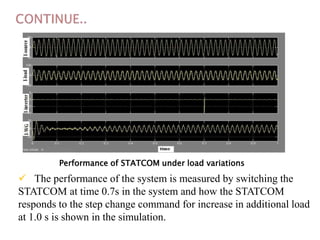
Performance of STATCOM under load variations

 The performance of the system is measured by switching the
STATCOM at time 0.7s in the system and how the STATCOM
responds to the step change command for increase in additional load
at 1.0 s is shown in the simulation.
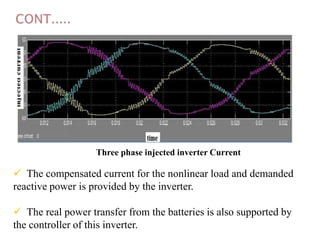
Three phase injected inverter Current

 The compensated current for the nonlinear load and demanded
reactive power is provided by the inverter.
 The real power transfer from the batteries is also supported by
the controller of this inverter.
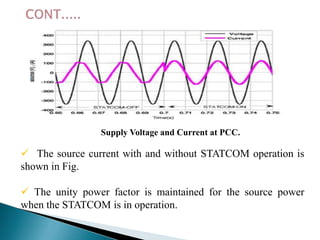
Supply Voltage and Current at PCC.

 The source current with and without STATCOM operation is
shown in Fig.
 The unity power factor is maintained for the source power
when the STATCOM is in operation.
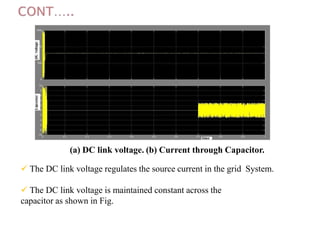
(a) DC link voltage. (b) Current through Capacitor.
 The DC link voltage regulates the source current in the grid System.
 The DC link voltage is maintained constant across the
capacitor as shown in Fig.
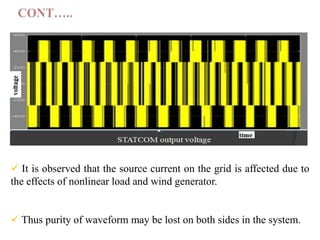
 It is observed that the source current on the grid is affected due to
the effects of nonlinear load and wind generator.
 Thus purity of waveform may be lost on both sides in the system.


The power quality issues and its consequences are
presented.



STATCOM has a capability to cancel out the harmonic
parts of the load current.



STATCOM maintains the source voltage and current inphase and support the reactive power demand for the
wind generator and load at PCC.



Thus the proposed scheme fulfills the power quality
norms as per the IEC standard 61400-21.


Power system voltage control applications.



Large electric arc furnace installations.



Reactive power compensation applications.



Railway or underground systems with huge load
variations


STATCOM can be replaced with UPQC for better power control.



Replacing the induction generator with doubly fed induction
generator is preferred for better results.



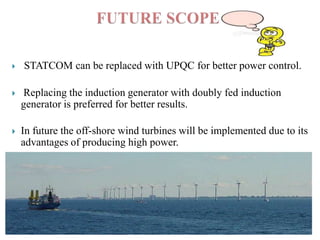
In future the off-shore wind turbines will be implemented due to its
advantages of producing high power.
Power quality.ppt
Power quality.ppt

Power quality.ppt

  • 1.
    UNDER THE GUIDENCEOF Mrs. M. KIRAN JYOTHI BY B.BALA KRISHNA P.VARSHINI P.N.S.V.MADHAV P.SRINIVAS
  • 2.
    Injection of thewind power into an electric grid affects the power quality. The performance of the wind turbine and thereby power quality are determined on the basis of measurements and the norms followed according to the guideline specified in International Electro-technical Commission standard,IEC-61400. The influence of the wind turbine in the grid system concerning the power quality measurements are measured according to national/international guidelines. In this proposed scheme Static Compensator (STATCOM) is connected at a point of common coupling with a battery energy storage system (BESS) to mitigate the power quality issues. The battery energy storage is integrated to sustain the real power source under fluctuating wind power.
  • 3.
     Injecting Wind Powerinto Grid & Improve the Power Quality.
  • 4.
  • 5.
  • 6.
     It is asystem composed of static equipment.  Used to enhance controllability and increase power transfer capability."
  • 7.
     It is aregulating device used on AC transmission networks.  It is based on a voltage-source converter.  It acts in either capacitive or inductive mode
  • 8.
    WIND ENERGY GENERATINGSYSTEM Load kinetic Energy Mechanical Energy Electrical Energy
  • 9.
    TYPES OF WINDTURBINES VAWT HAWT have the main rotor shaft and generator at the top of a tower and must be pointed into the wind. VAWT have the main rotor shaft arranged vertically .The generator and gear box placed near the ground.
  • 10.
     It is usedfor the purpose of voltage regulation.  It can be used to level the power fluctuation by charging and discharging operation.  It rapidly injects or absorbed reactive power to stabilize the grid system.
  • 11.
     Without the properpower, an electrical device may malfunction, not operate at all.  Power quality determines the fitness of electrical power to consumer devices.  Synchronization of the voltage frequency and phase allows electrical systems to function properly.
  • 12.
  • 14.
     It is basedon injecting the currents into the grid using “bang-bang controller.”  The controller uses a hysteresis current controlled technique.  The controller keeps the control system variable between boundaries of hysteresis area.  It gives correct switching signals for STATCOM operation.
  • 15.
    Switching signal withina control hysteresis band o The three phase injected current into the grid from STATCOM will cancel out the distortion caused by the nonlinear load and wind generator. o The generation of switching signals from reference current is simulated within hysteresis band of 0.08..
  • 16.
    Performance of STATCOMunder load variations  The performance of the system is measured by switching the STATCOM at time 0.7s in the system and how the STATCOM responds to the step change command for increase in additional load at 1.0 s is shown in the simulation.
  • 17.
    Three phase injectedinverter Current  The compensated current for the nonlinear load and demanded reactive power is provided by the inverter.  The real power transfer from the batteries is also supported by the controller of this inverter.
  • 18.
    Supply Voltage andCurrent at PCC.  The source current with and without STATCOM operation is shown in Fig.  The unity power factor is maintained for the source power when the STATCOM is in operation.
  • 19.
    (a) DC linkvoltage. (b) Current through Capacitor.  The DC link voltage regulates the source current in the grid System.  The DC link voltage is maintained constant across the capacitor as shown in Fig.
  • 20.
     It isobserved that the source current on the grid is affected due to the effects of nonlinear load and wind generator.  Thus purity of waveform may be lost on both sides in the system.
  • 21.
     The power qualityissues and its consequences are presented.  STATCOM has a capability to cancel out the harmonic parts of the load current.  STATCOM maintains the source voltage and current inphase and support the reactive power demand for the wind generator and load at PCC.  Thus the proposed scheme fulfills the power quality norms as per the IEC standard 61400-21.
  • 22.
     Power system voltagecontrol applications.  Large electric arc furnace installations.  Reactive power compensation applications.  Railway or underground systems with huge load variations
  • 23.
     STATCOM can bereplaced with UPQC for better power control.  Replacing the induction generator with doubly fed induction generator is preferred for better results.  In future the off-shore wind turbines will be implemented due to its advantages of producing high power.