



ALLPPT.com _ Free PowerPoint Templates, Diagrams and Charts
DIRECT AC-DC
ELECTRONIC
CONVERTER
TOPOLOGY.
Presented by:
Bilal Ahmad.
Areez Irfan.
Hamza Ahmad.
CONTENTS.
 Introduction.
 Converter Topologies.
 Implementation Design.
 Simulation Results.
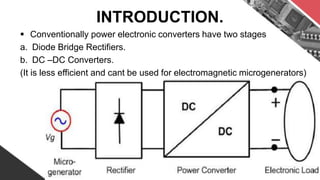
 Conventionally power electronic converters have two stages
a. Diode Bridge Rectifiers.
b. DC –DC Converters.
(It is less efficient and cant be used for electromagnetic microgenerators)
INTRODUCTION.
 For efficient and maximum energy direct AC-DC power
electronic converter topology is proposed.
 The single stage AC to DC power conversion is
achieved by utilizing the bidirectional conduction capability of MOSFETs.
ELECTROMAGNETIC
MICROGENERATORS.
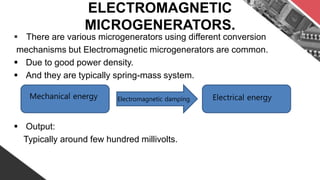
 There are various microgenerators using different conversion
mechanisms but Electromagnetic microgenerators are common.
 Due to good power density.
 And they are typically spring-mass system.
 Output:
Typically around few hundred millivolts.
Mechanical energy Electrical energyElectromagnetic damping
`
 Power processing stage between transducer and load.
 Output has to be processed by power converter to produce suitable
DC output voltage.
 Amount of energy conversion depends on the damping force.
 Damping force can be varied by changing the effective
resistance.
CONVERTER TOPOLOGIES.
 A power converter is required for energy-harvesting applications.
 Main function of the converter is to condition the AC output of the
microgenerator to a suitable DC level and offer an adjustive resistive
load to the microgenerator.
 Two stage power converter is not used for electromagnetic microgeneration
 Because :
a) Diode voltages in bridge rectifier are difficult to overcome for low input voltage.
b) Diode losses are increased as input current is much higher than output current.
c) A rectifier offers a nonlinear load, which makes the converter unsuitable for
energy harvesting.
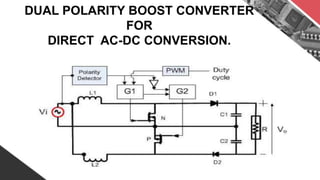
 Above disadvantages are eliminated with Direct AC-DC boost converters.
DUAL POLARITY BOOST CONVERTER
FOR
DIRECT AC-DC CONVERSION.
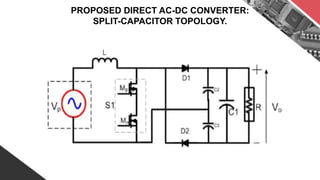
PROPOSED DIRECT AC-DC CONVERTER:
SPLIT-CAPACITOR TOPOLOGY.
This operation has many advantages:
a) A constant duty cycle extracts constant power from source, enabling a
simple control.
b) A converter operating with a constant duty cycle has only fundamental and
switching harmonic frequency components and thus offers a resistive load to
the microgenerator.
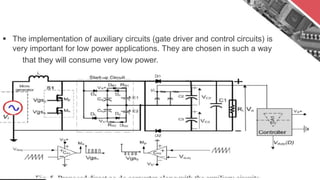
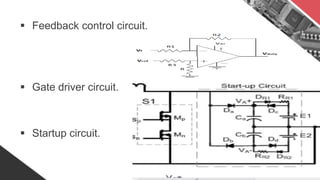
 The implementation of auxiliary circuits (gate driver and control circuits) is
very important for low power applications. They are chosen in such a way
that they will consume very low power.
 Feedback control circuit.
 Gate driver circuit.
 Startup circuit.
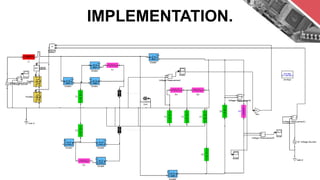
IMPLEMENTATION.
SIMULATION RESULT.
Any Questions

AC-DC conversion using microgenerator

  • 2.
    ALLPPT.com _ FreePowerPoint Templates, Diagrams and Charts DIRECT AC-DC ELECTRONIC CONVERTER TOPOLOGY. Presented by: Bilal Ahmad. Areez Irfan. Hamza Ahmad.
  • 3.
    CONTENTS.  Introduction.  ConverterTopologies.  Implementation Design.  Simulation Results.
  • 4.
     Conventionally powerelectronic converters have two stages a. Diode Bridge Rectifiers. b. DC –DC Converters. (It is less efficient and cant be used for electromagnetic microgenerators) INTRODUCTION.
  • 5.
     For efficientand maximum energy direct AC-DC power electronic converter topology is proposed.  The single stage AC to DC power conversion is achieved by utilizing the bidirectional conduction capability of MOSFETs.
  • 6.
    ELECTROMAGNETIC MICROGENERATORS.  There arevarious microgenerators using different conversion mechanisms but Electromagnetic microgenerators are common.  Due to good power density.  And they are typically spring-mass system.  Output: Typically around few hundred millivolts. Mechanical energy Electrical energyElectromagnetic damping
  • 7.
    `  Power processingstage between transducer and load.  Output has to be processed by power converter to produce suitable DC output voltage.  Amount of energy conversion depends on the damping force.  Damping force can be varied by changing the effective resistance.
  • 8.
    CONVERTER TOPOLOGIES.  Apower converter is required for energy-harvesting applications.  Main function of the converter is to condition the AC output of the microgenerator to a suitable DC level and offer an adjustive resistive load to the microgenerator.
  • 9.
     Two stagepower converter is not used for electromagnetic microgeneration  Because : a) Diode voltages in bridge rectifier are difficult to overcome for low input voltage. b) Diode losses are increased as input current is much higher than output current. c) A rectifier offers a nonlinear load, which makes the converter unsuitable for energy harvesting.  Above disadvantages are eliminated with Direct AC-DC boost converters.
  • 10.
    DUAL POLARITY BOOSTCONVERTER FOR DIRECT AC-DC CONVERSION.
  • 11.
    PROPOSED DIRECT AC-DCCONVERTER: SPLIT-CAPACITOR TOPOLOGY.
  • 12.
    This operation hasmany advantages: a) A constant duty cycle extracts constant power from source, enabling a simple control. b) A converter operating with a constant duty cycle has only fundamental and switching harmonic frequency components and thus offers a resistive load to the microgenerator.
  • 13.
     The implementationof auxiliary circuits (gate driver and control circuits) is very important for low power applications. They are chosen in such a way that they will consume very low power.
  • 14.
     Feedback controlcircuit.  Gate driver circuit.  Startup circuit.
  • 15.
  • 16.
  • 18.

Editor's Notes

  • #5 the diode bridge rectification is not normally feasible due to extreme low output voltage of the microgenerators
  • #8 Because transducer doesnot give suitable output to load and also load doesnot present transducer with optimal load charcteristics for electric energy generation.