Sri Padmavathi Mahila Visvavidyalayam
(Women’s University)
School of Engineering and Technology
Presented
By
CH. Chaitanya Madhu Mallika
Control Scheme For a Stand-Alone
Wind Energy Conversion System
 Now a days with the competitive costs for electricity generation wind
energy conversion system is deployed for meeting for both grid
connected and stand-alone load demand.
 Small scale stand alone wind turbine provide a very attractive renewable
energy source for off-grid remote applications. It is an advantage of
variable speed turbine technology.
Purpose
 There are many loads such as remote villages, islands, ships and so
on that are away from the main grid.
 They require stand-alone generator system which can provide
constant nominal voltage and frequency to provide for their local
electrification.
Problem
 Energy is the considered to be the pivotal input for development.
 At present owing to the depletion of available conventional resources
and concern regarding environmental degradation, the renewable
sources are being utilized to meet the ever increasing energy demand.
 Due to a relatively low cost of electricity production wind energy is
considered to be one of the potential sources of clean energy for the
future.
Solution
WHY NOW?
 A low power wind system operating in autonomous mode. We present a control
structure that ensures the maximization of wind energy conversion and the
balance between required and produced power.
 The application of the model predictive control (MPC) approach to control
the voltage and frequency of a stand alone wind generation system. This
scheme consists of a wind turbine which drives an induction generator
feeding an isolated load. A static VAR compensator is connected at the
induction generator terminals to regulate the load voltage.
 Wind energy one of the world’s fastest growing energy technologies.
 In order to maximize the efficiency of the renewable energy system it is
necessary to track the maximum power point of the input source.
Market Size
 It is estimated that 16% of the world’s electricity will be harnessed from
wind power by 2020.
 The total installed capacity has registered a growth by 20 times from 2001
t0 2010.
 The generation capacity increased from 26000MW in 2001 to 507000MW
in 2010 wind Energy conversion system(WECS) can operate in conjunction
with grid or in isolation, based on this they can be classified as grid
connected or autonomous/stand-alone systems.
 Small wind turbine with capacity ranging from 300W to 25KW are now
available in Indian market and gaining popularity.
 Providing steady income through lease to the land owners .Farmers can also
grow crops or rise cattle next to the towers.
Competition
The other renewable source of energy we can use instead of
wind power is solar power.
Competitive advantages
 Solar energy has intermittency issues which is not present in wind
energy. In case of insufficient availability of wind energy backup storage
is utilized for continuous conduction.
 No fuel cost .
 Limited use of land.
 New market.
Operating cost will be less.
Wind energy equipment are not more fragile.
Environment friendly and pollution free.
.
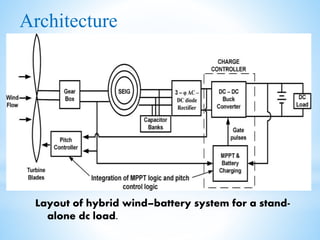
Layout of hybrid wind–battery system for a stand-
alone dc load.
Architecture
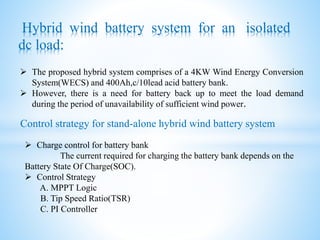
Control strategy for stand-alone hybrid wind battery system
Hybrid wind battery system for an isolated
dc load:
 The proposed hybrid system comprises of a 4KW Wind Energy Conversion
System(WECS) and 400Ah,c/10lead acid battery bank.
 However, there is a need for battery back up to meet the load demand
during the period of unavailability of sufficient wind power.
 Charge control for battery bank
The current required for charging the battery bank depends on the
Battery State Of Charge(SOC).
 Control Strategy
A. MPPT Logic
B. Tip Speed Ratio(TSR)
C. PI Controller
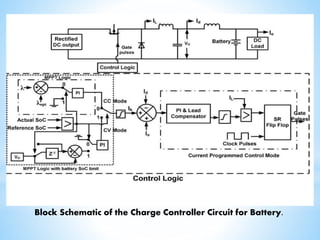
Block Schematic of the Charge Controller Circuit for Battery.
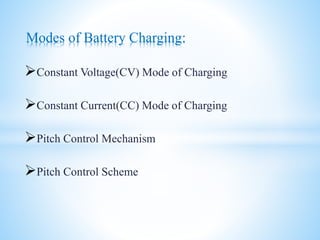
Constant Voltage(CV) Mode of Charging
Constant Current(CC) Mode of Charging
Pitch Control Mechanism
Pitch Control Scheme
Modes of Battery Charging:
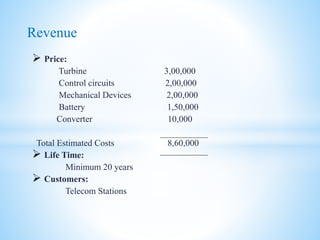
 Price:
Turbine 3,00,000
Control circuits 2,00,000
Mechanical Devices 2,00,000
Battery 1,50,000
Converter 10,000
Total Estimated Costs 8,60,000
 Life Time:
Minimum 20 years
 Customers:
Telecom Stations
Revenue
Board of Advisors
CH.Chaitanya Madhu Mallika
K.Bhavani
R.Harika
N.Kalpana
Founder
MS.M.Pallavi
THANK
YOU…!!!!

Control Scheme for a Stand-Alone Wind Energy Conversion System

  • 1.
    Sri Padmavathi MahilaVisvavidyalayam (Women’s University) School of Engineering and Technology Presented By CH. Chaitanya Madhu Mallika
  • 2.
    Control Scheme Fora Stand-Alone Wind Energy Conversion System
  • 3.
     Now adays with the competitive costs for electricity generation wind energy conversion system is deployed for meeting for both grid connected and stand-alone load demand.  Small scale stand alone wind turbine provide a very attractive renewable energy source for off-grid remote applications. It is an advantage of variable speed turbine technology. Purpose
  • 4.
     There aremany loads such as remote villages, islands, ships and so on that are away from the main grid.  They require stand-alone generator system which can provide constant nominal voltage and frequency to provide for their local electrification. Problem
  • 5.
     Energy isthe considered to be the pivotal input for development.  At present owing to the depletion of available conventional resources and concern regarding environmental degradation, the renewable sources are being utilized to meet the ever increasing energy demand.  Due to a relatively low cost of electricity production wind energy is considered to be one of the potential sources of clean energy for the future. Solution
  • 6.
    WHY NOW?  Alow power wind system operating in autonomous mode. We present a control structure that ensures the maximization of wind energy conversion and the balance between required and produced power.  The application of the model predictive control (MPC) approach to control the voltage and frequency of a stand alone wind generation system. This scheme consists of a wind turbine which drives an induction generator feeding an isolated load. A static VAR compensator is connected at the induction generator terminals to regulate the load voltage.  Wind energy one of the world’s fastest growing energy technologies.  In order to maximize the efficiency of the renewable energy system it is necessary to track the maximum power point of the input source.
  • 7.
    Market Size  Itis estimated that 16% of the world’s electricity will be harnessed from wind power by 2020.  The total installed capacity has registered a growth by 20 times from 2001 t0 2010.  The generation capacity increased from 26000MW in 2001 to 507000MW in 2010 wind Energy conversion system(WECS) can operate in conjunction with grid or in isolation, based on this they can be classified as grid connected or autonomous/stand-alone systems.  Small wind turbine with capacity ranging from 300W to 25KW are now available in Indian market and gaining popularity.  Providing steady income through lease to the land owners .Farmers can also grow crops or rise cattle next to the towers.
  • 8.
    Competition The other renewablesource of energy we can use instead of wind power is solar power. Competitive advantages  Solar energy has intermittency issues which is not present in wind energy. In case of insufficient availability of wind energy backup storage is utilized for continuous conduction.  No fuel cost .  Limited use of land.  New market. Operating cost will be less. Wind energy equipment are not more fragile. Environment friendly and pollution free. .
  • 9.
    Layout of hybridwind–battery system for a stand- alone dc load. Architecture
  • 10.
    Control strategy forstand-alone hybrid wind battery system Hybrid wind battery system for an isolated dc load:  The proposed hybrid system comprises of a 4KW Wind Energy Conversion System(WECS) and 400Ah,c/10lead acid battery bank.  However, there is a need for battery back up to meet the load demand during the period of unavailability of sufficient wind power.  Charge control for battery bank The current required for charging the battery bank depends on the Battery State Of Charge(SOC).  Control Strategy A. MPPT Logic B. Tip Speed Ratio(TSR) C. PI Controller
  • 11.
    Block Schematic ofthe Charge Controller Circuit for Battery.
  • 12.
    Constant Voltage(CV) Modeof Charging Constant Current(CC) Mode of Charging Pitch Control Mechanism Pitch Control Scheme Modes of Battery Charging:
  • 13.
     Price: Turbine 3,00,000 Controlcircuits 2,00,000 Mechanical Devices 2,00,000 Battery 1,50,000 Converter 10,000 Total Estimated Costs 8,60,000  Life Time: Minimum 20 years  Customers: Telecom Stations Revenue
  • 14.
    Board of Advisors CH.ChaitanyaMadhu Mallika K.Bhavani R.Harika N.Kalpana Founder MS.M.Pallavi
  • 15.