A presentation on
Hard Gelatin Capsule
Group C
Submitted by:
20150109002
20151209008
20150109016
20150109017
20151209030
20151209036
20150109039
20151209040
20141209004
20140109013
Submitted to:
Shanita Zaman Smritiy
Lecturer
Dept. of Pharmacy
BSMRSTU
CONTENTS:
 Introduction
 Parts of capsule
 Types of capsule
 Hard gelatin capsule
 Ingredients of hard gelatin capsule
 Size of capsule
 Criteria of HGC
 Difference between HGC & SGC
 Formulation of gelatin
 Manufacture of empty capsule shell
CONTENTS:
 Capsule shell filling
 Advantage of HGC
 Disadvantage of HGC
 Problems and remedies
 Evaluation of capsule
 Conclusion
Introduction:
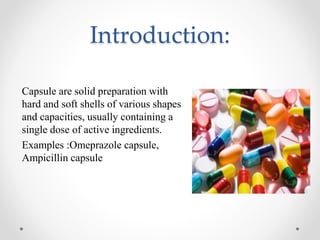
Capsule are solid preparation with
hard and soft shells of various shapes
and capacities, usually containing a
single dose of active ingredients.
Examples :Omeprazole capsule,
Ampicillin capsule
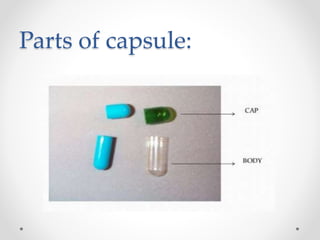
Parts of capsule:
1. Cap
2. Body
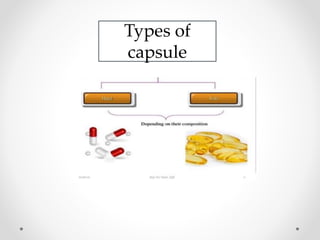
Types of
capsule
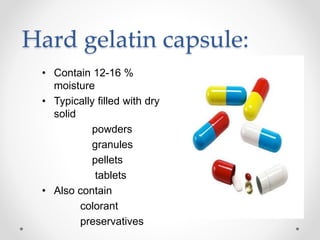
Hard gelatin capsule:
• Contain 12-16 %
moisture
• Typically filled with dry
solid
powders
granules
pellets
tablets
• Also contain
colorant
preservatives
Ingredients for hard gelatin
capsule:
• Active ingredient .
• Gelatin
• Preservatives
• Colorant
• Plasticizer
• Filler
• Water
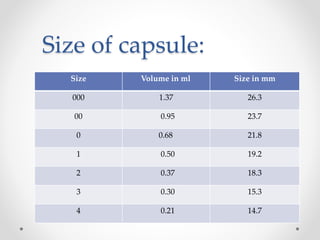
Size of capsule:
Size Volume in ml Size in mm
000 1.37 26.3
00 0.95 23.7
0 0.68 21.8
1 0.50 19.2
2 0.37 18.3
3 0.30 15.3
4 0.21 14.7
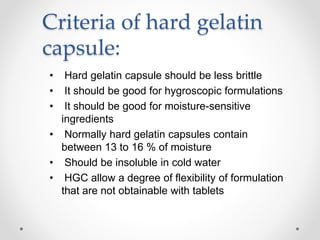
Criteria of hard gelatin
capsule:
• Hard gelatin capsule should be less brittle
• It should be good for hygroscopic formulations
• It should be good for moisture-sensitive
ingredients
• Normally hard gelatin capsules contain
between 13 to 16 % of moisture
• Should be insoluble in cold water
• HGC allow a degree of flexibility of formulation
that are not obtainable with tablets
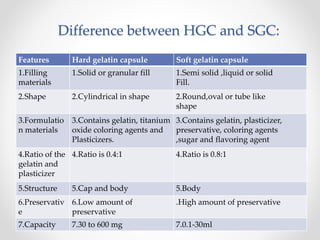
Difference between HGC and SGC:
Features Hard gelatin capsule Soft gelatin capsule
1.Filling
materials
1.Solid or granular fill 1.Semi solid ,liquid or solid
Fill.
2.Shape 2.Cylindrical in shape 2.Round,oval or tube like
shape
3.Formulatio
n materials
3.Contains gelatin, titanium
oxide coloring agents and
Plasticizers.
3.Contains gelatin, plasticizer,
preservative, coloring agents
,sugar and flavoring agent
4.Ratio of the
gelatin and
plasticizer
4.Ratio is 0.4:1 4.Ratio is 0.8:1
5.Structure 5.Cap and body 5.Body
6.Preservativ
e
6.Low amount of
preservative
.High amount of preservative
7.Capacity 7.30 to 600 mg 7.0.1-30ml
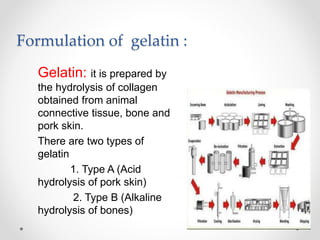
Formulation of gelatin :
Gelatin: it is prepared by
the hydrolysis of collagen
obtained from animal
connective tissue, bone and
pork skin.
There are two types of
gelatin
1. Type A (Acid
hydrolysis of pork skin)
2. Type B (Alkaline
hydrolysis of bones)
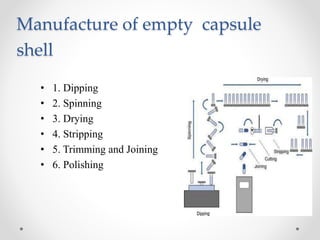
Manufacture of empty capsule
shell
• 1. Dipping
• 2. Spinning
• 3. Drying
• 4. Stripping
• 5. Trimming and Joining
• 6. Polishing
Capsule shell filling:
1.Filling of powder formulation:
a. bench – scale filling
b. industrial scale filling
2. Pellet filling
3. Tablet filling
4. Semi-solid and liquid filling
Advantages of HGC:
• Easy to shallow
• Masking capacity
• Protection of medicament
• Therapeutically inert and easy to digest
• Easy to handle and carry
• Different sizes are available
• Product identification
• Provide enteric and sustained release
effects
Disadvantages of
HGC:
• Hydroscopic drug is not suitable for filling into
the capsule.
• chloride are sudden release such compound in
the stomach cause irritation.
• Efflorescent substance may cause to capsule
too soft.
• Deliquescent material may dry to the capsule
shell to excessive.
Problems and Remedies of HGC:
1. Hygroscopic powders
Remedy :Adsorbent such as ;Magnesium
carbonate ,Magnesium Oxide
2. Eutectic mixture
Remedy: Use of adsorbent
3.Small dose of drug
Remedy: Addition of inert powder
4.Lack of adhesiveness difficult to fill by punch
method
Remedy : Moistened with alcohol ,granules
reduced to powders
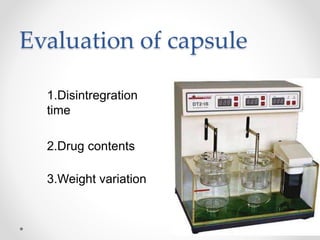
Evaluation of capsule
1.Disintregration
time
2.Drug contents
3.Weight variation
1. Disintegration Time: One capsule was placed in each of six tubes of
assembly and
assembly was suspended in water. Discs were added to each tube,
temperature was
maintained at 37±2°C and assembly was operated for 60 min.
2. Drug Content: Weigh an amount of the granules equivalent to 50 mg of
losartan
potassium was dissolved in 100 ml of phosphate buffer pH 6.8, filtered,
diluted suitably
and analyzed for the drug content at 246 nm using UV-visible
spectrophotometer.
3. Weight variation: 20 capsules are individually weighed, average weight
and percentage
deviation limits are average weight ±10%. If the weight variations are
beyond the limit,
net weights are determined, the net weights of the not more than 2
capsules should fall
outside the average net weight ±10% values and net weight of no capsule
should be
outside the average net weight ±25% limit.
Conclusion
Capsule are more advantageous than the other dosage
forms .Hard gelatin capsule is more versatile over the world
.
Thanks to all

A presentation on Hard Gelatin Capsule

  • 2.
    A presentation on HardGelatin Capsule Group C Submitted by: 20150109002 20151209008 20150109016 20150109017 20151209030 20151209036 20150109039 20151209040 20141209004 20140109013 Submitted to: Shanita Zaman Smritiy Lecturer Dept. of Pharmacy BSMRSTU
  • 3.
    CONTENTS:  Introduction  Partsof capsule  Types of capsule  Hard gelatin capsule  Ingredients of hard gelatin capsule  Size of capsule  Criteria of HGC  Difference between HGC & SGC  Formulation of gelatin  Manufacture of empty capsule shell
  • 4.
    CONTENTS:  Capsule shellfilling  Advantage of HGC  Disadvantage of HGC  Problems and remedies  Evaluation of capsule  Conclusion
  • 5.
    Introduction: Capsule are solidpreparation with hard and soft shells of various shapes and capacities, usually containing a single dose of active ingredients. Examples :Omeprazole capsule, Ampicillin capsule
  • 6.
  • 7.
  • 8.
    Hard gelatin capsule: •Contain 12-16 % moisture • Typically filled with dry solid powders granules pellets tablets • Also contain colorant preservatives
  • 9.
    Ingredients for hardgelatin capsule: • Active ingredient . • Gelatin • Preservatives • Colorant • Plasticizer • Filler • Water
  • 10.
    Size of capsule: SizeVolume in ml Size in mm 000 1.37 26.3 00 0.95 23.7 0 0.68 21.8 1 0.50 19.2 2 0.37 18.3 3 0.30 15.3 4 0.21 14.7
  • 11.
    Criteria of hardgelatin capsule: • Hard gelatin capsule should be less brittle • It should be good for hygroscopic formulations • It should be good for moisture-sensitive ingredients • Normally hard gelatin capsules contain between 13 to 16 % of moisture • Should be insoluble in cold water • HGC allow a degree of flexibility of formulation that are not obtainable with tablets
  • 12.
    Difference between HGCand SGC: Features Hard gelatin capsule Soft gelatin capsule 1.Filling materials 1.Solid or granular fill 1.Semi solid ,liquid or solid Fill. 2.Shape 2.Cylindrical in shape 2.Round,oval or tube like shape 3.Formulatio n materials 3.Contains gelatin, titanium oxide coloring agents and Plasticizers. 3.Contains gelatin, plasticizer, preservative, coloring agents ,sugar and flavoring agent 4.Ratio of the gelatin and plasticizer 4.Ratio is 0.4:1 4.Ratio is 0.8:1 5.Structure 5.Cap and body 5.Body 6.Preservativ e 6.Low amount of preservative .High amount of preservative 7.Capacity 7.30 to 600 mg 7.0.1-30ml
  • 13.
    Formulation of gelatin: Gelatin: it is prepared by the hydrolysis of collagen obtained from animal connective tissue, bone and pork skin. There are two types of gelatin 1. Type A (Acid hydrolysis of pork skin) 2. Type B (Alkaline hydrolysis of bones)
  • 14.
    Manufacture of emptycapsule shell • 1. Dipping • 2. Spinning • 3. Drying • 4. Stripping • 5. Trimming and Joining • 6. Polishing
  • 15.
    Capsule shell filling: 1.Fillingof powder formulation: a. bench – scale filling b. industrial scale filling 2. Pellet filling 3. Tablet filling 4. Semi-solid and liquid filling
  • 16.
    Advantages of HGC: •Easy to shallow • Masking capacity • Protection of medicament • Therapeutically inert and easy to digest • Easy to handle and carry • Different sizes are available • Product identification • Provide enteric and sustained release effects
  • 17.
    Disadvantages of HGC: • Hydroscopicdrug is not suitable for filling into the capsule. • chloride are sudden release such compound in the stomach cause irritation. • Efflorescent substance may cause to capsule too soft. • Deliquescent material may dry to the capsule shell to excessive.
  • 18.
    Problems and Remediesof HGC: 1. Hygroscopic powders Remedy :Adsorbent such as ;Magnesium carbonate ,Magnesium Oxide 2. Eutectic mixture Remedy: Use of adsorbent 3.Small dose of drug Remedy: Addition of inert powder 4.Lack of adhesiveness difficult to fill by punch method Remedy : Moistened with alcohol ,granules reduced to powders
  • 19.
  • 20.
    1. Disintegration Time:One capsule was placed in each of six tubes of assembly and assembly was suspended in water. Discs were added to each tube, temperature was maintained at 37±2°C and assembly was operated for 60 min. 2. Drug Content: Weigh an amount of the granules equivalent to 50 mg of losartan potassium was dissolved in 100 ml of phosphate buffer pH 6.8, filtered, diluted suitably and analyzed for the drug content at 246 nm using UV-visible spectrophotometer. 3. Weight variation: 20 capsules are individually weighed, average weight and percentage deviation limits are average weight ±10%. If the weight variations are beyond the limit, net weights are determined, the net weights of the not more than 2 capsules should fall outside the average net weight ±10% values and net weight of no capsule should be outside the average net weight ±25% limit.
  • 21.
    Conclusion Capsule are moreadvantageous than the other dosage forms .Hard gelatin capsule is more versatile over the world .
  • 22.