
A Practical and Robust Bump-mapping Technique for Today’s GPUs Stanford Shading Group presentation May 8, 2000
Mark J. Kilgard Graphics Software Engineer NVIDIA Corporation
“Hardware Bump Mapping” mostly hype so far Previous techniques Prone to aliasing artifacts Do not correctly handle surface self-shadowing Cut too many corners, i.e. fail to renormalize, etc. Too expensive: many passes (OIM), needs accumulation buffer or glCopyPixels Only handle infinite, non-attenuated, non-spotlight lights Assume local viewer Correct only for essentially flat surfaces Difficult to implement and author
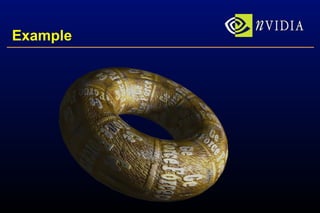
Example
Overview of the Technique Uses new NVIDIA GPU features Cube maps - for per-pixel normalization EXT_texture_cube_map extension Register combiners - for per-pixel dot products and additional math NV_register_combiners And dual-textured - for normalization cube map and 2D normal map ARB_multitexture
Features of the technique Correctly handles Surface self-shadowing for both diffuse and specular contributions Diffuse minification so that bumped objects in the distance look dimmer than equivalent smooth distant objects Mipmap filtering of normal maps minimizes aliasing Local, attenuated, and/or spot-light light sources with local viewer Ambient and surface decals
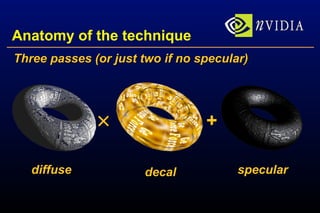
Anatomy of the technique Three passes (or just two if no specular)  + diffuse decal specular
High-level view Tangent space per-pixel lighting [Peercy 97] CPU supplies tangent space light vector or half-angle vector as (s,t,r) texture coordinates linearly interpolated normalized by an RGB8 cube map texture Normal map is RGBA8 2D texture RGB contains “compressed” normalized perturbed normal Alpha contains averaged normal shortening But no hard-wired per-pixel “lighting engine”!
Per-pixel lighting building blocks Cube maps enable per-pixel vector normalization Cube map normalizes interpolated (s,t,r) into RGB (s,t,r) is interpolated per-vertex light  or half-angle vector Combiners  expand RGB from [0,1] range to [-1,1] range expansion done by register combiners Optimization :  If infinite viewer or infinite light used, half-angle can be computed within the cube map! 32x32x6 RGB8 cube map texture is sufficient
Per-pixel lighting building blocks Register combiners perform per-pixel math Signed math for dot products L dot N’ for diffuse, H dot N’ for Blinn specular L and H properly normalized by cube map Pre-normalized N’ supplied by normal map Uses tangent space L z  for geometric surface self-shadowing Constant color for adding in ambient contribution Successive squaring for specular exponent
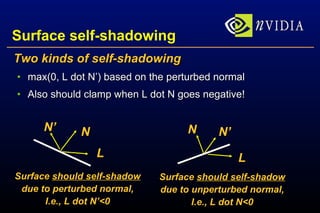
Surface self-shadowing Two kinds of self-shadowing max(0, L dot N’) based on the perturbed normal Also should clamp when L dot N goes negative! L N N’ L N’ N Surface  should self-shadow due to perturbed normal, I.e., L dot N’<0 Surface  should self-shadow due to unperturbed normal, I.e., L dot N<0
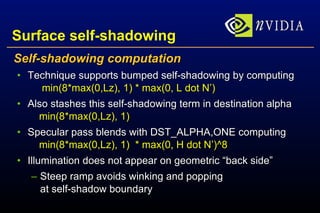
Surface self-shadowing Self-shadowing computation Technique supports bumped self-shadowing by computing   min(8*max(0,Lz), 1) * max(0, L dot N’) Also stashes this self-shadowing term in destination alpha   min(8*max(0,Lz), 1)  Specular pass blends with DST_ALPHA,ONE computing   min(8*max(0,Lz), 1)  * max(0, H dot N’)^8 Illumination does not appear on geometric “back side” Steep ramp avoids winking and popping at self-shadow boundary
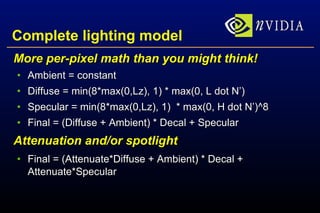
Complete lighting model More per-pixel math than you might think! Ambient = constant Diffuse = min(8*max(0,Lz), 1) * max(0, L dot N’) Specular = min(8*max(0,Lz), 1)  * max(0, H dot N’)^8 Final = (Diffuse + Ambient) * Decal + Specular Attenuation and/or spotlight Final = (Attenuate*Diffuse + Ambient) * Decal + Attenuate*Specular
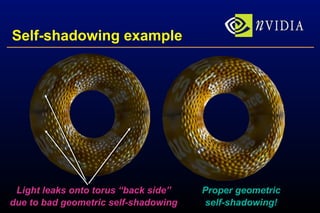
Self-shadowing example Light leaks onto torus “back side” due to bad geometric self-shadowing Proper geometric self-shadowing!
Some CPU work required Per-vertex work Model requires per-vertex tangent space basis any bump mapping scheme needs surface normals (N), tangents (T), and binormals (B) If light or viewer (in the specular case) changes relative to the object, CPU re-compute tangent space light and half-angle Transform object-space vector by [ T B N ] 3x3 matrix Nice split:  CPU does per-vertex work, GPU does transform and per-pixel work
Normal Map Filtering Issues Normal map filtering is important Consider two objects in the distance chalk golf ball (diffuse, bumpy) smooth chalk ball (diffuse, but not bumpy) bumpy ball should look dimmer How to properly account for this? Corresponds to heavy minification of the normal map would imply sub-fragment lighting
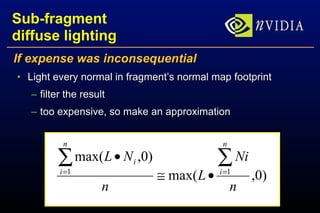
Sub-fragment diffuse lighting If expense was inconsequential Light every normal in fragment’s normal map footprint filter the result too expensive, so make an approximation
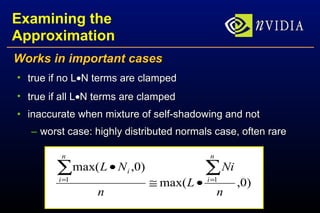
Examining the Approximation Works in important cases true if no L  N terms are clamped true if all L  N terms are clamped inaccurate when mixture of self-shadowing and not worst case: highly distributed normals case, often rare
Diffuse Normal Map Filtering Simpler than you think Simply average normals in the normal map minified normals are often denormalized do NOT renormalize Better than hyper-tessellation and per-vertex lighting hyper-tessellation cannot simulate sub-pixel lighting without sub-pixel rendering Issue: mipmap bleeding possible solution: borders and LOD clamping
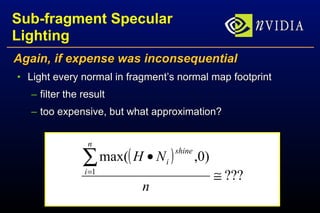
Sub-fragment Specular Lighting Again, if expense was inconsequential Light every normal in fragment’s normal map footprint filter the result too expensive, but what approximation?
Attempting a Specular Approximation Why specular approximation is hard specular exponent cannot be factored out specular exponent needs H    N to be 1.0 when H and N are coincident an issue if N is de-normalized if length of N is too short, specular term never “glints” Known issue, see [Fournier 92] and [Schilling 97] current solutions too expensive for hardware
Specular Filtering Stand-in Same as diffuse filtering, but re-normalize About the best we can do Like [Fournier 92] approximation, just one “surface”
Single Filtered Normal Map Texture Combines diffuse and specular filtering Keep normalized filtered normal in (R,G,B) Use (R,G,B) directly for specular Keep de-normalization factor in A Scale (R,G,B) by A for diffuse Efficient since RGB 24-bit texel format is often padded out to 32-bit RGBA texel format for nice word accesses
Issues Truth in advertising Specular exponent only 8 so not too shiny banding evident in specular highlights, though easy to hide artifacts in surface decal and diffuse contribution Perturbed normal slightly de-normalized by filtering causes very slight dimming, alternative is aliasing most objectionable when magnifying, “grated” look Not “bumped environment mapping” but DX6 bump-env support is a joke Requires GeForce 256, Quadro, or any future NVIDIA GPU
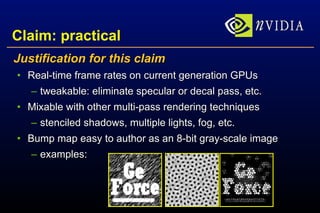
Claim: practical Justification for this claim Real-time frame rates on current generation GPUs tweakable: eliminate specular or decal pass, etc. Mixable with other multi-pass rendering techniques stenciled shadows, multiple lights, fog, etc. Bump map easy to author as an 8-bit gray-scale image examples:
Claim: robust Justification for this claim Animates with minimal temporal aliasing Models both self-shadowing terms, including for specular Diffuse illumination filtered reasonably Light and half-angle vectors renormalized per-pixel Local, attenuated, and spot-light light sources Local viewer Overall, very reasonable fidelity to Blinn’s original formulation
Source available on the web already Bumpdemo source code Go to www.nvidia.com Developer Section http://www.nvidia.com/developer.nsf/htmlmedia/devMainFR_top.html Find and download bumpdemo.zip requires GeForce 256 or Quadro to run Also download “NVIDIA OpenGL Extension Specifications” nvOpenGLspecs.pdf Adobe Acrobat, 197 pages documents OpenGL extensions used by bumpdemo
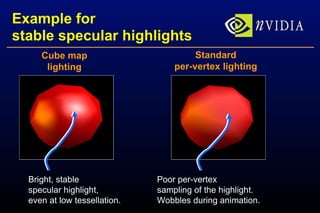
Other novel uses for cube mapping Stable specular highlights Encode specular & diffuse lighting solution Diffuse cube map using  normal  map texgen Specular cube map using  reflection  map texgen Encode unlimited number of directional lights Result is stable specular highlights Less significant for diffuse lighting Average of dot products    dot product of averages Excepting clamping
Example for stable specular highlights Bright, stable specular highlight, even at low tessellation. Poor per-vertex sampling of the highlight. Wobbles during animation. Cube map lighting Standard per-vertex lighting
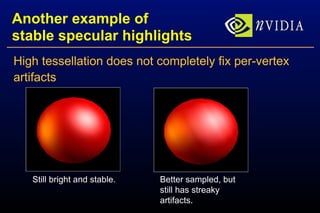
Another example of stable specular highlights High tessellation does not completely fix per-vertex artifacts Still bright and stable. Better sampled, but still has streaky artifacts.
Per-pixel specular normal mapping Assumes fancy per-pixel dot product operations! Cube map encodes normalized half-angle  Texgen supplies view vector Cube map generates normalize(V+L) vector Another 2D texture supplies per-pixel surface normals Per-pixel specular lighting  Per-pixel “normalized(V+L) dot N” ! Still more novel uses for cube maps & combiners
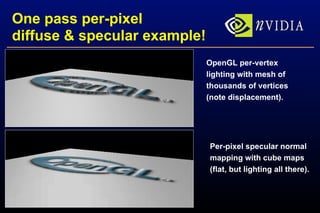
One pass per-pixel diffuse & specular example! OpenGL per-vertex lighting with mesh of thousands of vertices (note displacement). Per-pixel specular normal mapping with cube maps (flat, but lighting all there).
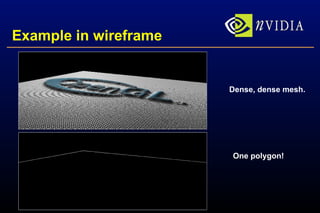
Example in wireframe Dense, dense mesh. One polygon!
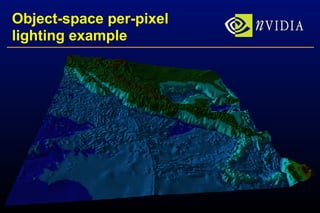
Object-space per-pixel lighting example
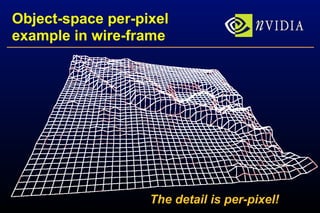
Object-space per-pixel example in wire-frame The detail is per-pixel!
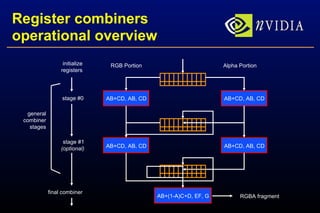
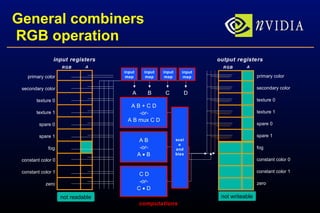
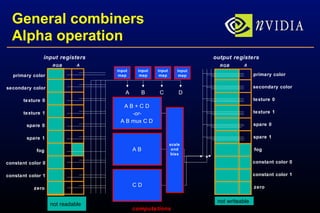
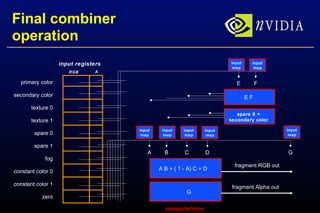
Register combiners overview overrides texture stages/environment, color sum, and fog in current APIs signed math (negative one to positive range) extended range through scaling dot products for lighting and image processing applications designed for specular, diffuse, and ambient per-pixel lighting object space bump map lighting tangent space bump map lighting post-filtering 3x3 color matrix for color space conversions register model supports non-linear data flows superior to linear chain in current APIs effectively, a VLIW instruction set for fragment coloring very efficient hardware implementation
Register combiners operational overview general combiner stages final combiner RGB Portion Alpha Portion initialize registers stage #0 stage #1 (optional) AB+CD, AB, CD AB+CD, AB, CD AB+CD, AB, CD AB+CD, AB, CD AB+(1-A)C+D, EF, G RGBA fragment
General combiners  RGB operation zero primary color secondary color constant color 0 constant color 1 fog spare 1 spare 0 texture 0 texture 1 A B C D input map input map input map not writeable RGB A RGB A input registers computations output registers scale and bias input map not readable zero primary color secondary color constant color 0 constant color 1 fog spare 1 spare 0 texture 0 texture 1 A B + C D A B mux C D -or- A B A    B -or- C    D C D -or-
General combiners Alpha operation zero primary color secondary color constant color 0 constant color 1 fog spare 1 spare 0 texture 0 texture 1 A B C D A B C D input map input map input map not writeable RGB A RGB A input registers computations output registers scale and bias input map not readable zero primary color secondary color constant color 0 constant color 1 fog spare 1 spare 0 texture 0 texture 1 A B + C D A B mux C D -or-
Final combiner operation zero primary color secondary color constant color 0 constant color 1 fog spare 1 spare 0 texture 0 texture 1 A B C D RGB A input registers computations A B + ( 1 - A) C + D E F E F G spare 0 + secondary color input map input map input map input map input map input map input map fragment RGB out fragment Alpha out G

A Practical and Robust Bump-mapping Technique for Today’s GPUs (slides)

  • 1.
    A Practical andRobust Bump-mapping Technique for Today’s GPUs Stanford Shading Group presentation May 8, 2000
  • 2.
    Mark J. KilgardGraphics Software Engineer NVIDIA Corporation
  • 3.
    “Hardware Bump Mapping”mostly hype so far Previous techniques Prone to aliasing artifacts Do not correctly handle surface self-shadowing Cut too many corners, i.e. fail to renormalize, etc. Too expensive: many passes (OIM), needs accumulation buffer or glCopyPixels Only handle infinite, non-attenuated, non-spotlight lights Assume local viewer Correct only for essentially flat surfaces Difficult to implement and author
  • 4.
  • 5.
    Overview of theTechnique Uses new NVIDIA GPU features Cube maps - for per-pixel normalization EXT_texture_cube_map extension Register combiners - for per-pixel dot products and additional math NV_register_combiners And dual-textured - for normalization cube map and 2D normal map ARB_multitexture
  • 6.
    Features of thetechnique Correctly handles Surface self-shadowing for both diffuse and specular contributions Diffuse minification so that bumped objects in the distance look dimmer than equivalent smooth distant objects Mipmap filtering of normal maps minimizes aliasing Local, attenuated, and/or spot-light light sources with local viewer Ambient and surface decals
  • 7.
    Anatomy of thetechnique Three passes (or just two if no specular)  + diffuse decal specular
  • 8.
    High-level view Tangentspace per-pixel lighting [Peercy 97] CPU supplies tangent space light vector or half-angle vector as (s,t,r) texture coordinates linearly interpolated normalized by an RGB8 cube map texture Normal map is RGBA8 2D texture RGB contains “compressed” normalized perturbed normal Alpha contains averaged normal shortening But no hard-wired per-pixel “lighting engine”!
  • 9.
    Per-pixel lighting buildingblocks Cube maps enable per-pixel vector normalization Cube map normalizes interpolated (s,t,r) into RGB (s,t,r) is interpolated per-vertex light or half-angle vector Combiners expand RGB from [0,1] range to [-1,1] range expansion done by register combiners Optimization : If infinite viewer or infinite light used, half-angle can be computed within the cube map! 32x32x6 RGB8 cube map texture is sufficient
  • 10.
    Per-pixel lighting buildingblocks Register combiners perform per-pixel math Signed math for dot products L dot N’ for diffuse, H dot N’ for Blinn specular L and H properly normalized by cube map Pre-normalized N’ supplied by normal map Uses tangent space L z for geometric surface self-shadowing Constant color for adding in ambient contribution Successive squaring for specular exponent
  • 11.
    Surface self-shadowing Twokinds of self-shadowing max(0, L dot N’) based on the perturbed normal Also should clamp when L dot N goes negative! L N N’ L N’ N Surface should self-shadow due to perturbed normal, I.e., L dot N’<0 Surface should self-shadow due to unperturbed normal, I.e., L dot N<0
  • 12.
    Surface self-shadowing Self-shadowingcomputation Technique supports bumped self-shadowing by computing min(8*max(0,Lz), 1) * max(0, L dot N’) Also stashes this self-shadowing term in destination alpha min(8*max(0,Lz), 1) Specular pass blends with DST_ALPHA,ONE computing min(8*max(0,Lz), 1) * max(0, H dot N’)^8 Illumination does not appear on geometric “back side” Steep ramp avoids winking and popping at self-shadow boundary
  • 13.
    Complete lighting modelMore per-pixel math than you might think! Ambient = constant Diffuse = min(8*max(0,Lz), 1) * max(0, L dot N’) Specular = min(8*max(0,Lz), 1) * max(0, H dot N’)^8 Final = (Diffuse + Ambient) * Decal + Specular Attenuation and/or spotlight Final = (Attenuate*Diffuse + Ambient) * Decal + Attenuate*Specular
  • 14.
    Self-shadowing example Lightleaks onto torus “back side” due to bad geometric self-shadowing Proper geometric self-shadowing!
  • 15.
    Some CPU workrequired Per-vertex work Model requires per-vertex tangent space basis any bump mapping scheme needs surface normals (N), tangents (T), and binormals (B) If light or viewer (in the specular case) changes relative to the object, CPU re-compute tangent space light and half-angle Transform object-space vector by [ T B N ] 3x3 matrix Nice split: CPU does per-vertex work, GPU does transform and per-pixel work
  • 16.
    Normal Map FilteringIssues Normal map filtering is important Consider two objects in the distance chalk golf ball (diffuse, bumpy) smooth chalk ball (diffuse, but not bumpy) bumpy ball should look dimmer How to properly account for this? Corresponds to heavy minification of the normal map would imply sub-fragment lighting
  • 17.
    Sub-fragment diffuse lightingIf expense was inconsequential Light every normal in fragment’s normal map footprint filter the result too expensive, so make an approximation
  • 18.
    Examining the ApproximationWorks in important cases true if no L  N terms are clamped true if all L  N terms are clamped inaccurate when mixture of self-shadowing and not worst case: highly distributed normals case, often rare
  • 19.
    Diffuse Normal MapFiltering Simpler than you think Simply average normals in the normal map minified normals are often denormalized do NOT renormalize Better than hyper-tessellation and per-vertex lighting hyper-tessellation cannot simulate sub-pixel lighting without sub-pixel rendering Issue: mipmap bleeding possible solution: borders and LOD clamping
  • 20.
    Sub-fragment Specular LightingAgain, if expense was inconsequential Light every normal in fragment’s normal map footprint filter the result too expensive, but what approximation?
  • 21.
    Attempting a SpecularApproximation Why specular approximation is hard specular exponent cannot be factored out specular exponent needs H  N to be 1.0 when H and N are coincident an issue if N is de-normalized if length of N is too short, specular term never “glints” Known issue, see [Fournier 92] and [Schilling 97] current solutions too expensive for hardware
  • 22.
    Specular Filtering Stand-inSame as diffuse filtering, but re-normalize About the best we can do Like [Fournier 92] approximation, just one “surface”
  • 23.
    Single Filtered NormalMap Texture Combines diffuse and specular filtering Keep normalized filtered normal in (R,G,B) Use (R,G,B) directly for specular Keep de-normalization factor in A Scale (R,G,B) by A for diffuse Efficient since RGB 24-bit texel format is often padded out to 32-bit RGBA texel format for nice word accesses
  • 24.
    Issues Truth inadvertising Specular exponent only 8 so not too shiny banding evident in specular highlights, though easy to hide artifacts in surface decal and diffuse contribution Perturbed normal slightly de-normalized by filtering causes very slight dimming, alternative is aliasing most objectionable when magnifying, “grated” look Not “bumped environment mapping” but DX6 bump-env support is a joke Requires GeForce 256, Quadro, or any future NVIDIA GPU
  • 25.
    Claim: practical Justificationfor this claim Real-time frame rates on current generation GPUs tweakable: eliminate specular or decal pass, etc. Mixable with other multi-pass rendering techniques stenciled shadows, multiple lights, fog, etc. Bump map easy to author as an 8-bit gray-scale image examples:
  • 26.
    Claim: robust Justificationfor this claim Animates with minimal temporal aliasing Models both self-shadowing terms, including for specular Diffuse illumination filtered reasonably Light and half-angle vectors renormalized per-pixel Local, attenuated, and spot-light light sources Local viewer Overall, very reasonable fidelity to Blinn’s original formulation
  • 27.
    Source available onthe web already Bumpdemo source code Go to www.nvidia.com Developer Section http://www.nvidia.com/developer.nsf/htmlmedia/devMainFR_top.html Find and download bumpdemo.zip requires GeForce 256 or Quadro to run Also download “NVIDIA OpenGL Extension Specifications” nvOpenGLspecs.pdf Adobe Acrobat, 197 pages documents OpenGL extensions used by bumpdemo
  • 28.
    Other novel usesfor cube mapping Stable specular highlights Encode specular & diffuse lighting solution Diffuse cube map using normal map texgen Specular cube map using reflection map texgen Encode unlimited number of directional lights Result is stable specular highlights Less significant for diffuse lighting Average of dot products  dot product of averages Excepting clamping
  • 29.
    Example for stablespecular highlights Bright, stable specular highlight, even at low tessellation. Poor per-vertex sampling of the highlight. Wobbles during animation. Cube map lighting Standard per-vertex lighting
  • 30.
    Another example ofstable specular highlights High tessellation does not completely fix per-vertex artifacts Still bright and stable. Better sampled, but still has streaky artifacts.
  • 31.
    Per-pixel specular normalmapping Assumes fancy per-pixel dot product operations! Cube map encodes normalized half-angle Texgen supplies view vector Cube map generates normalize(V+L) vector Another 2D texture supplies per-pixel surface normals Per-pixel specular lighting Per-pixel “normalized(V+L) dot N” ! Still more novel uses for cube maps & combiners
  • 32.
    One pass per-pixeldiffuse & specular example! OpenGL per-vertex lighting with mesh of thousands of vertices (note displacement). Per-pixel specular normal mapping with cube maps (flat, but lighting all there).
  • 33.
    Example in wireframeDense, dense mesh. One polygon!
  • 34.
  • 35.
    Object-space per-pixel examplein wire-frame The detail is per-pixel!
  • 36.
    Register combiners overviewoverrides texture stages/environment, color sum, and fog in current APIs signed math (negative one to positive range) extended range through scaling dot products for lighting and image processing applications designed for specular, diffuse, and ambient per-pixel lighting object space bump map lighting tangent space bump map lighting post-filtering 3x3 color matrix for color space conversions register model supports non-linear data flows superior to linear chain in current APIs effectively, a VLIW instruction set for fragment coloring very efficient hardware implementation
  • 37.
    Register combiners operationaloverview general combiner stages final combiner RGB Portion Alpha Portion initialize registers stage #0 stage #1 (optional) AB+CD, AB, CD AB+CD, AB, CD AB+CD, AB, CD AB+CD, AB, CD AB+(1-A)C+D, EF, G RGBA fragment
  • 38.
    General combiners RGB operation zero primary color secondary color constant color 0 constant color 1 fog spare 1 spare 0 texture 0 texture 1 A B C D input map input map input map not writeable RGB A RGB A input registers computations output registers scale and bias input map not readable zero primary color secondary color constant color 0 constant color 1 fog spare 1 spare 0 texture 0 texture 1 A B + C D A B mux C D -or- A B A  B -or- C  D C D -or-
  • 39.
    General combiners Alphaoperation zero primary color secondary color constant color 0 constant color 1 fog spare 1 spare 0 texture 0 texture 1 A B C D A B C D input map input map input map not writeable RGB A RGB A input registers computations output registers scale and bias input map not readable zero primary color secondary color constant color 0 constant color 1 fog spare 1 spare 0 texture 0 texture 1 A B + C D A B mux C D -or-
  • 40.
    Final combiner operationzero primary color secondary color constant color 0 constant color 1 fog spare 1 spare 0 texture 0 texture 1 A B C D RGB A input registers computations A B + ( 1 - A) C + D E F E F G spare 0 + secondary color input map input map input map input map input map input map input map fragment RGB out fragment Alpha out G