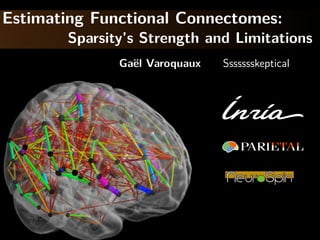
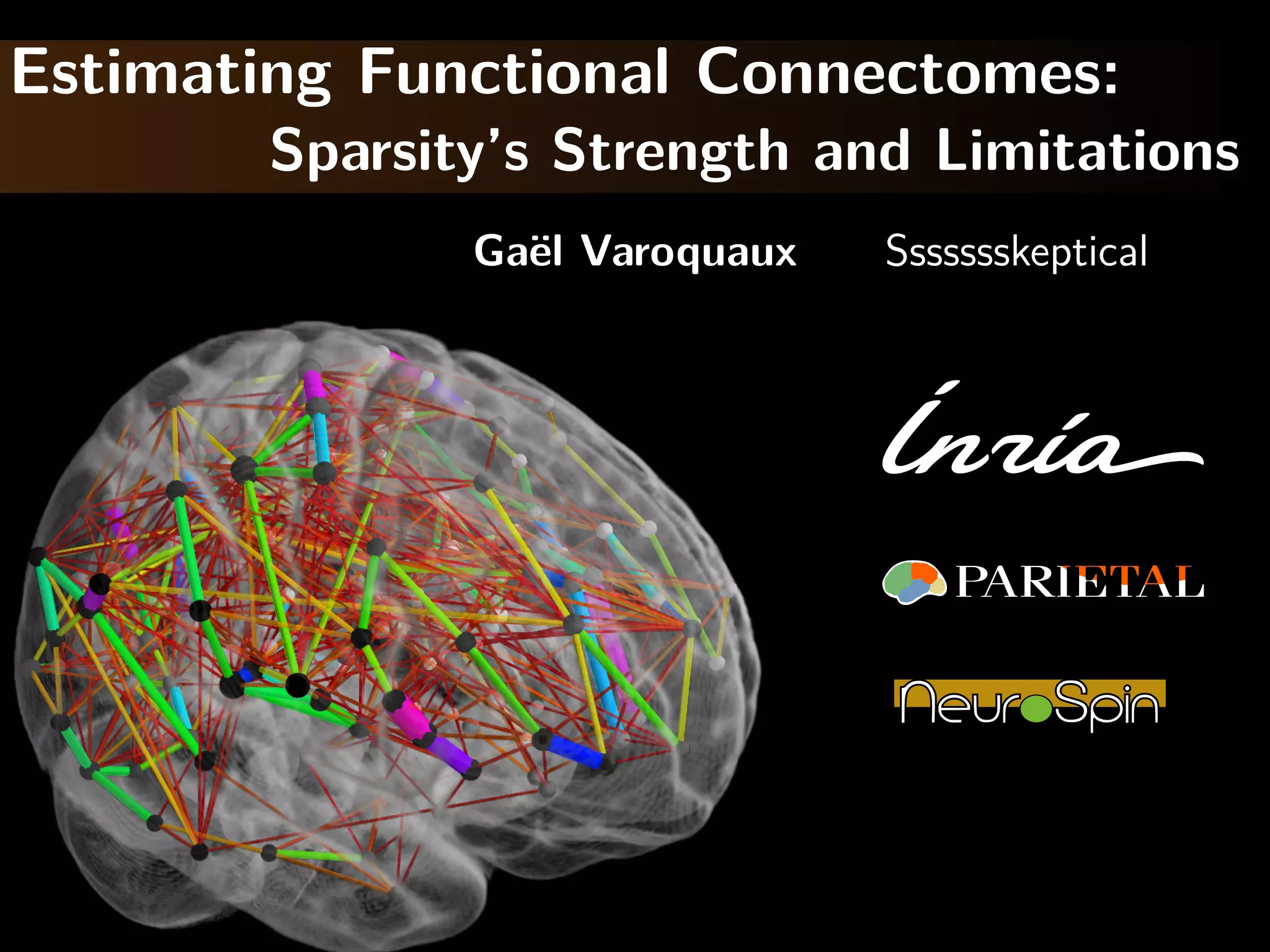
Estimating Functional Connectomes:
Sparsity’s Strength and Limitations
Ga¨el Varoquaux Ssssssskeptical
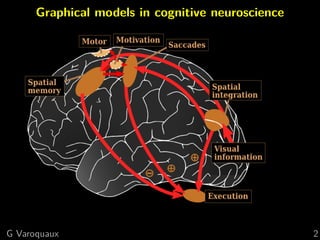
Graphical models in cognitive neuroscience
G Varoquaux 2
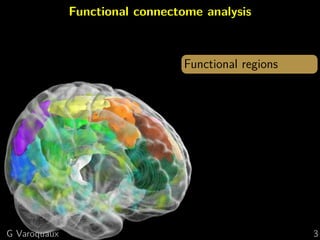
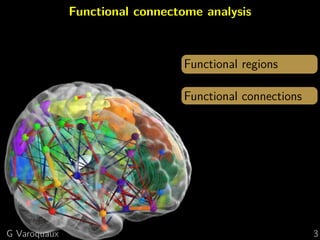
Functional connectome analysis
Functional regions
G Varoquaux 3
Functional connectome analysis
Functional regions
Functional connections
G Varoquaux 3
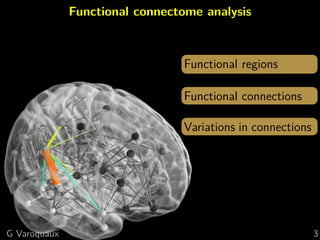
Functional connectome analysis
Functional regions
Functional connections
Variations in connections
G Varoquaux 3
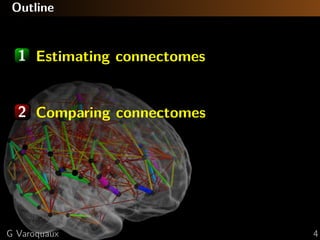
Outline
1 Estimating connectomes
2 Comparing connectomes
G Varoquaux 4
1 Estimating connectomes
Functional connectome
Graph of interactions between regions
[Varoquaux and Craddock 2013]
G Varoquaux 5
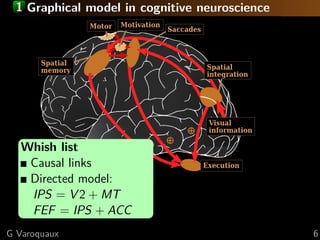
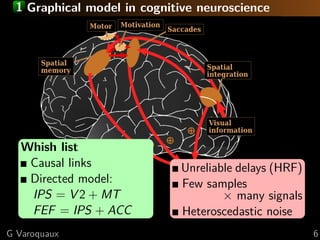
1 Graphical model in cognitive neuroscience
Whish list
Causal links
Directed model:
IPS = V 2 + MT
FEF = IPS + ACC
G Varoquaux 6
1 Graphical model in cognitive neuroscience
Whish list
Causal links
Directed model:
IPS = V 2 + MT
FEF = IPS + ACC
Unreliable delays (HRF)
Few samples
× many signals
Heteroscedastic noise
G Varoquaux 6
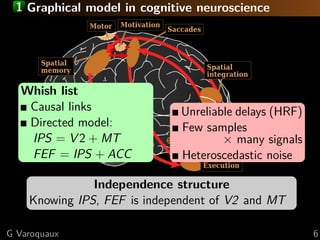
1 Graphical model in cognitive neuroscience
Whish list
Causal links
Directed model:
IPS = V 2 + MT
FEF = IPS + ACC
Unreliable delays (HRF)
Few samples
× many signals
Heteroscedastic noise
Independence structure
Knowing IPS, FEF is independent of V2 and MT
G Varoquaux 6
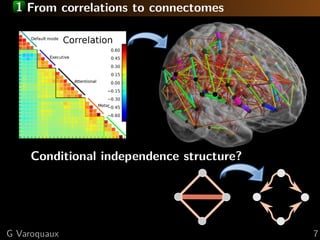
1 From correlations to connectomes
Conditional independence structure?
G Varoquaux 7
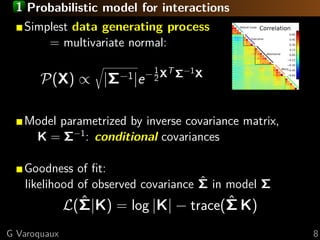
1 Probabilistic model for interactions
Simplest data generating process
= multivariate normal:
P(X) ∝ |Σ−1|e−1
2XT Σ−1X
Model parametrized by inverse covariance matrix,
K = Σ−1
: conditional covariances
Goodness of fit:
likelihood of observed covariance ˆΣ in model Σ
L( ˆΣ|K) = log |K| − trace( ˆΣ K)
G Varoquaux 8
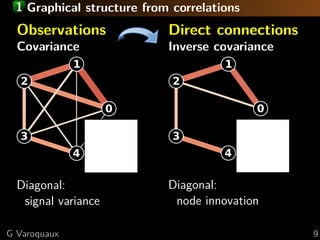
1 Graphical structure from correlations
Observations
Covariance
0
1
2
3
4
Diagonal:
signal variance
Direct connections
Inverse covariance
0
1
2
3
4
Diagonal:
node innovation
G Varoquaux 9
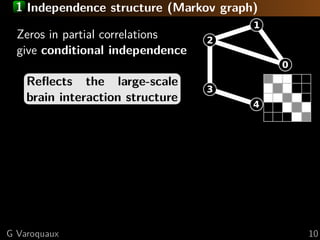
1 Independence structure (Markov graph)
Zeros in partial correlations
give conditional independence
Reflects the large-scale
brain interaction structure
G Varoquaux 10
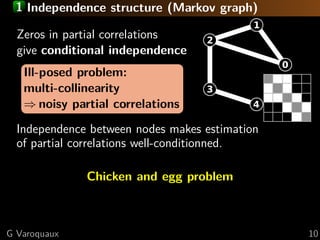
1 Independence structure (Markov graph)
Zeros in partial correlations
give conditional independence
Ill-posed problem:
multi-collinearity
⇒ noisy partial correlations
Independence between nodes makes estimation
of partial correlations well-conditionned.
Chicken and egg problem
G Varoquaux 10
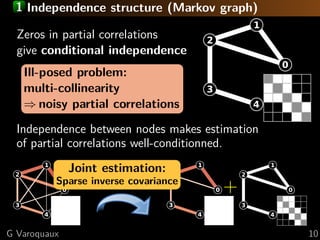
1 Independence structure (Markov graph)
Zeros in partial correlations
give conditional independence
Ill-posed problem:
multi-collinearity
⇒ noisy partial correlations
Independence between nodes makes estimation
of partial correlations well-conditionned.
0
1
2
3
4
0
1
2
3
4
+
Joint estimation:
Sparse inverse covariance
G Varoquaux 10
1 Sparse inverse covariance: penalization
[Friedman... 2008, Varoquaux... 2010b, Smith... 2011]
Maximum a posteriori:
Fit models with a penalty
Sparsity ⇒ Lasso-like problem: 1 penalization
K = argmin
K 0
L( ˆΣ|K) + λ 1(K)
Data fit,
Likelihood
Penalization,
x2
x1
G Varoquaux 11
1 Sparse inverse covariance: penalization
[Varoquaux... 2010b]
ˆΣ−1 Sparse
inverse
Likelihood of new data (cross-validation)
Subject data, Σ−1
-57.1
Subject data, sparse inverse 43.0
G Varoquaux 12
1 Limitations of sparsity Sssssskeptical
Theoretical limitation to sparse recovery
Number of samples for s edges, p nodes:
n = O (s + p) log p [Lam and Fan 2009]
High-degree nodes fail [Ravikumar... 2011]
Empirically
Optimal graph
almost dense
2.5 3.0 3.5 4.0
−log10λ
Test-datalikelihood
Sparsity
[Varoquaux... 2012]
Very sparse graphs
don’t fit the data
G Varoquaux 13
1 Multi-subject to overcome subject data scarsity
[Varoquaux... 2010b]
ˆΣ−1 Sparse
inverse
Sparse group
concat
Likelihood of new data (cross-validation)
Subject data, Σ−1
-57.1
Subject data, sparse inverse 43.0
Group concat data, Σ−1
40.6
Group concat data, sparse inverse 41.8
Inter-subject variability
G Varoquaux 14
1 Multi-subject sparsity
[Varoquaux... 2010b]
Common independence structure but different
connection values
{Ks
} = argmin
{Ks 0} s
L( ˆΣs
|Ks
) + λ 21({Ks
})
Multi-subject data fit,
Likelihood
Group-lasso penalization
G Varoquaux 15
1 Multi-subject sparsity
[Varoquaux... 2010b]
Common independence structure but different
connection values
{Ks
} = argmin
{Ks 0} s
L( ˆΣs
|Ks
) + λ 21({Ks
})
Multi-subject data fit,
Likelihood
1 on the connections of
the 2 on the subjects
G Varoquaux 15
1 Multi-subject sparse graphs perform better
[Varoquaux... 2010b]
ˆΣ−1 Sparse
inverse
Population
prior
Likelihood of new data (cross-validation) sparsity
Subject data, Σ−1
-57.1
Subject data, sparse inverse 43.0 60% full
Group concat data, Σ−1
40.6
Group concat data, sparse inverse 41.8 80% full
Group sparse model 45.6 20% full
G Varoquaux 16
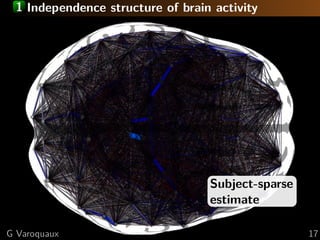
1 Independence structure of brain activity
Subject-sparse
estimate
G Varoquaux 17
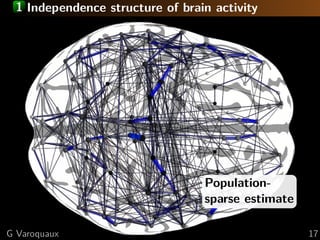
1 Independence structure of brain activity
Population-
sparse estimate
G Varoquaux 17
1 Large scale organization: communities
Graph communities
[Eguiluz... 2005]
Non-sparse
Neural communities
G Varoquaux 18
1 Large scale organization: communities
Graph communities
[Eguiluz... 2005]
Group-sparse
Neural communities
= large known functional networks
[Varoquaux... 2010b]
G Varoquaux 18
1 Giving up on sparsity?
Sparsity is finicky
Sensitive hyper-parameter
Slow and unreliable convergence
Unstable set of selected edges
Shrinkage
Softly push partial correlations to zero
ΣShrunk = (1 − λ)ΣMLE + λId
Ledoit-Wolf oracle to set λ
[Ledoit and Wolf 2004]
G Varoquaux 19
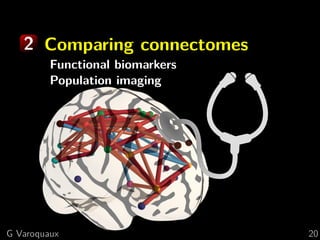
2 Comparing connectomes
Functional biomarkers
Population imaging
G Varoquaux 20
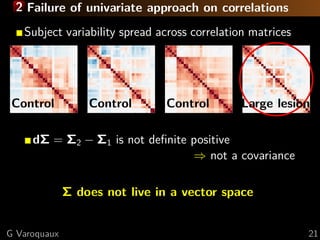
2 Failure of univariate approach on correlations
Subject variability spread across correlation matrices
0 5 10 15 20 25
0
5
10
15
20
25 Control
0 5 10 15 20 25
0
5
10
15
20
25 Control
0 5 10 15 20 25
0
5
10
15
20
25 Control
0 5 10 15 20 25
0
5
10
15
20
25Large lesion
dΣ = Σ2 − Σ1 is not definite positive
⇒ not a covariance
Σ does not live in a vector space
G Varoquaux 21
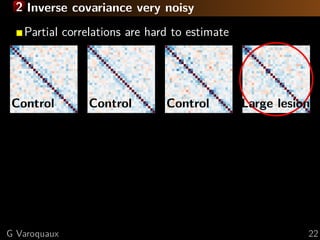
2 Inverse covariance very noisy
Partial correlations are hard to estimate
0 5 10 15 20 25
0
5
10
15
20
25 Control
0 5 10 15 20 25
0
5
10
15
20
25 Control
0 5 10 15 20 25
0
5
10
15
20
25 Control
0 5 10 15 20 25
0
5
10
15
20
25Large lesion
G Varoquaux 22
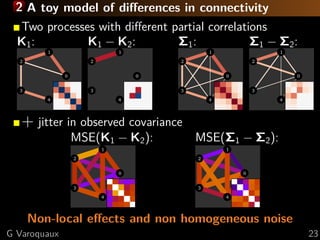
2 A toy model of differences in connectivity
Two processes with different partial correlations
K1: K1 − K2: Σ1: Σ1 − Σ2:
+ jitter in observed covariance
MSE(K1 − K2): MSE(Σ1 − Σ2):
Non-local effects and non homogeneous noise
G Varoquaux 23
2 Theory: error geometry
Disentangle parameters (edge-level connectivities)
Connectivity matrices form a manifold
⇒ project to tangent space
θ¹
θ²
( )θ¹I
-1
( )θ²I
-1
Estimation error of covariances
Assymptotics given by Fisher matrix [Rao 1945]
Cramer-Rao bounds
G Varoquaux 24
2 Theory: error geometry
Disentangle parameters (edge-level connectivities)
Connectivity matrices form a manifold
⇒ project to tangent space
M
anifold
[Varoquaux... 2010a]
Estimation error of covariances
Assymptotics given by Fisher matrix [Rao 1945]
Defines a metric on a manifold of models
With covariances: Lie-algebra structure [Lenglet... 2006]
G Varoquaux 24
2 Reparametrization for uniform error geometry
Disentangle parameters (edge-level connectivities)
Connectivity matrices form a manifold
⇒ project to tangent space
Controls
Patient
dΣ
M
anifold
Tangent
dΣ = Σ
− 1
/2
Ctrl ΣPatientΣ
− 1
/2
Ctrl
[Varoquaux... 2010a]
G Varoquaux 24
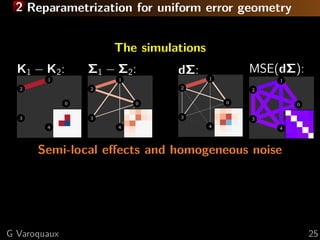
2 Reparametrization for uniform error geometry
The simulations
K1 − K2: Σ1 − Σ2: dΣ: MSE(dΣ):
Semi-local effects and homogeneous noise
G Varoquaux 25
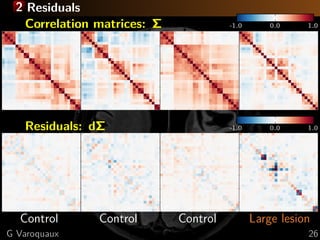
2 Residuals
Correlation matrices: Σ -1.0 0.0 1.0
0 5 10 15 20 25
0
5
0
5
0
5
0 5 10 15 20 25
0
5
10
15
20
25
0 5 10 15 20 25
0
5
10
15
20
25
0 5 10 15 20 25
0
5
10
15
20
25
Residuals: dΣ -1.0 0.0 1.0
0 5 10 15 20 25
0
5
0
5
0
5
Control
0 5 10 15 20 25
0
5
10
15
20
25
Control
0 5 10 15 20 25
0
5
10
15
20
25
Control
0 5 10 15 20 25
0
5
10
15
20
25
Large lesion
G Varoquaux 26
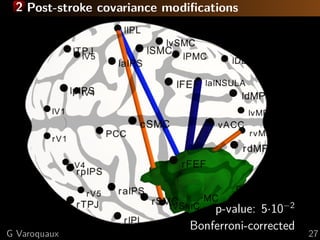
2 Post-stroke covariance modifications
p-value: 5·10−2
Bonferroni-corrected
G Varoquaux 27
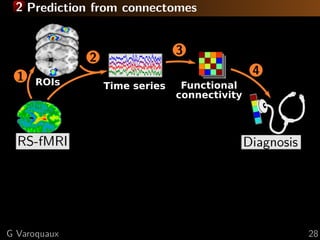
2 Prediction from connectomes
RS-fMRI
Functional
connectivity
Time series
2
4
3
1
Diagnosis
ROIs
G Varoquaux 28
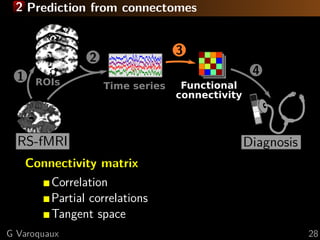
2 Prediction from connectomes
Time series
2
RS-fMRI
41
Diagnosis
ROIs Functional
connectivity
3
Connectivity matrix
Correlation
Partial correlations
Tangent space
G Varoquaux 28
2 Prediction from connectomes
Time series
2
RS-fMRI
41
Diagnosis
ROIs Functional
connectivity
3
Connectivity matrix
Correlation
Partial correlations
Tangent space
Prediction accuracy
Autism
[Abraham2016]
[K. Reddy, Poster 3916]
G Varoquaux 28
@GaelVaroquaux
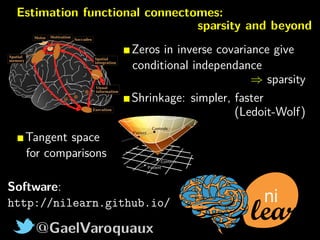
Estimation functional connectomes:
sparsity and beyond
Zeros in inverse covariance give
conditional independance
⇒ sparsity
Shrinkage: simpler, faster
(Ledoit-Wolf)
Tangent space
for comparisons
Controls
Patient
Controls
Patient
Software:
http://nilearn.github.io/ ni
References I
V. M. Eguiluz, D. R. Chialvo, G. A. Cecchi, M. Baliki, and
A. V. Apkarian. Scale-free brain functional networks.
Physical review letters, 94:018102, 2005.
J. Friedman, T. Hastie, and R. Tibshirani. Sparse inverse
covariance estimation with the graphical lasso. Biostatistics,
9:432, 2008.
C. Lam and J. Fan. Sparsistency and rates of convergence in
large covariance matrix estimation. Annals of statistics, 37
(6B):4254, 2009.
O. Ledoit and M. Wolf. A well-conditioned estimator for
large-dimensional covariance matrices. J. Multivar. Anal.,
88:365, 2004.
References II
C. Lenglet, M. Rousson, R. Deriche, and O. Faugeras.
Statistics on the manifold of multivariate normal
distributions: Theory and application to diffusion tensor
MRI processing. Journal of Mathematical Imaging and
Vision, 25:423, 2006.
C. Rao. Information and accuracy attainable in the estimation
of statistical parameters. Bull. Calcutta Math. Soc., 37:81,
1945.
P. Ravikumar, M. J. Wainwright, G. Raskutti, B. Yu, ...
High-dimensional covariance estimation by minimizing
1-penalized log-determinant divergence. Electronic Journal
of Statistics, 5:935–980, 2011.
S. Smith, K. Miller, G. Salimi-Khorshidi, M. Webster,
C. Beckmann, T. Nichols, J. Ramsey, and M. Woolrich.
Network modelling methods for fMRI. Neuroimage, 54:875,
2011.
References III
G. Varoquaux and R. C. Craddock. Learning and comparing
functional connectomes across subjects. NeuroImage, 80:
405, 2013.
G. Varoquaux, F. Baronnet, A. Kleinschmidt, P. Fillard, and
B. Thirion. Detection of brain functional-connectivity
difference in post-stroke patients using group-level
covariance modeling. In MICCAI. 2010a.
G. Varoquaux, A. Gramfort, J. B. Poline, and B. Thirion.
Brain covariance selection: better individual functional
connectivity models using population prior. In NIPS. 2010b.
G. Varoquaux, A. Gramfort, J. B. Poline, and B. Thirion.
Markov models for fMRI correlation structure: is brain
functional connectivity small world, or decomposable into
networks? Journal of Physiology - Paris, 106:212, 2012.

Estimating Functional Connectomes: Sparsity’s Strength and Limitations

  • 1.
    Estimating Functional Connectomes: Sparsity’sStrength and Limitations Ga¨el Varoquaux Ssssssskeptical
  • 2.
    Graphical models incognitive neuroscience G Varoquaux 2
  • 3.
  • 4.
    Functional connectome analysis Functionalregions Functional connections G Varoquaux 3
  • 5.
    Functional connectome analysis Functionalregions Functional connections Variations in connections G Varoquaux 3
  • 6.
    Outline 1 Estimating connectomes 2Comparing connectomes G Varoquaux 4
  • 7.
    1 Estimating connectomes Functionalconnectome Graph of interactions between regions [Varoquaux and Craddock 2013] G Varoquaux 5
  • 8.
    1 Graphical modelin cognitive neuroscience Whish list Causal links Directed model: IPS = V 2 + MT FEF = IPS + ACC G Varoquaux 6
  • 9.
    1 Graphical modelin cognitive neuroscience Whish list Causal links Directed model: IPS = V 2 + MT FEF = IPS + ACC Unreliable delays (HRF) Few samples × many signals Heteroscedastic noise G Varoquaux 6
  • 10.
    1 Graphical modelin cognitive neuroscience Whish list Causal links Directed model: IPS = V 2 + MT FEF = IPS + ACC Unreliable delays (HRF) Few samples × many signals Heteroscedastic noise Independence structure Knowing IPS, FEF is independent of V2 and MT G Varoquaux 6
  • 11.
    1 From correlationsto connectomes Conditional independence structure? G Varoquaux 7
  • 12.
    1 Probabilistic modelfor interactions Simplest data generating process = multivariate normal: P(X) ∝ |Σ−1|e−1 2XT Σ−1X Model parametrized by inverse covariance matrix, K = Σ−1 : conditional covariances Goodness of fit: likelihood of observed covariance ˆΣ in model Σ L( ˆΣ|K) = log |K| − trace( ˆΣ K) G Varoquaux 8
  • 13.
    1 Graphical structurefrom correlations Observations Covariance 0 1 2 3 4 Diagonal: signal variance Direct connections Inverse covariance 0 1 2 3 4 Diagonal: node innovation G Varoquaux 9
  • 14.
    1 Independence structure(Markov graph) Zeros in partial correlations give conditional independence Reflects the large-scale brain interaction structure G Varoquaux 10
  • 15.
    1 Independence structure(Markov graph) Zeros in partial correlations give conditional independence Ill-posed problem: multi-collinearity ⇒ noisy partial correlations Independence between nodes makes estimation of partial correlations well-conditionned. Chicken and egg problem G Varoquaux 10
  • 16.
    1 Independence structure(Markov graph) Zeros in partial correlations give conditional independence Ill-posed problem: multi-collinearity ⇒ noisy partial correlations Independence between nodes makes estimation of partial correlations well-conditionned. 0 1 2 3 4 0 1 2 3 4 + Joint estimation: Sparse inverse covariance G Varoquaux 10
  • 17.
    1 Sparse inversecovariance: penalization [Friedman... 2008, Varoquaux... 2010b, Smith... 2011] Maximum a posteriori: Fit models with a penalty Sparsity ⇒ Lasso-like problem: 1 penalization K = argmin K 0 L( ˆΣ|K) + λ 1(K) Data fit, Likelihood Penalization, x2 x1 G Varoquaux 11
  • 18.
    1 Sparse inversecovariance: penalization [Varoquaux... 2010b] ˆΣ−1 Sparse inverse Likelihood of new data (cross-validation) Subject data, Σ−1 -57.1 Subject data, sparse inverse 43.0 G Varoquaux 12
  • 19.
    1 Limitations ofsparsity Sssssskeptical Theoretical limitation to sparse recovery Number of samples for s edges, p nodes: n = O (s + p) log p [Lam and Fan 2009] High-degree nodes fail [Ravikumar... 2011] Empirically Optimal graph almost dense 2.5 3.0 3.5 4.0 −log10λ Test-datalikelihood Sparsity [Varoquaux... 2012] Very sparse graphs don’t fit the data G Varoquaux 13
  • 20.
    1 Multi-subject toovercome subject data scarsity [Varoquaux... 2010b] ˆΣ−1 Sparse inverse Sparse group concat Likelihood of new data (cross-validation) Subject data, Σ−1 -57.1 Subject data, sparse inverse 43.0 Group concat data, Σ−1 40.6 Group concat data, sparse inverse 41.8 Inter-subject variability G Varoquaux 14
  • 21.
    1 Multi-subject sparsity [Varoquaux...2010b] Common independence structure but different connection values {Ks } = argmin {Ks 0} s L( ˆΣs |Ks ) + λ 21({Ks }) Multi-subject data fit, Likelihood Group-lasso penalization G Varoquaux 15
  • 22.
    1 Multi-subject sparsity [Varoquaux...2010b] Common independence structure but different connection values {Ks } = argmin {Ks 0} s L( ˆΣs |Ks ) + λ 21({Ks }) Multi-subject data fit, Likelihood 1 on the connections of the 2 on the subjects G Varoquaux 15
  • 23.
    1 Multi-subject sparsegraphs perform better [Varoquaux... 2010b] ˆΣ−1 Sparse inverse Population prior Likelihood of new data (cross-validation) sparsity Subject data, Σ−1 -57.1 Subject data, sparse inverse 43.0 60% full Group concat data, Σ−1 40.6 Group concat data, sparse inverse 41.8 80% full Group sparse model 45.6 20% full G Varoquaux 16
  • 24.
    1 Independence structureof brain activity Subject-sparse estimate G Varoquaux 17
  • 25.
    1 Independence structureof brain activity Population- sparse estimate G Varoquaux 17
  • 26.
    1 Large scaleorganization: communities Graph communities [Eguiluz... 2005] Non-sparse Neural communities G Varoquaux 18
  • 27.
    1 Large scaleorganization: communities Graph communities [Eguiluz... 2005] Group-sparse Neural communities = large known functional networks [Varoquaux... 2010b] G Varoquaux 18
  • 28.
    1 Giving upon sparsity? Sparsity is finicky Sensitive hyper-parameter Slow and unreliable convergence Unstable set of selected edges Shrinkage Softly push partial correlations to zero ΣShrunk = (1 − λ)ΣMLE + λId Ledoit-Wolf oracle to set λ [Ledoit and Wolf 2004] G Varoquaux 19
  • 29.
    2 Comparing connectomes Functionalbiomarkers Population imaging G Varoquaux 20
  • 30.
    2 Failure ofunivariate approach on correlations Subject variability spread across correlation matrices 0 5 10 15 20 25 0 5 10 15 20 25 Control 0 5 10 15 20 25 0 5 10 15 20 25 Control 0 5 10 15 20 25 0 5 10 15 20 25 Control 0 5 10 15 20 25 0 5 10 15 20 25Large lesion dΣ = Σ2 − Σ1 is not definite positive ⇒ not a covariance Σ does not live in a vector space G Varoquaux 21
  • 31.
    2 Inverse covariancevery noisy Partial correlations are hard to estimate 0 5 10 15 20 25 0 5 10 15 20 25 Control 0 5 10 15 20 25 0 5 10 15 20 25 Control 0 5 10 15 20 25 0 5 10 15 20 25 Control 0 5 10 15 20 25 0 5 10 15 20 25Large lesion G Varoquaux 22
  • 32.
    2 A toymodel of differences in connectivity Two processes with different partial correlations K1: K1 − K2: Σ1: Σ1 − Σ2: + jitter in observed covariance MSE(K1 − K2): MSE(Σ1 − Σ2): Non-local effects and non homogeneous noise G Varoquaux 23
  • 33.
    2 Theory: errorgeometry Disentangle parameters (edge-level connectivities) Connectivity matrices form a manifold ⇒ project to tangent space θ¹ θ² ( )θ¹I -1 ( )θ²I -1 Estimation error of covariances Assymptotics given by Fisher matrix [Rao 1945] Cramer-Rao bounds G Varoquaux 24
  • 34.
    2 Theory: errorgeometry Disentangle parameters (edge-level connectivities) Connectivity matrices form a manifold ⇒ project to tangent space M anifold [Varoquaux... 2010a] Estimation error of covariances Assymptotics given by Fisher matrix [Rao 1945] Defines a metric on a manifold of models With covariances: Lie-algebra structure [Lenglet... 2006] G Varoquaux 24
  • 35.
    2 Reparametrization foruniform error geometry Disentangle parameters (edge-level connectivities) Connectivity matrices form a manifold ⇒ project to tangent space Controls Patient dΣ M anifold Tangent dΣ = Σ − 1 /2 Ctrl ΣPatientΣ − 1 /2 Ctrl [Varoquaux... 2010a] G Varoquaux 24
  • 36.
    2 Reparametrization foruniform error geometry The simulations K1 − K2: Σ1 − Σ2: dΣ: MSE(dΣ): Semi-local effects and homogeneous noise G Varoquaux 25
  • 37.
    2 Residuals Correlation matrices:Σ -1.0 0.0 1.0 0 5 10 15 20 25 0 5 0 5 0 5 0 5 10 15 20 25 0 5 10 15 20 25 0 5 10 15 20 25 0 5 10 15 20 25 0 5 10 15 20 25 0 5 10 15 20 25 Residuals: dΣ -1.0 0.0 1.0 0 5 10 15 20 25 0 5 0 5 0 5 Control 0 5 10 15 20 25 0 5 10 15 20 25 Control 0 5 10 15 20 25 0 5 10 15 20 25 Control 0 5 10 15 20 25 0 5 10 15 20 25 Large lesion G Varoquaux 26
  • 38.
    2 Post-stroke covariancemodifications p-value: 5·10−2 Bonferroni-corrected G Varoquaux 27
  • 39.
    2 Prediction fromconnectomes RS-fMRI Functional connectivity Time series 2 4 3 1 Diagnosis ROIs G Varoquaux 28
  • 40.
    2 Prediction fromconnectomes Time series 2 RS-fMRI 41 Diagnosis ROIs Functional connectivity 3 Connectivity matrix Correlation Partial correlations Tangent space G Varoquaux 28
  • 41.
    2 Prediction fromconnectomes Time series 2 RS-fMRI 41 Diagnosis ROIs Functional connectivity 3 Connectivity matrix Correlation Partial correlations Tangent space Prediction accuracy Autism [Abraham2016] [K. Reddy, Poster 3916] G Varoquaux 28
  • 42.
    @GaelVaroquaux Estimation functional connectomes: sparsityand beyond Zeros in inverse covariance give conditional independance ⇒ sparsity Shrinkage: simpler, faster (Ledoit-Wolf) Tangent space for comparisons Controls Patient Controls Patient Software: http://nilearn.github.io/ ni
  • 43.
    References I V. M.Eguiluz, D. R. Chialvo, G. A. Cecchi, M. Baliki, and A. V. Apkarian. Scale-free brain functional networks. Physical review letters, 94:018102, 2005. J. Friedman, T. Hastie, and R. Tibshirani. Sparse inverse covariance estimation with the graphical lasso. Biostatistics, 9:432, 2008. C. Lam and J. Fan. Sparsistency and rates of convergence in large covariance matrix estimation. Annals of statistics, 37 (6B):4254, 2009. O. Ledoit and M. Wolf. A well-conditioned estimator for large-dimensional covariance matrices. J. Multivar. Anal., 88:365, 2004.
  • 44.
    References II C. Lenglet,M. Rousson, R. Deriche, and O. Faugeras. Statistics on the manifold of multivariate normal distributions: Theory and application to diffusion tensor MRI processing. Journal of Mathematical Imaging and Vision, 25:423, 2006. C. Rao. Information and accuracy attainable in the estimation of statistical parameters. Bull. Calcutta Math. Soc., 37:81, 1945. P. Ravikumar, M. J. Wainwright, G. Raskutti, B. Yu, ... High-dimensional covariance estimation by minimizing 1-penalized log-determinant divergence. Electronic Journal of Statistics, 5:935–980, 2011. S. Smith, K. Miller, G. Salimi-Khorshidi, M. Webster, C. Beckmann, T. Nichols, J. Ramsey, and M. Woolrich. Network modelling methods for fMRI. Neuroimage, 54:875, 2011.
  • 45.
    References III G. Varoquauxand R. C. Craddock. Learning and comparing functional connectomes across subjects. NeuroImage, 80: 405, 2013. G. Varoquaux, F. Baronnet, A. Kleinschmidt, P. Fillard, and B. Thirion. Detection of brain functional-connectivity difference in post-stroke patients using group-level covariance modeling. In MICCAI. 2010a. G. Varoquaux, A. Gramfort, J. B. Poline, and B. Thirion. Brain covariance selection: better individual functional connectivity models using population prior. In NIPS. 2010b. G. Varoquaux, A. Gramfort, J. B. Poline, and B. Thirion. Markov models for fMRI correlation structure: is brain functional connectivity small world, or decomposable into networks? Journal of Physiology - Paris, 106:212, 2012.