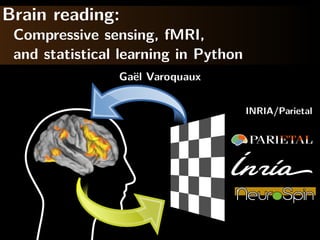
Brain reading:
 Compressive sensing, fMRI,
 and statistical learning in Python
                Ga¨l Varoquaux
                  e

                                      INRIA/Parietal
1 Brain reading: predictive models
   2 Sparse recovery with correlated de-
     signs
   3 Having an impact: software


G Varoquaux                                2
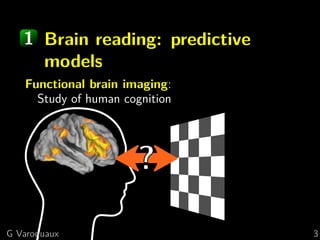
1 Brain reading: predictive
     models
   Functional brain imaging:
     Study of human cognition


G Varoquaux                      3
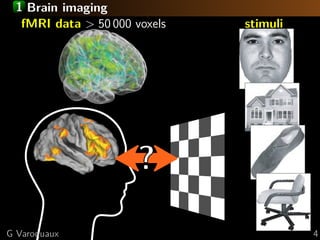
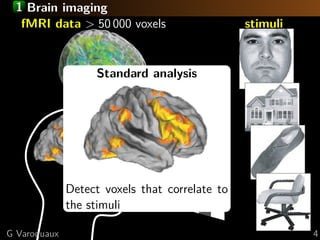
1 Brain imaging
  fMRI data > 50 000 voxels   stimuli


G Varoquaux                             4
1 Brain imaging
  fMRI data > 50 000 voxels                     stimuli


                   Standard analysis


              Detect voxels that correlate to
              the stimuli

G Varoquaux                                               4
1 Brain reading

  Predicting the object category viewed
   [Haxby 2001, Distributed and Overlapping
   Representations of Faces and Objects in Ventral
   Temporal Cortex ]
          Supervised learning task


G Varoquaux                                          5
1 Brain reading

  Predicting the object category viewed
   [Haxby 2001, Distributed and Overlapping
   Representations of Faces and Objects in Ventral
   Temporal Cortex ]combinations of voxels to
             Find
            predict the stimuli
          Supervised learning task


                Multi-variate statistics

G Varoquaux                                          5
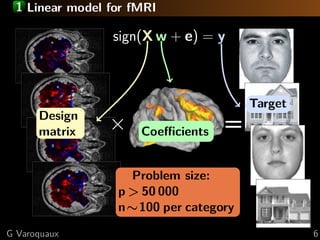
1 Linear model for fMRI

                sign(X w + e) = y


                                      Target
      Design
      matrix    ×    Coefficients   =

                   Problem size:
                 p > 50 000
                 n∼100 per category

G Varoquaux                                    6
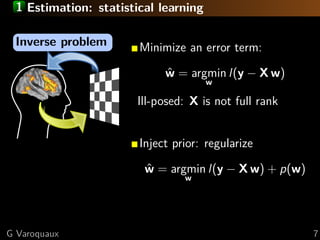
1 Estimation: statistical learning

 Inverse problem       Minimize an error term:

                            w = argmin l(y − X w)
                            ˆ
                                      w

                       Ill-posed: X is not full rank


                       Inject prior: regularize

                        w = argmin l(y − X w) + p(w)
                        ˆ
                                w


G Varoquaux                                            7
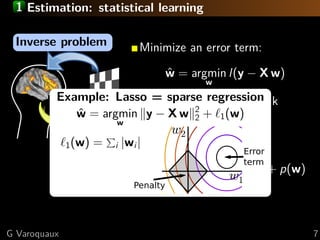
1 Estimation: statistical learning

 Inverse problem                  Minimize an error term:

                                       w = argmin l(y − X w)
                                       ˆ
                                                w
          Example: Lasso = sparseis not full rank
                       Ill-posed: X regression
             w = argmin y − X w 2 + 1 (w)
             ˆ                     2
                          w

              1 (w)   =   i   |wi |Inject prior: regularize

                                   w = argmin l(y − X w) + p(w)
                                   ˆ
                                            w


G Varoquaux                                                       7
1 TV-penalization to promote regions

                                                [Haxby 2001]
    Neuroscientists think in
    terms of brain regions


                           Total-variation penalization
                           Impose sparsity on the gradient
                           of the image:

                                  p(w) =   1(   w)

                                     [Michel TMI 2011]
G Varoquaux                                                    8
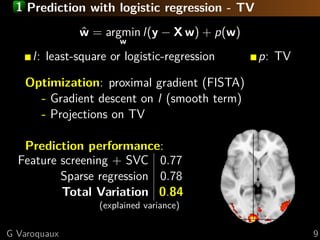
1 Prediction with logistic regression - TV
              w = argmin l(y − X w) + p(w)
              ˆ
                       w
     l: least-square or logistic-regression   p: TV

   Optimization: proximal gradient (FISTA)
     - Gradient descent on l (smooth term)
     - Projections on TV

   Prediction performance:
  Feature screening + SVC 0.77
          Sparse regression 0.78
          Total Variation 0.84
                  (explained variance)

G Varoquaux                                           9
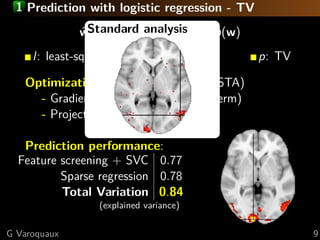
1 Prediction with logistic regression - TV
              wStandard l(y − X w) + p(w)
              ˆ = argmin analysis
                       w
     l: least-square or logistic-regression   p: TV

   Optimization: proximal gradient (FISTA)
     - Gradient descent on l (smooth term)
     - Projections on TV

   Prediction performance:
  Feature screening + SVC 0.77
          Sparse regression 0.78
          Total Variation 0.84
                  (explained variance)

G Varoquaux                                           9
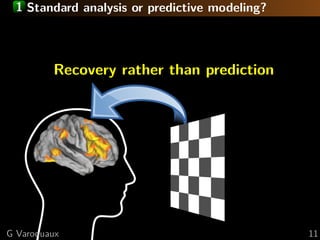
1 Standard analysis or predictive modeling?

  Predicting the object category viewed
   [Haxby 2001, Distributed and Overlapping
   Representations of Faces and Objects in Ventral
   Temporal Cortex ]
                                     Take home message:
                                 brain regions, not prediction


G Varoquaux                                                      10
1 Standard analysis or predictive modeling?


         Recovery rather than prediction


G Varoquaux                                    11
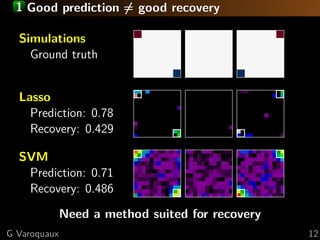
1 Good prediction = good recovery
                                   Ground truth
  Simulations
    Ground truth


  Lasso
    Prediction: 0.78
    Recovery: 0.429

  SVM
   Prediction: 0.71
   Recovery: 0.486

              Need a method suited for recovery
G Varoquaux                                       12
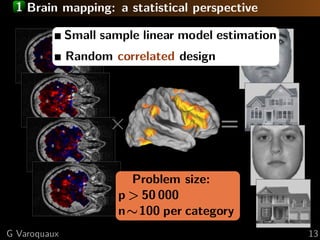
1 Brain mapping: a statistical perspective

              Small sample linear model estimation
              Random correlated design


                     ×                   =

                         Problem size:
                       p > 50 000
                       n∼100 per category
G Varoquaux                                          13
1 Brain mapping: a statistical perspective

               Small sample linear model estimation
               Random correlated design

    Estimation strategy
     Standard approach: univariate statistics
                         ×
     Multiple comparisons problem
                        ⇒ statistical power ∝ 1/p
                                                  =
      We want sub-linear sample complexity
         ⇒ non-rotationally-invariant estimators
                             e.g. 1 penalization
              [ Ng, 2004 Feature selection, 1 vs. 2 regularization,
                                         and rotational invariance ]
G Varoquaux                                                            13
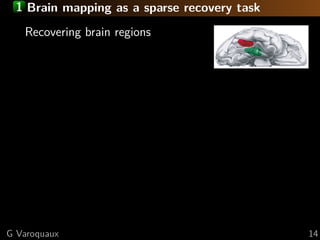
1 Brain mapping as a sparse recovery task
   Recovering brain regions


G Varoquaux                                  14
1 Brain mapping as a sparse recovery task
   Recovering k non-zero coefficients
     nmin ∼ 2 k log p
     Restricted-isometry-like property:
      The design matrix is well-conditioned       [Candes 2006]
      on sub-matrices of size > k                  [Tropp 2004]
                                              [Wainwright 2009]
     Mutual incoherence:
     Relevant features S and irrelevant
     ones S are not too correlated

   Violated by spatial
   correlations in our design

                                          lasso: 23 non-zeros
G Varoquaux                                                     14
1 Randomized sparsity
                  [Meinshausen and Buhlmann 2010, Bach 2008]
    Perturb the design matrix:
     Subsample the data
     Randomly rescale features
    + Run sparse estimator
    Keep features that are often selected
    ⇒ Good recovery without mutual incoherence
       But RIP-like condition

   Cannot recover large
       correlated groups
  For m correlated features,
  selection frequency divided by m
G Varoquaux                                                    15
2 Sparse recovery with
     correlated designs
     Not enough samples: nmin ∼ 2 k log p
     Spatial correlations


G Varoquaux                                 16
2 Sparse recovery with
     correlated designs
                    Combining

                      Clustering


                      Sparsity
                      [Varoquaux ICML 2012]

G Varoquaux                                   16
2 Brain parcellations
    Spatially-connected hierarchical clustering
    ⇒ reduces voxel numbers [Michel Pat Rec 2011]


    Replace features by corresponding cluster average
    + Use a supervised learner on reduced problem

       Cluster choice sub-optimal for regression
G Varoquaux                                             17
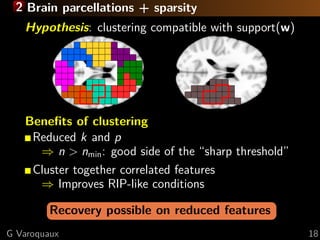
2 Brain parcellations + sparsity
   Hypothesis: clustering compatible with support(w)


   Benefits of clustering
    Reduced k and p
     ⇒ n > nmin : good side of the “sharp threshold”
    Cluster together correlated features
     ⇒ Improves RIP-like conditions

         Recovery possible on reduced features
G Varoquaux                                            18
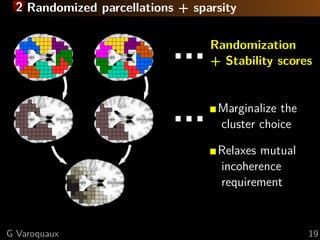
2 Randomized parcellations + sparsity

                                 Randomization
                                 + Stability scores


                                  Marginalize the
                                  cluster choice

                                  Relaxes mutual
                                  incoherence
                                  requirement


G Varoquaux                                         19
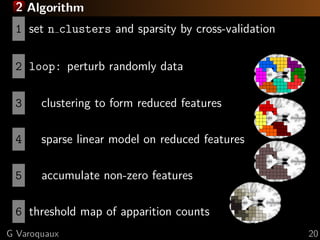
2 Algorithm
 1 set n clusters and sparsity by cross-validation

 2 loop: perturb randomly data

 3     clustering to form reduced features

 4     sparse linear model on reduced features

 5     accumulate non-zero features

 6 threshold map of apparition counts
G Varoquaux                                          20
2 Simulations
     p = 2048, k = 64, n = 256          (nmin > 1000)
     Weights w: patches of varying size
     Design matrix: 2D Gaussian random images of
                    varying smoothness
   Estimators
    Randomized lasso              Our approach
    Elastic Net                   Univariate F test
              Parameters set by cross-validation

   Performance metric
    Recovery seen as a 2-class problem
     ⇒ Report AUC of the precision-recall curve

G Varoquaux                                             21
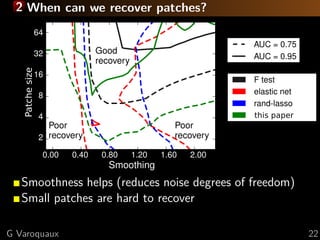
2 When can we recover patches?


   Smoothness helps (reduces noise degrees of freedom)
   Small patches are hard to recover

G Varoquaux                                              22
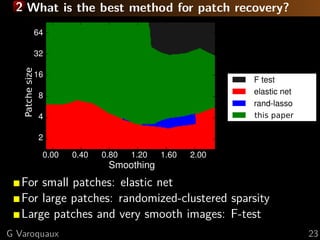
2 What is the best method for patch recovery?


   For small patches: elastic net
   For large patches: randomized-clustered sparsity
   Large patches and very smooth images: F-test
G Varoquaux                                           23
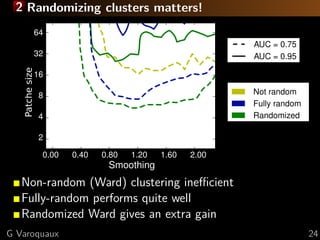
2 Randomizing clusters matters!


   Non-random (Ward) clustering inefficient
   Fully-random performs quite well
   Randomized Ward gives an extra gain
G Varoquaux                                 24
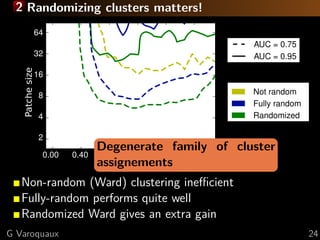
2 Randomizing clusters matters!


                Degenerate family of cluster
                assignements
   Non-random (Ward) clustering inefficient
   Fully-random performs quite well
   Randomized Ward gives an extra gain
G Varoquaux                                    24
2 fMRI: face vs house discrimination   [Haxby 2001]
        F-scores
                                             L              R
  L                R


y=-31                  x=17
                                        z=-17


  G Varoquaux                                               25
2 fMRI: face vs house discrimination   [Haxby 2001]

        1   Logistic
                                             L              R
  L                    R


y=-31                      x=17
                                        z=-17


  G Varoquaux                                               25
2 fMRI: face vs house discrimination   [Haxby 2001]
        Randomized   1   Logistic
                                             L              R
  L              R


y=-31                x=17
                                        z=-17


  G Varoquaux                                               25
2 fMRI: face vs house discrimination       [Haxby 2001]
        Randomized Clustered   1   Logistic
                                                L               R
  L              R


y=-31                x=17
                                              z=-17


  G Varoquaux                                                   25
2 fMRI: face vs house discrimination   [Haxby 2001]
        F-scores
                                             L              R
  L                R


y=-31                  x=17
                                        z=-17


  G Varoquaux                                               25
2 Predictive model on selected features
   Object recognition [Haxby 2001]


    Using recovered features improves prediction
G Varoquaux                                        26
Small-sample brain mapping
              Sparse recovery of patches on
              spatially-correlated designs

   Ingredients: Clustering + Randomization
    ⇒ Reduced feature set compatible with recovery:
        matches sparsity pattern + recovery conditions

           Compressive sensing questions
     Can we recover k > n, in the case of large patches?
     When do we loose sub-linear sample-complexity?


G Varoquaux                                                27
3 Having an impact: software
              How to we reach our target
              audience (neuroscientists)?

              How do we disseminate our ideas?

              How do we facilitate new ideas?


G Varoquaux                                      28
3 Python as a scientific environment

     General purpose

     Easy, readable syntax

     Interactive (ipython)

     Great scientific libraries (numpy, scipy, matplotlib...)


G Varoquaux                                                    29
3 Growing a software stack


     Code lines are costly

    ⇒ Open source + community driven

      Need quality and impact

       ⇒ Focus on the general purpose libraries first

       Scikit-learn: machine learning in Python
               http://scikit-learn.org


G Varoquaux                                            30
3 scikit-learn: machine learning in Python
Technical choices
 Prefer Python or Cython, focus on readability
  Documentation and examples are paramount
  Little object-oriented design. Opt for simplicity
  Prefer algorithms to framework
  Code quality: consistency and testing


G Varoquaux                                           31
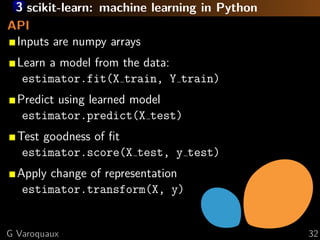
3 scikit-learn: machine learning in Python
API
 Inputs are numpy arrays
  Learn a model from the data:
   estimator.fit(X train, Y train)
  Predict using learned model
   estimator.predict(X test)
  Test goodness of fit
   estimator.score(X test, y test)
  Apply change of representation
   estimator.transform(X, y)


G Varoquaux                                   32
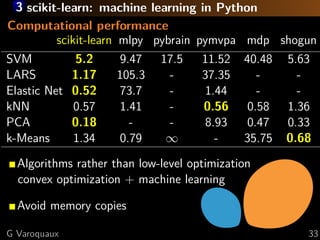
3 scikit-learn: machine learning in Python
Computational performance
          scikit-learn mlpy pybrain pymvpa mdp shogun
SVM           5.2       9.47 17.5    11.52 40.48 5.63
LARS         1.17      105.3   -     37.35    -    -
Elastic Net 0.52        73.7   -      1.44    -    -
kNN           0.57      1.41   -     0.56 0.58 1.36
PCA          0.18         -    -      8.93  0.47 0.33
k-Means       1.34      0.79  ∞         -  35.75 0.68
  Algorithms rather than low-level optimization
  convex optimization + machine learning

  Avoid memory copies

G Varoquaux                                        33
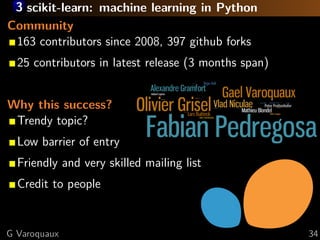
3 scikit-learn: machine learning in Python
Community
 163 contributors since 2008, 397 github forks
  25 contributors in latest release (3 months span)


Why this success?
 Trendy topic?
  Low barrier of entry
  Friendly and very skilled mailing list
  Credit to people


G Varoquaux                                           34
3 Research code = software library
              Factor 10 in time investment

     Corner cases in algorithm (numerical stability)

     Multiple platforms and library versions (Blas     )

     Documentation

     Making it simpler (and get less educated users)

     User and developer support ( ∼ 100 mails/day)

                                        Exhausting,
              but has impact on science and society
G Varoquaux                                                35
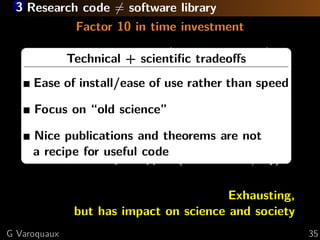
3 Research code = software library
              Factor 10 in time investment

     CornerTechnical + scientific tradeoffs
            cases in algorithm (numerical stability)

     Multiple platforms andof use rather than speed
     Ease of install/ease library versions (Blas )
     Documentation science”
     Focus on “old
     Making it simpler (and get less educatednot
     Nice publications and theorems are users)
     a recipe for useful code
     User and developer support ( ∼ 100 mails/day)

                                        Exhausting,
              but has impact on science and society
G Varoquaux                                            35
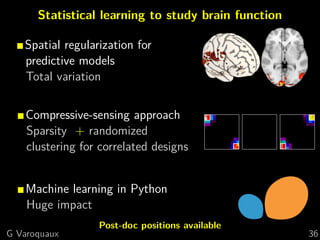
Statistical learning to study brain function

   Spatial regularization for
   predictive models
   Total variation


    Compressive-sensing approach
    Sparsity + randomized
    clustering for correlated designs


    Machine learning in Python
    Huge impact
                  Post-doc positions available
G Varoquaux                                          36
Bibliography
[Michel TMI 2011] V. Michel, et al., Total variation regularization for
fMRI-based prediction of behaviour, IEEE Transactions in medical
imaging (2011)
http://hal.inria.fr/inria-00563468/en
[Varoquaux ICML 2012] G. Varoquaux, A. Gramfort, B. Thirion
Small-sample brain mapping: sparse recovery on spatially correlated
designs with randomization and clustering, ICML (2012)
http://hal.inria.fr/hal-00705192/en
[Michel Pat Rec 2011] V. Michel, et al., A supervised clustering approach
for fMRI-based inference of brain states, Pattern Recognition (2011)
http://hal.inria.fr/inria-00589201/en
[Pedregosa ICML 2011] F. Pedregosa, el al., Scikit-learn: machine
learning in Python, JMRL (2011)
http://hal.inria.fr/hal-00650905/en


G Varoquaux                                                                 37

Brain reading, compressive sensing, fMRI and statistical learning in Python

  • 1.
    Brain reading: Compressivesensing, fMRI, and statistical learning in Python Ga¨l Varoquaux e INRIA/Parietal
  • 2.
    1 Brain reading:predictive models 2 Sparse recovery with correlated de- signs 3 Having an impact: software G Varoquaux 2
  • 3.
    1 Brain reading:predictive models Functional brain imaging: Study of human cognition G Varoquaux 3
  • 4.
    1 Brain imaging fMRI data > 50 000 voxels stimuli G Varoquaux 4
  • 5.
    1 Brain imaging fMRI data > 50 000 voxels stimuli Standard analysis Detect voxels that correlate to the stimuli G Varoquaux 4
  • 6.
    1 Brain reading Predicting the object category viewed [Haxby 2001, Distributed and Overlapping Representations of Faces and Objects in Ventral Temporal Cortex ] Supervised learning task G Varoquaux 5
  • 7.
    1 Brain reading Predicting the object category viewed [Haxby 2001, Distributed and Overlapping Representations of Faces and Objects in Ventral Temporal Cortex ]combinations of voxels to Find predict the stimuli Supervised learning task Multi-variate statistics G Varoquaux 5
  • 8.
    1 Linear modelfor fMRI sign(X w + e) = y Target Design matrix × Coefficients = Problem size: p > 50 000 n∼100 per category G Varoquaux 6
  • 9.
    1 Estimation: statisticallearning Inverse problem Minimize an error term: w = argmin l(y − X w) ˆ w Ill-posed: X is not full rank Inject prior: regularize w = argmin l(y − X w) + p(w) ˆ w G Varoquaux 7
  • 10.
    1 Estimation: statisticallearning Inverse problem Minimize an error term: w = argmin l(y − X w) ˆ w Example: Lasso = sparseis not full rank Ill-posed: X regression w = argmin y − X w 2 + 1 (w) ˆ 2 w 1 (w) = i |wi |Inject prior: regularize w = argmin l(y − X w) + p(w) ˆ w G Varoquaux 7
  • 11.
    1 TV-penalization topromote regions [Haxby 2001] Neuroscientists think in terms of brain regions Total-variation penalization Impose sparsity on the gradient of the image: p(w) = 1( w) [Michel TMI 2011] G Varoquaux 8
  • 12.
    1 Prediction withlogistic regression - TV w = argmin l(y − X w) + p(w) ˆ w l: least-square or logistic-regression p: TV Optimization: proximal gradient (FISTA) - Gradient descent on l (smooth term) - Projections on TV Prediction performance: Feature screening + SVC 0.77 Sparse regression 0.78 Total Variation 0.84 (explained variance) G Varoquaux 9
  • 13.
    1 Prediction withlogistic regression - TV wStandard l(y − X w) + p(w) ˆ = argmin analysis w l: least-square or logistic-regression p: TV Optimization: proximal gradient (FISTA) - Gradient descent on l (smooth term) - Projections on TV Prediction performance: Feature screening + SVC 0.77 Sparse regression 0.78 Total Variation 0.84 (explained variance) G Varoquaux 9
  • 14.
    1 Standard analysisor predictive modeling? Predicting the object category viewed [Haxby 2001, Distributed and Overlapping Representations of Faces and Objects in Ventral Temporal Cortex ] Take home message: brain regions, not prediction G Varoquaux 10
  • 15.
    1 Standard analysisor predictive modeling? Recovery rather than prediction G Varoquaux 11
  • 16.
    1 Good prediction= good recovery Ground truth Simulations Ground truth Lasso Prediction: 0.78 Recovery: 0.429 SVM Prediction: 0.71 Recovery: 0.486 Need a method suited for recovery G Varoquaux 12
  • 17.
    1 Brain mapping:a statistical perspective Small sample linear model estimation Random correlated design × = Problem size: p > 50 000 n∼100 per category G Varoquaux 13
  • 18.
    1 Brain mapping:a statistical perspective Small sample linear model estimation Random correlated design Estimation strategy Standard approach: univariate statistics × Multiple comparisons problem ⇒ statistical power ∝ 1/p = We want sub-linear sample complexity ⇒ non-rotationally-invariant estimators e.g. 1 penalization [ Ng, 2004 Feature selection, 1 vs. 2 regularization, and rotational invariance ] G Varoquaux 13
  • 19.
    1 Brain mappingas a sparse recovery task Recovering brain regions G Varoquaux 14
  • 20.
    1 Brain mappingas a sparse recovery task Recovering k non-zero coefficients nmin ∼ 2 k log p Restricted-isometry-like property: The design matrix is well-conditioned [Candes 2006] on sub-matrices of size > k [Tropp 2004] [Wainwright 2009] Mutual incoherence: Relevant features S and irrelevant ones S are not too correlated Violated by spatial correlations in our design lasso: 23 non-zeros G Varoquaux 14
  • 21.
    1 Randomized sparsity [Meinshausen and Buhlmann 2010, Bach 2008] Perturb the design matrix: Subsample the data Randomly rescale features + Run sparse estimator Keep features that are often selected ⇒ Good recovery without mutual incoherence But RIP-like condition Cannot recover large correlated groups For m correlated features, selection frequency divided by m G Varoquaux 15
  • 22.
    2 Sparse recoverywith correlated designs Not enough samples: nmin ∼ 2 k log p Spatial correlations G Varoquaux 16
  • 23.
    2 Sparse recoverywith correlated designs Combining Clustering Sparsity [Varoquaux ICML 2012] G Varoquaux 16
  • 24.
    2 Brain parcellations Spatially-connected hierarchical clustering ⇒ reduces voxel numbers [Michel Pat Rec 2011] Replace features by corresponding cluster average + Use a supervised learner on reduced problem Cluster choice sub-optimal for regression G Varoquaux 17
  • 25.
    2 Brain parcellations+ sparsity Hypothesis: clustering compatible with support(w) Benefits of clustering Reduced k and p ⇒ n > nmin : good side of the “sharp threshold” Cluster together correlated features ⇒ Improves RIP-like conditions Recovery possible on reduced features G Varoquaux 18
  • 26.
    2 Randomized parcellations+ sparsity Randomization + Stability scores Marginalize the cluster choice Relaxes mutual incoherence requirement G Varoquaux 19
  • 27.
    2 Algorithm 1set n clusters and sparsity by cross-validation 2 loop: perturb randomly data 3 clustering to form reduced features 4 sparse linear model on reduced features 5 accumulate non-zero features 6 threshold map of apparition counts G Varoquaux 20
  • 28.
    2 Simulations p = 2048, k = 64, n = 256 (nmin > 1000) Weights w: patches of varying size Design matrix: 2D Gaussian random images of varying smoothness Estimators Randomized lasso Our approach Elastic Net Univariate F test Parameters set by cross-validation Performance metric Recovery seen as a 2-class problem ⇒ Report AUC of the precision-recall curve G Varoquaux 21
  • 29.
    2 When canwe recover patches? Smoothness helps (reduces noise degrees of freedom) Small patches are hard to recover G Varoquaux 22
  • 30.
    2 What isthe best method for patch recovery? For small patches: elastic net For large patches: randomized-clustered sparsity Large patches and very smooth images: F-test G Varoquaux 23
  • 31.
    2 Randomizing clustersmatters! Non-random (Ward) clustering inefficient Fully-random performs quite well Randomized Ward gives an extra gain G Varoquaux 24
  • 32.
    2 Randomizing clustersmatters! Degenerate family of cluster assignements Non-random (Ward) clustering inefficient Fully-random performs quite well Randomized Ward gives an extra gain G Varoquaux 24
  • 33.
    2 fMRI: facevs house discrimination [Haxby 2001] F-scores L R L R y=-31 x=17 z=-17 G Varoquaux 25
  • 34.
    2 fMRI: facevs house discrimination [Haxby 2001] 1 Logistic L R L R y=-31 x=17 z=-17 G Varoquaux 25
  • 35.
    2 fMRI: facevs house discrimination [Haxby 2001] Randomized 1 Logistic L R L R y=-31 x=17 z=-17 G Varoquaux 25
  • 36.
    2 fMRI: facevs house discrimination [Haxby 2001] Randomized Clustered 1 Logistic L R L R y=-31 x=17 z=-17 G Varoquaux 25
  • 37.
    2 fMRI: facevs house discrimination [Haxby 2001] F-scores L R L R y=-31 x=17 z=-17 G Varoquaux 25
  • 38.
    2 Predictive modelon selected features Object recognition [Haxby 2001] Using recovered features improves prediction G Varoquaux 26
  • 39.
    Small-sample brain mapping Sparse recovery of patches on spatially-correlated designs Ingredients: Clustering + Randomization ⇒ Reduced feature set compatible with recovery: matches sparsity pattern + recovery conditions Compressive sensing questions Can we recover k > n, in the case of large patches? When do we loose sub-linear sample-complexity? G Varoquaux 27
  • 40.
    3 Having animpact: software How to we reach our target audience (neuroscientists)? How do we disseminate our ideas? How do we facilitate new ideas? G Varoquaux 28
  • 41.
    3 Python asa scientific environment General purpose Easy, readable syntax Interactive (ipython) Great scientific libraries (numpy, scipy, matplotlib...) G Varoquaux 29
  • 42.
    3 Growing asoftware stack Code lines are costly ⇒ Open source + community driven Need quality and impact ⇒ Focus on the general purpose libraries first Scikit-learn: machine learning in Python http://scikit-learn.org G Varoquaux 30
  • 43.
    3 scikit-learn: machinelearning in Python Technical choices Prefer Python or Cython, focus on readability Documentation and examples are paramount Little object-oriented design. Opt for simplicity Prefer algorithms to framework Code quality: consistency and testing G Varoquaux 31
  • 44.
    3 scikit-learn: machinelearning in Python API Inputs are numpy arrays Learn a model from the data: estimator.fit(X train, Y train) Predict using learned model estimator.predict(X test) Test goodness of fit estimator.score(X test, y test) Apply change of representation estimator.transform(X, y) G Varoquaux 32
  • 45.
    3 scikit-learn: machinelearning in Python Computational performance scikit-learn mlpy pybrain pymvpa mdp shogun SVM 5.2 9.47 17.5 11.52 40.48 5.63 LARS 1.17 105.3 - 37.35 - - Elastic Net 0.52 73.7 - 1.44 - - kNN 0.57 1.41 - 0.56 0.58 1.36 PCA 0.18 - - 8.93 0.47 0.33 k-Means 1.34 0.79 ∞ - 35.75 0.68 Algorithms rather than low-level optimization convex optimization + machine learning Avoid memory copies G Varoquaux 33
  • 46.
    3 scikit-learn: machinelearning in Python Community 163 contributors since 2008, 397 github forks 25 contributors in latest release (3 months span) Why this success? Trendy topic? Low barrier of entry Friendly and very skilled mailing list Credit to people G Varoquaux 34
  • 47.
    3 Research code= software library Factor 10 in time investment Corner cases in algorithm (numerical stability) Multiple platforms and library versions (Blas ) Documentation Making it simpler (and get less educated users) User and developer support ( ∼ 100 mails/day) Exhausting, but has impact on science and society G Varoquaux 35
  • 48.
    3 Research code= software library Factor 10 in time investment CornerTechnical + scientific tradeoffs cases in algorithm (numerical stability) Multiple platforms andof use rather than speed Ease of install/ease library versions (Blas ) Documentation science” Focus on “old Making it simpler (and get less educatednot Nice publications and theorems are users) a recipe for useful code User and developer support ( ∼ 100 mails/day) Exhausting, but has impact on science and society G Varoquaux 35
  • 49.
    Statistical learning tostudy brain function Spatial regularization for predictive models Total variation Compressive-sensing approach Sparsity + randomized clustering for correlated designs Machine learning in Python Huge impact Post-doc positions available G Varoquaux 36
  • 50.
    Bibliography [Michel TMI 2011]V. Michel, et al., Total variation regularization for fMRI-based prediction of behaviour, IEEE Transactions in medical imaging (2011) http://hal.inria.fr/inria-00563468/en [Varoquaux ICML 2012] G. Varoquaux, A. Gramfort, B. Thirion Small-sample brain mapping: sparse recovery on spatially correlated designs with randomization and clustering, ICML (2012) http://hal.inria.fr/hal-00705192/en [Michel Pat Rec 2011] V. Michel, et al., A supervised clustering approach for fMRI-based inference of brain states, Pattern Recognition (2011) http://hal.inria.fr/inria-00589201/en [Pedregosa ICML 2011] F. Pedregosa, el al., Scikit-learn: machine learning in Python, JMRL (2011) http://hal.inria.fr/hal-00650905/en G Varoquaux 37