



A Frequency-based RF Partial 
Discharge Detector for Low-power 
Wireless Sensing
index 
 INTRODUCTION 
 Rf pd monitoring 
 PD frequency characteristics 
 Wireless sensor network 
 Detector requirement 
 DETECTOR OVERVIEW 
 OUTPUT DATA 
 Laboratory case study 
 CONCLUSION 
 Reference
INTRODUCTION 
PARTIAL DISCHARGE 
“Partial discharge is a localized dielectric break down 
of a solid or fluid electrical insulation system under 
high voltage stress” 
 Degradation in dielectric insulation during 
operational life time or manufacturing time 
 Leads to internal arcing 
NEED FOR DETECTION 
• To avoid equipment failure 
• Ensure equipment uptime 
• Mitigate business risk
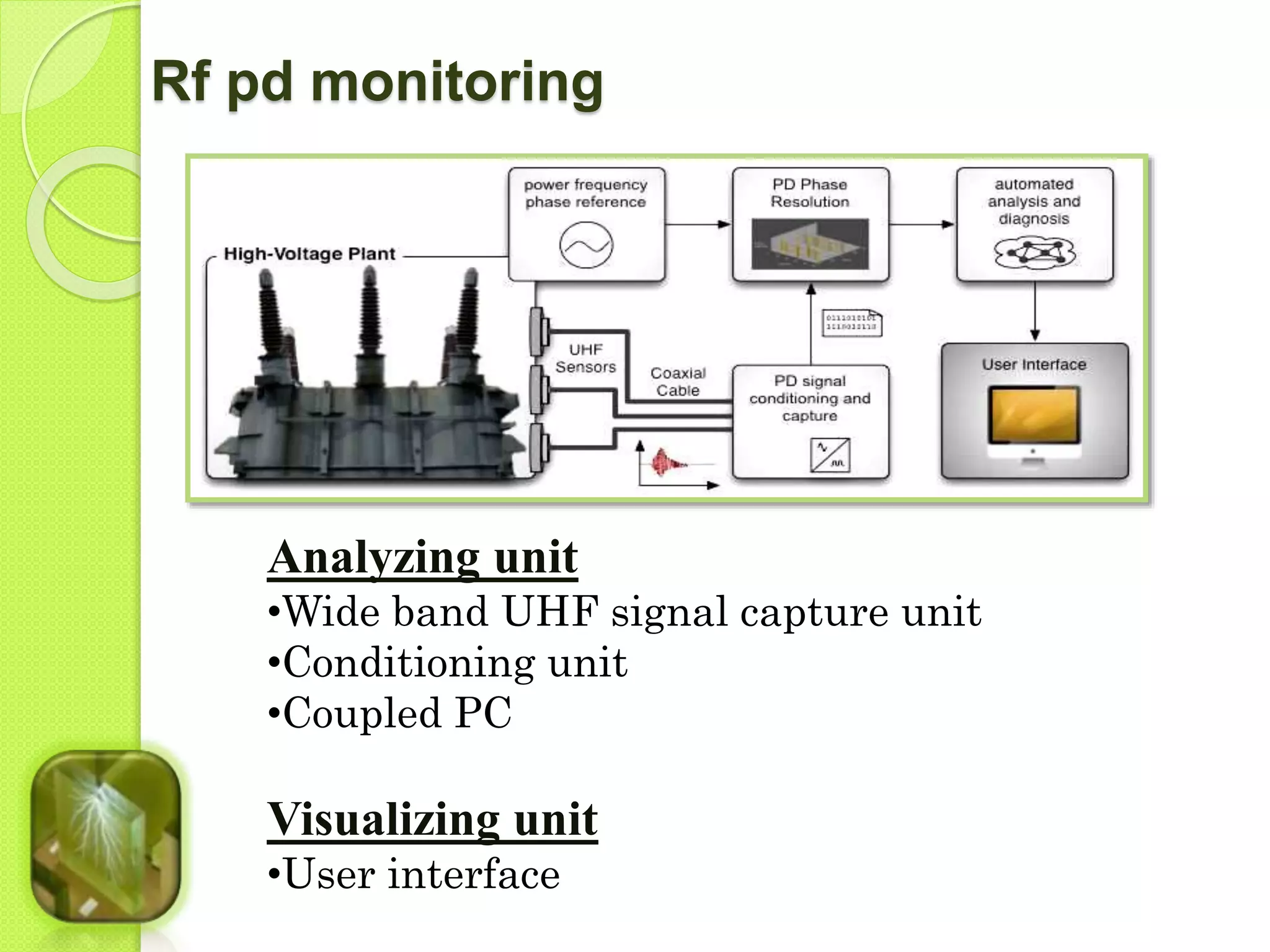
Rf pd monitoring 
Analyzing unit 
•Wide band UHF signal capture unit 
•Conditioning unit 
•Coupled PC 
Visualizing unit 
•User interface
Advantages 
• Effective & accurate tool. 
•GIS & oil filled transformer. 
Disadvantages 
•It requires a large processing capability 
to capture UHF signals 
•Not viable to install in all high voltage plants
PD frequency characteristics 
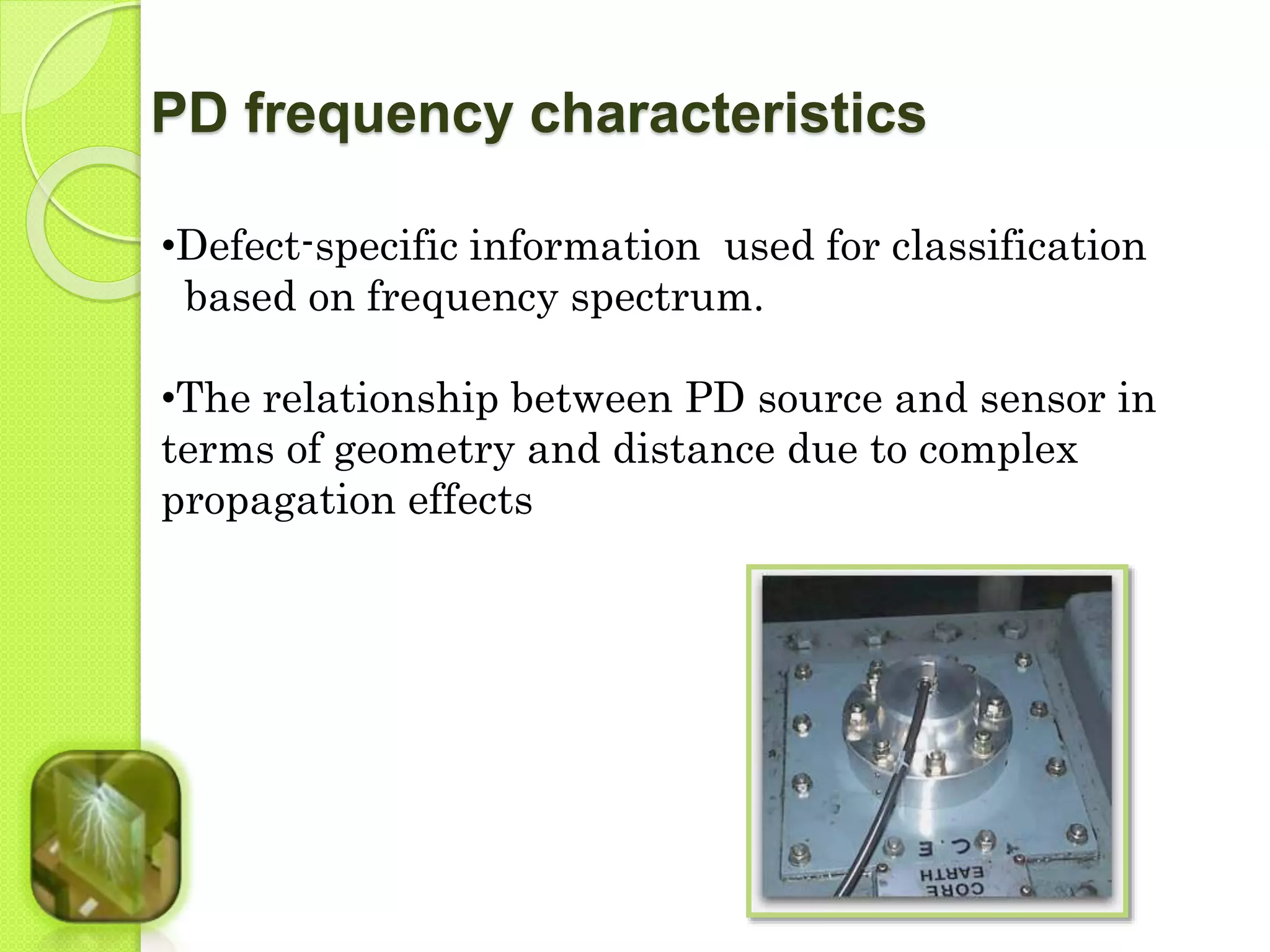
•Defect-specific information used for classification 
based on frequency spectrum. 
•The relationship between PD source and sensor in 
terms of geometry and distance due to complex 
propagation effects
Wireless sensor network 
 wide-range of monitoring applications. 
 Ad-hoc network with redundant links. 
 Sensory data is passed back through data 
aggregation nodes to a wired network 
 Data is presented to monitoring engineers. 
 Integrated computing platform; 
 Encapsulating sensing, processing, data storage, 
communications & power components in a single 
compact Package.
Advantages 
 Low cost 
 Absence of potentially hazardous cabling 
 Reduced bandwidth requirements 
 High capacity communication links b/w 
substations &corporate networks. 
Disadvantages 
 Degrading effect of Impulsive noise emitted by 
PDs on wireless data channels.
Detector requirement 
Functional requirements 
 Sensing & recording 
intensity of PD signals & relative spectral magnitudes 
 Differentiation of PD from RF noise 
 Relatively small 
 Interface with RF sensors ( plant enclosures) 
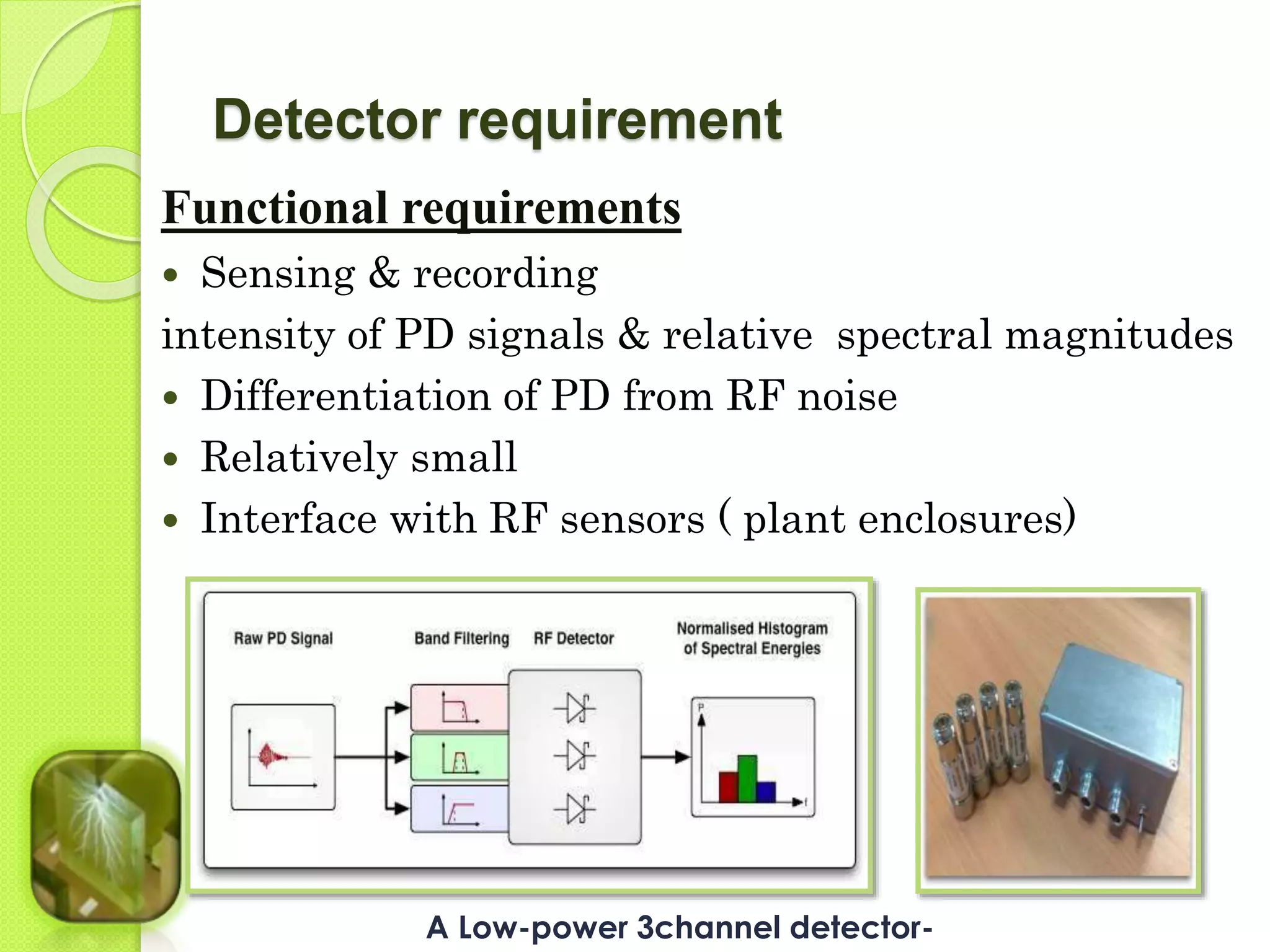
A Low-power 3channel detector-
DETECTOR OVERVIEW 
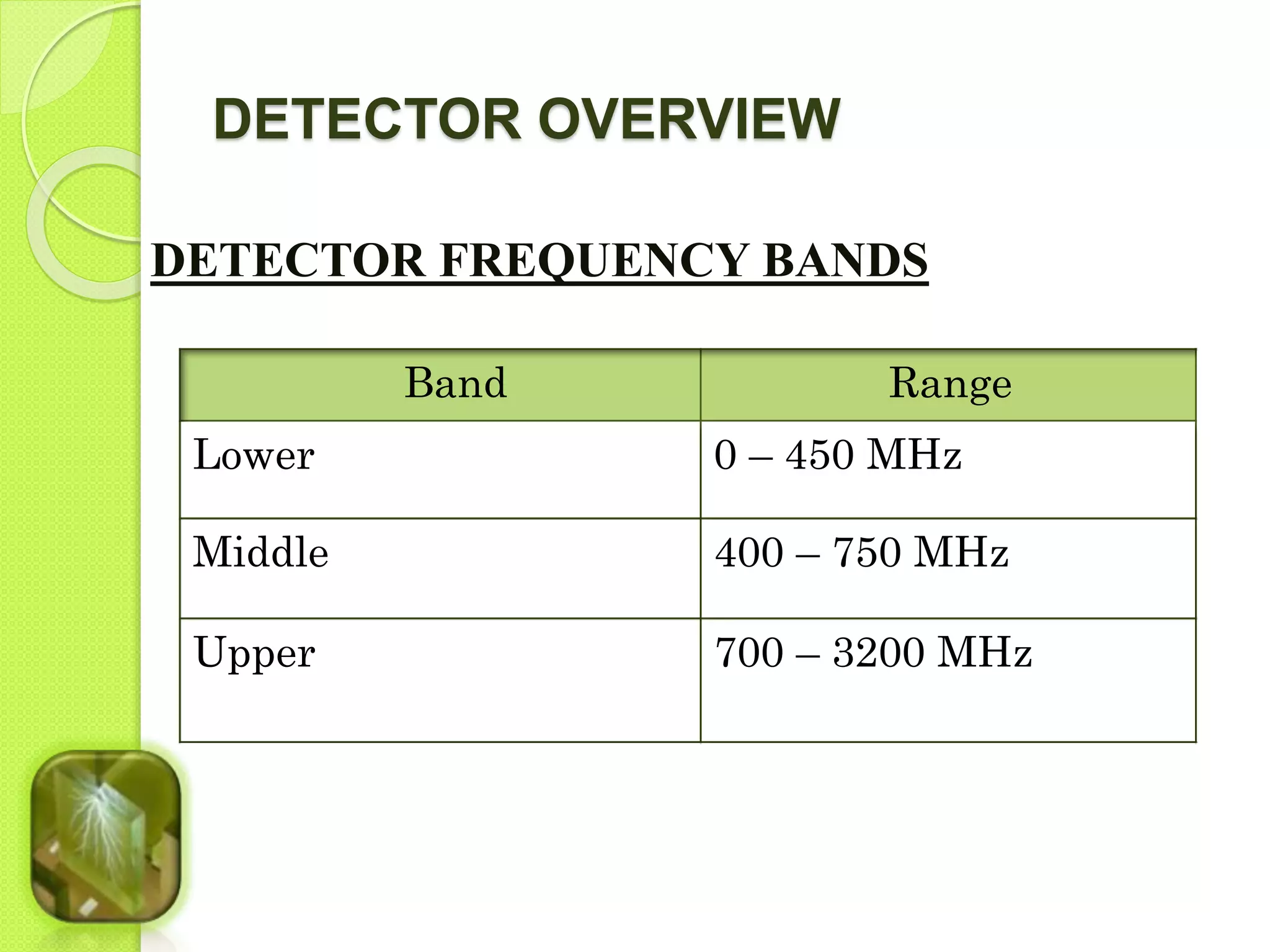
DETECTOR FREQUENCY BANDS 
Band Range 
Lower 0 – 450 MHz 
Middle 400 – 750 MHz 
Upper 700 – 3200 MHz
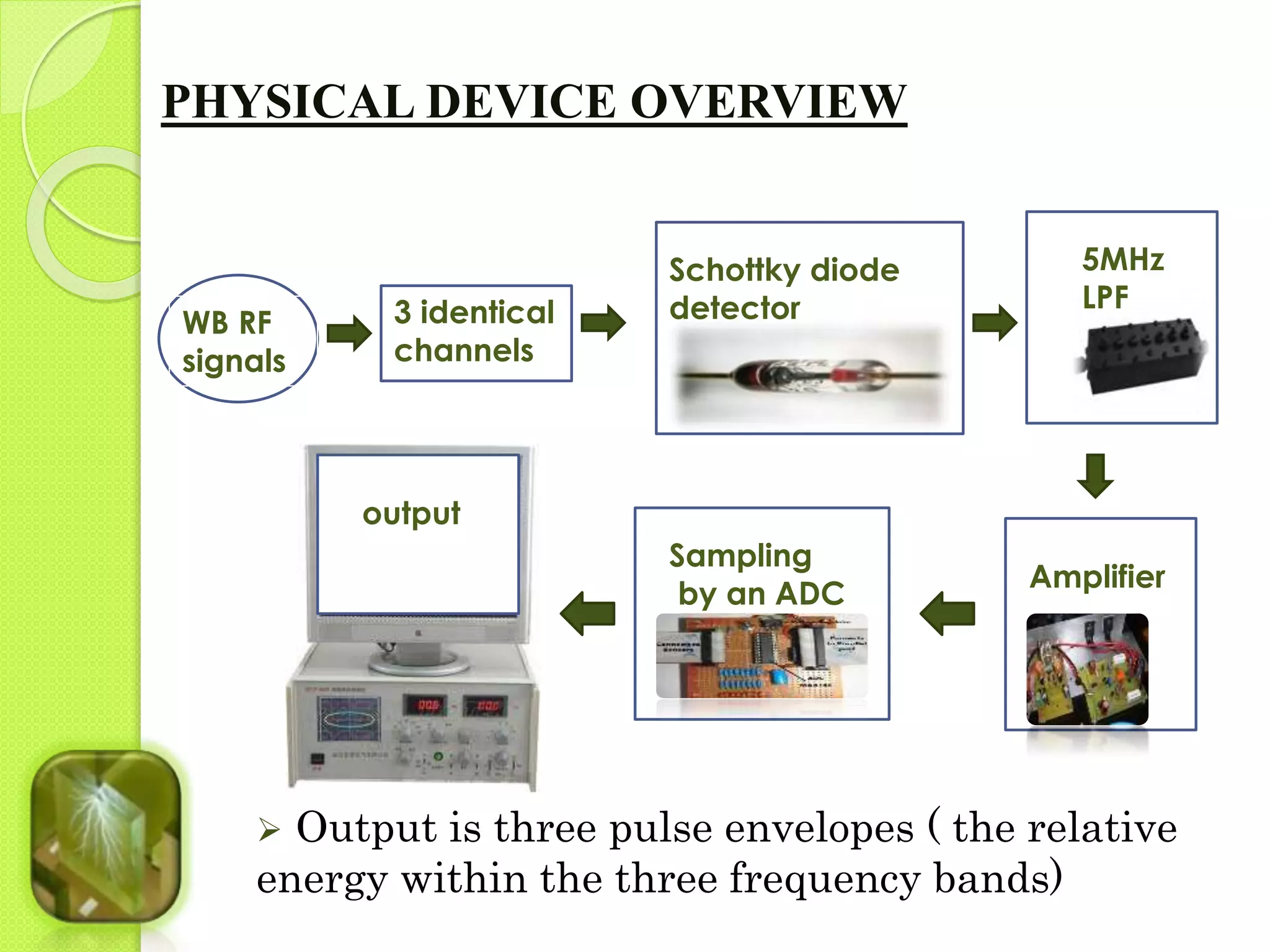
3 identical 
channels 
Schottky diode 
detector 
5MHz 
LPF 
Amplifier 
PHYSICAL DEVICE OVERVIEW 
Sampling 
by an ADC 
output 
WB RF 
signals 
 Output is three pulse envelopes ( the relative 
energy within the three frequency bands)
OUTPUT DATA 
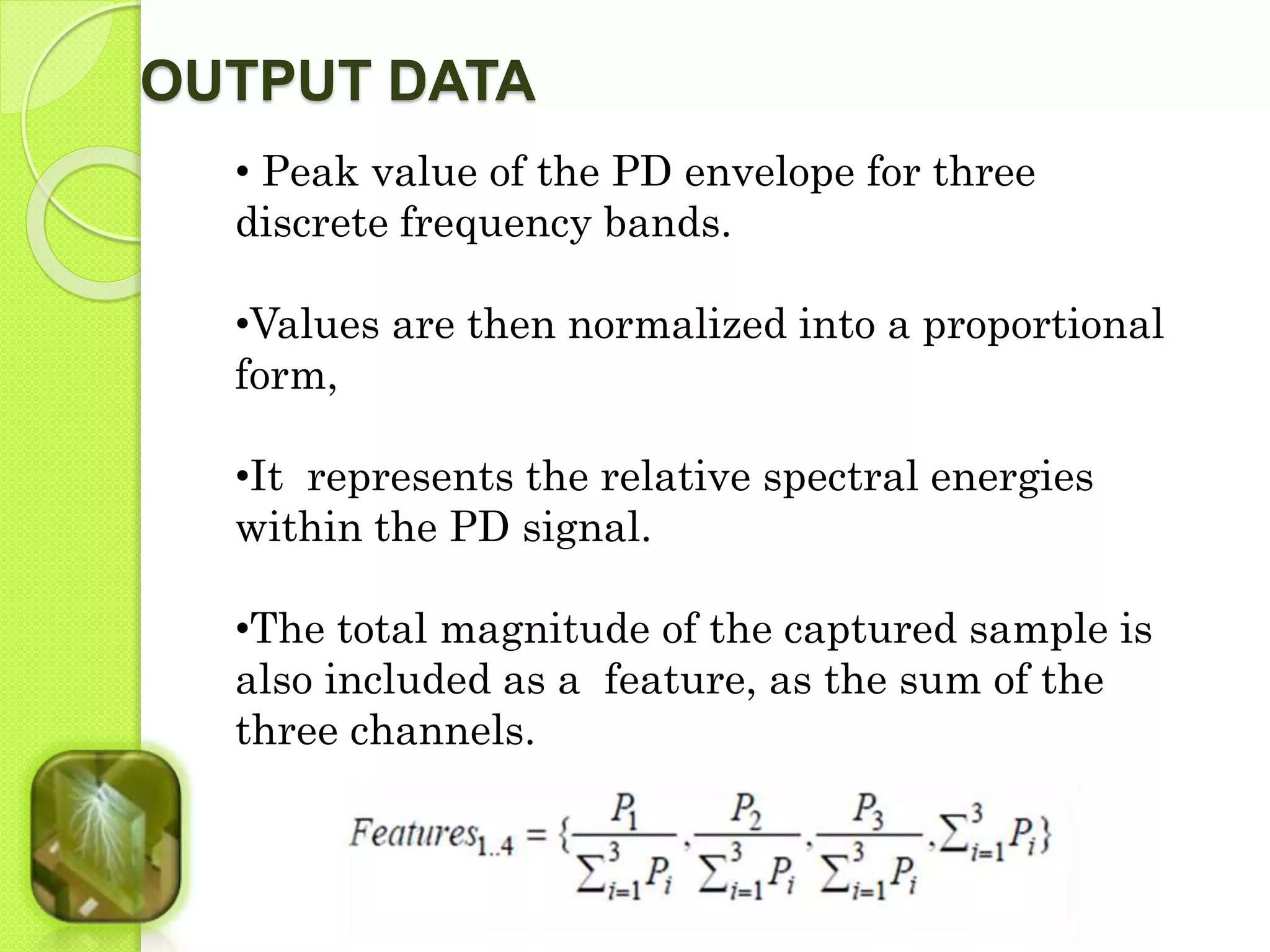
• Peak value of the PD envelope for three 
discrete frequency bands. 
•Values are then normalized into a proportional 
form, 
•It represents the relative spectral energies 
within the PD signal. 
•The total magnitude of the captured sample is 
also included as a feature, as the sum of the 
three channels.
Laboratory case study 
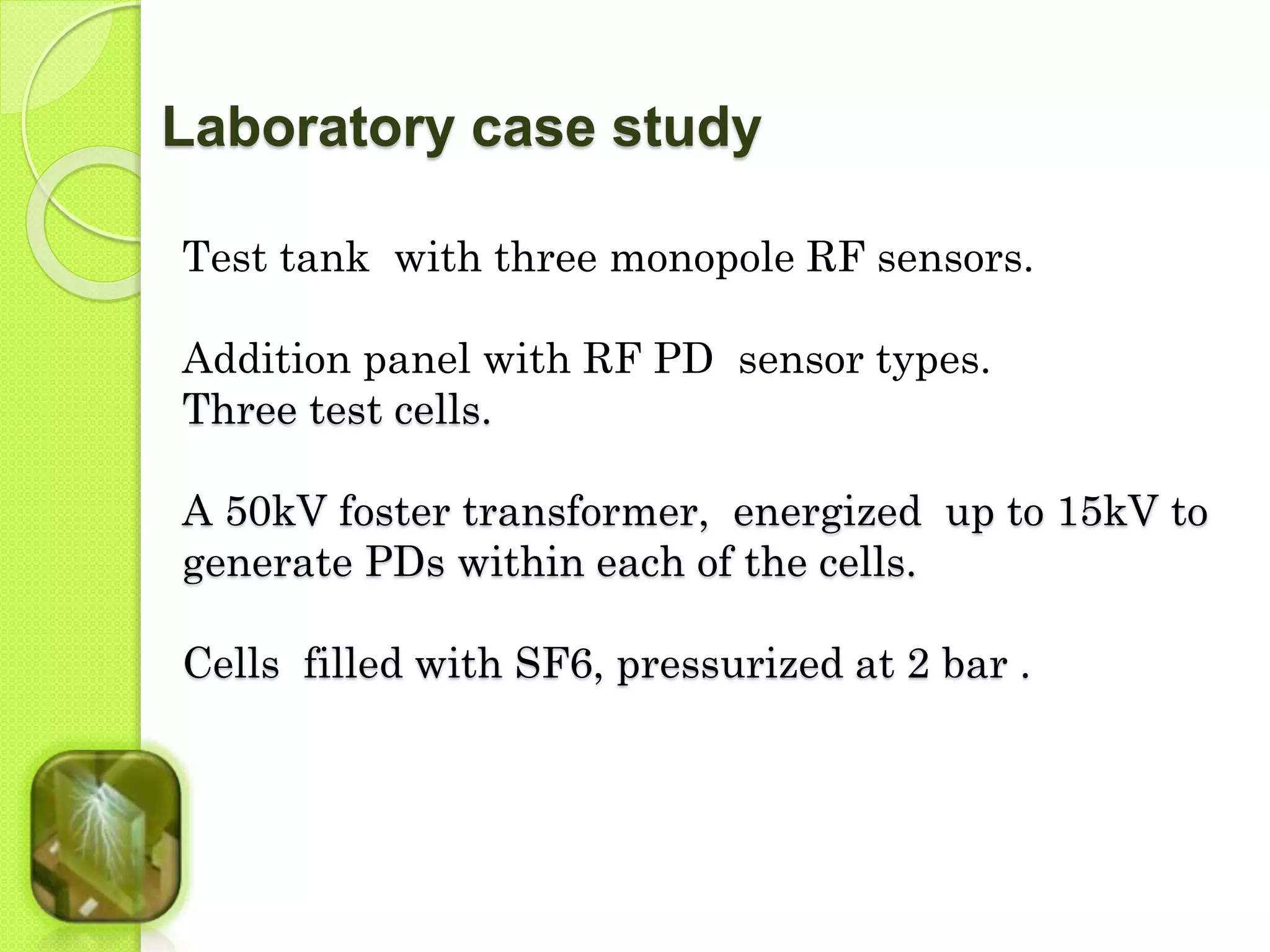
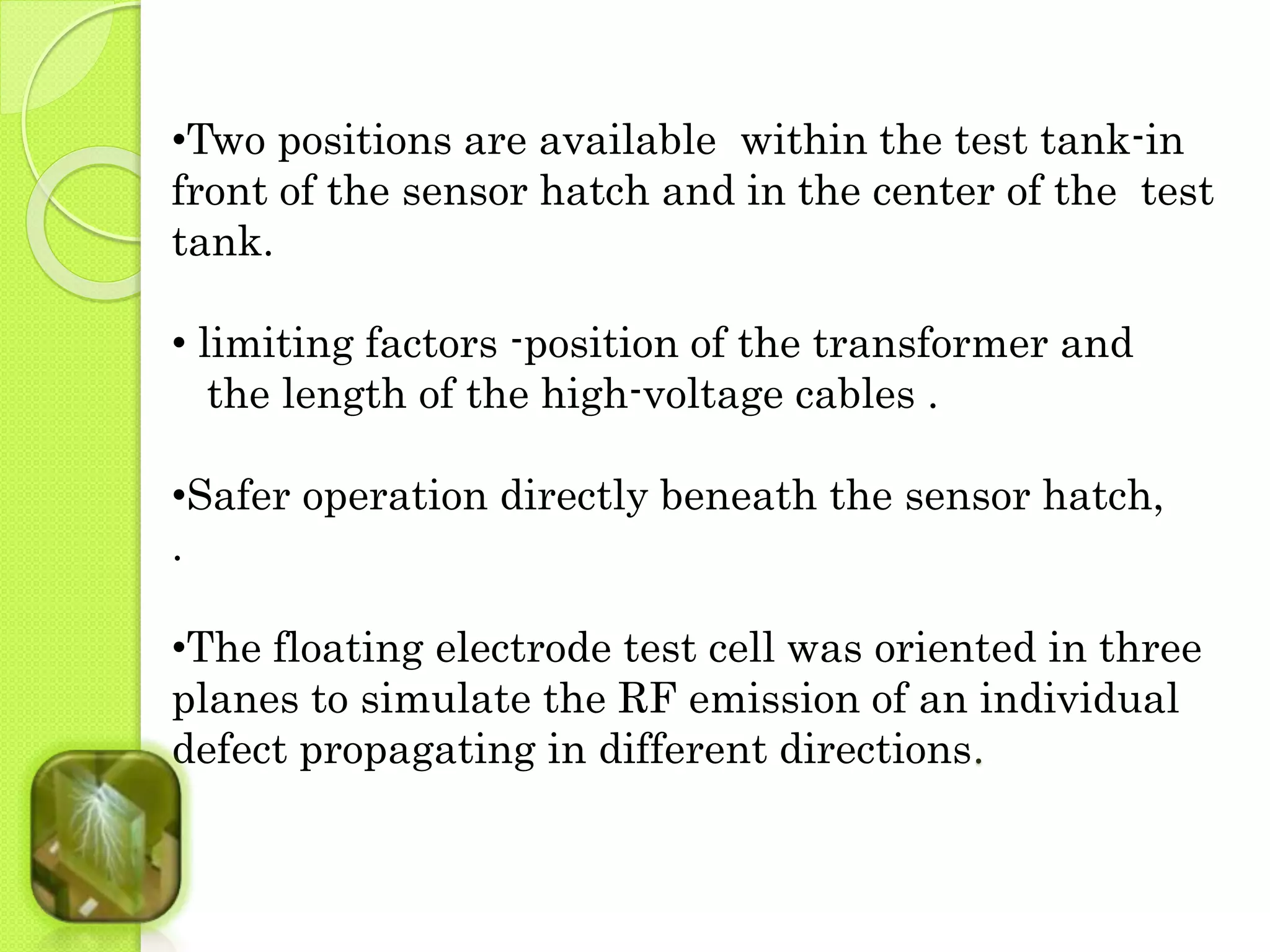
Test tank with three monopole RF sensors. 
Addition panel with RF PD sensor types. 
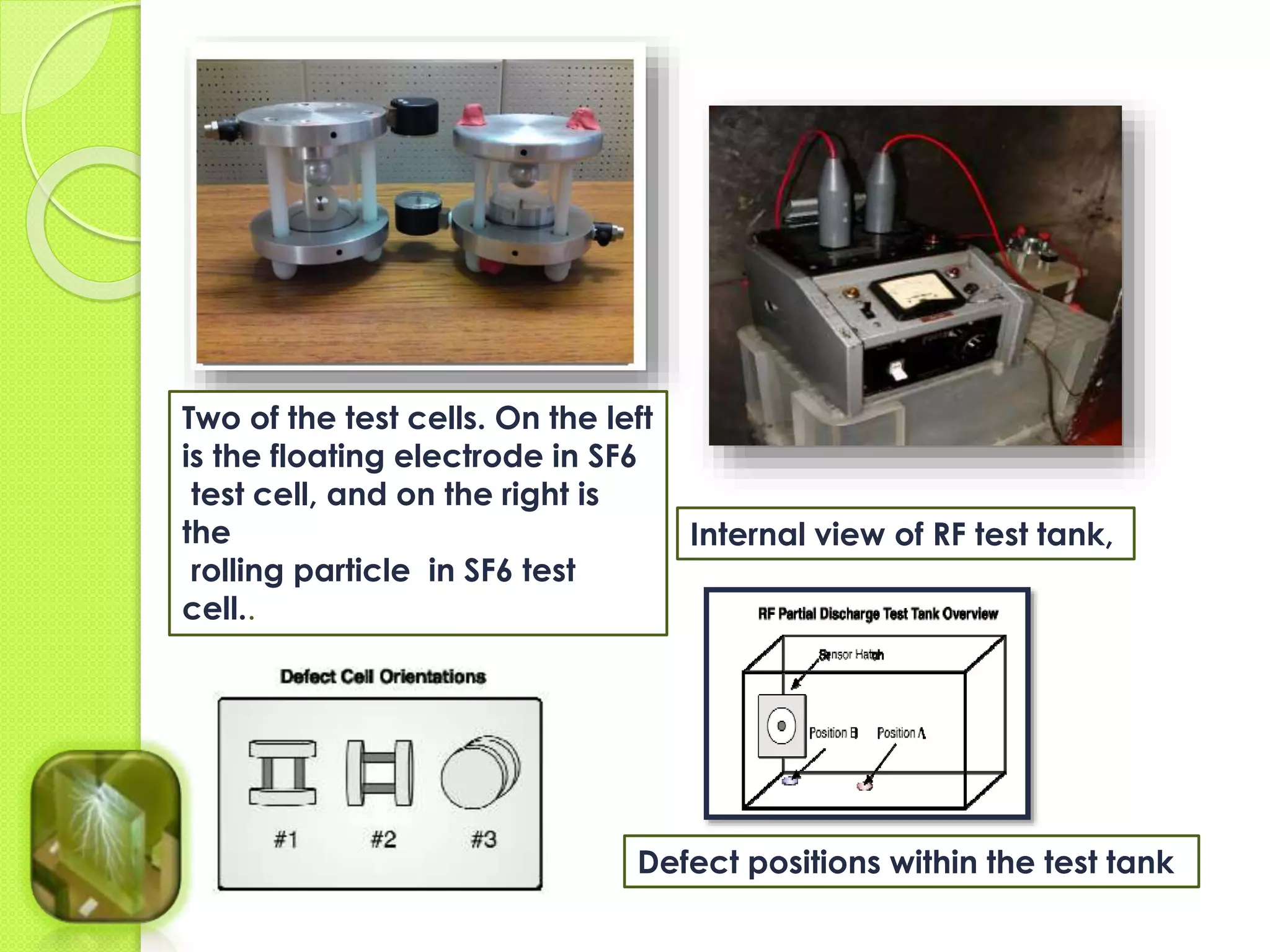
Three test cells. 
A 50kV foster transformer, energized up to 15kV to 
generate PDs within each of the cells. 
Cells filled with SF6, pressurized at 2 bar .
Two of the test cells. On the left 
is the floating electrode in SF6 
test cell, and on the right is 
the 
rolling particle in SF6 test 
cell.. 
Internal view of RF test tank, 
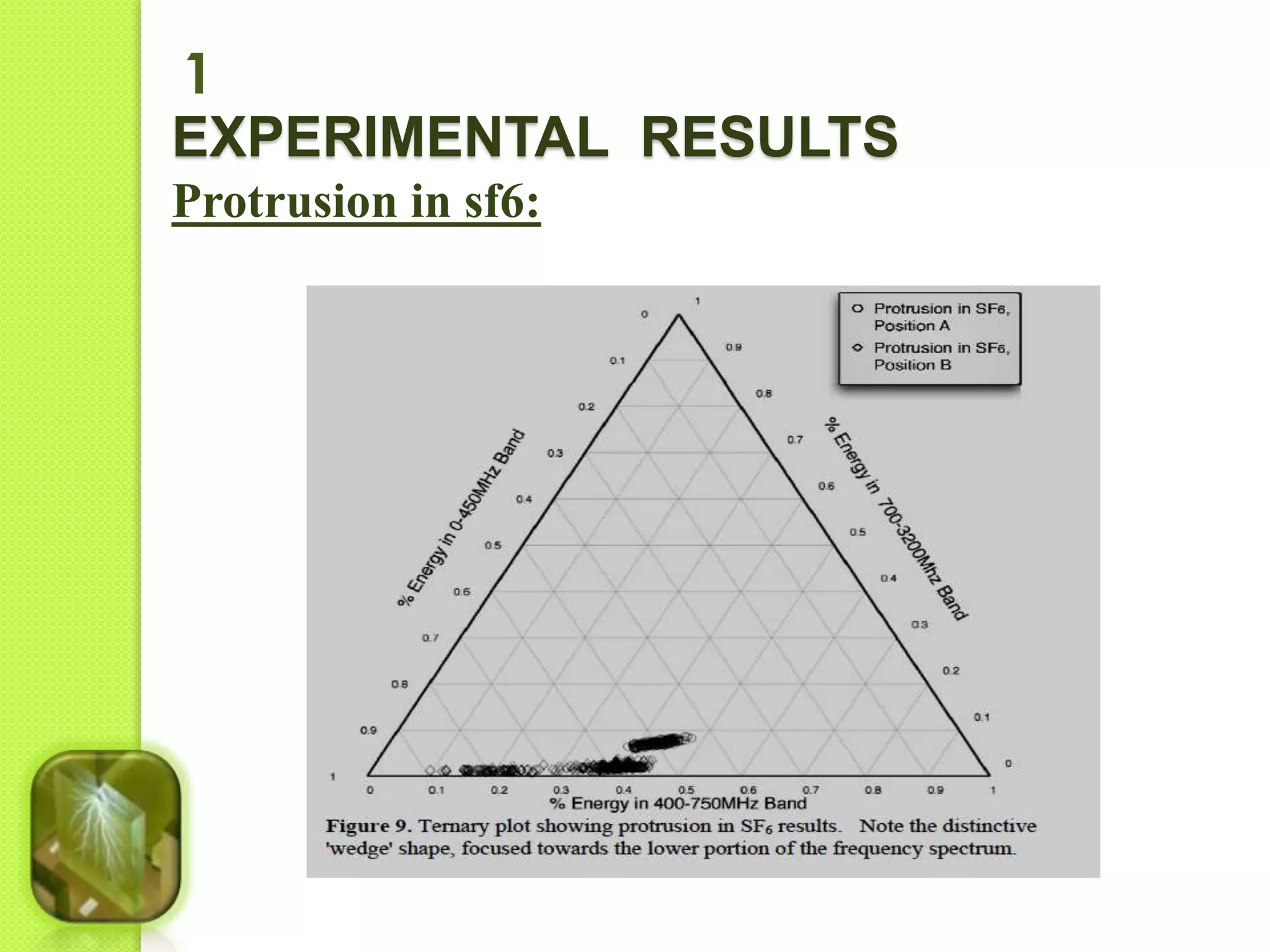
Defect positions within the test tank
•Two positions are available within the test tank-in 
front of the sensor hatch and in the center of the test 
tank. 
• limiting factors -position of the transformer and 
the length of the high-voltage cables . 
•Safer operation directly beneath the sensor hatch, 
. 
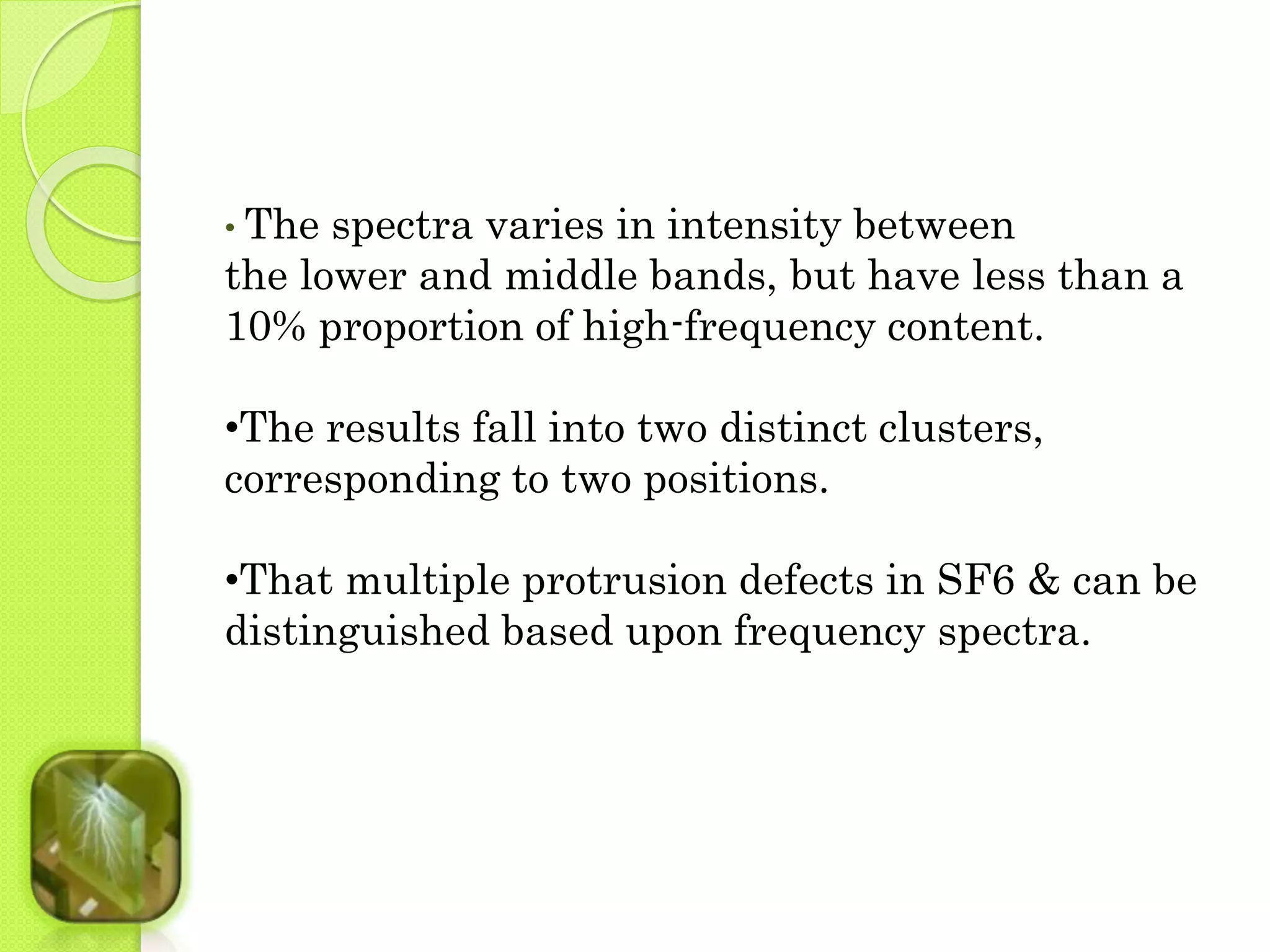
•The floating electrode test cell was oriented in three 
planes to simulate the RF emission of an individual 
defect propagating in different directions.
1 
EXPERIMENTAL RESULTS 
Protrusion in sf6:
• The spectra varies in intensity between 
the lower and middle bands, but have less than a 
10% proportion of high-frequency content. 
•The results fall into two distinct clusters, 
corresponding to two positions. 
•That multiple protrusion defects in SF6 & can be 
distinguished based upon frequency spectra.
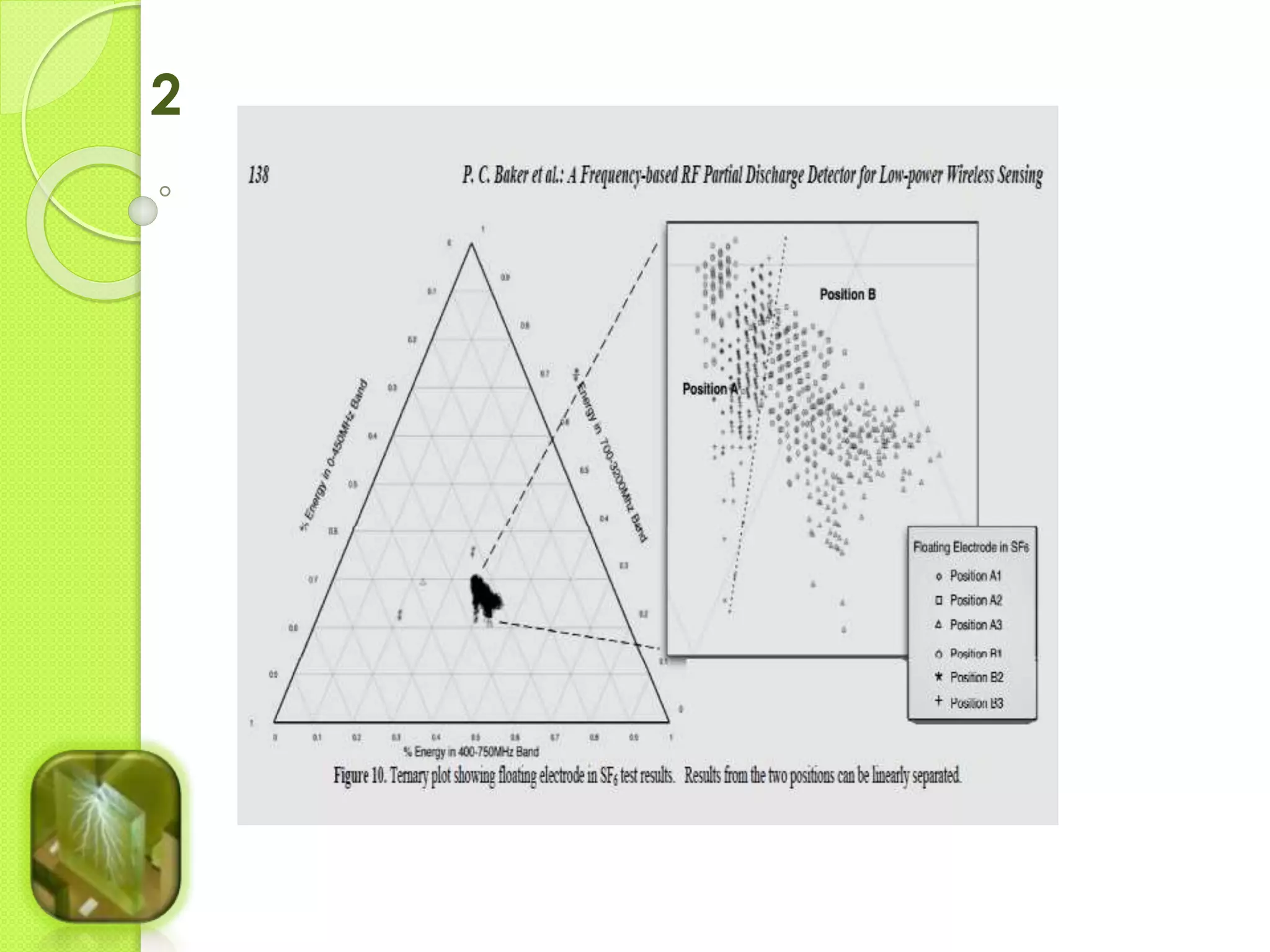
2
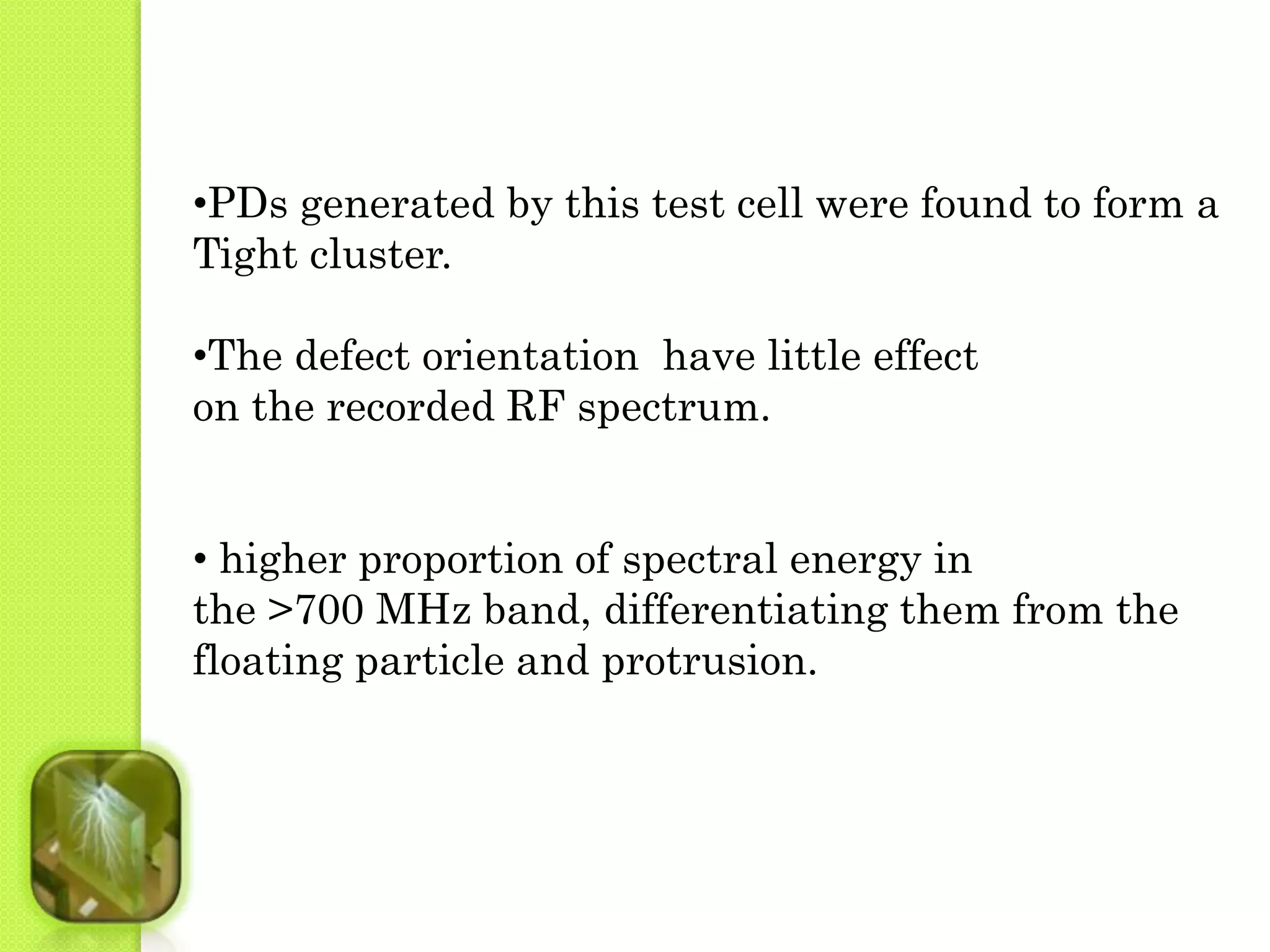
•PDs generated by this test cell were found to form a 
Tight cluster. 
•The defect orientation have little effect 
on the recorded RF spectrum. 
• higher proportion of spectral energy in 
the >700 MHz band, differentiating them from the 
floating particle and protrusion.
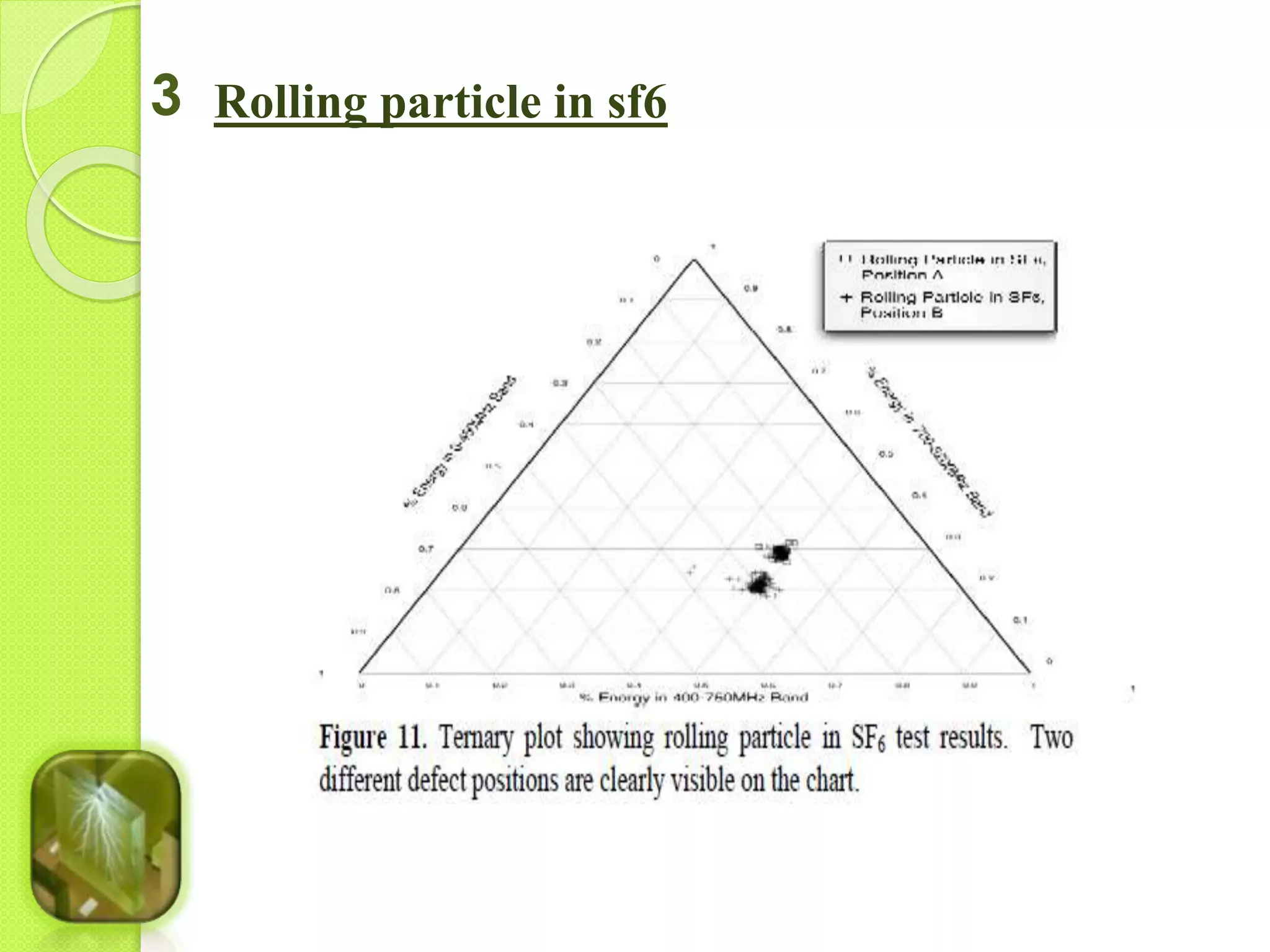
3 Rolling particle in sf6
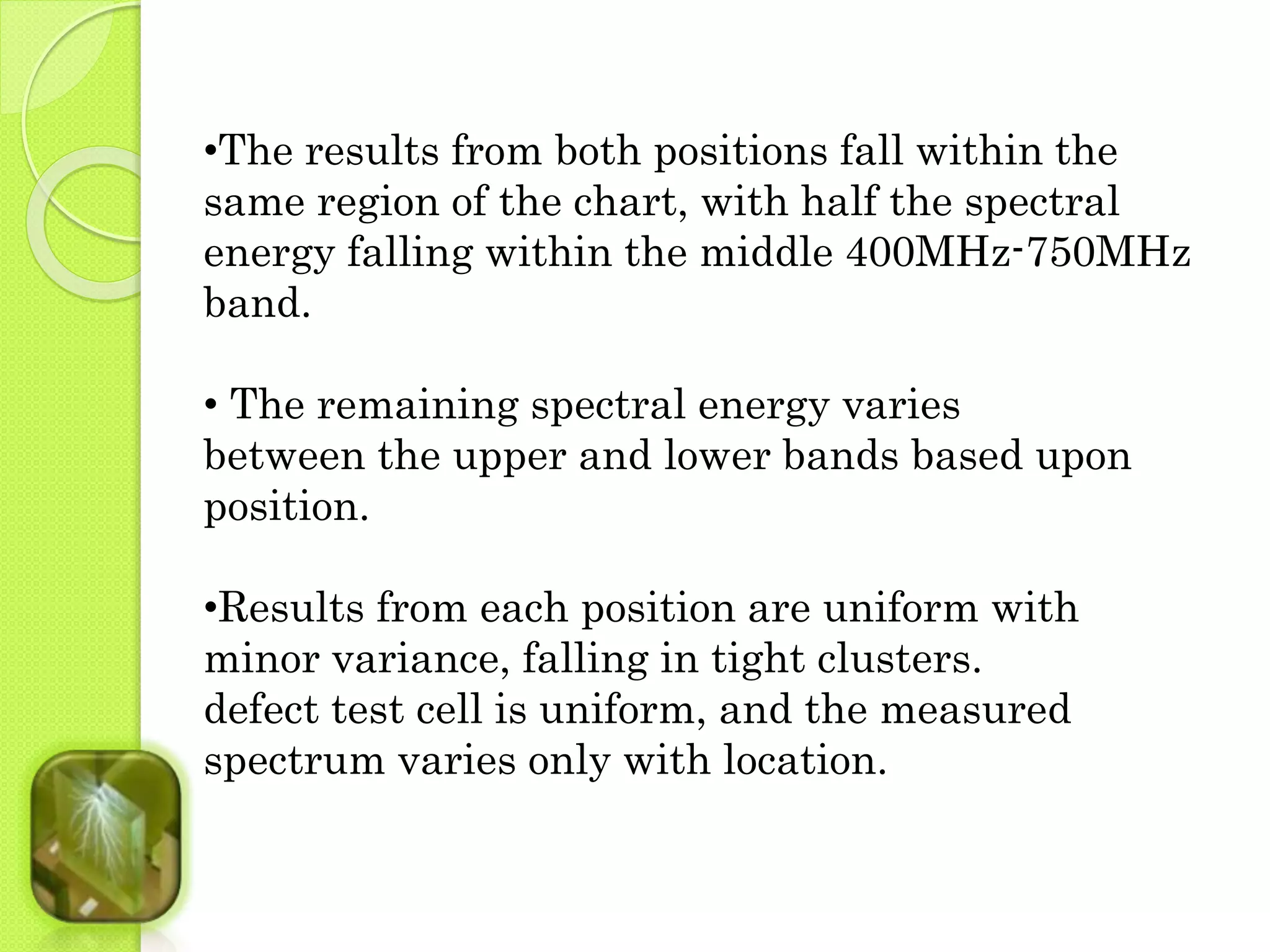
•The results from both positions fall within the 
same region of the chart, with half the spectral 
energy falling within the middle 400MHz-750MHz 
band. 
• The remaining spectral energy varies 
between the upper and lower bands based upon 
position. 
•Results from each position are uniform with 
minor variance, falling in tight clusters. 
defect test cell is uniform, and the measured 
spectrum varies only with location.
CONCLUSION: 
Novel approach to RF PD monitoring using a low-powered 
detector employing frequency-based 
technique. 
 Capable of determining the presence of multiple 
defects, & rudimentary defect classification. 
Ternary plots have been used for the presentation 
and analysis of the PD data, allowing linear 
separation of defects
Reference 
•IEEE Transactions on Dielectrics and Electrical Insulation Vol. 17, 
No. 1; February 2010 ”A Frequency-based RF Partial Discharge 
Detector for Low-power Wireless Sensing” P. C. Baker, M. D. Judd 
and S. D. J. McArthur 
•P. C. Baker, S. D. J. McArthur, and M. D. Judd, “Data Management of 
On-Line Partial Discharge Monitoring Using Wireless Sensor Nodes 
Integrated with a Multi-Agent System”, Intern. Conf. Intelligent 
Systems Applications to Power Systems (ISAP), pp. 1–6, 2007. 
•Z. Tang, C. Li, X. Cheng, W. Wang, J. Li, and J. Li, “Partial 
discharge 
location in power transformers using wideband RF detection”,
Thank you
A Frequency-based  RF Partial Discharge Detector  for Low-power Wireless SensingPartial dicharge

A Frequency-based RF Partial Discharge Detector for Low-power Wireless SensingPartial dicharge

  • 1.
    A Frequency-based RFPartial Discharge Detector for Low-power Wireless Sensing
  • 2.
    index  INTRODUCTION  Rf pd monitoring  PD frequency characteristics  Wireless sensor network  Detector requirement  DETECTOR OVERVIEW  OUTPUT DATA  Laboratory case study  CONCLUSION  Reference
  • 3.
    INTRODUCTION PARTIAL DISCHARGE “Partial discharge is a localized dielectric break down of a solid or fluid electrical insulation system under high voltage stress”  Degradation in dielectric insulation during operational life time or manufacturing time  Leads to internal arcing NEED FOR DETECTION • To avoid equipment failure • Ensure equipment uptime • Mitigate business risk
  • 4.
    Rf pd monitoring Analyzing unit •Wide band UHF signal capture unit •Conditioning unit •Coupled PC Visualizing unit •User interface
  • 5.
    Advantages • Effective& accurate tool. •GIS & oil filled transformer. Disadvantages •It requires a large processing capability to capture UHF signals •Not viable to install in all high voltage plants
  • 6.
    PD frequency characteristics •Defect-specific information used for classification based on frequency spectrum. •The relationship between PD source and sensor in terms of geometry and distance due to complex propagation effects
  • 7.
    Wireless sensor network  wide-range of monitoring applications.  Ad-hoc network with redundant links.  Sensory data is passed back through data aggregation nodes to a wired network  Data is presented to monitoring engineers.  Integrated computing platform;  Encapsulating sensing, processing, data storage, communications & power components in a single compact Package.
  • 8.
    Advantages  Lowcost  Absence of potentially hazardous cabling  Reduced bandwidth requirements  High capacity communication links b/w substations &corporate networks. Disadvantages  Degrading effect of Impulsive noise emitted by PDs on wireless data channels.
  • 9.
    Detector requirement Functionalrequirements  Sensing & recording intensity of PD signals & relative spectral magnitudes  Differentiation of PD from RF noise  Relatively small  Interface with RF sensors ( plant enclosures) A Low-power 3channel detector-
  • 10.
    DETECTOR OVERVIEW DETECTORFREQUENCY BANDS Band Range Lower 0 – 450 MHz Middle 400 – 750 MHz Upper 700 – 3200 MHz
  • 11.
    3 identical channels Schottky diode detector 5MHz LPF Amplifier PHYSICAL DEVICE OVERVIEW Sampling by an ADC output WB RF signals  Output is three pulse envelopes ( the relative energy within the three frequency bands)
  • 12.
    OUTPUT DATA •Peak value of the PD envelope for three discrete frequency bands. •Values are then normalized into a proportional form, •It represents the relative spectral energies within the PD signal. •The total magnitude of the captured sample is also included as a feature, as the sum of the three channels.
  • 13.
    Laboratory case study Test tank with three monopole RF sensors. Addition panel with RF PD sensor types. Three test cells. A 50kV foster transformer, energized up to 15kV to generate PDs within each of the cells. Cells filled with SF6, pressurized at 2 bar .
  • 14.
    Two of thetest cells. On the left is the floating electrode in SF6 test cell, and on the right is the rolling particle in SF6 test cell.. Internal view of RF test tank, Defect positions within the test tank
  • 15.
    •Two positions areavailable within the test tank-in front of the sensor hatch and in the center of the test tank. • limiting factors -position of the transformer and the length of the high-voltage cables . •Safer operation directly beneath the sensor hatch, . •The floating electrode test cell was oriented in three planes to simulate the RF emission of an individual defect propagating in different directions.
  • 16.
    1 EXPERIMENTAL RESULTS Protrusion in sf6:
  • 17.
    • The spectravaries in intensity between the lower and middle bands, but have less than a 10% proportion of high-frequency content. •The results fall into two distinct clusters, corresponding to two positions. •That multiple protrusion defects in SF6 & can be distinguished based upon frequency spectra.
  • 18.
  • 19.
    •PDs generated bythis test cell were found to form a Tight cluster. •The defect orientation have little effect on the recorded RF spectrum. • higher proportion of spectral energy in the >700 MHz band, differentiating them from the floating particle and protrusion.
  • 20.
  • 21.
    •The results fromboth positions fall within the same region of the chart, with half the spectral energy falling within the middle 400MHz-750MHz band. • The remaining spectral energy varies between the upper and lower bands based upon position. •Results from each position are uniform with minor variance, falling in tight clusters. defect test cell is uniform, and the measured spectrum varies only with location.
  • 22.
    CONCLUSION: Novel approachto RF PD monitoring using a low-powered detector employing frequency-based technique.  Capable of determining the presence of multiple defects, & rudimentary defect classification. Ternary plots have been used for the presentation and analysis of the PD data, allowing linear separation of defects
  • 23.
    Reference •IEEE Transactionson Dielectrics and Electrical Insulation Vol. 17, No. 1; February 2010 ”A Frequency-based RF Partial Discharge Detector for Low-power Wireless Sensing” P. C. Baker, M. D. Judd and S. D. J. McArthur •P. C. Baker, S. D. J. McArthur, and M. D. Judd, “Data Management of On-Line Partial Discharge Monitoring Using Wireless Sensor Nodes Integrated with a Multi-Agent System”, Intern. Conf. Intelligent Systems Applications to Power Systems (ISAP), pp. 1–6, 2007. •Z. Tang, C. Li, X. Cheng, W. Wang, J. Li, and J. Li, “Partial discharge location in power transformers using wideband RF detection”,
  • 24.