Shri Sad Vidya Mandal
Institute Of Technology
1
Branch :- Electrical (8 𝑡ℎ 𝑆𝑒𝑚)
Presented by :-
Jha Rajiv P. 150450109012
Guided By :- Prof. A.K.Mehta
CONTENTS.
a. What is transient disturbance?
b. Some causes of transient disturbances.
c. Transient disturbance analyser.
d. Types of analysers.
2
WHAT IS TRANSIENT DISTURBANCE?
 The term transient usually originates from electric circuit theory
where it describes voltage and current variations from its present
steady state to next steady state.
 In the power system the term transient is usually denotes abrupt
change in voltage and current for short duration.
 Usually for duration less than period of power system voltage and
current signal(50-60 Hz).
3
WHAT IS TRANSIENT DISTURBANCE?
 Previously it was considered that transient disturbances are only
because of incorrect operation of circuit breakers and switching of
high voltage line.
 Electronic equipment have very less voltage handling capacities.
 Temporal fluctuations produces parity error and interrupts protection
system.
4
SOME CAUSES OF TRANSIENT
DISTURBANCES.
 Switching operations, faults, and other disturbances like lightning
strikes.
 Shutdown of heavily load circuits.
 Necessary commutation of a high powered network (e.g, pf
correction)
 Loose connections in the distribution system that results to arcing
accidents.
5
TRANSIENT DISTURBANCE ANALYSER
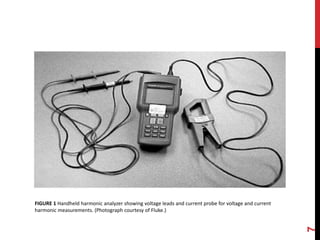
 Transient-disturbance analyzers are advanced data acquisition devices
for capturing, storing, and presenting short-duration, sub-cycle power
system disturbances.
 It is not untypical for transient-disturbance recorders to have
sampling rates in the range of 2 to 4 million samples per second.
 Transient events are recorded in terms of their amplitude and
frequency content.
6
7
FIGURE 1 Handheld harmonic analyzer showing voltage leads and current probe for voltage and current
harmonic measurements. (Photograph courtesy of Fluke.)
TRANSIENT DISTURBANCE ANALYSER
 Both these attributes are essential for performing transient analysis.
 Amplitude of the waveform provides information about the potential
for damage to the affected equipment.
 Frequency content informs us as to how the events may couple to
other circuits and how they might be mitigated.
8
9
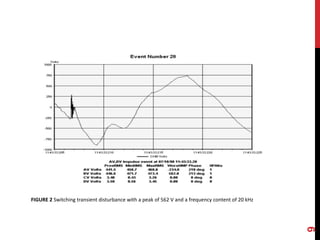
FIGURE 2 Switching transient disturbance with a peak of 562 V and a frequency content of 20 kHz
TRANSIENT DISTURBANCE ANALYSER
 Figure 2 shows a transient that reached peak amplitude of 562 V with
a frequency content of approximately 200 kHz.
 The length of the wires used to connect the instrumentation to the
test points becomes very important to measure fast rise time.
 The leads should be kept as short as possible.
10
TRANSIENT DISTURBANCE ANALYSER
 In order to minimize noise pickup from external sources.
 The leads should be kept as straight as possible without sharp bends or
loops.
 Excess lead length should never be wound into a coil.
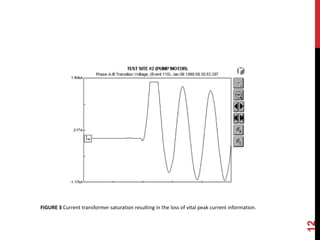
 Current transformers used in transient current measurement must have a
peak current rating at least equal to the maximum expected current.
11
12
FIGURE 3 Current transformer saturation resulting in the loss of vital peak current information.
Conventional
analyser
Graphic
analyser
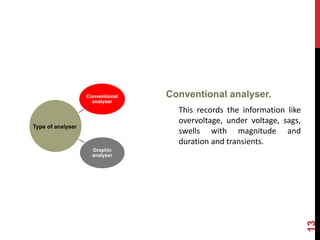
Conventional analyser.
This records the information like
overvoltage, under voltage, sags,
swells with magnitude and
duration and transients.
13
Type of analyser
Conventional
analyser
Graphic
analyser
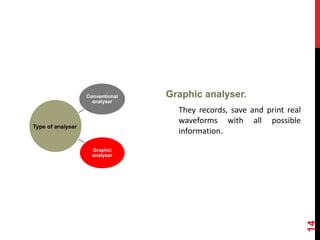
Graphic analyser.
They records, save and print real
waveforms with all possible
information.
14
Type of analyser
15

Transient disturbance analyzer

  • 1.
    Shri Sad VidyaMandal Institute Of Technology 1 Branch :- Electrical (8 𝑡ℎ 𝑆𝑒𝑚) Presented by :- Jha Rajiv P. 150450109012 Guided By :- Prof. A.K.Mehta
  • 2.
    CONTENTS. a. What istransient disturbance? b. Some causes of transient disturbances. c. Transient disturbance analyser. d. Types of analysers. 2
  • 3.
    WHAT IS TRANSIENTDISTURBANCE?  The term transient usually originates from electric circuit theory where it describes voltage and current variations from its present steady state to next steady state.  In the power system the term transient is usually denotes abrupt change in voltage and current for short duration.  Usually for duration less than period of power system voltage and current signal(50-60 Hz). 3
  • 4.
    WHAT IS TRANSIENTDISTURBANCE?  Previously it was considered that transient disturbances are only because of incorrect operation of circuit breakers and switching of high voltage line.  Electronic equipment have very less voltage handling capacities.  Temporal fluctuations produces parity error and interrupts protection system. 4
  • 5.
    SOME CAUSES OFTRANSIENT DISTURBANCES.  Switching operations, faults, and other disturbances like lightning strikes.  Shutdown of heavily load circuits.  Necessary commutation of a high powered network (e.g, pf correction)  Loose connections in the distribution system that results to arcing accidents. 5
  • 6.
    TRANSIENT DISTURBANCE ANALYSER Transient-disturbance analyzers are advanced data acquisition devices for capturing, storing, and presenting short-duration, sub-cycle power system disturbances.  It is not untypical for transient-disturbance recorders to have sampling rates in the range of 2 to 4 million samples per second.  Transient events are recorded in terms of their amplitude and frequency content. 6
  • 7.
    7 FIGURE 1 Handheldharmonic analyzer showing voltage leads and current probe for voltage and current harmonic measurements. (Photograph courtesy of Fluke.)
  • 8.
    TRANSIENT DISTURBANCE ANALYSER Both these attributes are essential for performing transient analysis.  Amplitude of the waveform provides information about the potential for damage to the affected equipment.  Frequency content informs us as to how the events may couple to other circuits and how they might be mitigated. 8
  • 9.
    9 FIGURE 2 Switchingtransient disturbance with a peak of 562 V and a frequency content of 20 kHz
  • 10.
    TRANSIENT DISTURBANCE ANALYSER Figure 2 shows a transient that reached peak amplitude of 562 V with a frequency content of approximately 200 kHz.  The length of the wires used to connect the instrumentation to the test points becomes very important to measure fast rise time.  The leads should be kept as short as possible. 10
  • 11.
    TRANSIENT DISTURBANCE ANALYSER In order to minimize noise pickup from external sources.  The leads should be kept as straight as possible without sharp bends or loops.  Excess lead length should never be wound into a coil.  Current transformers used in transient current measurement must have a peak current rating at least equal to the maximum expected current. 11
  • 12.
    12 FIGURE 3 Currenttransformer saturation resulting in the loss of vital peak current information.
  • 13.
    Conventional analyser Graphic analyser Conventional analyser. This recordsthe information like overvoltage, under voltage, sags, swells with magnitude and duration and transients. 13 Type of analyser
  • 14.
    Conventional analyser Graphic analyser Graphic analyser. They records,save and print real waveforms with all possible information. 14 Type of analyser
  • 15.