EEK150 Project 1
Making of:
PD Data Acqusition System
Author:
Johannes Avaheden
Vishal Mathur
Supervisor:
Xiangrong Chen
Department of Electric Power Engineering
Chalmers University of technology
Gothenburg, October 27, 2013
Abstract
Partial discharges (PD) occurring in insulation systems can be
characterized by the magnitude of the apparent charge as well as the
phase angle relative to the power line cycle. This project describes
a partial discharge measurement system based on USB digitizer NI-
5133, which is a 2 channel high speed digitizer with the analysis and
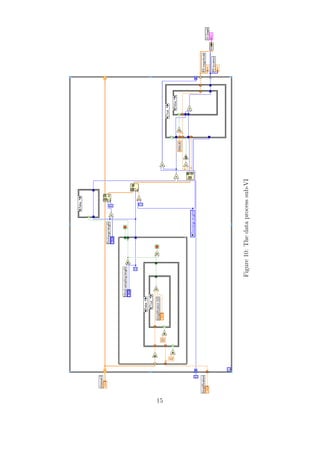
acquisition program written in labVIEW. Once the analog data has
been acquired it is processed and then presented grafically on a phase
resolved basis. The acquisition system was developed using artificially
generated pulses from a signal generator. This setup was subjected
to actual high voltage test along with the haefley 568 PD system for
comparison.
i
Acknowledgements
We would like to extend much gratitude to our supervisor:
Xiangrong Chen
who have been of great help throughout the project!
ii
Contents
1 Background 1
2 Aim of the project 1
3 Task and problem description 2
3.1 Hardware . . . . . . . . . . . . . . . . . . . . . . . . . . . . . 2
3.2 Software . . . . . . . . . . . . . . . . . . . . . . . . . . . . . . 2
4 The project scope 3
5 Theory behind PD-measurement 4
5.0.1 Phase resolved analysis . . . . . . . . . . . . . . . . . . 5
6 Method 6
6.1 Choice of Hardware . . . . . . . . . . . . . . . . . . . . . . . . 6
6.2 Quadripole synchronizing port voltage test . . . . . . . . . . . 7
6.3 Software development . . . . . . . . . . . . . . . . . . . . . . . 9
6.3.1 Choise of development platform . . . . . . . . . . . . . 9
6.3.2 Creation of a basic software structure . . . . . . . . . . 9
6.4 First prototype . . . . . . . . . . . . . . . . . . . . . . . . . . 10
6.4.1 Block part 1 . . . . . . . . . . . . . . . . . . . . . . . . 10
6.4.2 Block part 2 and 3 . . . . . . . . . . . . . . . . . . . . 12
6.4.3 Block part 4 . . . . . . . . . . . . . . . . . . . . . . . . 12
6.5 Data processing . . . . . . . . . . . . . . . . . . . . . . . . . . 13
6.5.1 Initial signal processing . . . . . . . . . . . . . . . . . . 13
6.5.2 PD-signal processing . . . . . . . . . . . . . . . . . . . 14
6.6 Final software version . . . . . . . . . . . . . . . . . . . . . . . 16
7 Results 18
8 Discussion 21
8.1 Future additional work . . . . . . . . . . . . . . . . . . . . . . 21
iii
1 Background
Measurement and analysis of partial discharge (PD) is an essential tool for
diagnosis of insulation condition [1]. As the High voltage devices ages, the
insulation tends to become weak which could lead to breakdowns due to
various phenomenon occurring inside the device, raising the risk of insulation
failure, which could be disastrous. Thus it becomes imperative to have a
system that enables analysis of potential insulation problems so that the
devices may be repaired or replaced well in advance.
To analyze the PD’s the magnitude of discharge is measured. Furthermore
the phase position (ϕ) when the discharge takes place during the sinosoidal
voltage period is measured. When the PD magnitude (q) is plotted against
the phase angle the PD pattern is obtained. This pattern is what characterise
a certain type of partial discharge. Traditionally this is done with an analog
PD pattern analyzer but as most modern systems today usually run digitally,
a way to analyze PD patterns digitally is therefore desirable.
2 Aim of the project
The Aim of the project is to develop a portable, digital system for partial
discharge acquisition using an analogue input from hardware such as Haefely
PD568.
1
3 Task and problem description
The task of this project is to develop a digital Partial discharge detection sys-
tem for a sinusoidal voltage application. The system shall be able to measure
partial discharges and extract the parameters ϕ and q of the discharges.
The problem could be divided into two parts, choice of hardware and
development of software.
3.1 Hardware
A research has to be carried out for selecting the proper hardware. This
hardware is required to have a high bandwidth for better resolution and a
high frequency, multichannel interface.
3.2 Software
Software compatible with this device will be used for programming as well
as displaying the graphical outcome of the partial discharge using the phase
resolving technique. The data thus collected should be in a position to be
saved to disk for further external analysis.
2
4 The project scope
The main focus will be upon establishing the link between the host computer
and the PD detector, that shall include hardware selection, interfacing as well
as software selection and programming. Further analysis of the discretized
data shall be done to find out two parameters crucial for phase resolved
technique i.e. peak magnitude as well as the phase angle with respect to the
power voltage frequency.
However other parameters used for PD characterization such as average
value of integrated distribution parameters, would not be included. Analysis
of the complete setup calls for a Digital signal processing approach which
shall not be discussed as it is not within the scope. All the analysis and
discussion would be based on a phase resolved pattern Analysis only.
3
5 Theory behind PD-measurement
A number of methods have been developed for detection of phenomenon that
occurrs during PD, such as the electromagnetic field, dielectric losses and the
electrical method. This project is based on the electrical method.
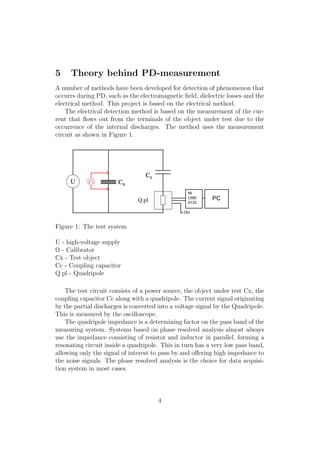
The electrical detection method is based on the measurement of the cur-
rent that flows out from the terminals of the object under test due to the
occurrence of the internal discharges. The method uses the measurement
circuit as shown in Figure 1.
Figure 1: The test system
U - high-voltage supply
Ω - Calibrator
Cx - Test object
Cc - Coupling capacitor
Q.pl - Quadripole
The test circuit consists of a power source, the object under test Cx, the
coupling capacitor Cc along with a quadripole. The current signal originating
by the partial discharges is converted into a voltage signal by the Quadripole.
This is measured by the oscilloscope.
The quadripole impedance is a determining factor on the pass band of the
measuring system. Systems based on phase resolved analysis almost always
use the impedance consisting of resistor and inductor in parallel, forming a
resonating circuit inside a quadripole. This in turn has a very low pass band,
allowing only the signal of interest to pass by and offering high impedance to
the noise signals. The phase resolved analysis is the choice for data acquisi-
tion system in most cases.
4
5.0.1 Phase resolved analysis
Analysis based on phase resolved technique depicts the type of defect and
the level of insulation degradation reached. This is done with the help of
analyzing the discharge occurrence pattern over the power line sinusoidal
wave. This type of distribution is known as the ”fingerprint of a discharge”.
This plays an important role in identifying the kind of defect present in
insulation and the level of deterioration. A typical PD-pattern is presented
in Figure 2.
Figure 2: A typical PD-pattern recieved with the phase resolve method [1]
5
6 Method
The development was divided into two parts. First proper hardware were to
be chosen. Second the software to run the hardware were to be developed.
6.1 Choice of Hardware
As explained in Section 3, the digital PD-acquisition system needs to have
the capability to sample and store data to characterize PD’s. It should also
be capable of transferring the data obtained to the host PC’s random access
memory to generate (ϕ, q) plots.
NI USB- 5133 digitizer fulfills all the needs required for this system.
Figure 3: The NI USB-5133 digitizer [2]
The main factors that were considered while selecting digitizer were the
sampling rate, which for the USB-5133 is 100 MS/s. That assures a truthful
reproduction of the analog signal to digital. The bandwidth of 50 MHz and
2 simultaneously sampled channels with 8-bit resolution makes it an ideal
choice. It is having 8 Mb memory equally divided between two channels
CH1 and CH2. The bus powered, plug and play feature of this device makes
it portable and easy to use.
As presented in Figure 1, the USB digitizer would be connected to the the
synchronizing port of the quadripole via channel CH0 or CH1. The digitizer
is having an operating voltage range of 40 Vp−p, i.e. from -20V to +20V. In
6
order to ensure that the input voltage to the digitizer does not exceed the
given limit, the voltage profile of the Haefley PD 568 should be known in
advance. For this reason a test was conducted in a high voltage laboratory
to determine the input – output voltage characteristics of the quadripole.
6.2 Quadripole synchronizing port voltage test
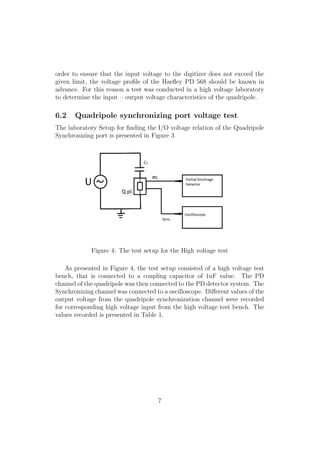
The laboratory Setup for finding the I/O voltage relation of the Quadripole
Synchronizing port is presented in Figure 3
Figure 4: The test setup for the High voltage test
As presented in Figure 4, the test setup consisted of a high voltage test
bench, that is connected to a coupling capacitor of 1nF value. The PD
channel of the quadripole was then connected to the PD detector system. The
Synchronizing channel was connected to a oscilloscope. Different values of the
output voltage from the quadripole synchronization channel were recorded
for corresponding high voltage input from the high voltage test bench. The
values recorded is presented in Table 1.
7
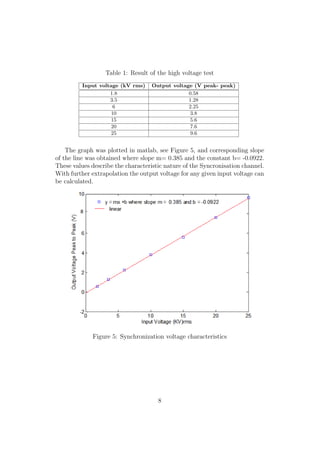
Table 1: Result of the high voltage test
Input voltage (kV rms) Output voltage (V peak- peak)
1.8 0.58
3.5 1.28
6 2.25
10 3.8
15 5.6
20 7.6
25 9.6
The graph was plotted in matlab, see Figure 5, and corresponding slope
of the line was obtained where slope m= 0.385 and the constant b= -0.0922.
These values describe the characteristic nature of the Syncronisation channel.
With further extrapolation the output voltage for any given input voltage can
be calculated.
Figure 5: Synchronization voltage characteristics
8
6.3 Software development
The software that were to be developed had to be able to handle mainly three
tasks:
• Display the PD pattern
• Extract the main parameters phase ϕ and the aparent charge q.
• Gather and export the main parameters to a database.
These tasks were therefore set as requirements for the final software.
6.3.1 Choise of development platform
LabView is capable of handling all of the sampling cards features and there-
fore suitable for the development of the end user software. As LabView also
was suggested by the project client LabView was chosen to be the develop-
ment platform.
6.3.2 Creation of a basic software structure
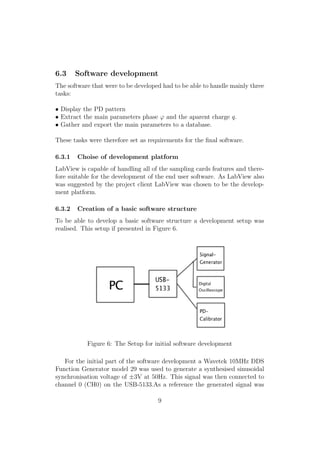
To be able to develop a basic software structure a development setup was
realised. This setup if presented in Figure 6.
Figure 6: The Setup for initial software development
For the initial part of the software development a Wavetek 10MHz DDS
Function Generator model 29 was used to generate a synthesised sinusoidal
synchronisation voltage of ±3V at 50Hz. This signal was then connected to
channel 0 (CH0) on the USB-5133.As a reference the generated signal was
9
sent to a Tektronix TDS 2004B Digital Oscilloscope, this to be able to see
that the digitalised signal presented in the developed software was correct.
A PD-calibrator was then connected to CH1 on the USB-5133.
As the main structure for the software, the LabView function tree NI-
Scope was used.For understanding of the NI-Scope functions the predefined
LabView VI NI-Scope Express was studied together with the NI-Scope doc-
umentation in LabView.
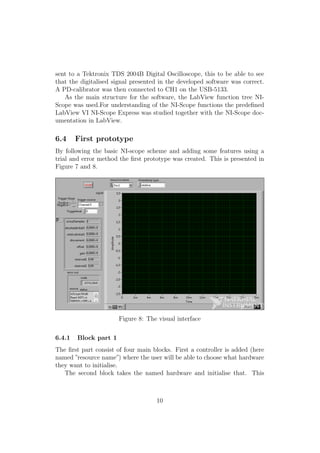
6.4 First prototype
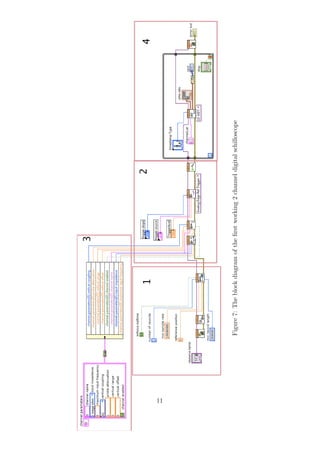
By following the basic NI-scope scheme and adding some features using a
trial and error method the first prototype was created. This is presented in
Figure 7 and 8.
Figure 8: The visual interface
6.4.1 Block part 1
The first part consist of four main blocks. First a controller is added (here
named ”resource name”) where the user will be able to choose what hardware
they want to initialise.
The second block takes the named hardware and initialise that. This
10
Figure7:Theblockdiagramofthefirstworking2channeldigitalschilloscope
11
block then generates two outputs that will follow throughout the whole pro-
gram, instrument handle and error.
The third block is the auto setup that will do a rough setup of the sam-
pling card, and takes care of any future unattended parameter.
The forth block is the Horizontal setup. Here real-time acquisition is
enforced and since realtime is used only one record is needed. Furthermore
the sampling rate aswell as the time reference position is set. This will ensure
that the maximum sampling rate of the card is used and that the presented
wave-graph begins at time t=0s. The min record length dictates how many
samples is recorded and later shown in the graph window, here the number
of samples for one period is chosen.
6.4.2 Block part 2 and 3
The First two blocks in the second part both define the vertical setup. As
they are closely intertwined and different setups are to be set for the two input
channels, a memory cluster was created (block part 3) to hold information
for both channels.
For correct measurements the input impedance is stated, together with
the vertical coupling used. The desired vertical range (in volt) is chosen as
well as the offset and probe attenuation.
The third block in part 2 is the trigger controller. Here visual controllers
is created so the user can choose positive or negative trigger slope, the trigger
source channel and the trigger level (in volt).
The last block in part 2 is the initialisation of the acquisition.
6.4.3 Block part 4
In the Fourth part a while-loop is created for the actual reading. Here its
stated that both channel 0 and 1 are to be read. The timestamp type is a
controller that is to be set to ”relative” in the visual interface for a correct
display, this will keep the reference point steady at t=0s. The waveform
information and the actual waveforms are then sent to their respectively
windows in the visual interface for display.
When the stop button is pressed the program will jump out of the while-
loop and the second to last block will terminate the acquisition and reset the
hardware. When that is done the eventual error is sent for display in the
visual interface.
12
6.5 Data processing
The next step of the software development was to process the acquired data.
As explained in Section 5, to recieve the PD-pattern the parameters angle
of the discharge ϕ and the amplitude of the discharge q has to be extracted
from the sampled signal.
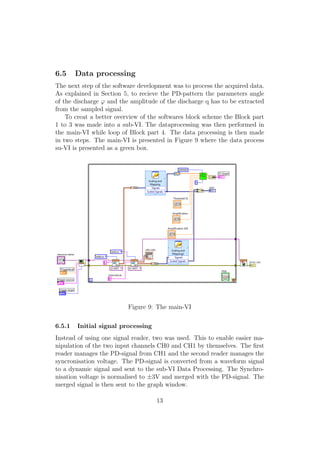
To creat a better overview of the softwares block scheme the Block part
1 to 3 was made into a sub-VI. The dataprocessing was then performed in
the main-VI while loop of Block part 4. The data processing is then made
in two steps. The main-VI is presented in Figure 9 where the data process
su-VI is presented as a green box.
Figure 9: The main-VI
6.5.1 Initial signal processing
Instead of using one signal reader, two was used. This to enable easier ma-
nipulation of the two input channels CH0 and CH1 by themselves. The first
reader manages the PD-signal from CH1 and the second reader manages the
syncronisation voltage. The PD-signal is converted from a waveform signal
to a dynamic signal and sent to the sub-VI Data Processing. The Synchro-
nisation voltage is normalised to ±3V and merged with the PD-signal. The
merged signal is then sent to the graph window.
13
6.5.2 PD-signal processing
The Data process sub-VI have six inputs; the PD-signal, threshold level,
”ampification × 1”, ”ampification × 10”, minimum samplel length and dis-
charge length. The sample length was set to 2MS. The other factors were
connected to controls for easy calibration from the software interphase.
The chosen amplification is applied before the magnitude of the PD-signal
is measured and extracted as a double. The phase at the discharge is then
extracted and these two parameters is sent back to the main-VI. The data
process sub-VI is presented in Figure 10.
14
Figure10:Thedataprocesssub-VI
15
6.6 Final software version
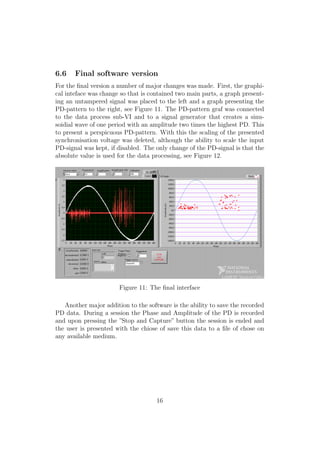
For the final version a number of major changes was made. First, the graphi-
cal inteface was change so that is contained two main parts, a graph present-
ing an untampered signal was placed to the left and a graph presenting the
PD-pattern to the right, see Figure 11. The PD-pattern graf was connected
to the data process sub-VI and to a signal generator that creates a sinu-
soidial wave of one period with an amplitude two times the highest PD. This
to present a perspicuous PD-pattern. With this the scaling of the presented
synchronisation voltage was deleted, although the ability to scale the input
PD-signal was kept, if disabled. The only change of the PD-signal is that the
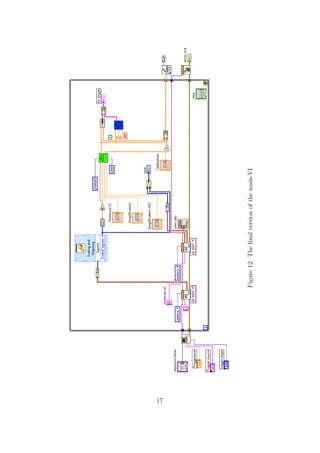
absolute value is used for the data processing, see Figure 12.
Figure 11: The final interface
Another major addition to the software is the ability to save the recorded
PD data. During a session the Phase and Amplitude of the PD is recorded
and upon pressing the ”Stop and Capture” button the session is ended and
the user is presented with the chiose of save this data to a file of chose on
any available medium.
16
Figure12:Thefinalversionofthemain-VI
17
7 Results
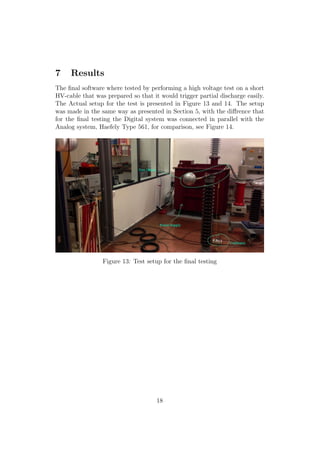
The final software where tested by performing a high voltage test on a short
HV-cable that was prepared so that it would trigger partial discharge easily.
The Actual setup for the test is presented in Figure 13 and 14. The setup
was made in the same way as presented in Section 5, with the diffrence that
for the final testing the Digital system was connected in parallel with the
Analog system, Haefely Type 561, for comparison, see Figure 14.
Figure 13: Test setup for the final testing
18
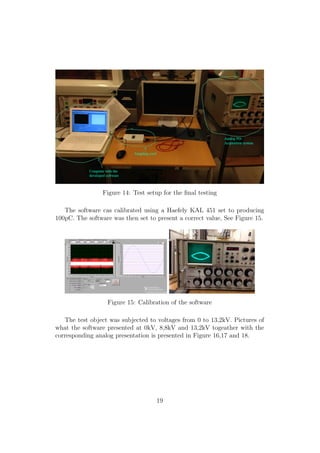
Figure 14: Test setup for the final testing
The software cas calibrated using a Haefely KAL 451 set to producing
100pC. The software was then set to present a correct value, See Figure 15.
Figure 15: Calibration of the software
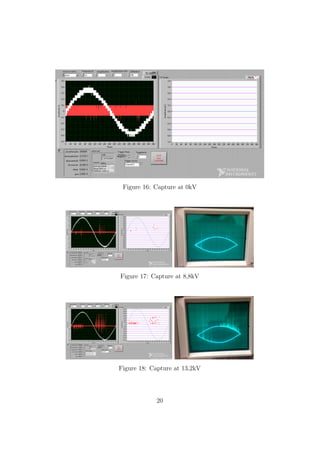
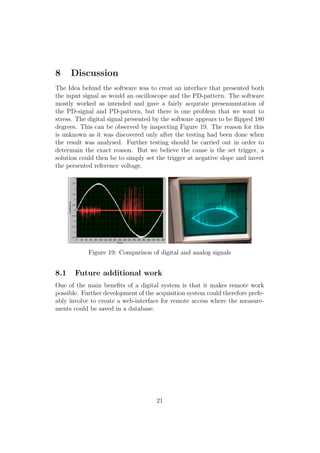
The test object was subjected to voltages from 0 to 13,2kV. Pictures of
what the software presented at 0kV, 8,8kV and 13,2kV togeather with the
corresponding analog presentation is presented in Figure 16,17 and 18.
19
Figure 16: Capture at 0kV
Figure 17: Capture at 8,8kV
Figure 18: Capture at 13,2kV
20
8 Discussion
The Idea behind the software was to creat an interface that presented both
the input signal as would an oscilloscope and the PD-pattern. The software
mostly worked as intended and gave a fairly acqurate presenmmtation of
the PD-signal and PD-pattern, but there is one problem that we want to
stress. The digital signal presented by the software appears to be flipped 180
degrees. This can be observed by inspecting Figure 19. The reason for this
is unknown as it was discovered only after the testing had been done when
the result was analysed. Further testing should be carried out in order to
determain the exact reason. But we believe the cause is the set trigger, a
solution could then be to simply set the trigger at negative slope and invert
the persented reference voltage.
Figure 19: Comparison of digital and analog signals
8.1 Future additional work
One of the main benefits of a digital system is that it makes remote work
possible. Further development of the acquisition system could therefore prefe-
ably involve to create a web-interface for remote access where the measure-
ments could be saved in a database.
21
References
[1] J.A. Ardila-Rey et. al. A Partial Discharges Acquisition and Statistical
Analysis Software. 2012.
[2] url: http://sine.ni.com/nips/cds/view/p/lang/sv/nid/203720.
22

Making of a PD Data Acqusition System

  • 1.
    EEK150 Project 1 Makingof: PD Data Acqusition System Author: Johannes Avaheden Vishal Mathur Supervisor: Xiangrong Chen Department of Electric Power Engineering Chalmers University of technology Gothenburg, October 27, 2013
  • 2.
    Abstract Partial discharges (PD)occurring in insulation systems can be characterized by the magnitude of the apparent charge as well as the phase angle relative to the power line cycle. This project describes a partial discharge measurement system based on USB digitizer NI- 5133, which is a 2 channel high speed digitizer with the analysis and acquisition program written in labVIEW. Once the analog data has been acquired it is processed and then presented grafically on a phase resolved basis. The acquisition system was developed using artificially generated pulses from a signal generator. This setup was subjected to actual high voltage test along with the haefley 568 PD system for comparison. i
  • 3.
    Acknowledgements We would liketo extend much gratitude to our supervisor: Xiangrong Chen who have been of great help throughout the project! ii
  • 4.
    Contents 1 Background 1 2Aim of the project 1 3 Task and problem description 2 3.1 Hardware . . . . . . . . . . . . . . . . . . . . . . . . . . . . . 2 3.2 Software . . . . . . . . . . . . . . . . . . . . . . . . . . . . . . 2 4 The project scope 3 5 Theory behind PD-measurement 4 5.0.1 Phase resolved analysis . . . . . . . . . . . . . . . . . . 5 6 Method 6 6.1 Choice of Hardware . . . . . . . . . . . . . . . . . . . . . . . . 6 6.2 Quadripole synchronizing port voltage test . . . . . . . . . . . 7 6.3 Software development . . . . . . . . . . . . . . . . . . . . . . . 9 6.3.1 Choise of development platform . . . . . . . . . . . . . 9 6.3.2 Creation of a basic software structure . . . . . . . . . . 9 6.4 First prototype . . . . . . . . . . . . . . . . . . . . . . . . . . 10 6.4.1 Block part 1 . . . . . . . . . . . . . . . . . . . . . . . . 10 6.4.2 Block part 2 and 3 . . . . . . . . . . . . . . . . . . . . 12 6.4.3 Block part 4 . . . . . . . . . . . . . . . . . . . . . . . . 12 6.5 Data processing . . . . . . . . . . . . . . . . . . . . . . . . . . 13 6.5.1 Initial signal processing . . . . . . . . . . . . . . . . . . 13 6.5.2 PD-signal processing . . . . . . . . . . . . . . . . . . . 14 6.6 Final software version . . . . . . . . . . . . . . . . . . . . . . . 16 7 Results 18 8 Discussion 21 8.1 Future additional work . . . . . . . . . . . . . . . . . . . . . . 21 iii
  • 5.
    1 Background Measurement andanalysis of partial discharge (PD) is an essential tool for diagnosis of insulation condition [1]. As the High voltage devices ages, the insulation tends to become weak which could lead to breakdowns due to various phenomenon occurring inside the device, raising the risk of insulation failure, which could be disastrous. Thus it becomes imperative to have a system that enables analysis of potential insulation problems so that the devices may be repaired or replaced well in advance. To analyze the PD’s the magnitude of discharge is measured. Furthermore the phase position (ϕ) when the discharge takes place during the sinosoidal voltage period is measured. When the PD magnitude (q) is plotted against the phase angle the PD pattern is obtained. This pattern is what characterise a certain type of partial discharge. Traditionally this is done with an analog PD pattern analyzer but as most modern systems today usually run digitally, a way to analyze PD patterns digitally is therefore desirable. 2 Aim of the project The Aim of the project is to develop a portable, digital system for partial discharge acquisition using an analogue input from hardware such as Haefely PD568. 1
  • 6.
    3 Task andproblem description The task of this project is to develop a digital Partial discharge detection sys- tem for a sinusoidal voltage application. The system shall be able to measure partial discharges and extract the parameters ϕ and q of the discharges. The problem could be divided into two parts, choice of hardware and development of software. 3.1 Hardware A research has to be carried out for selecting the proper hardware. This hardware is required to have a high bandwidth for better resolution and a high frequency, multichannel interface. 3.2 Software Software compatible with this device will be used for programming as well as displaying the graphical outcome of the partial discharge using the phase resolving technique. The data thus collected should be in a position to be saved to disk for further external analysis. 2
  • 7.
    4 The projectscope The main focus will be upon establishing the link between the host computer and the PD detector, that shall include hardware selection, interfacing as well as software selection and programming. Further analysis of the discretized data shall be done to find out two parameters crucial for phase resolved technique i.e. peak magnitude as well as the phase angle with respect to the power voltage frequency. However other parameters used for PD characterization such as average value of integrated distribution parameters, would not be included. Analysis of the complete setup calls for a Digital signal processing approach which shall not be discussed as it is not within the scope. All the analysis and discussion would be based on a phase resolved pattern Analysis only. 3
  • 8.
    5 Theory behindPD-measurement A number of methods have been developed for detection of phenomenon that occurrs during PD, such as the electromagnetic field, dielectric losses and the electrical method. This project is based on the electrical method. The electrical detection method is based on the measurement of the cur- rent that flows out from the terminals of the object under test due to the occurrence of the internal discharges. The method uses the measurement circuit as shown in Figure 1. Figure 1: The test system U - high-voltage supply Ω - Calibrator Cx - Test object Cc - Coupling capacitor Q.pl - Quadripole The test circuit consists of a power source, the object under test Cx, the coupling capacitor Cc along with a quadripole. The current signal originating by the partial discharges is converted into a voltage signal by the Quadripole. This is measured by the oscilloscope. The quadripole impedance is a determining factor on the pass band of the measuring system. Systems based on phase resolved analysis almost always use the impedance consisting of resistor and inductor in parallel, forming a resonating circuit inside a quadripole. This in turn has a very low pass band, allowing only the signal of interest to pass by and offering high impedance to the noise signals. The phase resolved analysis is the choice for data acquisi- tion system in most cases. 4
  • 9.
    5.0.1 Phase resolvedanalysis Analysis based on phase resolved technique depicts the type of defect and the level of insulation degradation reached. This is done with the help of analyzing the discharge occurrence pattern over the power line sinusoidal wave. This type of distribution is known as the ”fingerprint of a discharge”. This plays an important role in identifying the kind of defect present in insulation and the level of deterioration. A typical PD-pattern is presented in Figure 2. Figure 2: A typical PD-pattern recieved with the phase resolve method [1] 5
  • 10.
    6 Method The developmentwas divided into two parts. First proper hardware were to be chosen. Second the software to run the hardware were to be developed. 6.1 Choice of Hardware As explained in Section 3, the digital PD-acquisition system needs to have the capability to sample and store data to characterize PD’s. It should also be capable of transferring the data obtained to the host PC’s random access memory to generate (ϕ, q) plots. NI USB- 5133 digitizer fulfills all the needs required for this system. Figure 3: The NI USB-5133 digitizer [2] The main factors that were considered while selecting digitizer were the sampling rate, which for the USB-5133 is 100 MS/s. That assures a truthful reproduction of the analog signal to digital. The bandwidth of 50 MHz and 2 simultaneously sampled channels with 8-bit resolution makes it an ideal choice. It is having 8 Mb memory equally divided between two channels CH1 and CH2. The bus powered, plug and play feature of this device makes it portable and easy to use. As presented in Figure 1, the USB digitizer would be connected to the the synchronizing port of the quadripole via channel CH0 or CH1. The digitizer is having an operating voltage range of 40 Vp−p, i.e. from -20V to +20V. In 6
  • 11.
    order to ensurethat the input voltage to the digitizer does not exceed the given limit, the voltage profile of the Haefley PD 568 should be known in advance. For this reason a test was conducted in a high voltage laboratory to determine the input – output voltage characteristics of the quadripole. 6.2 Quadripole synchronizing port voltage test The laboratory Setup for finding the I/O voltage relation of the Quadripole Synchronizing port is presented in Figure 3 Figure 4: The test setup for the High voltage test As presented in Figure 4, the test setup consisted of a high voltage test bench, that is connected to a coupling capacitor of 1nF value. The PD channel of the quadripole was then connected to the PD detector system. The Synchronizing channel was connected to a oscilloscope. Different values of the output voltage from the quadripole synchronization channel were recorded for corresponding high voltage input from the high voltage test bench. The values recorded is presented in Table 1. 7
  • 12.
    Table 1: Resultof the high voltage test Input voltage (kV rms) Output voltage (V peak- peak) 1.8 0.58 3.5 1.28 6 2.25 10 3.8 15 5.6 20 7.6 25 9.6 The graph was plotted in matlab, see Figure 5, and corresponding slope of the line was obtained where slope m= 0.385 and the constant b= -0.0922. These values describe the characteristic nature of the Syncronisation channel. With further extrapolation the output voltage for any given input voltage can be calculated. Figure 5: Synchronization voltage characteristics 8
  • 13.
    6.3 Software development Thesoftware that were to be developed had to be able to handle mainly three tasks: • Display the PD pattern • Extract the main parameters phase ϕ and the aparent charge q. • Gather and export the main parameters to a database. These tasks were therefore set as requirements for the final software. 6.3.1 Choise of development platform LabView is capable of handling all of the sampling cards features and there- fore suitable for the development of the end user software. As LabView also was suggested by the project client LabView was chosen to be the develop- ment platform. 6.3.2 Creation of a basic software structure To be able to develop a basic software structure a development setup was realised. This setup if presented in Figure 6. Figure 6: The Setup for initial software development For the initial part of the software development a Wavetek 10MHz DDS Function Generator model 29 was used to generate a synthesised sinusoidal synchronisation voltage of ±3V at 50Hz. This signal was then connected to channel 0 (CH0) on the USB-5133.As a reference the generated signal was 9
  • 14.
    sent to aTektronix TDS 2004B Digital Oscilloscope, this to be able to see that the digitalised signal presented in the developed software was correct. A PD-calibrator was then connected to CH1 on the USB-5133. As the main structure for the software, the LabView function tree NI- Scope was used.For understanding of the NI-Scope functions the predefined LabView VI NI-Scope Express was studied together with the NI-Scope doc- umentation in LabView. 6.4 First prototype By following the basic NI-scope scheme and adding some features using a trial and error method the first prototype was created. This is presented in Figure 7 and 8. Figure 8: The visual interface 6.4.1 Block part 1 The first part consist of four main blocks. First a controller is added (here named ”resource name”) where the user will be able to choose what hardware they want to initialise. The second block takes the named hardware and initialise that. This 10
  • 15.
  • 16.
    block then generatestwo outputs that will follow throughout the whole pro- gram, instrument handle and error. The third block is the auto setup that will do a rough setup of the sam- pling card, and takes care of any future unattended parameter. The forth block is the Horizontal setup. Here real-time acquisition is enforced and since realtime is used only one record is needed. Furthermore the sampling rate aswell as the time reference position is set. This will ensure that the maximum sampling rate of the card is used and that the presented wave-graph begins at time t=0s. The min record length dictates how many samples is recorded and later shown in the graph window, here the number of samples for one period is chosen. 6.4.2 Block part 2 and 3 The First two blocks in the second part both define the vertical setup. As they are closely intertwined and different setups are to be set for the two input channels, a memory cluster was created (block part 3) to hold information for both channels. For correct measurements the input impedance is stated, together with the vertical coupling used. The desired vertical range (in volt) is chosen as well as the offset and probe attenuation. The third block in part 2 is the trigger controller. Here visual controllers is created so the user can choose positive or negative trigger slope, the trigger source channel and the trigger level (in volt). The last block in part 2 is the initialisation of the acquisition. 6.4.3 Block part 4 In the Fourth part a while-loop is created for the actual reading. Here its stated that both channel 0 and 1 are to be read. The timestamp type is a controller that is to be set to ”relative” in the visual interface for a correct display, this will keep the reference point steady at t=0s. The waveform information and the actual waveforms are then sent to their respectively windows in the visual interface for display. When the stop button is pressed the program will jump out of the while- loop and the second to last block will terminate the acquisition and reset the hardware. When that is done the eventual error is sent for display in the visual interface. 12
  • 17.
    6.5 Data processing Thenext step of the software development was to process the acquired data. As explained in Section 5, to recieve the PD-pattern the parameters angle of the discharge ϕ and the amplitude of the discharge q has to be extracted from the sampled signal. To creat a better overview of the softwares block scheme the Block part 1 to 3 was made into a sub-VI. The dataprocessing was then performed in the main-VI while loop of Block part 4. The data processing is then made in two steps. The main-VI is presented in Figure 9 where the data process su-VI is presented as a green box. Figure 9: The main-VI 6.5.1 Initial signal processing Instead of using one signal reader, two was used. This to enable easier ma- nipulation of the two input channels CH0 and CH1 by themselves. The first reader manages the PD-signal from CH1 and the second reader manages the syncronisation voltage. The PD-signal is converted from a waveform signal to a dynamic signal and sent to the sub-VI Data Processing. The Synchro- nisation voltage is normalised to ±3V and merged with the PD-signal. The merged signal is then sent to the graph window. 13
  • 18.
    6.5.2 PD-signal processing TheData process sub-VI have six inputs; the PD-signal, threshold level, ”ampification × 1”, ”ampification × 10”, minimum samplel length and dis- charge length. The sample length was set to 2MS. The other factors were connected to controls for easy calibration from the software interphase. The chosen amplification is applied before the magnitude of the PD-signal is measured and extracted as a double. The phase at the discharge is then extracted and these two parameters is sent back to the main-VI. The data process sub-VI is presented in Figure 10. 14
  • 19.
  • 20.
    6.6 Final softwareversion For the final version a number of major changes was made. First, the graphi- cal inteface was change so that is contained two main parts, a graph present- ing an untampered signal was placed to the left and a graph presenting the PD-pattern to the right, see Figure 11. The PD-pattern graf was connected to the data process sub-VI and to a signal generator that creates a sinu- soidial wave of one period with an amplitude two times the highest PD. This to present a perspicuous PD-pattern. With this the scaling of the presented synchronisation voltage was deleted, although the ability to scale the input PD-signal was kept, if disabled. The only change of the PD-signal is that the absolute value is used for the data processing, see Figure 12. Figure 11: The final interface Another major addition to the software is the ability to save the recorded PD data. During a session the Phase and Amplitude of the PD is recorded and upon pressing the ”Stop and Capture” button the session is ended and the user is presented with the chiose of save this data to a file of chose on any available medium. 16
  • 21.
  • 22.
    7 Results The finalsoftware where tested by performing a high voltage test on a short HV-cable that was prepared so that it would trigger partial discharge easily. The Actual setup for the test is presented in Figure 13 and 14. The setup was made in the same way as presented in Section 5, with the diffrence that for the final testing the Digital system was connected in parallel with the Analog system, Haefely Type 561, for comparison, see Figure 14. Figure 13: Test setup for the final testing 18
  • 23.
    Figure 14: Testsetup for the final testing The software cas calibrated using a Haefely KAL 451 set to producing 100pC. The software was then set to present a correct value, See Figure 15. Figure 15: Calibration of the software The test object was subjected to voltages from 0 to 13,2kV. Pictures of what the software presented at 0kV, 8,8kV and 13,2kV togeather with the corresponding analog presentation is presented in Figure 16,17 and 18. 19
  • 24.
    Figure 16: Captureat 0kV Figure 17: Capture at 8,8kV Figure 18: Capture at 13,2kV 20
  • 25.
    8 Discussion The Ideabehind the software was to creat an interface that presented both the input signal as would an oscilloscope and the PD-pattern. The software mostly worked as intended and gave a fairly acqurate presenmmtation of the PD-signal and PD-pattern, but there is one problem that we want to stress. The digital signal presented by the software appears to be flipped 180 degrees. This can be observed by inspecting Figure 19. The reason for this is unknown as it was discovered only after the testing had been done when the result was analysed. Further testing should be carried out in order to determain the exact reason. But we believe the cause is the set trigger, a solution could then be to simply set the trigger at negative slope and invert the persented reference voltage. Figure 19: Comparison of digital and analog signals 8.1 Future additional work One of the main benefits of a digital system is that it makes remote work possible. Further development of the acquisition system could therefore prefe- ably involve to create a web-interface for remote access where the measure- ments could be saved in a database. 21
  • 26.
    References [1] J.A. Ardila-Reyet. al. A Partial Discharges Acquisition and Statistical Analysis Software. 2012. [2] url: http://sine.ni.com/nips/cds/view/p/lang/sv/nid/203720. 22