Partial Discharge
Detection
Partial Discharge (PD) is a localized electrical discharge that occurs
in a dielectric material under high voltage stress. It is a precursor to
insulation breakdown and can be a sign of impending failure in
electrical equipment.
by
Mrs. Rachna Tyagi
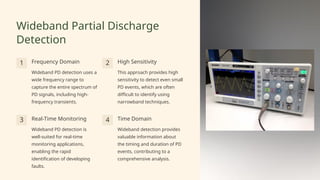
Wideband Partial Discharge
Detection
1 Frequency Domain
Wideband PD detection uses a
wide frequency range to
capture the entire spectrum of
PD signals, including high-
frequency transients.
2 High Sensitivity
This approach provides high
sensitivity to detect even small
PD events, which are often
difficult to identify using
narrowband techniques.
3 Real-Time Monitoring
Wideband PD detection is
well-suited for real-time
monitoring applications,
enabling the rapid
identification of developing
faults.
4 Time Domain
Wideband detection provides
valuable information about
the timing and duration of PD
events, contributing to a
comprehensive analysis.
Narrowband Partial Discharge Detection
Specific Frequencies
Narrowband PD detection focuses
on specific frequency ranges,
typically targeting the resonant
frequencies of the equipment
under test.
Targeted Analysis
This technique is effective for
analyzing specific types of PD
phenomena, such as corona
discharges or surface discharges.
Simplified Interpretation
The limited frequency range can
simplify the interpretation of PD
signals, facilitating a focused
analysis of the data.
Comparison of Wideband
and Narrowband
Techniques
Characteristic Wideband Narrowband
Frequency Range Wide Narrow
Sensitivity High Lower
Real-Time
Monitoring
Suitable Less Suitable
Data Interpretation Complex Simpler
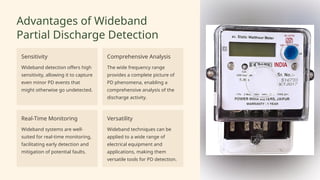
Advantages of Wideband
Partial Discharge Detection
Sensitivity
Wideband detection offers high
sensitivity, allowing it to capture
even minor PD events that
might otherwise go undetected.
Comprehensive Analysis
The wide frequency range
provides a complete picture of
PD phenomena, enabling a
comprehensive analysis of the
discharge activity.
Real-Time Monitoring
Wideband systems are well-
suited for real-time monitoring,
facilitating early detection and
mitigation of potential faults.
Versatility
Wideband techniques can be
applied to a wide range of
electrical equipment and
applications, making them
versatile tools for PD detection.
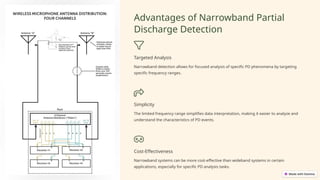
Advantages of Narrowband Partial
Discharge Detection
Targeted Analysis
Narrowband detection allows for focused analysis of specific PD phenomena by targeting
specific frequency ranges.
Simplicity
The limited frequency range simplifies data interpretation, making it easier to analyze and
understand the characteristics of PD events.
Cost-Effectiveness
Narrowband systems can be more cost-effective than wideband systems in certain
applications, especially for specific PD analysis tasks.
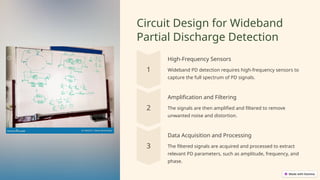
Circuit Design for Wideband
Partial Discharge Detection
High-Frequency Sensors
Wideband PD detection requires high-frequency sensors to
capture the full spectrum of PD signals.
Amplification and Filtering
The signals are then amplified and filtered to remove
unwanted noise and distortion.
Data Acquisition and Processing
The filtered signals are acquired and processed to extract
relevant PD parameters, such as amplitude, frequency, and
phase.
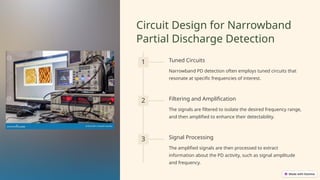
Circuit Design for Narrowband
Partial Discharge Detection
1 Tuned Circuits
Narrowband PD detection often employs tuned circuits that
resonate at specific frequencies of interest.
2 Filtering and Amplification
The signals are filtered to isolate the desired frequency range,
and then amplified to enhance their detectability.
3 Signal Processing
The amplified signals are then processed to extract
information about the PD activity, such as signal amplitude
and frequency.
Practical Considerations in Partial Discharge
Measurement
Interference
External interference from other electrical sources can affect
PD measurements. It is important to minimize interference
through proper grounding and shielding techniques.
Safety
High-voltage electrical equipment poses a safety hazard. It is
crucial to take appropriate precautions to ensure the safety of
personnel during PD measurements.
Conclusion and Summary
Wideband and narrowband PD detection techniques offer distinct advantages and are valuable tools for monitoring
the health of electrical equipment. The choice of technique depends on the specific application, the type of PD
phenomena being investigated, and the required level of detail in the analysis.

Partial-Discharge-Detection Partial-Discharge-Detection Partial-Discharge-Detection

  • 1.
    Partial Discharge Detection Partial Discharge(PD) is a localized electrical discharge that occurs in a dielectric material under high voltage stress. It is a precursor to insulation breakdown and can be a sign of impending failure in electrical equipment. by Mrs. Rachna Tyagi
  • 2.
    Wideband Partial Discharge Detection 1Frequency Domain Wideband PD detection uses a wide frequency range to capture the entire spectrum of PD signals, including high- frequency transients. 2 High Sensitivity This approach provides high sensitivity to detect even small PD events, which are often difficult to identify using narrowband techniques. 3 Real-Time Monitoring Wideband PD detection is well-suited for real-time monitoring applications, enabling the rapid identification of developing faults. 4 Time Domain Wideband detection provides valuable information about the timing and duration of PD events, contributing to a comprehensive analysis.
  • 3.
    Narrowband Partial DischargeDetection Specific Frequencies Narrowband PD detection focuses on specific frequency ranges, typically targeting the resonant frequencies of the equipment under test. Targeted Analysis This technique is effective for analyzing specific types of PD phenomena, such as corona discharges or surface discharges. Simplified Interpretation The limited frequency range can simplify the interpretation of PD signals, facilitating a focused analysis of the data.
  • 4.
    Comparison of Wideband andNarrowband Techniques Characteristic Wideband Narrowband Frequency Range Wide Narrow Sensitivity High Lower Real-Time Monitoring Suitable Less Suitable Data Interpretation Complex Simpler
  • 5.
    Advantages of Wideband PartialDischarge Detection Sensitivity Wideband detection offers high sensitivity, allowing it to capture even minor PD events that might otherwise go undetected. Comprehensive Analysis The wide frequency range provides a complete picture of PD phenomena, enabling a comprehensive analysis of the discharge activity. Real-Time Monitoring Wideband systems are well- suited for real-time monitoring, facilitating early detection and mitigation of potential faults. Versatility Wideband techniques can be applied to a wide range of electrical equipment and applications, making them versatile tools for PD detection.
  • 6.
    Advantages of NarrowbandPartial Discharge Detection Targeted Analysis Narrowband detection allows for focused analysis of specific PD phenomena by targeting specific frequency ranges. Simplicity The limited frequency range simplifies data interpretation, making it easier to analyze and understand the characteristics of PD events. Cost-Effectiveness Narrowband systems can be more cost-effective than wideband systems in certain applications, especially for specific PD analysis tasks.
  • 7.
    Circuit Design forWideband Partial Discharge Detection High-Frequency Sensors Wideband PD detection requires high-frequency sensors to capture the full spectrum of PD signals. Amplification and Filtering The signals are then amplified and filtered to remove unwanted noise and distortion. Data Acquisition and Processing The filtered signals are acquired and processed to extract relevant PD parameters, such as amplitude, frequency, and phase.
  • 8.
    Circuit Design forNarrowband Partial Discharge Detection 1 Tuned Circuits Narrowband PD detection often employs tuned circuits that resonate at specific frequencies of interest. 2 Filtering and Amplification The signals are filtered to isolate the desired frequency range, and then amplified to enhance their detectability. 3 Signal Processing The amplified signals are then processed to extract information about the PD activity, such as signal amplitude and frequency.
  • 9.
    Practical Considerations inPartial Discharge Measurement Interference External interference from other electrical sources can affect PD measurements. It is important to minimize interference through proper grounding and shielding techniques. Safety High-voltage electrical equipment poses a safety hazard. It is crucial to take appropriate precautions to ensure the safety of personnel during PD measurements.
  • 10.
    Conclusion and Summary Widebandand narrowband PD detection techniques offer distinct advantages and are valuable tools for monitoring the health of electrical equipment. The choice of technique depends on the specific application, the type of PD phenomena being investigated, and the required level of detail in the analysis.