A Computational
  Model of Staged
Language Acquisition
         JACK, Kris
DRT/FAR/LIST/DTSI/SRCI/LIC2M

   MrKrisJack@gmail.com
A Computational
  Model of Staged
Language Acquisition
                       Introduction
 Introduction          ●   Children appear to acquire language effortlessly
 Child Language            ● They do not, however, do so overnight
 Models
                           ● Typically, they progress through stages of
 LAT
 Testing                     linguistic development
 Results               ●   Computational modelling can help us to better
 Discussion                understand the language acquisition process by
 Conclusions               estimating the problem and developing possible
                           solutions
                           ●A computational model that tackles such staged
                            linguistic development is absent from current
                            literature
                       ●   Overview of presentation


 Kris Jack
A Computational
  Model of Staged
Language Acquisition
                       Stages in Language Acquisition
 Introduction          ●   How does child language typically develop?
 Child Language        ●   Language acquisition is consistently described in
 ➢ Pre-linguistic
 ➢ Holophrastic
                           stages (e.g. Brown, Pinker, Tomasello)
 ➢ Early Multi-word

 ➢ Late Multi-word
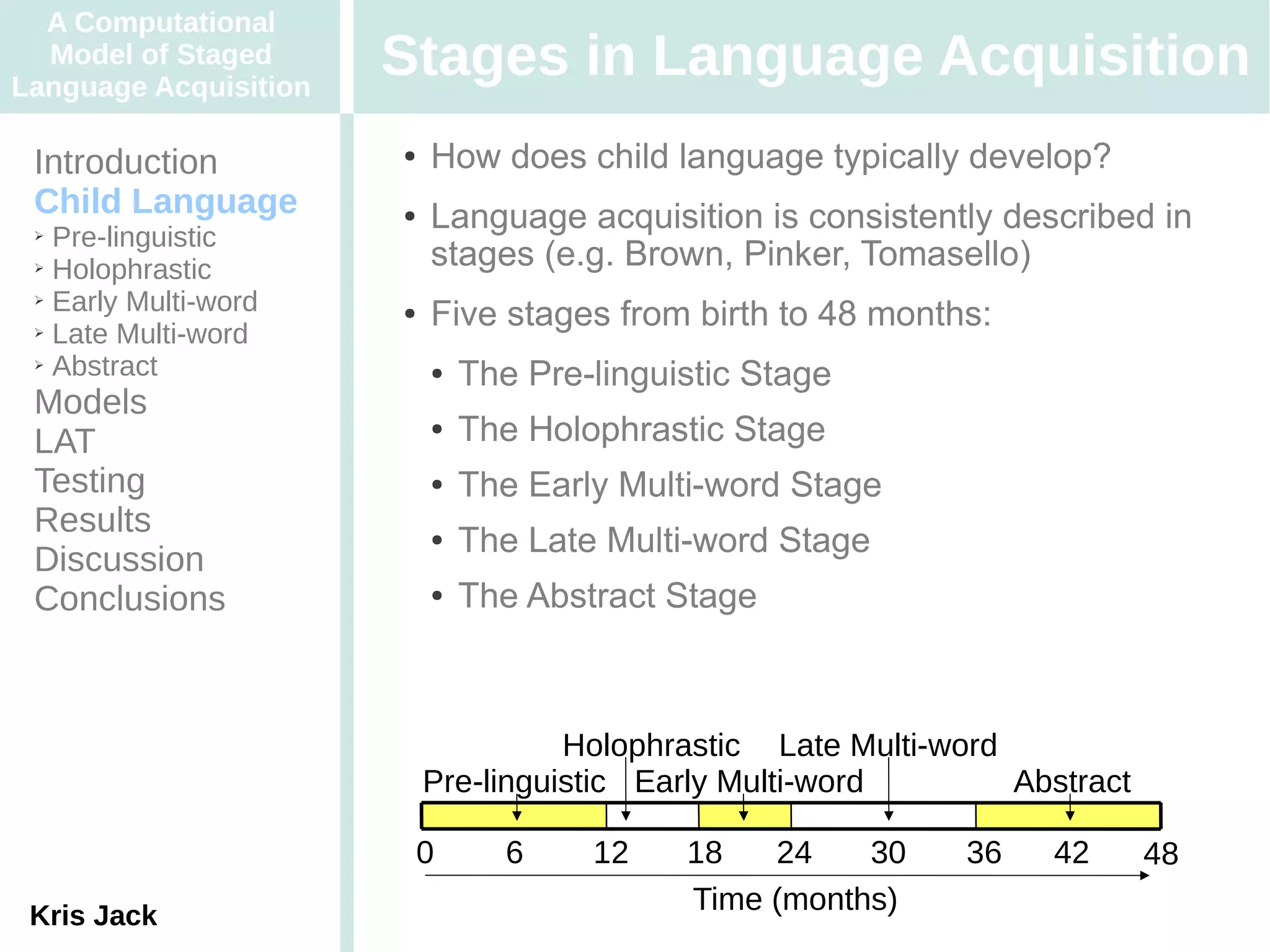
                       ●   Five stages from birth to 48 months:
 ➢ Abstract
                           ●   The Pre-linguistic Stage
 Models
 LAT
                           ●   The Holophrastic Stage
 Testing                   ●   The Early Multi-word Stage
 Results                   ●   The Late Multi-word Stage
 Discussion
 Conclusions               ●   The Abstract Stage


                                     Holophrastic Late Multi-word
                           Pre-linguistic Early Multi-word        Abstract

                           0      6    12    18   24    30     36   42       48
 Kris Jack
                                             Time (months)
A Computational
  Model of Staged
Language Acquisition
                       The Pre-linguistic Stage (1/2)
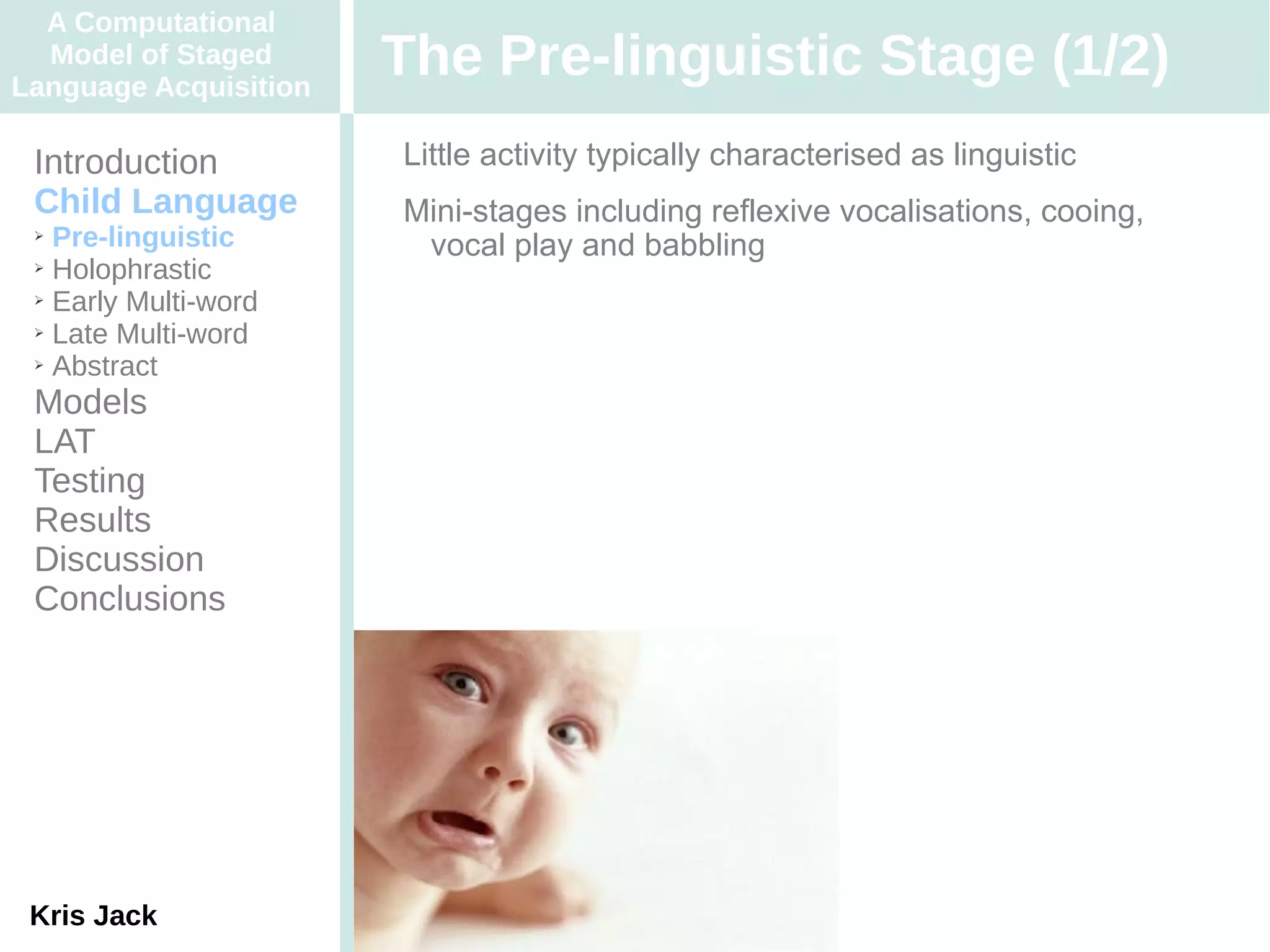
 Introduction          Little activity typically characterised as linguistic
 Child Language        Mini-stages including reflexive vocalisations, cooing,
 ➢ Pre-linguistic       vocal play and babbling
 ➢ Holophrastic

 ➢ Early Multi-word

 ➢ Late Multi-word

 ➢ Abstract


 Models
 LAT
 Testing
 Results
 Discussion
 Conclusions


 Kris Jack
A Computational
  Model of Staged
Language Acquisition
                       The Pre-linguistic Stage (2/2)
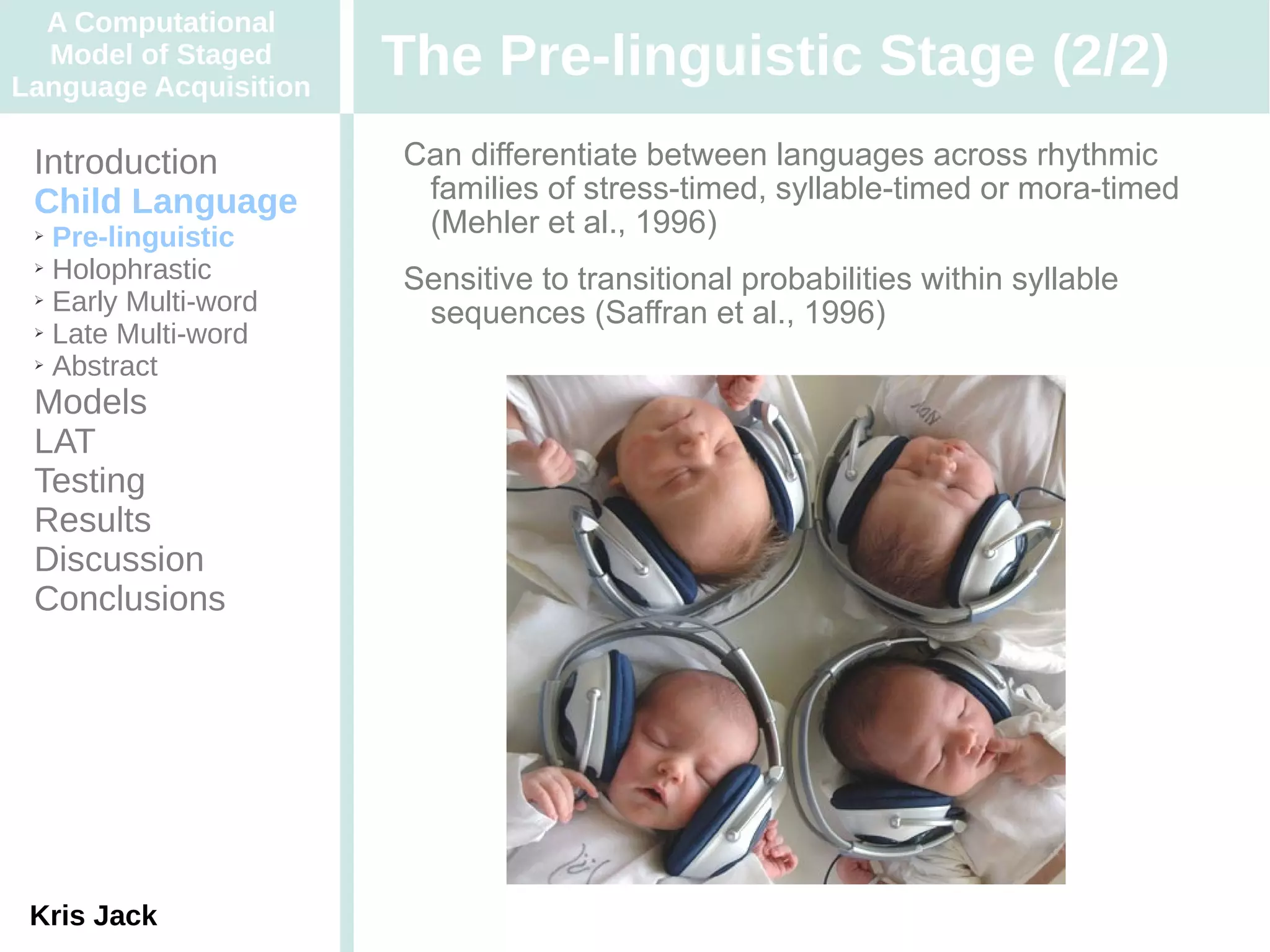
 Introduction          Can differentiate between languages across rhythmic
 Child Language         families of stress-timed, syllable-timed or mora-timed
 ➢ Pre-linguistic       (Mehler et al., 1996)
 ➢ Holophrastic

 ➢ Early Multi-word
                       Sensitive to transitional probabilities within syllable
 ➢ Late Multi-word
                        sequences (Saffran et al., 1996)
 ➢ Abstract


 Models
 LAT
 Testing
 Results
 Discussion
 Conclusions


 Kris Jack
A Computational
  Model of Staged
Language Acquisition
                       The Holophrastic Stage (1/2)
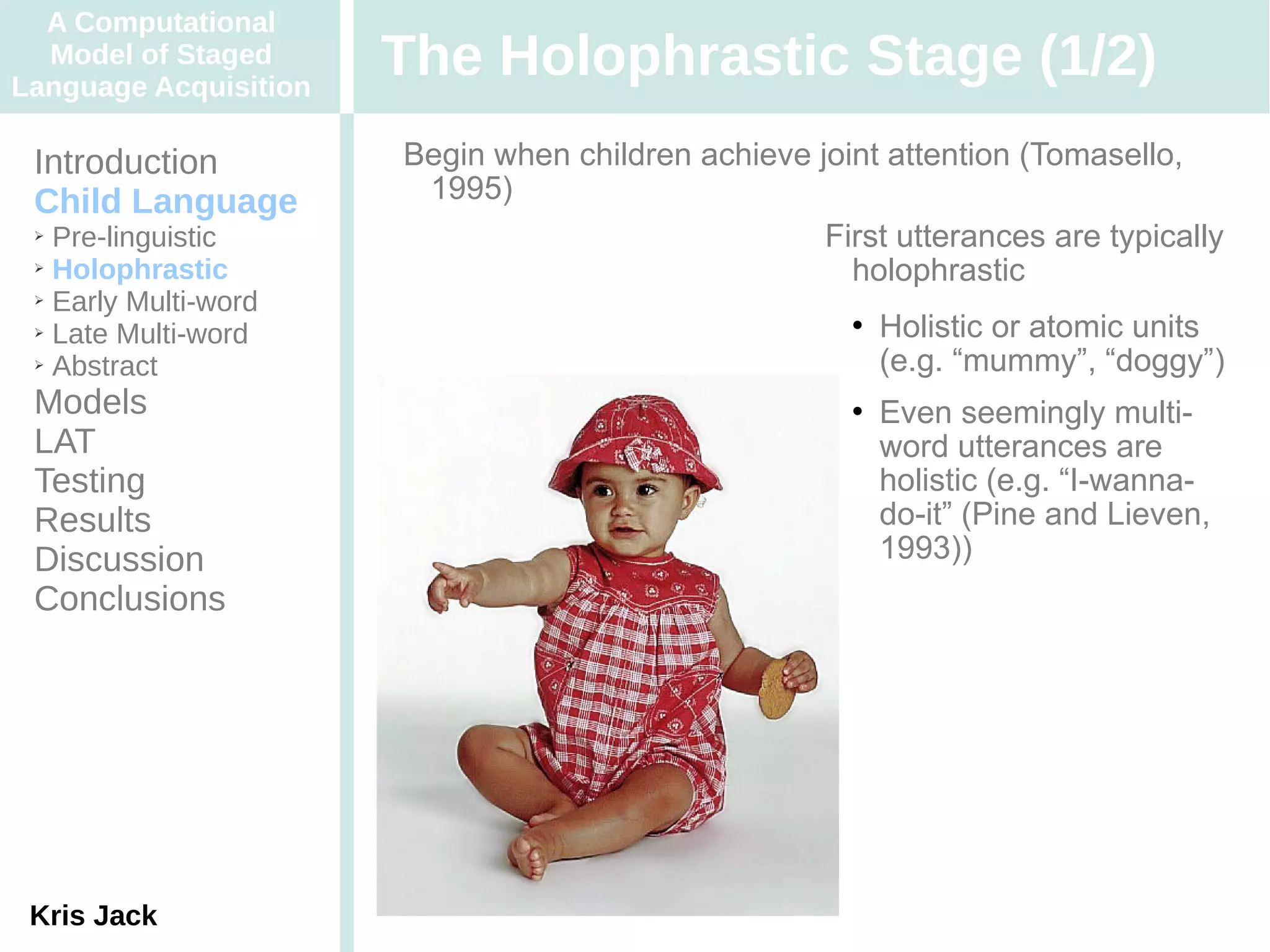
 Introduction          Begin when children achieve joint attention (Tomasello,
 Child Language         1995)
 ➢ Pre-linguistic                                   First utterances are typically
 ➢ Holophrastic
                                                      holophrastic
 ➢ Early Multi-word

 ➢ Late Multi-word
                                                          Holistic or atomic units
 ➢ Abstract                                                (e.g. “mummy”, “doggy”)
 Models                                                   Even seemingly multi-
 LAT                                                       word utterances are
 Testing                                                   holistic (e.g. “I-wanna-
 Results                                                   do-it” (Pine and Lieven,
 Discussion                                                1993))
 Conclusions


 Kris Jack
A Computational
  Model of Staged
Language Acquisition
                       The Holophrastic Stage (2/2)
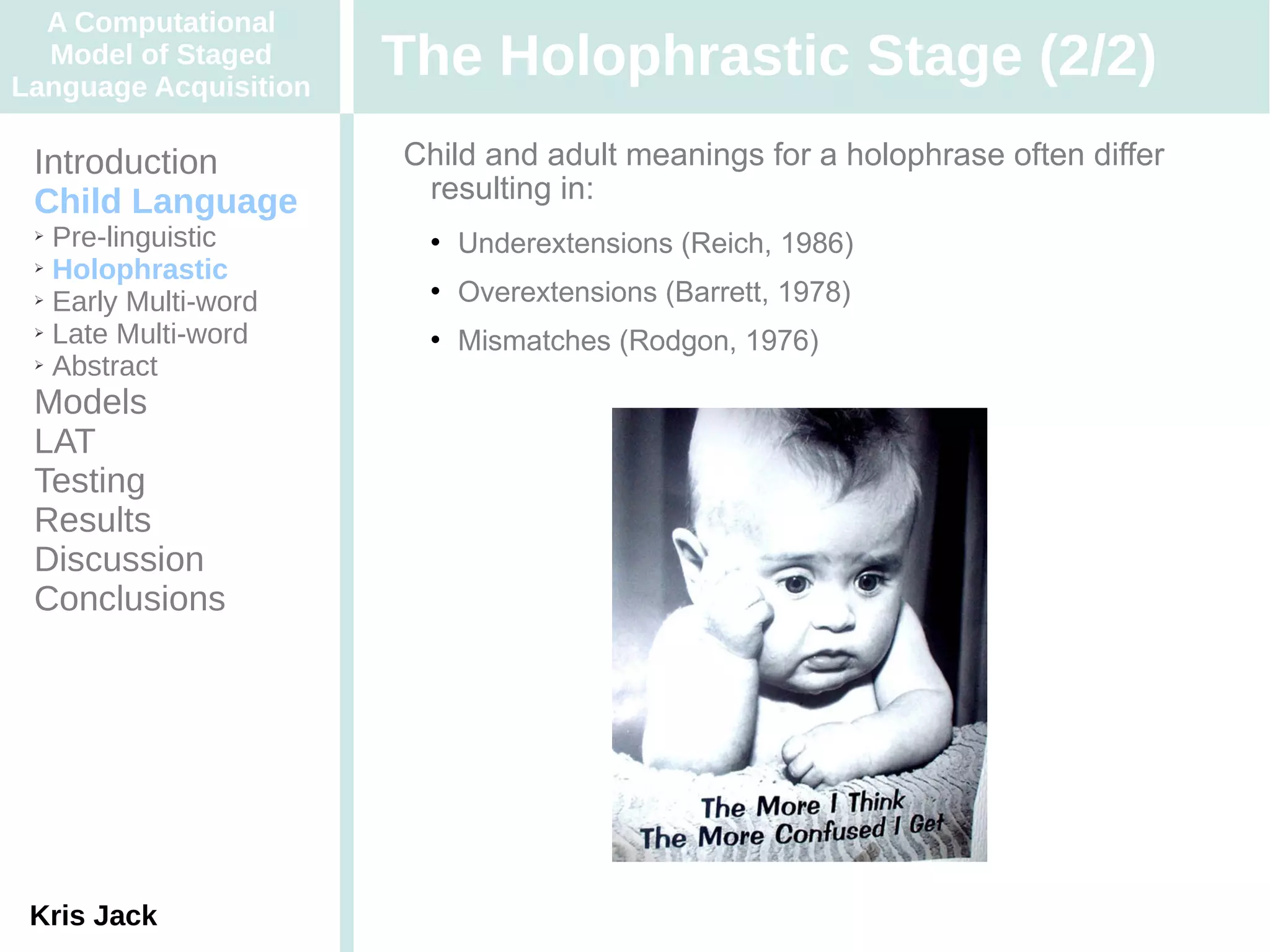
 Introduction          Child and adult meanings for a holophrase often differ
 Child Language         resulting in:
 ➢ Pre-linguistic          Underextensions (Reich, 1986)
 ➢ Holophrastic

 ➢ Early Multi-word
                           Overextensions (Barrett, 1978)
 ➢ Late Multi-word
                           Mismatches (Rodgon, 1976)
 ➢ Abstract


 Models
 LAT
 Testing
 Results
 Discussion
 Conclusions


 Kris Jack
A Computational
  Model of Staged
Language Acquisition
                       The Early Multi-word Stage
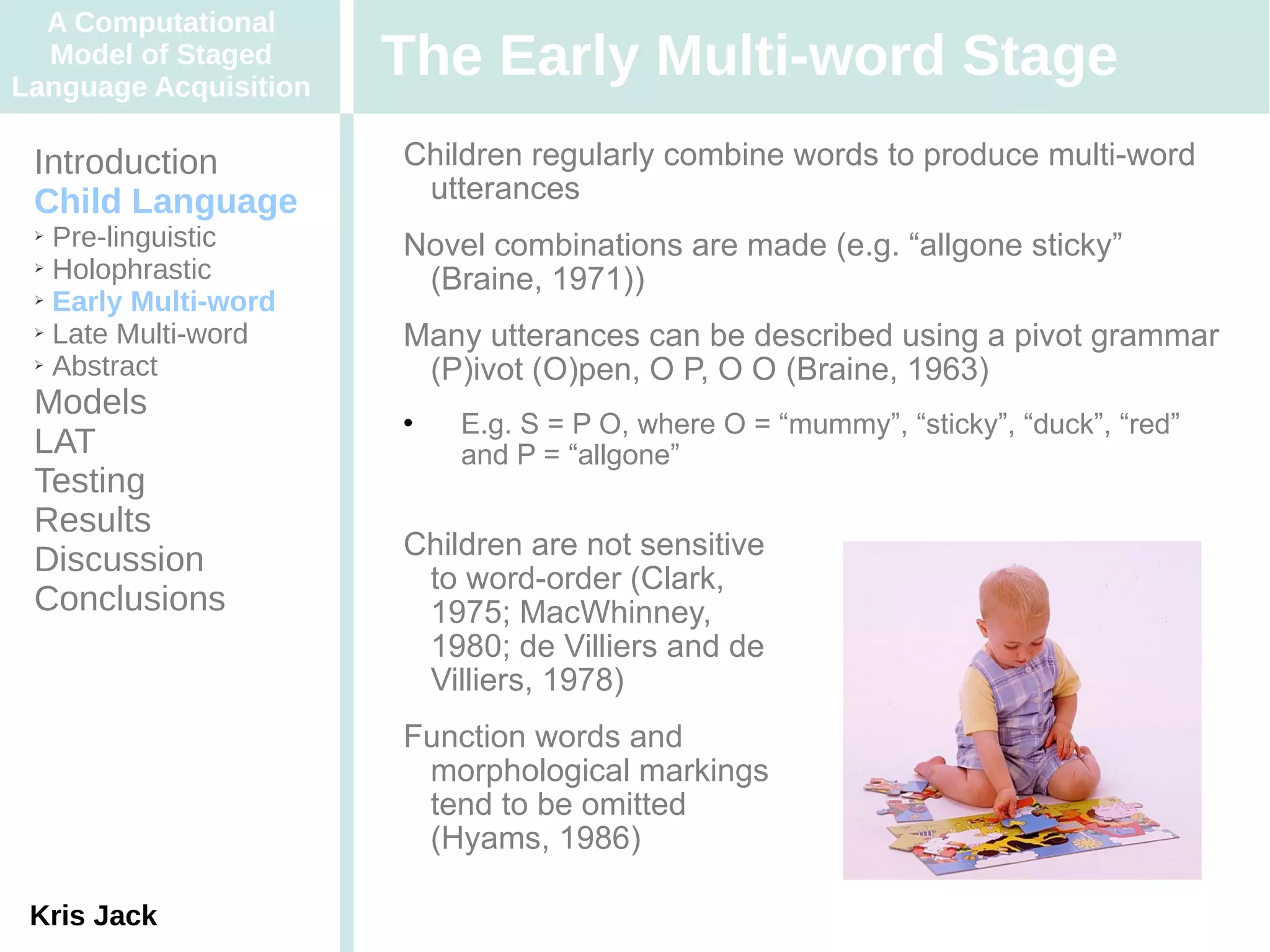
 Introduction          Children regularly combine words to produce multi-word
 Child Language         utterances
 ➢ Pre-linguistic      Novel combinations are made (e.g. “allgone sticky”
 ➢ Holophrastic

 ➢ Early Multi-word
                        (Braine, 1971))
 ➢ Late Multi-word
                       Many utterances can be described using a pivot grammar
 ➢ Abstract
                        (P)ivot (O)pen, O P, O O (Braine, 1963)
 Models                   E.g. S = P O, where O = “mummy”, “sticky”, “duck”, “red”
 LAT                       and P = “allgone”
 Testing
 Results
                       Children are not sensitive
 Discussion
                        to word-order (Clark,
 Conclusions            1975; MacWhinney,
                        1980; de Villiers and de
                        Villiers, 1978)
                       Function words and
                        morphological markings
                        tend to be omitted
                        (Hyams, 1986)

 Kris Jack
A Computational
  Model of Staged
Language Acquisition
                       The Late Multi-word Stage
 Introduction          Child language becomes increasingly complex
 Child Language        The emergence of syntactic awareness
 ➢ Pre-linguistic
 ➢ Holophrastic        In English, word-order can define participant roles e.g.
 ➢ Early Multi-word
                         “Make the doggie bite the cat” (de Villiers and de
 ➢ Late Multi-word
                         Villiers, 1973)
 ➢ Abstract


 Models                Children are found to have an irregular, item-based,
                        knowledge of language:
 LAT
 Testing                   Verb islands (Tomasello, 1992)
 Results                   Inconsistent use of determiners (Pine and Lieven, 1997)
 Discussion
 Conclusions


 Kris Jack
A Computational
  Model of Staged
Language Acquisition
                       The Abstract Stage
 Introduction          Evidence of all of the grammatical machinery found in
 Child Language         adults (Pinker, 1994)
 ➢ Pre-linguistic      The item-specific quality of child language gives way to a
 ➢ Holophrastic

 ➢ Early Multi-word
                        more abstract quality (Tomasello, 2003)
 ➢ Late Multi-word
                       Strong generative capacity asserts itself
 ➢ Abstract


 Models
 LAT
 Testing
 Results
 Discussion
 Conclusions


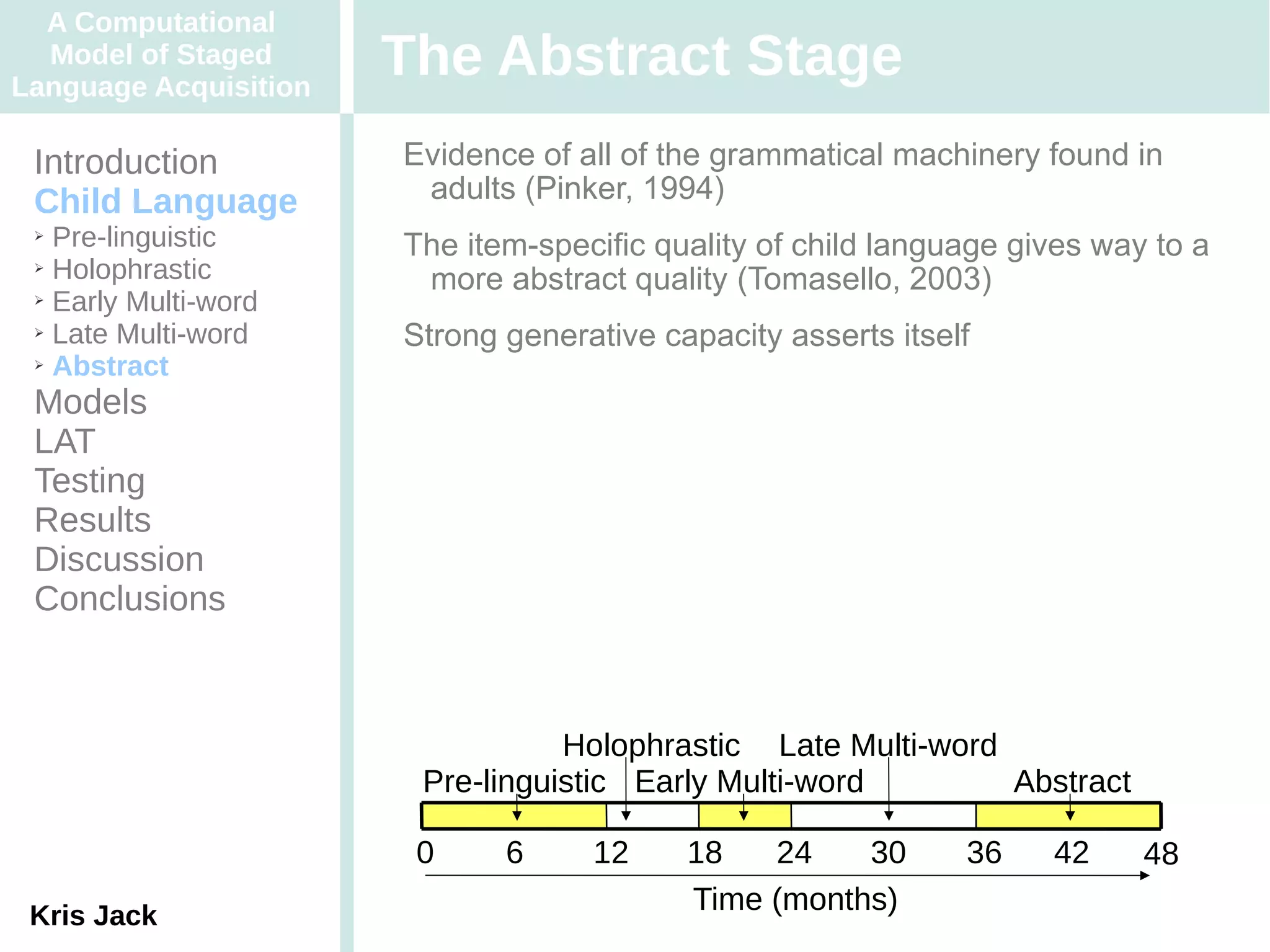
                                  Holophrastic Late Multi-word
                        Pre-linguistic Early Multi-word        Abstract

                        0     6     12     18   24    30       36    42     48
 Kris Jack
                                           Time (months)
A Computational
  Model of Staged
Language Acquisition
                       Stages Summary
 Introduction          ●   Pre-linguistic Stage
 Child Language                –   little real linguistic activity
 ➢ Pre-linguistic
 ➢ Holophrastic        ●   Holophrastic Stage
 ➢ Early Multi-word

 ➢ Late Multi-word             –   first words
 ➢ Abstract
                       ●   Early Multi-word Stage
 Models
 LAT                           –   first word combinations
 Testing               ●   Late Multi-word Stage
 Results
 Discussion                    –   word combinations with syntax
 Conclusions           ●   Abstract Stage
                               –   strong generative capacity

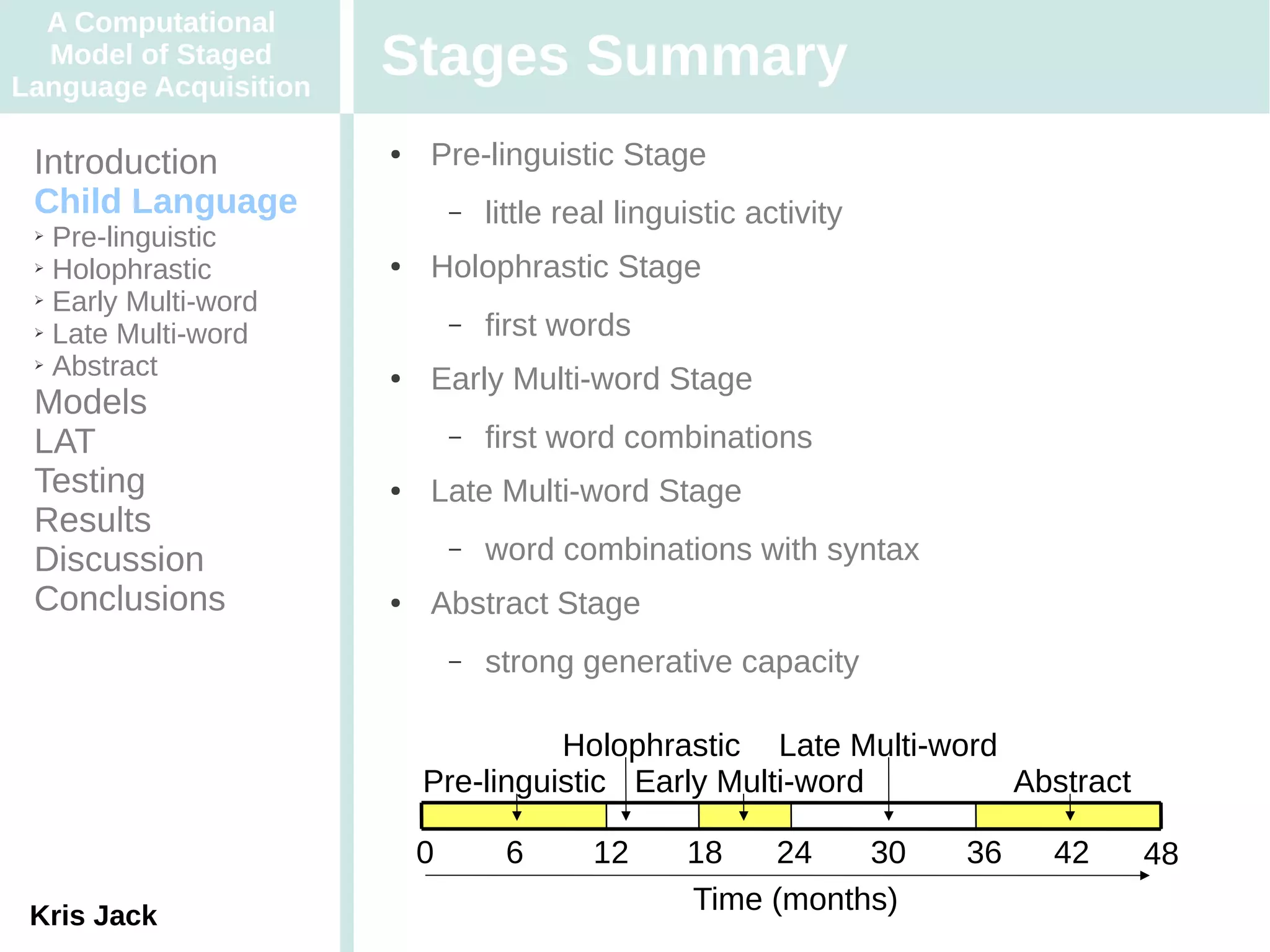
                                     Holophrastic Late Multi-word
                           Pre-linguistic Early Multi-word        Abstract

                           0        6       12      18   24    30    36   42   48
 Kris Jack
                                                    Time (months)
A Computational
  Model of Staged
Language Acquisition
                       Goals
 Introduction          ●   What triggers the emergence of each stage?
 Child Language        ●   What accounts for the linguistic shape of each
 ➢ Pre-linguistic
 ➢ Holophrastic            stage?
 ➢ Early Multi-word

 ➢ Late Multi-word

 ➢ Abstract


 Models
 LAT
 Testing
 Results
 Discussion            ●   We can produce computational models that
 Conclusions               estimate learning tasks faced by children to help
                           us better understand the problem


 Kris Jack
A Computational
  Model of Staged
Language Acquisition
                       Language Models (1/2)
 Introduction          Many computational models have been produced to
 Child Language         study language learning
 Models                The Miniature Language Acquisition Paradigm
 ➢ Data Filtering
 ➢ Incremental
                        (Feldman et al., 1990)
 ➢ Iterated
                           Place a computational model in an environment with
 LAT                        access to visual and acoustic stimuli (simulated or
 Testing                    grounded)
 Results                   Train the model by providing descriptions of visually-
 Discussion                 based scenes from a miniature language (e.g. “the
 Conclusions                red square is on top of the green circle”)
                           The model is said to have acquired the language
                            when it can both comprehend and produce all
                            sentences within the miniature language


 Kris Jack
A Computational
  Model of Staged
Language Acquisition
                       Language Models (2/2)
 Introduction          A computational model that demonstrates stage
 Child Language         transitions from the Pre-linguistic Stage to the
 Models                 Abstract Stage is missing from current literature
 ➢ Data Filtering
 ➢ Incremental
                       Some models demonstrate stage-like learning by:
 ➢ Iterated
                          Externally modifying the training data
 LAT
 Testing
                          Modifying the functionality of the model
 Results                  Internally modifying the training data
 Discussion
 Conclusions


 Kris Jack
A Computational
  Model of Staged
Language Acquisition
                       Temporal Data Filtering
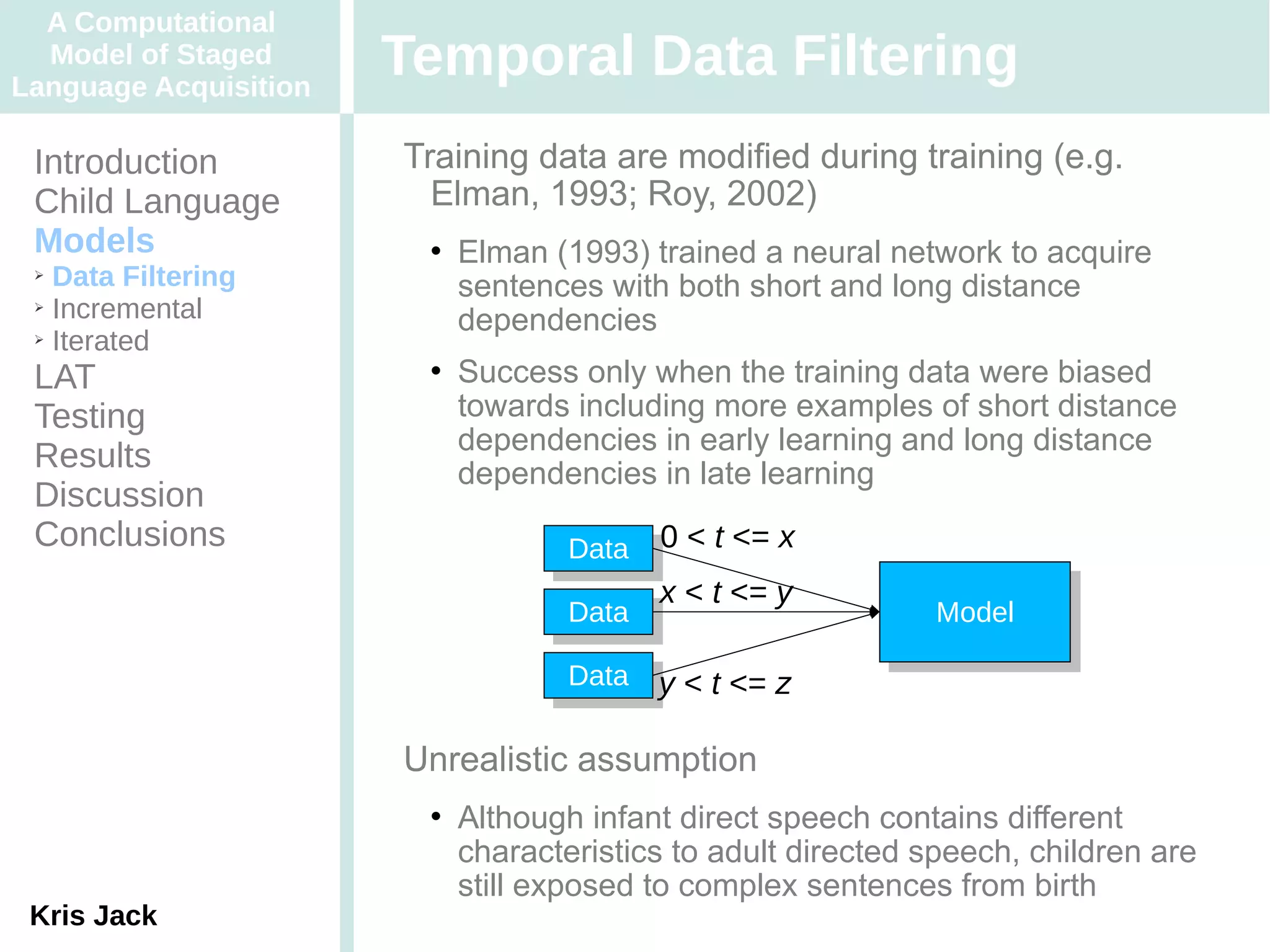
 Introduction          Training data are modified during training (e.g.
 Child Language          Elman, 1993; Roy, 2002)
 Models                    Elman (1993) trained a neural network to acquire
 ➢ Data Filtering           sentences with both short and long distance
 ➢ Incremental

 ➢ Iterated
                            dependencies
 LAT                       Success only when the training data were biased
 Testing                    towards including more examples of short distance
                            dependencies in early learning and long distance
 Results                    dependencies in late learning
 Discussion
 Conclusions                        Data 0 < t <= x
                                    Data
                                           x < t <= y
                                    Data
                                    Data                      Model
                                                              Model
                                    Data y < t <= z
                                    Data

                       Unrealistic assumption
                           Although infant direct speech contains different
                            characteristics to adult directed speech, children are
                            still exposed to complex sentences from birth
 Kris Jack
A Computational
  Model of Staged
Language Acquisition
                       Incremental Learning
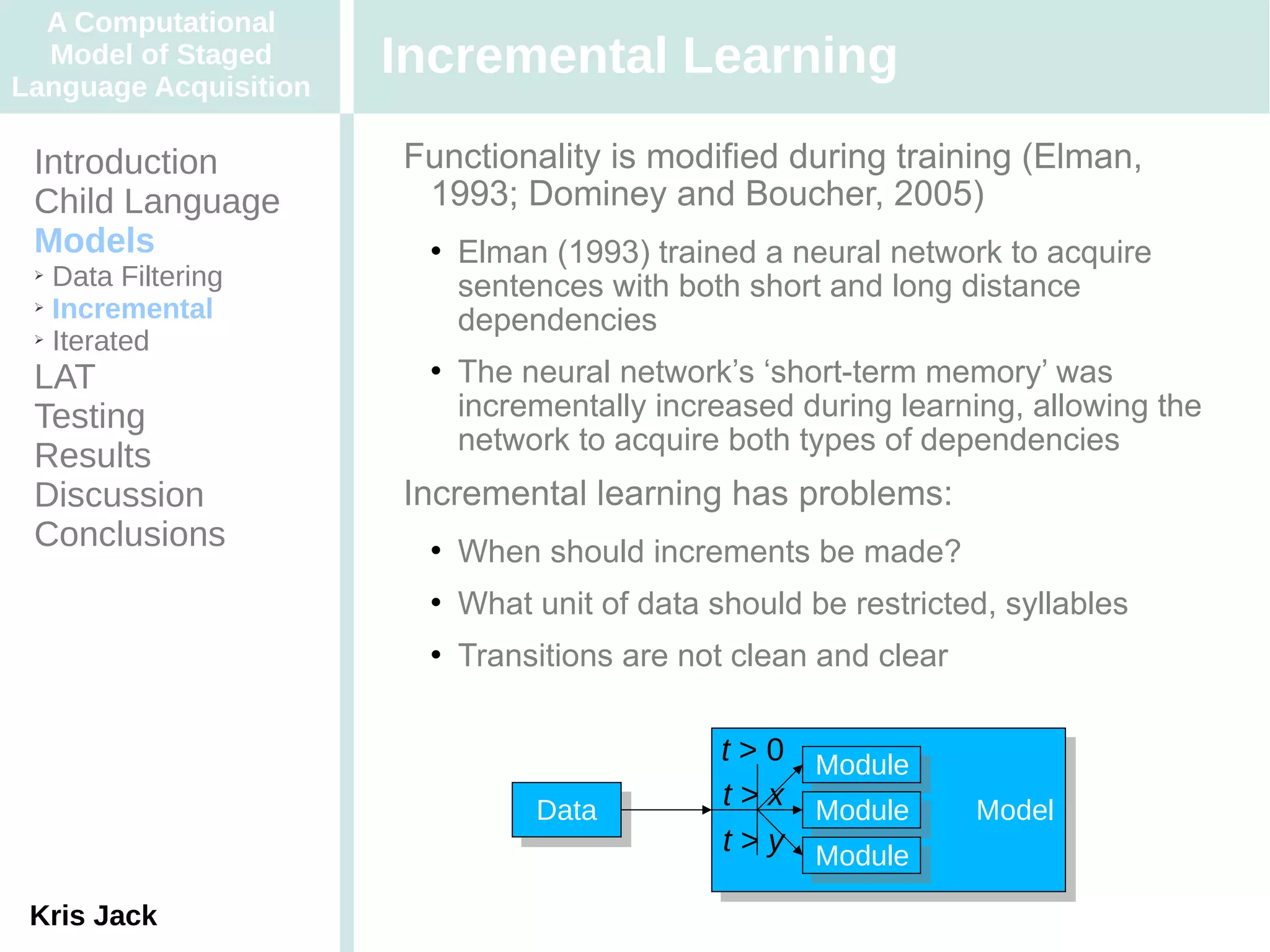
 Introduction          Functionality is modified during training (Elman,
 Child Language         1993; Dominey and Boucher, 2005)
 Models                    Elman (1993) trained a neural network to acquire
 ➢ Data Filtering           sentences with both short and long distance
 ➢ Incremental

 ➢ Iterated
                            dependencies
 LAT                       The neural network’s ‘short-term memory’ was
 Testing                    incrementally increased during learning, allowing the
                            network to acquire both types of dependencies
 Results
 Discussion            Incremental learning has problems:
 Conclusions               When should increments be made?
                           What unit of data should be restricted, syllables
                           Transitions are not clean and clear

                                               t > 0 Module
                                                     Module
                                 Data
                                               t > x Module       Model
                                 Data                Module       Model
                                               t > y Module
                                                      Module
 Kris Jack
A Computational
  Model of Staged
Language Acquisition
                       Iterated Learning
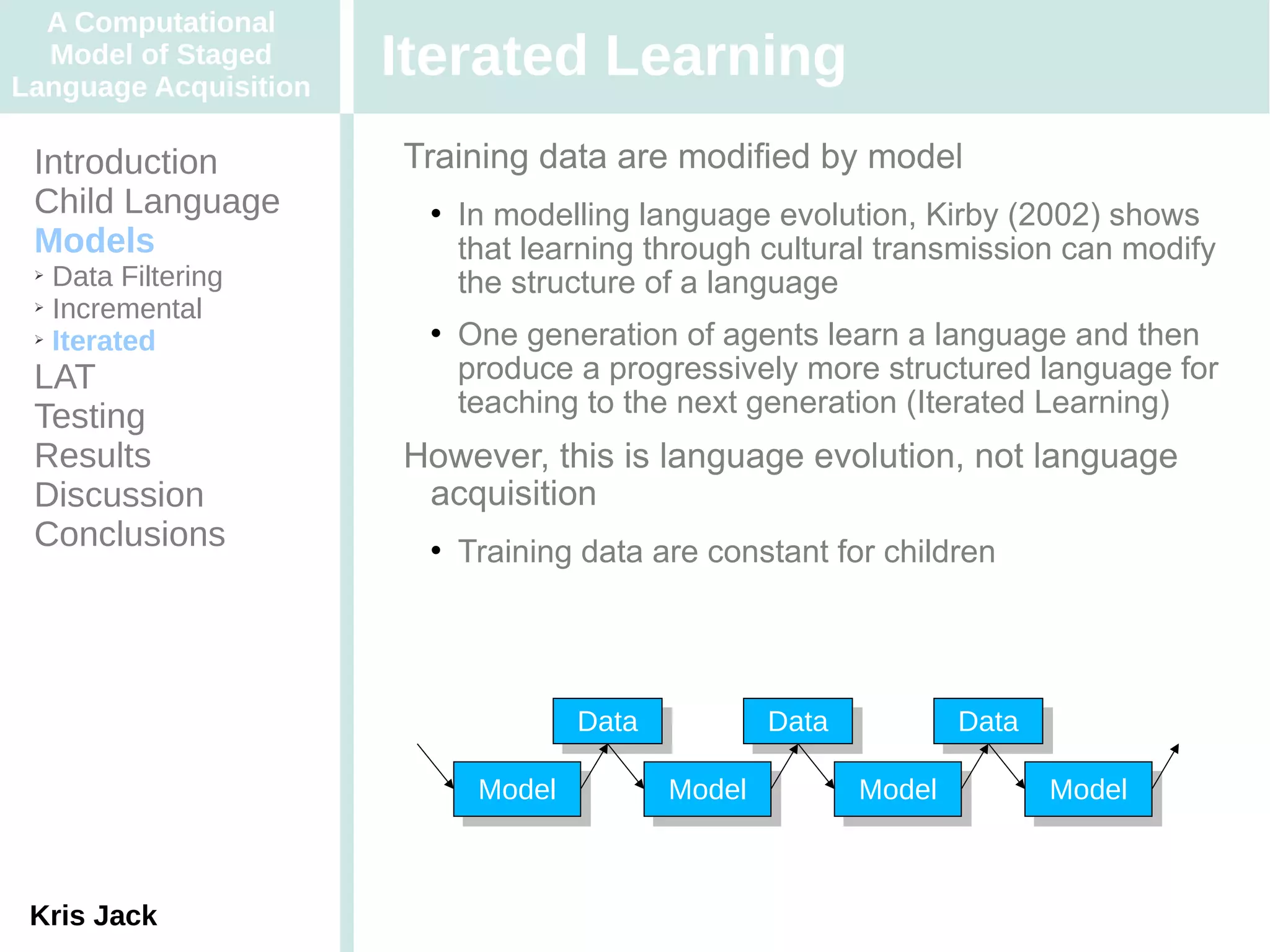
 Introduction          Training data are modified by model
 Child Language            In modelling language evolution, Kirby (2002) shows
 Models                     that learning through cultural transmission can modify
 ➢ Data Filtering           the structure of a language
 ➢ Incremental

 ➢ Iterated                One generation of agents learn a language and then
 LAT                        produce a progressively more structured language for
 Testing                    teaching to the next generation (Iterated Learning)
 Results               However, this is language evolution, not language
 Discussion             acquisition
 Conclusions               Training data are constant for children


                                     Data
                                     Data           Data
                                                    Data           Data
                                                                   Data

                             Model
                             Model          Model
                                            Model          Model
                                                           Model          Model
                                                                          Model


 Kris Jack
A Computational
  Model of Staged
Language Acquisition
                       Problem
 Introduction          Can we model the stages of language acquisition
 Child Language         when:
 Models                    The functionality of the model is kept constant AND
 ➢ Data Filtering
 ➢ Incremental             The training data provided to the model are constant?
 ➢ Iterated


 LAT
 Testing
 Results
 Discussion
 Conclusions


 Kris Jack
A Computational
  Model of Staged
Language Acquisition
                       Language Acquisition Toolkit
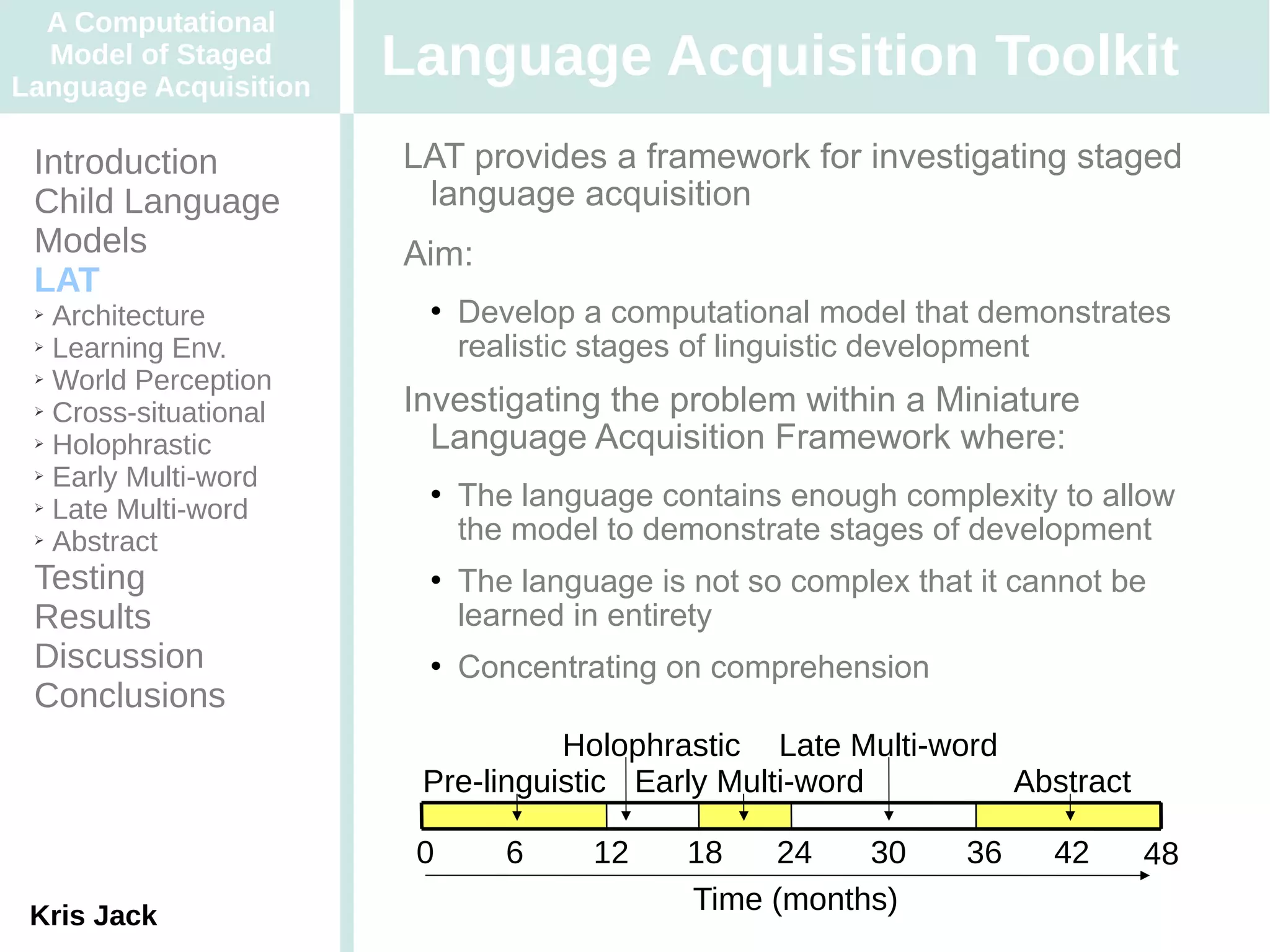
 Introduction          LAT provides a framework for investigating staged
 Child Language         language acquisition
 Models                Aim:
 LAT
 ➢ Architecture            Develop a computational model that demonstrates
 ➢ Learning Env.            realistic stages of linguistic development
 ➢ World Perception

 ➢ Cross-situational   Investigating the problem within a Miniature
 ➢ Holophrastic          Language Acquisition Framework where:
 ➢ Early Multi-word

 ➢ Late Multi-word
                           The language contains enough complexity to allow
 ➢ Abstract                 the model to demonstrate stages of development
 Testing                   The language is not so complex that it cannot be
 Results                    learned in entirety
 Discussion                Concentrating on comprehension
 Conclusions
                                  Holophrastic Late Multi-word
                        Pre-linguistic Early Multi-word        Abstract

                        0      6     12    18   24    30       36    42    48
 Kris Jack
                                           Time (months)
A Computational
  Model of Staged
Language Acquisition
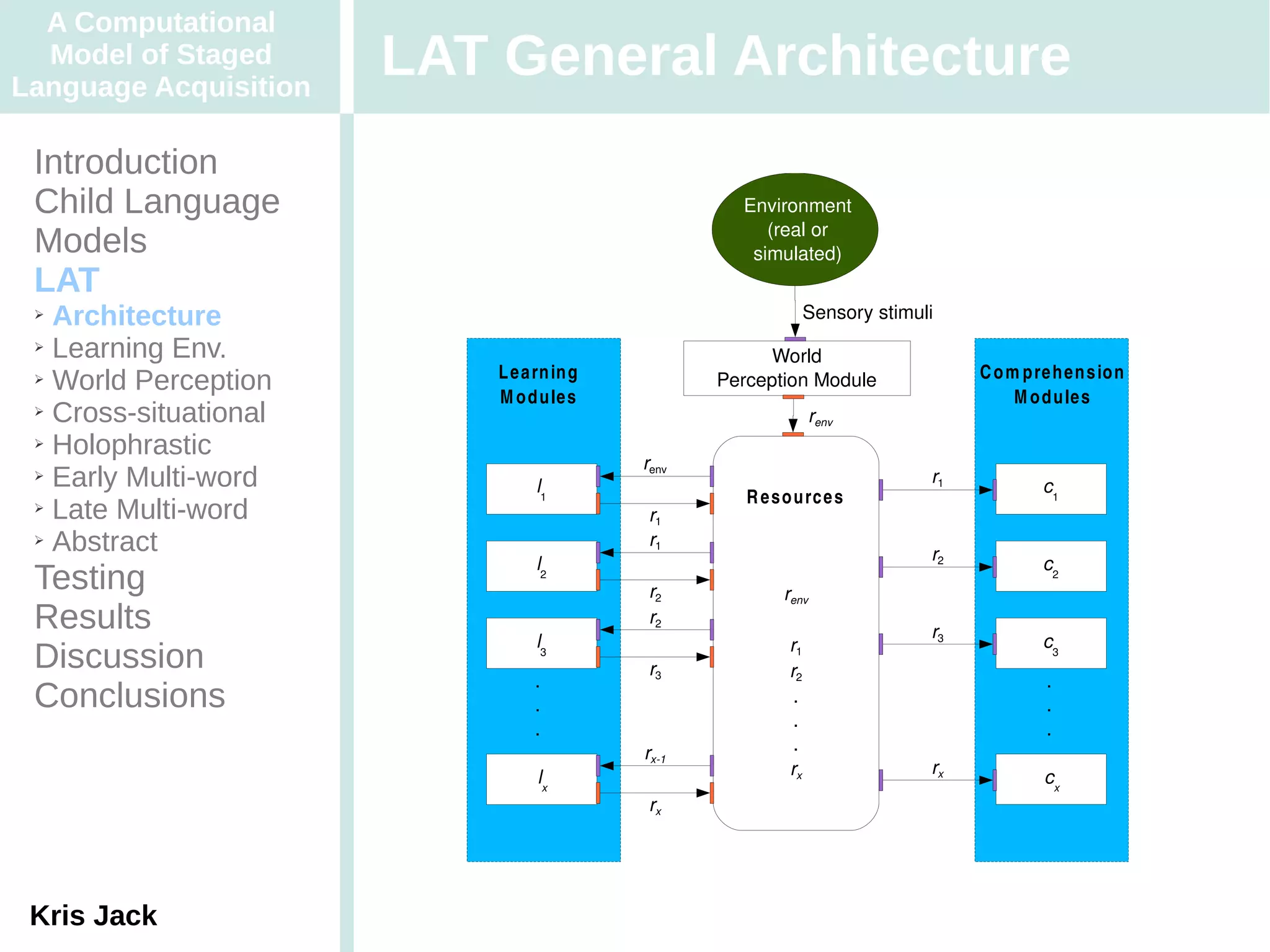
                       LAT General Architecture
 Introduction
 Child Language                                           Environment
                                                             (real or
 Models                                                    simulated)
 LAT
 ➢ Architecture                                                         Sensory stimuli
 ➢ Learning Env.
                                                            World
 ➢ World Perception        L e a rn in g              Perception Module                    C o m p re h e n s io n
                           M o d u le s                                                         M o d u le s
 ➢ Cross-situational                                                 renv
 ➢ Holophrastic
                                           renv
 ➢ Early Multi-word                                                                   r1
                                 l1                                                                  c1
 ➢ Late Multi-word
                                                          R e s o u rc e s
                                            r1
 ➢ Abstract                                 r1
                                                                                      r2
                                 l2                                                                  c2
 Testing                                    r2                  renv
 Results                                    r2
                                                                                      r3
                                 l3                              r1                                  c3
 Discussion                                 r3                   r2
                                .                                                                    .
 Conclusions                    .                                 .                                  .
                                .                                 .                                  .
                                           rx­1                   .
                                                                 rx                   rx
                                 lx                                                                  cx
                                            rx


 Kris Jack
A Computational
  Model of Staged
Language Acquisition
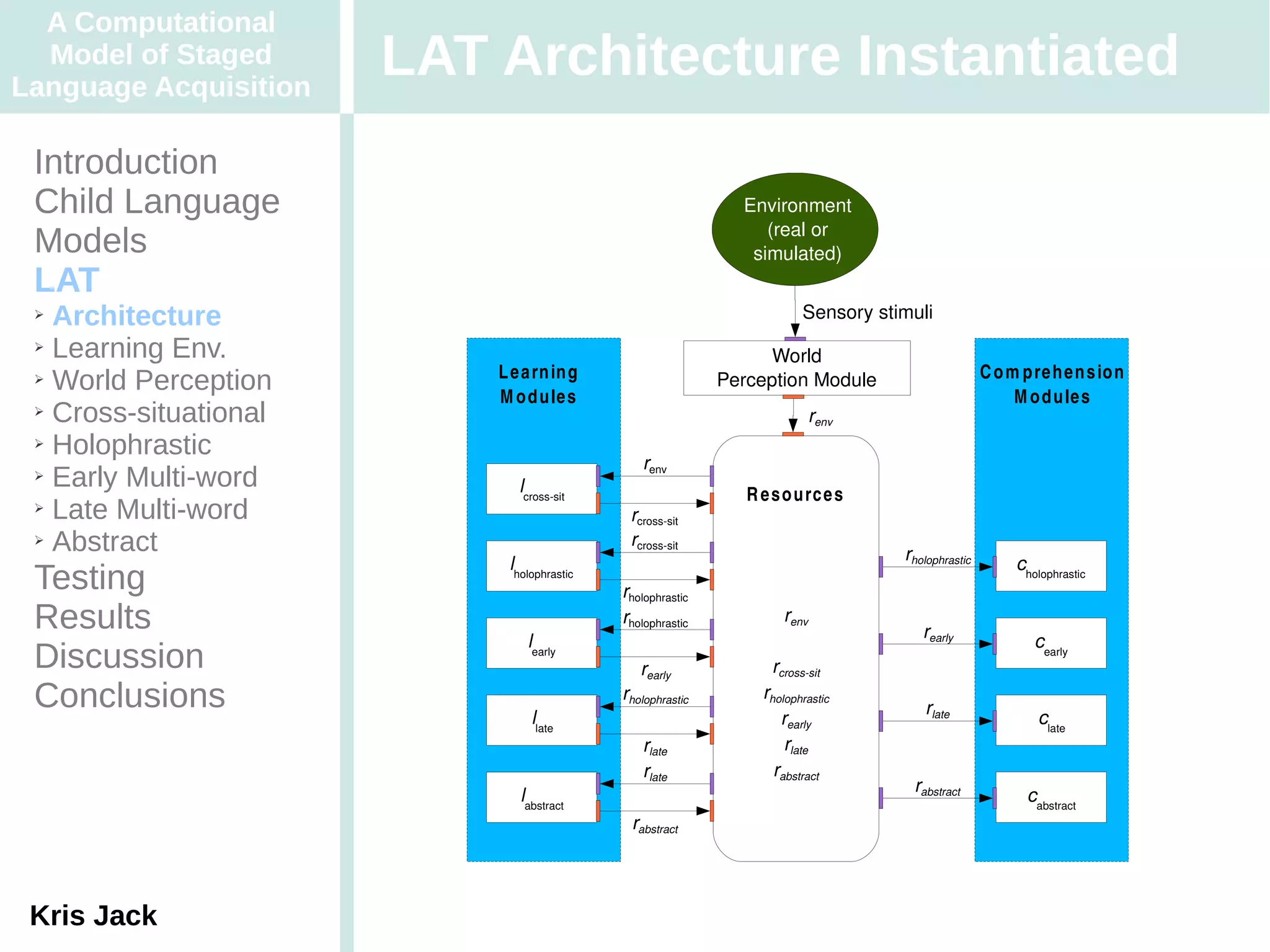
                       LAT Architecture Instantiated
 Introduction
 Child Language                                                 Environment
                                                                   (real or
 Models                                                          simulated)
 LAT
 ➢ Architecture                                                               Sensory stimuli
 ➢ Learning Env.
                                                                  World
 ➢ World Perception        L e a rn in g                    Perception Module                           C o m p re h e n s io n
                           M o d u le s                                                                      M o d u le s
 ➢ Cross-situational                                                       renv
 ➢ Holophrastic
                                                renv
 ➢ Early Multi-word
                              lcross­sit                        R e s o u rc e s
 ➢ Late Multi-word
                                             rcross­sit
 ➢ Abstract                                  rcross­sit
                                                                                        rholophrastic
                            lholophrastic                                                                    cholophrastic
 Testing                                    rholophrastic
 Results                                    rholophrastic              renv
                                                                                           rearly
                               learly                                                                           cearly
 Discussion                                    rearly               rcross­sit
 Conclusions                    llate
                                            rholophrastic          rholophrastic
                                                                      rearly
                                                                                            rlate
                                                                                                                 clate
                                                rlate                  rlate
                                                rlate                rabstract
                                                                                          rabstract
                              labstract                                                                        cabstract
                                             rabstract


 Kris Jack
A Computational
  Model of Staged
Language Acquisition
                       Learning Environment
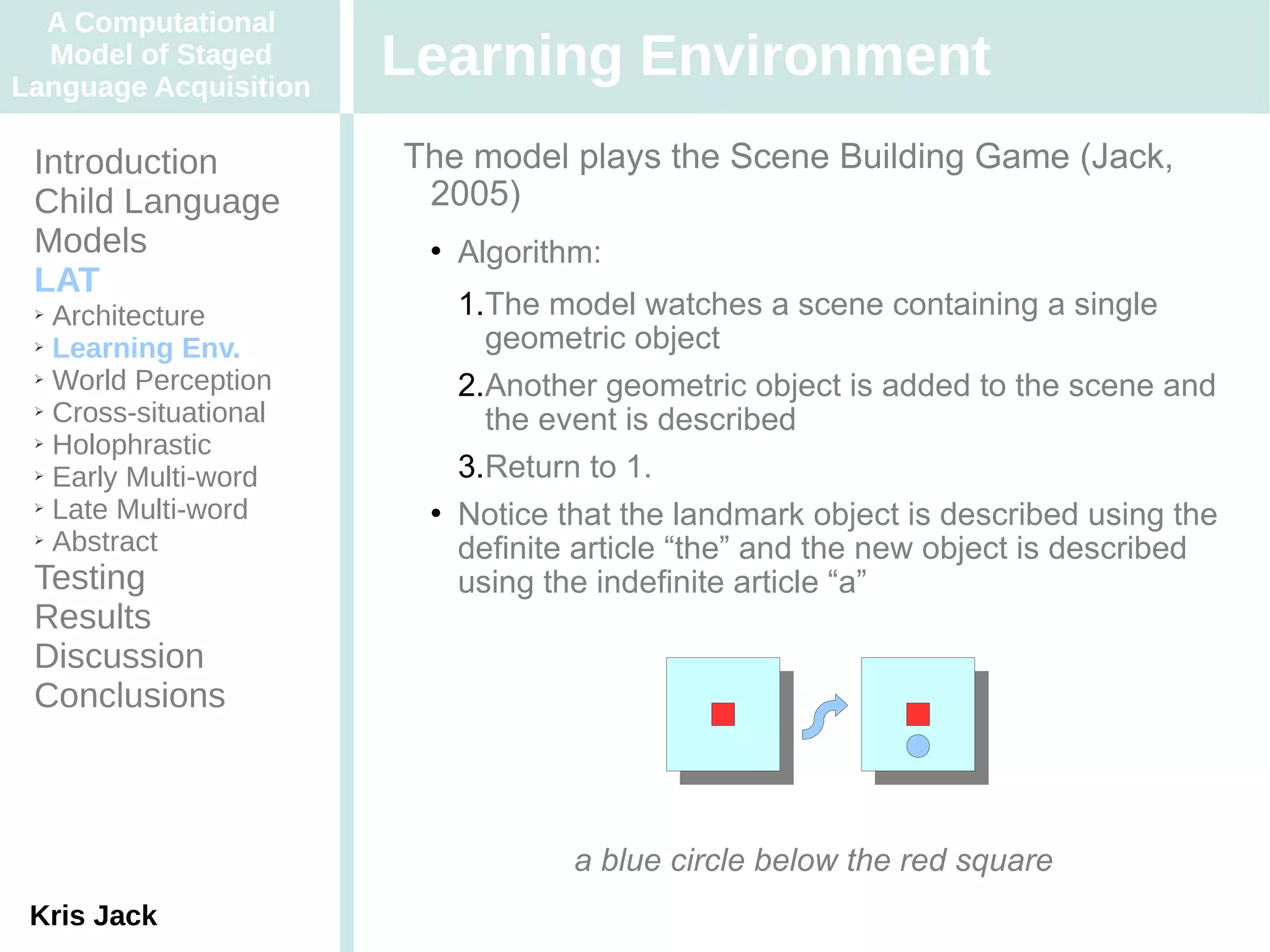
 Introduction          The model plays the Scene Building Game (Jack,
 Child Language         2005)
 Models                    Algorithm:
 LAT
 ➢ Architecture             1.The model watches a scene containing a single
 ➢ Learning Env.              geometric object
 ➢ World Perception
                            2.Another geometric object is added to the scene and
 ➢ Cross-situational
                              the event is described
 ➢ Holophrastic

 ➢ Early Multi-word         3.Return to 1.
 ➢ Late Multi-word         Notice that the landmark object is described using the
 ➢ Abstract
                            definite article “the” and the new object is described
 Testing                    using the indefinite article “a”
 Results
 Discussion
 Conclusions


                                    a blue circle below the red square
 Kris Jack
A Computational
  Model of Staged
Language Acquisition
                       The World Perception Module
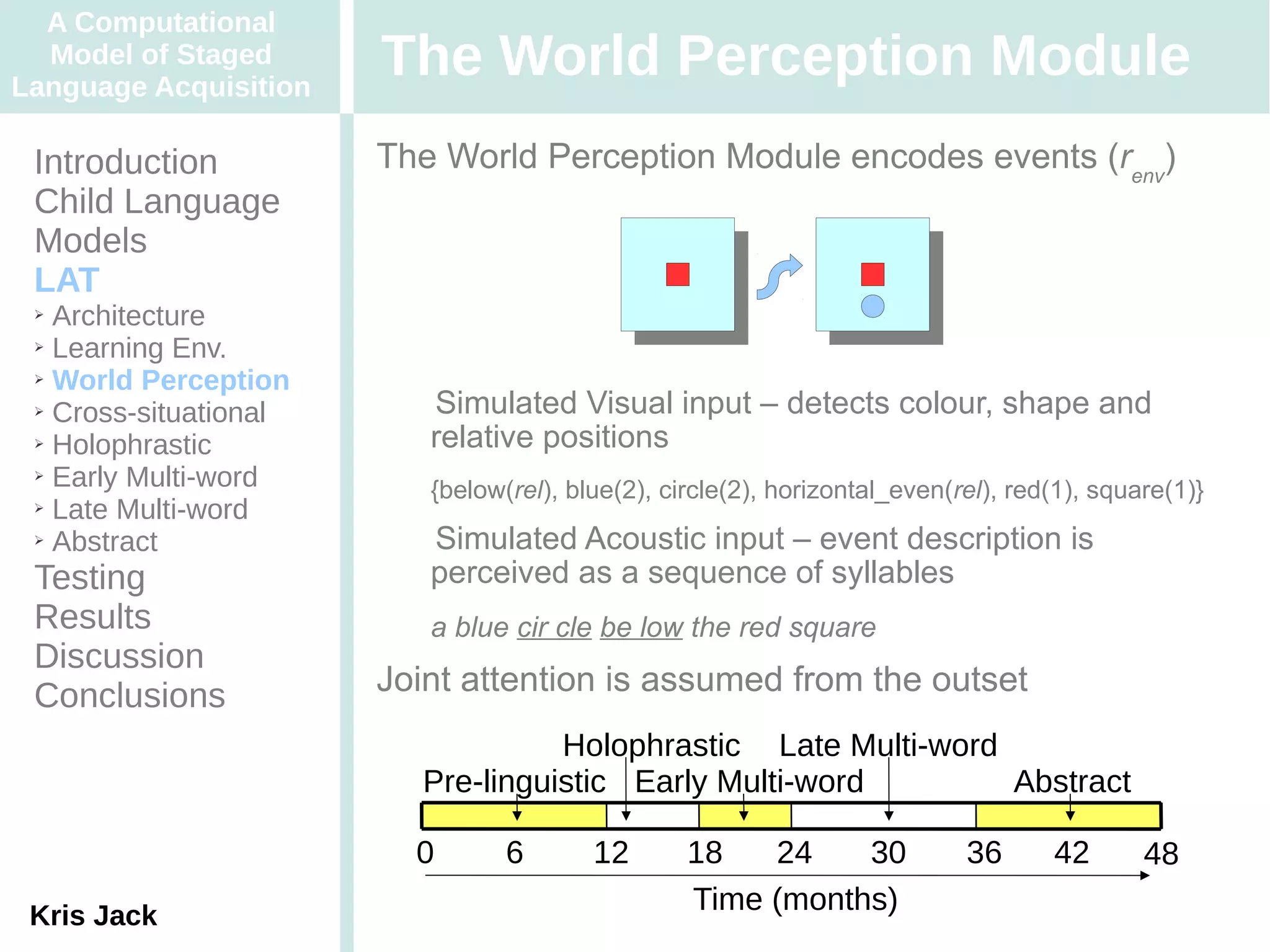
 Introduction          The World Perception Module encodes events (renv)
 Child Language
 Models
 LAT
 ➢ Architecture
 ➢ Learning Env.

 ➢ World Perception

 ➢ Cross-situational    Simulated Visual input – detects colour, shape and
 ➢ Holophrastic          relative positions
 ➢ Early Multi-word
                          {below(rel), blue(2), circle(2), horizontal_even(rel), red(1), square(1)}
 ➢ Late Multi-word

 ➢ Abstract             Simulated Acoustic input – event description is
 Testing                 perceived as a sequence of syllables
 Results                  a blue cir cle be low the red square
 Discussion
 Conclusions           Joint attention is assumed from the outset
                                    Holophrastic Late Multi-word
                          Pre-linguistic Early Multi-word        Abstract

                         0       6       12       18   24    30             36      42       48
 Kris Jack
                                                  Time (months)
A Computational
  Model of Staged
Language Acquisition
                       Cross-situational Learning Module
 Introduction          Aims
 Child Language            Find similarities between observed events
 Models
 LAT
                           Derive possible form-meaning pairs
 ➢ Architecture            Create new resource rcross-sit
 ➢ Learning Env.

 ➢ World Perception

 ➢ Cross-situational

 ➢ Holophrastic

 ➢ Early Multi-word

 ➢ Late Multi-word

 ➢ Abstract


 Testing
 Results
 Discussion
 Conclusions


 Kris Jack
A Computational
  Model of Staged
Language Acquisition
                       Cross-situational Learning
 Introduction          Method
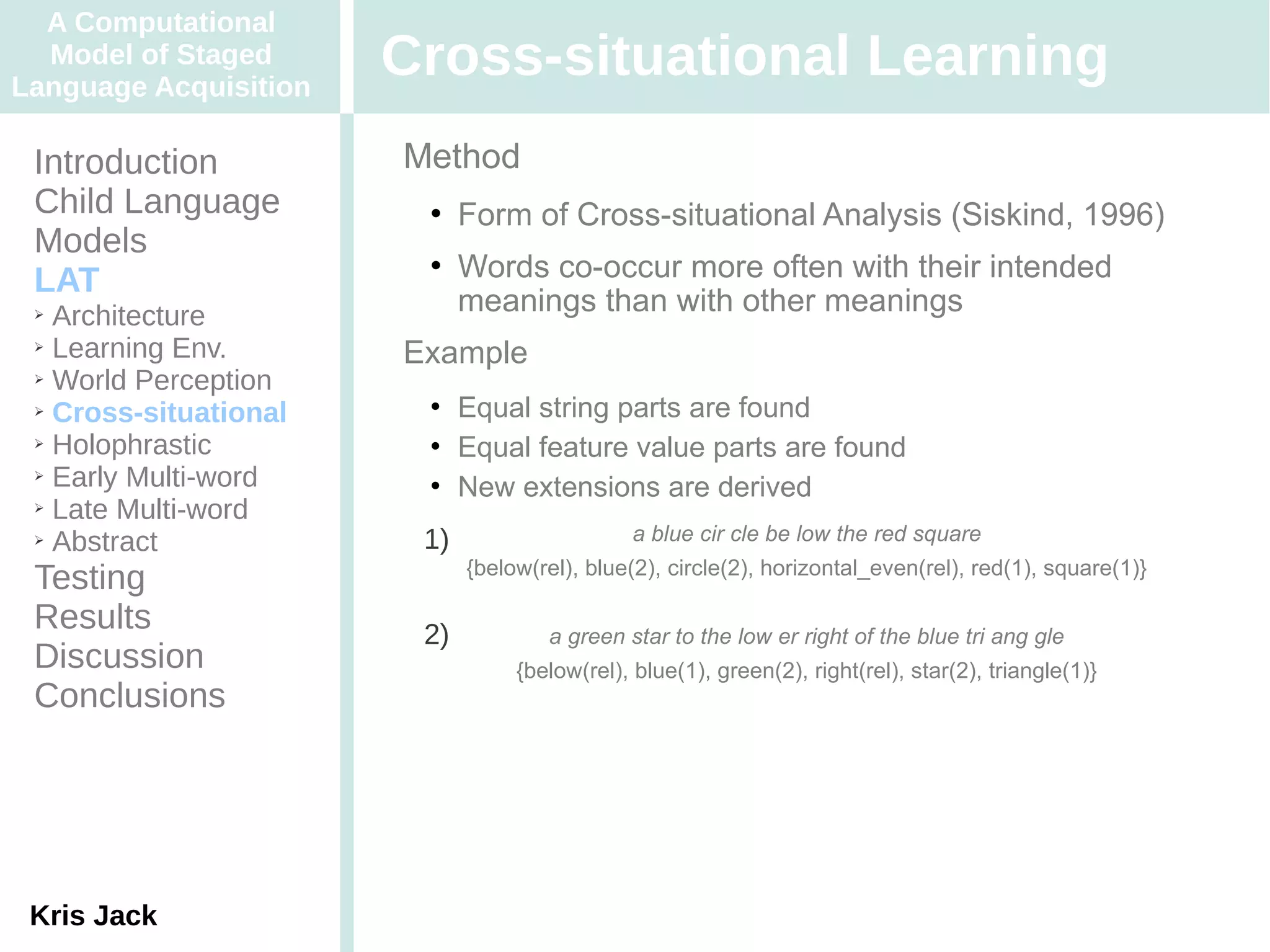
 Child Language             Form of Cross-situational Analysis (Siskind, 1996)
 Models
 LAT
                            Words co-occur more often with their intended
 ➢ Architecture              meanings than with other meanings
 ➢ Learning Env.
                       Example
 ➢ World Perception

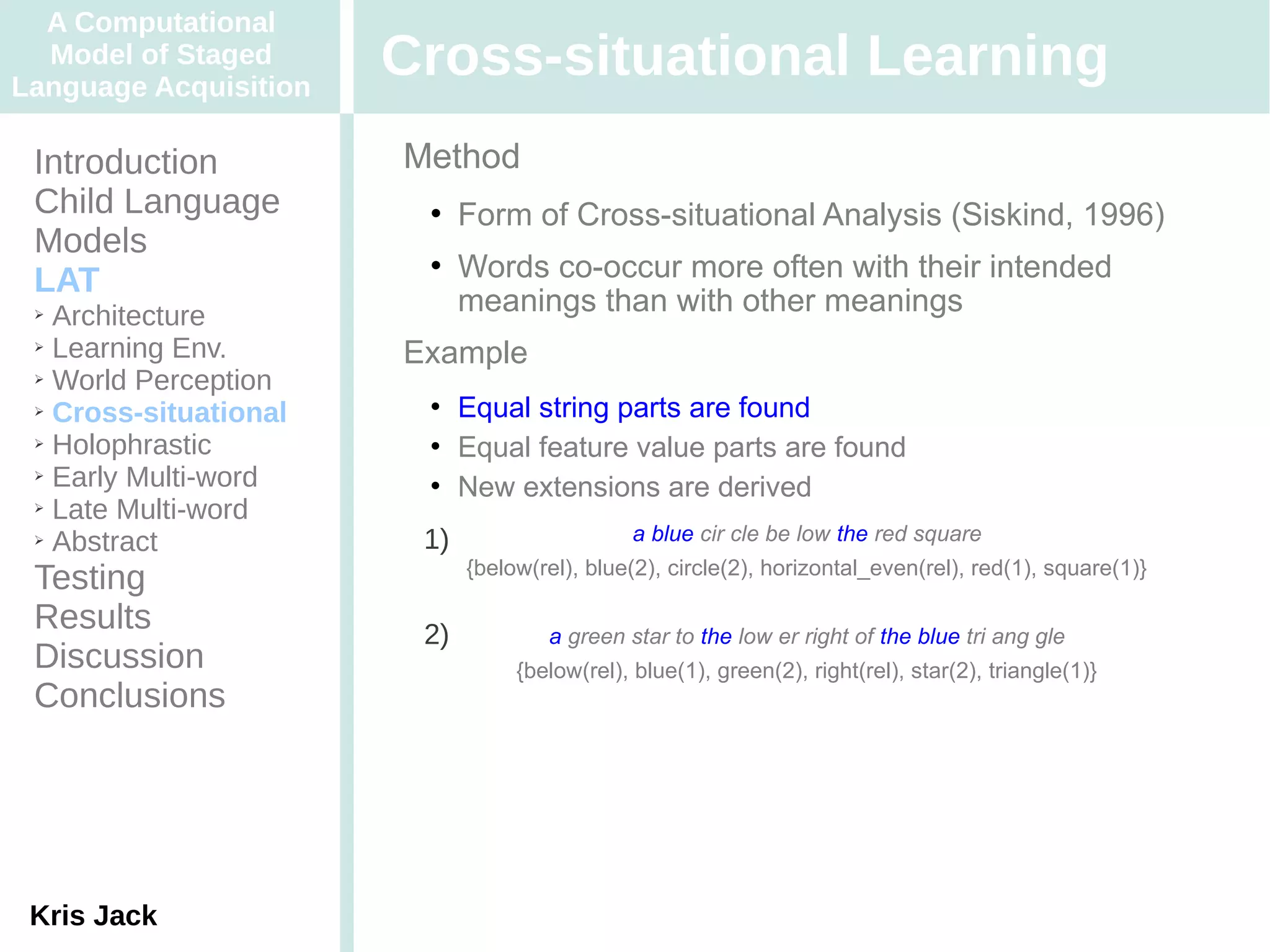
 ➢ Cross-situational        Equal string parts are found
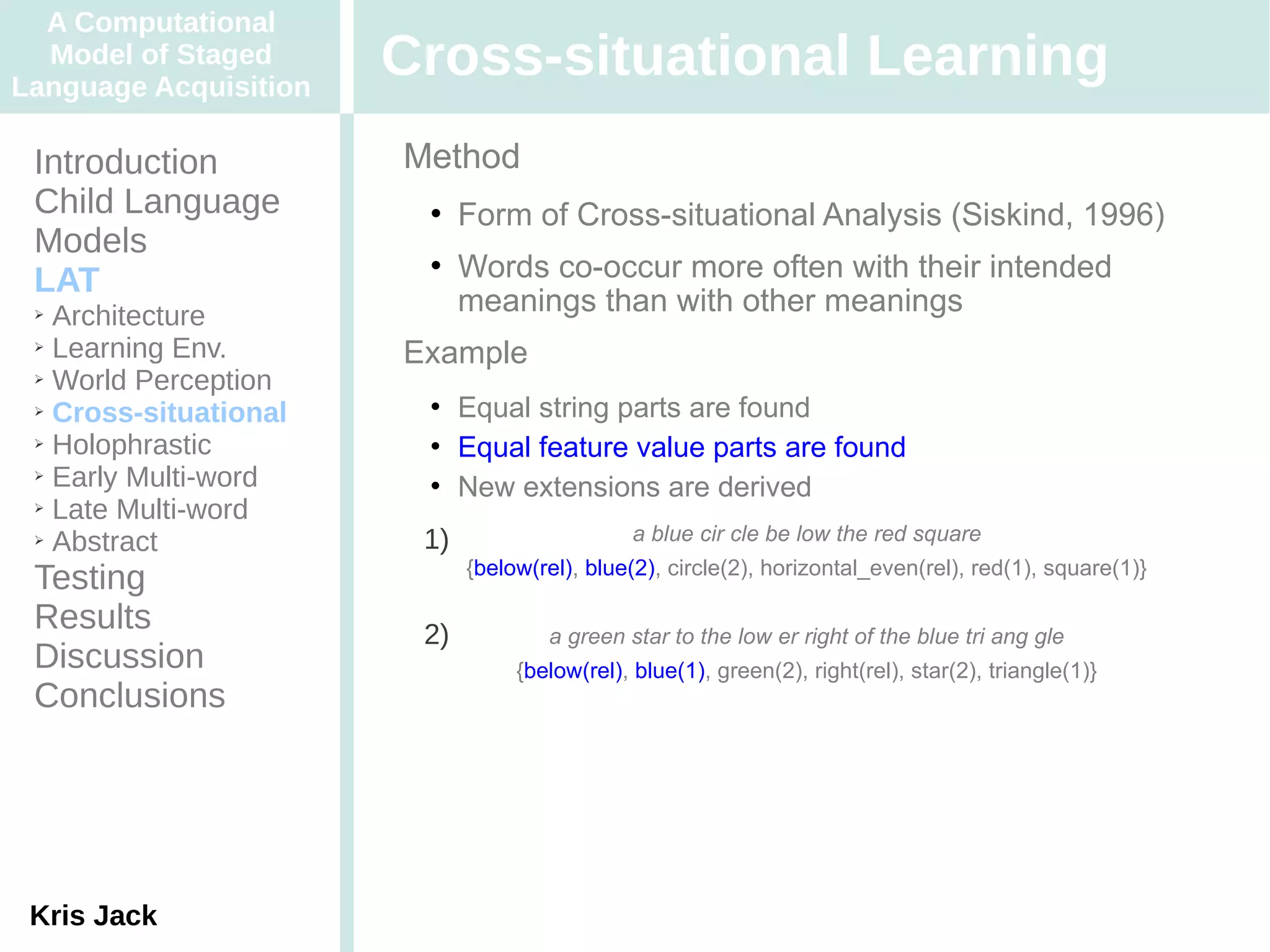
 ➢ Holophrastic             Equal feature value parts are found
 ➢ Early Multi-word
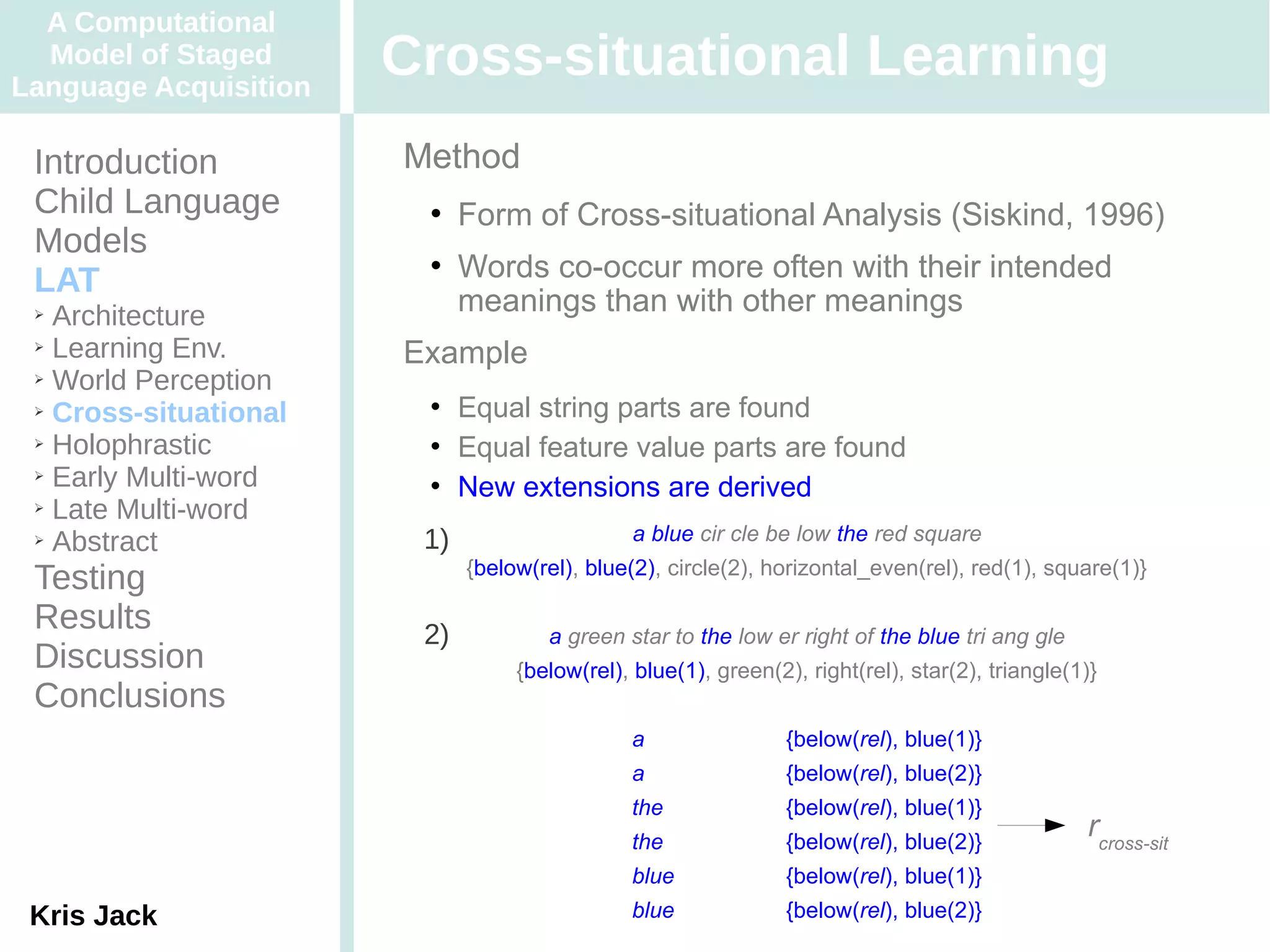
                            New extensions are derived
 ➢ Late Multi-word

 ➢ Abstract             1)                    a blue cir cle be low the red square
                             {below(rel), blue(2), circle(2), horizontal_even(rel), red(1), square(1)}
 Testing
 Results                2)           a green star to the low er right of the blue tri ang gle
 Discussion                       {below(rel), blue(1), green(2), right(rel), star(2), triangle(1)}
 Conclusions


 Kris Jack
A Computational
  Model of Staged
Language Acquisition
                       Cross-situational Learning
 Introduction          Method
 Child Language             Form of Cross-situational Analysis (Siskind, 1996)
 Models
 LAT
                            Words co-occur more often with their intended
 ➢ Architecture              meanings than with other meanings
 ➢ Learning Env.
                       Example
 ➢ World Perception

 ➢ Cross-situational        Equal string parts are found
 ➢ Holophrastic             Equal feature value parts are found
 ➢ Early Multi-word
                            New extensions are derived
 ➢ Late Multi-word

 ➢ Abstract             1)                    a blue cir cle be low the red square
                             {below(rel), blue(2), circle(2), horizontal_even(rel), red(1), square(1)}
 Testing
 Results                2)           a green star to the low er right of the blue tri ang gle
 Discussion                       {below(rel), blue(1), green(2), right(rel), star(2), triangle(1)}
 Conclusions


 Kris Jack
A Computational
  Model of Staged
Language Acquisition
                       Cross-situational Learning
 Introduction          Method
 Child Language             Form of Cross-situational Analysis (Siskind, 1996)
 Models
 LAT
                            Words co-occur more often with their intended
 ➢ Architecture              meanings than with other meanings
 ➢ Learning Env.
                       Example
 ➢ World Perception

 ➢ Cross-situational        Equal string parts are found
 ➢ Holophrastic             Equal feature value parts are found
 ➢ Early Multi-word
                            New extensions are derived
 ➢ Late Multi-word

 ➢ Abstract             1)                    a blue cir cle be low the red square
                             {below(rel), blue(2), circle(2), horizontal_even(rel), red(1), square(1)}
 Testing
 Results                2)           a green star to the low er right of the blue tri ang gle
 Discussion                       {below(rel), blue(1), green(2), right(rel), star(2), triangle(1)}
 Conclusions


 Kris Jack
A Computational
  Model of Staged
Language Acquisition
                       Cross-situational Learning
 Introduction          Method
 Child Language             Form of Cross-situational Analysis (Siskind, 1996)
 Models
 LAT
                            Words co-occur more often with their intended
 ➢ Architecture              meanings than with other meanings
 ➢ Learning Env.
                       Example
 ➢ World Perception

 ➢ Cross-situational        Equal string parts are found
 ➢ Holophrastic             Equal feature value parts are found
 ➢ Early Multi-word
                            New extensions are derived
 ➢ Late Multi-word

 ➢ Abstract             1)                    a blue cir cle be low the red square
                             {below(rel), blue(2), circle(2), horizontal_even(rel), red(1), square(1)}
 Testing
 Results                2)           a green star to the low er right of the blue tri ang gle
 Discussion                       {below(rel), blue(1), green(2), right(rel), star(2), triangle(1)}
 Conclusions
                                              a                 {below(rel), blue(1)}
                                              a                 {below(rel), blue(2)}
                                              the               {below(rel), blue(1)}
                                              the               {below(rel), blue(2)}
                                                                                                 rcross-sit
                                              blue              {below(rel), blue(1)}
 Kris Jack                                    blue              {below(rel), blue(2)}
A Computational
  Model of Staged
Language Acquisition
                       Holophrastic Learning Module
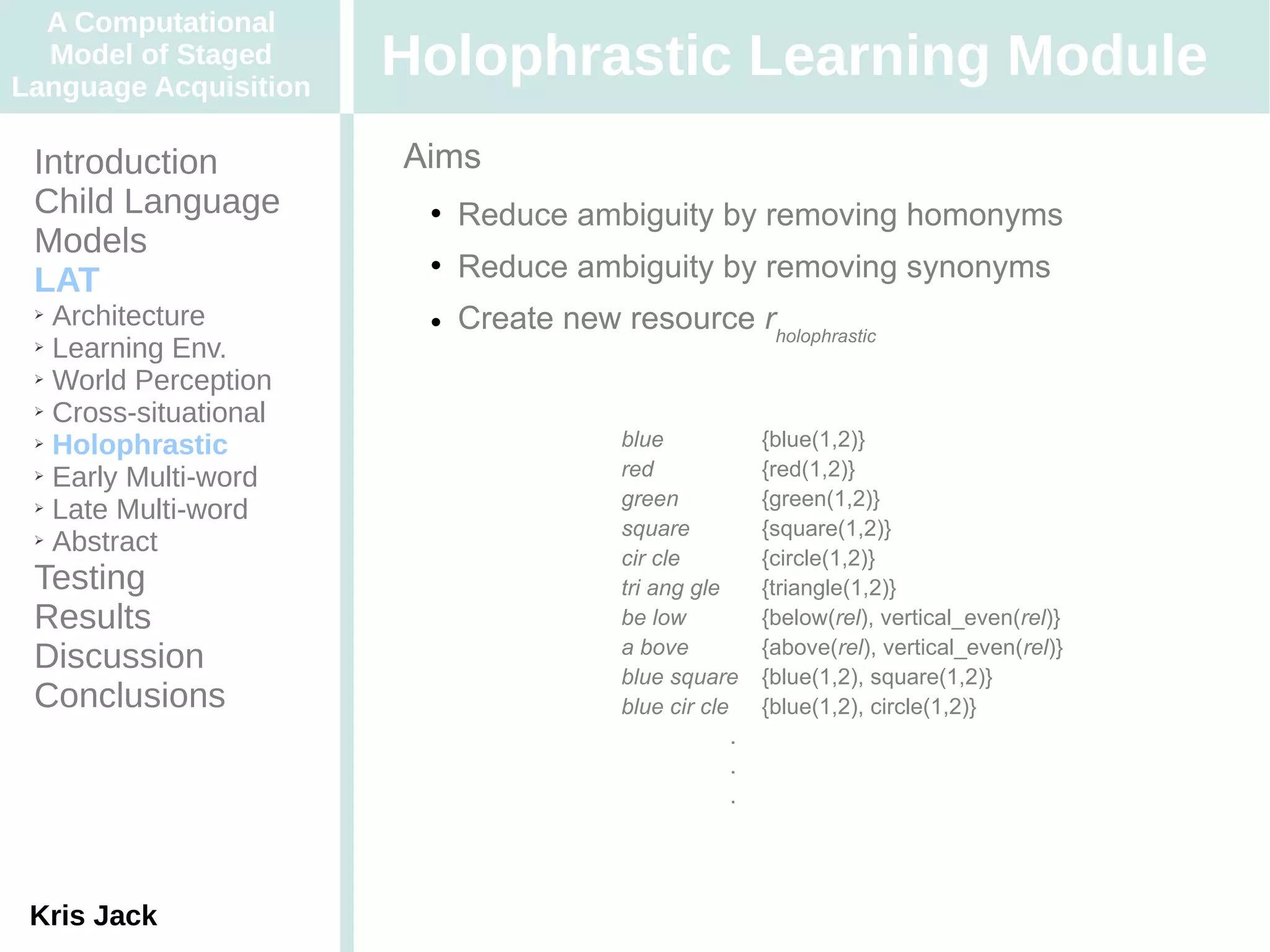
 Introduction          Aims
 Child Language            Reduce ambiguity by removing homonyms
 Models
 LAT
                           Reduce ambiguity by removing synonyms
 ➢ Architecture            Create new resource rholophrastic
 ➢ Learning Env.

 ➢ World Perception

 ➢ Cross-situational

 ➢ Holophrastic                         blue             {blue(1,2)}
 ➢ Early Multi-word                     red              {red(1,2)}
 ➢ Late Multi-word
                                        green            {green(1,2)}
 ➢ Abstract
                                        square           {square(1,2)}
                                        cir cle          {circle(1,2)}
 Testing                                tri ang gle      {triangle(1,2)}
 Results                                be low           {below(rel), vertical_even(rel)}
                                        a bove           {above(rel), vertical_even(rel)}
 Discussion                             blue square      {blue(1,2), square(1,2)}
 Conclusions                            blue cir cle     {blue(1,2), circle(1,2)}
                                                     .
                                                     .
                                                     .


 Kris Jack
A Computational
  Model of Staged
Language Acquisition
                       Holophrastic Learning Module
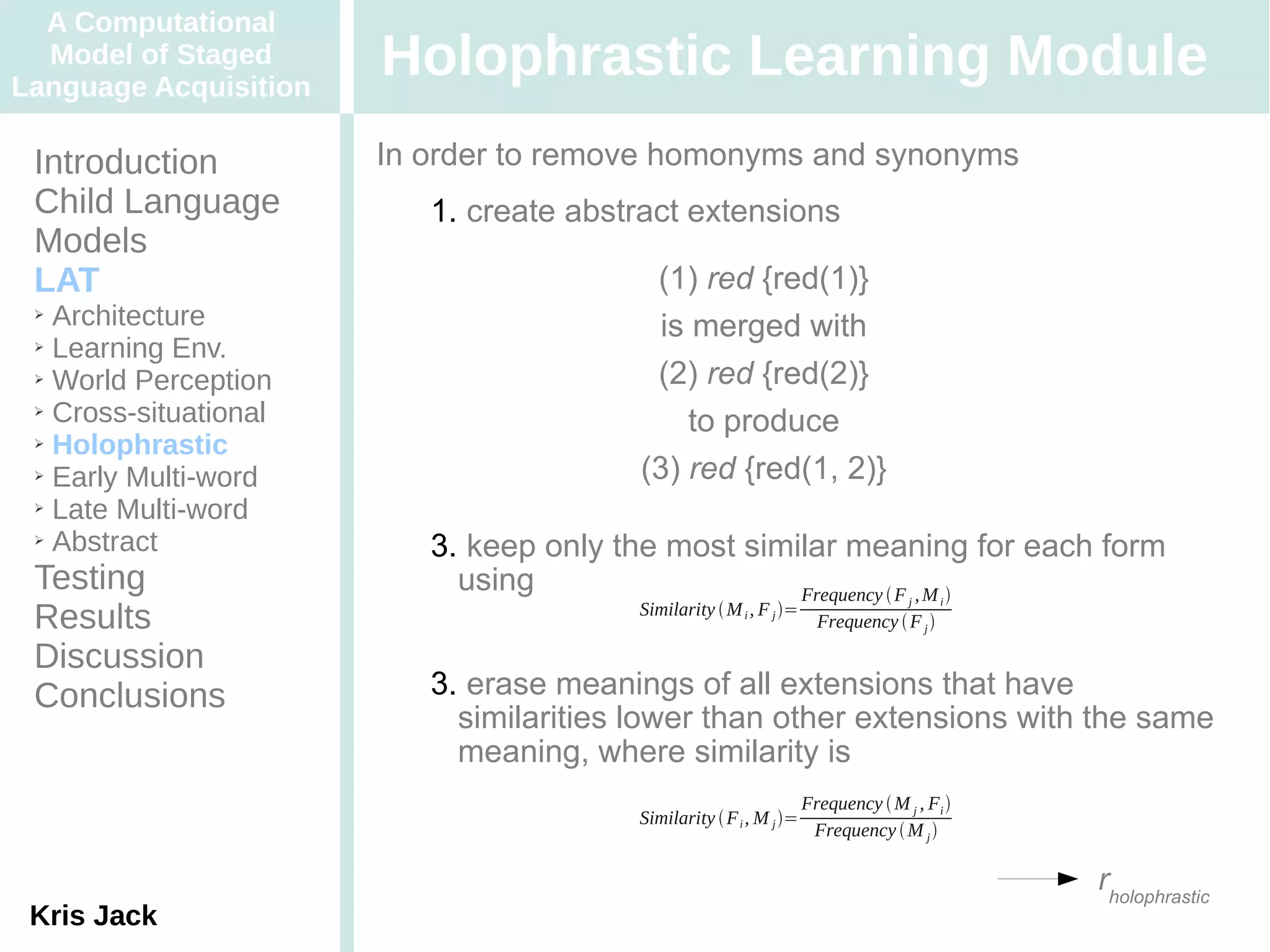
 Introduction          In order to remove homonyms and synonyms
 Child Language           1. create abstract extensions
 Models
 LAT                                      (1) red {red(1)}
 ➢ Architecture                            is merged with
 ➢ Learning Env.

 ➢ World Perception                       (2) red {red(2)}
 ➢ Cross-situational
                                             to produce
 ➢ Holophrastic

 ➢ Early Multi-word                      (3) red {red(1, 2)}
 ➢ Late Multi-word

 ➢ Abstract
                          3. keep only the most similar meaning for each form
 Testing                    using                   Frequency  F , M             j      i
 Results                                Similarity  M i , F j =
                                                                      Frequency  F j 

 Discussion
 Conclusions              3. erase meanings of all extensions that have
                            similarities lower than other extensions with the same
                            meaning, where similarity is
                                                                    Frequency  M j , Fi 
                                        Similarity  F i , M j =
                                                                     Frequency  M j 

                                                                                              rholophrastic
 Kris Jack
A Computational
  Model of Staged      Holophrastic Comprehension Module
Language Acquisition

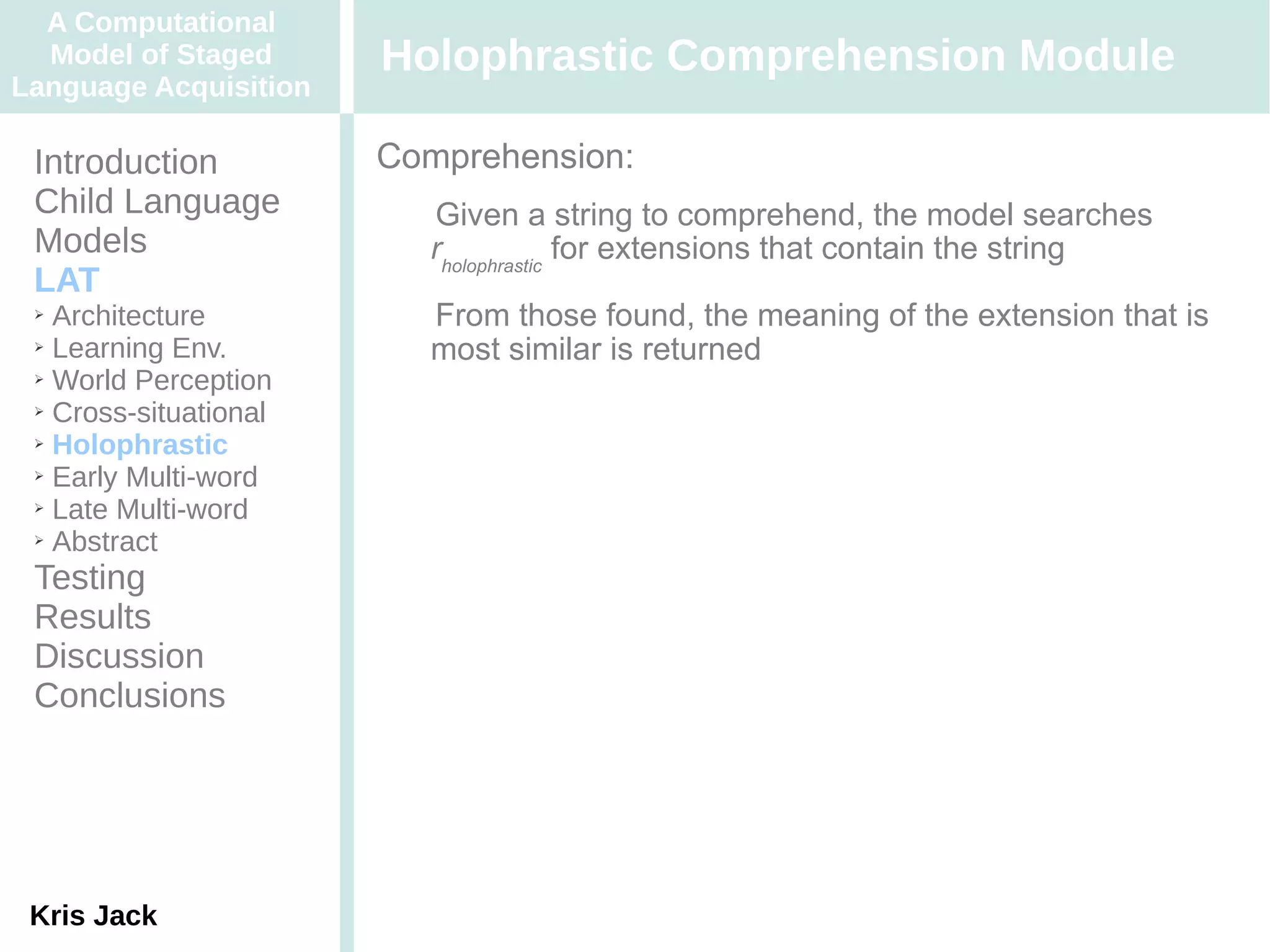
 Introduction          Comprehension:
 Child Language         Given a string to comprehend, the model searches
 Models                  rholophrastic for extensions that contain the string
 LAT
 ➢ Architecture         From those found, the meaning of the extension that is
 ➢ Learning Env.
                         most similar is returned
 ➢ World Perception

 ➢ Cross-situational

 ➢ Holophrastic

 ➢ Early Multi-word

 ➢ Late Multi-word

 ➢ Abstract


 Testing
 Results
 Discussion
 Conclusions


 Kris Jack
A Computational
  Model of Staged
Language Acquisition
                       Early Multi-word Learning Module
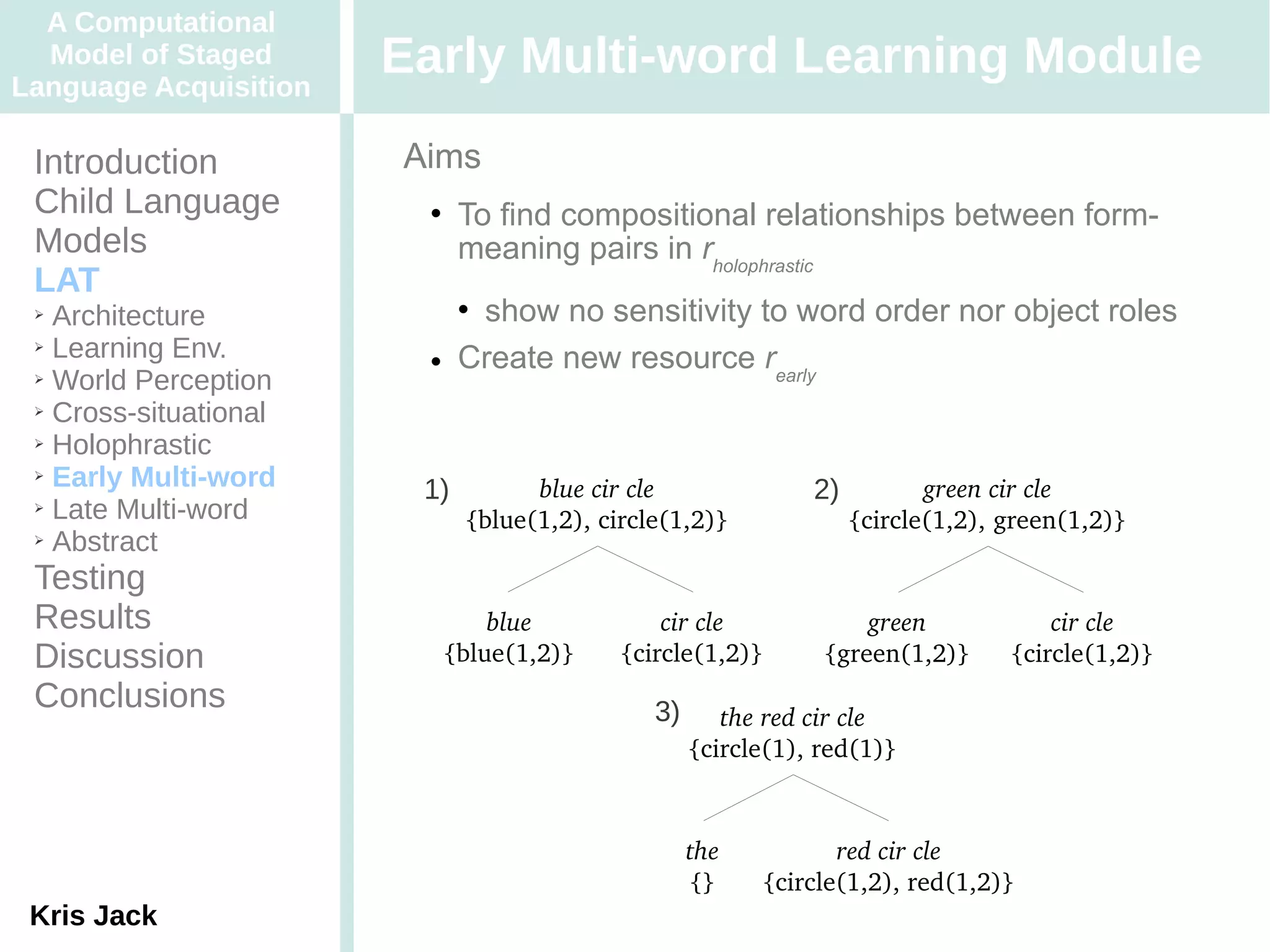
 Introduction          Aims
 Child Language             To find compositional relationships between form-
 Models                      meaning pairs in rholophrastic
 LAT
 ➢ Architecture              show no sensitivity to word order nor object roles
 ➢ Learning Env.

 ➢ World Perception
                            Create new resource rearly
 ➢ Cross-situational

 ➢ Holophrastic

 ➢ Early Multi-word
                        1)         blue cir cle                2)          green cir cle
 ➢ Late Multi-word
                             {blue(1,2), circle(1,2)}               {circle(1,2), green(1,2)}
 ➢ Abstract


 Testing
 Results                     blue              cir cle              green             cir cle
 Discussion              {blue(1,2)}       {circle(1,2)}        {green(1,2)}      {circle(1,2)}
 Conclusions                                  3)      the red cir cle
                                                   {circle(1), red(1)}


                                                   the            red cir cle
                                                   {}      {circle(1,2), red(1,2)}
 Kris Jack
A Computational
  Model of Staged
Language Acquisition
                       Early Multi-word Learning Module
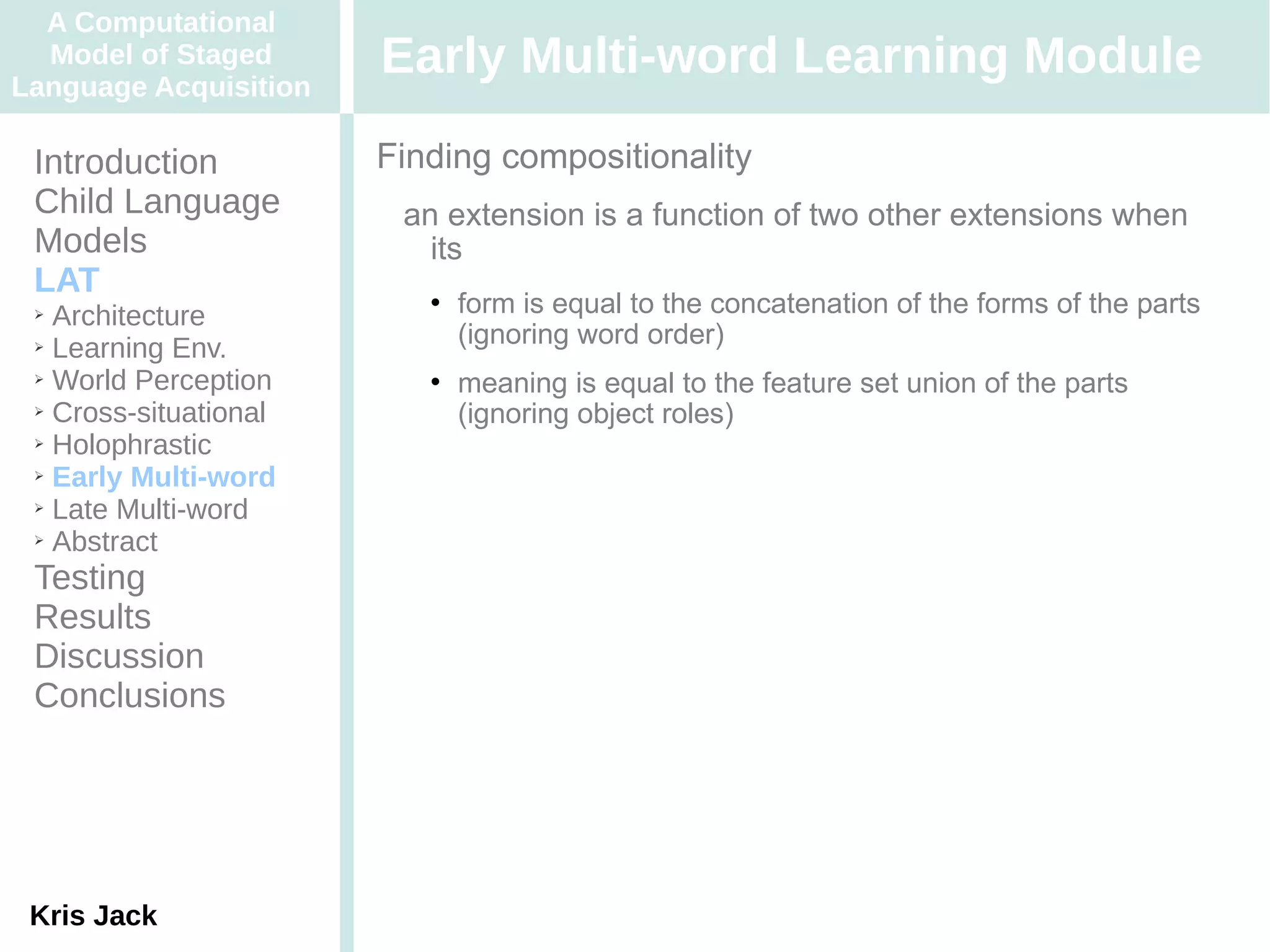
 Introduction          Finding compositionality
 Child Language         an extension is a function of two other extensions when
 Models                   its
 LAT
 ➢ Architecture
                             form is equal to the concatenation of the forms of the parts
 ➢ Learning Env.
                              (ignoring word order)
 ➢ World Perception          meaning is equal to the feature set union of the parts
 ➢ Cross-situational
                              (ignoring object roles)
 ➢ Holophrastic

 ➢ Early Multi-word

 ➢ Late Multi-word

 ➢ Abstract


 Testing
 Results
 Discussion
 Conclusions


 Kris Jack
A Computational
  Model of Staged
Language Acquisition
                       Early Multi-word Learning Module
 Introduction          Finding compositionality
 Child Language         an extension is a function of two other extensions when
 Models                   its
 LAT
 ➢ Architecture
                             form is equal to the concatenation of the forms of the parts
 ➢ Learning Env.
                              (ignoring word order)
 ➢ World Perception          meaning is equal to the feature set union of the parts
 ➢ Cross-situational
                              (ignoring object roles)
 ➢ Holophrastic

 ➢ Early Multi-word

 ➢ Late Multi-word
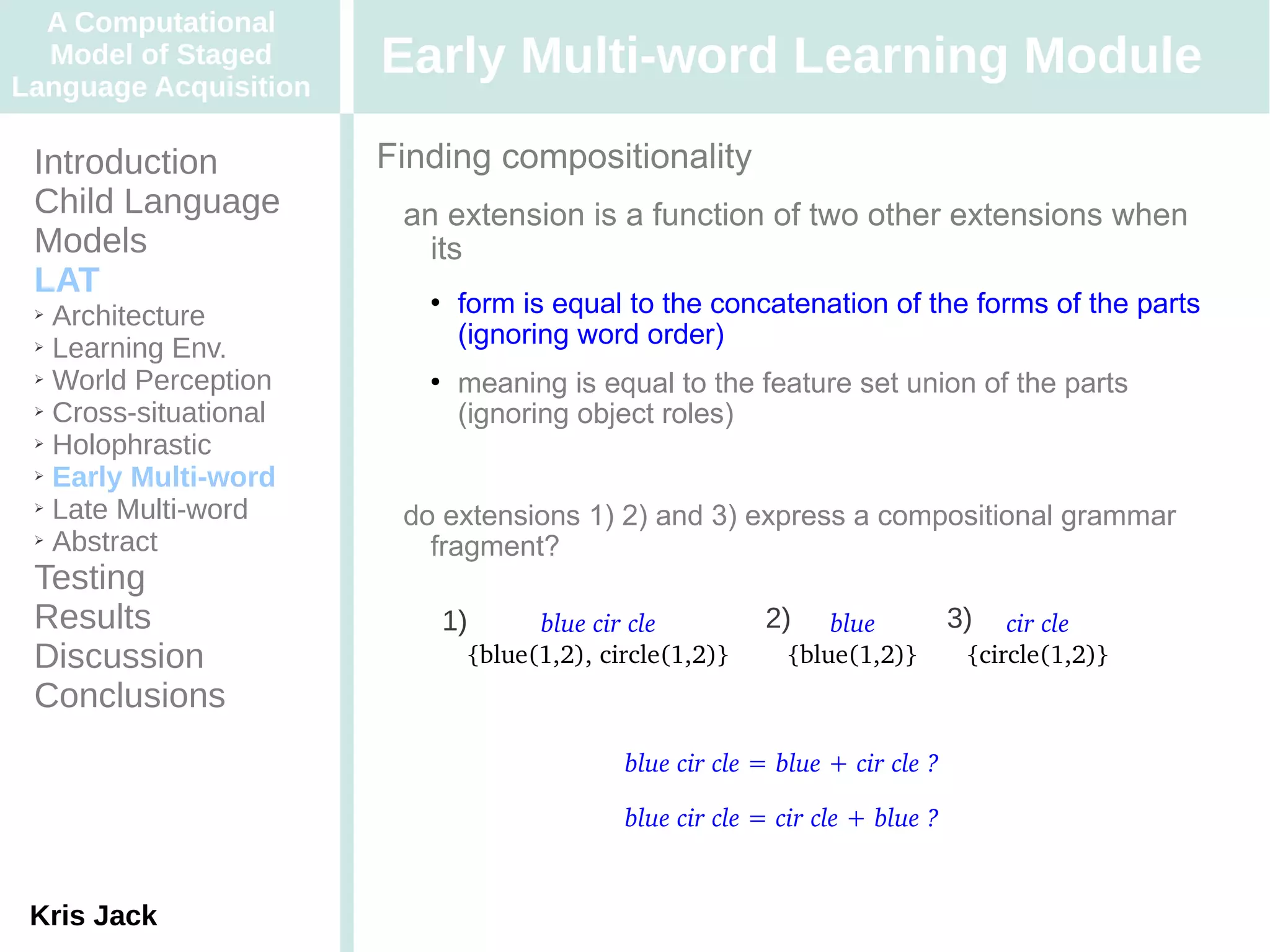
                        do extensions 1) 2) and 3) express a compositional grammar
 ➢ Abstract
                          fragment?
 Testing
 Results                   1)       blue cir cle         2)     blue          3)   cir cle
 Discussion                   {blue(1,2), circle(1,2)}      {blue(1,2)}        {circle(1,2)}
 Conclusions
                                            blue cir cle = blue + cir cle ?

                                            blue cir cle = cir cle + blue ?


 Kris Jack
A Computational
  Model of Staged
Language Acquisition
                       Early Multi-word Learning Module
 Introduction          Finding compositionality
 Child Language         an extension is a function of two other extensions when
 Models                   its
 LAT
 ➢ Architecture
                             form is equal to the concatenation of the forms of the parts
 ➢ Learning Env.
                              (ignoring word order)
 ➢ World Perception          meaning is equal to the feature set union of the parts
 ➢ Cross-situational
                              (ignoring object roles)
 ➢ Holophrastic

 ➢ Early Multi-word

 ➢ Late Multi-word
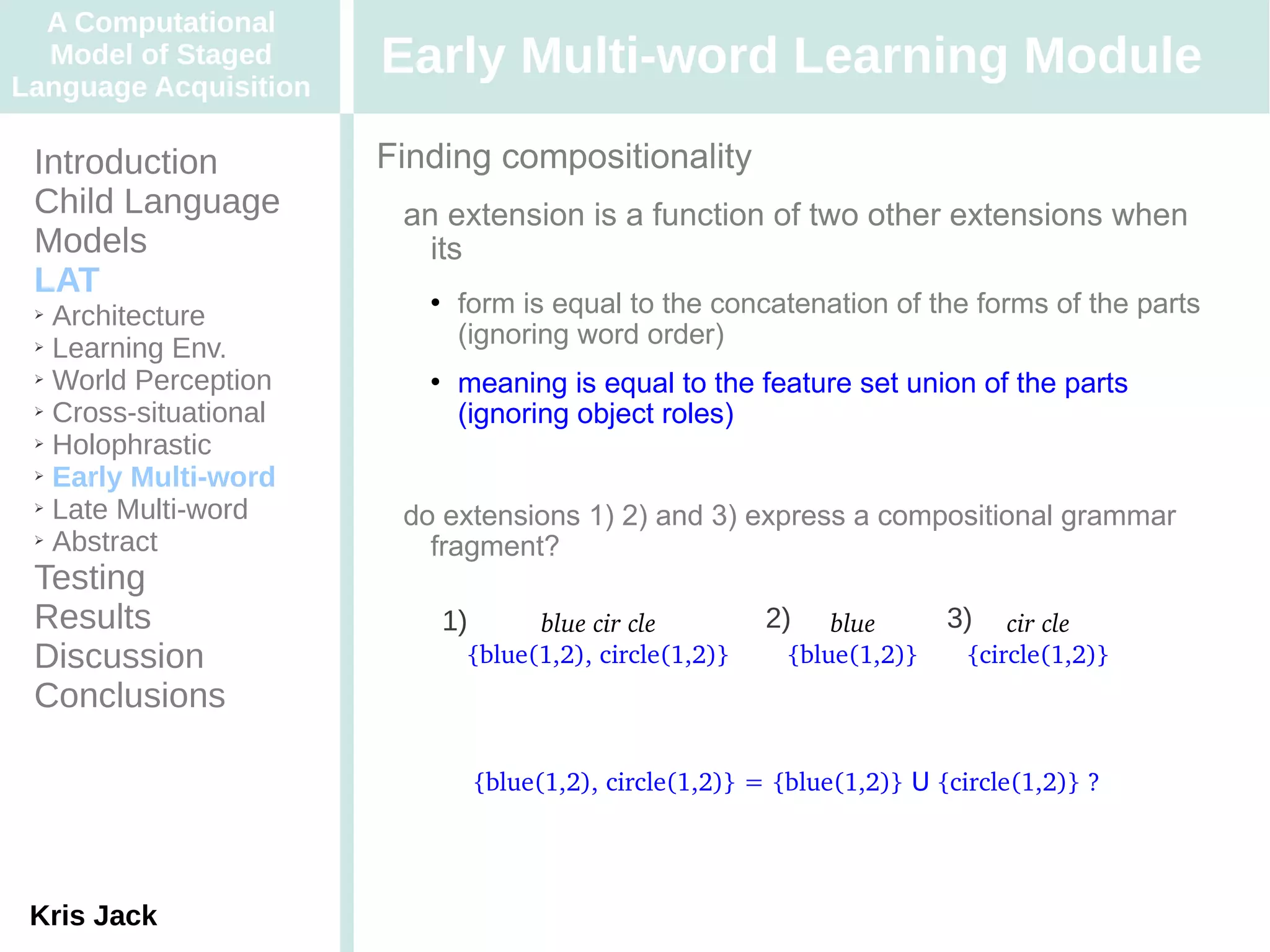
                        do extensions 1) 2) and 3) express a compositional grammar
 ➢ Abstract
                          fragment?
 Testing
 Results                   1)       blue cir cle          2)    blue      3)    cir cle
 Discussion                   {blue(1,2), circle(1,2)}      {blue(1,2)}     {circle(1,2)}
 Conclusions

                                {blue(1,2), circle(1,2)} = {blue(1,2)} U {circle(1,2)} ?


 Kris Jack
A Computational
  Model of Staged
Language Acquisition
                       Early Multi-word Learning Module
 Introduction          Finding compositionality
 Child Language         an extension is a function of two other extensions when
 Models                   its
 LAT
 ➢ Architecture
                              form is equal to the concatenation of the forms of the parts
 ➢ Learning Env.
                               (ignoring word order)
 ➢ World Perception           meaning is equal to the feature set union of the parts
 ➢ Cross-situational
                               (ignoring object roles)
 ➢ Holophrastic

 ➢ Early Multi-word

 ➢ Late Multi-word
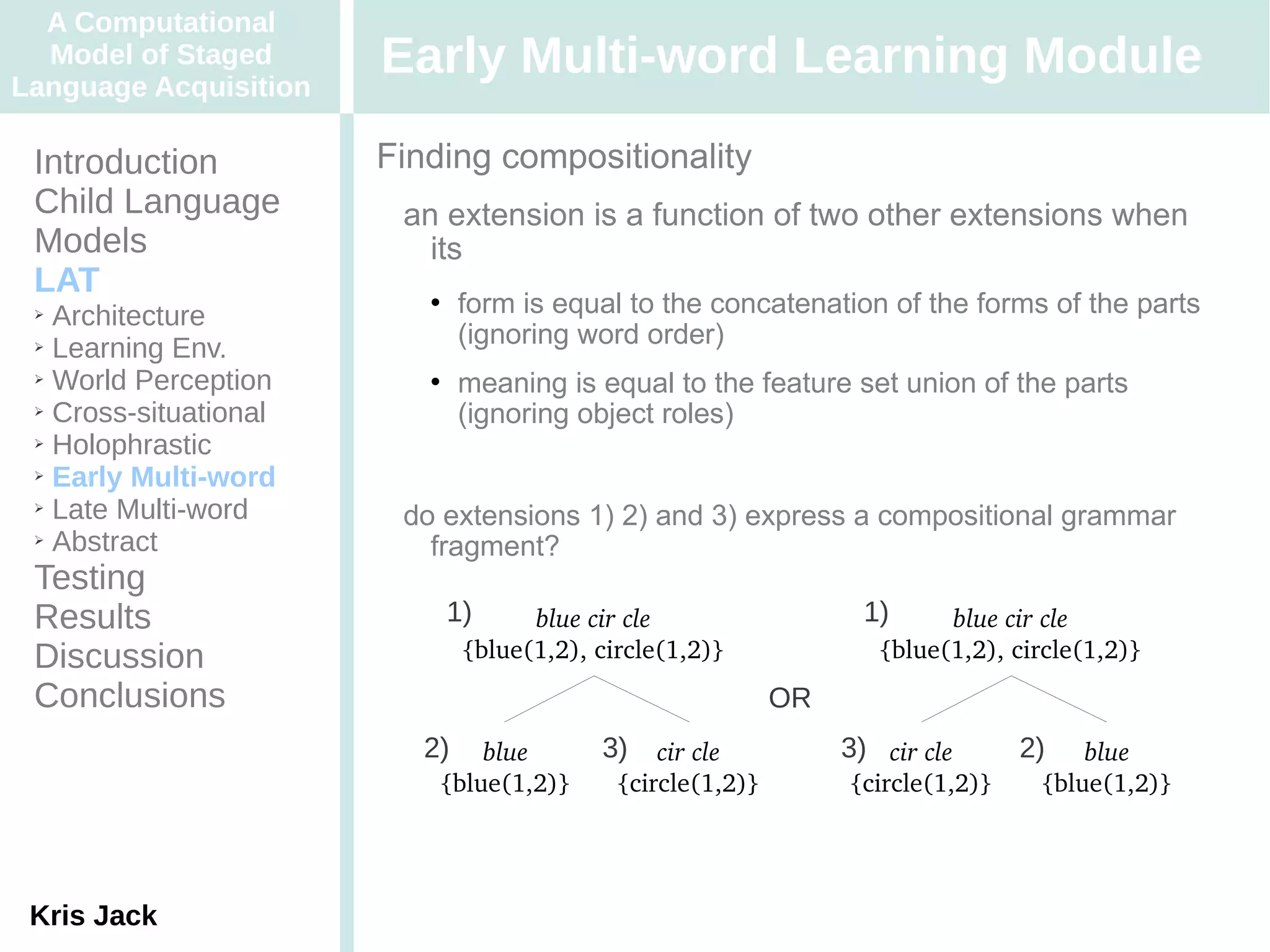
                        do extensions 1) 2) and 3) express a compositional grammar
 ➢ Abstract
                          fragment?
 Testing
 Results                      1)     blue cir cle                   1)     blue cir cle
 Discussion                    {blue(1,2), circle(1,2)}              {blue(1,2), circle(1,2)}
 Conclusions                                                 OR
                          2)   blue        3)    cir cle          3) cir cle      2)   blue
                           {blue(1,2)}       {circle(1,2)}        {circle(1,2)}    {blue(1,2)}


 Kris Jack
A Computational
  Model of Staged
Language Acquisition
                       Early Multi-word Learning Module
 Introduction          Finding compositionality
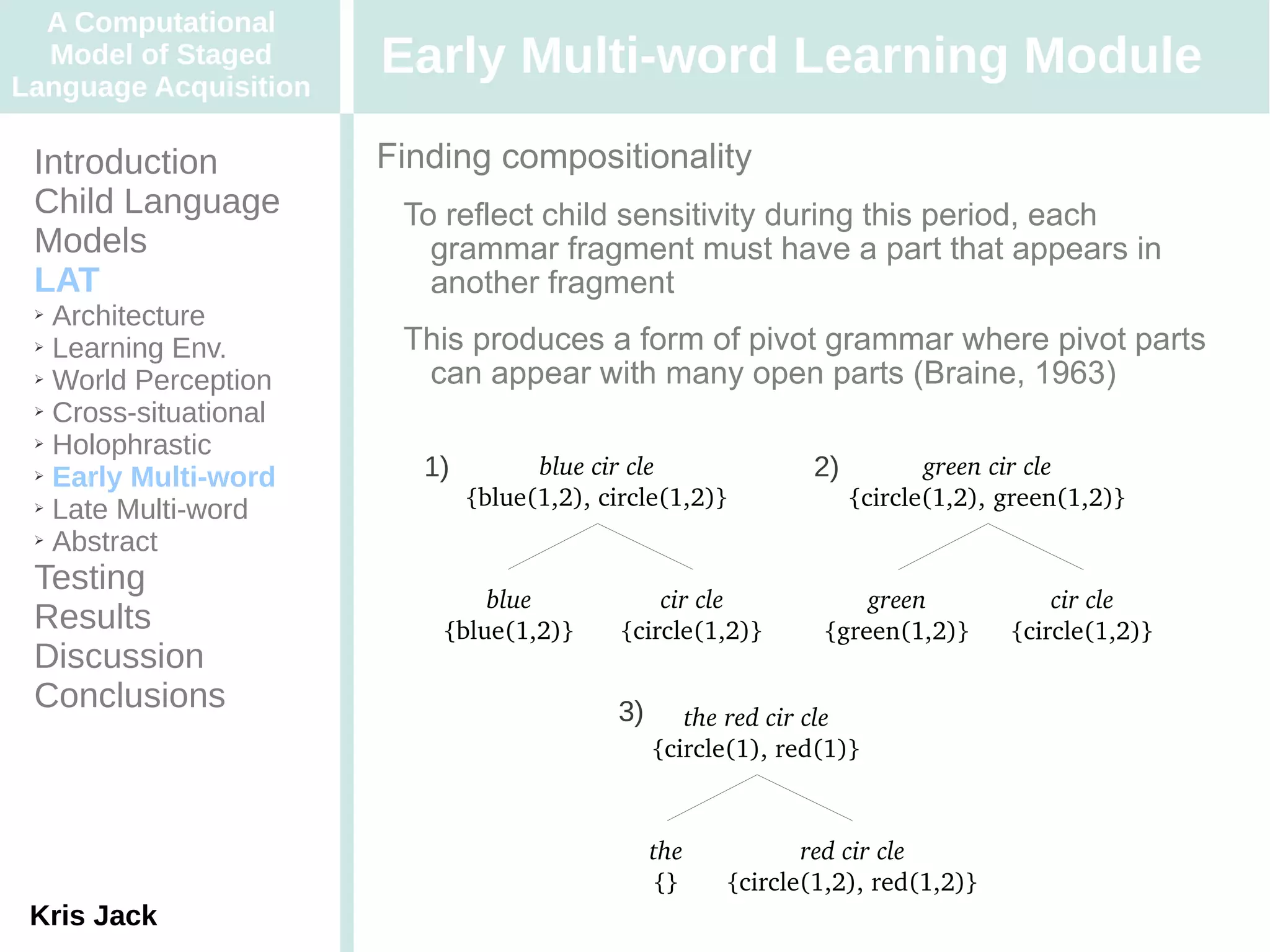
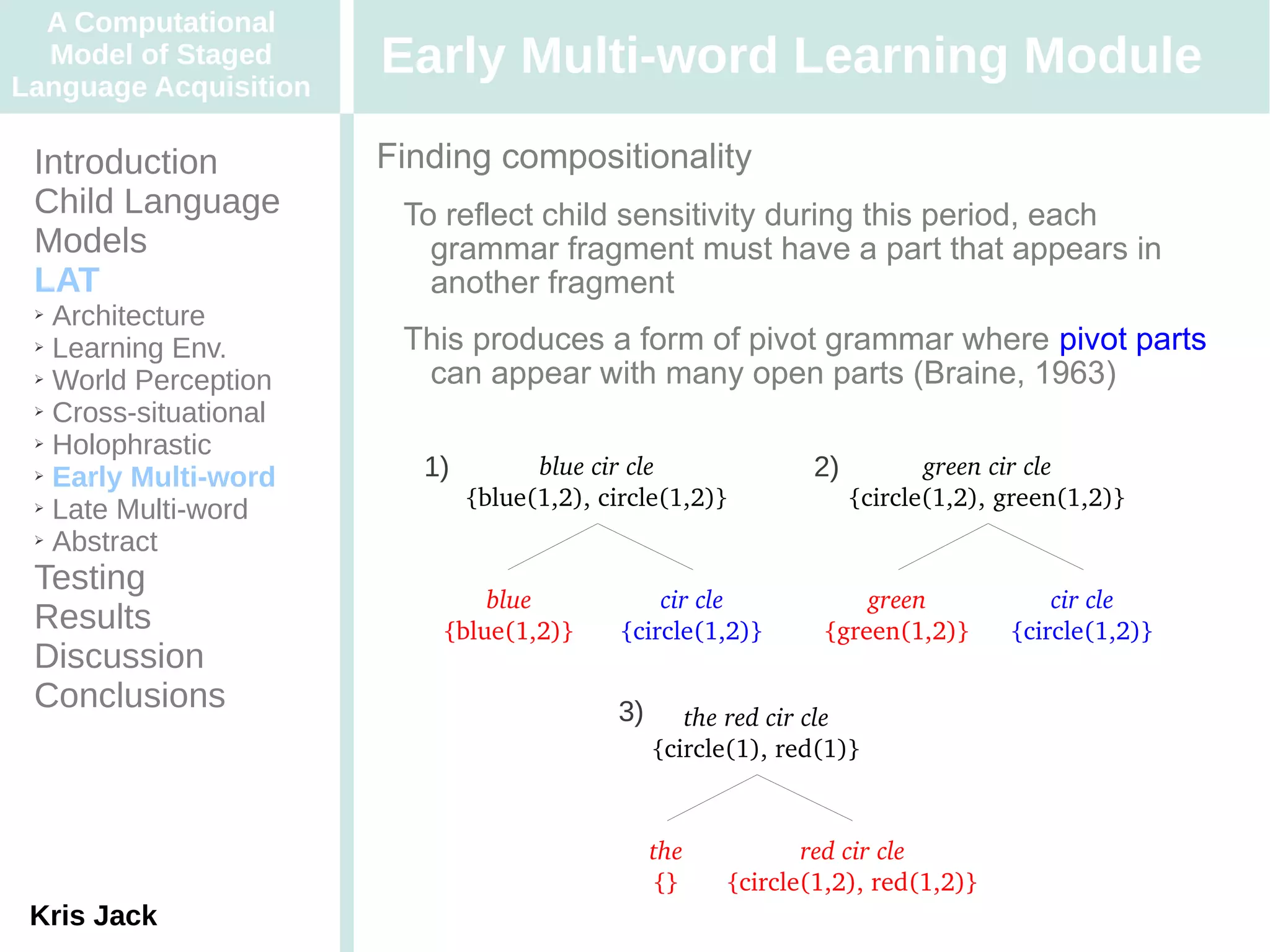
 Child Language         To reflect child sensitivity during this period, each
 Models                   grammar fragment must have a part that appears in
 LAT                      another fragment
 ➢ Architecture
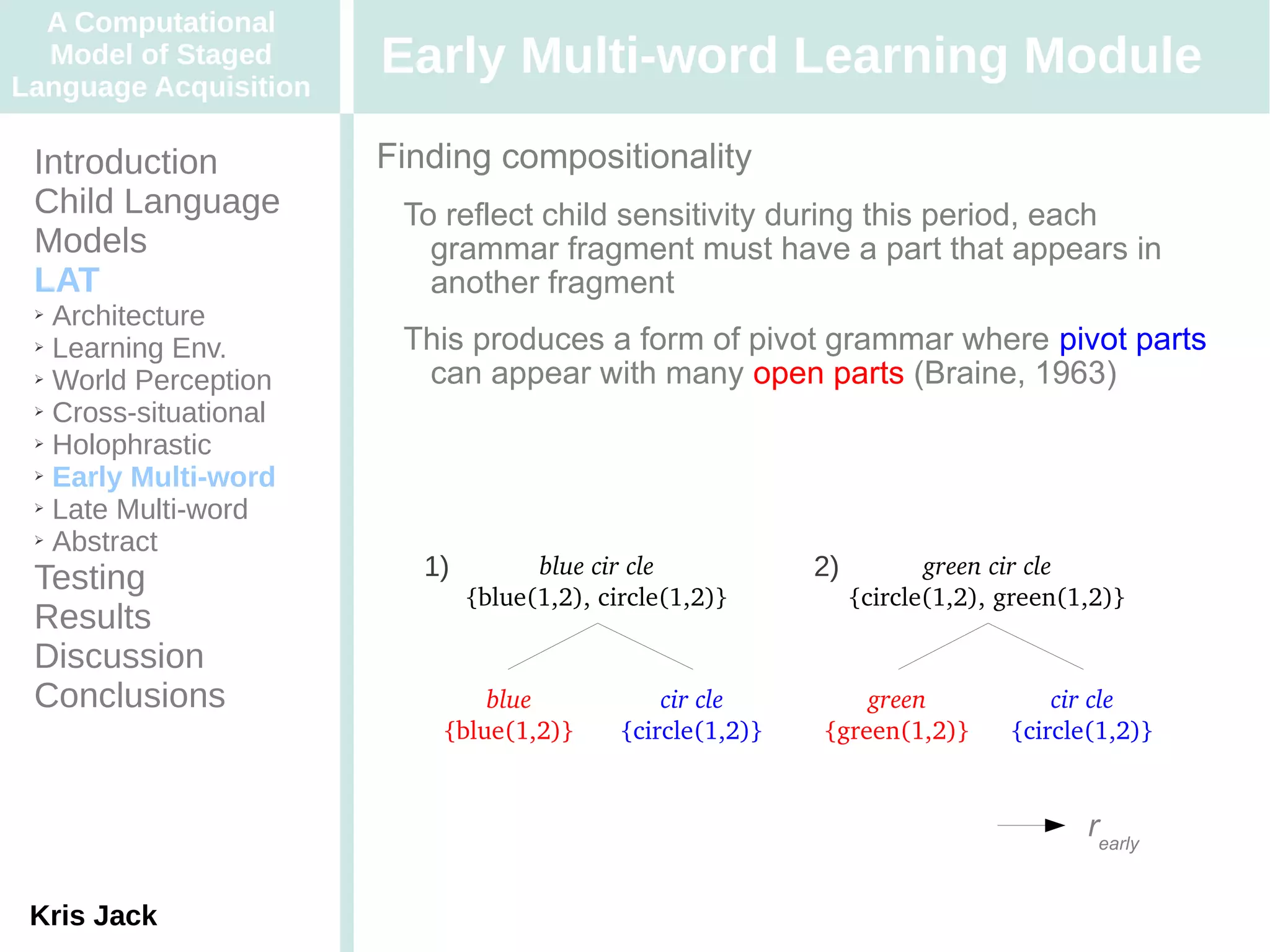
 ➢ Learning Env.        This produces a form of pivot grammar where pivot parts
 ➢ World Perception      can appear with many open parts (Braine, 1963)
 ➢ Cross-situational

 ➢ Holophrastic

 ➢ Early Multi-word       1)         blue cir cle              2)          green cir cle
 ➢ Late Multi-word
                               {blue(1,2), circle(1,2)}             {circle(1,2), green(1,2)}
 ➢ Abstract


 Testing
                               blue              cir cle            green             cir cle
 Results                   {blue(1,2)}       {circle(1,2)}      {green(1,2)}      {circle(1,2)}
 Discussion
 Conclusions                                3)      the red cir cle
                                                 {circle(1), red(1)}


                                                 the          red cir cle
                                                 {}    {circle(1,2), red(1,2)}
 Kris Jack
A Computational
  Model of Staged
Language Acquisition
                       Early Multi-word Learning Module
 Introduction          Finding compositionality
 Child Language         To reflect child sensitivity during this period, each
 Models                   grammar fragment must have a part that appears in
 LAT                      another fragment
 ➢ Architecture
 ➢ Learning Env.        This produces a form of pivot grammar where pivot parts
 ➢ World Perception      can appear with many open parts (Braine, 1963)
 ➢ Cross-situational

 ➢ Holophrastic

 ➢ Early Multi-word       1)         blue cir cle             2)          green cir cle
 ➢ Late Multi-word
                               {blue(1,2), circle(1,2)}            {circle(1,2), green(1,2)}
 ➢ Abstract


 Testing
                               blue              cir cle           green             cir cle
 Results                   {blue(1,2)}       {circle(1,2)}     {green(1,2)}      {circle(1,2)}
 Discussion
 Conclusions                                 3) the red cir cle
                                               3)
                                                {circle(1), red(1)}


                                               the           red cir cle
                                               {}     {circle(1,2), red(1,2)}
 Kris Jack
A Computational
  Model of Staged
Language Acquisition
                       Early Multi-word Learning Module
 Introduction          Finding compositionality
 Child Language         To reflect child sensitivity during this period, each
 Models                   grammar fragment must have a part that appears in
 LAT                      another fragment
 ➢ Architecture
 ➢ Learning Env.        This produces a form of pivot grammar where pivot parts
 ➢ World Perception      can appear with many open parts (Braine, 1963)
 ➢ Cross-situational

 ➢ Holophrastic

 ➢ Early Multi-word

 ➢ Late Multi-word

 ➢ Abstract

                          1)         blue cir cle            2)          green cir cle
 Testing                       {blue(1,2), circle(1,2)}           {circle(1,2), green(1,2)}
 Results
 Discussion
 Conclusions                   blue              cir cle         green              cir cle
                           {blue(1,2)}       {circle(1,2)}   {green(1,2)}       {circle(1,2)}


                                                                                       rearly

 Kris Jack
A Computational
  Model of Staged      Early Multi-word Comprehension Module
Language Acquisition

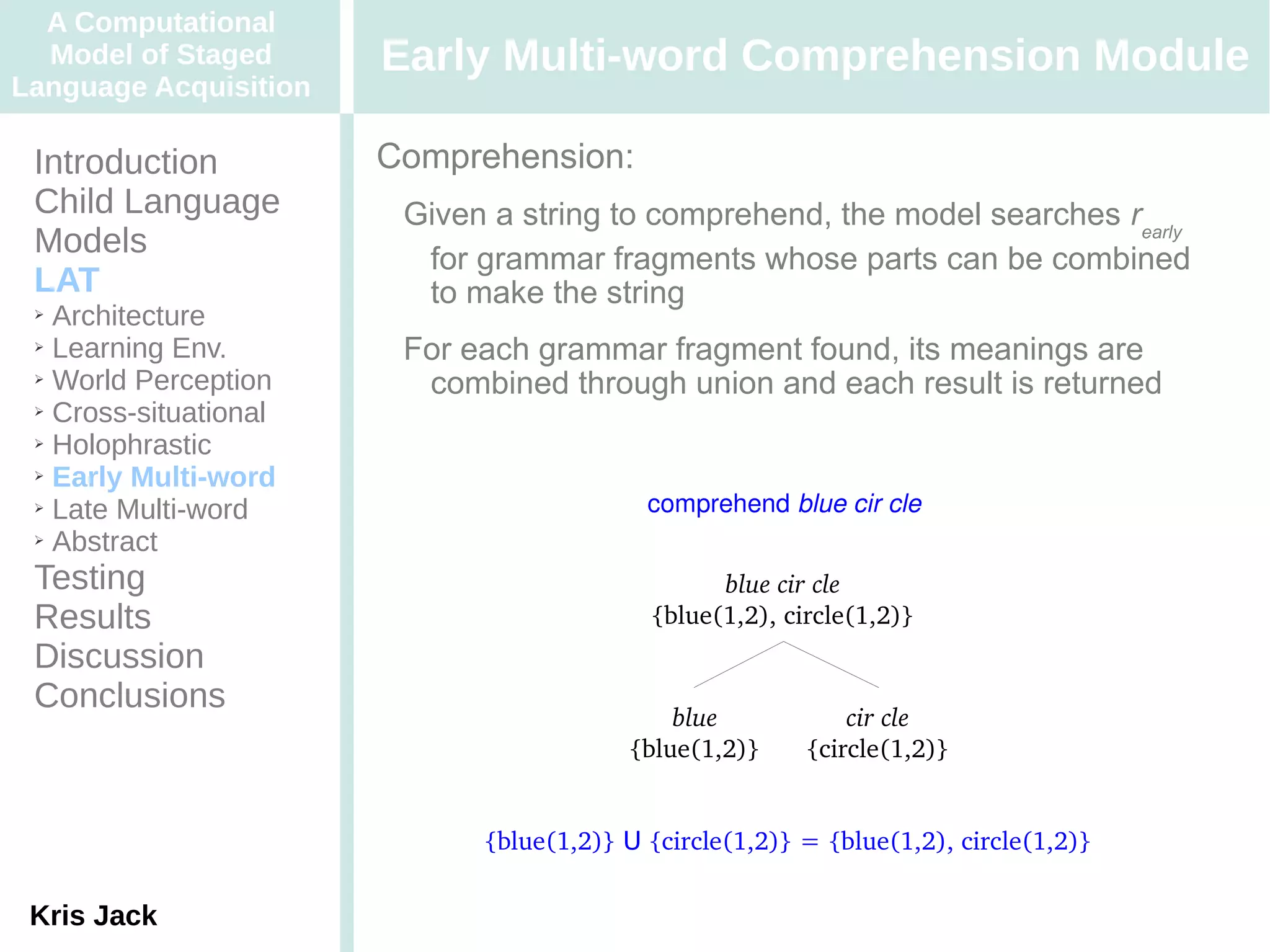
 Introduction          Comprehension:
 Child Language         Given a string to comprehend, the model searches rearly
 Models                  for grammar fragments whose parts can be combined
 LAT                     to make the string
 ➢ Architecture
 ➢ Learning Env.
                        For each grammar fragment found, its meanings are
 ➢ World Perception
                         combined through union and each result is returned
 ➢ Cross-situational

 ➢ Holophrastic

 ➢ Early Multi-word

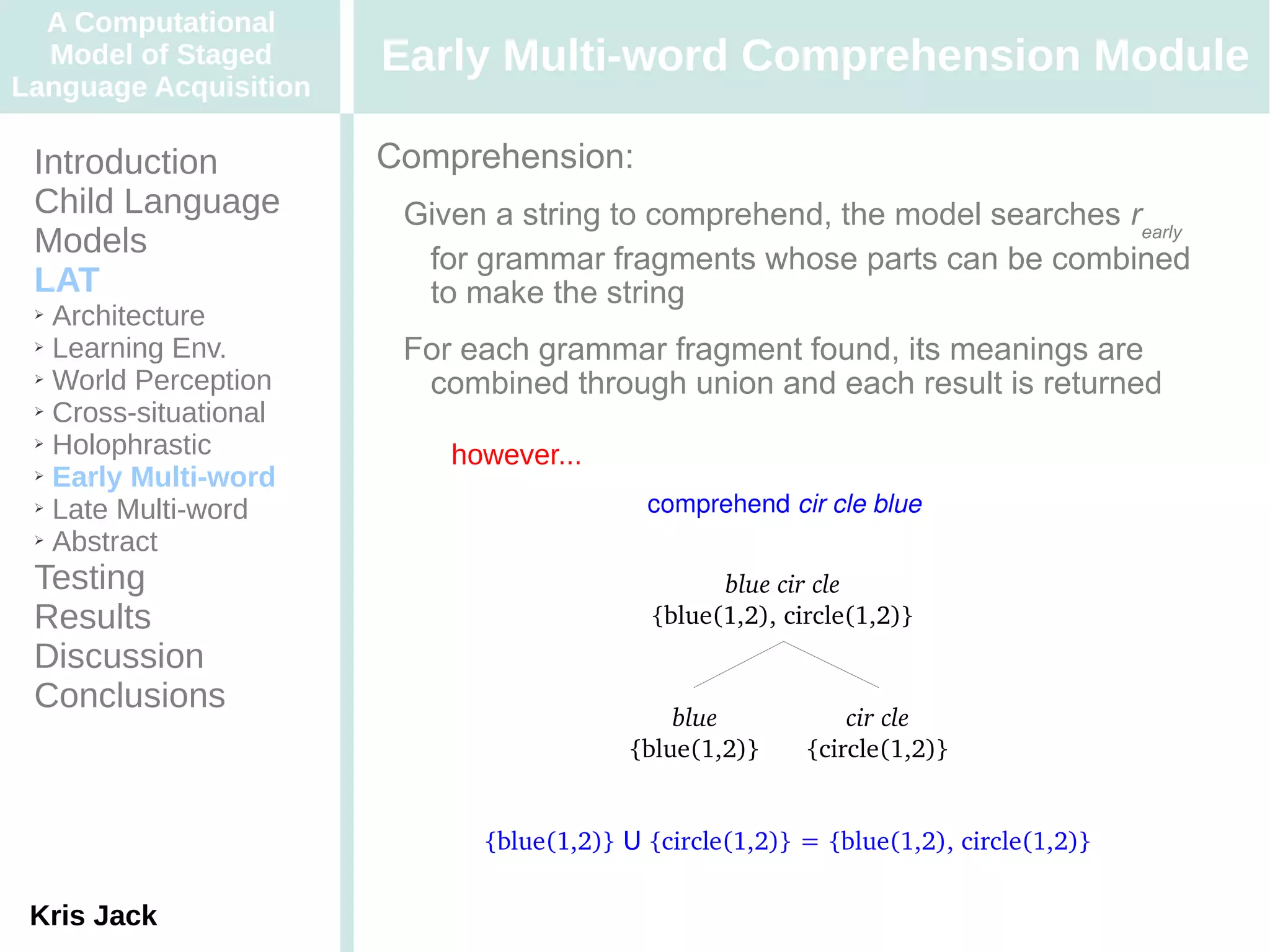
 ➢ Late Multi-word                         comprehend blue cir cle
 ➢ Abstract


 Testing                                         blue cir cle
 Results                                   {blue(1,2), circle(1,2)}
 Discussion
 Conclusions
                                             blue            cir cle
                                         {blue(1,2)}     {circle(1,2)}


                             {blue(1,2)} U {circle(1,2)} = {blue(1,2), circle(1,2)}

 Kris Jack
A Computational
  Model of Staged      Early Multi-word Comprehension Module
Language Acquisition

 Introduction          Comprehension:
 Child Language         Given a string to comprehend, the model searches rearly
 Models                  for grammar fragments whose parts can be combined
 LAT                     to make the string
 ➢ Architecture
 ➢ Learning Env.
                        For each grammar fragment found, its meanings are
 ➢ World Perception
                         combined through union and each result is returned
 ➢ Cross-situational

 ➢ Holophrastic
                           however...
 ➢ Early Multi-word

 ➢ Late Multi-word                         comprehend cir cle blue
 ➢ Abstract


 Testing                                         blue cir cle
 Results                                   {blue(1,2), circle(1,2)}
 Discussion
 Conclusions
                                             blue            cir cle
                                         {blue(1,2)}     {circle(1,2)}


                             {blue(1,2)} U {circle(1,2)} = {blue(1,2), circle(1,2)}

 Kris Jack
A Computational
  Model of Staged      Early Multi-word Comprehension Module
Language Acquisition

 Introduction          Comprehension:
 Child Language         Given a string to comprehend, the model searches rearly
 Models                  for grammar fragments whose parts can be combined
 LAT                     to make the string
 ➢ Architecture
 ➢ Learning Env.
                        For each grammar fragment found, its meanings are
 ➢ World Perception
                         combined through union and each result is returned
 ➢ Cross-situational

 ➢ Holophrastic
                           however...
 ➢ Early Multi-word

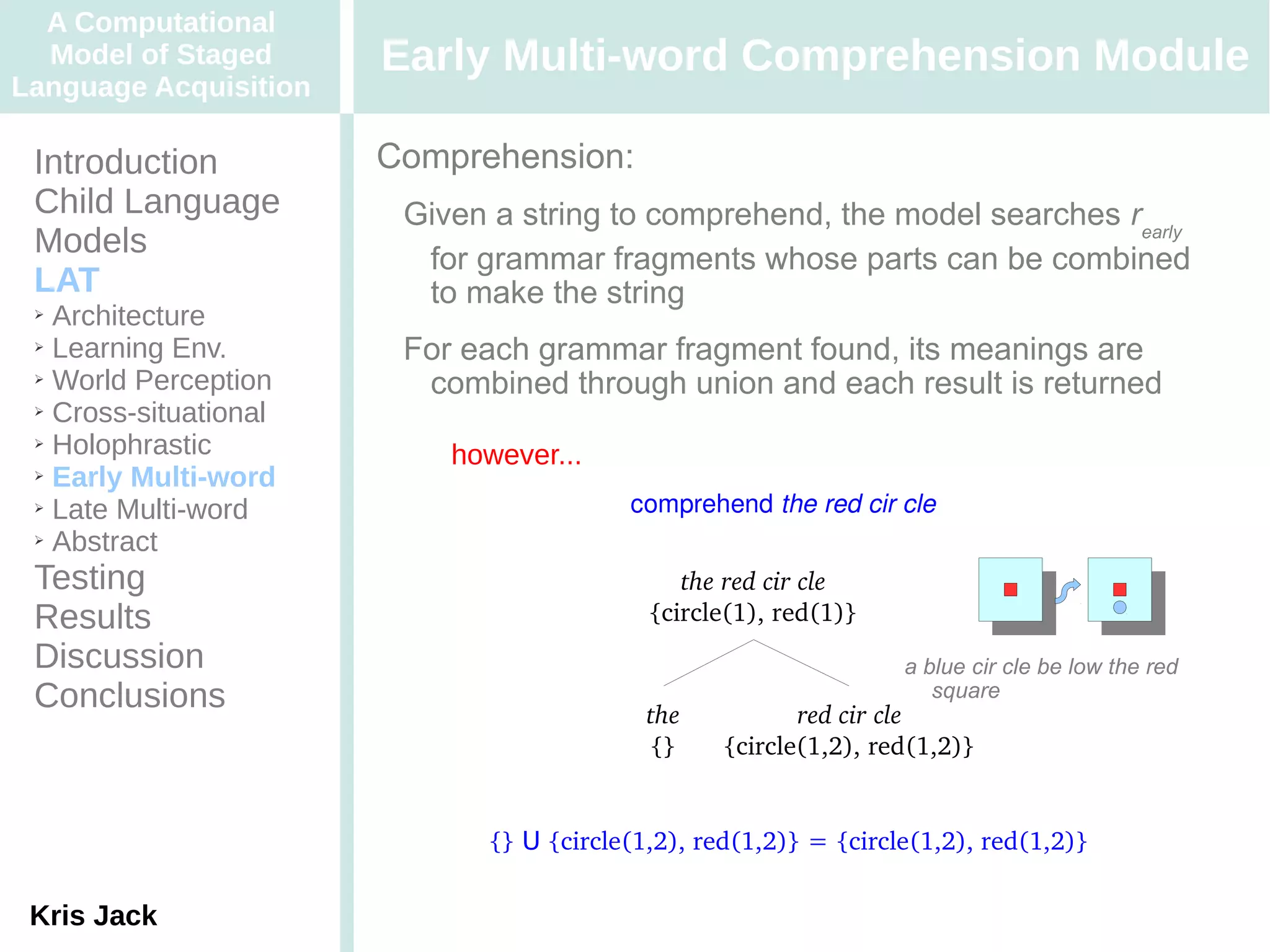
 ➢ Late Multi-word                       comprehend the red cir cle
 ➢ Abstract


 Testing                                      the red cir cle
 Results                                   {circle(1), red(1)}
 Discussion                                                       a blue cir cle be low the red
 Conclusions                               the           red cir cle
                                                                     square

                                           {}     {circle(1,2), red(1,2)}


                             {} U {circle(1,2), red(1,2)} = {circle(1,2), red(1,2)}

 Kris Jack
A Computational
  Model of Staged
Language Acquisition
                       Late Multi-word Learning Module
 Introduction          Aims
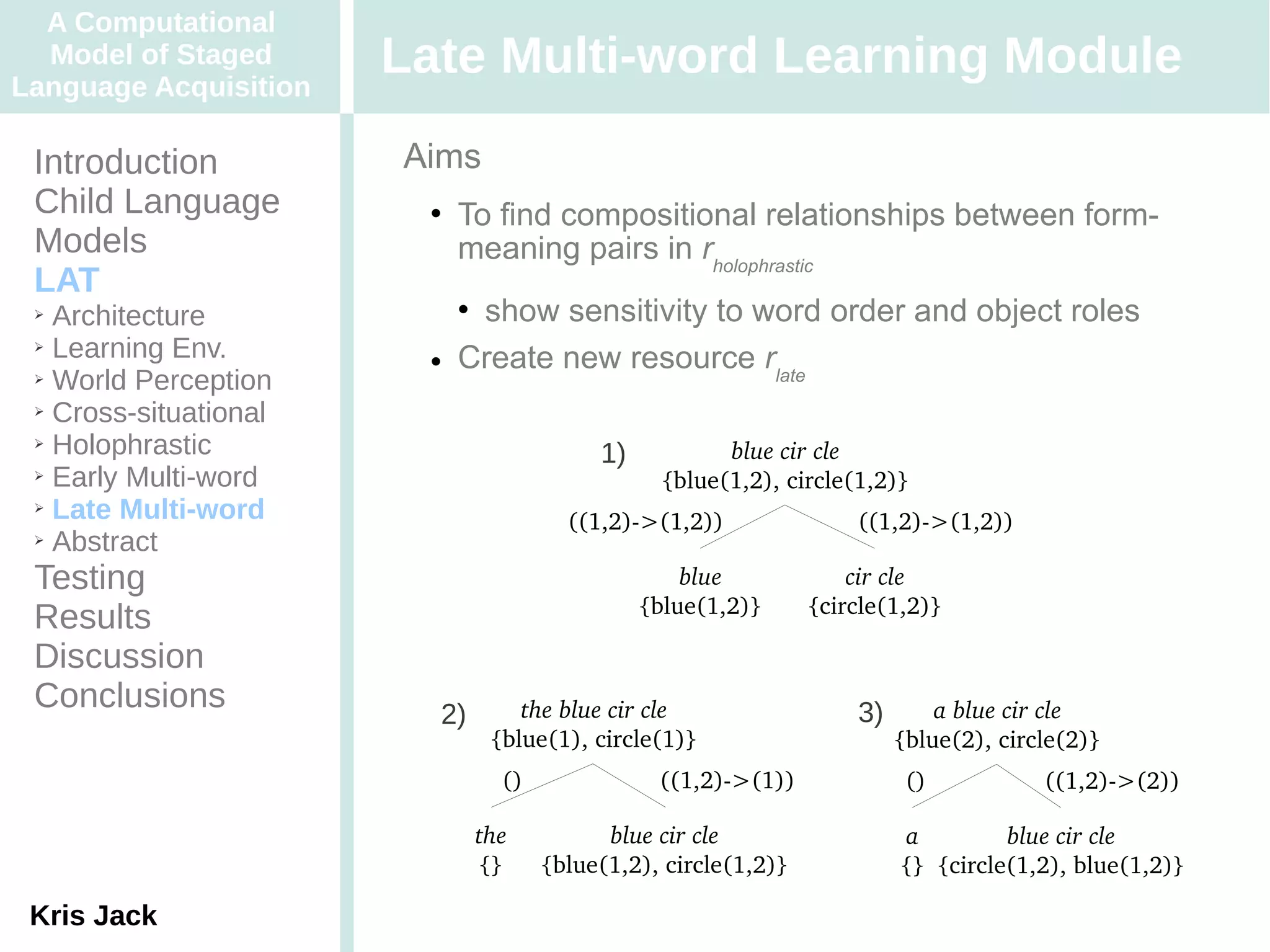
 Child Language            To find compositional relationships between form-
 Models                     meaning pairs in rholophrastic
 LAT
 ➢ Architecture             show sensitivity to word order and object roles
 ➢ Learning Env.

 ➢ World Perception
                           Create new resource rlate
 ➢ Cross-situational

 ➢ Holophrastic
                                            1)           blue cir cle
 ➢ Early Multi-word
                                                   {blue(1,2), circle(1,2)}
 ➢ Late Multi-word
                                         ((1,2)­>(1,2))               ((1,2)­>(1,2))
 ➢ Abstract


 Testing                                             blue             cir cle
                                                 {blue(1,2)}      {circle(1,2)}
 Results
 Discussion
 Conclusions             2)         the blue cir cle                  3)       a blue cir cle
                                 {blue(1), circle(1)}                      {blue(2), circle(2)}
                                  ()              ((1,2)­>(1))              ()           ((1,2)­>(2))

                                the          blue cir cle                  a         blue cir cle
                                {}     {blue(1,2), circle(1,2)}            {} {circle(1,2), blue(1,2)}

 Kris Jack
A Computational
  Model of Staged
Language Acquisition
                       Late Multi-word Learning Module
 Introduction          Finding compositionality
 Child Language         an extension is a function of two other extensions when
 Models                   its
 LAT
 ➢ Architecture
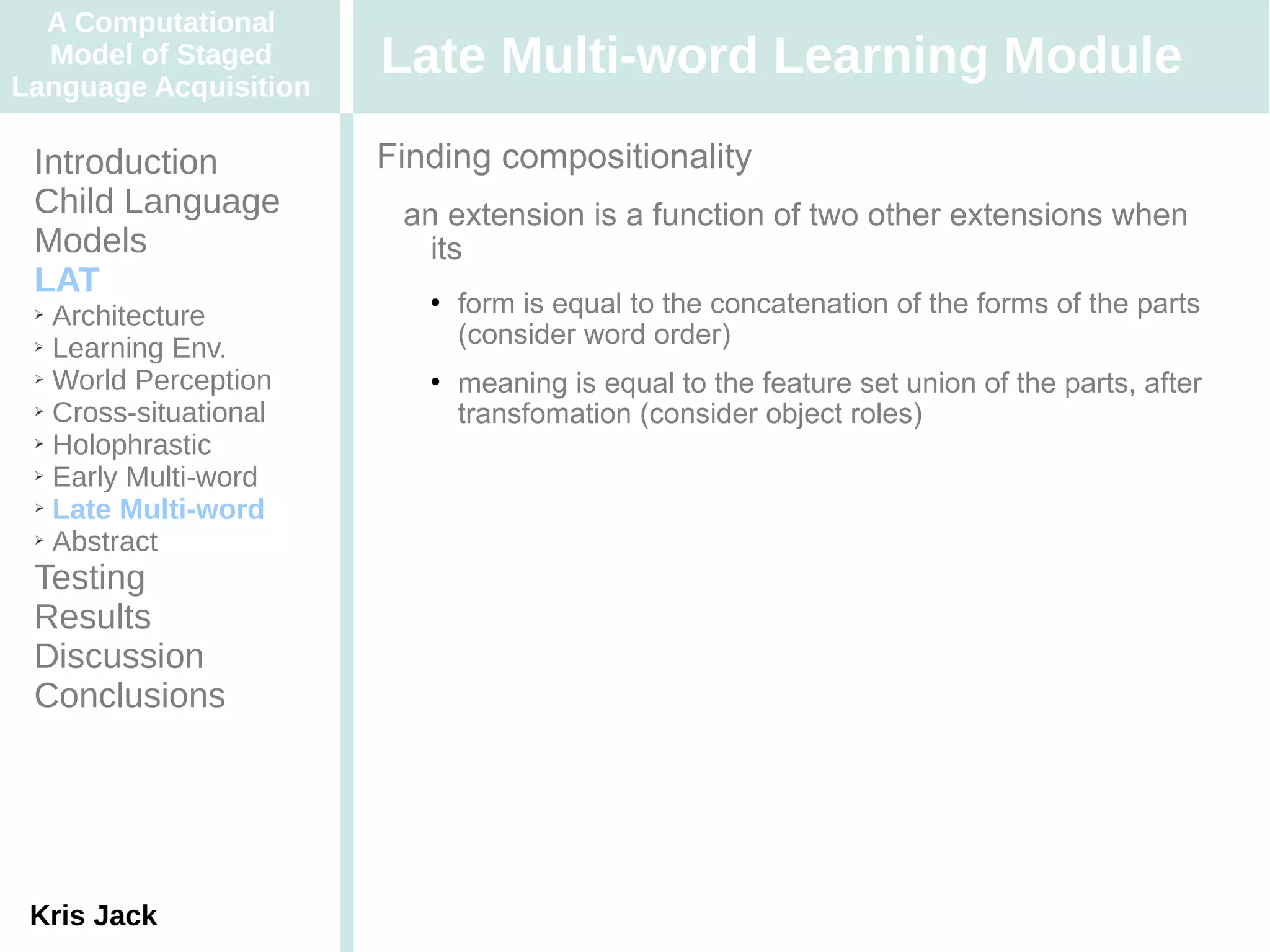
                             form is equal to the concatenation of the forms of the parts
 ➢ Learning Env.
                              (consider word order)
 ➢ World Perception          meaning is equal to the feature set union of the parts, after
 ➢ Cross-situational
                              transfomation (consider object roles)
 ➢ Holophrastic

 ➢ Early Multi-word

 ➢ Late Multi-word

 ➢ Abstract


 Testing
 Results
 Discussion
 Conclusions


 Kris Jack
A Computational
  Model of Staged
Language Acquisition
                       Late Multi-word Learning Module
 Introduction          Finding compositionality
 Child Language         an extension is a function of two other extensions when
 Models                   its
 LAT
 ➢ Architecture
                             form is equal to the concatenation of the forms of the parts
 ➢ Learning Env.
                              (consider word order)
 ➢ World Perception          meaning is equal to the feature set union of the parts, after
 ➢ Cross-situational
                              transfomation (consider object roles)
 ➢ Holophrastic

 ➢ Early Multi-word

 ➢ Late Multi-word
                        do extensions 1) 2) and 3) express a compositional grammar
 ➢ Abstract
                          fragment?
 Testing
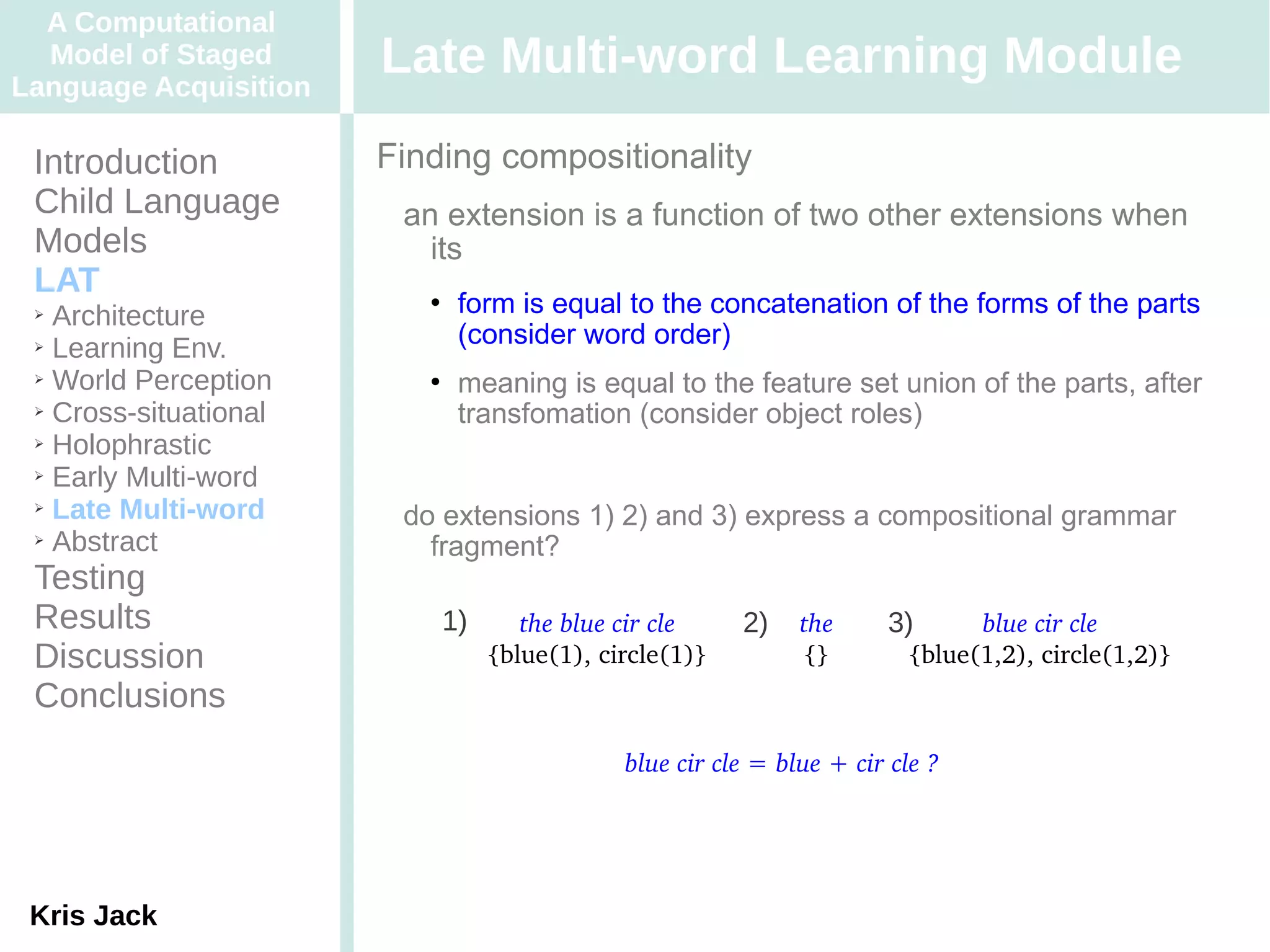
 Results                   1)      the blue cir cle    2)    the     3)      blue cir cle
 Discussion                     {blue(1), circle(1)}         {}        {blue(1,2), circle(1,2)}
 Conclusions
                                            blue cir cle = blue + cir cle ?


 Kris Jack
A Computational
  Model of Staged
Language Acquisition
                       Late Multi-word Learning Module
 Introduction          Finding compositionality
 Child Language          an extension is a function of two other extensions when
 Models                    its
 LAT
 ➢ Architecture
                              form is equal to the concatenation of the forms of the parts
 ➢ Learning Env.
                               (consider word order)
 ➢ World Perception           meaning is equal to the feature set union of the parts, after
 ➢ Cross-situational
                               transfomation (consider object roles)
 ➢ Holophrastic

 ➢ Early Multi-word

 ➢ Late Multi-word
                         do extensions 1) 2) and 3) express a compositional grammar
 ➢ Abstract
                           fragment?
 Testing
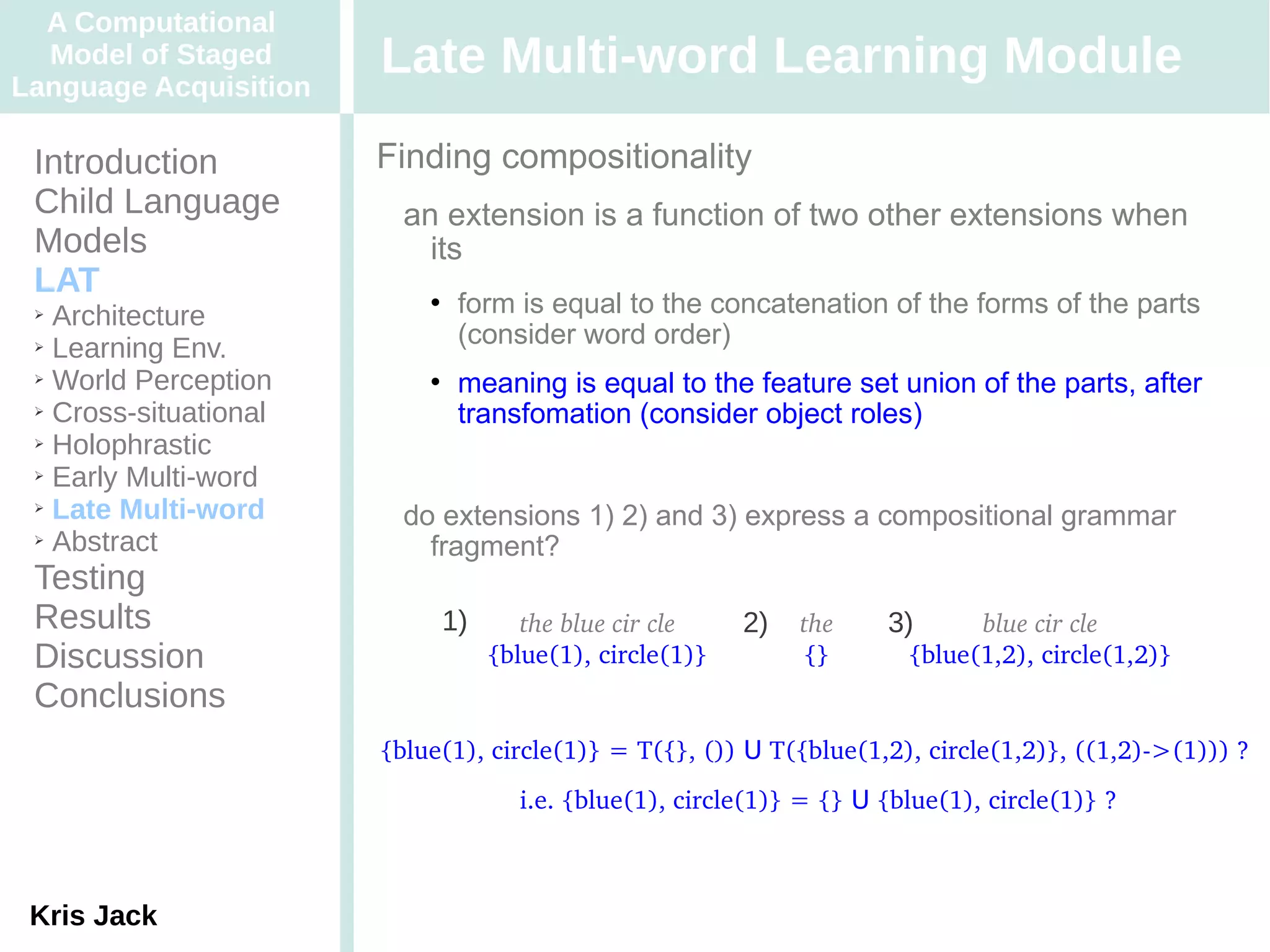
 Results                    1)      the blue cir cle    2)   the     3)      blue cir cle
 Discussion                      {blue(1), circle(1)}        {}        {blue(1,2), circle(1,2)}
 Conclusions
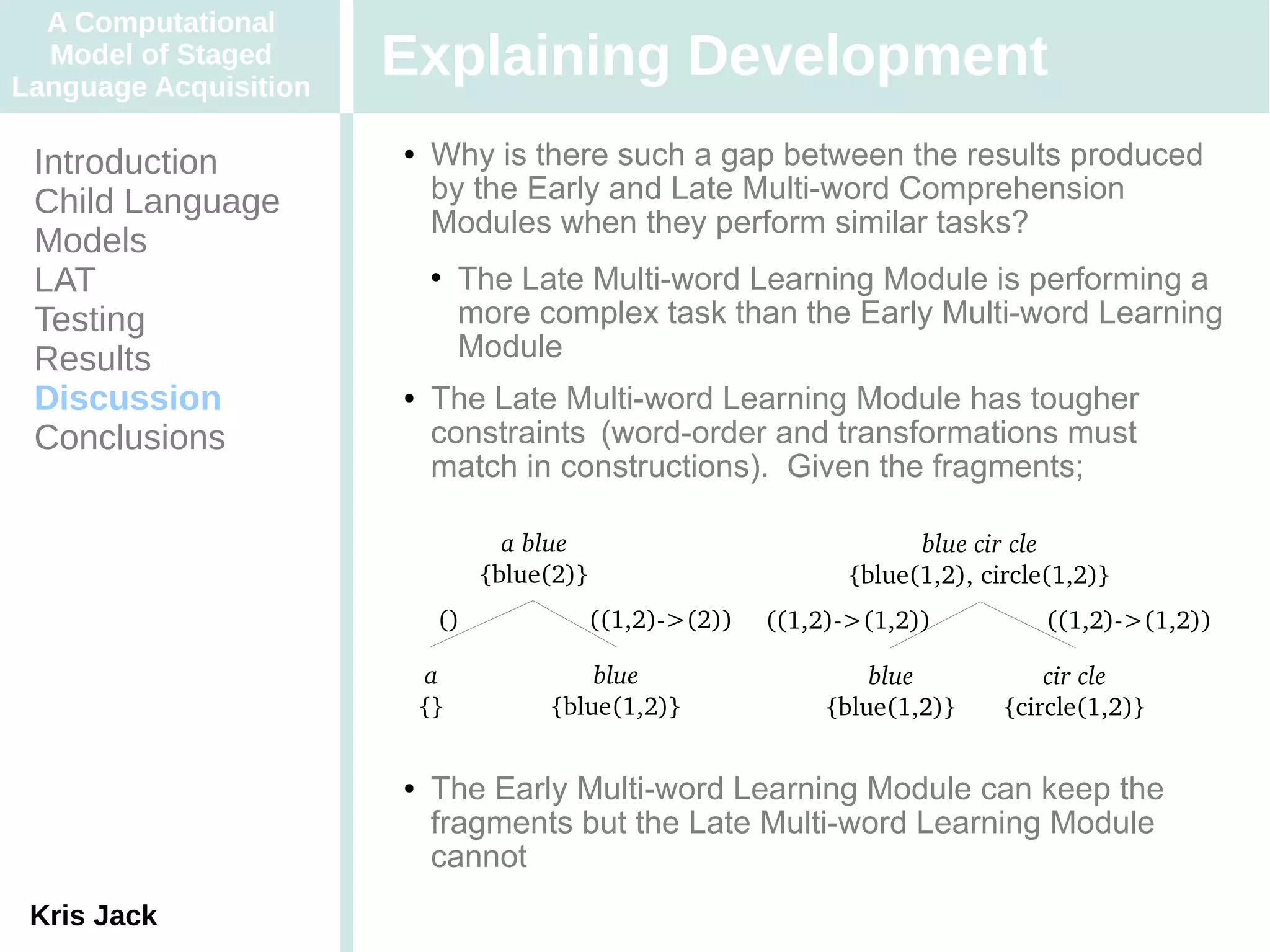
                       {blue(1), circle(1)} = T({}, ()) U T({blue(1,2), circle(1,2)}, ((1,2)­>(1))) ?
                                    i.e. {blue(1), circle(1)} = {} U {blue(1), circle(1)} ?


 Kris Jack
A Computational
  Model of Staged
Language Acquisition
                       Late Multi-word Learning Module
 Introduction          Finding compositionality
 Child Language         an extension is a function of two other extensions when
 Models                   its
 LAT
 ➢ Architecture
                             form is equal to the concatenation of the forms of the parts
 ➢ Learning Env.
                              (consider word order)
 ➢ World Perception          meaning is equal to the feature set union of the parts, after
 ➢ Cross-situational
                              transfomation (consider object roles)
 ➢ Holophrastic

 ➢ Early Multi-word

 ➢ Late Multi-word
                        do extensions 1) 2) and 3) express a compositional grammar
 ➢ Abstract
                          fragment?
 Testing
 Results
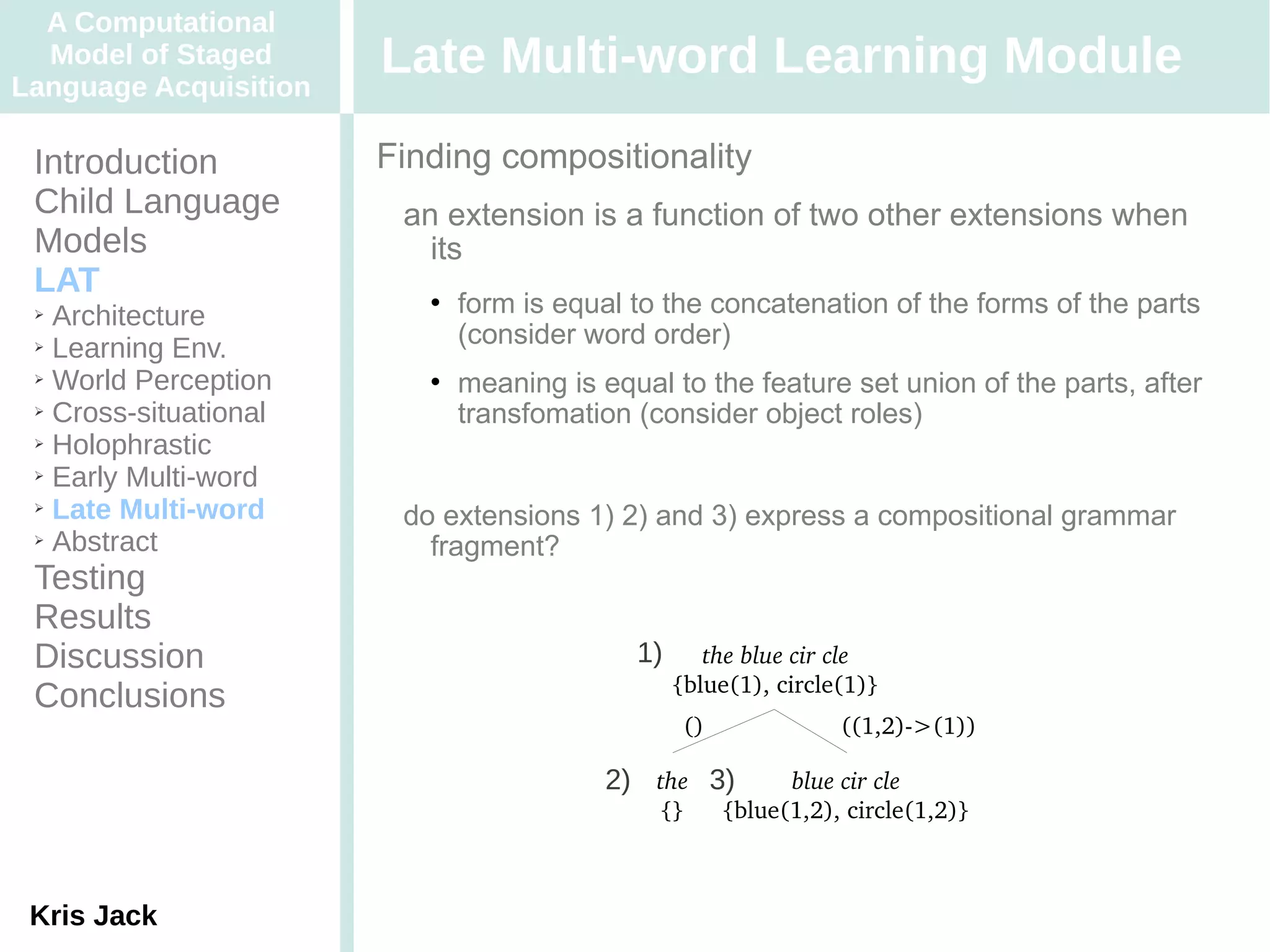
 Discussion                                 1)      the blue cir cle
                                                 {blue(1), circle(1)}
 Conclusions
                                                  ()              ((1,2)­>(1))

                                          2) the 3)          blue cir cle
                                              {}       {blue(1,2), circle(1,2)}


 Kris Jack
A Computational
  Model of Staged
Language Acquisition
                       Late Multi-word Learning Module
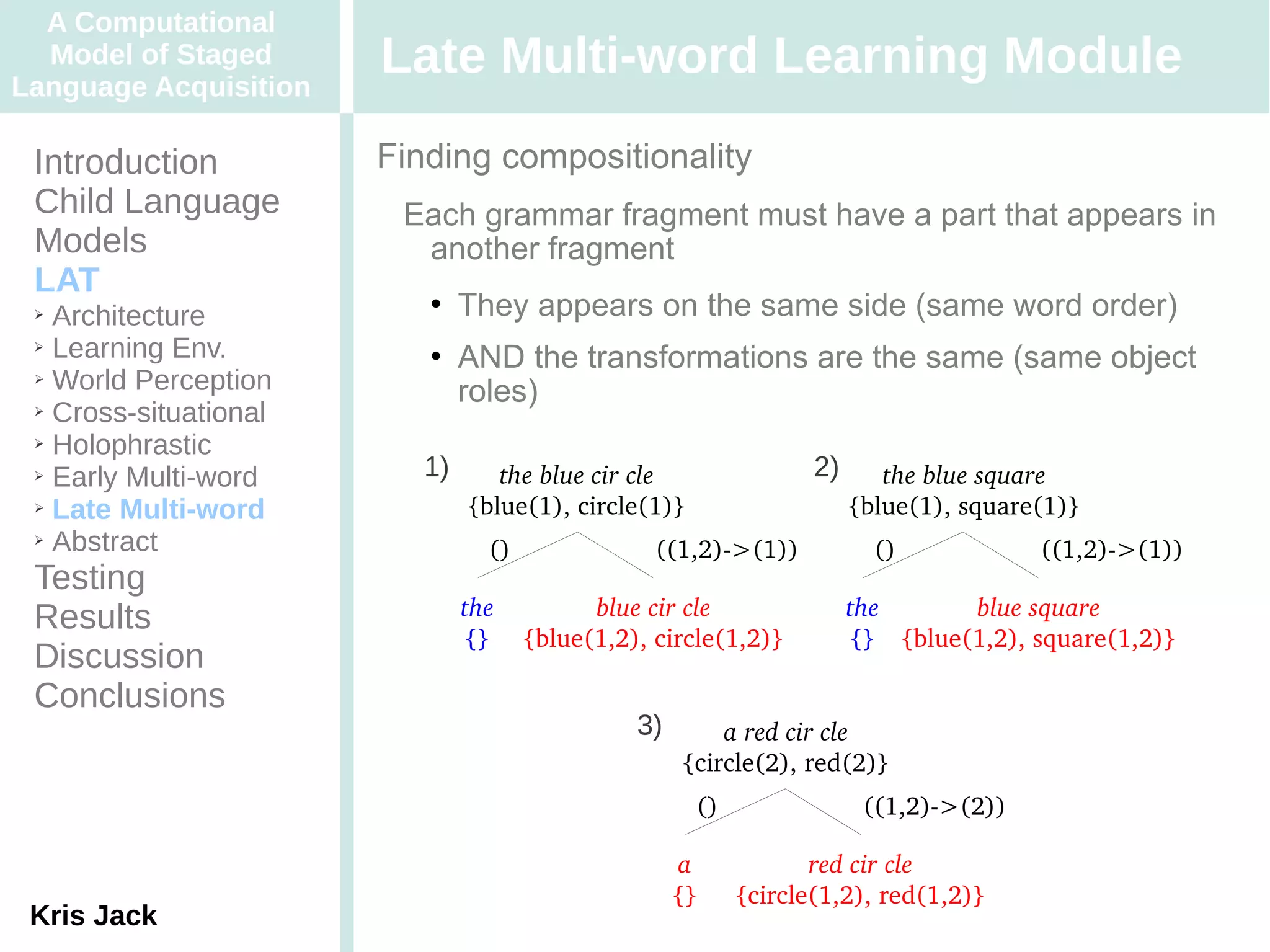
 Introduction          Finding compositionality
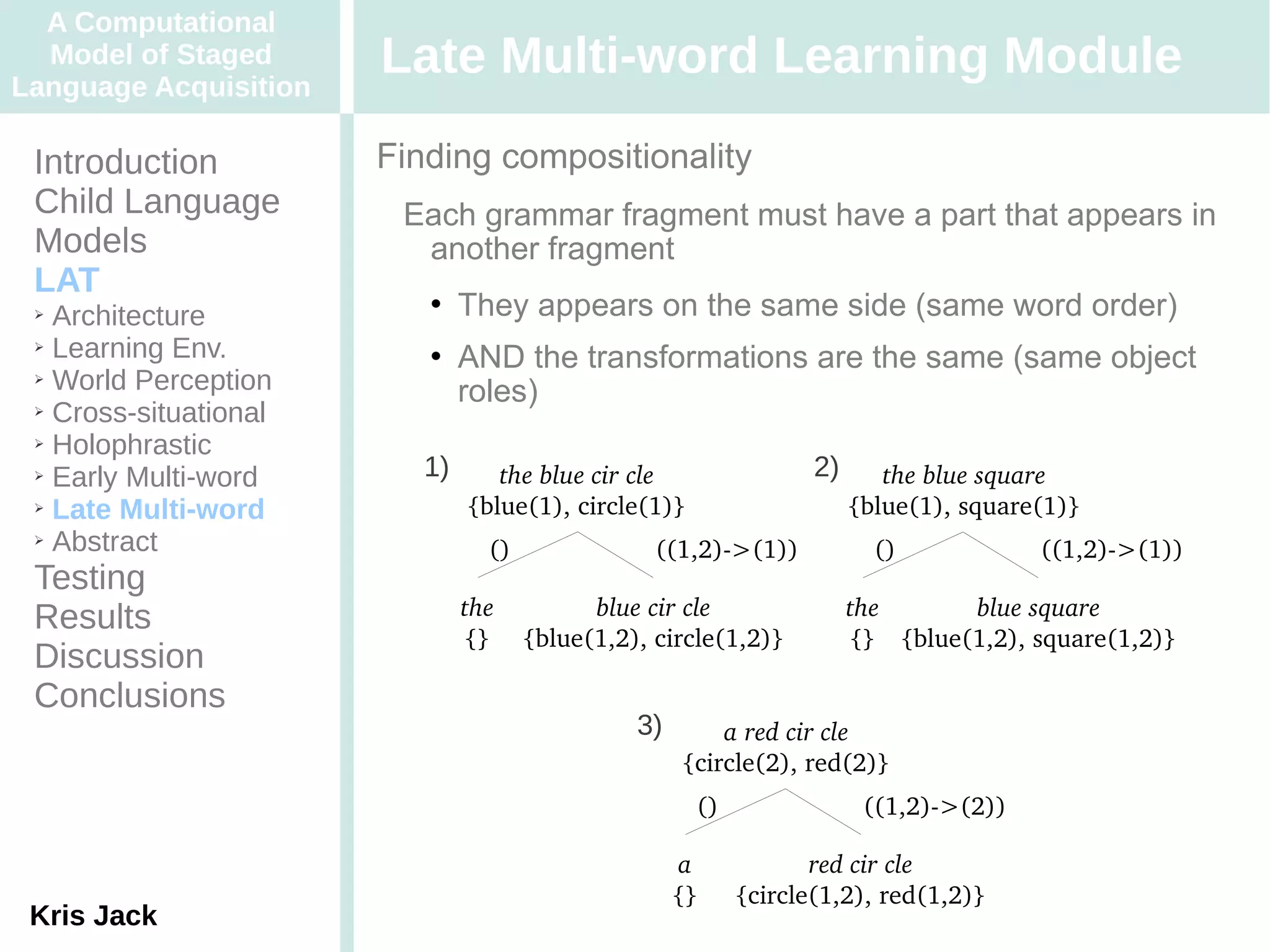
 Child Language         Each grammar fragment must have a part that appears in
 Models                  another fragment
 LAT
 ➢ Architecture
                              They appears on the same side (same word order)
 ➢ Learning Env.
                              AND the transformations are the same (same object
 ➢ World Perception

 ➢ Cross-situational
                               roles)
 ➢ Holophrastic

 ➢ Early Multi-word       1)      the blue cir cle                2)      the blue square
 ➢ Late Multi-word             {blue(1), circle(1)}                    {blue(1), square(1)}
 ➢ Abstract
                                 ()               ((1,2)­>(1))           ()            ((1,2)­>(1))
 Testing
 Results                       the          blue cir cle               the      blue square
                               {}     {blue(1,2), circle(1,2)}         {} {blue(1,2), square(1,2)}
 Discussion
 Conclusions
                                                3)       a red cir cle
                                                     {circle(2), red(2)}
                                                      ()                ((1,2)­>(2))

                                                     a            red cir cle
                                                     {}    {circle(1,2), red(1,2)}
 Kris Jack
A Computational
  Model of Staged
Language Acquisition
                       Late Multi-word Learning Module
 Introduction          Finding compositionality
 Child Language         Each grammar fragment must have a part that appears in
 Models                  another fragment
 LAT
 ➢ Architecture
                              They appears on the same side (same word order)
 ➢ Learning Env.
                              AND the transformations are the same (same object
 ➢ World Perception

 ➢ Cross-situational
                               roles)
 ➢ Holophrastic

 ➢ Early Multi-word       1)      the blue cir cle                2)      the blue square
 ➢ Late Multi-word             {blue(1), circle(1)}                    {blue(1), square(1)}
 ➢ Abstract
                                 ()               ((1,2)­>(1))           ()            ((1,2)­>(1))
 Testing
 Results                       the          blue cir cle               the      blue square
                               {}     {blue(1,2), circle(1,2)}         {} {blue(1,2), square(1,2)}
 Discussion
 Conclusions
                                                3)       a red cir cle
                                                     {circle(2), red(2)}
                                                      ()                ((1,2)­>(2))

                                                     a            red cir cle
                                                     {}    {circle(1,2), red(1,2)}
 Kris Jack
A Computational
  Model of Staged
Language Acquisition
                       Late Multi-word Learning Module
 Introduction          Finding compositionality
 Child Language         Each grammar fragment must have a part that appears in
 Models                  another fragment
 LAT
 ➢ Architecture
                              They appears on the same side (same word order)
 ➢ Learning Env.
                              AND the transformations are the same (same object
 ➢ World Perception

 ➢ Cross-situational
                               roles)
 ➢ Holophrastic

 ➢ Early Multi-word

 ➢ Late Multi-word

 ➢ Abstract
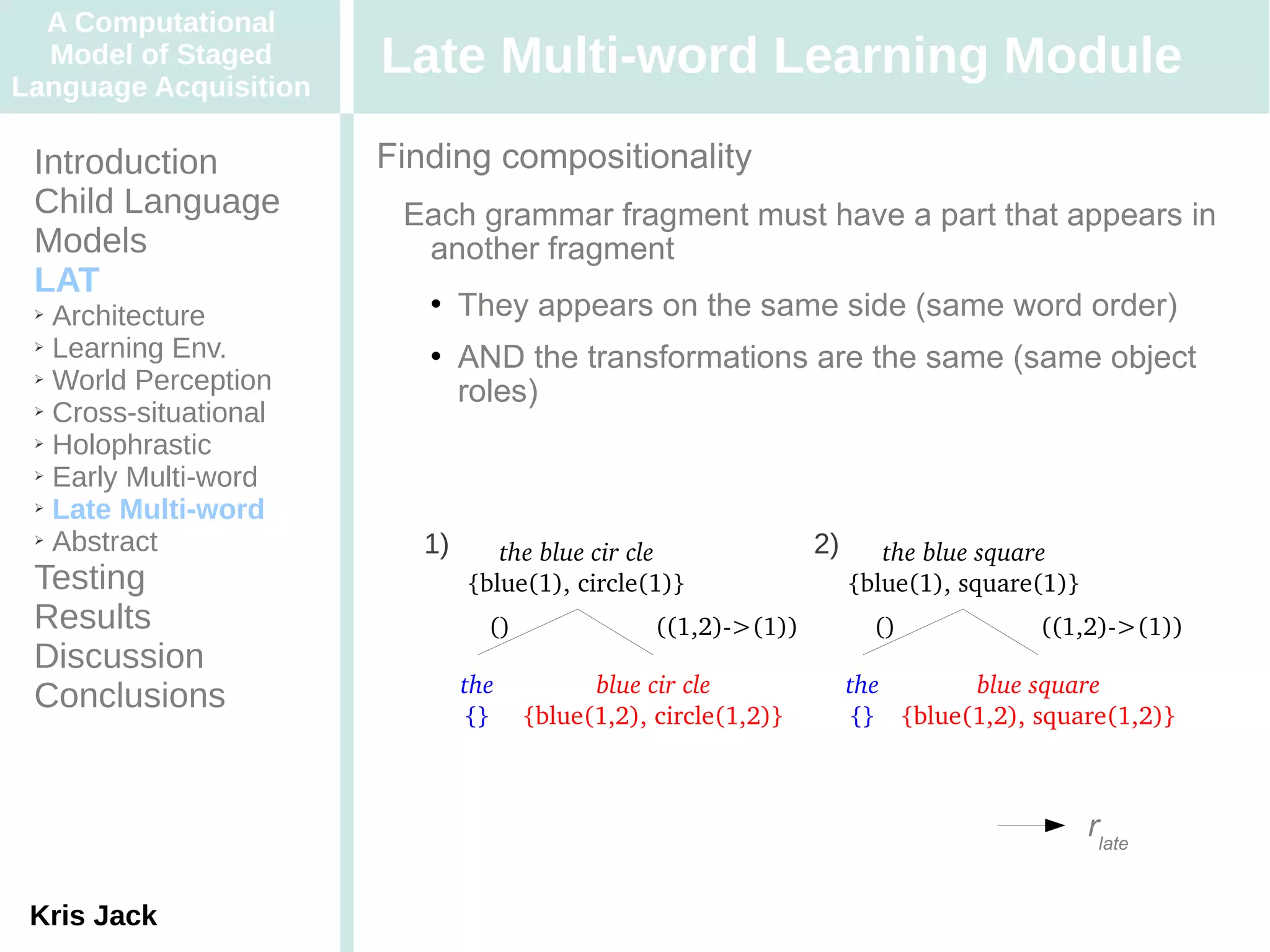
                          1)      the blue cir cle               2)      the blue square
 Testing                       {blue(1), circle(1)}                   {blue(1), square(1)}
 Results                         ()               ((1,2)­>(1))          ()            ((1,2)­>(1))
 Discussion
                               the          blue cir cle              the      blue square
 Conclusions                   {}     {blue(1,2), circle(1,2)}        {} {blue(1,2), square(1,2)}


                                                                                             rlate

 Kris Jack
A Computational
  Model of Staged      Late Multi-word Comprehension Module
Language Acquisition

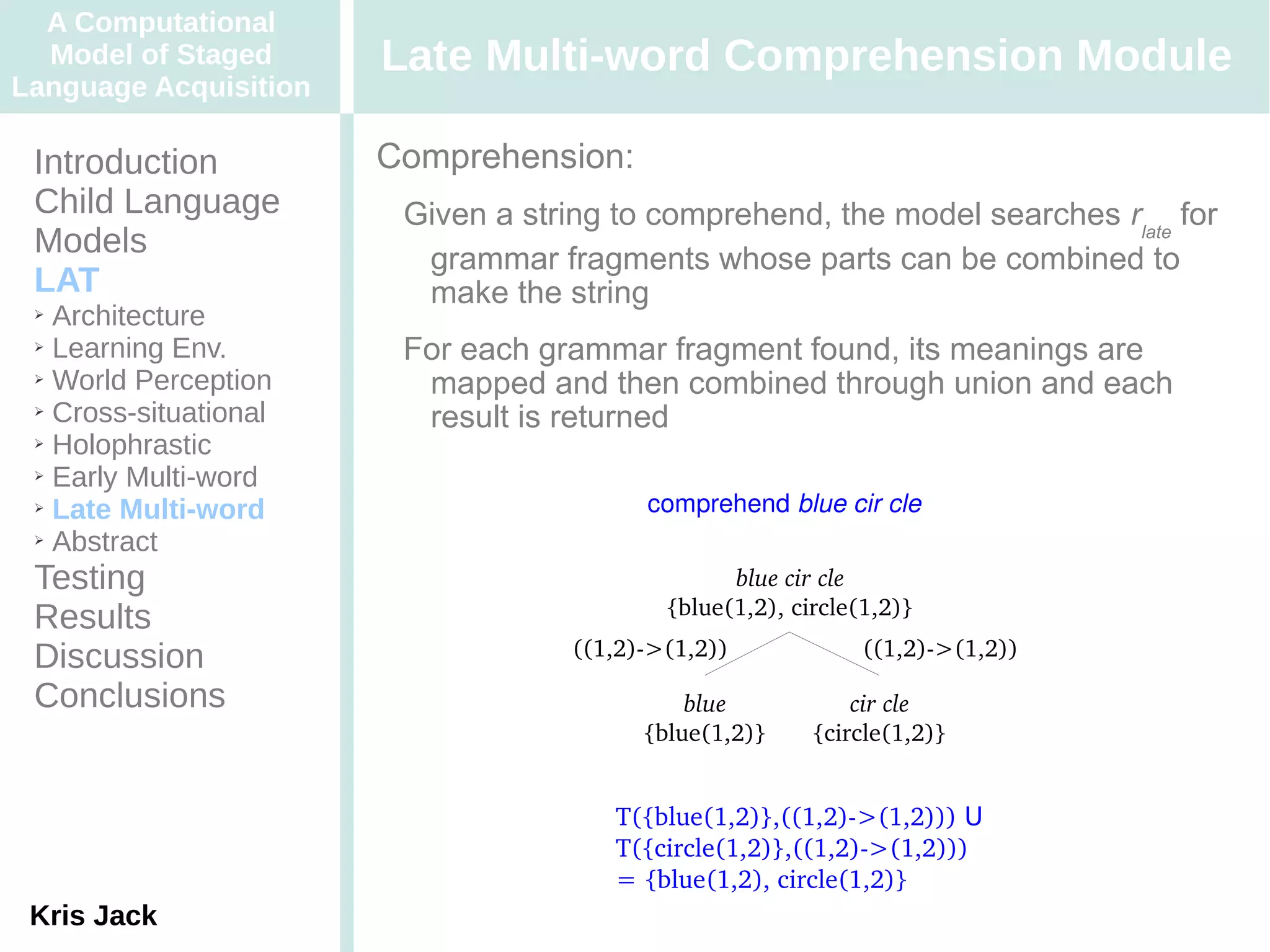
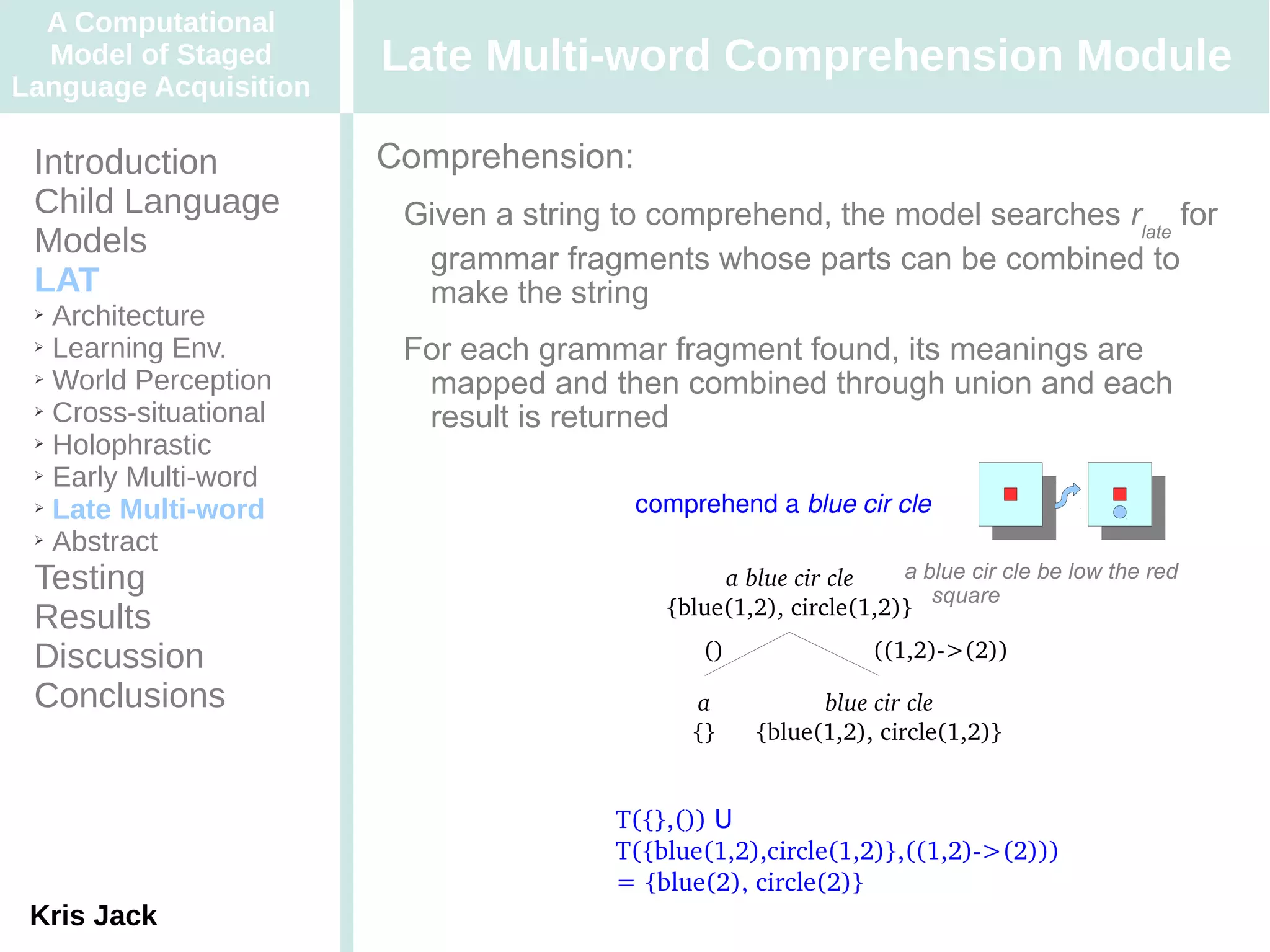
 Introduction          Comprehension:
 Child Language         Given a string to comprehend, the model searches rlate for
 Models                  grammar fragments whose parts can be combined to
 LAT                     make the string
 ➢ Architecture
 ➢ Learning Env.
                        For each grammar fragment found, its meanings are
 ➢ World Perception
                         mapped and then combined through union and each
 ➢ Cross-situational
                         result is returned
 ➢ Holophrastic

 ➢ Early Multi-word

 ➢ Late Multi-word                        comprehend blue cir cle
 ➢ Abstract


 Testing                                          blue cir cle
                                            {blue(1,2), circle(1,2)}
 Results
 Discussion                         ((1,2)­>(1,2))             ((1,2)­>(1,2))

 Conclusions                                  blue            cir cle
                                          {blue(1,2)}     {circle(1,2)}


                                       T({blue(1,2)},((1,2)­>(1,2))) U
                                       T({circle(1,2)},((1,2)­>(1,2))) 
                                       = {blue(1,2), circle(1,2)}
 Kris Jack
A Computational
  Model of Staged      Late Multi-word Comprehension Module
Language Acquisition

 Introduction          Comprehension:
 Child Language         Given a string to comprehend, the model searches rlate for
 Models                  grammar fragments whose parts can be combined to
 LAT                     make the string
 ➢ Architecture
 ➢ Learning Env.
                        For each grammar fragment found, its meanings are
 ➢ World Perception
                         mapped and then combined through union and each
 ➢ Cross-situational
                         result is returned
 ➢ Holophrastic

 ➢ Early Multi-word

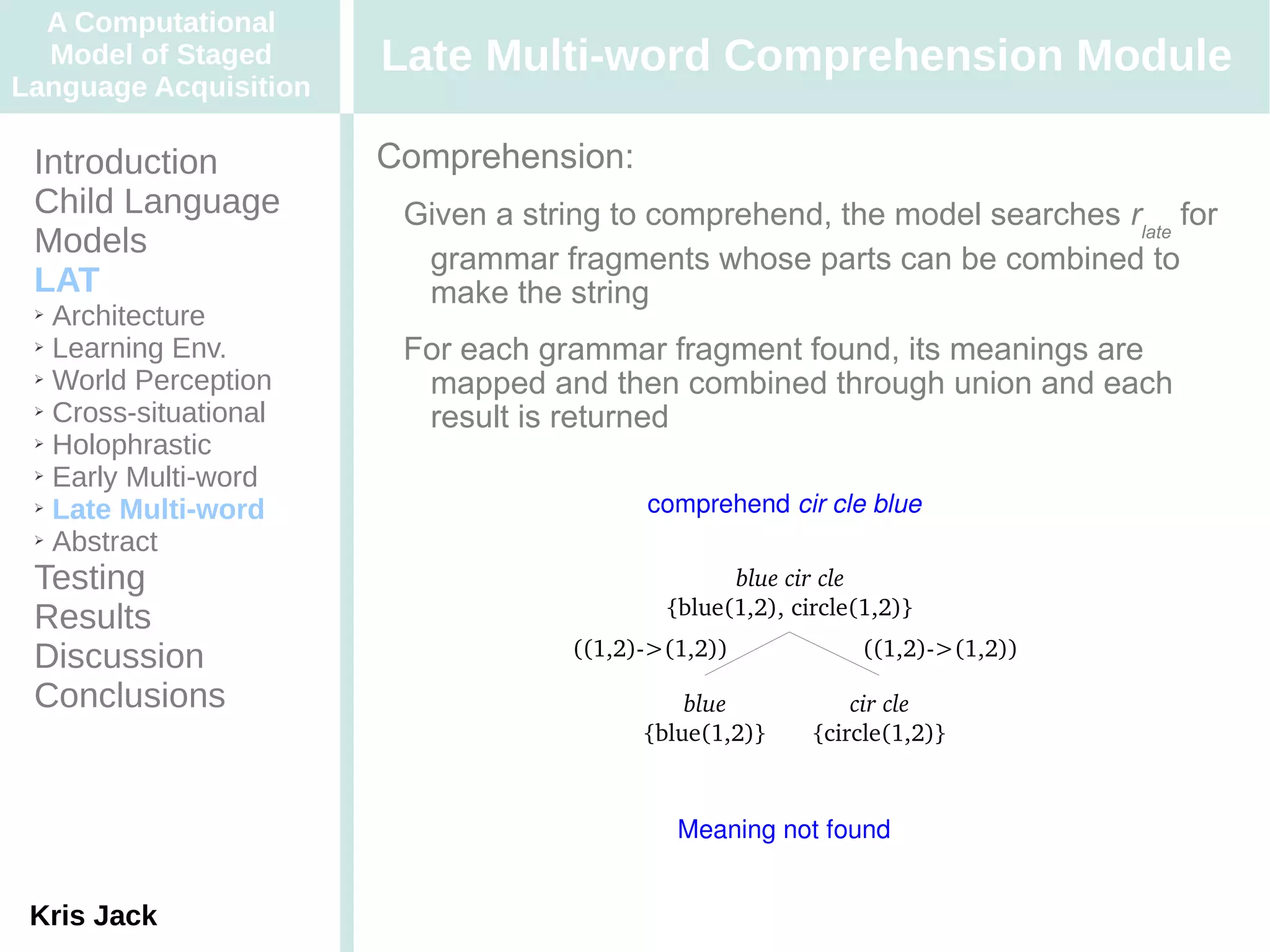
 ➢ Late Multi-word                        comprehend cir cle blue
 ➢ Abstract


 Testing                                          blue cir cle
                                            {blue(1,2), circle(1,2)}
 Results
 Discussion                         ((1,2)­>(1,2))             ((1,2)­>(1,2))

 Conclusions                                  blue            cir cle
                                          {blue(1,2)}     {circle(1,2)}


                                             Meaning not found


 Kris Jack
A Computational
  Model of Staged      Late Multi-word Comprehension Module
Language Acquisition

 Introduction          Comprehension:
 Child Language         Given a string to comprehend, the model searches rlate for
 Models                  grammar fragments whose parts can be combined to
 LAT                     make the string
 ➢ Architecture
 ➢ Learning Env.
                        For each grammar fragment found, its meanings are
 ➢ World Perception
                         mapped and then combined through union and each
 ➢ Cross-situational
                         result is returned
 ➢ Holophrastic

 ➢ Early Multi-word

 ➢ Late Multi-word                      comprehend a blue cir cle
 ➢ Abstract


 Testing                                        a blue cir cle    a blue cir cle be low the red
                                                                     square
                                           {blue(1,2), circle(1,2)}
 Results
 Discussion                                   ()                ((1,2)­>(2))

 Conclusions                                 a            blue cir cle
                                             {}     {blue(1,2), circle(1,2)}


                                       T({},()) U
                                       T({blue(1,2),circle(1,2)},((1,2)­>(2))) 
                                       = {blue(2), circle(2)}
 Kris Jack
A Computational
  Model of Staged
Language Acquisition
                       Abstract Learning Module
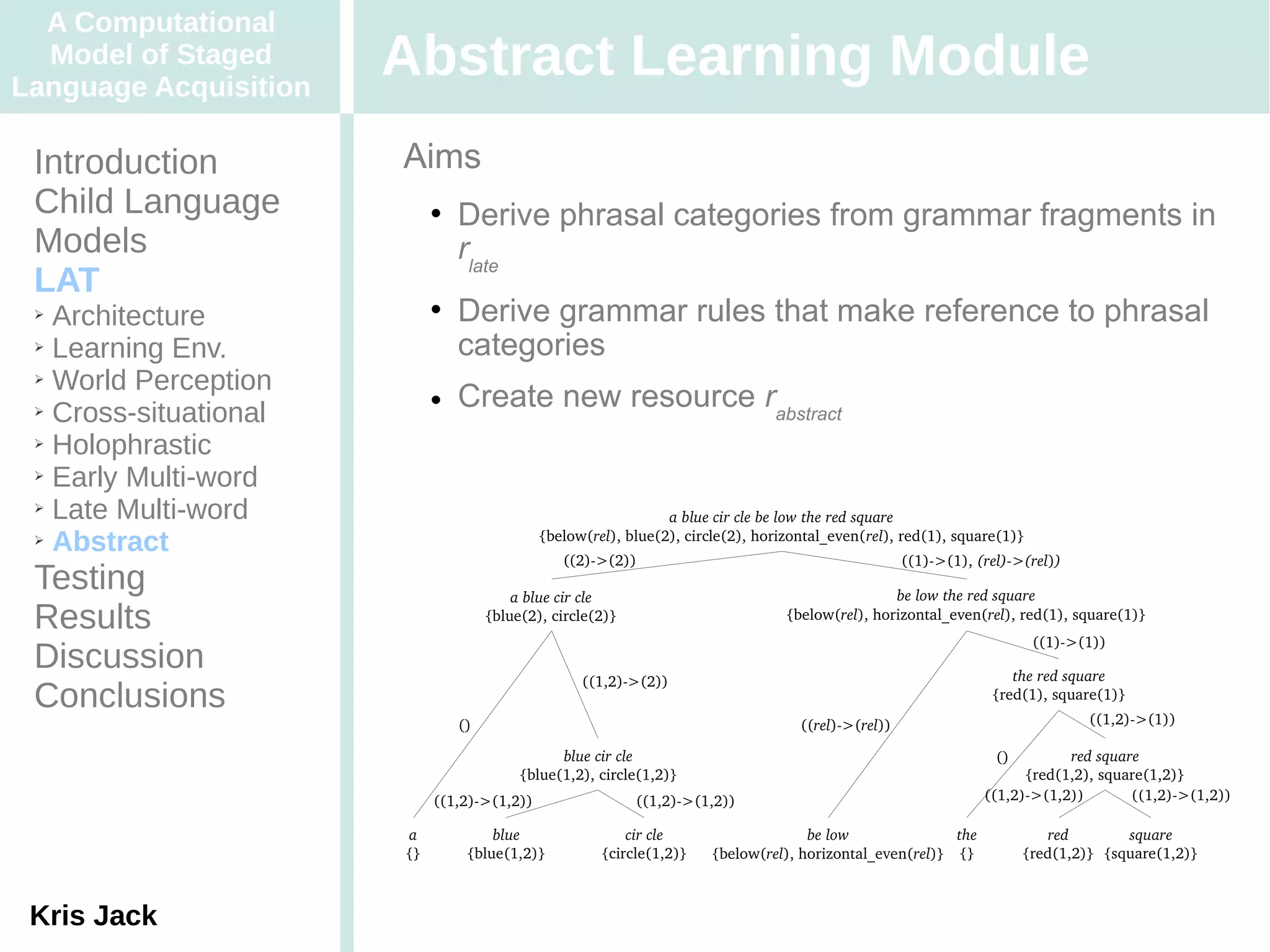
 Introduction          Aims
 Child Language                Derive phrasal categories from grammar fragments in
 Models                         rlate
 LAT
 ➢ Architecture                Derive grammar rules that make reference to phrasal
 ➢ Learning Env.                categories
 ➢ World Perception

 ➢ Cross-situational
                               Create new resource rabstract
 ➢ Holophrastic

 ➢ Early Multi-word

 ➢ Late Multi-word
                                                                a blue cir cle be low the red square
 ➢ Abstract                                  {below(rel), blue(2), circle(2), horizontal_even(rel), red(1), square(1)}
                                                ((2)­>(2))                                           ((1)­>(1), (rel)­>(rel))
 Testing                                 a blue cir cle                                           be low the red square
 Results                             {blue(2), circle(2)}                         {below(rel), horizontal_even(rel), red(1), square(1)}
                                                                                                                         ((1)­>(1))
 Discussion                                                                                                          the red square
                                                   ((1,2)­>(2))
 Conclusions                                                                                                      {red(1), square(1)}
                                                                                                                                 ((1,2)­>(1))
                                ()                                                  ((rel)­>(rel))
                                                blue cir cle                                                       ()        red square
                                          {blue(1,2), circle(1,2)}                                                     {red(1,2), square(1,2)}
                            ((1,2)­>(1,2))                  ((1,2)­>(1,2))                                       ((1,2)­>(1,2))       ((1,2)­>(1,2))

                       a             blue                 cir cle                    be low               the              red        square
                       {}        {blue(1,2)}          {circle(1,2)}    {below(rel), horizontal_even(rel)} {}            {red(1,2)} {square(1,2)}


 Kris Jack
A Computational
  Model of Staged
Language Acquisition
                       Abstract Learning Module
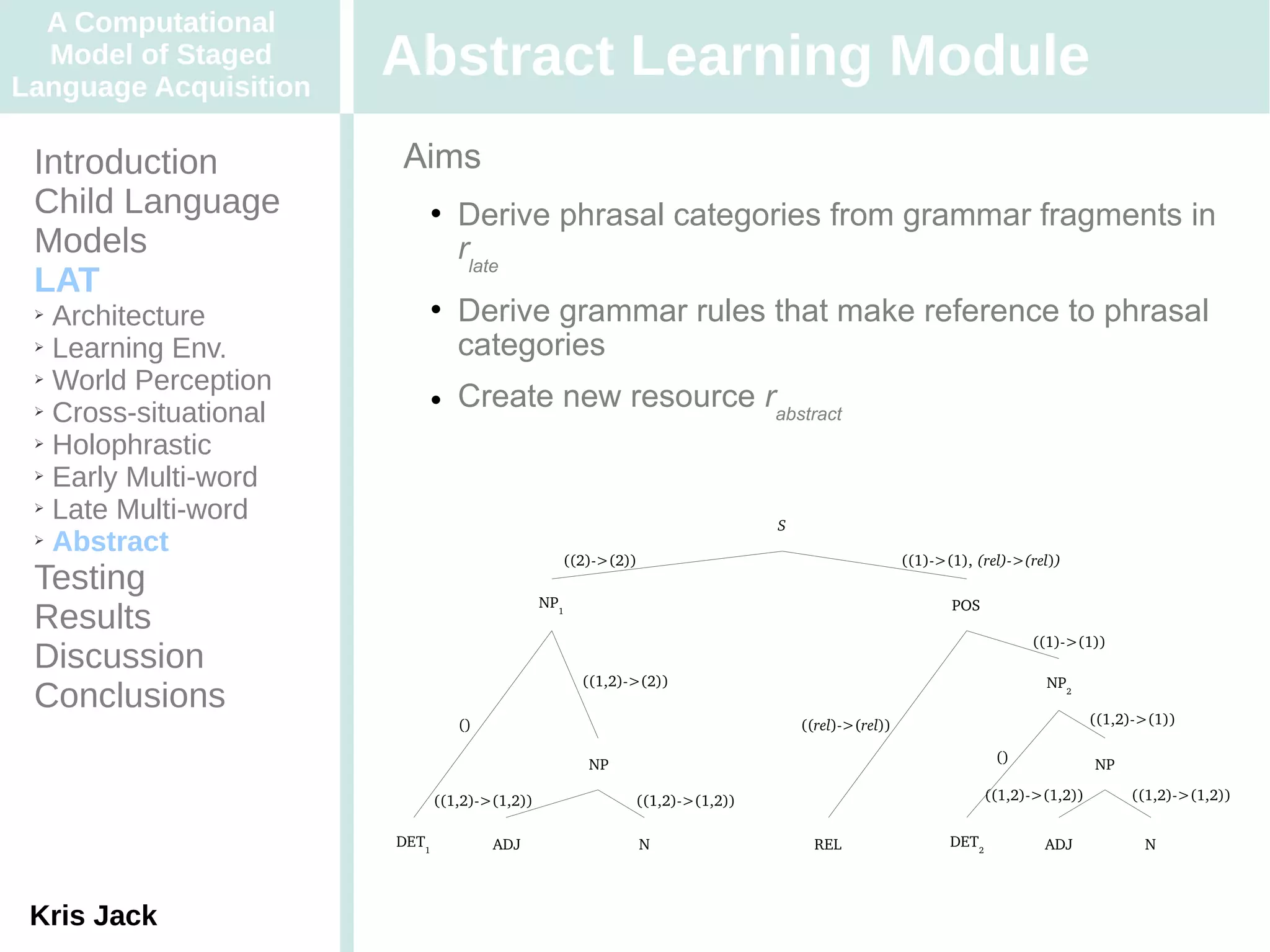
 Introduction          Aims
 Child Language                  Derive phrasal categories from grammar fragments in
 Models                           rlate
 LAT
 ➢ Architecture                  Derive grammar rules that make reference to phrasal
 ➢ Learning Env.                  categories
 ➢ World Perception

 ➢ Cross-situational
                                 Create new resource rabstract
 ➢ Holophrastic

 ➢ Early Multi-word

 ➢ Late Multi-word
                                                                             S
 ➢ Abstract
                                                 ((2)­>(2))                                       ((1)­>(1), (rel)­>(rel))
 Testing
                                               NP1                                                       POS
 Results
                                                                                                                      ((1)­>(1))
 Discussion
                                                     ((1,2)­>(2))                                                       NP2
 Conclusions                                                                                                                     ((1,2)­>(1))
                                  ()                                             ((rel)­>(rel))

                                                     NP                                                          ()              NP

                              ((1,2)­>(1,2))                ((1,2)­>(1,2))                                      ((1,2)­>(1,2))        ((1,2)­>(1,2))


                       DET1            ADJ                    N                    REL                   DET2           ADJ             N


 Kris Jack
A Computational
  Model of Staged
Language Acquisition
                       Abstract Learning Module
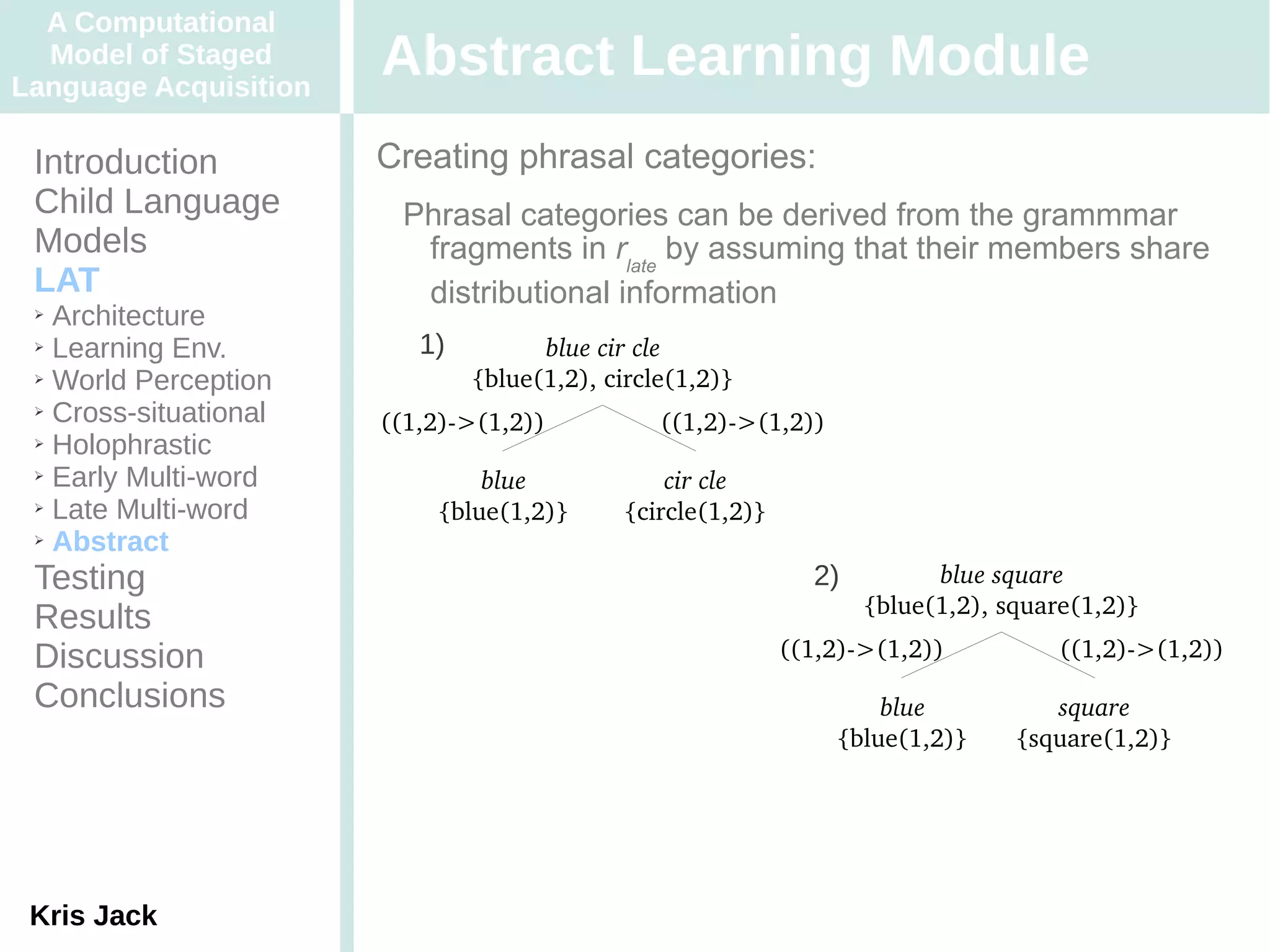
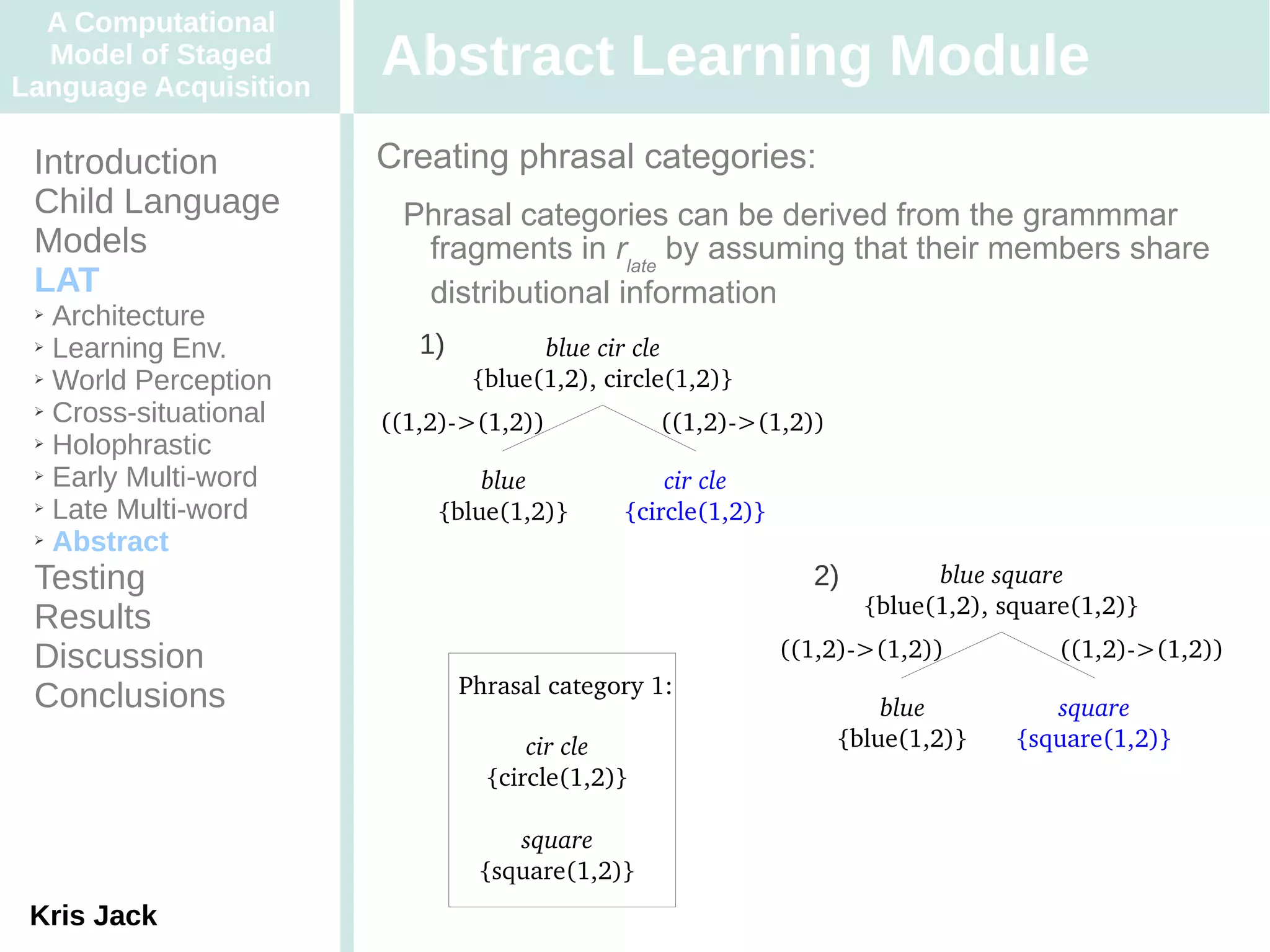
 Introduction          Creating phrasal categories:
 Child Language         Phrasal categories can be derived from the grammmar
 Models                  fragments in rlate by assuming that their members share
 LAT                     distributional information
 ➢ Architecture
 ➢ Learning Env.          1)         blue cir cle
 ➢ World Perception            {blue(1,2), circle(1,2)}
 ➢ Cross-situational
                       ((1,2)­>(1,2))           ((1,2)­>(1,2))
 ➢ Holophrastic

 ➢ Early Multi-word
                               blue             cir cle
 ➢ Late Multi-word
                           {blue(1,2)}      {circle(1,2)}
 ➢ Abstract


 Testing                                                      2)         blue square
                                                                   {blue(1,2), square(1,2)}
 Results
 Discussion                                                 ((1,2)­>(1,2))          ((1,2)­>(1,2))
 Conclusions                                                         blue          square
                                                                 {blue(1,2)}    {square(1,2)}


 Kris Jack
A Computational
  Model of Staged
Language Acquisition
                       Abstract Learning Module
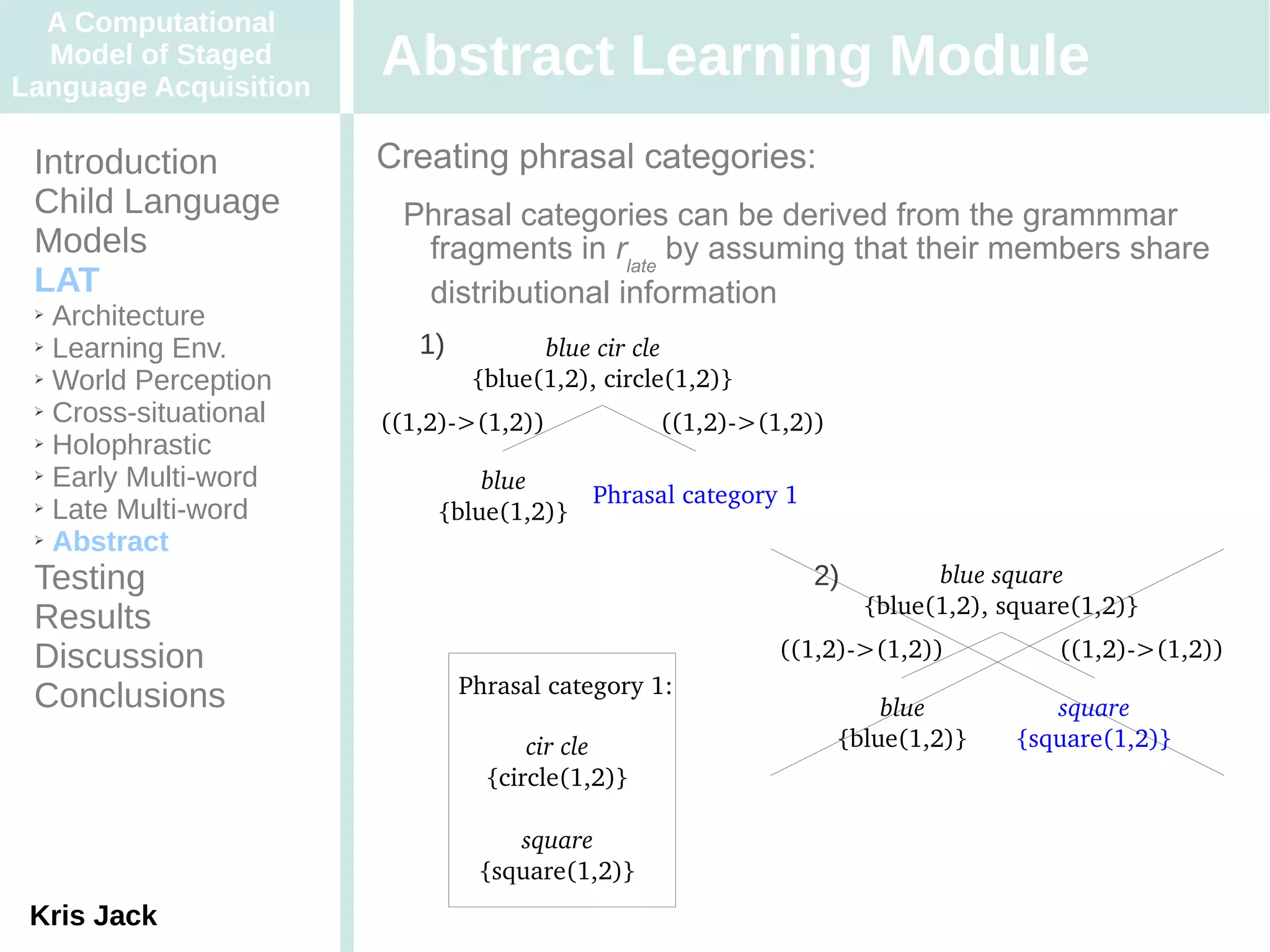
 Introduction          Creating phrasal categories:
 Child Language         Phrasal categories can be derived from the grammmar
 Models                  fragments in rlate by assuming that their members share
 LAT                     distributional information
 ➢ Architecture
 ➢ Learning Env.          1)          blue cir cle
 ➢ World Perception             {blue(1,2), circle(1,2)}
 ➢ Cross-situational
                       ((1,2)­>(1,2))            ((1,2)­>(1,2))
 ➢ Holophrastic

 ➢ Early Multi-word
                               blue              cir cle
 ➢ Late Multi-word
                           {blue(1,2)}       {circle(1,2)}
 ➢ Abstract


 Testing                                                       2)         blue square
                                                                    {blue(1,2), square(1,2)}
 Results
 Discussion                                                  ((1,2)­>(1,2))          ((1,2)­>(1,2))
                               Phrasal category 1:
 Conclusions                                                          blue          square
                                     cir cle                      {blue(1,2)}    {square(1,2)}
                                 {circle(1,2)}

                                   square
                                {square(1,2)}
 Kris Jack
A Computational
  Model of Staged
Language Acquisition
                       Abstract Learning Module
 Introduction          Creating phrasal categories:
 Child Language         Phrasal categories can be derived from the grammmar
 Models                  fragments in rlate by assuming that their members share
 LAT                     distributional information
 ➢ Architecture
 ➢ Learning Env.          1)          blue cir cle
 ➢ World Perception             {blue(1,2), circle(1,2)}
 ➢ Cross-situational
                       ((1,2)­>(1,2))            ((1,2)­>(1,2))
 ➢ Holophrastic

 ➢ Early Multi-word
                               blue
 ➢ Late Multi-word
                                       Phrasal category 1
                           {blue(1,2)}
 ➢ Abstract


 Testing                                                      2)          blue square
                                                                    {blue(1,2), square(1,2)}
 Results
 Discussion                                                ((1,2)­>(1,2))            ((1,2)­>(1,2))
                               Phrasal category 1:
 Conclusions                                                          blue          square
                                     cir cle                      {blue(1,2)}    {square(1,2)}
                                 {circle(1,2)}

                                   square
                                {square(1,2)}
 Kris Jack
A Computational
  Model of Staged
Language Acquisition
                       Abstract Learning Module
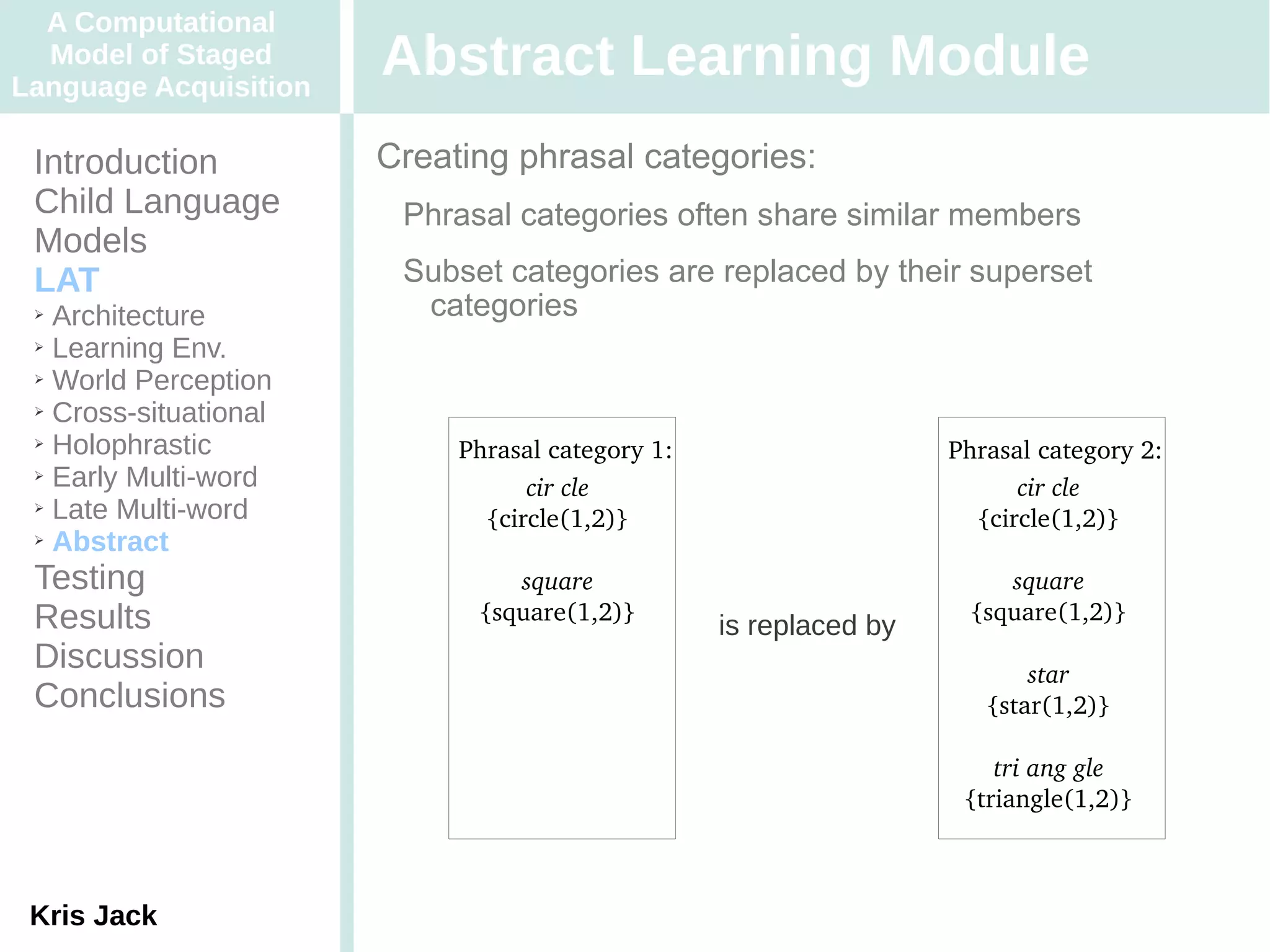
 Introduction          Creating phrasal categories:
 Child Language         Phrasal categories often share similar members
 Models
 LAT                    Subset categories are replaced by their superset
 ➢ Architecture          categories
 ➢ Learning Env.

 ➢ World Perception

 ➢ Cross-situational

 ➢ Holophrastic
                            Phrasal category 1:                    Phrasal category 2:
 ➢ Early Multi-word
                                  cir cle                                cir cle
 ➢ Late Multi-word
                              {circle(1,2)}                          {circle(1,2)}
 ➢ Abstract


 Testing                        square                                 square
 Results                     {square(1,2)}                          {square(1,2)}
                                                  is replaced by
 Discussion                                                               star
 Conclusions                                                          {star(1,2)}

                                                                       tri ang gle
                                                                    {triangle(1,2)}


 Kris Jack
A Computational
  Model of Staged
Language Acquisition
                       Abstract Learning Module
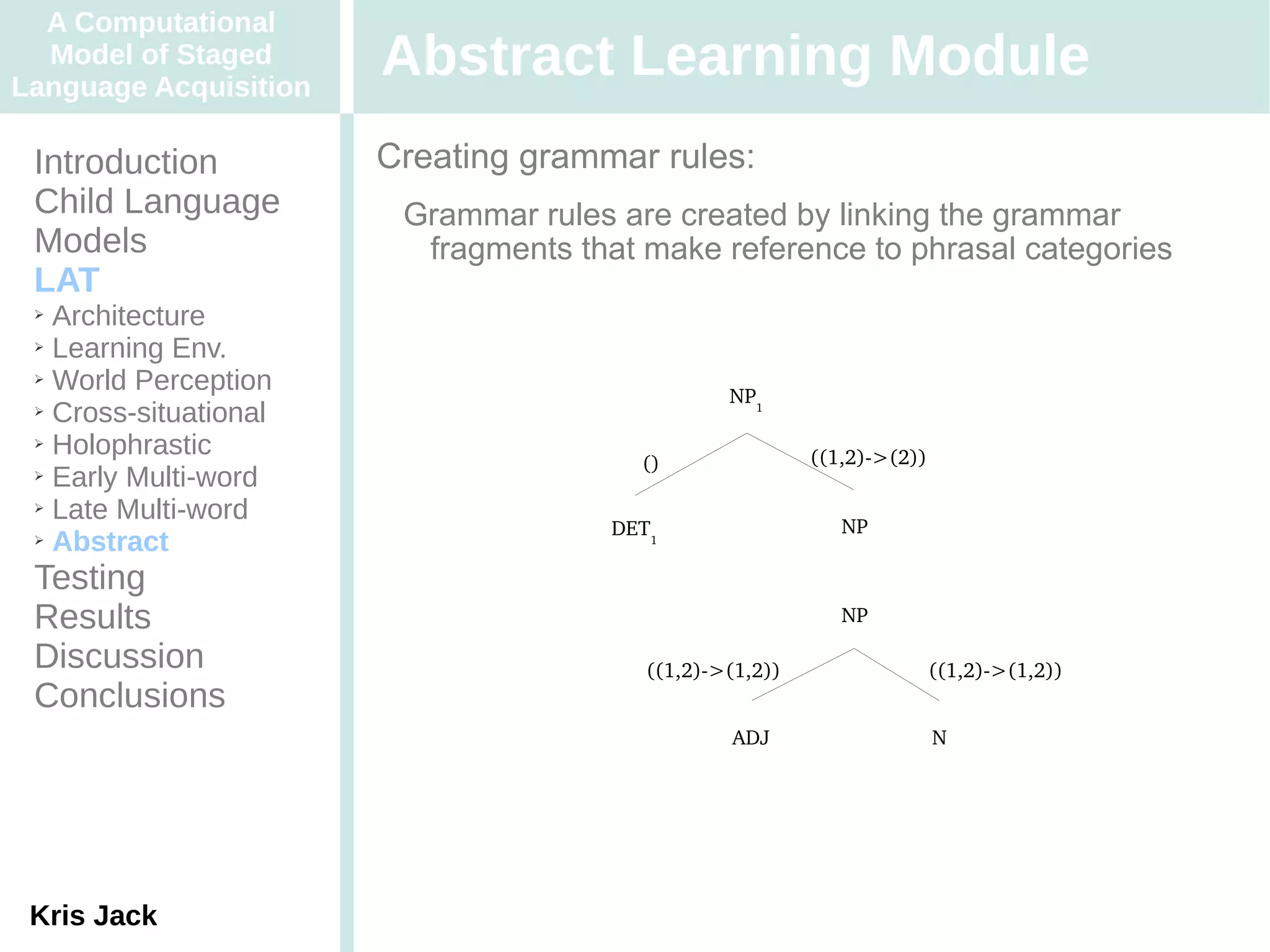
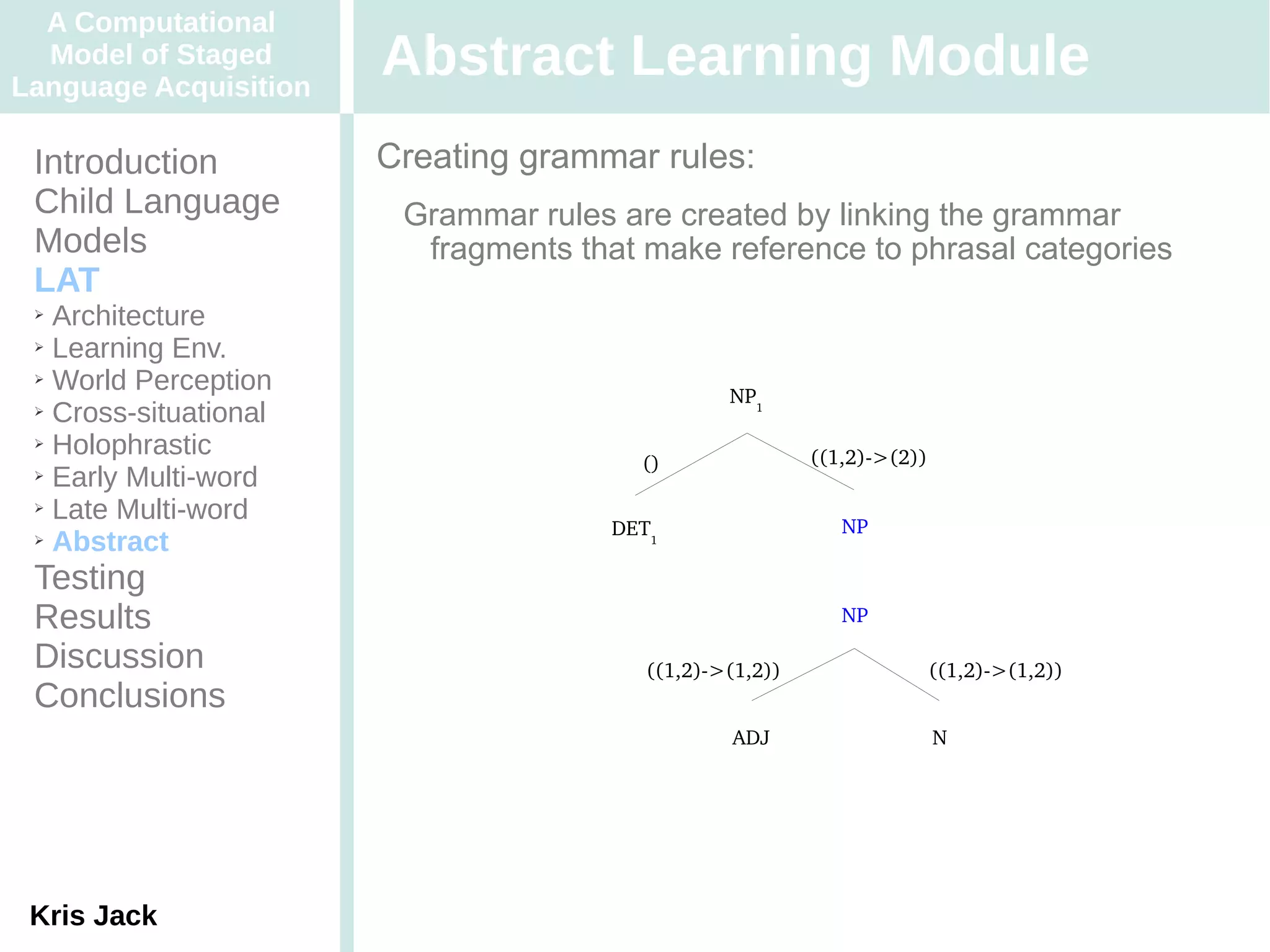
 Introduction          Creating grammar rules:
 Child Language         Grammar rules are created by linking the grammar
 Models                  fragments that make reference to phrasal categories
 LAT
 ➢ Architecture
 ➢ Learning Env.

 ➢ World Perception
                                                 NP1
 ➢ Cross-situational

 ➢ Holophrastic
                                        ()                ((1,2)­>(2))
 ➢ Early Multi-word

 ➢ Late Multi-word
                                      DET1                   NP
 ➢ Abstract


 Testing
 Results                                                     NP

 Discussion                              ((1,2)­>(1,2))                  ((1,2)­>(1,2))
 Conclusions
                                                 ADJ                     N


 Kris Jack
A Computational
  Model of Staged
Language Acquisition
                       Abstract Learning Module
 Introduction          Creating grammar rules:
 Child Language         Grammar rules are created by linking the grammar
 Models                  fragments that make reference to phrasal categories
 LAT
 ➢ Architecture
 ➢ Learning Env.

 ➢ World Perception
                                                 NP1
 ➢ Cross-situational

 ➢ Holophrastic
                                        ()                ((1,2)­>(2))
 ➢ Early Multi-word

 ➢ Late Multi-word
                                      DET1                   NP
 ➢ Abstract


 Testing
 Results                                                     NP

 Discussion                              ((1,2)­>(1,2))                  ((1,2)­>(1,2))
 Conclusions
                                                 ADJ                     N


 Kris Jack
A Computational
  Model of Staged
Language Acquisition
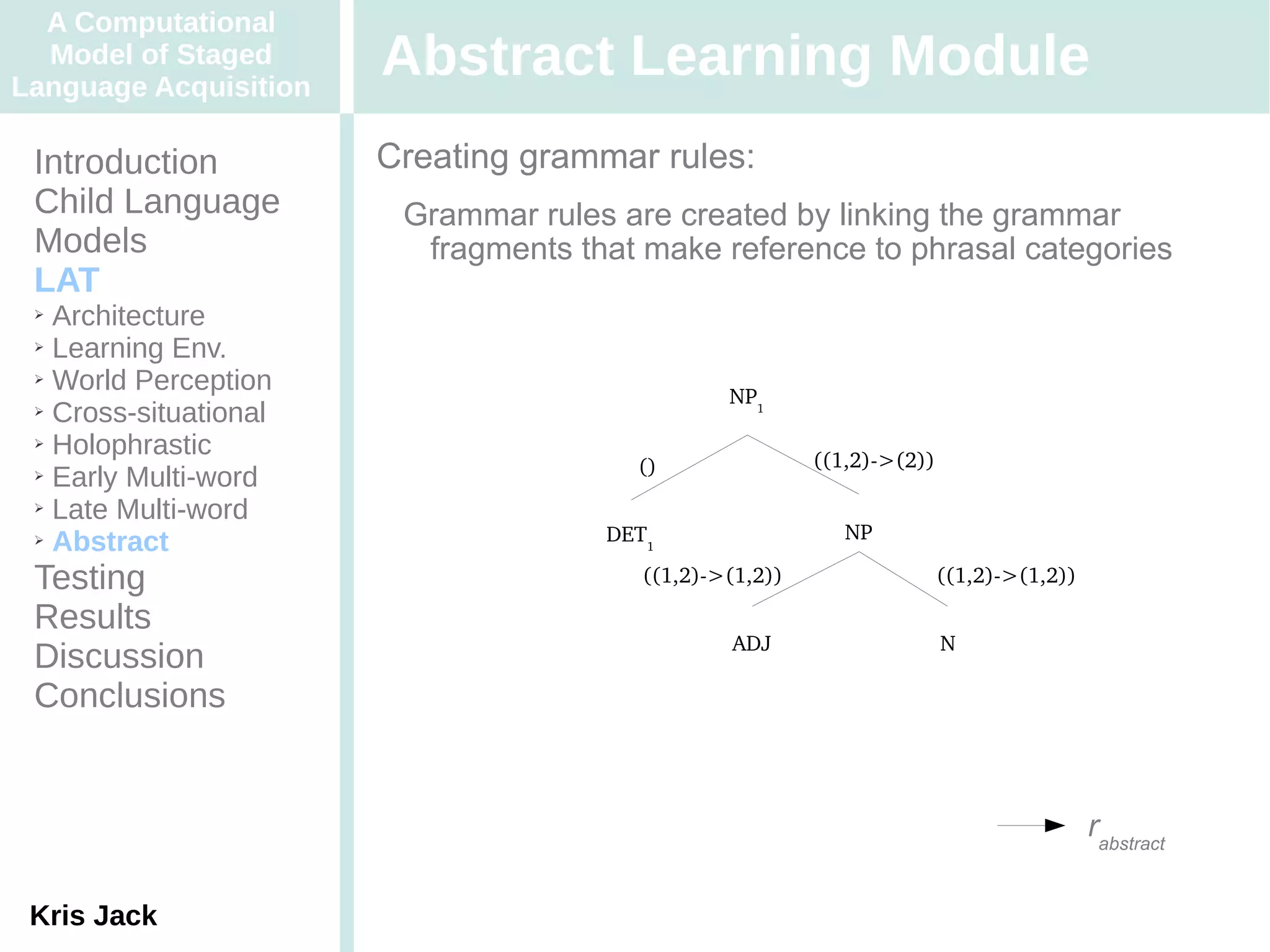
                       Abstract Learning Module
 Introduction          Creating grammar rules:
 Child Language         Grammar rules are created by linking the grammar
 Models                  fragments that make reference to phrasal categories
 LAT
 ➢ Architecture
 ➢ Learning Env.

 ➢ World Perception
                                                NP1
 ➢ Cross-situational

 ➢ Holophrastic
                                       ()                ((1,2)­>(2))
 ➢ Early Multi-word

 ➢ Late Multi-word

 ➢ Abstract                          DET1                   NP

 Testing                                ((1,2)­>(1,2))                  ((1,2)­>(1,2))

 Results
                                                ADJ                     N
 Discussion
 Conclusions


                                                                                         rabstract

 Kris Jack
A Computational
  Model of Staged
Language Acquisition
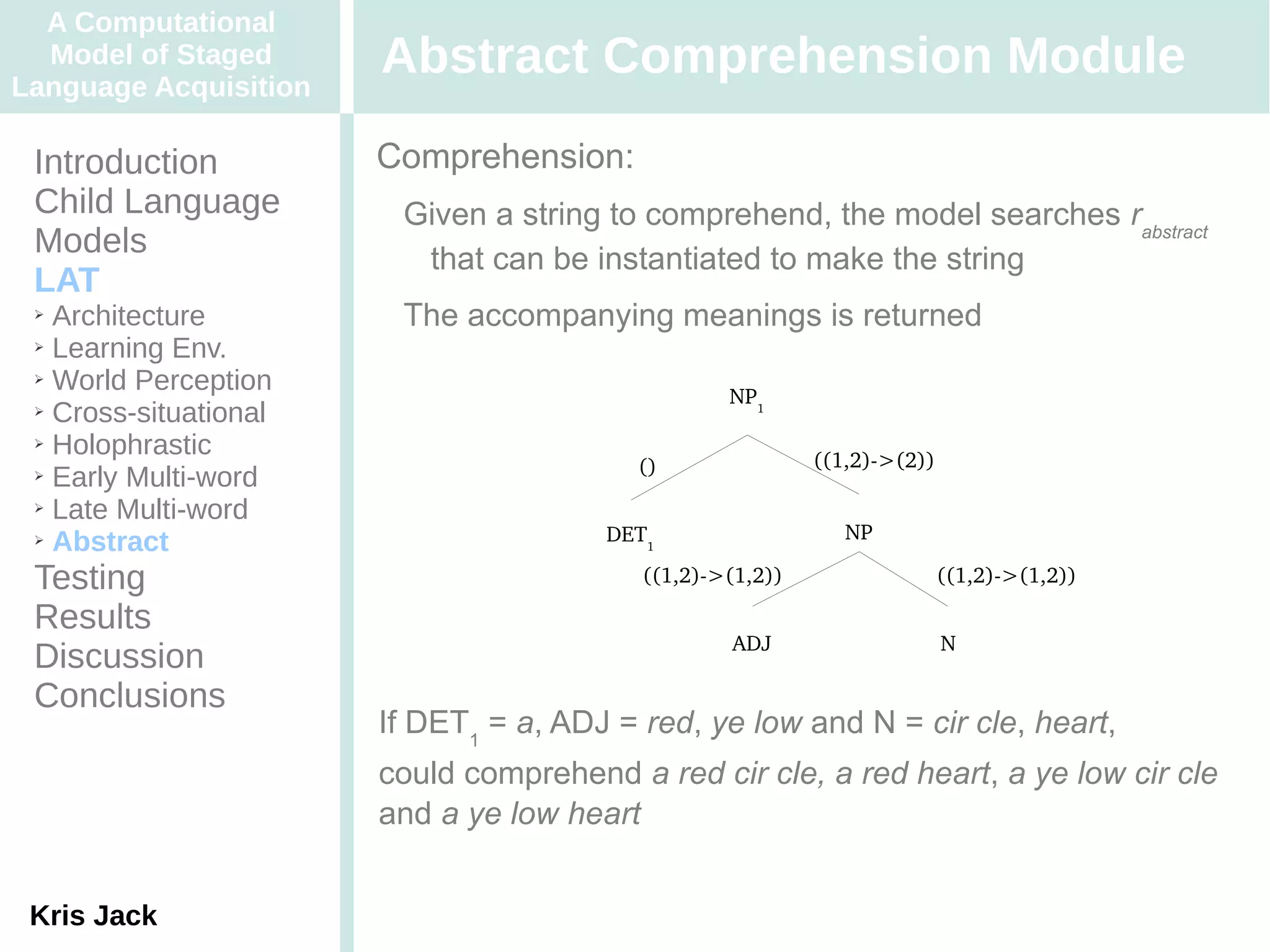
                       Abstract Comprehension Module
 Introduction          Comprehension:
 Child Language         Given a string to comprehend, the model searches rabstract
 Models                  that can be instantiated to make the string
 LAT
 ➢ Architecture         The accompanying meanings is returned
 ➢ Learning Env.

 ➢ World Perception
                                                  NP1
 ➢ Cross-situational

 ➢ Holophrastic
                                          ()               ((1,2)­>(2))
 ➢ Early Multi-word

 ➢ Late Multi-word

 ➢ Abstract                            DET1                   NP

 Testing                                  ((1,2)­>(1,2))                  ((1,2)­>(1,2))

 Results
                                                  ADJ                     N
 Discussion
 Conclusions
                       If DET1 = a, ADJ = red, ye low and N = cir cle, heart,
                       could comprehend a red cir cle, a red heart, a ye low cir cle
                       and a ye low heart


 Kris Jack
A Computational
  Model of Staged
Language Acquisition
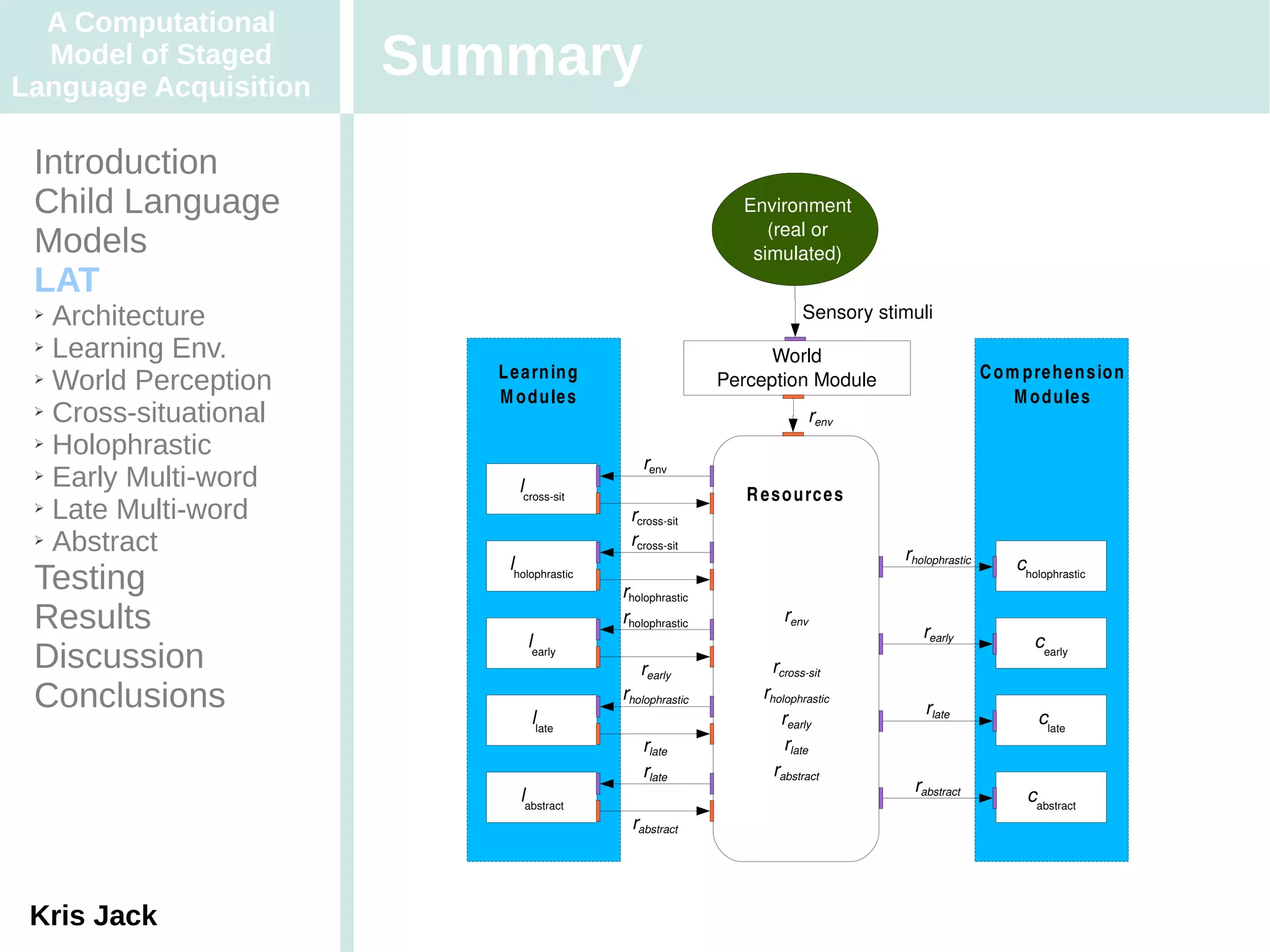
                       Summary
 Introduction
 Child Language                                                Environment
                                                                  (real or
 Models                                                         simulated)
 LAT
 ➢ Architecture                                                              Sensory stimuli
 ➢ Learning Env.
                                                                 World
 ➢ World Perception       L e a rn in g                    Perception Module                           C o m p re h e n s io n
                          M o d u le s                                                                      M o d u le s
 ➢ Cross-situational                                                      renv
 ➢ Holophrastic
                                               renv
 ➢ Early Multi-word
                             lcross­sit                        R e s o u rc e s
 ➢ Late Multi-word
                                            rcross­sit
 ➢ Abstract                                 rcross­sit
                                                                                       rholophrastic
                           lholophrastic                                                                    cholophrastic
 Testing                                   rholophrastic
 Results                                   rholophrastic              renv
                                                                                          rearly
                              learly                                                                           cearly
 Discussion                                   rearly               rcross­sit
 Conclusions                   llate
                                           rholophrastic          rholophrastic
                                                                     rearly
                                                                                           rlate
                                                                                                                clate
                                               rlate                  rlate
                                               rlate                rabstract
                                                                                         rabstract
                             labstract                                                                        cabstract
                                            rabstract


 Kris Jack
A Computational
  Model of Staged
Language Acquisition
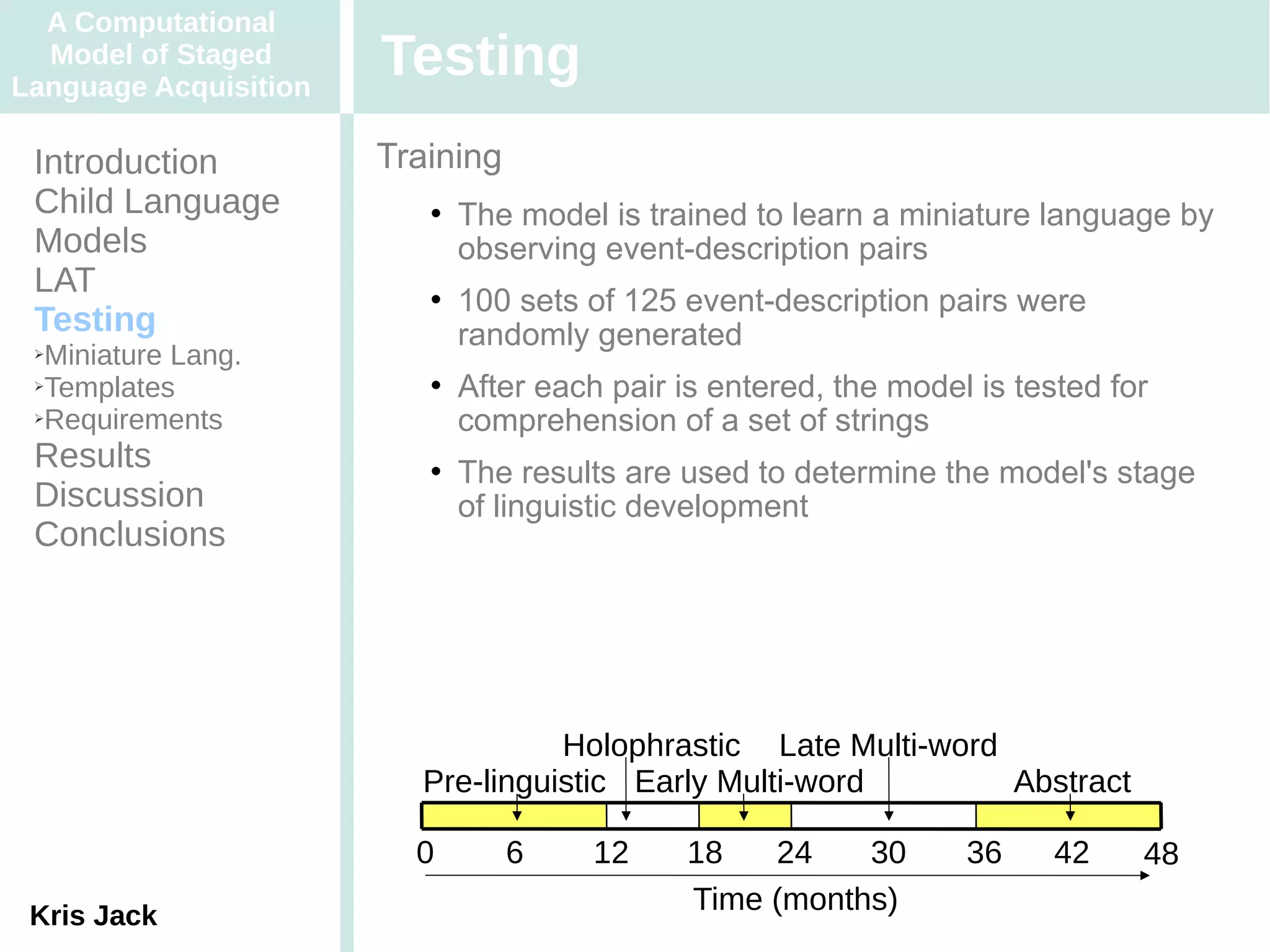
                       Testing
 Introduction          Training
 Child Language              The model is trained to learn a miniature language by
 Models                       observing event-description pairs
 LAT                         100 sets of 125 event-description pairs were
 Testing                      randomly generated
 ➢Miniature Lang.
 ➢Templates                  After each pair is entered, the model is tested for
 ➢Requirements
                              comprehension of a set of strings
 Results                     The results are used to determine the model's stage
 Discussion                   of linguistic development
 Conclusions


                                   Holophrastic Late Multi-word
                         Pre-linguistic Early Multi-word        Abstract

                         0        6     12    18   24    30        36     42    48
 Kris Jack
                                              Time (months)
A Computational
  Model of Staged
Language Acquisition
                       Miniature Language
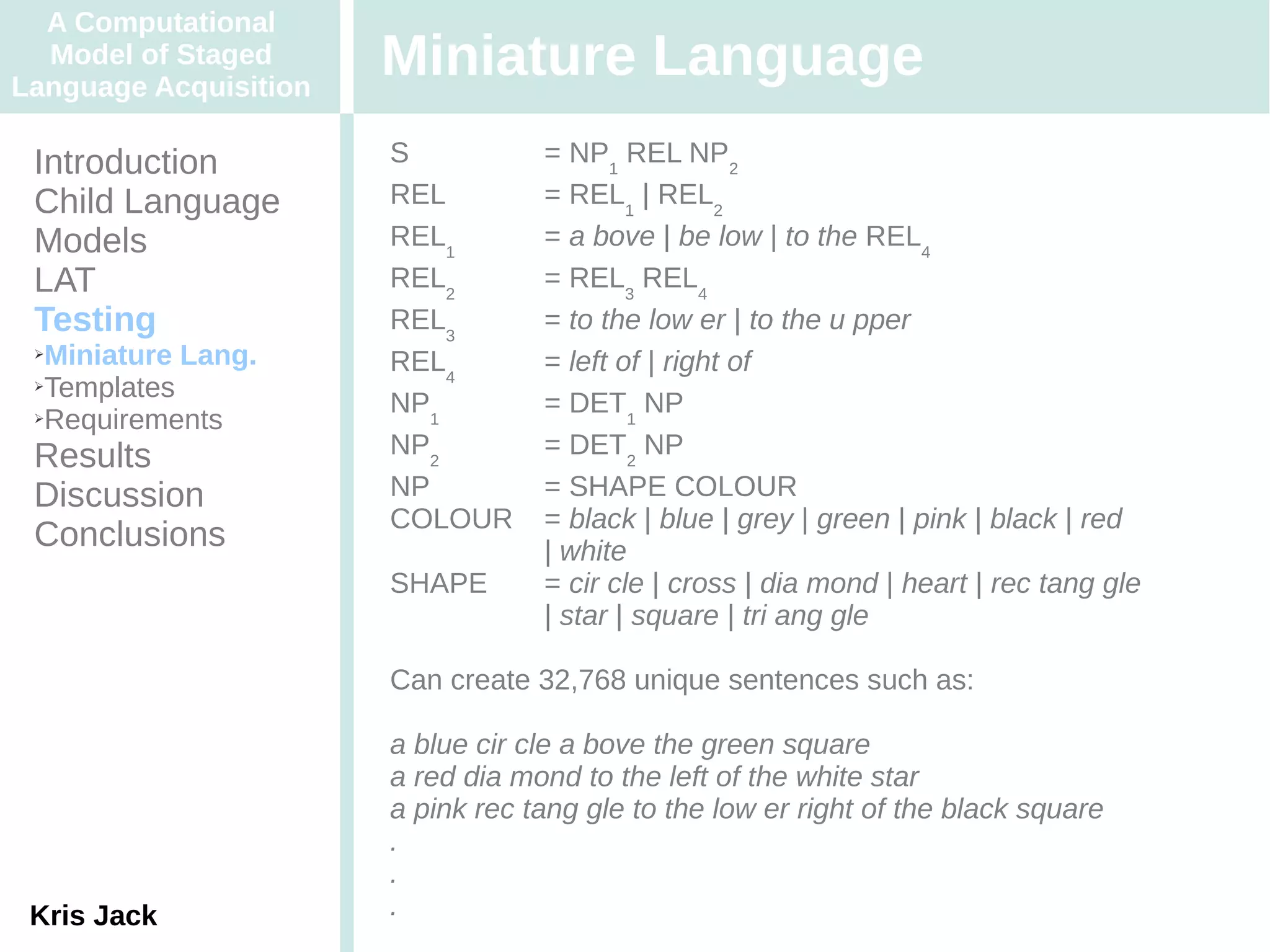
 Introduction          S           = NP1 REL NP2
 Child Language        REL         = REL1 | REL2
 Models                REL1        = a bove | be low | to the REL4
 LAT                   REL2        = REL3 REL4
 Testing               REL3        = to the low er | to the u pper
 ➢Miniature Lang.      REL4        = left of | right of
 ➢Templates

 ➢Requirements
                       NP1         = DET1 NP
 Results               NP2         = DET2 NP
 Discussion            NP          = SHAPE COLOUR
                       COLOUR      = black | blue | grey | green | pink | black | red
 Conclusions                       | white
                       SHAPE       = cir cle | cross | dia mond | heart | rec tang gle
                                   | star | square | tri ang gle

                       Can create 32,768 unique sentences such as:

                       a blue cir cle a bove the green square
                       a red dia mond to the left of the white star
                       a pink rec tang gle to the low er right of the black square
                       .
                       .
 Kris Jack             .
A Computational
  Model of Staged
Language Acquisition
                       String Templates for Testing
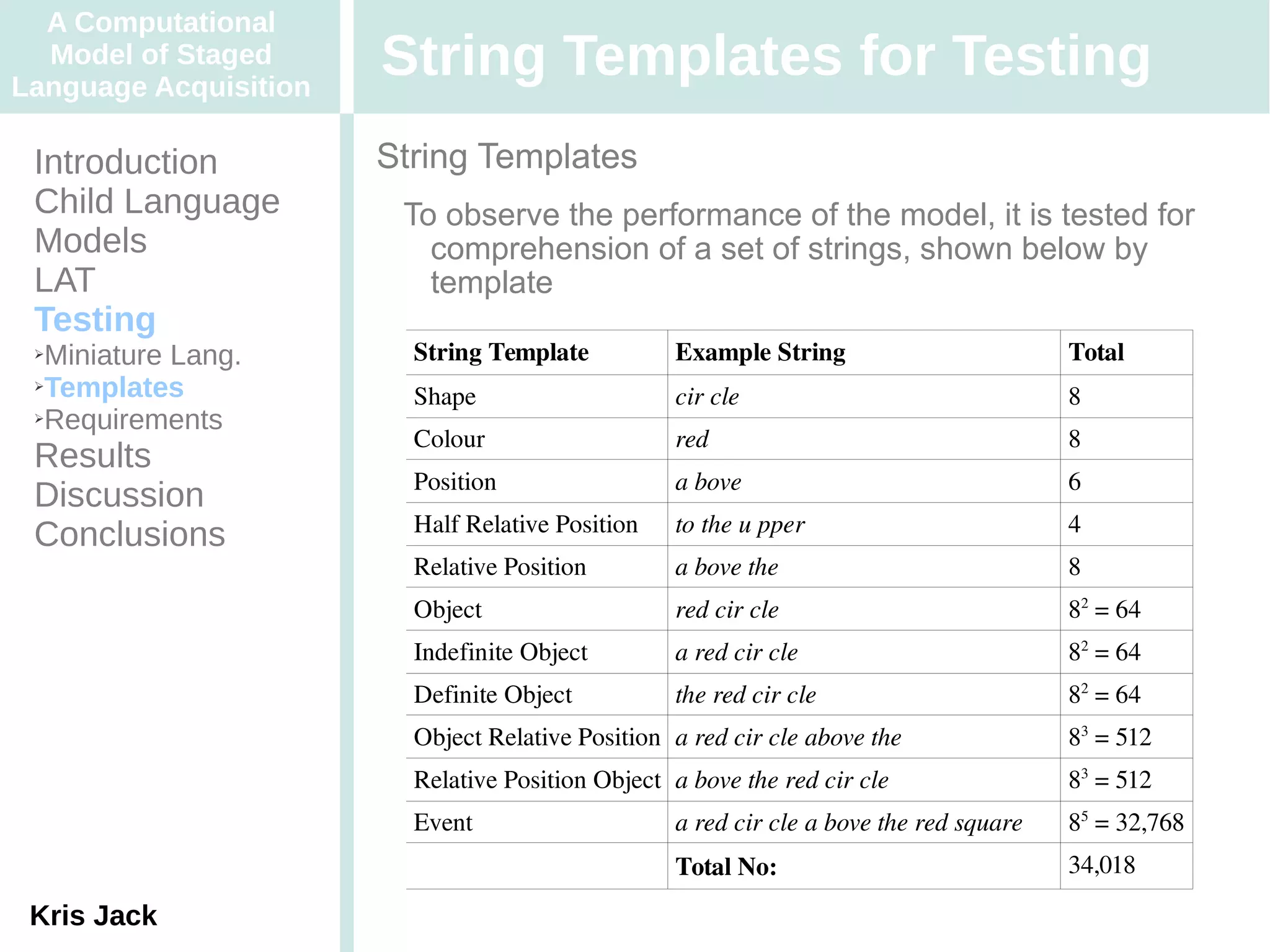
 Introduction          String Templates
 Child Language         To observe the performance of the model, it is tested for
 Models                   comprehension of a set of strings, shown below by
 LAT                      template
 Testing
 ➢Miniature Lang.        String Template          Example String                        Total
 ➢Templates
                         Shape                    cir cle                               8
 ➢Requirements
                         Colour                   red                                   8
 Results
                         Position                 a bove                                6
 Discussion
                         Half Relative Position   to the u pper                         4
 Conclusions
                         Relative Position        a bove the                            8
                         Object                   red cir cle                           82 = 64
                         Indefinite Object        a red cir cle                         82 = 64
                         Definite Object          the red cir cle                       82 = 64
                         Object Relative Position a red cir cle above the               83 = 512
                         Relative Position Object a bove the red cir cle                83 = 512
                         Event                    a red cir cle a bove the red square   85 = 32,768
                                                  Total No:                             34,018

 Kris Jack
A Computational
  Model of Staged
Language Acquisition
                       Judging Linguistic Stage
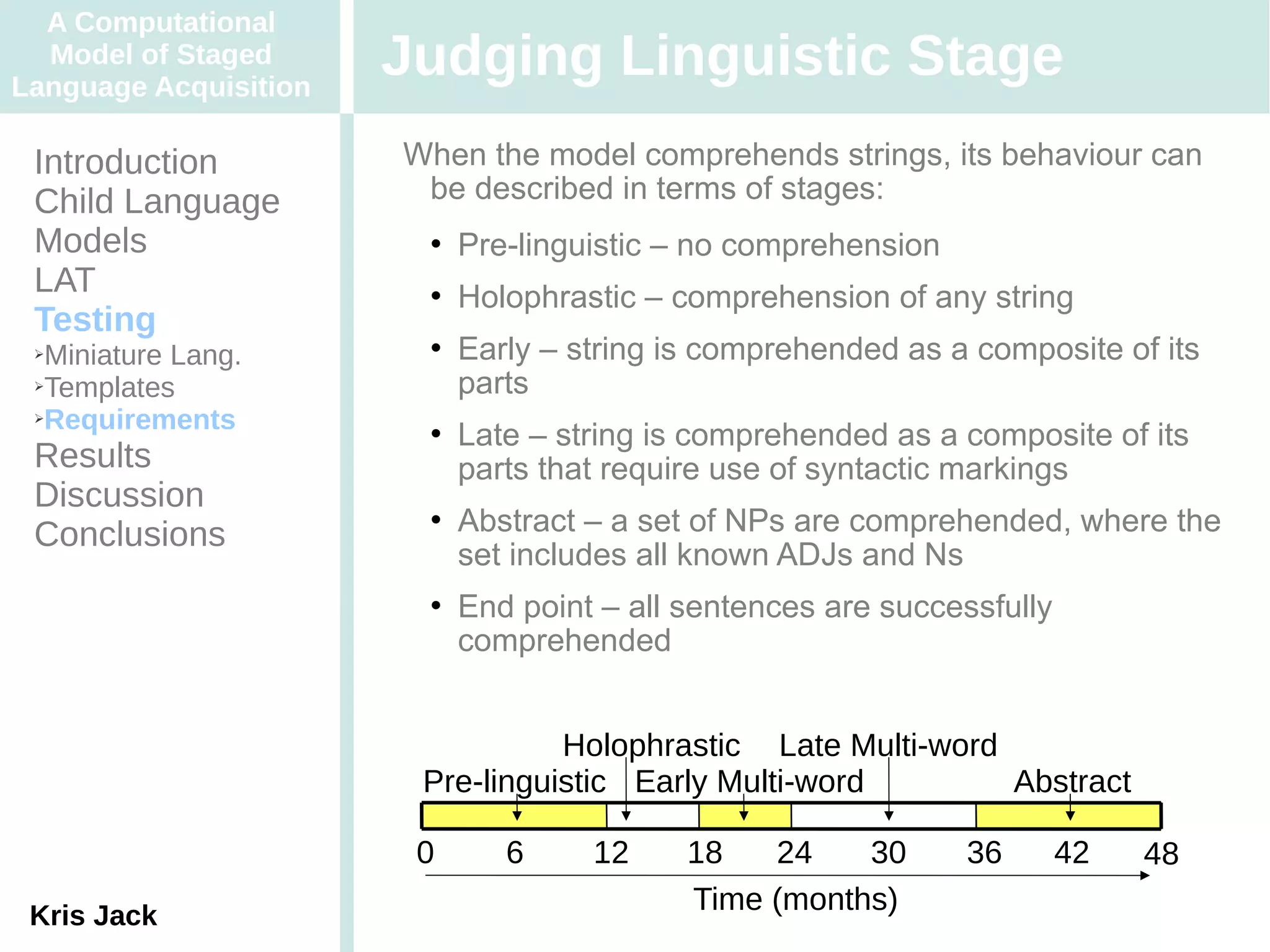
 Introduction          When the model comprehends strings, its behaviour can
 Child Language         be described in terms of stages:
 Models                    Pre-linguistic – no comprehension
 LAT                       Holophrastic – comprehension of any string
 Testing
 ➢Miniature Lang.          Early – string is comprehended as a composite of its
 ➢Templates                 parts
 ➢Requirements
                           Late – string is comprehended as a composite of its
 Results                    parts that require use of syntactic markings
 Discussion
 Conclusions
                           Abstract – a set of NPs are comprehended, where the
                            set includes all known ADJs and Ns
                           End point – all sentences are successfully
                            comprehended


                                  Holophrastic Late Multi-word
                        Pre-linguistic Early Multi-word        Abstract

                        0      6     12     18   24    30       36       42   48
 Kris Jack
                                            Time (months)
A Computational
  Model of Staged
Language Acquisition
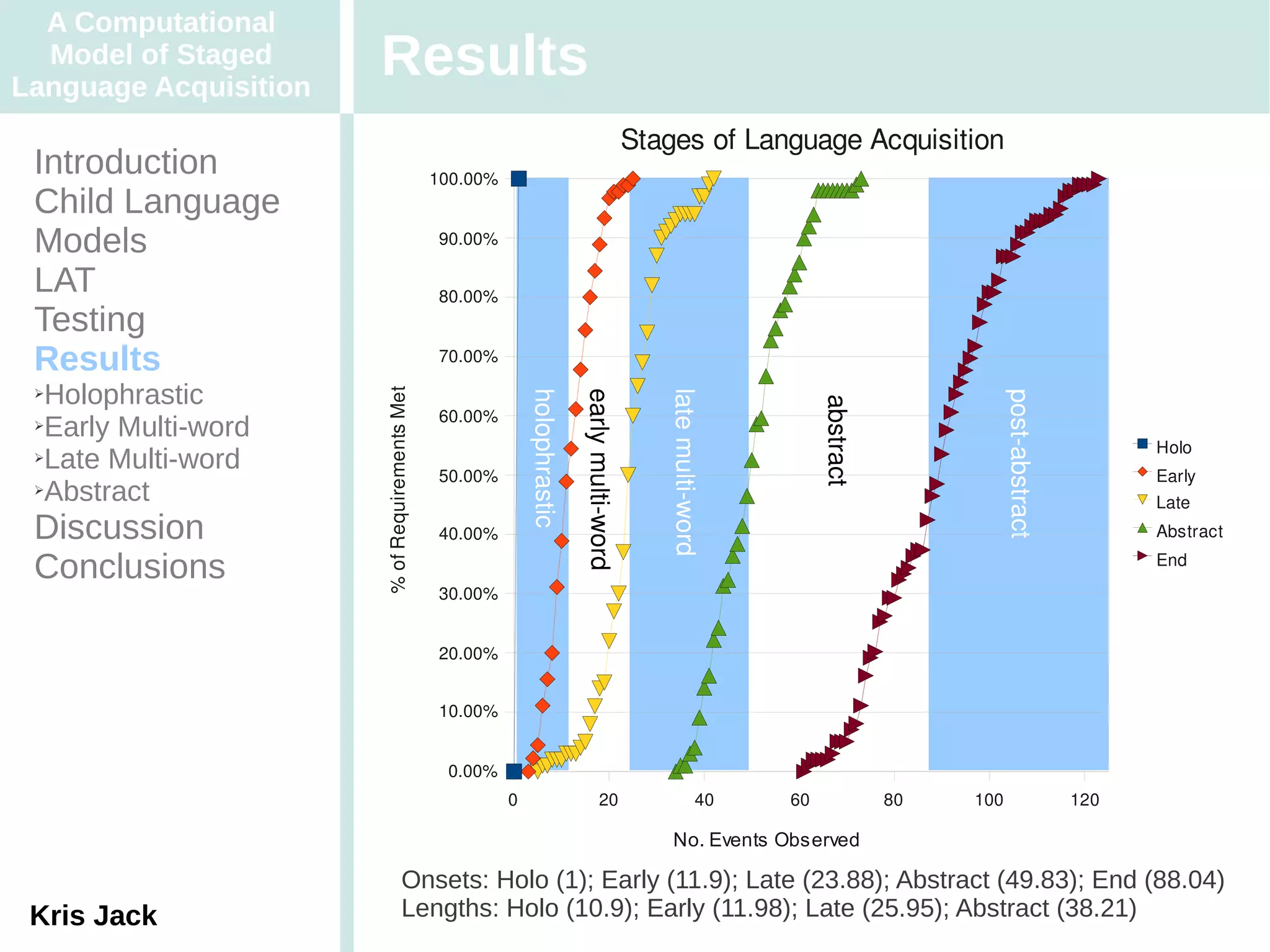
                       Results
                                                                                               Stages of Language Acquisition
 Introduction                                  100.00%
 Child Language
 Models                                        90.00%

 LAT                                           80.00%
 Testing
 Results                                       70.00%

 ➢Holophrastic         % of Requirements Met


                                                             holophrastic

                                                                            early multi­word


                                                                                                  late multi­word


                                                                                                                                               post­abstract
                                                                                                                         abstract
 ➢Early Multi-word
                                               60.00%
                                                                                                                                                                     Holo
 ➢Late Multi-word
                                               50.00%                                                                                                                Early
 ➢Abstract
                                                                                                                                                                     Late
 Discussion                                    40.00%                                                                                                                Abstract

 Conclusions                                                                                                                                                         End
                                               30.00%


                                               20.00%


                                               10.00%


                                                0.00%
                                                         0                         20                        40     60              80   100                   120

                                                                                                    No. Events Observed

                                    Onsets: Holo (1); Early (11.9); Late (23.88); Abstract (49.83); End (88.04)
 Kris Jack                          Lengths: Holo (10.9); Early (11.98); Late (25.95); Abstract (38.21)
A Computational
  Model of Staged
Language Acquisition
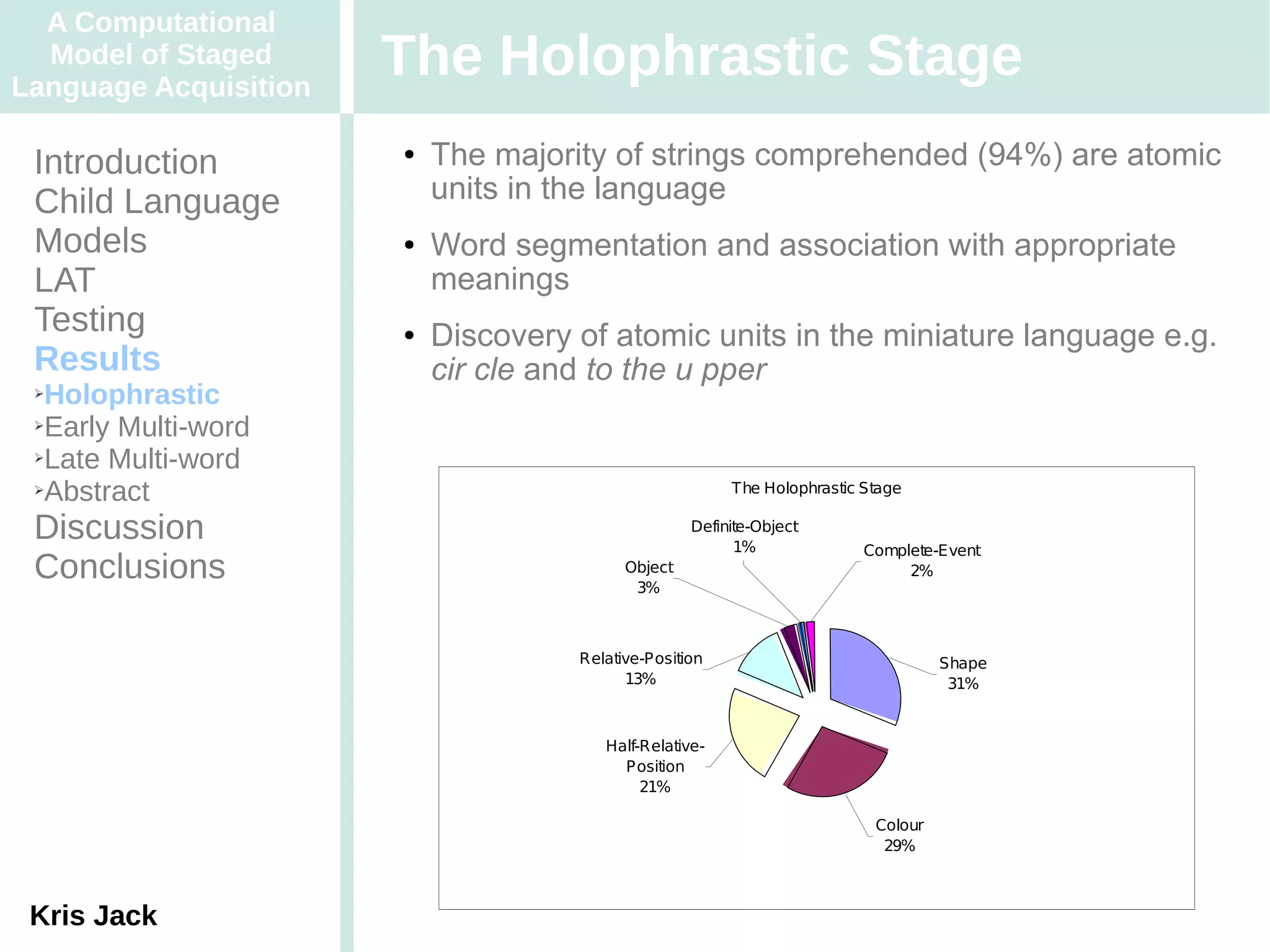
                       The Holophrastic Stage
 Introduction          ●   The majority of strings comprehended (94%) are atomic
 Child Language            units in the language
 Models                ●   Word segmentation and association with appropriate
 LAT                       meanings
 Testing               ●   Discovery of atomic units in the miniature language e.g.
 Results                   cir cle and to the u pper
 ➢Holophrastic
 ➢Early Multi-word

 ➢Late Multi-word

 ➢Abstract                                               The Holophrastic Stage

 Discussion                                         Definite-Object
                                                          1%              Complete-Event
 Conclusions                               Object
                                            3%
                                                                               2%


                                     Relative-Position                              Shape
                                           13%                                       31%


                                        Half-Relative-
                                          Position
                                             21%

                                                                           Colour
                                                                            29%


 Kris Jack
A Computational
  Model of Staged
Language Acquisition
                       The Holophrastic Stage
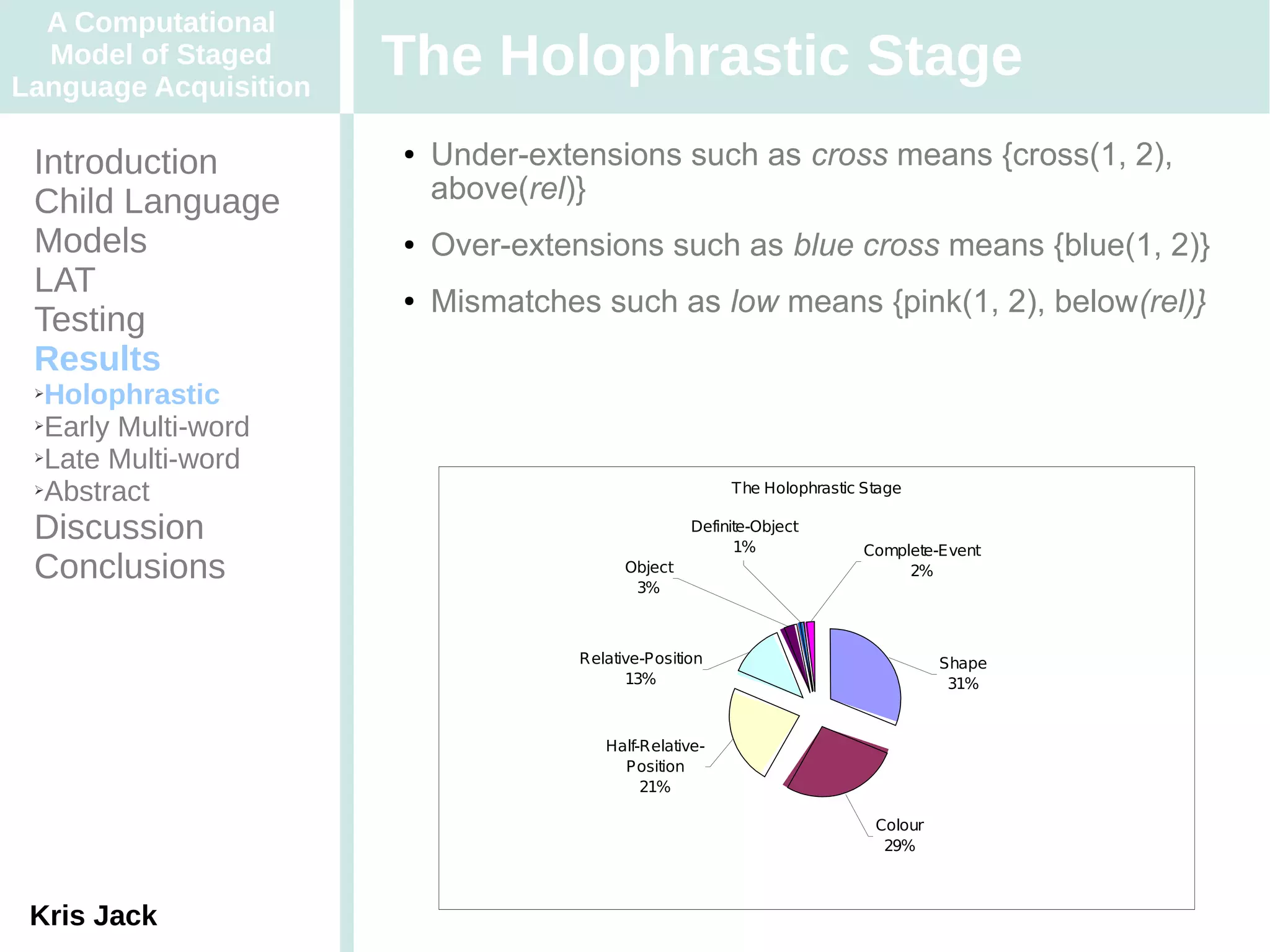
 Introduction          ●   Under-extensions such as cross means {cross(1, 2),
 Child Language            above(rel)}
 Models                ●   Over-extensions such as blue cross means {blue(1, 2)}
 LAT                   ●   Mismatches such as low means {pink(1, 2), below(rel)}
 Testing
 Results
 ➢Holophrastic
 ➢Early Multi-word

 ➢Late Multi-word

 ➢Abstract                                               The Holophrastic Stage

 Discussion                                         Definite-Object
                                                          1%              Complete-Event
 Conclusions                               Object
                                            3%
                                                                               2%


                                     Relative-Position                              Shape
                                           13%                                       31%


                                        Half-Relative-
                                          Position
                                             21%

                                                                           Colour
                                                                            29%


 Kris Jack
A Computational
  Model of Staged
Language Acquisition
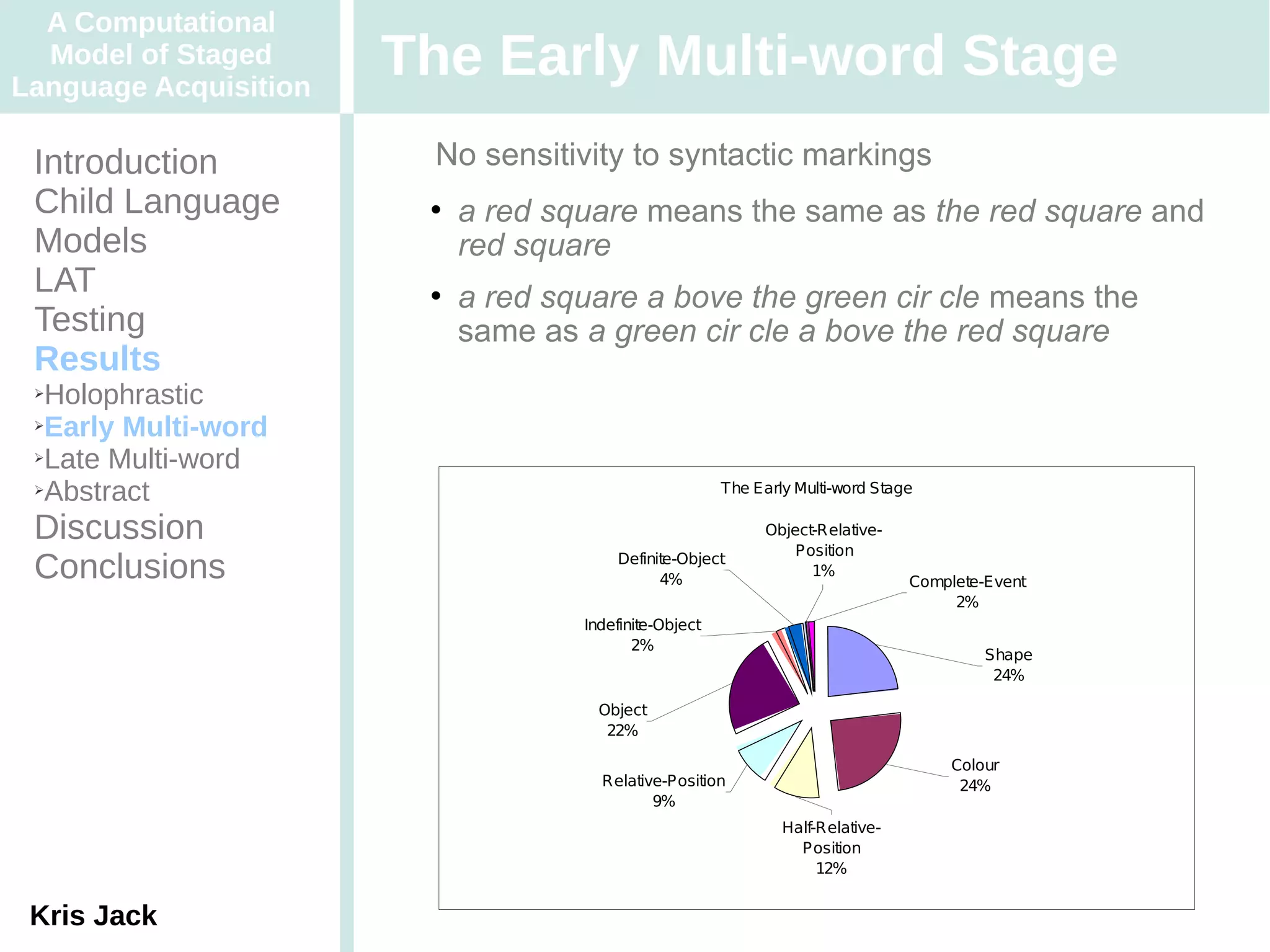
                       The Early Multi-word Stage
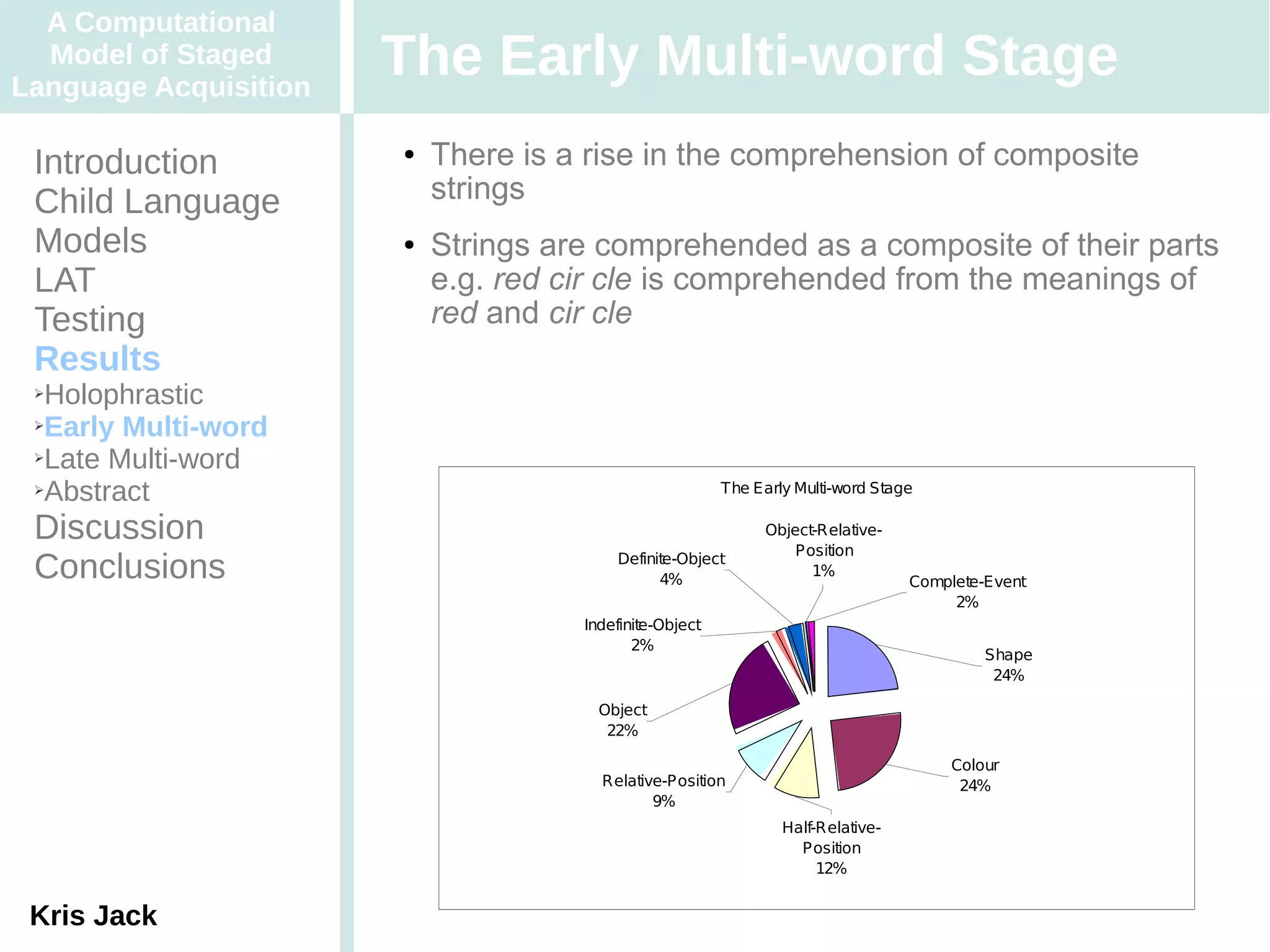
 Introduction          ●   There is a rise in the comprehension of composite
 Child Language            strings
 Models                ●   Strings are comprehended as a composite of their parts
 LAT                       e.g. red cir cle is comprehended from the meanings of
 Testing                   red and cir cle
 Results
 ➢Holophrastic
 ➢Early Multi-word

 ➢Late Multi-word

 ➢Abstract                                               The Early Multi-word Stage

 Discussion                                                    Object-Relative-
                                                                   Position
 Conclusions                             Definite-Object
                                               4%
                                                                     1%
                                                                                  Complete-Event
                                                                                       2%
                                     Indefinite-Object
                                            2%
                                                                                           Shape
                                                                                            24%

                                       Object
                                        22%

                                                                                       Colour
                                       Relative-Position                                24%
                                              9%
                                                                 Half-Relative-
                                                                   Position
                                                                      12%


 Kris Jack
A Computational
  Model of Staged
Language Acquisition
                       The Early Multi-word Stage
 Introduction          No sensitivity to syntactic markings
 Child Language            a red square means the same as the red square and
 Models                     red square
 LAT                       a red square a bove the green cir cle means the
 Testing                    same as a green cir cle a bove the red square
 Results
 ➢Holophrastic
 ➢Early Multi-word

 ➢Late Multi-word

 ➢Abstract                                              The Early Multi-word Stage

 Discussion                                                   Object-Relative-
                                                                  Position
 Conclusions                            Definite-Object
                                              4%
                                                                    1%
                                                                                 Complete-Event
                                                                                      2%
                                    Indefinite-Object
                                           2%
                                                                                          Shape
                                                                                           24%

                                      Object
                                       22%

                                                                                      Colour
                                      Relative-Position                                24%
                                             9%
                                                                Half-Relative-
                                                                  Position
                                                                     12%


 Kris Jack
A Computational
  Model of Staged
Language Acquisition
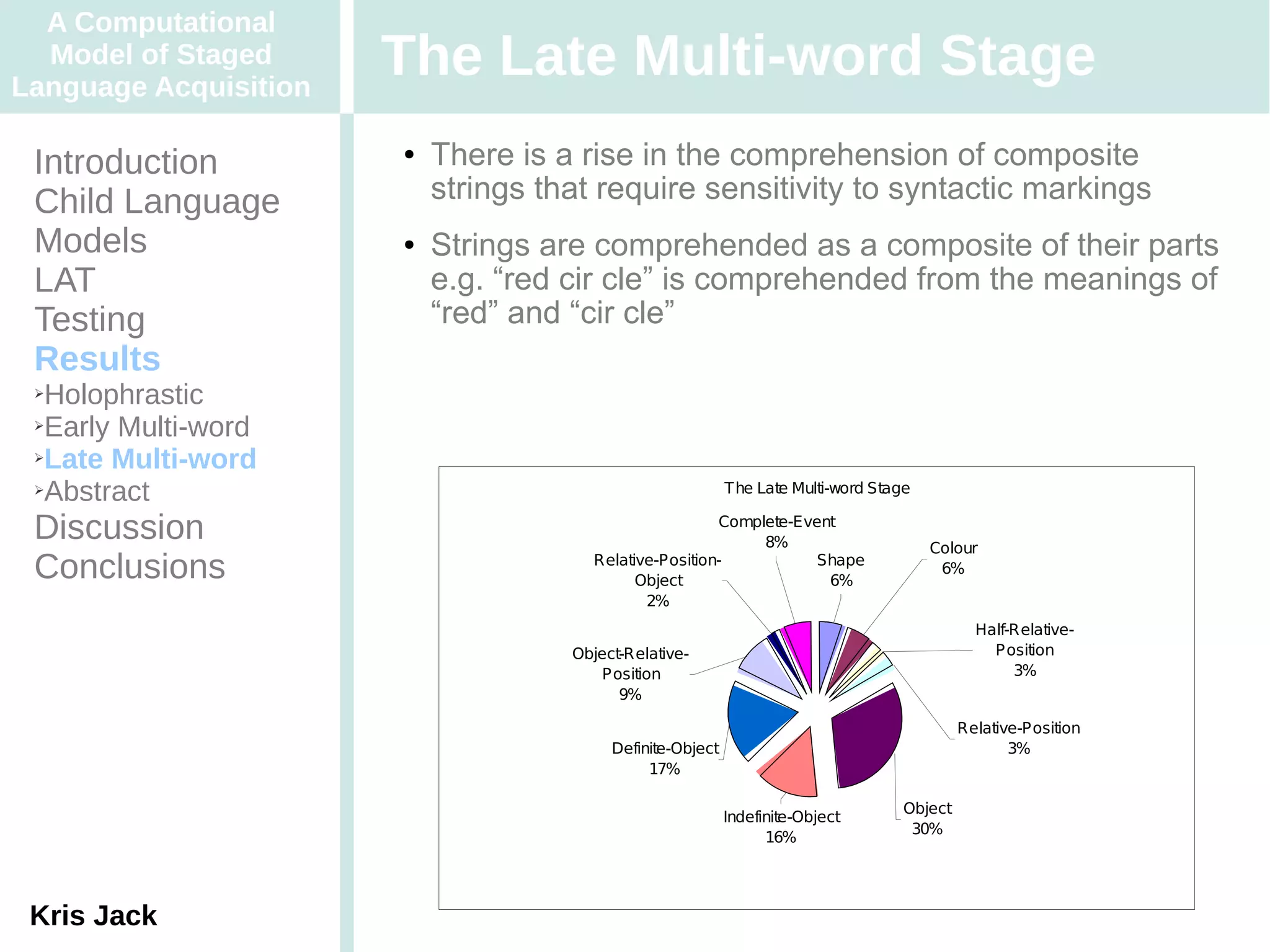
                       The Late Multi-word Stage
 Introduction          ●   There is a rise in the comprehension of composite
 Child Language            strings that require sensitivity to syntactic markings
 Models                ●   Strings are comprehended as a composite of their parts
 LAT                       e.g. “red cir cle” is comprehended from the meanings of
 Testing                   “red” and “cir cle”
 Results
 ➢Holophrastic
 ➢Early Multi-word

 ➢Late Multi-word

 ➢Abstract                                                  The Late Multi-word Stage

 Discussion                                             Complete-Event
                                                             8%                         Colour
 Conclusions                           Relative-Position-
                                             Object
                                                                    Shape
                                                                     6%
                                                                                         6%

                                              2%
                                                                                               Half-Relative-
                                     Object-Relative-                                            Position
                                         Position                                                   3%
                                           9%

                                                                                             Relative-Position
                                          Definite-Object                                           3%
                                               17%

                                                                                    Object
                                                            Indefinite-Object
                                                                                     30%
                                                                  16%


 Kris Jack
A Computational
  Model of Staged
Language Acquisition
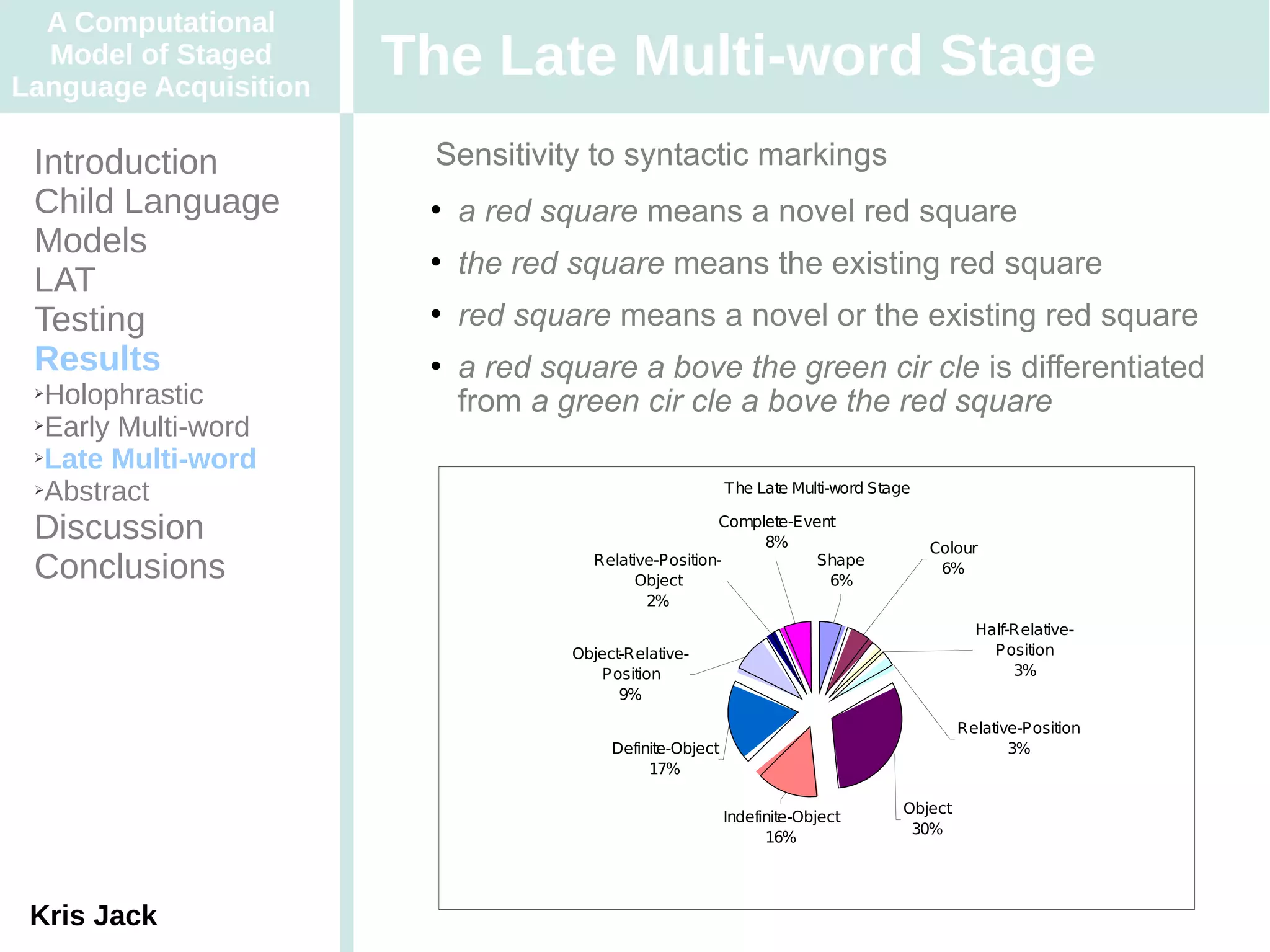
                       The Late Multi-word Stage
 Introduction          Sensitivity to syntactic markings
 Child Language            a red square means a novel red square
 Models                    the red square means the existing red square
 LAT
 Testing                   red square means a novel or the existing red square
 Results                   a red square a bove the green cir cle is differentiated
 ➢Holophrastic              from a green cir cle a bove the red square
 ➢Early Multi-word

 ➢Late Multi-word

 ➢Abstract                                                 The Late Multi-word Stage

 Discussion                                            Complete-Event
                                                            8%                         Colour
 Conclusions                          Relative-Position-
                                            Object
                                                                   Shape
                                                                    6%
                                                                                        6%

                                             2%
                                                                                              Half-Relative-
                                    Object-Relative-                                            Position
                                        Position                                                   3%
                                          9%

                                                                                            Relative-Position
                                         Definite-Object                                           3%
                                              17%

                                                                                   Object
                                                           Indefinite-Object
                                                                                    30%
                                                                 16%


 Kris Jack
A Computational
  Model of Staged
Language Acquisition
                       The Abstract Stage
 Introduction          ●   The majority of strings comprehended are Complete
 Child Language            Events
 Models                ●   Complete Events are comprehended as the
 LAT                       composition of multiple atomic units
 Testing
 Results
 ➢Holophrastic
 ➢Early Multi-word

 ➢Late Multi-word

 ➢Abstract                                                The Abstract Stage

 Discussion                                     Indefinite-Object   Definite-Object
 Conclusions                                           1%                 1%
                                                                                       Object-Relative-
                                       Object                                              Position
                                        1%                                                   3%


                                                                                      Relative-Position-
                                                                                            Object
                                                                                             3%


                                                Complete-Event
                                                    91%


 Kris Jack
A Computational
  Model of Staged
Language Acquisition
                       The Abstract Stage
 Introduction          ●   A form of rote learning is displaced by generative
 Child Language            comprehension
 Models                ●   Grammars are derived that allow any string in the
 LAT                       miniature language to be comprehended from a
 Testing                   relatively small exposure to examples
 Results
 ➢Holophrastic
 ➢Early Multi-word

 ➢Late Multi-word

 ➢Abstract                                                 The Abstract Stage

 Discussion                                      Indefinite-Object   Definite-Object
 Conclusions                                            1%                 1%
                                                                                        Object-Relative-
                                        Object                                              Position
                                         1%                                                   3%


                                                                                       Relative-Position-
                                                                                             Object
                                                                                              3%


                                                 Complete-Event
                                                     91%


 Kris Jack
A Computational
  Model of Staged
Language Acquisition
                       Discussion
 Introduction          Behavioural stages emerge:
 Child Language         ●   In the same order as found in child language
 Models
 LAT
                        ●   At similar time intervals as found in child language
 Testing                ●   With similar developmental characteristics as found
 Results                    in child language
 Discussion            What accounts for this similar developmental trajectory
 Conclusions              bearing in mind that:
                        ●   Training data are kept constant?
                        ●   The model’s functionality is kept constant?


 Kris Jack
A Computational
  Model of Staged
Language Acquisition
                       Explaining Development
 Introduction          The Modular Architecture
 Child Language            Each module concentrates on performing a different
 Models                     task
 LAT                       Each task requires a different amount of training to
 Testing                    produce results
 Results                   A new behaviour emerges when a learning
 Discussion                 mechanism solves a task for the first time
 Conclusions
                           Modules depend upon training data which can be
                            internally filtered by other modules


 Kris Jack
A Computational
  Model of Staged
Language Acquisition
                       Explaining Development
 Introduction          ●   The Cross-situational Learning Module receives
 Child Language            unaltered training data
 Models                ●   The Holophrastic Modules breaks the language down
 LAT                       into atomic units producing holophrastic behaviour
 Testing               ●   The Early Multi-word Modules begins to reconstruct the
 Results                   language by discovering compositional relationships
 Discussion
 Conclusions
                       ●   Both the Holophrastic and Early Multi-word Modules
                           work simultaneously, allowing the model to continue
                           learning words while discovering compositions
                       ●   The Late Multi-word Module begins to reconstruct the
                           language by discovering compositionality WITH
                           sensitivity to word order and syntactic markings
                       ●   Why is there such a gap between the results produced
                           by the Early and Late Multi-word Comprehension
                           Modules when they perform similar tasks?


 Kris Jack
A Computational
  Model of Staged
Language Acquisition
                       Explaining Development
 Introduction          ●   Why is there such a gap between the results produced
 Child Language            by the Early and Late Multi-word Comprehension
                           Modules when they perform similar tasks?
 Models
 LAT                           The Late Multi-word Learning Module is performing a
 Testing                        more complex task than the Early Multi-word Learning
 Results                        Module
 Discussion            ●   The Late Multi-word Learning Module has tougher
 Conclusions               constraints (word-order and transformations must
                           match in constructions). Given the fragments;

                                   a blue                               blue cir cle
                                 {blue(2)}                        {blue(1,2), circle(1,2)}
                            ()               ((1,2)­>(2))   ((1,2)­>(1,2))          ((1,2)­>(1,2))

                           a              blue                       blue           cir cle
                           {}         {blue(1,2)}                {blue(1,2)}    {circle(1,2)}


                       ●   The Early Multi-word Learning Module can keep the
                           fragments but the Late Multi-word Learning Module
                           cannot
 Kris Jack
A Computational
  Model of Staged
Language Acquisition
                       Explaining Development
 Introduction          ●   The Abstract Modules produce results much earlier
 Child Language            than the abstract stage begins
 Models                ●   Much of the generative capacity in the model comes
 LAT                       from the Abstract Modules
 Testing               ●   The Abstract Comprehension Module accounts for
 Results                   comprehension of novel strings even during the early
 Discussion                multi-word stage
 Conclusions           ●   It is inappropriate to think of each module’s contribution
                           to comprehension as being limited to a particular stage
                       ●   It is better to think of each stage as being the result of
                           all modules producing the best results that they can
                           given their experience


 Kris Jack
A Computational
  Model of Staged
Language Acquisition
                       Conclusions
 Introduction          A computational model that demonstrates a similar
 Child Language          developmental trajectory as found in child language has
                         been produced
 Models
 LAT                       There is linguistic maturation without physical
 Testing                    maturation
 Results                   The model is given a realistic exposure to training
 Discussion                 data
 Conclusions           A Modular Structure accounts for much of the
                         developmental shape
                           The stages emerge on a reasonable timescale
                           The stages emerge in the same order
                           Different modules focus upon different problems
                       Different linguistic behaviours may be the best indicators
                         of underlying learning mechanisms in children
                       Children may also have a modular framework for learning
                        and comprehending

 Kris Jack
A Computational
  Model of Staged
Language Acquisition
                       Coming soon...
 Introduction          ●   Language Acquisition Toolkit (LAT)
 Child Language
 Models                    online
 LAT
 Testing
                           –   Freely available for research
 Results                   –   GNU Licence
 Discussion
 Conclusions               –   Run language acquisition
                               simulations with your own modules
                           –   Compare results within a common
                               framework


 Kris Jack

A Computational Model of Staged Language Acquisition

  • 1.
    A Computational Model of Staged Language Acquisition JACK, Kris DRT/FAR/LIST/DTSI/SRCI/LIC2M MrKrisJack@gmail.com
  • 2.
    A Computational Model of Staged Language Acquisition Introduction Introduction ● Children appear to acquire language effortlessly Child Language ● They do not, however, do so overnight Models ● Typically, they progress through stages of LAT Testing linguistic development Results ● Computational modelling can help us to better Discussion understand the language acquisition process by Conclusions estimating the problem and developing possible solutions ●A computational model that tackles such staged linguistic development is absent from current literature ● Overview of presentation Kris Jack
  • 3.
    A Computational Model of Staged Language Acquisition Stages in Language Acquisition Introduction ● How does child language typically develop? Child Language ● Language acquisition is consistently described in ➢ Pre-linguistic ➢ Holophrastic stages (e.g. Brown, Pinker, Tomasello) ➢ Early Multi-word ➢ Late Multi-word ● Five stages from birth to 48 months: ➢ Abstract ● The Pre-linguistic Stage Models LAT ● The Holophrastic Stage Testing ● The Early Multi-word Stage Results ● The Late Multi-word Stage Discussion Conclusions ● The Abstract Stage Holophrastic Late Multi-word Pre-linguistic Early Multi-word Abstract 0 6 12 18 24 30 36 42 48 Kris Jack Time (months)
  • 4.
    A Computational Model of Staged Language Acquisition The Pre-linguistic Stage (1/2) Introduction Little activity typically characterised as linguistic Child Language Mini-stages including reflexive vocalisations, cooing, ➢ Pre-linguistic vocal play and babbling ➢ Holophrastic ➢ Early Multi-word ➢ Late Multi-word ➢ Abstract Models LAT Testing Results Discussion Conclusions Kris Jack
  • 5.
    A Computational Model of Staged Language Acquisition The Pre-linguistic Stage (2/2) Introduction Can differentiate between languages across rhythmic Child Language families of stress-timed, syllable-timed or mora-timed ➢ Pre-linguistic (Mehler et al., 1996) ➢ Holophrastic ➢ Early Multi-word Sensitive to transitional probabilities within syllable ➢ Late Multi-word sequences (Saffran et al., 1996) ➢ Abstract Models LAT Testing Results Discussion Conclusions Kris Jack
  • 6.
    A Computational Model of Staged Language Acquisition The Holophrastic Stage (1/2) Introduction Begin when children achieve joint attention (Tomasello, Child Language 1995) ➢ Pre-linguistic First utterances are typically ➢ Holophrastic holophrastic ➢ Early Multi-word ➢ Late Multi-word  Holistic or atomic units ➢ Abstract (e.g. “mummy”, “doggy”) Models  Even seemingly multi- LAT word utterances are Testing holistic (e.g. “I-wanna- Results do-it” (Pine and Lieven, Discussion 1993)) Conclusions Kris Jack
  • 7.
    A Computational Model of Staged Language Acquisition The Holophrastic Stage (2/2) Introduction Child and adult meanings for a holophrase often differ Child Language resulting in: ➢ Pre-linguistic  Underextensions (Reich, 1986) ➢ Holophrastic ➢ Early Multi-word  Overextensions (Barrett, 1978) ➢ Late Multi-word  Mismatches (Rodgon, 1976) ➢ Abstract Models LAT Testing Results Discussion Conclusions Kris Jack
  • 8.
    A Computational Model of Staged Language Acquisition The Early Multi-word Stage Introduction Children regularly combine words to produce multi-word Child Language utterances ➢ Pre-linguistic Novel combinations are made (e.g. “allgone sticky” ➢ Holophrastic ➢ Early Multi-word (Braine, 1971)) ➢ Late Multi-word Many utterances can be described using a pivot grammar ➢ Abstract (P)ivot (O)pen, O P, O O (Braine, 1963) Models  E.g. S = P O, where O = “mummy”, “sticky”, “duck”, “red” LAT and P = “allgone” Testing Results Children are not sensitive Discussion to word-order (Clark, Conclusions 1975; MacWhinney, 1980; de Villiers and de Villiers, 1978) Function words and morphological markings tend to be omitted (Hyams, 1986) Kris Jack
  • 9.
    A Computational Model of Staged Language Acquisition The Late Multi-word Stage Introduction Child language becomes increasingly complex Child Language The emergence of syntactic awareness ➢ Pre-linguistic ➢ Holophrastic In English, word-order can define participant roles e.g. ➢ Early Multi-word “Make the doggie bite the cat” (de Villiers and de ➢ Late Multi-word Villiers, 1973) ➢ Abstract Models Children are found to have an irregular, item-based, knowledge of language: LAT Testing  Verb islands (Tomasello, 1992) Results  Inconsistent use of determiners (Pine and Lieven, 1997) Discussion Conclusions Kris Jack
  • 10.
    A Computational Model of Staged Language Acquisition The Abstract Stage Introduction Evidence of all of the grammatical machinery found in Child Language adults (Pinker, 1994) ➢ Pre-linguistic The item-specific quality of child language gives way to a ➢ Holophrastic ➢ Early Multi-word more abstract quality (Tomasello, 2003) ➢ Late Multi-word Strong generative capacity asserts itself ➢ Abstract Models LAT Testing Results Discussion Conclusions Holophrastic Late Multi-word Pre-linguistic Early Multi-word Abstract 0 6 12 18 24 30 36 42 48 Kris Jack Time (months)
  • 11.
    A Computational Model of Staged Language Acquisition Stages Summary Introduction ● Pre-linguistic Stage Child Language – little real linguistic activity ➢ Pre-linguistic ➢ Holophrastic ● Holophrastic Stage ➢ Early Multi-word ➢ Late Multi-word – first words ➢ Abstract ● Early Multi-word Stage Models LAT – first word combinations Testing ● Late Multi-word Stage Results Discussion – word combinations with syntax Conclusions ● Abstract Stage – strong generative capacity Holophrastic Late Multi-word Pre-linguistic Early Multi-word Abstract 0 6 12 18 24 30 36 42 48 Kris Jack Time (months)
  • 12.
    A Computational Model of Staged Language Acquisition Goals Introduction ● What triggers the emergence of each stage? Child Language ● What accounts for the linguistic shape of each ➢ Pre-linguistic ➢ Holophrastic stage? ➢ Early Multi-word ➢ Late Multi-word ➢ Abstract Models LAT Testing Results Discussion ● We can produce computational models that Conclusions estimate learning tasks faced by children to help us better understand the problem Kris Jack
  • 13.
    A Computational Model of Staged Language Acquisition Language Models (1/2) Introduction Many computational models have been produced to Child Language study language learning Models The Miniature Language Acquisition Paradigm ➢ Data Filtering ➢ Incremental (Feldman et al., 1990) ➢ Iterated  Place a computational model in an environment with LAT access to visual and acoustic stimuli (simulated or Testing grounded) Results  Train the model by providing descriptions of visually- Discussion based scenes from a miniature language (e.g. “the Conclusions red square is on top of the green circle”)  The model is said to have acquired the language when it can both comprehend and produce all sentences within the miniature language Kris Jack
  • 14.
    A Computational Model of Staged Language Acquisition Language Models (2/2) Introduction A computational model that demonstrates stage Child Language transitions from the Pre-linguistic Stage to the Models Abstract Stage is missing from current literature ➢ Data Filtering ➢ Incremental Some models demonstrate stage-like learning by: ➢ Iterated  Externally modifying the training data LAT Testing  Modifying the functionality of the model Results  Internally modifying the training data Discussion Conclusions Kris Jack
  • 15.
    A Computational Model of Staged Language Acquisition Temporal Data Filtering Introduction Training data are modified during training (e.g. Child Language Elman, 1993; Roy, 2002) Models  Elman (1993) trained a neural network to acquire ➢ Data Filtering sentences with both short and long distance ➢ Incremental ➢ Iterated dependencies LAT  Success only when the training data were biased Testing towards including more examples of short distance dependencies in early learning and long distance Results dependencies in late learning Discussion Conclusions Data 0 < t <= x Data x < t <= y Data Data Model Model Data y < t <= z Data Unrealistic assumption  Although infant direct speech contains different characteristics to adult directed speech, children are still exposed to complex sentences from birth Kris Jack
  • 16.
    A Computational Model of Staged Language Acquisition Incremental Learning Introduction Functionality is modified during training (Elman, Child Language 1993; Dominey and Boucher, 2005) Models  Elman (1993) trained a neural network to acquire ➢ Data Filtering sentences with both short and long distance ➢ Incremental ➢ Iterated dependencies LAT  The neural network’s ‘short-term memory’ was Testing incrementally increased during learning, allowing the network to acquire both types of dependencies Results Discussion Incremental learning has problems: Conclusions  When should increments be made?  What unit of data should be restricted, syllables  Transitions are not clean and clear t > 0 Module Module Data t > x Module Model Data Module Model t > y Module Module Kris Jack
  • 17.
    A Computational Model of Staged Language Acquisition Iterated Learning Introduction Training data are modified by model Child Language  In modelling language evolution, Kirby (2002) shows Models that learning through cultural transmission can modify ➢ Data Filtering the structure of a language ➢ Incremental ➢ Iterated  One generation of agents learn a language and then LAT produce a progressively more structured language for Testing teaching to the next generation (Iterated Learning) Results However, this is language evolution, not language Discussion acquisition Conclusions  Training data are constant for children Data Data Data Data Data Data Model Model Model Model Model Model Model Model Kris Jack
  • 18.
    A Computational Model of Staged Language Acquisition Problem Introduction Can we model the stages of language acquisition Child Language when: Models  The functionality of the model is kept constant AND ➢ Data Filtering ➢ Incremental  The training data provided to the model are constant? ➢ Iterated LAT Testing Results Discussion Conclusions Kris Jack
  • 19.
    A Computational Model of Staged Language Acquisition Language Acquisition Toolkit Introduction LAT provides a framework for investigating staged Child Language language acquisition Models Aim: LAT ➢ Architecture  Develop a computational model that demonstrates ➢ Learning Env. realistic stages of linguistic development ➢ World Perception ➢ Cross-situational Investigating the problem within a Miniature ➢ Holophrastic Language Acquisition Framework where: ➢ Early Multi-word ➢ Late Multi-word  The language contains enough complexity to allow ➢ Abstract the model to demonstrate stages of development Testing  The language is not so complex that it cannot be Results learned in entirety Discussion  Concentrating on comprehension Conclusions Holophrastic Late Multi-word Pre-linguistic Early Multi-word Abstract 0 6 12 18 24 30 36 42 48 Kris Jack Time (months)
  • 20.
    A Computational Model of Staged Language Acquisition LAT General Architecture Introduction Child Language Environment (real or Models simulated) LAT ➢ Architecture                            Sensory stimuli ➢ Learning Env. World ➢ World Perception L e a rn in g Perception Module C o m p re h e n s io n M o d u le s M o d u le s ➢ Cross-situational           renv ➢ Holophrastic renv ➢ Early Multi-word r1 l1 c1 ➢ Late Multi-word R e s o u rc e s r1 ➢ Abstract r1 r2 l2 c2 Testing r2 renv Results r2 r3 l3 r1 c3 Discussion r3 r2 . . Conclusions . . . . . . rx­1 . rx rx lx cx rx Kris Jack
  • 21.
    A Computational Model of Staged Language Acquisition LAT Architecture Instantiated Introduction Child Language Environment (real or Models simulated) LAT ➢ Architecture                            Sensory stimuli ➢ Learning Env. World ➢ World Perception L e a rn in g Perception Module C o m p re h e n s io n M o d u le s M o d u le s ➢ Cross-situational           renv ➢ Holophrastic renv ➢ Early Multi-word lcross­sit R e s o u rc e s ➢ Late Multi-word rcross­sit ➢ Abstract rcross­sit rholophrastic lholophrastic cholophrastic Testing rholophrastic Results rholophrastic renv rearly learly cearly Discussion rearly rcross­sit Conclusions llate rholophrastic rholophrastic rearly rlate clate rlate rlate rlate rabstract rabstract labstract cabstract rabstract Kris Jack
  • 22.
    A Computational Model of Staged Language Acquisition Learning Environment Introduction The model plays the Scene Building Game (Jack, Child Language 2005) Models  Algorithm: LAT ➢ Architecture 1.The model watches a scene containing a single ➢ Learning Env. geometric object ➢ World Perception 2.Another geometric object is added to the scene and ➢ Cross-situational the event is described ➢ Holophrastic ➢ Early Multi-word 3.Return to 1. ➢ Late Multi-word  Notice that the landmark object is described using the ➢ Abstract definite article “the” and the new object is described Testing using the indefinite article “a” Results Discussion Conclusions a blue circle below the red square Kris Jack
  • 23.
    A Computational Model of Staged Language Acquisition The World Perception Module Introduction The World Perception Module encodes events (renv) Child Language Models LAT ➢ Architecture ➢ Learning Env. ➢ World Perception ➢ Cross-situational Simulated Visual input – detects colour, shape and ➢ Holophrastic relative positions ➢ Early Multi-word {below(rel), blue(2), circle(2), horizontal_even(rel), red(1), square(1)} ➢ Late Multi-word ➢ Abstract Simulated Acoustic input – event description is Testing perceived as a sequence of syllables Results a blue cir cle be low the red square Discussion Conclusions Joint attention is assumed from the outset Holophrastic Late Multi-word Pre-linguistic Early Multi-word Abstract 0 6 12 18 24 30 36 42 48 Kris Jack Time (months)
  • 24.
    A Computational Model of Staged Language Acquisition Cross-situational Learning Module Introduction Aims Child Language  Find similarities between observed events Models LAT  Derive possible form-meaning pairs ➢ Architecture  Create new resource rcross-sit ➢ Learning Env. ➢ World Perception ➢ Cross-situational ➢ Holophrastic ➢ Early Multi-word ➢ Late Multi-word ➢ Abstract Testing Results Discussion Conclusions Kris Jack
  • 25.
    A Computational Model of Staged Language Acquisition Cross-situational Learning Introduction Method Child Language  Form of Cross-situational Analysis (Siskind, 1996) Models LAT  Words co-occur more often with their intended ➢ Architecture meanings than with other meanings ➢ Learning Env. Example ➢ World Perception ➢ Cross-situational  Equal string parts are found ➢ Holophrastic  Equal feature value parts are found ➢ Early Multi-word  New extensions are derived ➢ Late Multi-word ➢ Abstract 1) a blue cir cle be low the red square {below(rel), blue(2), circle(2), horizontal_even(rel), red(1), square(1)} Testing Results 2) a green star to the low er right of the blue tri ang gle Discussion {below(rel), blue(1), green(2), right(rel), star(2), triangle(1)} Conclusions Kris Jack
  • 26.
    A Computational Model of Staged Language Acquisition Cross-situational Learning Introduction Method Child Language  Form of Cross-situational Analysis (Siskind, 1996) Models LAT  Words co-occur more often with their intended ➢ Architecture meanings than with other meanings ➢ Learning Env. Example ➢ World Perception ➢ Cross-situational  Equal string parts are found ➢ Holophrastic  Equal feature value parts are found ➢ Early Multi-word  New extensions are derived ➢ Late Multi-word ➢ Abstract 1) a blue cir cle be low the red square {below(rel), blue(2), circle(2), horizontal_even(rel), red(1), square(1)} Testing Results 2) a green star to the low er right of the blue tri ang gle Discussion {below(rel), blue(1), green(2), right(rel), star(2), triangle(1)} Conclusions Kris Jack
  • 27.
    A Computational Model of Staged Language Acquisition Cross-situational Learning Introduction Method Child Language  Form of Cross-situational Analysis (Siskind, 1996) Models LAT  Words co-occur more often with their intended ➢ Architecture meanings than with other meanings ➢ Learning Env. Example ➢ World Perception ➢ Cross-situational  Equal string parts are found ➢ Holophrastic  Equal feature value parts are found ➢ Early Multi-word  New extensions are derived ➢ Late Multi-word ➢ Abstract 1) a blue cir cle be low the red square {below(rel), blue(2), circle(2), horizontal_even(rel), red(1), square(1)} Testing Results 2) a green star to the low er right of the blue tri ang gle Discussion {below(rel), blue(1), green(2), right(rel), star(2), triangle(1)} Conclusions Kris Jack
  • 28.
    A Computational Model of Staged Language Acquisition Cross-situational Learning Introduction Method Child Language  Form of Cross-situational Analysis (Siskind, 1996) Models LAT  Words co-occur more often with their intended ➢ Architecture meanings than with other meanings ➢ Learning Env. Example ➢ World Perception ➢ Cross-situational  Equal string parts are found ➢ Holophrastic  Equal feature value parts are found ➢ Early Multi-word  New extensions are derived ➢ Late Multi-word ➢ Abstract 1) a blue cir cle be low the red square {below(rel), blue(2), circle(2), horizontal_even(rel), red(1), square(1)} Testing Results 2) a green star to the low er right of the blue tri ang gle Discussion {below(rel), blue(1), green(2), right(rel), star(2), triangle(1)} Conclusions a {below(rel), blue(1)} a {below(rel), blue(2)} the {below(rel), blue(1)} the {below(rel), blue(2)} rcross-sit blue {below(rel), blue(1)} Kris Jack blue {below(rel), blue(2)}
  • 29.
    A Computational Model of Staged Language Acquisition Holophrastic Learning Module Introduction Aims Child Language  Reduce ambiguity by removing homonyms Models LAT  Reduce ambiguity by removing synonyms ➢ Architecture  Create new resource rholophrastic ➢ Learning Env. ➢ World Perception ➢ Cross-situational ➢ Holophrastic blue {blue(1,2)} ➢ Early Multi-word red {red(1,2)} ➢ Late Multi-word green {green(1,2)} ➢ Abstract square {square(1,2)} cir cle {circle(1,2)} Testing tri ang gle {triangle(1,2)} Results be low {below(rel), vertical_even(rel)} a bove {above(rel), vertical_even(rel)} Discussion blue square {blue(1,2), square(1,2)} Conclusions blue cir cle {blue(1,2), circle(1,2)} . . . Kris Jack
  • 30.
    A Computational Model of Staged Language Acquisition Holophrastic Learning Module Introduction In order to remove homonyms and synonyms Child Language 1. create abstract extensions Models LAT (1) red {red(1)} ➢ Architecture is merged with ➢ Learning Env. ➢ World Perception (2) red {red(2)} ➢ Cross-situational to produce ➢ Holophrastic ➢ Early Multi-word (3) red {red(1, 2)} ➢ Late Multi-word ➢ Abstract 3. keep only the most similar meaning for each form Testing using Frequency  F , M  j i Results Similarity  M i , F j = Frequency  F j  Discussion Conclusions 3. erase meanings of all extensions that have similarities lower than other extensions with the same meaning, where similarity is Frequency  M j , Fi  Similarity  F i , M j = Frequency  M j  rholophrastic Kris Jack
  • 31.
    A Computational Model of Staged Holophrastic Comprehension Module Language Acquisition Introduction Comprehension: Child Language Given a string to comprehend, the model searches Models rholophrastic for extensions that contain the string LAT ➢ Architecture From those found, the meaning of the extension that is ➢ Learning Env. most similar is returned ➢ World Perception ➢ Cross-situational ➢ Holophrastic ➢ Early Multi-word ➢ Late Multi-word ➢ Abstract Testing Results Discussion Conclusions Kris Jack
  • 32.
    A Computational Model of Staged Language Acquisition Early Multi-word Learning Module Introduction Aims Child Language  To find compositional relationships between form- Models meaning pairs in rholophrastic LAT ➢ Architecture show no sensitivity to word order nor object roles ➢ Learning Env. ➢ World Perception  Create new resource rearly ➢ Cross-situational ➢ Holophrastic ➢ Early Multi-word 1) blue cir cle 2) green cir cle ➢ Late Multi-word {blue(1,2), circle(1,2)} {circle(1,2), green(1,2)} ➢ Abstract Testing Results blue cir cle green cir cle Discussion {blue(1,2)} {circle(1,2)} {green(1,2)} {circle(1,2)} Conclusions 3) the red cir cle {circle(1), red(1)} the red cir cle {} {circle(1,2), red(1,2)} Kris Jack
  • 33.
    A Computational Model of Staged Language Acquisition Early Multi-word Learning Module Introduction Finding compositionality Child Language an extension is a function of two other extensions when Models its LAT ➢ Architecture  form is equal to the concatenation of the forms of the parts ➢ Learning Env. (ignoring word order) ➢ World Perception  meaning is equal to the feature set union of the parts ➢ Cross-situational (ignoring object roles) ➢ Holophrastic ➢ Early Multi-word ➢ Late Multi-word ➢ Abstract Testing Results Discussion Conclusions Kris Jack
  • 34.
    A Computational Model of Staged Language Acquisition Early Multi-word Learning Module Introduction Finding compositionality Child Language an extension is a function of two other extensions when Models its LAT ➢ Architecture  form is equal to the concatenation of the forms of the parts ➢ Learning Env. (ignoring word order) ➢ World Perception  meaning is equal to the feature set union of the parts ➢ Cross-situational (ignoring object roles) ➢ Holophrastic ➢ Early Multi-word ➢ Late Multi-word do extensions 1) 2) and 3) express a compositional grammar ➢ Abstract fragment? Testing Results 1) blue cir cle 2) blue 3) cir cle Discussion {blue(1,2), circle(1,2)} {blue(1,2)} {circle(1,2)} Conclusions blue cir cle = blue + cir cle ? blue cir cle = cir cle + blue ? Kris Jack
  • 35.
    A Computational Model of Staged Language Acquisition Early Multi-word Learning Module Introduction Finding compositionality Child Language an extension is a function of two other extensions when Models its LAT ➢ Architecture  form is equal to the concatenation of the forms of the parts ➢ Learning Env. (ignoring word order) ➢ World Perception  meaning is equal to the feature set union of the parts ➢ Cross-situational (ignoring object roles) ➢ Holophrastic ➢ Early Multi-word ➢ Late Multi-word do extensions 1) 2) and 3) express a compositional grammar ➢ Abstract fragment? Testing Results 1) blue cir cle 2) blue 3) cir cle Discussion {blue(1,2), circle(1,2)} {blue(1,2)} {circle(1,2)} Conclusions {blue(1,2), circle(1,2)} = {blue(1,2)} U {circle(1,2)} ? Kris Jack
  • 36.
    A Computational Model of Staged Language Acquisition Early Multi-word Learning Module Introduction Finding compositionality Child Language an extension is a function of two other extensions when Models its LAT ➢ Architecture  form is equal to the concatenation of the forms of the parts ➢ Learning Env. (ignoring word order) ➢ World Perception  meaning is equal to the feature set union of the parts ➢ Cross-situational (ignoring object roles) ➢ Holophrastic ➢ Early Multi-word ➢ Late Multi-word do extensions 1) 2) and 3) express a compositional grammar ➢ Abstract fragment? Testing Results 1) blue cir cle 1) blue cir cle Discussion {blue(1,2), circle(1,2)} {blue(1,2), circle(1,2)} Conclusions OR 2) blue 3) cir cle 3) cir cle 2) blue {blue(1,2)} {circle(1,2)} {circle(1,2)} {blue(1,2)} Kris Jack
  • 37.
    A Computational Model of Staged Language Acquisition Early Multi-word Learning Module Introduction Finding compositionality Child Language To reflect child sensitivity during this period, each Models grammar fragment must have a part that appears in LAT another fragment ➢ Architecture ➢ Learning Env. This produces a form of pivot grammar where pivot parts ➢ World Perception can appear with many open parts (Braine, 1963) ➢ Cross-situational ➢ Holophrastic ➢ Early Multi-word 1) blue cir cle 2) green cir cle ➢ Late Multi-word {blue(1,2), circle(1,2)} {circle(1,2), green(1,2)} ➢ Abstract Testing blue cir cle green cir cle Results {blue(1,2)} {circle(1,2)} {green(1,2)} {circle(1,2)} Discussion Conclusions 3) the red cir cle {circle(1), red(1)} the red cir cle {} {circle(1,2), red(1,2)} Kris Jack
  • 38.
    A Computational Model of Staged Language Acquisition Early Multi-word Learning Module Introduction Finding compositionality Child Language To reflect child sensitivity during this period, each Models grammar fragment must have a part that appears in LAT another fragment ➢ Architecture ➢ Learning Env. This produces a form of pivot grammar where pivot parts ➢ World Perception can appear with many open parts (Braine, 1963) ➢ Cross-situational ➢ Holophrastic ➢ Early Multi-word 1) blue cir cle 2) green cir cle ➢ Late Multi-word {blue(1,2), circle(1,2)} {circle(1,2), green(1,2)} ➢ Abstract Testing blue cir cle green cir cle Results {blue(1,2)} {circle(1,2)} {green(1,2)} {circle(1,2)} Discussion Conclusions 3) the red cir cle 3) {circle(1), red(1)} the red cir cle {} {circle(1,2), red(1,2)} Kris Jack
  • 39.
    A Computational Model of Staged Language Acquisition Early Multi-word Learning Module Introduction Finding compositionality Child Language To reflect child sensitivity during this period, each Models grammar fragment must have a part that appears in LAT another fragment ➢ Architecture ➢ Learning Env. This produces a form of pivot grammar where pivot parts ➢ World Perception can appear with many open parts (Braine, 1963) ➢ Cross-situational ➢ Holophrastic ➢ Early Multi-word ➢ Late Multi-word ➢ Abstract 1) blue cir cle 2) green cir cle Testing {blue(1,2), circle(1,2)} {circle(1,2), green(1,2)} Results Discussion Conclusions blue cir cle green cir cle {blue(1,2)} {circle(1,2)} {green(1,2)} {circle(1,2)} rearly Kris Jack
  • 40.
    A Computational Model of Staged Early Multi-word Comprehension Module Language Acquisition Introduction Comprehension: Child Language Given a string to comprehend, the model searches rearly Models for grammar fragments whose parts can be combined LAT to make the string ➢ Architecture ➢ Learning Env. For each grammar fragment found, its meanings are ➢ World Perception combined through union and each result is returned ➢ Cross-situational ➢ Holophrastic ➢ Early Multi-word ➢ Late Multi-word comprehend blue cir cle ➢ Abstract Testing blue cir cle Results {blue(1,2), circle(1,2)} Discussion Conclusions blue cir cle {blue(1,2)} {circle(1,2)} {blue(1,2)} U {circle(1,2)} = {blue(1,2), circle(1,2)} Kris Jack
  • 41.
    A Computational Model of Staged Early Multi-word Comprehension Module Language Acquisition Introduction Comprehension: Child Language Given a string to comprehend, the model searches rearly Models for grammar fragments whose parts can be combined LAT to make the string ➢ Architecture ➢ Learning Env. For each grammar fragment found, its meanings are ➢ World Perception combined through union and each result is returned ➢ Cross-situational ➢ Holophrastic however... ➢ Early Multi-word ➢ Late Multi-word comprehend cir cle blue ➢ Abstract Testing blue cir cle Results {blue(1,2), circle(1,2)} Discussion Conclusions blue cir cle {blue(1,2)} {circle(1,2)} {blue(1,2)} U {circle(1,2)} = {blue(1,2), circle(1,2)} Kris Jack
  • 42.
    A Computational Model of Staged Early Multi-word Comprehension Module Language Acquisition Introduction Comprehension: Child Language Given a string to comprehend, the model searches rearly Models for grammar fragments whose parts can be combined LAT to make the string ➢ Architecture ➢ Learning Env. For each grammar fragment found, its meanings are ➢ World Perception combined through union and each result is returned ➢ Cross-situational ➢ Holophrastic however... ➢ Early Multi-word ➢ Late Multi-word comprehend the red cir cle ➢ Abstract Testing the red cir cle Results {circle(1), red(1)} Discussion a blue cir cle be low the red Conclusions the red cir cle square {} {circle(1,2), red(1,2)} {} U {circle(1,2), red(1,2)} = {circle(1,2), red(1,2)} Kris Jack
  • 43.
    A Computational Model of Staged Language Acquisition Late Multi-word Learning Module Introduction Aims Child Language  To find compositional relationships between form- Models meaning pairs in rholophrastic LAT ➢ Architecture show sensitivity to word order and object roles ➢ Learning Env. ➢ World Perception  Create new resource rlate ➢ Cross-situational ➢ Holophrastic 1) blue cir cle ➢ Early Multi-word {blue(1,2), circle(1,2)} ➢ Late Multi-word ((1,2)­>(1,2)) ((1,2)­>(1,2)) ➢ Abstract Testing blue cir cle {blue(1,2)} {circle(1,2)} Results Discussion Conclusions 2) the blue cir cle 3) a blue cir cle {blue(1), circle(1)} {blue(2), circle(2)} () ((1,2)­>(1)) () ((1,2)­>(2)) the blue cir cle a blue cir cle {} {blue(1,2), circle(1,2)} {} {circle(1,2), blue(1,2)} Kris Jack
  • 44.
    A Computational Model of Staged Language Acquisition Late Multi-word Learning Module Introduction Finding compositionality Child Language an extension is a function of two other extensions when Models its LAT ➢ Architecture  form is equal to the concatenation of the forms of the parts ➢ Learning Env. (consider word order) ➢ World Perception  meaning is equal to the feature set union of the parts, after ➢ Cross-situational transfomation (consider object roles) ➢ Holophrastic ➢ Early Multi-word ➢ Late Multi-word ➢ Abstract Testing Results Discussion Conclusions Kris Jack
  • 45.
    A Computational Model of Staged Language Acquisition Late Multi-word Learning Module Introduction Finding compositionality Child Language an extension is a function of two other extensions when Models its LAT ➢ Architecture  form is equal to the concatenation of the forms of the parts ➢ Learning Env. (consider word order) ➢ World Perception  meaning is equal to the feature set union of the parts, after ➢ Cross-situational transfomation (consider object roles) ➢ Holophrastic ➢ Early Multi-word ➢ Late Multi-word do extensions 1) 2) and 3) express a compositional grammar ➢ Abstract fragment? Testing Results 1) the blue cir cle 2) the 3) blue cir cle Discussion {blue(1), circle(1)} {} {blue(1,2), circle(1,2)} Conclusions blue cir cle = blue + cir cle ? Kris Jack
  • 46.
    A Computational Model of Staged Language Acquisition Late Multi-word Learning Module Introduction Finding compositionality Child Language an extension is a function of two other extensions when Models its LAT ➢ Architecture  form is equal to the concatenation of the forms of the parts ➢ Learning Env. (consider word order) ➢ World Perception  meaning is equal to the feature set union of the parts, after ➢ Cross-situational transfomation (consider object roles) ➢ Holophrastic ➢ Early Multi-word ➢ Late Multi-word do extensions 1) 2) and 3) express a compositional grammar ➢ Abstract fragment? Testing Results 1) the blue cir cle 2) the 3) blue cir cle Discussion {blue(1), circle(1)} {} {blue(1,2), circle(1,2)} Conclusions {blue(1), circle(1)} = T({}, ()) U T({blue(1,2), circle(1,2)}, ((1,2)­>(1))) ? i.e. {blue(1), circle(1)} = {} U {blue(1), circle(1)} ? Kris Jack
  • 47.
    A Computational Model of Staged Language Acquisition Late Multi-word Learning Module Introduction Finding compositionality Child Language an extension is a function of two other extensions when Models its LAT ➢ Architecture  form is equal to the concatenation of the forms of the parts ➢ Learning Env. (consider word order) ➢ World Perception  meaning is equal to the feature set union of the parts, after ➢ Cross-situational transfomation (consider object roles) ➢ Holophrastic ➢ Early Multi-word ➢ Late Multi-word do extensions 1) 2) and 3) express a compositional grammar ➢ Abstract fragment? Testing Results Discussion 1) the blue cir cle {blue(1), circle(1)} Conclusions () ((1,2)­>(1)) 2) the 3) blue cir cle {} {blue(1,2), circle(1,2)} Kris Jack
  • 48.
    A Computational Model of Staged Language Acquisition Late Multi-word Learning Module Introduction Finding compositionality Child Language Each grammar fragment must have a part that appears in Models another fragment LAT ➢ Architecture  They appears on the same side (same word order) ➢ Learning Env.  AND the transformations are the same (same object ➢ World Perception ➢ Cross-situational roles) ➢ Holophrastic ➢ Early Multi-word 1) the blue cir cle 2) the blue square ➢ Late Multi-word {blue(1), circle(1)} {blue(1), square(1)} ➢ Abstract () ((1,2)­>(1)) () ((1,2)­>(1)) Testing Results the blue cir cle the blue square {} {blue(1,2), circle(1,2)} {} {blue(1,2), square(1,2)} Discussion Conclusions 3) a red cir cle {circle(2), red(2)} () ((1,2)­>(2)) a red cir cle {} {circle(1,2), red(1,2)} Kris Jack
  • 49.
    A Computational Model of Staged Language Acquisition Late Multi-word Learning Module Introduction Finding compositionality Child Language Each grammar fragment must have a part that appears in Models another fragment LAT ➢ Architecture  They appears on the same side (same word order) ➢ Learning Env.  AND the transformations are the same (same object ➢ World Perception ➢ Cross-situational roles) ➢ Holophrastic ➢ Early Multi-word 1) the blue cir cle 2) the blue square ➢ Late Multi-word {blue(1), circle(1)} {blue(1), square(1)} ➢ Abstract () ((1,2)­>(1)) () ((1,2)­>(1)) Testing Results the blue cir cle the blue square {} {blue(1,2), circle(1,2)} {} {blue(1,2), square(1,2)} Discussion Conclusions 3) a red cir cle {circle(2), red(2)} () ((1,2)­>(2)) a red cir cle {} {circle(1,2), red(1,2)} Kris Jack
  • 50.
    A Computational Model of Staged Language Acquisition Late Multi-word Learning Module Introduction Finding compositionality Child Language Each grammar fragment must have a part that appears in Models another fragment LAT ➢ Architecture  They appears on the same side (same word order) ➢ Learning Env.  AND the transformations are the same (same object ➢ World Perception ➢ Cross-situational roles) ➢ Holophrastic ➢ Early Multi-word ➢ Late Multi-word ➢ Abstract 1) the blue cir cle 2) the blue square Testing {blue(1), circle(1)} {blue(1), square(1)} Results () ((1,2)­>(1)) () ((1,2)­>(1)) Discussion the blue cir cle the blue square Conclusions {} {blue(1,2), circle(1,2)} {} {blue(1,2), square(1,2)} rlate Kris Jack
  • 51.
    A Computational Model of Staged Late Multi-word Comprehension Module Language Acquisition Introduction Comprehension: Child Language Given a string to comprehend, the model searches rlate for Models grammar fragments whose parts can be combined to LAT make the string ➢ Architecture ➢ Learning Env. For each grammar fragment found, its meanings are ➢ World Perception mapped and then combined through union and each ➢ Cross-situational result is returned ➢ Holophrastic ➢ Early Multi-word ➢ Late Multi-word comprehend blue cir cle ➢ Abstract Testing blue cir cle {blue(1,2), circle(1,2)} Results Discussion ((1,2)­>(1,2)) ((1,2)­>(1,2)) Conclusions blue cir cle {blue(1,2)} {circle(1,2)} T({blue(1,2)},((1,2)­>(1,2))) U T({circle(1,2)},((1,2)­>(1,2)))  = {blue(1,2), circle(1,2)} Kris Jack
  • 52.
    A Computational Model of Staged Late Multi-word Comprehension Module Language Acquisition Introduction Comprehension: Child Language Given a string to comprehend, the model searches rlate for Models grammar fragments whose parts can be combined to LAT make the string ➢ Architecture ➢ Learning Env. For each grammar fragment found, its meanings are ➢ World Perception mapped and then combined through union and each ➢ Cross-situational result is returned ➢ Holophrastic ➢ Early Multi-word ➢ Late Multi-word comprehend cir cle blue ➢ Abstract Testing blue cir cle {blue(1,2), circle(1,2)} Results Discussion ((1,2)­>(1,2)) ((1,2)­>(1,2)) Conclusions blue cir cle {blue(1,2)} {circle(1,2)} Meaning not found Kris Jack
  • 53.
    A Computational Model of Staged Late Multi-word Comprehension Module Language Acquisition Introduction Comprehension: Child Language Given a string to comprehend, the model searches rlate for Models grammar fragments whose parts can be combined to LAT make the string ➢ Architecture ➢ Learning Env. For each grammar fragment found, its meanings are ➢ World Perception mapped and then combined through union and each ➢ Cross-situational result is returned ➢ Holophrastic ➢ Early Multi-word ➢ Late Multi-word comprehend a blue cir cle ➢ Abstract Testing a blue cir cle a blue cir cle be low the red square {blue(1,2), circle(1,2)} Results Discussion () ((1,2)­>(2)) Conclusions a blue cir cle {} {blue(1,2), circle(1,2)} T({},()) U T({blue(1,2),circle(1,2)},((1,2)­>(2)))  = {blue(2), circle(2)} Kris Jack
  • 54.
    A Computational Model of Staged Language Acquisition Abstract Learning Module Introduction Aims Child Language  Derive phrasal categories from grammar fragments in Models rlate LAT ➢ Architecture  Derive grammar rules that make reference to phrasal ➢ Learning Env. categories ➢ World Perception ➢ Cross-situational  Create new resource rabstract ➢ Holophrastic ➢ Early Multi-word ➢ Late Multi-word a blue cir cle be low the red square ➢ Abstract {below(rel), blue(2), circle(2), horizontal_even(rel), red(1), square(1)} ((2)­>(2)) ((1)­>(1), (rel)­>(rel)) Testing a blue cir cle be low the red square Results {blue(2), circle(2)} {below(rel), horizontal_even(rel), red(1), square(1)} ((1)­>(1)) Discussion the red square ((1,2)­>(2)) Conclusions {red(1), square(1)} ((1,2)­>(1)) () ((rel)­>(rel)) blue cir cle () red square {blue(1,2), circle(1,2)} {red(1,2), square(1,2)} ((1,2)­>(1,2)) ((1,2)­>(1,2)) ((1,2)­>(1,2)) ((1,2)­>(1,2)) a blue cir cle be low the red square {} {blue(1,2)} {circle(1,2)} {below(rel), horizontal_even(rel)} {} {red(1,2)} {square(1,2)} Kris Jack
  • 55.
    A Computational Model of Staged Language Acquisition Abstract Learning Module Introduction Aims Child Language  Derive phrasal categories from grammar fragments in Models rlate LAT ➢ Architecture  Derive grammar rules that make reference to phrasal ➢ Learning Env. categories ➢ World Perception ➢ Cross-situational  Create new resource rabstract ➢ Holophrastic ➢ Early Multi-word ➢ Late Multi-word S ➢ Abstract ((2)­>(2)) ((1)­>(1), (rel)­>(rel)) Testing NP1 POS Results ((1)­>(1)) Discussion ((1,2)­>(2)) NP2 Conclusions ((1,2)­>(1)) () ((rel)­>(rel)) NP () NP ((1,2)­>(1,2)) ((1,2)­>(1,2)) ((1,2)­>(1,2)) ((1,2)­>(1,2)) DET1 ADJ N REL DET2 ADJ N Kris Jack
  • 56.
    A Computational Model of Staged Language Acquisition Abstract Learning Module Introduction Creating phrasal categories: Child Language Phrasal categories can be derived from the grammmar Models fragments in rlate by assuming that their members share LAT distributional information ➢ Architecture ➢ Learning Env. 1) blue cir cle ➢ World Perception {blue(1,2), circle(1,2)} ➢ Cross-situational ((1,2)­>(1,2)) ((1,2)­>(1,2)) ➢ Holophrastic ➢ Early Multi-word blue cir cle ➢ Late Multi-word {blue(1,2)} {circle(1,2)} ➢ Abstract Testing 2) blue square {blue(1,2), square(1,2)} Results Discussion ((1,2)­>(1,2)) ((1,2)­>(1,2)) Conclusions blue square {blue(1,2)} {square(1,2)} Kris Jack
  • 57.
    A Computational Model of Staged Language Acquisition Abstract Learning Module Introduction Creating phrasal categories: Child Language Phrasal categories can be derived from the grammmar Models fragments in rlate by assuming that their members share LAT distributional information ➢ Architecture ➢ Learning Env. 1) blue cir cle ➢ World Perception {blue(1,2), circle(1,2)} ➢ Cross-situational ((1,2)­>(1,2)) ((1,2)­>(1,2)) ➢ Holophrastic ➢ Early Multi-word blue cir cle ➢ Late Multi-word {blue(1,2)} {circle(1,2)} ➢ Abstract Testing 2) blue square {blue(1,2), square(1,2)} Results Discussion ((1,2)­>(1,2)) ((1,2)­>(1,2)) Phrasal category 1: Conclusions blue square cir cle {blue(1,2)} {square(1,2)} {circle(1,2)} square {square(1,2)} Kris Jack
  • 58.
    A Computational Model of Staged Language Acquisition Abstract Learning Module Introduction Creating phrasal categories: Child Language Phrasal categories can be derived from the grammmar Models fragments in rlate by assuming that their members share LAT distributional information ➢ Architecture ➢ Learning Env. 1) blue cir cle ➢ World Perception {blue(1,2), circle(1,2)} ➢ Cross-situational ((1,2)­>(1,2)) ((1,2)­>(1,2)) ➢ Holophrastic ➢ Early Multi-word blue ➢ Late Multi-word Phrasal category 1 {blue(1,2)} ➢ Abstract Testing 2) blue square {blue(1,2), square(1,2)} Results Discussion ((1,2)­>(1,2)) ((1,2)­>(1,2)) Phrasal category 1: Conclusions blue square cir cle {blue(1,2)} {square(1,2)} {circle(1,2)} square {square(1,2)} Kris Jack
  • 59.
    A Computational Model of Staged Language Acquisition Abstract Learning Module Introduction Creating phrasal categories: Child Language Phrasal categories often share similar members Models LAT Subset categories are replaced by their superset ➢ Architecture categories ➢ Learning Env. ➢ World Perception ➢ Cross-situational ➢ Holophrastic Phrasal category 1: Phrasal category 2: ➢ Early Multi-word cir cle cir cle ➢ Late Multi-word {circle(1,2)} {circle(1,2)} ➢ Abstract Testing square square Results {square(1,2)} {square(1,2)} is replaced by Discussion star Conclusions {star(1,2)} tri ang gle {triangle(1,2)} Kris Jack
  • 60.
    A Computational Model of Staged Language Acquisition Abstract Learning Module Introduction Creating grammar rules: Child Language Grammar rules are created by linking the grammar Models fragments that make reference to phrasal categories LAT ➢ Architecture ➢ Learning Env. ➢ World Perception NP1 ➢ Cross-situational ➢ Holophrastic () ((1,2)­>(2)) ➢ Early Multi-word ➢ Late Multi-word DET1 NP ➢ Abstract Testing Results NP Discussion ((1,2)­>(1,2)) ((1,2)­>(1,2)) Conclusions ADJ N Kris Jack
  • 61.
    A Computational Model of Staged Language Acquisition Abstract Learning Module Introduction Creating grammar rules: Child Language Grammar rules are created by linking the grammar Models fragments that make reference to phrasal categories LAT ➢ Architecture ➢ Learning Env. ➢ World Perception NP1 ➢ Cross-situational ➢ Holophrastic () ((1,2)­>(2)) ➢ Early Multi-word ➢ Late Multi-word DET1 NP ➢ Abstract Testing Results NP Discussion ((1,2)­>(1,2)) ((1,2)­>(1,2)) Conclusions ADJ N Kris Jack
  • 62.
    A Computational Model of Staged Language Acquisition Abstract Learning Module Introduction Creating grammar rules: Child Language Grammar rules are created by linking the grammar Models fragments that make reference to phrasal categories LAT ➢ Architecture ➢ Learning Env. ➢ World Perception NP1 ➢ Cross-situational ➢ Holophrastic () ((1,2)­>(2)) ➢ Early Multi-word ➢ Late Multi-word ➢ Abstract DET1 NP Testing ((1,2)­>(1,2)) ((1,2)­>(1,2)) Results ADJ N Discussion Conclusions rabstract Kris Jack
  • 63.
    A Computational Model of Staged Language Acquisition Abstract Comprehension Module Introduction Comprehension: Child Language Given a string to comprehend, the model searches rabstract Models that can be instantiated to make the string LAT ➢ Architecture The accompanying meanings is returned ➢ Learning Env. ➢ World Perception NP1 ➢ Cross-situational ➢ Holophrastic () ((1,2)­>(2)) ➢ Early Multi-word ➢ Late Multi-word ➢ Abstract DET1 NP Testing ((1,2)­>(1,2)) ((1,2)­>(1,2)) Results ADJ N Discussion Conclusions If DET1 = a, ADJ = red, ye low and N = cir cle, heart, could comprehend a red cir cle, a red heart, a ye low cir cle and a ye low heart Kris Jack
  • 64.
    A Computational Model of Staged Language Acquisition Summary Introduction Child Language Environment (real or Models simulated) LAT ➢ Architecture                            Sensory stimuli ➢ Learning Env. World ➢ World Perception L e a rn in g Perception Module C o m p re h e n s io n M o d u le s M o d u le s ➢ Cross-situational           renv ➢ Holophrastic renv ➢ Early Multi-word lcross­sit R e s o u rc e s ➢ Late Multi-word rcross­sit ➢ Abstract rcross­sit rholophrastic lholophrastic cholophrastic Testing rholophrastic Results rholophrastic renv rearly learly cearly Discussion rearly rcross­sit Conclusions llate rholophrastic rholophrastic rearly rlate clate rlate rlate rlate rabstract rabstract labstract cabstract rabstract Kris Jack
  • 65.
    A Computational Model of Staged Language Acquisition Testing Introduction Training Child Language  The model is trained to learn a miniature language by Models observing event-description pairs LAT  100 sets of 125 event-description pairs were Testing randomly generated ➢Miniature Lang. ➢Templates  After each pair is entered, the model is tested for ➢Requirements comprehension of a set of strings Results  The results are used to determine the model's stage Discussion of linguistic development Conclusions Holophrastic Late Multi-word Pre-linguistic Early Multi-word Abstract 0 6 12 18 24 30 36 42 48 Kris Jack Time (months)
  • 66.
    A Computational Model of Staged Language Acquisition Miniature Language Introduction S = NP1 REL NP2 Child Language REL = REL1 | REL2 Models REL1 = a bove | be low | to the REL4 LAT REL2 = REL3 REL4 Testing REL3 = to the low er | to the u pper ➢Miniature Lang. REL4 = left of | right of ➢Templates ➢Requirements NP1 = DET1 NP Results NP2 = DET2 NP Discussion NP = SHAPE COLOUR COLOUR = black | blue | grey | green | pink | black | red Conclusions | white SHAPE = cir cle | cross | dia mond | heart | rec tang gle | star | square | tri ang gle Can create 32,768 unique sentences such as: a blue cir cle a bove the green square a red dia mond to the left of the white star a pink rec tang gle to the low er right of the black square . . Kris Jack .
  • 67.
    A Computational Model of Staged Language Acquisition String Templates for Testing Introduction String Templates Child Language To observe the performance of the model, it is tested for Models comprehension of a set of strings, shown below by LAT template Testing ➢Miniature Lang. String Template Example String Total ➢Templates Shape cir cle 8 ➢Requirements Colour red 8 Results Position a bove 6 Discussion Half Relative Position to the u pper 4 Conclusions Relative Position a bove the 8 Object red cir cle 82 = 64 Indefinite Object a red cir cle 82 = 64 Definite Object the red cir cle 82 = 64 Object Relative Position a red cir cle above the 83 = 512 Relative Position Object a bove the red cir cle 83 = 512 Event a red cir cle a bove the red square 85 = 32,768 Total No: 34,018 Kris Jack
  • 68.
    A Computational Model of Staged Language Acquisition Judging Linguistic Stage Introduction When the model comprehends strings, its behaviour can Child Language be described in terms of stages: Models  Pre-linguistic – no comprehension LAT  Holophrastic – comprehension of any string Testing ➢Miniature Lang.  Early – string is comprehended as a composite of its ➢Templates parts ➢Requirements  Late – string is comprehended as a composite of its Results parts that require use of syntactic markings Discussion Conclusions  Abstract – a set of NPs are comprehended, where the set includes all known ADJs and Ns  End point – all sentences are successfully comprehended Holophrastic Late Multi-word Pre-linguistic Early Multi-word Abstract 0 6 12 18 24 30 36 42 48 Kris Jack Time (months)
  • 69.
    A Computational Model of Staged Language Acquisition Results Stages of Language Acquisition Introduction 100.00% Child Language Models 90.00% LAT 80.00% Testing Results 70.00% ➢Holophrastic % of Requirements Met holophrastic early multi­word late multi­word post­abstract abstract ➢Early Multi-word 60.00% Holo ➢Late Multi-word 50.00% Early ➢Abstract Late Discussion 40.00% Abstract Conclusions End 30.00% 20.00% 10.00% 0.00% 0 20 40 60 80 100 120 No. Events Observed Onsets: Holo (1); Early (11.9); Late (23.88); Abstract (49.83); End (88.04) Kris Jack Lengths: Holo (10.9); Early (11.98); Late (25.95); Abstract (38.21)
  • 70.
    A Computational Model of Staged Language Acquisition The Holophrastic Stage Introduction ● The majority of strings comprehended (94%) are atomic Child Language units in the language Models ● Word segmentation and association with appropriate LAT meanings Testing ● Discovery of atomic units in the miniature language e.g. Results cir cle and to the u pper ➢Holophrastic ➢Early Multi-word ➢Late Multi-word ➢Abstract The Holophrastic Stage Discussion Definite-Object 1% Complete-Event Conclusions Object 3% 2% Relative-Position Shape 13% 31% Half-Relative- Position 21% Colour 29% Kris Jack
  • 71.
    A Computational Model of Staged Language Acquisition The Holophrastic Stage Introduction ● Under-extensions such as cross means {cross(1, 2), Child Language above(rel)} Models ● Over-extensions such as blue cross means {blue(1, 2)} LAT ● Mismatches such as low means {pink(1, 2), below(rel)} Testing Results ➢Holophrastic ➢Early Multi-word ➢Late Multi-word ➢Abstract The Holophrastic Stage Discussion Definite-Object 1% Complete-Event Conclusions Object 3% 2% Relative-Position Shape 13% 31% Half-Relative- Position 21% Colour 29% Kris Jack
  • 72.
    A Computational Model of Staged Language Acquisition The Early Multi-word Stage Introduction ● There is a rise in the comprehension of composite Child Language strings Models ● Strings are comprehended as a composite of their parts LAT e.g. red cir cle is comprehended from the meanings of Testing red and cir cle Results ➢Holophrastic ➢Early Multi-word ➢Late Multi-word ➢Abstract The Early Multi-word Stage Discussion Object-Relative- Position Conclusions Definite-Object 4% 1% Complete-Event 2% Indefinite-Object 2% Shape 24% Object 22% Colour Relative-Position 24% 9% Half-Relative- Position 12% Kris Jack
  • 73.
    A Computational Model of Staged Language Acquisition The Early Multi-word Stage Introduction No sensitivity to syntactic markings Child Language  a red square means the same as the red square and Models red square LAT  a red square a bove the green cir cle means the Testing same as a green cir cle a bove the red square Results ➢Holophrastic ➢Early Multi-word ➢Late Multi-word ➢Abstract The Early Multi-word Stage Discussion Object-Relative- Position Conclusions Definite-Object 4% 1% Complete-Event 2% Indefinite-Object 2% Shape 24% Object 22% Colour Relative-Position 24% 9% Half-Relative- Position 12% Kris Jack
  • 74.
    A Computational Model of Staged Language Acquisition The Late Multi-word Stage Introduction ● There is a rise in the comprehension of composite Child Language strings that require sensitivity to syntactic markings Models ● Strings are comprehended as a composite of their parts LAT e.g. “red cir cle” is comprehended from the meanings of Testing “red” and “cir cle” Results ➢Holophrastic ➢Early Multi-word ➢Late Multi-word ➢Abstract The Late Multi-word Stage Discussion Complete-Event 8% Colour Conclusions Relative-Position- Object Shape 6% 6% 2% Half-Relative- Object-Relative- Position Position 3% 9% Relative-Position Definite-Object 3% 17% Object Indefinite-Object 30% 16% Kris Jack
  • 75.
    A Computational Model of Staged Language Acquisition The Late Multi-word Stage Introduction Sensitivity to syntactic markings Child Language  a red square means a novel red square Models  the red square means the existing red square LAT Testing  red square means a novel or the existing red square Results  a red square a bove the green cir cle is differentiated ➢Holophrastic from a green cir cle a bove the red square ➢Early Multi-word ➢Late Multi-word ➢Abstract The Late Multi-word Stage Discussion Complete-Event 8% Colour Conclusions Relative-Position- Object Shape 6% 6% 2% Half-Relative- Object-Relative- Position Position 3% 9% Relative-Position Definite-Object 3% 17% Object Indefinite-Object 30% 16% Kris Jack
  • 76.
    A Computational Model of Staged Language Acquisition The Abstract Stage Introduction ● The majority of strings comprehended are Complete Child Language Events Models ● Complete Events are comprehended as the LAT composition of multiple atomic units Testing Results ➢Holophrastic ➢Early Multi-word ➢Late Multi-word ➢Abstract The Abstract Stage Discussion Indefinite-Object Definite-Object Conclusions 1% 1% Object-Relative- Object Position 1% 3% Relative-Position- Object 3% Complete-Event 91% Kris Jack
  • 77.
    A Computational Model of Staged Language Acquisition The Abstract Stage Introduction ● A form of rote learning is displaced by generative Child Language comprehension Models ● Grammars are derived that allow any string in the LAT miniature language to be comprehended from a Testing relatively small exposure to examples Results ➢Holophrastic ➢Early Multi-word ➢Late Multi-word ➢Abstract The Abstract Stage Discussion Indefinite-Object Definite-Object Conclusions 1% 1% Object-Relative- Object Position 1% 3% Relative-Position- Object 3% Complete-Event 91% Kris Jack
  • 78.
    A Computational Model of Staged Language Acquisition Discussion Introduction Behavioural stages emerge: Child Language ● In the same order as found in child language Models LAT ● At similar time intervals as found in child language Testing ● With similar developmental characteristics as found Results in child language Discussion What accounts for this similar developmental trajectory Conclusions bearing in mind that: ● Training data are kept constant? ● The model’s functionality is kept constant? Kris Jack
  • 79.
    A Computational Model of Staged Language Acquisition Explaining Development Introduction The Modular Architecture Child Language  Each module concentrates on performing a different Models task LAT  Each task requires a different amount of training to Testing produce results Results  A new behaviour emerges when a learning Discussion mechanism solves a task for the first time Conclusions  Modules depend upon training data which can be internally filtered by other modules Kris Jack
  • 80.
    A Computational Model of Staged Language Acquisition Explaining Development Introduction ● The Cross-situational Learning Module receives Child Language unaltered training data Models ● The Holophrastic Modules breaks the language down LAT into atomic units producing holophrastic behaviour Testing ● The Early Multi-word Modules begins to reconstruct the Results language by discovering compositional relationships Discussion Conclusions ● Both the Holophrastic and Early Multi-word Modules work simultaneously, allowing the model to continue learning words while discovering compositions ● The Late Multi-word Module begins to reconstruct the language by discovering compositionality WITH sensitivity to word order and syntactic markings ● Why is there such a gap between the results produced by the Early and Late Multi-word Comprehension Modules when they perform similar tasks? Kris Jack
  • 81.
    A Computational Model of Staged Language Acquisition Explaining Development Introduction ● Why is there such a gap between the results produced Child Language by the Early and Late Multi-word Comprehension Modules when they perform similar tasks? Models LAT  The Late Multi-word Learning Module is performing a Testing more complex task than the Early Multi-word Learning Results Module Discussion ● The Late Multi-word Learning Module has tougher Conclusions constraints (word-order and transformations must match in constructions). Given the fragments; a blue blue cir cle {blue(2)} {blue(1,2), circle(1,2)} () ((1,2)­>(2)) ((1,2)­>(1,2)) ((1,2)­>(1,2)) a blue blue cir cle {} {blue(1,2)} {blue(1,2)} {circle(1,2)} ● The Early Multi-word Learning Module can keep the fragments but the Late Multi-word Learning Module cannot Kris Jack
  • 82.
    A Computational Model of Staged Language Acquisition Explaining Development Introduction ● The Abstract Modules produce results much earlier Child Language than the abstract stage begins Models ● Much of the generative capacity in the model comes LAT from the Abstract Modules Testing ● The Abstract Comprehension Module accounts for Results comprehension of novel strings even during the early Discussion multi-word stage Conclusions ● It is inappropriate to think of each module’s contribution to comprehension as being limited to a particular stage ● It is better to think of each stage as being the result of all modules producing the best results that they can given their experience Kris Jack
  • 83.
    A Computational Model of Staged Language Acquisition Conclusions Introduction A computational model that demonstrates a similar Child Language developmental trajectory as found in child language has been produced Models LAT  There is linguistic maturation without physical Testing maturation Results  The model is given a realistic exposure to training Discussion data Conclusions A Modular Structure accounts for much of the developmental shape  The stages emerge on a reasonable timescale  The stages emerge in the same order  Different modules focus upon different problems Different linguistic behaviours may be the best indicators of underlying learning mechanisms in children Children may also have a modular framework for learning and comprehending Kris Jack
  • 84.
    A Computational Model of Staged Language Acquisition Coming soon... Introduction ● Language Acquisition Toolkit (LAT) Child Language Models online LAT Testing – Freely available for research Results – GNU Licence Discussion Conclusions – Run language acquisition simulations with your own modules – Compare results within a common framework Kris Jack