The document discusses Bley-Froman's Fundamental Difference Hypothesis regarding differences between child and adult second language acquisition. Specifically, it states that Bley-Froman believes adults' SLA is guided by general cognitive learning capacities rather than the domain-specific module that guarantees children's success in first language acquisition. Adults may reach a plateau in SLA that children do not, and adults never attain the same level of grammatical intuition as native speakers.
SLA – 3Information Processing Helena I. R. Agustien [email_address]
2.
From UG toInformation Processing Because studies examining the L2 learner’s access to UG are controversial and inconclusive, some researchers openly deny that L2 learners have access to UG. Bley-Froman (1989, 43) does not believe that L2 learners have access to UG. Adults’ SLA lacks “general guaranteed success” L2 acquisition is guided by “general human cognitive learning capacities rather than by the same domain-specific module which guarantees child’s success in first language acquisition (1989,44).
3.
Bley-Froman Adults setup different goals as to their desired level of L2 mastery. Children do not experience this flexibility because their goals are under control of language faculty that unfolds along a genetically programmed sequence. Adults may reach a certain plateau that cannot be surpassed no matter how hard they try – fossilization. They never exhibit the same level of intuition as to the grammaticality of sentences that NSs do.
4.
Bley-Froman’s FundamentalDifference Hypothesis BF describes that the differences between child and adult LA are different internally, linguistically and qualitatively. Internal : It is caused by differences in the internal cognitive state of adult [and] children, not by some external factor or factors (insufficient input, for example) Linguistic : It is caused by a change in the lg faculty specifically, not by some general change in learning ability.
5.
Bley-Froman’s FundamentalDifference Hypothesis 3. Qualitative, not quantitative : The difference is not merely quantitative; the domain-specific acquisition system is not just attenuated. It is unavailable. Period. These differences are illustrated as follows:
6.
Bley-Froman’s (1989,51) FundamentalDifference Hypothesis Child Language development Universal Grammar Domain-specific learning procedures. Adult Foreign language learning Native language knowledge General problem solving systems
7.
Bley-Froman’s hypothesis BF’shypothesis is supported by Clahsen and Muysken (1986) in their study on the acquisition of German. Children start with SOV construction in subordinate clauses and gradually move to SVO in independent clauses Adult learners of German start with SVO in independent and subordinate clauses, then gradually move to SOV in subordinate clauses.
8.
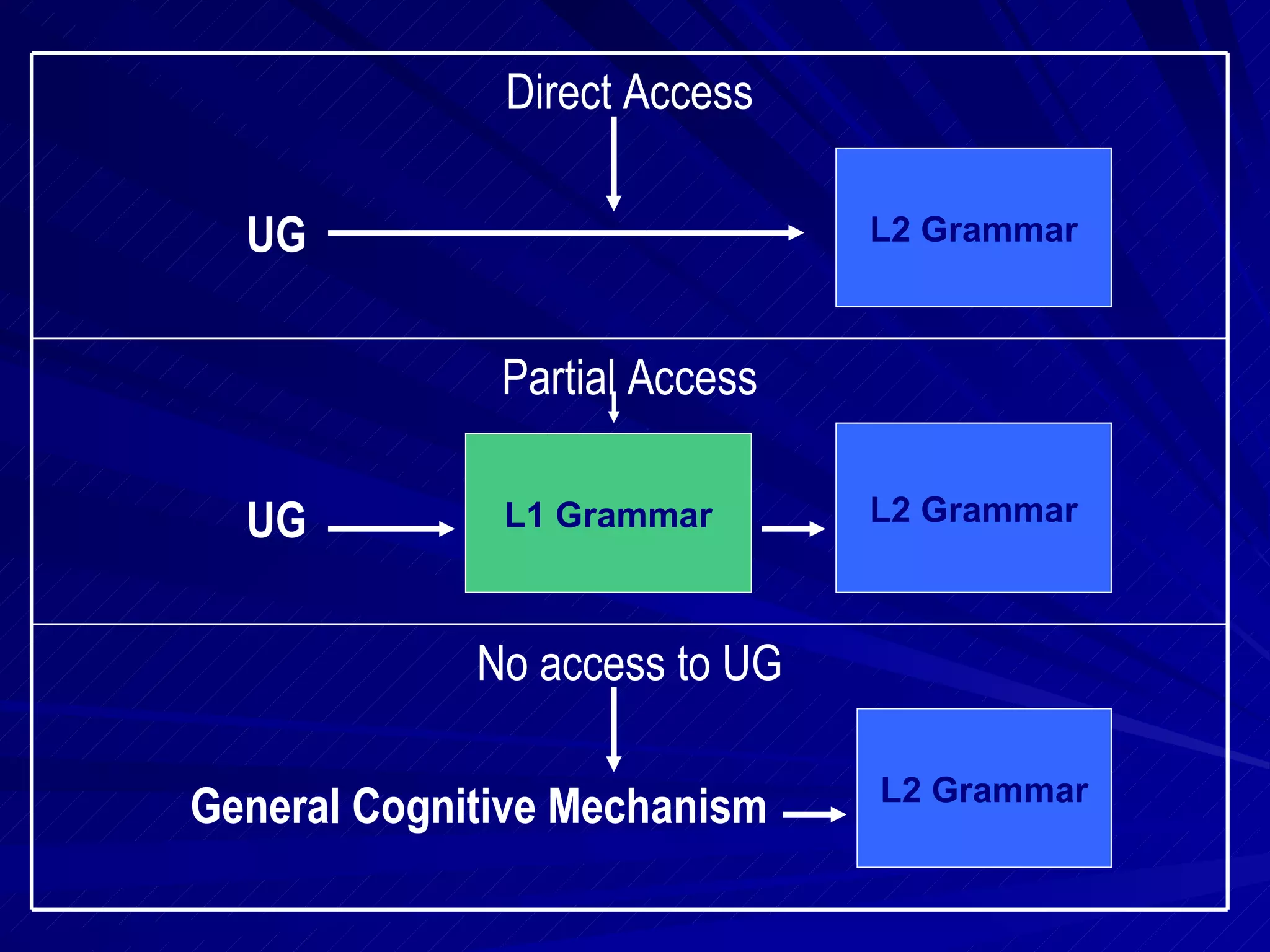
Contradicting Findings Flynn(1987) claims that adult L2 learners have full access to UG. White (1989) believes that L2 learners only have access to the parameters that have been activated in the in their first native language Felix (1985) agrees that L2 learners have access to UG and a general problem-solving module. The two mechanisms compete with each other and a general problem-solving module always wins.
9.
L2 Grammar L2Grammar L2 Grammar L1 Grammar No access to UG General Cognitive Mechanism Partial Access UG Direct Access UG
10.
Recall Krashen’s hypothesesDespite its theoretical shortcomings, Krashen’s input hypothesis has been very popular and his input hypothesis is responsible for Initiating the debate regarding the role of input – one way versus two-way interaction – in SLA; Triggering the research on the role of grammar instruction in SLA;
11.
Recall Krashen’s hypotheses3. identifying the processes that are responsible for the conversion of input into output; and 4. perhaps unintentionally, examining the relation between comprehensible input and mental processes (the learner’s external and internal process).
12.
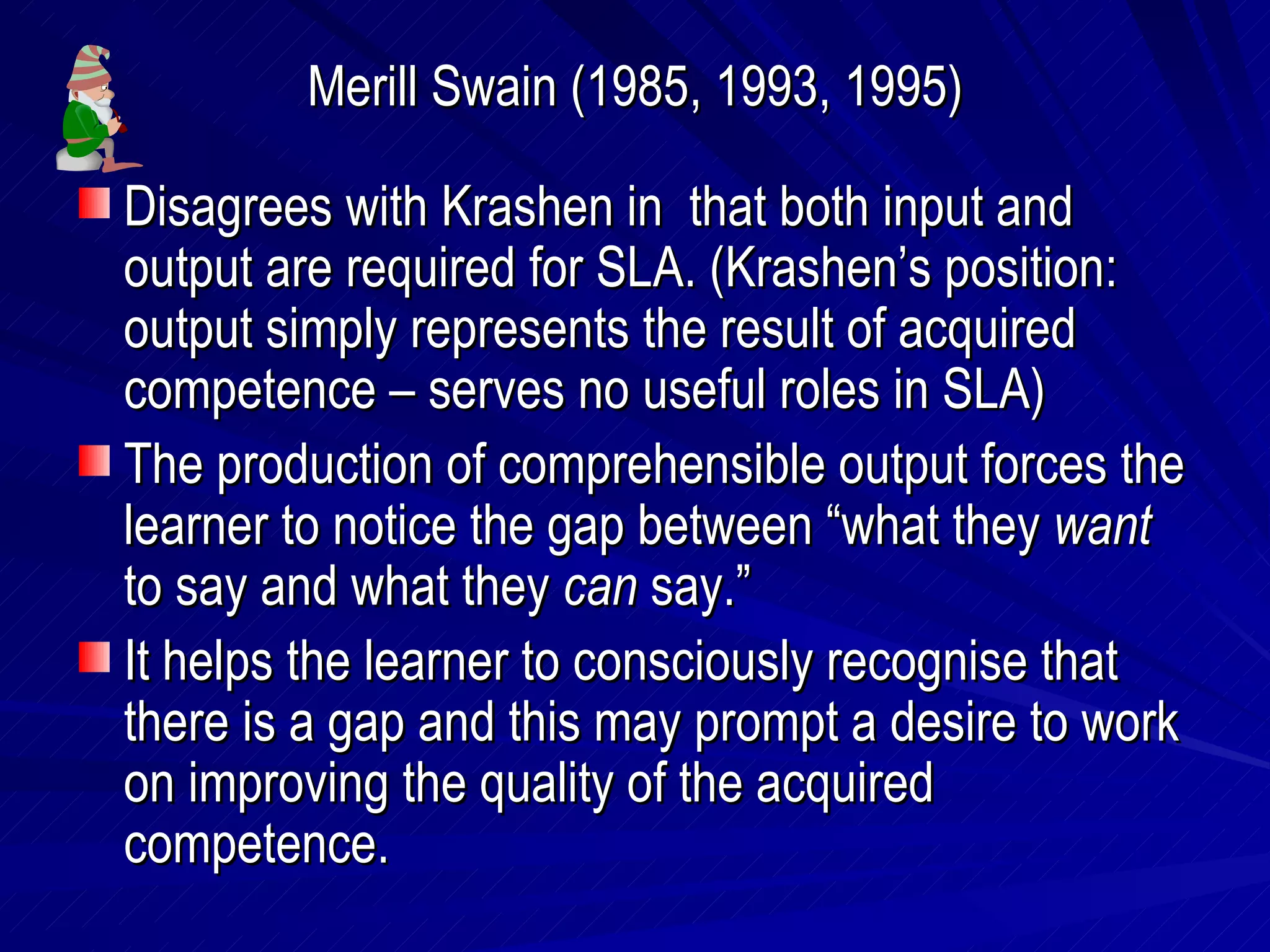
Merill Swain (1985,1993, 1995) Disagrees with Krashen in that both input and output are required for SLA. (Krashen’s position: output simply represents the result of acquired competence – serves no useful roles in SLA) The production of comprehensible output forces the learner to notice the gap between “what they want to say and what they can say.” It helps the learner to consciously recognise that there is a gap and this may prompt a desire to work on improving the quality of the acquired competence.
13.
Merill Swain (1985,1993, 1995) Comprehensible output plays a crucial role in changing the quality (that is, restructuring, McLaughlin 1990) the learner’s interlanguage. The “pushed out” input is necessary for the learner to engaged in syntactic processing that contributes to achieve higher grammatical accuracy. Swain identifies 3 functions of comprehensible output which she hypothesizes relate to “accuracy rather than fluency”
14.
Swain’s three functionsThe “noticing/triggering function or consciousness- raising role The hypothesis-testing function The metalinguistic function – reflecting role
15.
Call for CognitiveApproach Mainstream researchers disagree to the applicability and appropriateness of Chomsky’s linguistic theory for SLA, but they do not advocate the replacement of it with a more “environmentally” friendly or more socially oriented one. They call for its replacement with another cognitively oriented theory – claiming that the focus of SLA should be on describing and explaining mental processes responsible for SLA.
16.
Long (1997) (Inresponse to Firth and Wagner criticism) SLA theory and research is primarily focused on: The understanding of mental processes The acquisition of linguistic knowledge The investigation of cognitive variables within a well-established experimental type of research design
17.
Long’s Interaction Hypothesis(IH) Michael Long (1983a, 1983b) expanded on Krashen’s CI by introducing conversational adjustment. Knowledge of grammatical rules develops from conversational interaction, not from grammatical rules that are acquired independent of conversational interaction
18.
Long’s Definition ofIH “ It is proposed that environmental contributions to acquisition are mediated by selective attention and the learner’s developing L2 processing capacity, and that these resources are brought together most usefully, although not exclusively, during negotiation of meaning. Negative feedback obtained during negotiation work or elsewhere may be facilitative of L2 development, at least for vocabulary, morphology, and language-specific syntax, and essential for learning certain specifiable L1-L2 contrasts” (Long 1996, 414)
19.
Studies on InteractionalHypothesis Some studies on recast (“utterances that rephrase a child’s utterance by chnaging one or more sentence components (subject, verb or object) while still referring to its central meaning” – Long 1996,434) Recast allow the learner to compare his or her ungrammatical utterances with the grammatical utterances offered by others. Hopefully, the learner can notice the gap between input and his or her interlanguage.
20.
Studies on recastLong, Inagaki, Ortega (1998) – inconclusive Mackay and Philp (1998) – participants did dot modify their output in response to the recast. Inconclusive. Mackay (1999) – inconclusive Mackay, Gas and McDonough (2000)- learner’s perception regarding morphosyntactic feedback suggest that most of the ESL participants perceived it as semantic feedback. Thus recasts do not contribute to focusing the learner’s attention on linguistic forms. Instead, recast assists the learner comprehension of lexis, semantic meaning.
21.
Van Patten (CognitivePsychology) Learners cannot attend to form and function at the same time (a notion that Long’s IH seems to reject) “ We will draw upon various constructs from cognitive psychology, most notably attention, and argue that second language learners are limited capacity processor . As such, they can only attend to so much linguistic data at a time in the input during on-line comprehension.” (1996,14) The metaphors are characteristic of the information processing paradigm.
22.
Van Patten’s 3principles (1996) P1: Learners process input for meaning before they process it for from. Learners process the content words in the input before anything else. Learners prefer processing lexical items to grammatical items (e.g. morphological markings) for semantic information. Learners prefer processing ‘more meaningful” morphology before “less” or “nonmeaningful” morphology”
23.
Van Patten’s 3principles (1996) 2. For learners to process form that is not meaningful, they must be able to process informational or communicative content at no (or little) cost to attention (1996, 14-15) 3. Learners possess a default strategy that assigns the role of agent to the first noun (phrase) they encounter in a sentence.”We call this first noun strategy.” The first noun strategy can be overidden by lexical semantics and even probabilities
24.
Van Patten’s 3principles (1996) b. Learners will adopt other processing strategies for grammatical role assignment only after their developing system has incorporated other cues (e.g., case making, acoustic stress). (1996,32)
25.
Lexical Vs GrammaticalMeanings Schmidt : “you can’t learn a foreign language (or anything else, for that matter) through subliminal perception” (1990,142). Tomlin and Villa: During attentional processing, one process is of extreme importance for potential language acquisition – detection – which they define as “the process that selects, or engages, a particular and specific bit of information” (1994,192).
26.
Lexical Vs GrammaticalMeanings Van Patten: ”When all else is equal, form and meaning compete for detection – with meaning generally winning out.” (1996,18) Not everything in the input can be attended to and thus potentially detected. Mangubhai (1991): L2 learners acquire content words first before they are able to put these words together.
27.
Examples Morpheme ‘ed’in the past tense encodes semantic meaning. However, this can be conveyed by lexical item rather than by syntactic features ( yesterday, ago etc.) Morpheme that is phonologically salient, e.g. “ing” in English, is more audible than ”ed”. “ing” carries a relative greater communicative value and will be noticed prior to other grammatical items with less communicative value.
28.
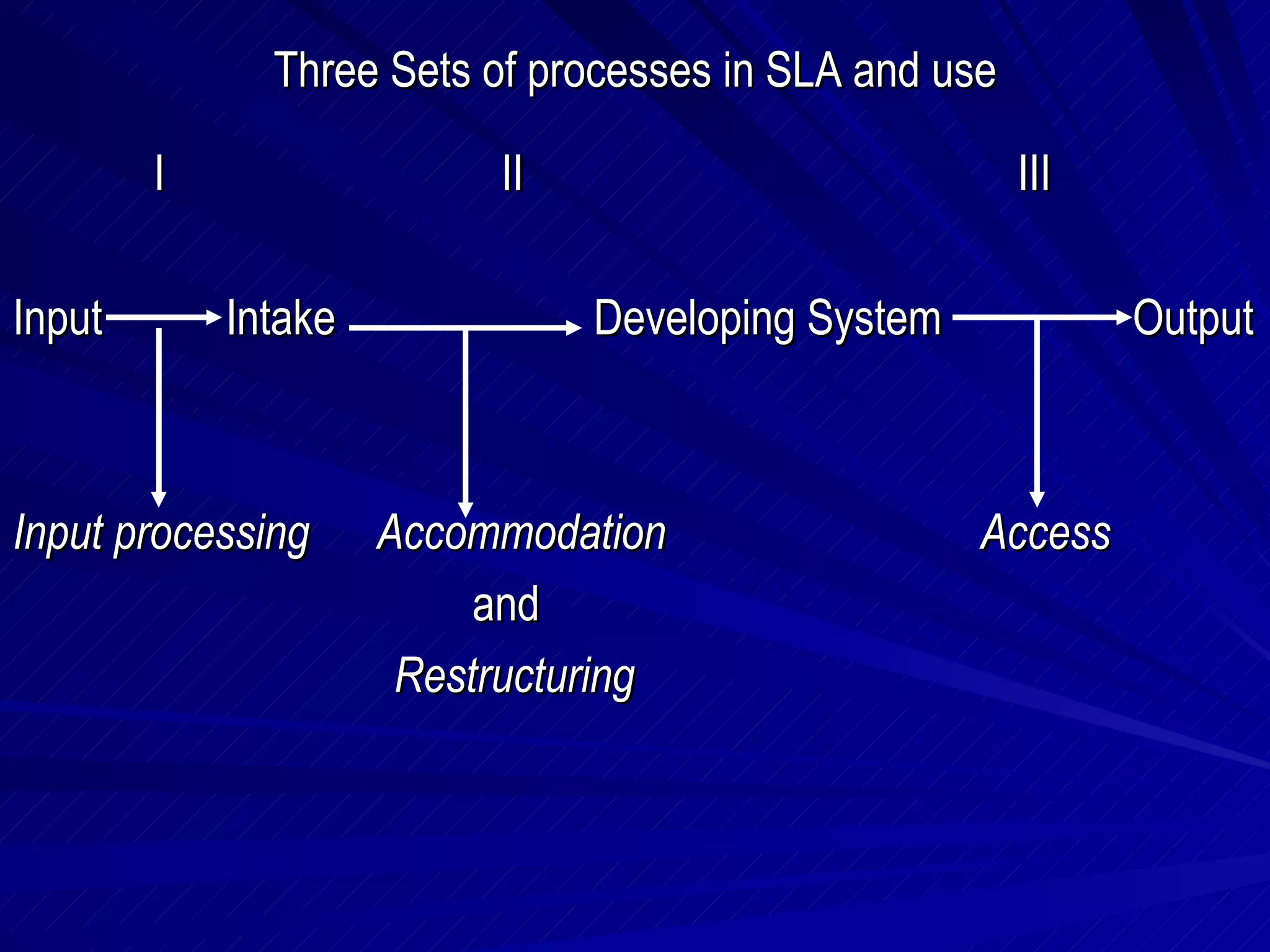
Three Sets ofprocesses in SLA and use I II III Input Intake Developing System Output Input processing Accommodation Access and Restructuring
29.
Van Pattern &Cadierno 1993,227) They criticize traditional approaches to teaching grammar that followed a flawed pattern: introduction to linguistic problem, practice exercises, and production. These approaches focus on the processes that convert the developing system into output while ignoring the processes that precede the output stage (the processes that convert input into intake).
30.
Van Pattern &Cadierno 1993,227) The processes that convert input into intake are called structured input activities. Van Patten provides some guidelines for developing structured input activities that help the learner to detect a connection between form and meaning in the provided input as follows:
31.
Van Patten andLanguage Teaching (1996, 67-69) Teach only one thing at a time. Keep meaning in focus. Learners must do something with the input. Use both oral and written input. Move from sentence to connected discourse. Keep the psycholinguistic processing strategies in mind.
32.
Van Patten andLanguage Teaching (1996, 67-69) According to the guidelines the developer of the structured input activities need to ensure that the learner is given a chance to attend to meaning oriented input. Activities should be confined to sentence-level input rather that connected discourse, which should be reserved for further teaching
33.
Doughty (1991) Long and Robinson (1998) Their studies indicate that meaning and form are not mutually exclusive. VP’s, Doughty, M. Long’s and P. Robinson’s studies are categorized as focus-on-form framework. At issue is whether learners are able to attend to form and meaning simultaneously or not.
34.
Gass and Selinker(2001) Gass (1988, 1997) identified 5 major stages involved in the conversion of input to output. They are: “apperceived input, comprehended input, intake, integration, and output” (Gass and Selinker 2001,400). Factors that make aspects of language noticed by learners include: frequency, affect, prior knowledge, and attention
35.
Gass Gass’ comprehension is defined more in terms of the word’s dictionary meaning than in terms of mental processes (Johnson 2004,80). Gass:”the most common way of getting at a syntactic analysis is by first having an understanding of the meaning. However, one can also imagine having an understanding of the syntax yet not being able to arrive at a meaning. This would be so in the case of idioms, for example, or a proverb.” (ibid)
36.
Johnson (2004) Thereseems to be some confusion as to semantic meaning and pragmatic meaning. In semantics, the minimal unit of analysis is a sentence. The same pertain to syntax. In pragmatics, however, the unit of analysis is an utterance. Pragmatic meaning goes beyond sentence-level semantic meaning and is dependent on a variety of contextual and textual features. Gass’ use of the two terms interchangeably is inappropriate and confusing.
37.
Gass and Selinker(2001,410) Acknowledge the effects of different factors on output and claim that “different grammatical information may be used in different genres” Johnson (2004,83): Although Gass’ model focuses on linguistic competence, it also claims to account for the use of knowledge in real-life-situations – in which speech genres vary – without identifying processes that pertain to linguistic performance.
38.
Conclusion All thesemodels focus on the learner’s cognitive process. The process of analysing the incoming information is viewed as being mechanistic, predictable, stable, and universal. The outside reality, or social contexts, is acknowledged indirectly, abstractly and superficially.
39.
Conclusion Any humaninteraction is viewed as a “conversation for the sake of that conversation” that does not contribute to the acquisition of linguistic forms. Interaction is not viewed as a social issue, for which the individual is solely responsible. It is viewed primarily in terms of the interaction among different components of the model in the individual’s mind.
40.
Johnson (2004) Findsthe position held by Long and his followers dangerous because it hinders progress in SLA. Believes that cognitive approach and social approach can be reconciled and united under the framework which is based on Vygotsky’s socio-cultural theory. A dialogically based model of SLA is introduced.