Chapter13
second language acquisition
1
Goals
 introduce some of the main theories of second language acquisition
 processes of second language learning
 discuss second language pedagogy and its connections with SLA theory
2
What is SLA and FLA?
SLA:
refers to the process of acquiring a non-native language that is spoken by the
community where the learner is living
FLA:
refers to the process of acquiring a non-native language that is not spoken by the
surrounding community
3
Theories of second language acquisition
 Behaviorism
 Comprehensible input and the natural order hypothesis
 The interaction hypothesis
 Socioculturalism
 Universal grammar
 Frequency-based approaches
4
Behaviorism
o Learning through repetition and reinforcement (drill and kill)
o Errors could be attributed to interference from first language
o Using contrastive analysis hypothesis(CAH)
5
Comprehensible input and the natural
order hypothesis
 Comprehensible input (i+1)
 Learner’s affective filter
 Natural order hypothesis
6
The interaction hypothesis
 Communicate with other persons
 Clarification requests
 Modified output
 Corrective feedback like recast
7
Socioculturalism focus on the impact of interpersonal and social aspects of interaction on
language learning.
1. interaction between a less skilled L2 learner and a more expert
2. includes careful and detailed analysis of the social and linguistic context of the
participants in a communicative exchange
8
Universal grammar Universal grammar= nativism
 Innate linguistic knowledge
 Language acquisition device(LAD)
 Critical period(sensitive)
 Acceptability judgment tests(grammaticality)
9
Frequency-based approaches this innate endowment may be more like an emergent, bottom-up result of
frequencies and regular patterns of actions, events, and objects (both linguistic
and nonlinguistic) that language learners perceive in their environment.
10
Individual differences in SLA
 First language
 Age
 Gender
 Working memory
 Motivation
 Context of SLA
11
First language
 Researchers point out that:
1. learners often consciously transfer or employ their knowledge about the
L1 in their attempts to communicate in the L2, especially early in the
learning process.
2. Learners are more likely to transfer L1 knowledge when they believe the
L1 and L2 are similar or related.
3. The L1 may also influence what learners notice in the L2.
12
Age
 It is commonly thought that younger language learners are more successful
 critical period hypothesis
 sensitive period
13
Gender
females tend to use more language learning strategies
than males
females usually have more positive attitudes towards
learning an L2 and may be more motivated.
males and females process language differently Gender
can also influence classroom dynamics and potentially
affect the second language learning process.
14
Working memory
in their ability to store and process
information at the same time.
Research suggests that working memory
plays a role in first language acquisition,
language processing and language loss
15
Motivation who are willing to devote more time and energy to achieving fluency in
the target language, are more successful.
 integrative motivation :involving the learner’s attitudes towards the target
language group and the desire to integrate into the target language
community
 instrumental orientations: more practical reasons for language learning,
such as gaining some social or economic reward through L2 achievement.
16
Context of SLA
There are two different ways in which the term context is used in SLA:
 refer to the environmental context in which the learning occurs in an
immersion program, during study abroad, at home with an audiotape, in
a university classroom, and so on.
 refer to linguistic context, such as the topic of the conversation, the
meanings that can be gleaned from surrounding discourse, and (more
socially) the person with whom the learner is interacting.
17
SLA processes
 Attention
 Developmental sequences
 Fossilization
18
Attention
 Those features of the L2 that are not noticed do not get stored in
the short-term memory system and thus are not learned. The
hypothesis further claims that since learners are exposed to much
more language input than they can process, some kind of
mechanism (attention) is necessary to help them sort through the
large volume of language data and eventually to encode the data
into memory
19
Developmental sequences series of identifiable stages that L2 learners pass through in
acquiring the second language. Research methods in this
vein have included identifying when specific linguistic
features are learned and examining how errors change over
time (error analysis). This research shows that second
language learners acquire the non-native language in a
regular, systematic fashion, much like learners acquiring their
native languages.
20
Fossilization
 one of the most salient (and frustrating) traits of second
language learning is that L2 learners often do not sound like
native speakers even after many years of study and practice.
It has been argued that language learning typically fossilizes
and remains permanently at a level short of native-like
speech.
21
Teaching methods22
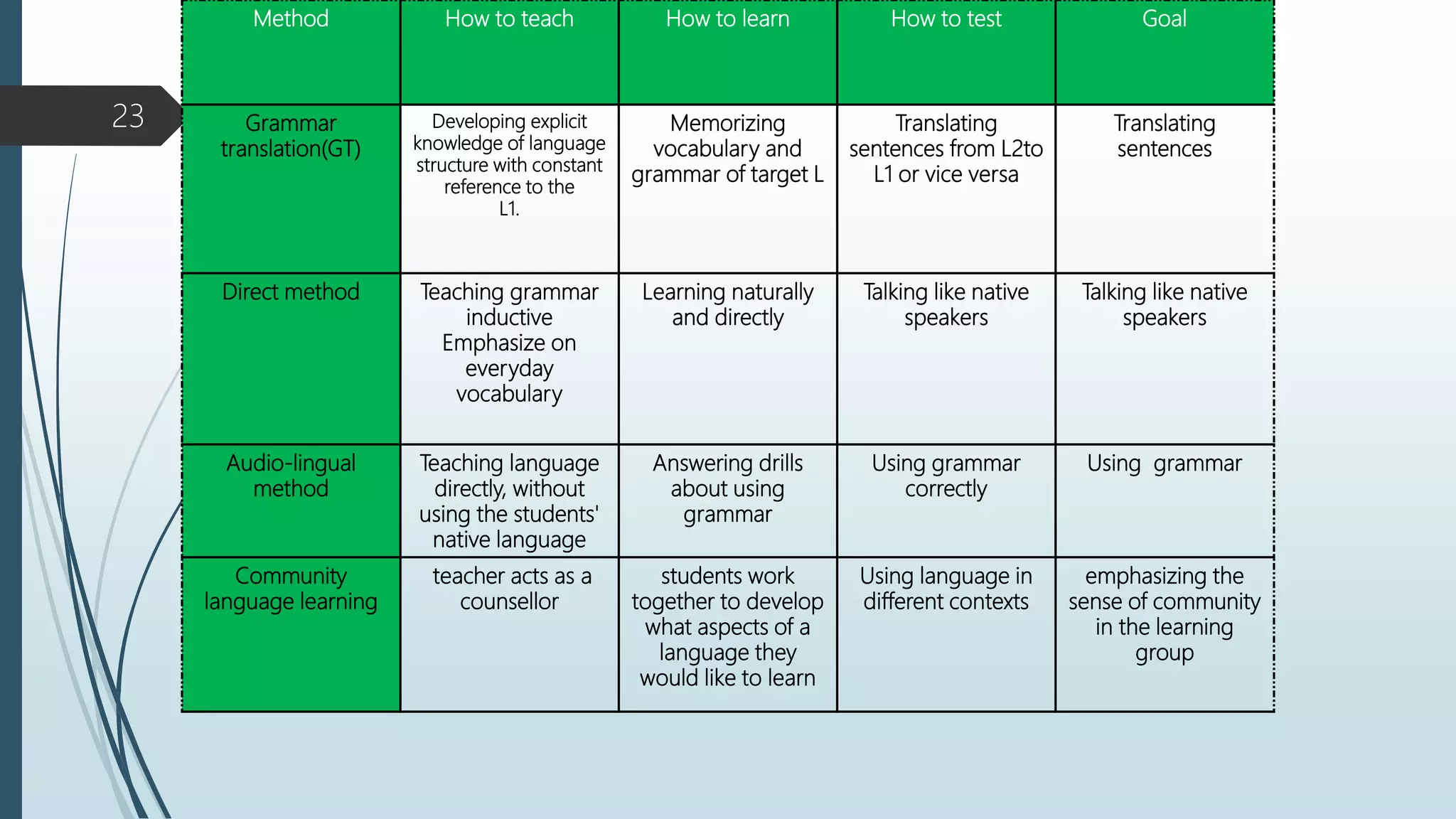
Method How to teach How to learn How to test Goal
Grammar
translation(GT)
Developing explicit
knowledge of language
structure with constant
reference to the
L1.
Memorizing
vocabulary and
grammar of target L
Translating
sentences from L2to
L1 or vice versa
Translating
sentences
Direct method Teaching grammar
inductive
Emphasize on
everyday
vocabulary
Learning naturally
and directly
Talking like native
speakers
Talking like native
speakers
Audio-lingual
method
Teaching language
directly, without
using the students'
native language
Answering drills
about using
grammar
Using grammar
correctly
Using grammar
Community
language learning
teacher acts as a
counsellor
students work
together to develop
what aspects of a
language they
would like to learn
Using language in
different contexts
emphasizing the
sense of community
in the learning
group
23
24
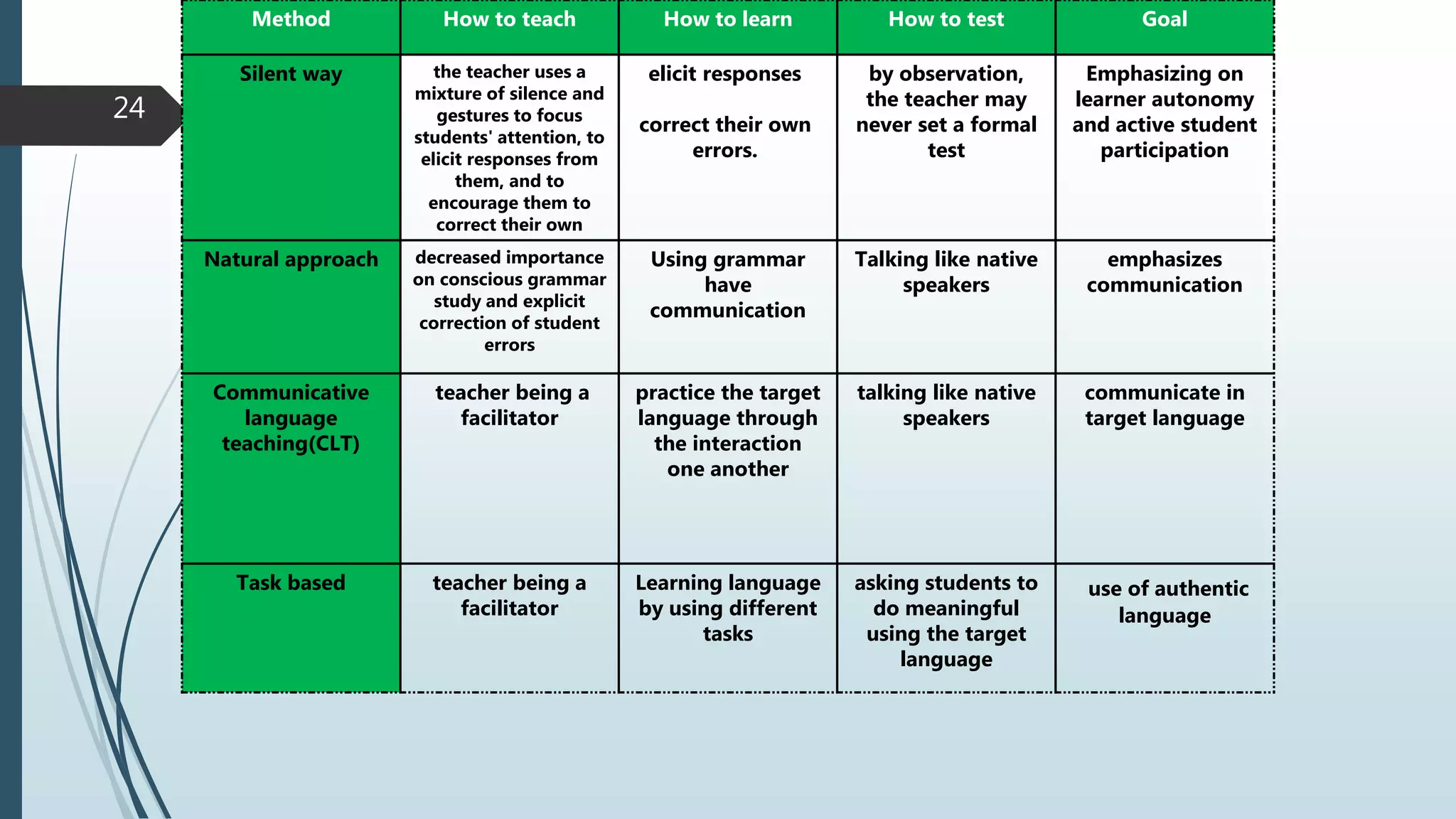
Method How to teach How to learn How to test Goal
Silent way the teacher uses a
mixture of silence and
gestures to focus
students' attention, to
elicit responses from
them, and to
encourage them to
correct their own
elicit responses
correct their own
errors.
by observation,
the teacher may
never set a formal
test
Emphasizing on
learner autonomy
and active student
participation
Natural approach decreased importance
on conscious grammar
study and explicit
correction of student
errors
Using grammar
have
communication
Talking like native
speakers
emphasizes
communication
Communicative
language
teaching(CLT)
teacher being a
facilitator
practice the target
language through
the interaction
one another
talking like native
speakers
communicate in
target language
Task based teacher being a
facilitator
Learning language
by using different
tasks
asking students to
do meaningful
using the target
language
use of authentic
language
25

second language acquisition

  • 1.
  • 2.
    Goals  introduce someof the main theories of second language acquisition  processes of second language learning  discuss second language pedagogy and its connections with SLA theory 2
  • 3.
    What is SLAand FLA? SLA: refers to the process of acquiring a non-native language that is spoken by the community where the learner is living FLA: refers to the process of acquiring a non-native language that is not spoken by the surrounding community 3
  • 4.
    Theories of secondlanguage acquisition  Behaviorism  Comprehensible input and the natural order hypothesis  The interaction hypothesis  Socioculturalism  Universal grammar  Frequency-based approaches 4
  • 5.
    Behaviorism o Learning throughrepetition and reinforcement (drill and kill) o Errors could be attributed to interference from first language o Using contrastive analysis hypothesis(CAH) 5
  • 6.
    Comprehensible input andthe natural order hypothesis  Comprehensible input (i+1)  Learner’s affective filter  Natural order hypothesis 6
  • 7.
    The interaction hypothesis Communicate with other persons  Clarification requests  Modified output  Corrective feedback like recast 7
  • 8.
    Socioculturalism focus onthe impact of interpersonal and social aspects of interaction on language learning. 1. interaction between a less skilled L2 learner and a more expert 2. includes careful and detailed analysis of the social and linguistic context of the participants in a communicative exchange 8
  • 9.
    Universal grammar Universalgrammar= nativism  Innate linguistic knowledge  Language acquisition device(LAD)  Critical period(sensitive)  Acceptability judgment tests(grammaticality) 9
  • 10.
    Frequency-based approaches thisinnate endowment may be more like an emergent, bottom-up result of frequencies and regular patterns of actions, events, and objects (both linguistic and nonlinguistic) that language learners perceive in their environment. 10
  • 11.
    Individual differences inSLA  First language  Age  Gender  Working memory  Motivation  Context of SLA 11
  • 12.
    First language  Researcherspoint out that: 1. learners often consciously transfer or employ their knowledge about the L1 in their attempts to communicate in the L2, especially early in the learning process. 2. Learners are more likely to transfer L1 knowledge when they believe the L1 and L2 are similar or related. 3. The L1 may also influence what learners notice in the L2. 12
  • 13.
    Age  It iscommonly thought that younger language learners are more successful  critical period hypothesis  sensitive period 13
  • 14.
    Gender females tend touse more language learning strategies than males females usually have more positive attitudes towards learning an L2 and may be more motivated. males and females process language differently Gender can also influence classroom dynamics and potentially affect the second language learning process. 14
  • 15.
    Working memory in theirability to store and process information at the same time. Research suggests that working memory plays a role in first language acquisition, language processing and language loss 15
  • 16.
    Motivation who arewilling to devote more time and energy to achieving fluency in the target language, are more successful.  integrative motivation :involving the learner’s attitudes towards the target language group and the desire to integrate into the target language community  instrumental orientations: more practical reasons for language learning, such as gaining some social or economic reward through L2 achievement. 16
  • 17.
    Context of SLA Thereare two different ways in which the term context is used in SLA:  refer to the environmental context in which the learning occurs in an immersion program, during study abroad, at home with an audiotape, in a university classroom, and so on.  refer to linguistic context, such as the topic of the conversation, the meanings that can be gleaned from surrounding discourse, and (more socially) the person with whom the learner is interacting. 17
  • 18.
    SLA processes  Attention Developmental sequences  Fossilization 18
  • 19.
    Attention  Those featuresof the L2 that are not noticed do not get stored in the short-term memory system and thus are not learned. The hypothesis further claims that since learners are exposed to much more language input than they can process, some kind of mechanism (attention) is necessary to help them sort through the large volume of language data and eventually to encode the data into memory 19
  • 20.
    Developmental sequences seriesof identifiable stages that L2 learners pass through in acquiring the second language. Research methods in this vein have included identifying when specific linguistic features are learned and examining how errors change over time (error analysis). This research shows that second language learners acquire the non-native language in a regular, systematic fashion, much like learners acquiring their native languages. 20
  • 21.
    Fossilization  one ofthe most salient (and frustrating) traits of second language learning is that L2 learners often do not sound like native speakers even after many years of study and practice. It has been argued that language learning typically fossilizes and remains permanently at a level short of native-like speech. 21
  • 22.
  • 23.
    Method How toteach How to learn How to test Goal Grammar translation(GT) Developing explicit knowledge of language structure with constant reference to the L1. Memorizing vocabulary and grammar of target L Translating sentences from L2to L1 or vice versa Translating sentences Direct method Teaching grammar inductive Emphasize on everyday vocabulary Learning naturally and directly Talking like native speakers Talking like native speakers Audio-lingual method Teaching language directly, without using the students' native language Answering drills about using grammar Using grammar correctly Using grammar Community language learning teacher acts as a counsellor students work together to develop what aspects of a language they would like to learn Using language in different contexts emphasizing the sense of community in the learning group 23
  • 24.
    24 Method How toteach How to learn How to test Goal Silent way the teacher uses a mixture of silence and gestures to focus students' attention, to elicit responses from them, and to encourage them to correct their own elicit responses correct their own errors. by observation, the teacher may never set a formal test Emphasizing on learner autonomy and active student participation Natural approach decreased importance on conscious grammar study and explicit correction of student errors Using grammar have communication Talking like native speakers emphasizes communication Communicative language teaching(CLT) teacher being a facilitator practice the target language through the interaction one another talking like native speakers communicate in target language Task based teacher being a facilitator Learning language by using different tasks asking students to do meaningful using the target language use of authentic language
  • 25.