UNIVERSIDAD TÉCNICA DE AMBATO
FACULTAD DE CIENCIAS HUMANAS Y DE LA
EDUCACIÓN
CARRERA DE IDIOMAS
LANGUAGE TEACHING STRATEGIES
Names:
Lissette Chango
Erika Vaca
SEMESTER: 6 TH
Second Language Acquisition Theory
• It is important describes some very important
hypotheses.
• The first three, the acquisition-learning
distinction, the natural order hypotheses, and
the Monitor hypothesis.
The acquisition-learning distinction
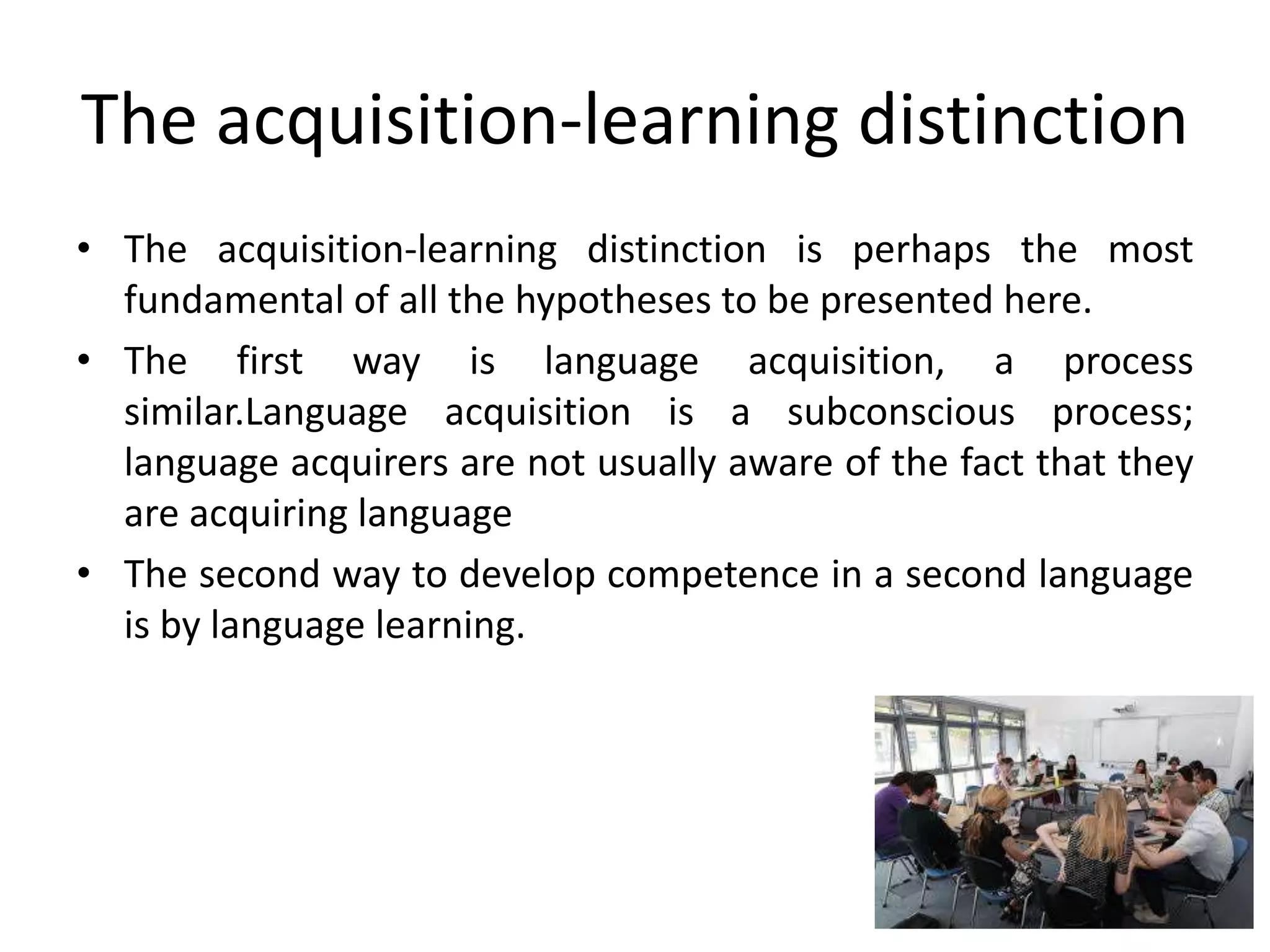
• The acquisition-learning distinction is perhaps the most
fundamental of all the hypotheses to be presented here.
• The first way is language acquisition, a process
similar.Language acquisition is a subconscious process;
language acquirers are not usually aware of the fact that they
are acquiring language
• The second way to develop competence in a second language
is by language learning.
The natural order hypothesis
• Acquirers of a given language tend to acquire
certain grammatical structures early, and
others later. The agreement among individual
acquirers is not always 100%, but there are
clear, statistically significant, similarities.
• This order is derived from an analysis of
empirical studies of second language
acquisition (Krashen, 1977).
Transitional forms
• Studies supporting the natural order hypothesis
show only the order in which mature, or well-
formed structures emerge.
• Transitional forms have been described for other
languages and for other structures. The stages for
a given target language appear to be strikingly
similar despite the first language of the acquirer
(although particular first languages may influence
the duration of certain stages.
The Monitor hypothesis
• The Monitor hypothesis implies that formal rules, or conscious learning,
play only a limited role in second language performance. These conditions
are necessary and not sufficient.
• Time. In order to think about and use conscious rules effectively, a second
language performer needs to have sufficient time.
• Focus on form. To use the Monitor effectively, time is not enough. The
performer must also be focussed on form, or thinking about correctness.
• Know the rule. This is a very formidable requirement. Linguistics has
taught us that the structure of language is extremely complex, and they
claim to have described only a fragment of the best known languages.
• The input hypothesis attempts to answer what is
perhaps the most important question in our field,
and gives an answer that has a potential impact
on all areas of language teaching.
STATEMENT OF THE HYPOTHESIS
We acquire when we understand language that contains
structure that is "a little beyond" where we are now. How
is this possible? How can we understand language that
contains structures that we have not yet acquired? We
also use context, our knowledge of the world, our extra-
linguistic information to help us understand language
directed at us.
Evidence supporting the hypothesis
1. First language acquisition in children. The input hypothesis is very
consistent with what is known about "caretaker speech", the
modifications that parents and others make when talking to young
children. The most interesting and perhaps the most important
characteristic of caretaker speech for us is that it is not a
deliberate attempt to teach language
2. A second characteristic of interest to us here is the finding that
caretaker speech, while it is syntactically simpler than adult-adult
speech, is "roughly-tuned" to the child's current level of linguistic
competence.
3. A third characteristic of caretaker speech that concerns us is
known as the "here and now" principle. It is well established that
caretakers talk mostly about what the child can perceive.
The Affective Filter hypothesis
• The Affective Filter hypothesis states how affective factors relate to
the second language acquisition process.
• Research over the last decade has confirmed that a variety of
affective variables relate to success in second language acquisition
Most of those studied can be placed into one of these three
categories:
(1) Motivation. Performers with high motivation generally do better in
second language acquisition (usually, but not always, "integrative"13
(2) Self-confidence. Performers with self-confidence and a good self-
image tend to do better in second language acquisition.
(3) Anxiety. Low anxiety appears to be conducive to second language
acquisition, whether measured as personal or classroom anxiety.
B. The Causative Variable in
Second Language Acquisition
1. The causative
variables
2. Language teaching:
does it help?
3. Exposure
variables
4. Age
5. Acculturation
1. THE CAUSATIVE VARIABLES
Our review of second language acquisition theory
thus far can be summarized as follows:
1. Acquisition is more important than learning.
2. In order to acquire, two conditions are
necessary.
• The first is comprehensible input containing i +
1, structures a bit beyond the acquirer's current
level.
• The second, a low or weak affective filter to
allow the input "in".
• This is equivalent to saying that comprehensible
input and the strength of the filter are the true
causes of second language acquisition.
• The comprehensible input + filter explanation helps
to solve some apparent problems and contradictions
in the research literature.
2. LANGUAGE TEACHING: DOES IT
HELP?
• (a) When language teaching helps .-
Language teaching helps when it is the main source of
low filter comprehensible input, that is, for beginners
and for foreign language students who do not have a
chance to get input outside the class.
• (b) When language teaching does not help.
Its primary function is to supply comprehensible input
for those who can not get it elsewhere, those constrained
by their situation (i.e. foreign language students who do
not have input sources outside the class) or by their
competence (those unable to understand the language of
the outside world).
3. EXPOSURE VARIABLES
Several exposure variables have been investigated with
respect to second language acquisition.
• The comprehensible input plus low filter are the true
causative variables predicts quite well when exposure
variables relate to second language acquisition and
when they do not. Thus, exposure variable are also
indirect and not in themselves causative.
4. AGE
• The age is not in itself a predictor of second language
rate or attainment, and that here too everything reduces
down to the quantity of comprehensible input and the
level of the affective filter.
• Krashen, Long, and Scarcella (1979) reviewed the effect
of age and second language acquisition and concluded
that all published studies were consistent with these
three generalization:
• 1. Adults
• 2. Older Children
• 3. Acquirers
Three generalization:
• 1. Adults proceed through the early stages of
second language development faster than
children do
• 2. Older children acquire faster than younger
children.
• 3. Acquirers who begin natural exposure to
second languages during childhood generally
achieve higher second language proficiency than
those beginning as adults.
5. ACCULTURATION
Schumann defines two types of acculturation:
• one acculturation
The learner is psychologically open to the TL such that
input to which he is exposed becomes intake.
• two acculturation
The learner regards the TL speakers as a reference group
whose life styles and values he consciously or
unconsciously desires to adopt.
Both types of acculturation are sufficient to cause acquisition
of the TL

Language adquisition 2

  • 1.
    UNIVERSIDAD TÉCNICA DEAMBATO FACULTAD DE CIENCIAS HUMANAS Y DE LA EDUCACIÓN CARRERA DE IDIOMAS LANGUAGE TEACHING STRATEGIES Names: Lissette Chango Erika Vaca SEMESTER: 6 TH
  • 2.
    Second Language AcquisitionTheory • It is important describes some very important hypotheses. • The first three, the acquisition-learning distinction, the natural order hypotheses, and the Monitor hypothesis.
  • 3.
    The acquisition-learning distinction •The acquisition-learning distinction is perhaps the most fundamental of all the hypotheses to be presented here. • The first way is language acquisition, a process similar.Language acquisition is a subconscious process; language acquirers are not usually aware of the fact that they are acquiring language • The second way to develop competence in a second language is by language learning.
  • 4.
    The natural orderhypothesis • Acquirers of a given language tend to acquire certain grammatical structures early, and others later. The agreement among individual acquirers is not always 100%, but there are clear, statistically significant, similarities. • This order is derived from an analysis of empirical studies of second language acquisition (Krashen, 1977).
  • 5.
    Transitional forms • Studiessupporting the natural order hypothesis show only the order in which mature, or well- formed structures emerge. • Transitional forms have been described for other languages and for other structures. The stages for a given target language appear to be strikingly similar despite the first language of the acquirer (although particular first languages may influence the duration of certain stages.
  • 6.
  • 7.
    • The Monitorhypothesis implies that formal rules, or conscious learning, play only a limited role in second language performance. These conditions are necessary and not sufficient. • Time. In order to think about and use conscious rules effectively, a second language performer needs to have sufficient time. • Focus on form. To use the Monitor effectively, time is not enough. The performer must also be focussed on form, or thinking about correctness. • Know the rule. This is a very formidable requirement. Linguistics has taught us that the structure of language is extremely complex, and they claim to have described only a fragment of the best known languages.
  • 8.
    • The inputhypothesis attempts to answer what is perhaps the most important question in our field, and gives an answer that has a potential impact on all areas of language teaching. STATEMENT OF THE HYPOTHESIS We acquire when we understand language that contains structure that is "a little beyond" where we are now. How is this possible? How can we understand language that contains structures that we have not yet acquired? We also use context, our knowledge of the world, our extra- linguistic information to help us understand language directed at us.
  • 9.
    Evidence supporting thehypothesis 1. First language acquisition in children. The input hypothesis is very consistent with what is known about "caretaker speech", the modifications that parents and others make when talking to young children. The most interesting and perhaps the most important characteristic of caretaker speech for us is that it is not a deliberate attempt to teach language 2. A second characteristic of interest to us here is the finding that caretaker speech, while it is syntactically simpler than adult-adult speech, is "roughly-tuned" to the child's current level of linguistic competence. 3. A third characteristic of caretaker speech that concerns us is known as the "here and now" principle. It is well established that caretakers talk mostly about what the child can perceive.
  • 10.
    The Affective Filterhypothesis • The Affective Filter hypothesis states how affective factors relate to the second language acquisition process. • Research over the last decade has confirmed that a variety of affective variables relate to success in second language acquisition Most of those studied can be placed into one of these three categories: (1) Motivation. Performers with high motivation generally do better in second language acquisition (usually, but not always, "integrative"13 (2) Self-confidence. Performers with self-confidence and a good self- image tend to do better in second language acquisition. (3) Anxiety. Low anxiety appears to be conducive to second language acquisition, whether measured as personal or classroom anxiety.
  • 11.
    B. The CausativeVariable in Second Language Acquisition 1. The causative variables 2. Language teaching: does it help? 3. Exposure variables 4. Age 5. Acculturation
  • 12.
    1. THE CAUSATIVEVARIABLES Our review of second language acquisition theory thus far can be summarized as follows: 1. Acquisition is more important than learning. 2. In order to acquire, two conditions are necessary. • The first is comprehensible input containing i + 1, structures a bit beyond the acquirer's current level. • The second, a low or weak affective filter to allow the input "in".
  • 13.
    • This isequivalent to saying that comprehensible input and the strength of the filter are the true causes of second language acquisition. • The comprehensible input + filter explanation helps to solve some apparent problems and contradictions in the research literature.
  • 14.
    2. LANGUAGE TEACHING:DOES IT HELP? • (a) When language teaching helps .- Language teaching helps when it is the main source of low filter comprehensible input, that is, for beginners and for foreign language students who do not have a chance to get input outside the class. • (b) When language teaching does not help. Its primary function is to supply comprehensible input for those who can not get it elsewhere, those constrained by their situation (i.e. foreign language students who do not have input sources outside the class) or by their competence (those unable to understand the language of the outside world).
  • 15.
    3. EXPOSURE VARIABLES Severalexposure variables have been investigated with respect to second language acquisition. • The comprehensible input plus low filter are the true causative variables predicts quite well when exposure variables relate to second language acquisition and when they do not. Thus, exposure variable are also indirect and not in themselves causative.
  • 16.
    4. AGE • Theage is not in itself a predictor of second language rate or attainment, and that here too everything reduces down to the quantity of comprehensible input and the level of the affective filter. • Krashen, Long, and Scarcella (1979) reviewed the effect of age and second language acquisition and concluded that all published studies were consistent with these three generalization: • 1. Adults • 2. Older Children • 3. Acquirers
  • 17.
    Three generalization: • 1.Adults proceed through the early stages of second language development faster than children do • 2. Older children acquire faster than younger children. • 3. Acquirers who begin natural exposure to second languages during childhood generally achieve higher second language proficiency than those beginning as adults.
  • 18.
    5. ACCULTURATION Schumann definestwo types of acculturation: • one acculturation The learner is psychologically open to the TL such that input to which he is exposed becomes intake. • two acculturation The learner regards the TL speakers as a reference group whose life styles and values he consciously or unconsciously desires to adopt. Both types of acculturation are sufficient to cause acquisition of the TL