

























Theories of First and Second Language AcquisitionMAESTRIA EN DIDACTICA DEL INGLESUNIVERSIDAD SURCOLOMBIANA M.A  Omar Andres Atehortua A.
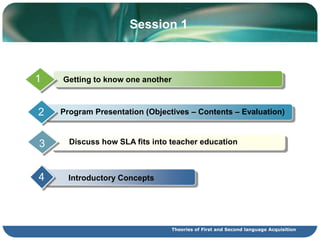
Session 11243Introductory ConceptsGetting to know one another Program Presentation (Objectives – Contents – Evaluation)Discuss how SLA fits into teacher educationTheories of First and Second language Acquisition
Getting to know one another . .Who are we professionally? Who are our students? Why are you pursuing a masters' degree? What are your expectations about this seminar?Grab a piece of paper and complete the following statements:  I am a person who likes/enjoys …………
  As a teacher I consider myself very …………………….
 The  best thing   about teaching is ………
  I think pursuing a Masters degree in ELT can help me to..……
 This seminar is important/not important because …………………
  I feel………… ……..-  I’m looking forward to…………………………………………………Theories of First and Second language Acquisition
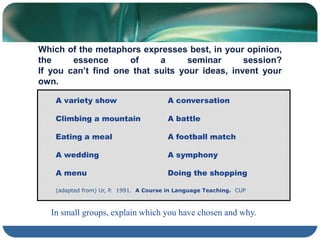
Which of the metaphors expresses best, in your opinion, the essence of a seminar session?If you can’t find one that suits your ideas, invent your own. In small groups, explain which you have chosen and why.
INTRODUCTIONWatch the video Educational QuotesChoose 3 or 4 quotes and write them down.Theories of First and Second language Acquisition
INTRODUCTIONWatch the video about Educational QuotesAnalyze the following quotes:Practice makes perfect
You can’t change the tides but you can learn to swimTheories of First and Second language Acquisition
Personal ReviewIn pairs, discussthefollowingquestion: RefertoBrown’sbook page 3Is teaching a craft or a science?Theories of First and Second language Acquisition
THE SEARCH FOR LANGUAGE TEACHING PROFESSIONALS Wallace (1991) states that any occupation aspiring to the title of “profession” will claim at least some of these qualities:A basis of scientific Knowledge.A period of rigorous study which is formally    assessed.A sense of public service;High standards of professional conduct;An ability to perform some specified demanding and socially useful tasks in a demonstrably competent manner.Theories of First and Second language Acquisition
Teachers’ skillsWhy do you think that teachers (of maths, history, English etc) should have a good knowledge of their subject matter?  What kind of knowledge and skills should an English teacher have?How can teachers improve their knowledge?Should teachers pass on all their knowledge to students?Do you think that learning a language means learning grammar rules?Theories of First and Second language Acquisition
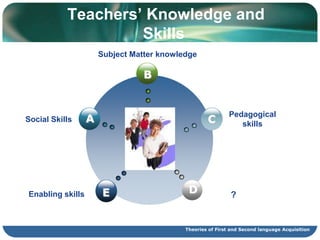
Subject Matter knowledgeBPedagogical skillsASocial SkillsCDEnabling skills?ETeachers’ Knowledge and SkillsTheories of First and Second language Acquisition
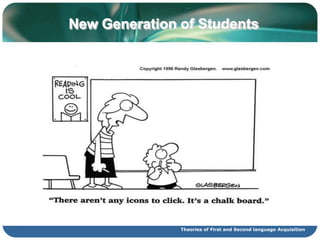
New Generation of StudentsTheories of First and Second language Acquisition
“The information revolution requires a matching education revolution”Institute for Learning and Research TechnologyTheories of First and Second language Acquisition
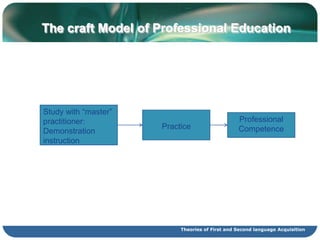
The craft Model of Professional EducationStudy with “master” practitioner:DemonstrationinstructionPracticeProfessional CompetenceTheories of First and Second language Acquisition
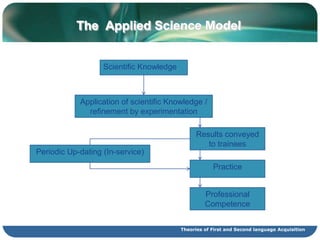
The  Applied Science ModelScientific KnowledgeApplication of scientific Knowledge / refinement by experimentationResults conveyed to traineesPeriodic Up-dating (In-service)PracticeProfessional CompetenceTheories of First and Second language Acquisition
Personal ReviewThink back to some incident or development that happened in class which you had not planned for, e.g.- A disciplinary problem- an unpredicted error made by a student- an unexpected lack of understanding- A decision on your part that  you would have to teach the lesson differently from what was planned, etc.1. What was the problem or development, exactly?2. How did you handle it?3. Why did you handle it the way you did?4. Would you handle it in the same way again? If not, why not?5. Has the incident changed your general view of how to go about the practice of teaching? (e.g, you may have decided in general to be more strict, to use group work less, to ask more questions, etc.) Theories of First and Second language Acquisition
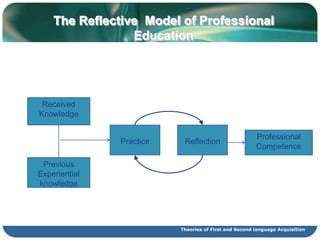
The Reflective  Model of Professional EducationReceived KnowledgePracticeReflectionProfessional CompetencePreviousExperiential knowledgeTheories of First and Second language Acquisition
YOU CANNOT EXPECT DIFFERENT RESULTS IF YOU ALWAYS DO THE SAME.Theories of First and Second language Acquisition
I hear and I forgetI see and I rememberI do and I Learn AncientChineseProverb& AnEducationalAphorismTheories of First and Second language Acquisition
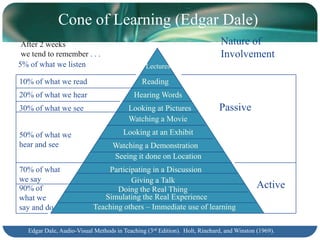
Cone of Learning (Edgar Dale)Nature of InvolvementAfter 2 weekswe tend to remember . . . 5% of what we listenLecturesReading10% of what we readHearing Words20% of what we hearPassiveLooking at Pictures30% of what we seeWatching a MovieLooking at an Exhibit50% of what we hear and seeWatching a DemonstrationSeeing it done on LocationParticipating in a Discussion70% of what we sayGiving a TalkActive90% of what we say and doDoing the Real ThingSimulating the Real ExperienceTeaching others – Immediate use of learningEdgar Dale, Audio-Visual Methods in Teaching (3rd Edition).  Holt, Rinehard, and Winston (1969).
LEARNING WITH A PURPOSE      Learning is an active, not passive, process. You can't sit around and expect professors to pour knowledge into you like water into an empty pitcher. To learn, you have to take an active part in learning by preparing for class actively, by working on assignments and projects, by questioning and responding in class, by synthesizing the materials from several classes. This means your professors are going to expect you to be active participants in your learning if you are going to be successful. The responsibility is largely on you! Taken from: Study Guidelines (Harvard)Theories of First and Second language Acquisition
Why Study Second Language AcquisitionBi- and multi- lingualism is the norm in the world.SLA research informs theory and practice in L2 teaching and learning.SLA serves as a testing ground for theories of language & cognitionTheories of First and Second language Acquisition
What does a theory of SLA have to account for?Process: the learner and learning, and the teacher and teachingas Pit Corder once pondered:Does learning take place because of the teacher or despite the teacher?Setting: naturalistic versus formal, second' versus 'foreign'  languageIndividual differences among learners: age,  aptitude, motivation, anxiety, etc.L1 influenceTheories of First and Second language Acquisition
SLA and Related FieldsLinguistics  Cognitive psychology (psycholinguistics)Language teaching Cross-cultural communication Language planning/language policy	Theories of First and Second language Acquisition
General issues in language learning research (L1 or L2)To what extent is language 'acquired' or 'learned'? What is being acquired?How do we know when and if it is acquired? How do we explain it?Theories of First and Second language Acquisition
Language learning and teachingBrown Claimsthat “secondlanguagelearningis a complex, longtermeffortthatrequiresmuch of thelearner”.In smallgroups of threetofive, share yourownexperiences in learning, orattemptingtolearn a foreignlanguage. Describe yourown a) commitment, b) involvement, c) efforttolearn. Thisdiscussionshould introduce youto a variety of patterns of learning.Theories of First and Second language Acquisition
Language Learning and TeachingWholeclassDiscussionLook at twodefinitionsfromlanguage , onefromanencyclopedia and onefrompinker’sbook. Why are thedifferencesbetweenthesetwodefinitions? Whatassumptionsorbiases do theyreflectonthepart of thelexicographer? How do thosedefinitionsrepresentcondensedtheories?  A language is a system of arbitrary symbols and the rules used to manipulate    them. Language can also refer to the use of such systems as a general phenomenon. Though commonly used as a means of communication among people, human language is only one instance of this phenomenon. Taken from: wikipedia     Language is a complex, specialized skill, which develops in the child spontaneously, without conscious effort or formal instruction, is deployed without awareness of its underlying logic, is qualitatively the same in every individual, and is distinct from more general abilities to process information or behave intelligently.Taken from: Pinker (1994) The language instinctTheories of First and Second language Acquisition
Language Learning and TeachingIndividual workBased on Brown and Ellis’ ideas, write your own definition of language, acquisition, learning and teaching.Theories of First and Second language Acquisition
Key issues and questions for discussionWhatdoes Brown mean, when he claimsthat,Your understanding of the components of language determines to  a  large   extent how you teach a language.
Byusing a cautious, enlightened, eclecticapproach, you can build a theorybasedonprinciples of secondlanguagelearning and teaching.Theories of First and Second language Acquisition
Key issues and questions for discussionConsideringtheproductiverelationshipbetweentheory and practice, think of somespecifictypes of activitiestypical of a foreignlanguageclassyouhavebeen in (choraldrills, translation, readingaloud, etc..) Whatkind of theoreticalassumptionsunderlinetheseactivities? Howmightthesuccess of theactivitypossibly alter thetheorybehindit?
Richards and Rodgers (1986:5) saidthegrammartranslationmethod “is a methodforwhichthereis no theory”. Whydidtheymakethatstatement? Do youagreewiththem? Share in yourgroupanyexperiencesyouhavehadwithgrammar – translation in yourforeignlanguageclasses. Theories of First and Second language Acquisition
Traditional Practice in Grammarinput         intake          developing system           output																		                    	        focused practice“...traditional grammar instruction, which is intended to cause a change in the developing system, is akin to putting the cart before the horse when it comes to acquisition; the learner is asked to produce when the developing system has not yet had a chance to build up a representation of the language based on input data.”Source: Lee & VanPatten (1995), p. 95Theories of First and Second language Acquisition
APPLICATIONGrammarpresentationtechniques    In groups of 2-3 analyzetheoptionsonhowtopresentgrammar (thepresentperfect tense), discusswithotherpairstheadvantages and disadvantages. How do thesetechniquesdifferfromthegrammartranslationmethod?Theories of First and Second language Acquisition
What about grammar?    Guiding principles for Input Processing approach:Use both oraland written input.
Focus on meaningbeforeform.
Link meaning and form.
Presentonething at a time.
Have learners DOsomething with input.
Design activities that require both discrete(one answer) andopen-ended(personal opinion) answers.
Have learners state the ruleas final phase of the lesson. Theories of First and Second language Acquisition
Comparing and contrasting Second Language AcquisitionLook at thepictures. Whatdifferencesthatinfluencelanguagelearning can you imagine betweenthetwolanguagelearningsituations? Think of at leastfiveTheories of First and Second language Acquisition
First Language AcquisitionVideo: Language and cognitionWatchthe video and analyzethefollowingissues:When do babiesstartto “pick up” a Language?When do babies lose orstartto lose soundsthat are not in theirnativelanguage?Towhatextentislanguagedevelopedwhenchildrenturn 5?Whatisthe role of thenaming center in thelanguagepart of thebrain?Accordingto Elizabeth Bates, Howdoeslearningtake place in thebrain?Whatisthe role of cognition  in thelearningprocess?Theories of First and Second language Acquisition
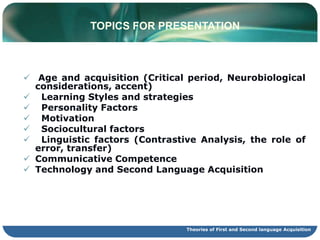
First Language AcquisitionIn groups of 3 prepare a short presentation 10 – 15 minutes onthefollowingtopics:Theories of  first Language Acquisition 1. Behavioristic approach to language acquisition2. TheNativistApproach3. FunctionalApproachesIssues in FirstLanguageAcquisition4. Competence and performance5. Comprehension and Production   - NatureorNurture6. Universals – Systematicity and Variability7. Imitation8. Practice – Input9. DiscourseTheories of First and Second language Acquisition
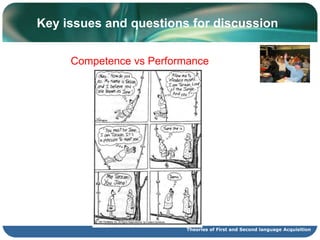
Key issues and questions for discussionCompetence vs Performance Theories of First and Second language Acquisition

Theoriesof Firstand Second Language Session1slideshare

  • 1.
    Theories of Firstand Second Language AcquisitionMAESTRIA EN DIDACTICA DEL INGLESUNIVERSIDAD SURCOLOMBIANA M.A Omar Andres Atehortua A.
  • 2.
    Session 11243Introductory ConceptsGettingto know one another Program Presentation (Objectives – Contents – Evaluation)Discuss how SLA fits into teacher educationTheories of First and Second language Acquisition
  • 3.
    Getting to knowone another . .Who are we professionally? Who are our students? Why are you pursuing a masters' degree? What are your expectations about this seminar?Grab a piece of paper and complete the following statements: I am a person who likes/enjoys …………
  • 4.
    Asa teacher I consider myself very …………………….
  • 5.
    The best thing about teaching is ………
  • 6.
    Ithink pursuing a Masters degree in ELT can help me to..……
  • 7.
    This seminaris important/not important because …………………
  • 8.
    Ifeel………… ……..- I’m looking forward to…………………………………………………Theories of First and Second language Acquisition
  • 9.
    Which of themetaphors expresses best, in your opinion, the essence of a seminar session?If you can’t find one that suits your ideas, invent your own. In small groups, explain which you have chosen and why.
  • 10.
    INTRODUCTIONWatch the videoEducational QuotesChoose 3 or 4 quotes and write them down.Theories of First and Second language Acquisition
  • 11.
    INTRODUCTIONWatch the videoabout Educational QuotesAnalyze the following quotes:Practice makes perfect
  • 12.
    You can’t changethe tides but you can learn to swimTheories of First and Second language Acquisition
  • 13.
    Personal ReviewIn pairs,discussthefollowingquestion: RefertoBrown’sbook page 3Is teaching a craft or a science?Theories of First and Second language Acquisition
  • 14.
    THE SEARCH FORLANGUAGE TEACHING PROFESSIONALS Wallace (1991) states that any occupation aspiring to the title of “profession” will claim at least some of these qualities:A basis of scientific Knowledge.A period of rigorous study which is formally assessed.A sense of public service;High standards of professional conduct;An ability to perform some specified demanding and socially useful tasks in a demonstrably competent manner.Theories of First and Second language Acquisition
  • 15.
    Teachers’ skillsWhy doyou think that teachers (of maths, history, English etc) should have a good knowledge of their subject matter? What kind of knowledge and skills should an English teacher have?How can teachers improve their knowledge?Should teachers pass on all their knowledge to students?Do you think that learning a language means learning grammar rules?Theories of First and Second language Acquisition
  • 16.
    Subject Matter knowledgeBPedagogicalskillsASocial SkillsCDEnabling skills?ETeachers’ Knowledge and SkillsTheories of First and Second language Acquisition
  • 17.
    New Generation ofStudentsTheories of First and Second language Acquisition
  • 18.
    “The information revolutionrequires a matching education revolution”Institute for Learning and Research TechnologyTheories of First and Second language Acquisition
  • 19.
    The craft Modelof Professional EducationStudy with “master” practitioner:DemonstrationinstructionPracticeProfessional CompetenceTheories of First and Second language Acquisition
  • 20.
    The AppliedScience ModelScientific KnowledgeApplication of scientific Knowledge / refinement by experimentationResults conveyed to traineesPeriodic Up-dating (In-service)PracticeProfessional CompetenceTheories of First and Second language Acquisition
  • 21.
    Personal ReviewThink backto some incident or development that happened in class which you had not planned for, e.g.- A disciplinary problem- an unpredicted error made by a student- an unexpected lack of understanding- A decision on your part that you would have to teach the lesson differently from what was planned, etc.1. What was the problem or development, exactly?2. How did you handle it?3. Why did you handle it the way you did?4. Would you handle it in the same way again? If not, why not?5. Has the incident changed your general view of how to go about the practice of teaching? (e.g, you may have decided in general to be more strict, to use group work less, to ask more questions, etc.) Theories of First and Second language Acquisition
  • 22.
    The Reflective Model of Professional EducationReceived KnowledgePracticeReflectionProfessional CompetencePreviousExperiential knowledgeTheories of First and Second language Acquisition
  • 23.
    YOU CANNOT EXPECTDIFFERENT RESULTS IF YOU ALWAYS DO THE SAME.Theories of First and Second language Acquisition
  • 24.
    I hear andI forgetI see and I rememberI do and I Learn AncientChineseProverb& AnEducationalAphorismTheories of First and Second language Acquisition
  • 25.
    Cone of Learning(Edgar Dale)Nature of InvolvementAfter 2 weekswe tend to remember . . . 5% of what we listenLecturesReading10% of what we readHearing Words20% of what we hearPassiveLooking at Pictures30% of what we seeWatching a MovieLooking at an Exhibit50% of what we hear and seeWatching a DemonstrationSeeing it done on LocationParticipating in a Discussion70% of what we sayGiving a TalkActive90% of what we say and doDoing the Real ThingSimulating the Real ExperienceTeaching others – Immediate use of learningEdgar Dale, Audio-Visual Methods in Teaching (3rd Edition). Holt, Rinehard, and Winston (1969).
  • 26.
    LEARNING WITH APURPOSE Learning is an active, not passive, process. You can't sit around and expect professors to pour knowledge into you like water into an empty pitcher. To learn, you have to take an active part in learning by preparing for class actively, by working on assignments and projects, by questioning and responding in class, by synthesizing the materials from several classes. This means your professors are going to expect you to be active participants in your learning if you are going to be successful. The responsibility is largely on you! Taken from: Study Guidelines (Harvard)Theories of First and Second language Acquisition
  • 27.
    Why Study SecondLanguage AcquisitionBi- and multi- lingualism is the norm in the world.SLA research informs theory and practice in L2 teaching and learning.SLA serves as a testing ground for theories of language & cognitionTheories of First and Second language Acquisition
  • 28.
    What does atheory of SLA have to account for?Process: the learner and learning, and the teacher and teachingas Pit Corder once pondered:Does learning take place because of the teacher or despite the teacher?Setting: naturalistic versus formal, second' versus 'foreign' languageIndividual differences among learners: age, aptitude, motivation, anxiety, etc.L1 influenceTheories of First and Second language Acquisition
  • 29.
    SLA and RelatedFieldsLinguistics Cognitive psychology (psycholinguistics)Language teaching Cross-cultural communication Language planning/language policy Theories of First and Second language Acquisition
  • 30.
    General issues inlanguage learning research (L1 or L2)To what extent is language 'acquired' or 'learned'? What is being acquired?How do we know when and if it is acquired? How do we explain it?Theories of First and Second language Acquisition
  • 31.
    Language learning andteachingBrown Claimsthat “secondlanguagelearningis a complex, longtermeffortthatrequiresmuch of thelearner”.In smallgroups of threetofive, share yourownexperiences in learning, orattemptingtolearn a foreignlanguage. Describe yourown a) commitment, b) involvement, c) efforttolearn. Thisdiscussionshould introduce youto a variety of patterns of learning.Theories of First and Second language Acquisition
  • 32.
    Language Learning andTeachingWholeclassDiscussionLook at twodefinitionsfromlanguage , onefromanencyclopedia and onefrompinker’sbook. Why are thedifferencesbetweenthesetwodefinitions? Whatassumptionsorbiases do theyreflectonthepart of thelexicographer? How do thosedefinitionsrepresentcondensedtheories? A language is a system of arbitrary symbols and the rules used to manipulate them. Language can also refer to the use of such systems as a general phenomenon. Though commonly used as a means of communication among people, human language is only one instance of this phenomenon. Taken from: wikipedia Language is a complex, specialized skill, which develops in the child spontaneously, without conscious effort or formal instruction, is deployed without awareness of its underlying logic, is qualitatively the same in every individual, and is distinct from more general abilities to process information or behave intelligently.Taken from: Pinker (1994) The language instinctTheories of First and Second language Acquisition
  • 33.
    Language Learning andTeachingIndividual workBased on Brown and Ellis’ ideas, write your own definition of language, acquisition, learning and teaching.Theories of First and Second language Acquisition
  • 34.
    Key issues andquestions for discussionWhatdoes Brown mean, when he claimsthat,Your understanding of the components of language determines to a large extent how you teach a language.
  • 35.
    Byusing a cautious,enlightened, eclecticapproach, you can build a theorybasedonprinciples of secondlanguagelearning and teaching.Theories of First and Second language Acquisition
  • 36.
    Key issues andquestions for discussionConsideringtheproductiverelationshipbetweentheory and practice, think of somespecifictypes of activitiestypical of a foreignlanguageclassyouhavebeen in (choraldrills, translation, readingaloud, etc..) Whatkind of theoreticalassumptionsunderlinetheseactivities? Howmightthesuccess of theactivitypossibly alter thetheorybehindit?
  • 37.
    Richards and Rodgers(1986:5) saidthegrammartranslationmethod “is a methodforwhichthereis no theory”. Whydidtheymakethatstatement? Do youagreewiththem? Share in yourgroupanyexperiencesyouhavehadwithgrammar – translation in yourforeignlanguageclasses. Theories of First and Second language Acquisition
  • 38.
    Traditional Practice inGrammarinput  intake  developing system  output   focused practice“...traditional grammar instruction, which is intended to cause a change in the developing system, is akin to putting the cart before the horse when it comes to acquisition; the learner is asked to produce when the developing system has not yet had a chance to build up a representation of the language based on input data.”Source: Lee & VanPatten (1995), p. 95Theories of First and Second language Acquisition
  • 39.
    APPLICATIONGrammarpresentationtechniques In groups of 2-3 analyzetheoptionsonhowtopresentgrammar (thepresentperfect tense), discusswithotherpairstheadvantages and disadvantages. How do thesetechniquesdifferfromthegrammartranslationmethod?Theories of First and Second language Acquisition
  • 40.
    What about grammar? Guiding principles for Input Processing approach:Use both oraland written input.
  • 41.
  • 42.
  • 43.
  • 44.
  • 45.
    Design activities thatrequire both discrete(one answer) andopen-ended(personal opinion) answers.
  • 46.
    Have learners statethe ruleas final phase of the lesson. Theories of First and Second language Acquisition
  • 47.
    Comparing and contrastingSecond Language AcquisitionLook at thepictures. Whatdifferencesthatinfluencelanguagelearning can you imagine betweenthetwolanguagelearningsituations? Think of at leastfiveTheories of First and Second language Acquisition
  • 48.
    First Language AcquisitionVideo:Language and cognitionWatchthe video and analyzethefollowingissues:When do babiesstartto “pick up” a Language?When do babies lose orstartto lose soundsthat are not in theirnativelanguage?Towhatextentislanguagedevelopedwhenchildrenturn 5?Whatisthe role of thenaming center in thelanguagepart of thebrain?Accordingto Elizabeth Bates, Howdoeslearningtake place in thebrain?Whatisthe role of cognition in thelearningprocess?Theories of First and Second language Acquisition
  • 49.
    First Language AcquisitionIngroups of 3 prepare a short presentation 10 – 15 minutes onthefollowingtopics:Theories of first Language Acquisition 1. Behavioristic approach to language acquisition2. TheNativistApproach3. FunctionalApproachesIssues in FirstLanguageAcquisition4. Competence and performance5. Comprehension and Production - NatureorNurture6. Universals – Systematicity and Variability7. Imitation8. Practice – Input9. DiscourseTheories of First and Second language Acquisition
  • 50.
    Key issues andquestions for discussionCompetence vs Performance Theories of First and Second language Acquisition