1. First Language Acquisition
2. The Acquisition schedule of Child’s language
3. Patterns in development; Developmental
sequences in First Language acquisition
Instructor: Bibi Halima
Bibi.Halima@uow.edu.pk
1. First Language Acquisition
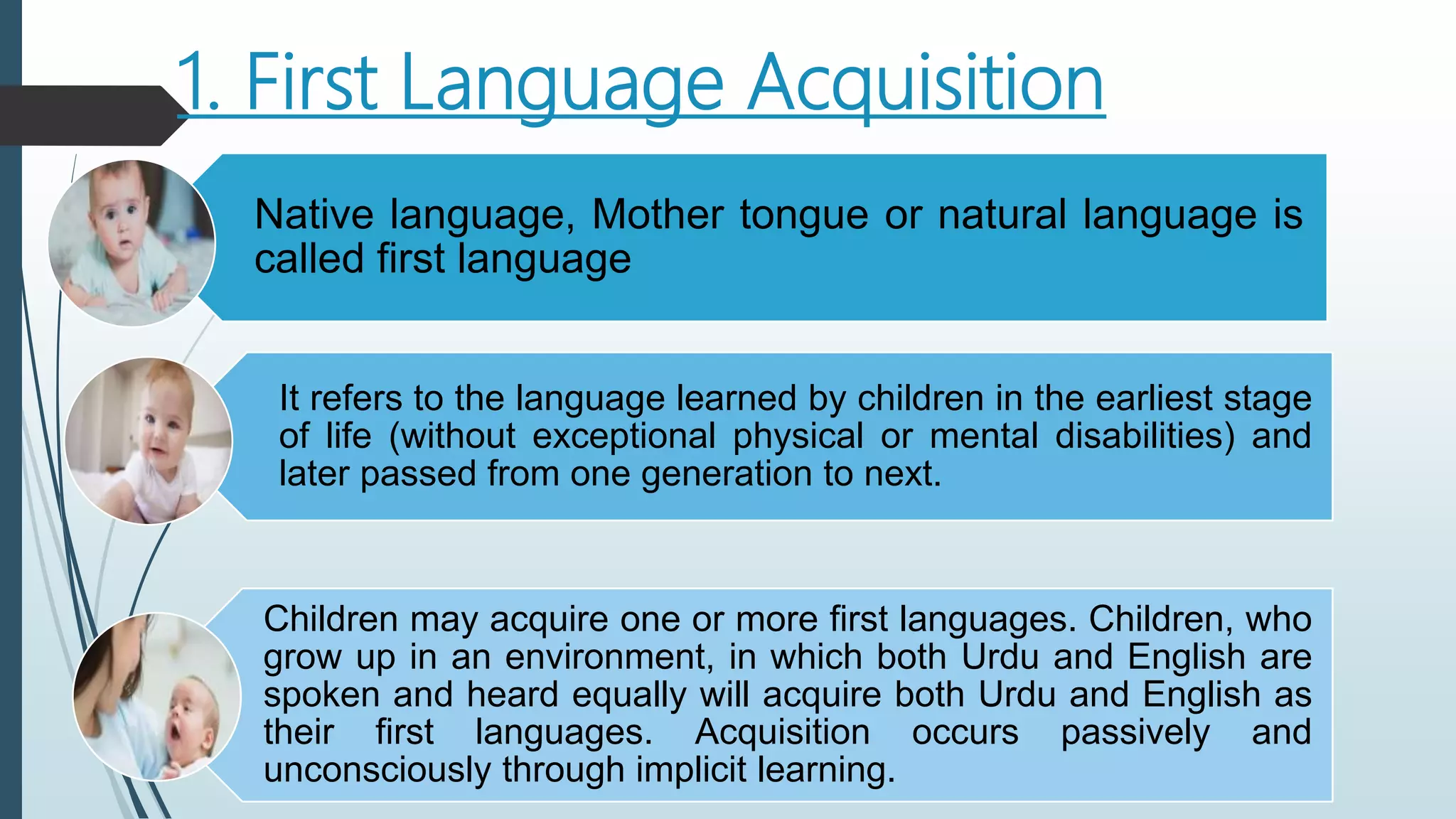
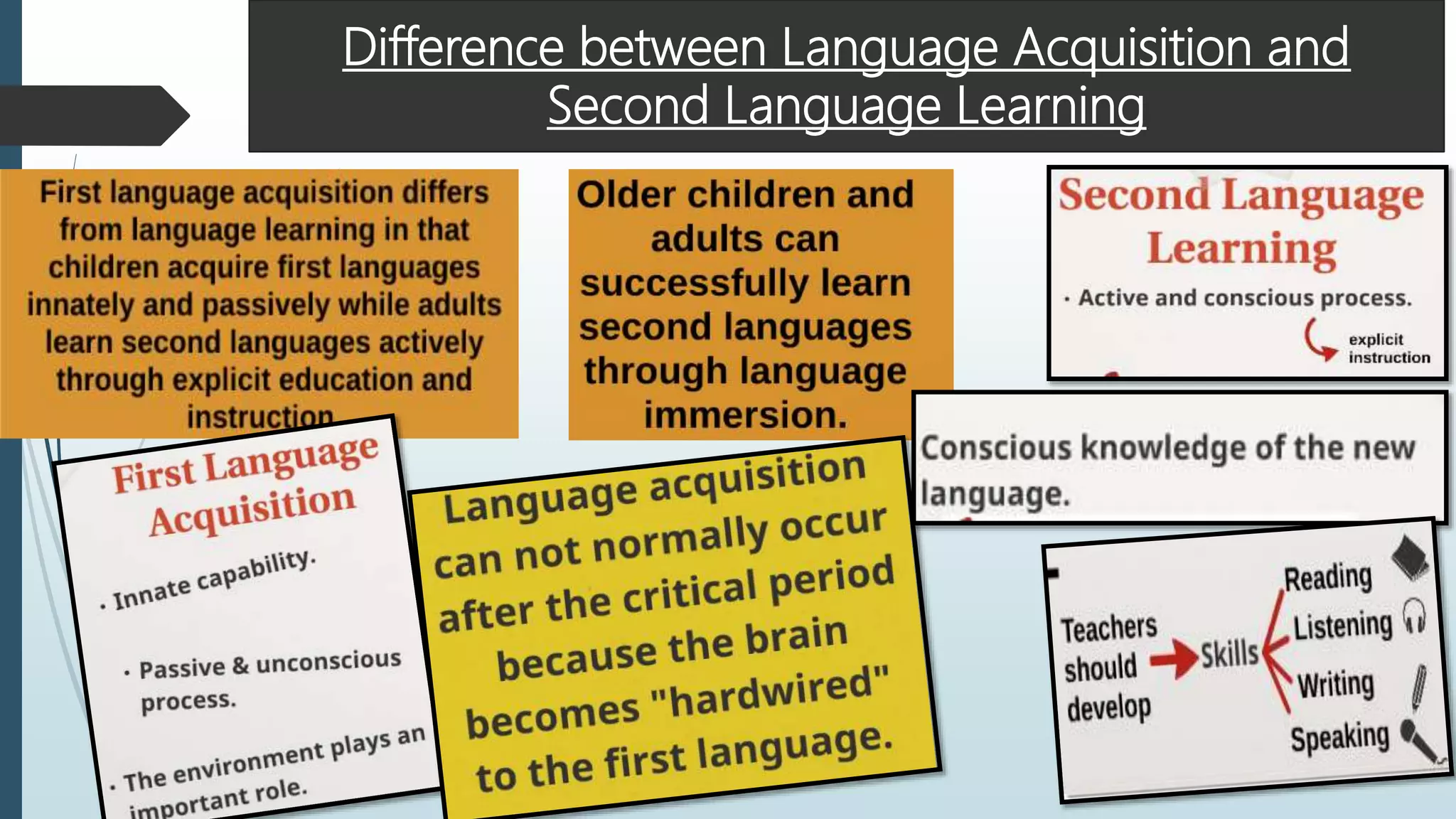
Native language, Mother tongue or natural language is
called first language
It refers to the language learned by children in the earliest stage
of life (without exceptional physical or mental disabilities) and
later passed from one generation to next.
Children may acquire one or more first languages. Children, who
grow up in an environment, in which both Urdu and English are
spoken and heard equally will acquire both Urdu and English as
their first languages. Acquisition occurs passively and
unconsciously through implicit learning.
Difference between Language Acquisition and
Second Language Learning
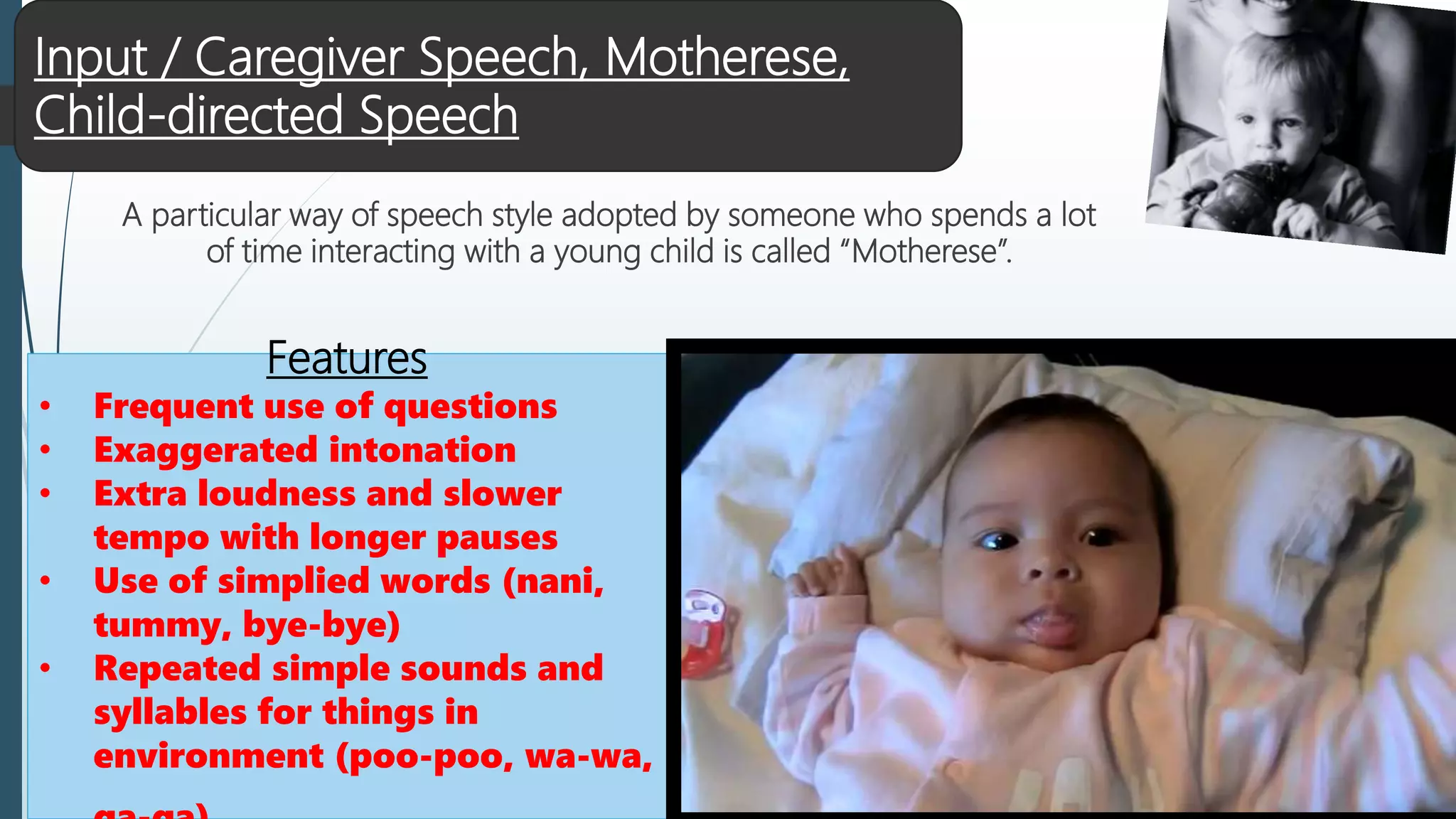
A particular way of speech style adopted by someone who spends a lot
of time interacting with a young child is called “Motherese”.
Input / Caregiver Speech, Motherese,
Child-directed Speech
Features
• Frequent use of questions
• Exaggerated intonation
• Extra loudness and slower
tempo with longer pauses
• Use of simplied words (nani,
tummy, bye-bye)
• Repeated simple sounds and
syllables for things in
environment (poo-poo, wa-wa,
Benefits
Child: want other one spoon, Daddy.
Father: you mean, you want the other spoon.
Child: yes, I want other one spoon, please daddy.
Father: can you say, “the other spoon”?
Child: other……. One……. Spoon..
Father: say “other”
Child: Other
Father: “spoon”
Child: Spoon
Father: “Other spoon”
Child: Other… Spoon… Now give me other one spoon?
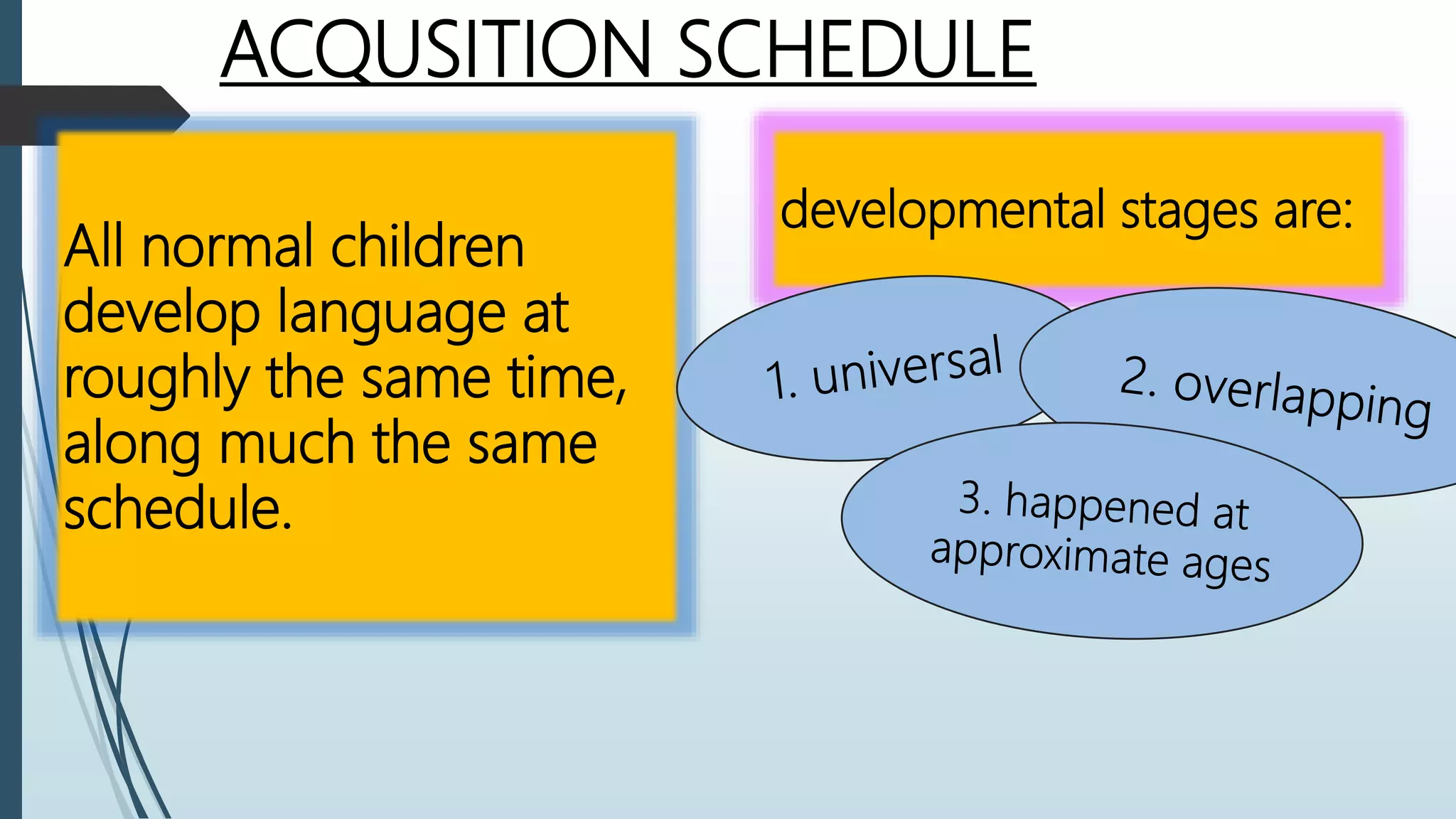
ACQUSITION SCHEDULE
All
All normal children
develop language at
roughly the same time,
along much the same
schedule.
developmental stages are:
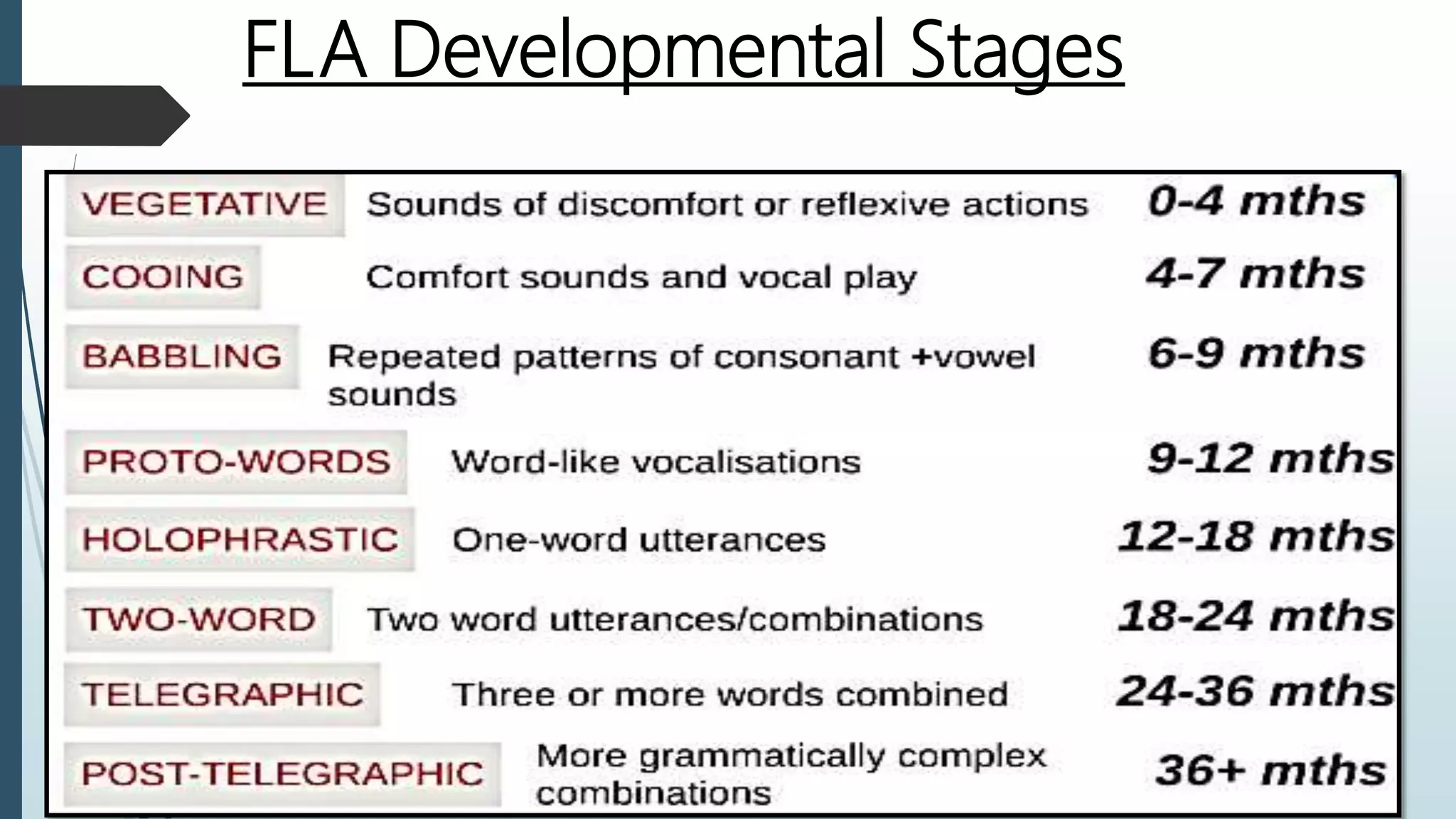
FLA Developmental Stages
Language Learning
begins in the womb.
• By hearing speech patterns and
rhythms in the womb, your baby
is learning her primary language.
• In fact, just hours after a baby is born,
he can distinguish between his native
tongue and the foreign language of
another mother
VEGETATIVE
Sucking Behavior
• The way infants increase or
decrease “Sucking behavior” in
response to speech sounds and
turn heads in the direction of
those sounds.
• Infants show a sense of
recognition or familiarization to
specific language.
Pre-linguistic Stages
1. High vowels similar to [i] and [u]
2. Develop and ability to make a contact
between tongue and soft palat and
hence produces sounds like [k] and
[g]
3. Can make a difference between
vowels [a] and [i], between syllables
like [ga], [ba] and [ka]
• Nasal sounds (ma-ma)
• complex syllables
combinations (ma-da-ga-
ba)
ONE-WORD / HOLOPHRASTIC STAGE
• Between 12 – 18 months, children
begin to use a variety of
recognizable single-unit utterances
for everyday objects like cup, cat,
dog, spoon, milk, cookie.
• They become able to understand
that sounds are related to
meanings and hence produce
“words”
• In this period, they tend to use
simplified versions of words or
syllables like “nany and momi”
The stage is called holophrastic
stage because:
1. Single utterance function as a phrase or
sentence
2. One word is used in multiple settings
and they give different meanings
In this stage, vocabulary moves beyond fifty words and
near the age of 2 years, a child can produce utterances like
“baby chair”, “mommy ear”, “Cat bed”.
The meaning of these utterance varies in different contexts
Two-word stage appears like “MINI-SENTENCES”
Communication in the form of question answer can take
place with the child and he will behave as conversational
partner
TWO-WORD STAGE
TELEGRAPHIC STAGE
By two-and-a-half years old, the child begins producing a large
number of utterances that could be classified as “multiple-word
speech”. A child can put string of words in phrases and
sentences. E.g, the shoe all wet, cat drink milk, daddy go bye
bye.
sentence building capacity gives him a sense of
word order (SVO). Other grammatical inflections also
begin to appear in this stage such as simple use of
prepositions.
The vocabulary expands rapidly, child can initiate a talk with
increased physical activity like running and jumping. By three
years, a child’s vocabulary has grown to hundred of words and
they become to pronounce clearly.
STUDY QUESTIONS?
 What is the difference between cooing and babbling?
 At about what particular age do children typically begin to produce varied
syllable combinations like “ma-ba-da-ga”
 What is meant by holophrastic and which stage is called so and why?
 Can we related cooing stage with BOW-WOW theory?
POST-TELEGRAPHIC
STAGES
It involves:
Picking up standard language forms, idiolects and
dialect
Using more complex tenses and verb forms (inflections,
prefixes, suffixes)
Using egocentric speech (turn-taking, channeling,
pragmatics of conversation)
Hedging, mitigation and other linguistics skills of
“socialization”
As the linguistic repertoire of child increases, he seems to test
and try different constructions whether they work or not.
The post-telegraphic stages clearly hint out that mere imitation is
not responsible for making a child speak a specific language.
Children simply do not produce what adults use rather they can
create their personal expressions for referring towards things in
environment. (e.g, other one spoon)
Children do have “personal constructed linguistic forms” as
described:
Child play is an important factor in the acquisition process. It
refers towards unique combination of sounds and words such as
“I go this way…. Way…baby…baby do dis bib…all
bib….bib….dere….”
CHILD: my teacher holded the baby rabbits and we patted them.
Mother: Did you say your teacher held the baby rabbits?
Child: Yes
Mother: What did you say she did?
Child: She holded the baby rabbits and we patted them
Mother: Did you say she held them tightly?
Child: No, she holded them loosely.
Developing Morphology
By two-and-a-half years old, the child begins understanding the use of word
that why and what is he giving a specific name. he will start incorporating
“Grammatical morphemes” in his use of language that will serve
grammatical purpose. Initially he will learn [-ing] form such as cat sitting, baby
drinking and mommy reading.
The second morphological development deals with the “The
regular plural –s form”. This stage is usually accompanied
by a process of overgeneralization.
The third stage deals with “to be” forms such as are, was, did, went, came.
Children will overgeneralized the past-tense forms of verb too. (goed, doed,
comed). At one stage, usually at the age of four, child will use –ed inflection
with every oddities such as comeded, walkeded, wented etc
OVERGENERALIZATION
In linguistics, overgeneralization is the application of a grammatical rule in
cases where it doesn't apply.
For example:
1. a young child may say "foots" instead of "feet," overgeneralizing the morphological rule
for making plural nouns.
2. “I'm not scared of Dan, Mama, he was nice to me. He gived me drinks of water, and
covered me up with his coat. and when he goed away, he said a prayer at me."
Results of morphological
developmental stage:
1. Variability in the usage of language ( a child may use correct form one
day and odd the next)
2. Children focus on communication rather correction
3. Imitation is the not the primary force in first language acquisition
Developing Syntax
A child does have his personal structure of language too. A child usually starts
developing syntax in three stages)
• First stage occurs between 18 to 26 months
• Second stage occurs between 22 – 30 months
• Third stage occurs between 24 to 40 months
Forming
Questions
Forming
Negatives
Formulation of Questions
In first stage, a child will use two simple ways to ask questions:
1: addition of Wh-form to the beginning of expression (where doggie)
2: uttering of expression with rising intonation (doggie?)
In second stage, little complex structure od questions will be used but wh-form
and rising intonation strategies continue to be used.
Examples: What book name?
See my doggie?
In third stage, the required movement of auxiliary verbs in questions
becomes evident such as (can I have…?). But the problem of using
correct of verb will remain in even in fifth and sixth year of life. (e.g, did I
caught it?)
USE OF NEGATIVES
In first stage, a child will use NO in the very beginning of sentence such as:
no cat, no mama, not my teddy
In second stage, additional negatives except No start appearing such as don’t and cannot.
Moreover, these negatives will be used before verns rather than beginning of sentences.
Examples: I don’t want milk
That no touch
You cannot dance
In third stage, more auxiliary forms will appear such didn’t and won’t while the typical stage one
form disappears. Negatives of second stage continues to be used for long time. Such as:
I didn’t caught it.
He not taking me.
she won’t let me go
Double negatives
Child: nobody don’t like me
Mother: no say, “nobody likes me”
Child: nobody don’t like me.
(eight repetition of the same dialogue)
Mother: No, now listen carefully and say, “nobody likes
me”
Child: Oh! Nobody don’t likes me.
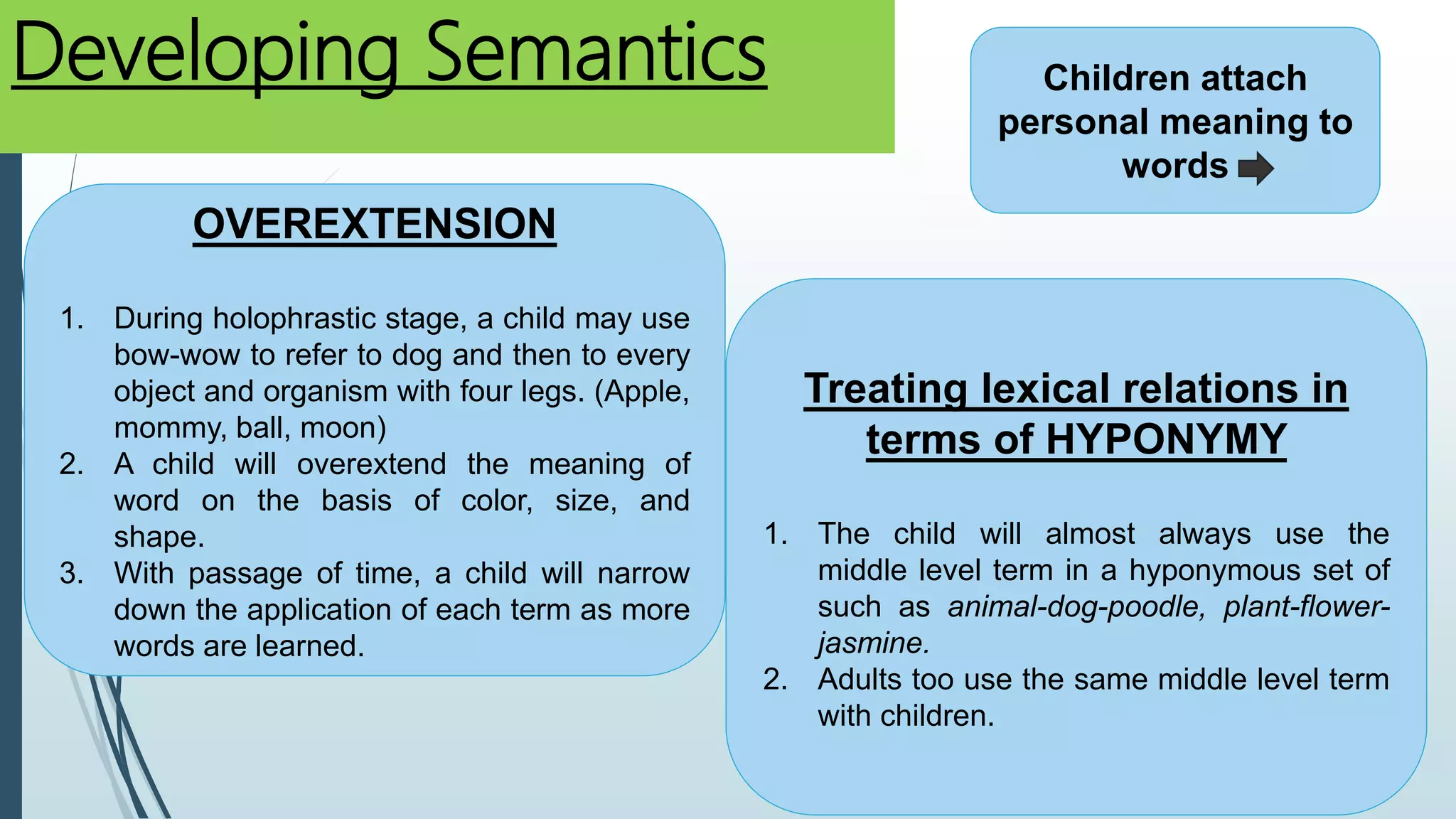
Developing Semantics Children attach
personal meaning to
words
OVEREXTENSION
1. During holophrastic stage, a child may use
bow-wow to refer to dog and then to every
object and organism with four legs. (Apple,
mommy, ball, moon)
2. A child will overextend the meaning of
word on the basis of color, size, and
shape.
3. With passage of time, a child will narrow
down the application of each term as more
words are learned.
Treating lexical relations in
terms of HYPONYMY
1. The child will almost always use the
middle level term in a hyponymous set of
such as animal-dog-poodle, plant-flower-
jasmine.
2. Adults too use the same middle level term
with children.
You may give them your love but not your thoughts,
For they have their own thoughts.
You may house their bodies but not their souls,
For their souls dwell in the house of tomorrow,
which you cannot visit, not even in your dreams.
ANTONYMS
1. Antonymous relationships are acquired
usually late (after the age of five years)
2. Understanding of distinction comes later in
life such as tall/small and before/after etc.
Normally, by the age of five, it
is assumed that child has
completed the greater part of
basic language acquisition
process.
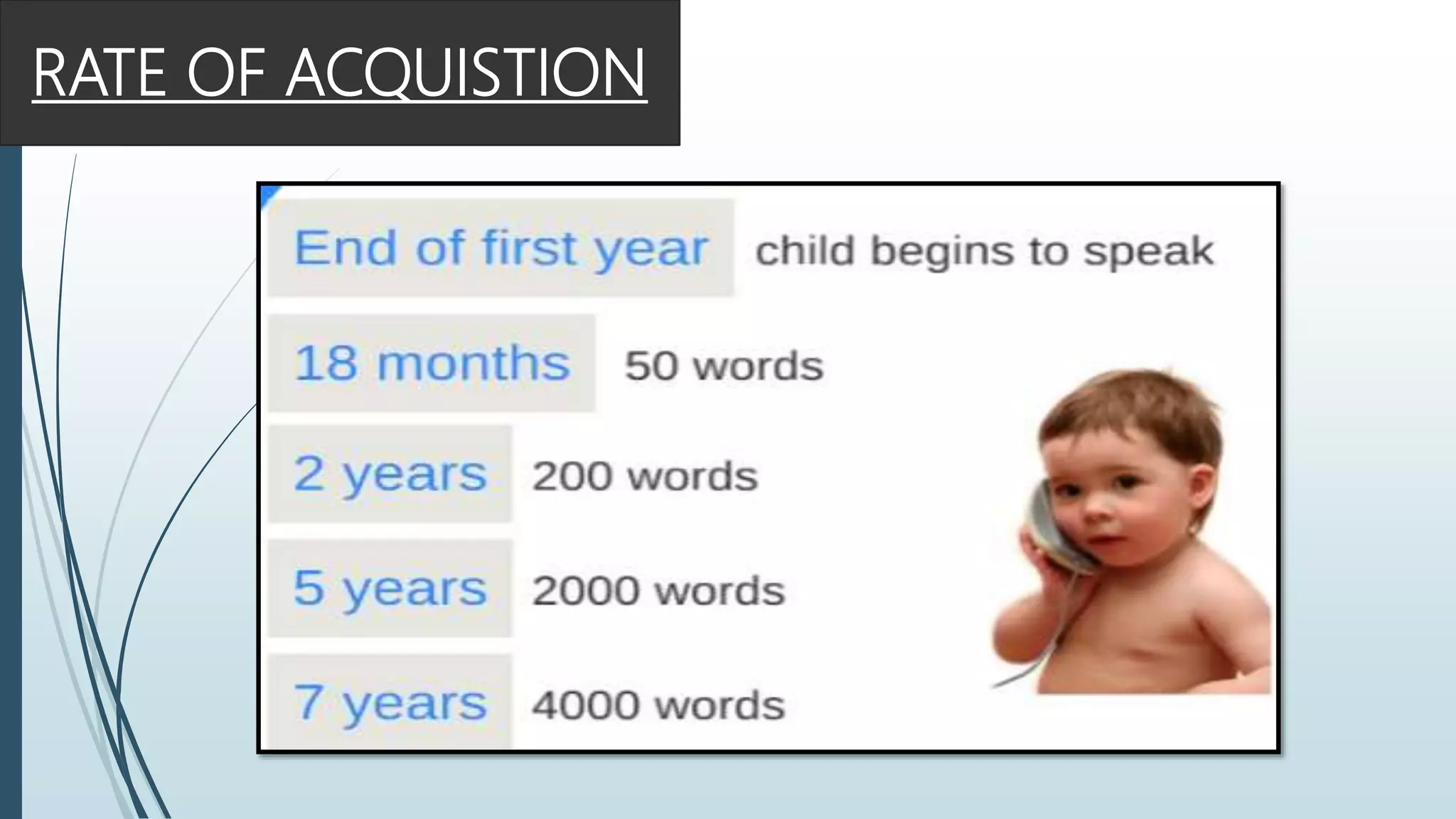
RATE OF ACQUISTION
Issues of First Language Acquisition
WHAT do children learn when they
acquire their first language?
HOW do they learn when they learn? (how
do they determine meaning of words and
how do they produce grammatical
utterance never heard before?
WHY do they learn a language? Do they
learn it because their parents teach it to
them? Are they genetically programmed
to acquire a language?
QUESTIONS

First Language Acquisition Schedule of Children

  • 1.
    1. First LanguageAcquisition 2. The Acquisition schedule of Child’s language 3. Patterns in development; Developmental sequences in First Language acquisition Instructor: Bibi Halima Bibi.Halima@uow.edu.pk
  • 2.
    1. First LanguageAcquisition Native language, Mother tongue or natural language is called first language It refers to the language learned by children in the earliest stage of life (without exceptional physical or mental disabilities) and later passed from one generation to next. Children may acquire one or more first languages. Children, who grow up in an environment, in which both Urdu and English are spoken and heard equally will acquire both Urdu and English as their first languages. Acquisition occurs passively and unconsciously through implicit learning.
  • 3.
    Difference between LanguageAcquisition and Second Language Learning
  • 4.
    A particular wayof speech style adopted by someone who spends a lot of time interacting with a young child is called “Motherese”. Input / Caregiver Speech, Motherese, Child-directed Speech Features • Frequent use of questions • Exaggerated intonation • Extra loudness and slower tempo with longer pauses • Use of simplied words (nani, tummy, bye-bye) • Repeated simple sounds and syllables for things in environment (poo-poo, wa-wa,
  • 5.
  • 6.
    Child: want otherone spoon, Daddy. Father: you mean, you want the other spoon. Child: yes, I want other one spoon, please daddy. Father: can you say, “the other spoon”? Child: other……. One……. Spoon.. Father: say “other” Child: Other Father: “spoon” Child: Spoon Father: “Other spoon” Child: Other… Spoon… Now give me other one spoon?
  • 7.
    ACQUSITION SCHEDULE All All normalchildren develop language at roughly the same time, along much the same schedule. developmental stages are:
  • 8.
  • 9.
    Language Learning begins inthe womb. • By hearing speech patterns and rhythms in the womb, your baby is learning her primary language. • In fact, just hours after a baby is born, he can distinguish between his native tongue and the foreign language of another mother
  • 10.
    VEGETATIVE Sucking Behavior • Theway infants increase or decrease “Sucking behavior” in response to speech sounds and turn heads in the direction of those sounds. • Infants show a sense of recognition or familiarization to specific language.
  • 11.
    Pre-linguistic Stages 1. Highvowels similar to [i] and [u] 2. Develop and ability to make a contact between tongue and soft palat and hence produces sounds like [k] and [g] 3. Can make a difference between vowels [a] and [i], between syllables like [ga], [ba] and [ka]
  • 12.
    • Nasal sounds(ma-ma) • complex syllables combinations (ma-da-ga- ba)
  • 15.
    ONE-WORD / HOLOPHRASTICSTAGE • Between 12 – 18 months, children begin to use a variety of recognizable single-unit utterances for everyday objects like cup, cat, dog, spoon, milk, cookie. • They become able to understand that sounds are related to meanings and hence produce “words” • In this period, they tend to use simplified versions of words or syllables like “nany and momi” The stage is called holophrastic stage because: 1. Single utterance function as a phrase or sentence 2. One word is used in multiple settings and they give different meanings
  • 18.
    In this stage,vocabulary moves beyond fifty words and near the age of 2 years, a child can produce utterances like “baby chair”, “mommy ear”, “Cat bed”. The meaning of these utterance varies in different contexts Two-word stage appears like “MINI-SENTENCES” Communication in the form of question answer can take place with the child and he will behave as conversational partner TWO-WORD STAGE
  • 20.
    TELEGRAPHIC STAGE By two-and-a-halfyears old, the child begins producing a large number of utterances that could be classified as “multiple-word speech”. A child can put string of words in phrases and sentences. E.g, the shoe all wet, cat drink milk, daddy go bye bye. sentence building capacity gives him a sense of word order (SVO). Other grammatical inflections also begin to appear in this stage such as simple use of prepositions. The vocabulary expands rapidly, child can initiate a talk with increased physical activity like running and jumping. By three years, a child’s vocabulary has grown to hundred of words and they become to pronounce clearly.
  • 23.
    STUDY QUESTIONS?  Whatis the difference between cooing and babbling?  At about what particular age do children typically begin to produce varied syllable combinations like “ma-ba-da-ga”  What is meant by holophrastic and which stage is called so and why?  Can we related cooing stage with BOW-WOW theory?
  • 24.
  • 25.
    It involves: Picking upstandard language forms, idiolects and dialect Using more complex tenses and verb forms (inflections, prefixes, suffixes) Using egocentric speech (turn-taking, channeling, pragmatics of conversation) Hedging, mitigation and other linguistics skills of “socialization”
  • 26.
    As the linguisticrepertoire of child increases, he seems to test and try different constructions whether they work or not. The post-telegraphic stages clearly hint out that mere imitation is not responsible for making a child speak a specific language. Children simply do not produce what adults use rather they can create their personal expressions for referring towards things in environment. (e.g, other one spoon) Children do have “personal constructed linguistic forms” as described: Child play is an important factor in the acquisition process. It refers towards unique combination of sounds and words such as “I go this way…. Way…baby…baby do dis bib…all bib….bib….dere….”
  • 27.
    CHILD: my teacherholded the baby rabbits and we patted them. Mother: Did you say your teacher held the baby rabbits? Child: Yes Mother: What did you say she did? Child: She holded the baby rabbits and we patted them Mother: Did you say she held them tightly? Child: No, she holded them loosely.
  • 28.
    Developing Morphology By two-and-a-halfyears old, the child begins understanding the use of word that why and what is he giving a specific name. he will start incorporating “Grammatical morphemes” in his use of language that will serve grammatical purpose. Initially he will learn [-ing] form such as cat sitting, baby drinking and mommy reading. The second morphological development deals with the “The regular plural –s form”. This stage is usually accompanied by a process of overgeneralization. The third stage deals with “to be” forms such as are, was, did, went, came. Children will overgeneralized the past-tense forms of verb too. (goed, doed, comed). At one stage, usually at the age of four, child will use –ed inflection with every oddities such as comeded, walkeded, wented etc
  • 29.
    OVERGENERALIZATION In linguistics, overgeneralizationis the application of a grammatical rule in cases where it doesn't apply. For example: 1. a young child may say "foots" instead of "feet," overgeneralizing the morphological rule for making plural nouns. 2. “I'm not scared of Dan, Mama, he was nice to me. He gived me drinks of water, and covered me up with his coat. and when he goed away, he said a prayer at me."
  • 30.
    Results of morphological developmentalstage: 1. Variability in the usage of language ( a child may use correct form one day and odd the next) 2. Children focus on communication rather correction 3. Imitation is the not the primary force in first language acquisition
  • 31.
    Developing Syntax A childdoes have his personal structure of language too. A child usually starts developing syntax in three stages) • First stage occurs between 18 to 26 months • Second stage occurs between 22 – 30 months • Third stage occurs between 24 to 40 months Forming Questions Forming Negatives
  • 32.
    Formulation of Questions Infirst stage, a child will use two simple ways to ask questions: 1: addition of Wh-form to the beginning of expression (where doggie) 2: uttering of expression with rising intonation (doggie?) In second stage, little complex structure od questions will be used but wh-form and rising intonation strategies continue to be used. Examples: What book name? See my doggie? In third stage, the required movement of auxiliary verbs in questions becomes evident such as (can I have…?). But the problem of using correct of verb will remain in even in fifth and sixth year of life. (e.g, did I caught it?)
  • 33.
    USE OF NEGATIVES Infirst stage, a child will use NO in the very beginning of sentence such as: no cat, no mama, not my teddy In second stage, additional negatives except No start appearing such as don’t and cannot. Moreover, these negatives will be used before verns rather than beginning of sentences. Examples: I don’t want milk That no touch You cannot dance In third stage, more auxiliary forms will appear such didn’t and won’t while the typical stage one form disappears. Negatives of second stage continues to be used for long time. Such as: I didn’t caught it. He not taking me. she won’t let me go
  • 34.
    Double negatives Child: nobodydon’t like me Mother: no say, “nobody likes me” Child: nobody don’t like me. (eight repetition of the same dialogue) Mother: No, now listen carefully and say, “nobody likes me” Child: Oh! Nobody don’t likes me.
  • 35.
    Developing Semantics Childrenattach personal meaning to words OVEREXTENSION 1. During holophrastic stage, a child may use bow-wow to refer to dog and then to every object and organism with four legs. (Apple, mommy, ball, moon) 2. A child will overextend the meaning of word on the basis of color, size, and shape. 3. With passage of time, a child will narrow down the application of each term as more words are learned. Treating lexical relations in terms of HYPONYMY 1. The child will almost always use the middle level term in a hyponymous set of such as animal-dog-poodle, plant-flower- jasmine. 2. Adults too use the same middle level term with children.
  • 36.
    You may givethem your love but not your thoughts, For they have their own thoughts. You may house their bodies but not their souls, For their souls dwell in the house of tomorrow, which you cannot visit, not even in your dreams.
  • 37.
    ANTONYMS 1. Antonymous relationshipsare acquired usually late (after the age of five years) 2. Understanding of distinction comes later in life such as tall/small and before/after etc. Normally, by the age of five, it is assumed that child has completed the greater part of basic language acquisition process.
  • 38.
  • 39.
    Issues of FirstLanguage Acquisition WHAT do children learn when they acquire their first language? HOW do they learn when they learn? (how do they determine meaning of words and how do they produce grammatical utterance never heard before? WHY do they learn a language? Do they learn it because their parents teach it to them? Are they genetically programmed to acquire a language?
  • 40.