Unit 11: Language
Comparison, Error Analysis, and
  Instructional Implications

      By: Caitlin Tramontozzi
           Frank Barbrie
First Language Acquisition
• First Language Acquisition is often referred to
  as the end result of a process of grammar
  – the mental system that allows people to speak
    and understand language
• A mature language user is able to produce and
  understand an unlimited number of novel
  sentences
Do Children Acquire these Skills?
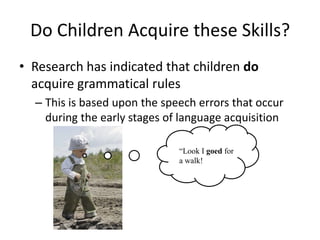
• Research has indicated that children do
  acquire grammatical rules
  – This is based upon the speech errors that occur
    during the early stages of language acquisition

                              “Look I goed for
                              a walk!
Language Acquisition
• Errors such as, doed, goed, and runned, tell us as
  educators that children must formulate a general
  rule that associates all of the past tense with the
  ending ed.
• In order to fully understand language acquisition,
  the researchers must often look to the study of
  phonology, morphology, and syntax for help in
  identifying and describing the grammatical
  system that children acquire during the first few
  years of life.
Methods of Data Collection
• Approaches:
  – Naturalistic approach: investigators observe and
    record children’s spontaneous utterances.
  – CHILDS (Children Language Data Exchange System)
• It is important to understand that data
  collection does not provide all of the answers
  about how the language acquisition process
  unfolds
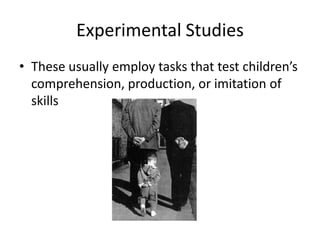
Experimental Studies
• These usually employ tasks that test children’s
  comprehension, production, or imitation of
  skills
Phonological Development
• Children seen to be born with a perceptual
  system that is especially designed for listening
  to speech
• From one month of age, children exhibit the
  ability to distinguish among certain speech
  sounds
• At six months babbling sounds begin
  – This is the beginning of speech development
Developmental Order
• Children begin with babbling
  – This increases until about the age of twelve
    months, here they begin to produce their first
    understandable words
• Once a child has acquired fifty or more words
  they begin to adopt a fairly regular pattern of
  pronunciation
Developmental Order
• Vowels are generally acquired before consonants
  (age 3)
• Stops tend to be acquired before other
  consonants
• Labial are often acquired first, followed by
  alveolar, velars, and alveopalatals
  – Interdentals are acquired last
• New phonemic contrasts manifest themselves
  first in word-initial position.
  – The /p/-/b/ contrast, for example, is manifested in
    pairs such as, pat-bat before mop-mob
Early Phonetic Process
• The ability to perceive the phonemic contrast
  of a language develops well in advance of the
  ability to produce one.
• The special character of the sound patterns in
  children’s early speech lies in the operation of
  a limited number of universal phonetic
  processes
Syllable Deletion
• Syllables bearing the primary or secondary
  stress are more noticeable than unstressed
  counterparts
• They are more salient to children in the early
  stages of language learning
• However, unstressed syllables in the final
  position are retained because the end of
  words are easier to notice and to remeber
Syllable Simplification
• Speech involves the systematic deletion of
  certain sounds in order to simplify syllable
  structure
  – Consonant clusters ae reduced by deleting one or
    more segments
Substitution
• The replacement of one sound by an
  alternative ha the child finds easier to
  articulate
  – Common substitution includes:
     • Stopping: the replacement of a fricative by a
       corresponding stop
     • Fronting: the moving forward of a sound’s place of
       articulation
     • Gliding: the replacement of a liquid by a glide
     • Denasalizing: the replacement of a nasal stop by a non-
       nasal counterpart
Assimilation
• The modification of one or more features of a
  segment under the influence of neighboring
  sounds
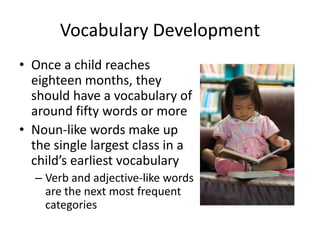
Vocabulary Development
• Once a child reaches
  eighteen months, they
  should have a vocabulary of
  around fifty words or more
• Noun-like words make up
  the single largest class in a
  child’s earliest vocabulary
  – Verb and adjective-like words
    are the next most frequent
    categories
Strategies for Acquiring Word Meaning
• There are three main strategies
  – The Whole Object Assumption: a new word refers
    to a whole object
  – The Type Assumption: a new word refers to a
    type of thing, not just a particular thing
  – The Basic Level Assumption: a new word refers to
    objects that are alike in basic ways
     • Appearance, behavior, etc…)
Meaning Errors
• Overextension and Underextension
  – Two most typical semantic errors
• Over: the child’s word is more general or
  inclusive that that of the corresponding adult
  form
• Under: the use of lexical items in an overly
  restrictive fashion
• Verb Meanings: errors that occur with verbs
  due to syntactic patterns
Morphological Development
• Words produced by English-speaking children
  seem to lack any internal morphological
  structure
  – Affixes are systematically absent and most words
    consist of a single root morpheme
• Overgeneralization: errors that result of the
  overly broad application of a rule
  – Adding (s) to irregular verbs to make them plural
Developmental Sequence
• An important result of child language is the
  development of bound morphemes and
  functional categories that takes place in an
  orderly fashion
• Determining Factors:
   –   Frequency
   –   Syllabicity
   –   Absence of homophony
   –   Few or no exceptions in the way it is used
   –   Allomorphic invariance
   –   Clearly discernible semantic function
Word Formation Process
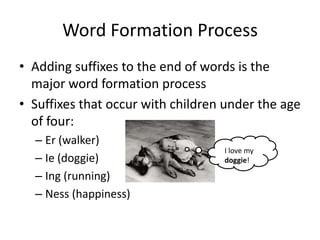
• Adding suffixes to the end of words is the
  major word formation process
• Suffixes that occur with children under the age
  of four:
  – Er (walker)
                                   I love my
  – Ie (doggie)                    doggie!

  – Ing (running)
  – Ness (happiness)
Syntactic Development
• The emergence of syntactic structure takes place
  in an orderly manner and reveals much about the
  nature of the language acquisition process
• One Word Stage: can be used to express the type
  of meaning that is associated with an entire
  sentence in adult speech (holophrases)
  – Using the word “dada” to assert “I see daddy”
• Two Word Stage: “mini sentences”
  – Baby chair (meaning the baby is sitting on the chair)
Later Development
• Children continue to acquire the complex
  grammar that underlies adult linguistic
  competence
• Children signal yes-no questions by means of
  rising intonation alone and auxiliary verbs
  appear in statements in child language
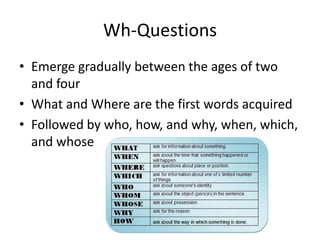
Wh-Questions
• Emerge gradually between the ages of two
  and four
• What and Where are the first words acquired
• Followed by who, how, and why, when, which,
  and whose
Interpretation of Sentence Structure
• Passive: Children are able to associate
  thematic roles with particular structural
  positions at a very early point in the
  acquisition process
• Children find it much harder to interpret
  certain other types of sentences correctly
How is Language Acquisition Possible?
• The relationship between input and
  acquisition is subtler and more complicated
  than one may think
• A connection between of such speech is
  caregiver speech
  – This helps because it is slow, carefully articulated
    speech
     • It is easy for children to learn and pronounce
Cognitive Development
• Language Acquisition is to a large extent
  independent of other types of cognitive
  development
  – A study of individuals whose general cognitive
    development is deficient but whose language is
    highly developed
     • This implies that mental mechanisms responsible for
       acquisition of parts of grammar are relatively
       autonomous
Inborn Knowledge
• Children are born with prior knowledge
• Language they Acquire will belong to a small
  set of syntactic categories combined with
  particular ways to create larger phrases
• Not ever feature of language’s grammar can
  be inborn
  – Vocabulary and morphology must be learned, as
    well as syntax

Unit11mindmap

  • 1.
    Unit 11: Language Comparison,Error Analysis, and Instructional Implications By: Caitlin Tramontozzi Frank Barbrie
  • 2.
    First Language Acquisition •First Language Acquisition is often referred to as the end result of a process of grammar – the mental system that allows people to speak and understand language • A mature language user is able to produce and understand an unlimited number of novel sentences
  • 3.
    Do Children Acquirethese Skills? • Research has indicated that children do acquire grammatical rules – This is based upon the speech errors that occur during the early stages of language acquisition “Look I goed for a walk!
  • 4.
    Language Acquisition • Errorssuch as, doed, goed, and runned, tell us as educators that children must formulate a general rule that associates all of the past tense with the ending ed. • In order to fully understand language acquisition, the researchers must often look to the study of phonology, morphology, and syntax for help in identifying and describing the grammatical system that children acquire during the first few years of life.
  • 5.
    Methods of DataCollection • Approaches: – Naturalistic approach: investigators observe and record children’s spontaneous utterances. – CHILDS (Children Language Data Exchange System) • It is important to understand that data collection does not provide all of the answers about how the language acquisition process unfolds
  • 6.
    Experimental Studies • Theseusually employ tasks that test children’s comprehension, production, or imitation of skills
  • 7.
    Phonological Development • Childrenseen to be born with a perceptual system that is especially designed for listening to speech • From one month of age, children exhibit the ability to distinguish among certain speech sounds • At six months babbling sounds begin – This is the beginning of speech development
  • 8.
    Developmental Order • Childrenbegin with babbling – This increases until about the age of twelve months, here they begin to produce their first understandable words • Once a child has acquired fifty or more words they begin to adopt a fairly regular pattern of pronunciation
  • 9.
    Developmental Order • Vowelsare generally acquired before consonants (age 3) • Stops tend to be acquired before other consonants • Labial are often acquired first, followed by alveolar, velars, and alveopalatals – Interdentals are acquired last • New phonemic contrasts manifest themselves first in word-initial position. – The /p/-/b/ contrast, for example, is manifested in pairs such as, pat-bat before mop-mob
  • 10.
    Early Phonetic Process •The ability to perceive the phonemic contrast of a language develops well in advance of the ability to produce one. • The special character of the sound patterns in children’s early speech lies in the operation of a limited number of universal phonetic processes
  • 11.
    Syllable Deletion • Syllablesbearing the primary or secondary stress are more noticeable than unstressed counterparts • They are more salient to children in the early stages of language learning • However, unstressed syllables in the final position are retained because the end of words are easier to notice and to remeber
  • 12.
    Syllable Simplification • Speechinvolves the systematic deletion of certain sounds in order to simplify syllable structure – Consonant clusters ae reduced by deleting one or more segments
  • 13.
    Substitution • The replacementof one sound by an alternative ha the child finds easier to articulate – Common substitution includes: • Stopping: the replacement of a fricative by a corresponding stop • Fronting: the moving forward of a sound’s place of articulation • Gliding: the replacement of a liquid by a glide • Denasalizing: the replacement of a nasal stop by a non- nasal counterpart
  • 14.
    Assimilation • The modificationof one or more features of a segment under the influence of neighboring sounds
  • 15.
    Vocabulary Development • Oncea child reaches eighteen months, they should have a vocabulary of around fifty words or more • Noun-like words make up the single largest class in a child’s earliest vocabulary – Verb and adjective-like words are the next most frequent categories
  • 16.
    Strategies for AcquiringWord Meaning • There are three main strategies – The Whole Object Assumption: a new word refers to a whole object – The Type Assumption: a new word refers to a type of thing, not just a particular thing – The Basic Level Assumption: a new word refers to objects that are alike in basic ways • Appearance, behavior, etc…)
  • 17.
    Meaning Errors • Overextensionand Underextension – Two most typical semantic errors • Over: the child’s word is more general or inclusive that that of the corresponding adult form • Under: the use of lexical items in an overly restrictive fashion • Verb Meanings: errors that occur with verbs due to syntactic patterns
  • 18.
    Morphological Development • Wordsproduced by English-speaking children seem to lack any internal morphological structure – Affixes are systematically absent and most words consist of a single root morpheme • Overgeneralization: errors that result of the overly broad application of a rule – Adding (s) to irregular verbs to make them plural
  • 19.
    Developmental Sequence • Animportant result of child language is the development of bound morphemes and functional categories that takes place in an orderly fashion • Determining Factors: – Frequency – Syllabicity – Absence of homophony – Few or no exceptions in the way it is used – Allomorphic invariance – Clearly discernible semantic function
  • 20.
    Word Formation Process •Adding suffixes to the end of words is the major word formation process • Suffixes that occur with children under the age of four: – Er (walker) I love my – Ie (doggie) doggie! – Ing (running) – Ness (happiness)
  • 21.
    Syntactic Development • Theemergence of syntactic structure takes place in an orderly manner and reveals much about the nature of the language acquisition process • One Word Stage: can be used to express the type of meaning that is associated with an entire sentence in adult speech (holophrases) – Using the word “dada” to assert “I see daddy” • Two Word Stage: “mini sentences” – Baby chair (meaning the baby is sitting on the chair)
  • 22.
    Later Development • Childrencontinue to acquire the complex grammar that underlies adult linguistic competence • Children signal yes-no questions by means of rising intonation alone and auxiliary verbs appear in statements in child language
  • 23.
    Wh-Questions • Emerge graduallybetween the ages of two and four • What and Where are the first words acquired • Followed by who, how, and why, when, which, and whose
  • 24.
    Interpretation of SentenceStructure • Passive: Children are able to associate thematic roles with particular structural positions at a very early point in the acquisition process • Children find it much harder to interpret certain other types of sentences correctly
  • 25.
    How is LanguageAcquisition Possible? • The relationship between input and acquisition is subtler and more complicated than one may think • A connection between of such speech is caregiver speech – This helps because it is slow, carefully articulated speech • It is easy for children to learn and pronounce
  • 26.
    Cognitive Development • LanguageAcquisition is to a large extent independent of other types of cognitive development – A study of individuals whose general cognitive development is deficient but whose language is highly developed • This implies that mental mechanisms responsible for acquisition of parts of grammar are relatively autonomous
  • 27.
    Inborn Knowledge • Childrenare born with prior knowledge • Language they Acquire will belong to a small set of syntactic categories combined with particular ways to create larger phrases • Not ever feature of language’s grammar can be inborn – Vocabulary and morphology must be learned, as well as syntax