ENTREPRENEURSHIP
Delivered By: Mr. Karthiban
Executive MSc in Project Management , BSc (Hons) in Computing ,
MBCS, BTEC HND in CSD
Entrepreneurship
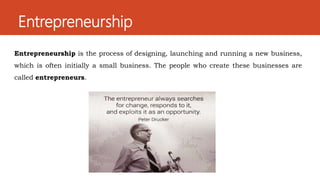
Entrepreneurship is the process of designing, launching and running a new business,
which is often initially a small business. The people who create these businesses are
called entrepreneurs.
Start-ups
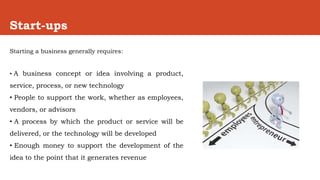
Starting a business generally requires:
• A business concept or idea involving a product,
service, process, or new technology
• People to support the work, whether as employees,
vendors, or advisors
• A process by which the product or service will be
delivered, or the technology will be developed
• Enough money to support the development of the
idea to the point that it generates revenue
How to Start a Business
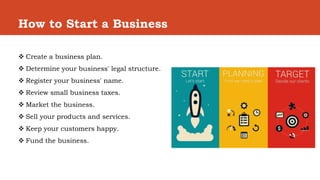
 Create a business plan.
 Determine your business' legal structure.
 Register your business' name.
 Review small business taxes.
 Market the business.
 Sell your products and services.
 Keep your customers happy.
 Fund the business.
Why New Businesses are Started
According to research by Cox Business, the main reasons entrepreneurs go out on
their own, rather than staying employed, are:
•Control – to be their own boss
•Ambition – to start something from scratch themselves
•Financial – opportunity to earn more money
What Kind of Business to Start
Finding a need or opportunity in the market and filling it is at the core of
entrepreneurship and small business success. That doesn’t mean that starting a
business similar to one already in existence can’t be successful, however.
In considering what kind of business to start, assess:
 Your interests
 Your background and experiences
 Your financial resources
 Unmet market needs
 Problems you can solve
 Your network and connections
Characteristics of Entrepreneurship
While there can be as many characteristics of an entrepreneurship as there are people in
this world with opinions, there are some characteristics that are considered indispensable
or necessary in an entrepreneur. These are listed here as follows.
 Ability to take Risks
 Innovation
 Visionary
 Leadership
 Open Minded
 Confident and Well Informed
4 Type of Entrepreneurship
Small Business Entrepreneurship
Scalable Startup Entrepreneurship
Large Company Entrepreneurship
Social Entrepreneurship
Small Business Entrepreneurship
In this day and age, small businesses still make up a
huge chunk of entrepreneurship and startups in the
world. The grocery store, the travel agent, the Salon and
the street food vendor. People would consider these as
small.
These are anyone who runs their own business, most of
which are barely profitable. They usually hire family
members or local employees to run their business with or
for them. Their measure of success are simple such
as being able to pay bills and indulge in small luxuries
like travel
Scalable Startup Entrepreneurship
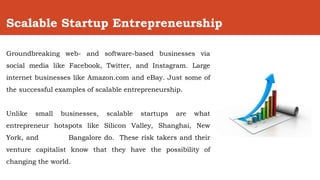
Groundbreaking web- and software-based businesses via
social media like Facebook, Twitter, and Instagram. Large
internet businesses like Amazon.com and eBay. Just some of
the successful examples of scalable entrepreneurship.
Unlike small businesses, scalable startups are what
entrepreneur hotspots like Silicon Valley, Shanghai, New
York, and Bangalore do. These risk takers and their
venture capitalist know that they have the possibility of
changing the world.
Large Company Entrepreneurship
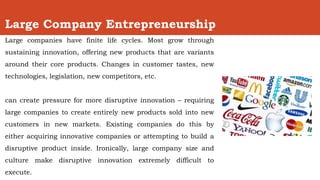
Large companies have finite life cycles. Most grow through
sustaining innovation, offering new products that are variants
around their core products. Changes in customer tastes, new
technologies, legislation, new competitors, etc.
can create pressure for more disruptive innovation – requiring
large companies to create entirely new products sold into new
customers in new markets. Existing companies do this by
either acquiring innovative companies or attempting to build a
disruptive product inside. Ironically, large company size and
culture make disruptive innovation extremely difficult to
execute.
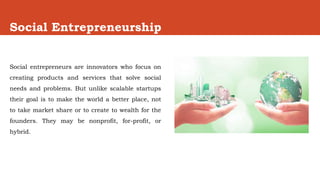
Social Entrepreneurship
Social entrepreneurs are innovators who focus on
creating products and services that solve social
needs and problems. But unlike scalable startups
their goal is to make the world a better place, not
to take market share or to create to wealth for the
founders. They may be nonprofit, for-profit, or
hybrid.
Entrepreneurship
Entrepreneurship

Entrepreneurship

  • 1.
    ENTREPRENEURSHIP Delivered By: Mr.Karthiban Executive MSc in Project Management , BSc (Hons) in Computing , MBCS, BTEC HND in CSD
  • 2.
    Entrepreneurship Entrepreneurship is theprocess of designing, launching and running a new business, which is often initially a small business. The people who create these businesses are called entrepreneurs.
  • 5.
    Start-ups Starting a businessgenerally requires: • A business concept or idea involving a product, service, process, or new technology • People to support the work, whether as employees, vendors, or advisors • A process by which the product or service will be delivered, or the technology will be developed • Enough money to support the development of the idea to the point that it generates revenue
  • 6.
    How to Starta Business  Create a business plan.  Determine your business' legal structure.  Register your business' name.  Review small business taxes.  Market the business.  Sell your products and services.  Keep your customers happy.  Fund the business.
  • 7.
    Why New Businessesare Started According to research by Cox Business, the main reasons entrepreneurs go out on their own, rather than staying employed, are: •Control – to be their own boss •Ambition – to start something from scratch themselves •Financial – opportunity to earn more money
  • 8.
    What Kind ofBusiness to Start Finding a need or opportunity in the market and filling it is at the core of entrepreneurship and small business success. That doesn’t mean that starting a business similar to one already in existence can’t be successful, however. In considering what kind of business to start, assess:  Your interests  Your background and experiences  Your financial resources  Unmet market needs  Problems you can solve  Your network and connections
  • 9.
    Characteristics of Entrepreneurship Whilethere can be as many characteristics of an entrepreneurship as there are people in this world with opinions, there are some characteristics that are considered indispensable or necessary in an entrepreneur. These are listed here as follows.  Ability to take Risks  Innovation  Visionary  Leadership  Open Minded  Confident and Well Informed
  • 10.
    4 Type ofEntrepreneurship Small Business Entrepreneurship Scalable Startup Entrepreneurship Large Company Entrepreneurship Social Entrepreneurship
  • 11.
    Small Business Entrepreneurship Inthis day and age, small businesses still make up a huge chunk of entrepreneurship and startups in the world. The grocery store, the travel agent, the Salon and the street food vendor. People would consider these as small. These are anyone who runs their own business, most of which are barely profitable. They usually hire family members or local employees to run their business with or for them. Their measure of success are simple such as being able to pay bills and indulge in small luxuries like travel
  • 12.
    Scalable Startup Entrepreneurship Groundbreakingweb- and software-based businesses via social media like Facebook, Twitter, and Instagram. Large internet businesses like Amazon.com and eBay. Just some of the successful examples of scalable entrepreneurship. Unlike small businesses, scalable startups are what entrepreneur hotspots like Silicon Valley, Shanghai, New York, and Bangalore do. These risk takers and their venture capitalist know that they have the possibility of changing the world.
  • 13.
    Large Company Entrepreneurship Largecompanies have finite life cycles. Most grow through sustaining innovation, offering new products that are variants around their core products. Changes in customer tastes, new technologies, legislation, new competitors, etc. can create pressure for more disruptive innovation – requiring large companies to create entirely new products sold into new customers in new markets. Existing companies do this by either acquiring innovative companies or attempting to build a disruptive product inside. Ironically, large company size and culture make disruptive innovation extremely difficult to execute.
  • 14.
    Social Entrepreneurship Social entrepreneursare innovators who focus on creating products and services that solve social needs and problems. But unlike scalable startups their goal is to make the world a better place, not to take market share or to create to wealth for the founders. They may be nonprofit, for-profit, or hybrid.