WHAT IS
COMPUTER?
A computer is a machine that can be instructed to carry out
sequences of arithmetic or logical operations automatically
via computer programming. Modern computers have the
ability to follow generalized sets of operations, called
programs. These programs enable computers to perform an
extremely wide range of tasks.
• Computer is used in various fields of life.
• Computer has made everything possible which seems to be
impossible in past.
• Computer has changed our living standards and views.
• Earlier, computer was used at government level but now it
is accessible to everyone.
ABACUS (Artitecture and
Building Aids Computer Unit):
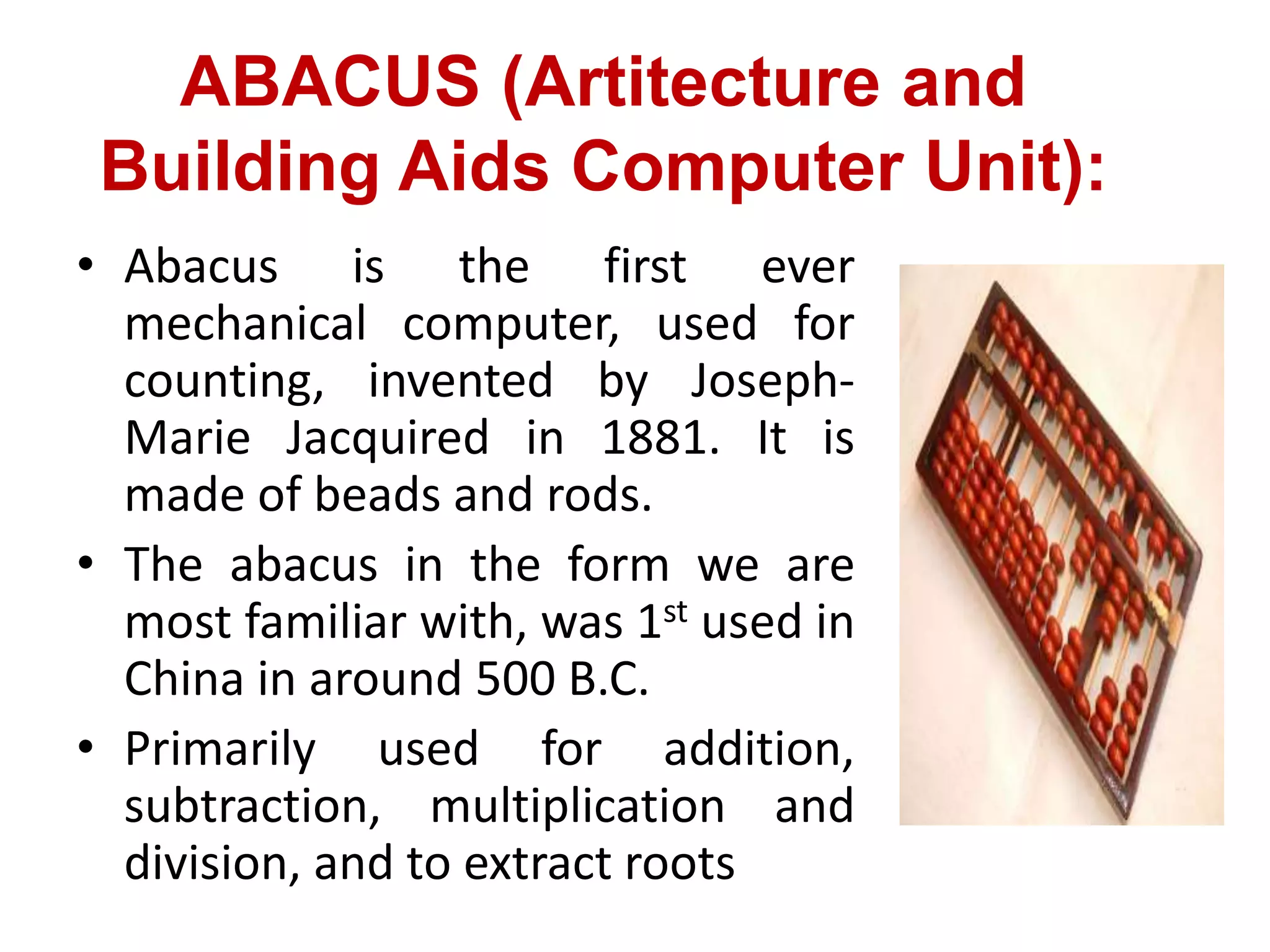
• Abacus is the first ever
mechanical computer, used for
counting, invented by Joseph-
Marie Jacquired in 1881. It is
made of beads and rods.
• The abacus in the form we are
most familiar with, was 1st used in
China in around 500 B.C.
• Primarily used for addition,
subtraction, multiplication and
division, and to extract roots.
NAPIER’S BONES:
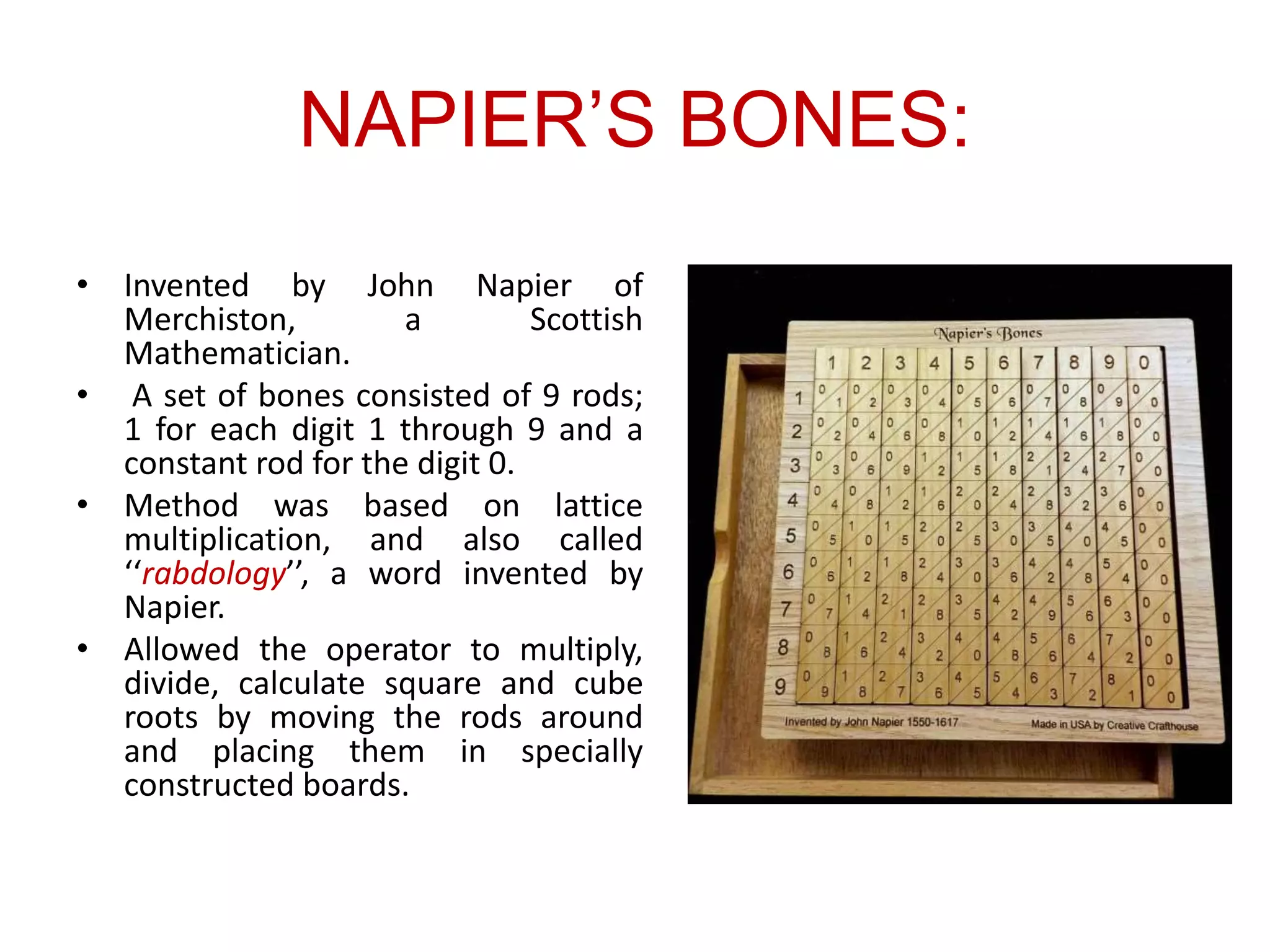
• Invented by John Napier of
Merchiston, a Scottish
Mathematician.
• A set of bones consisted of 9 rods;
1 for each digit 1 through 9 and a
constant rod for the digit 0.
• Method was based on lattice
multiplication, and also called
‘‘rabdology’’, a word invented by
Napier.
• Allowed the operator to multiply,
divide, calculate square and cube
roots by moving the rods around
and placing them in specially
constructed boards.
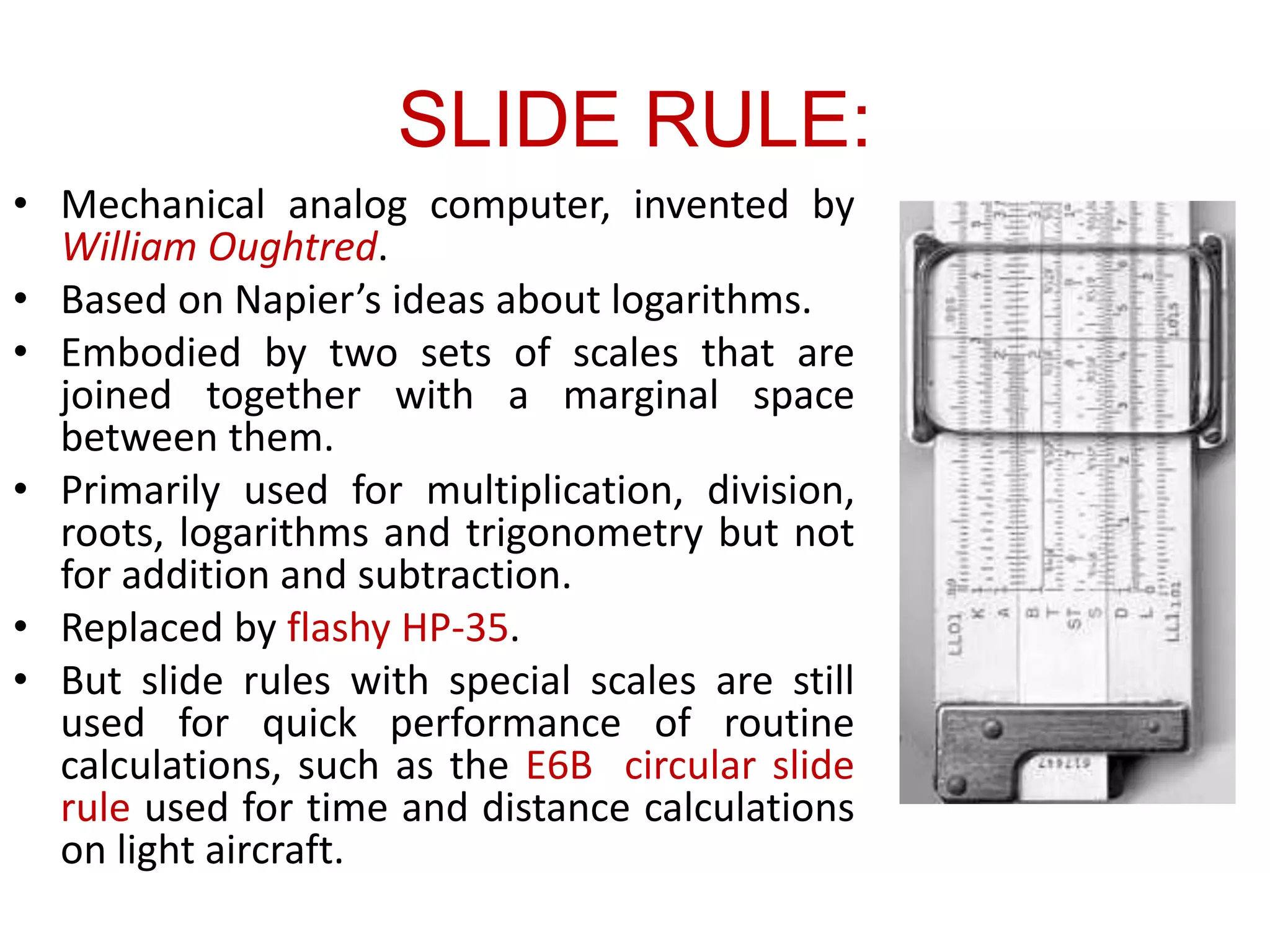
SLIDE RULE:
• Mechanical analog computer, invented by
William Oughtred.
• Based on Napier’s ideas about logarithms.
• Embodied by two sets of scales that are
joined together with a marginal space
between them.
• Primarily used for multiplication, division,
roots, logarithms and trigonometry but not
for addition and subtraction.
• Replaced by flashy HP-35.
• But slide rules with special scales are still
used for quick performance of routine
calculations, such as the E6B circular slide
rule used for time and distance calculations
on light aircraft.
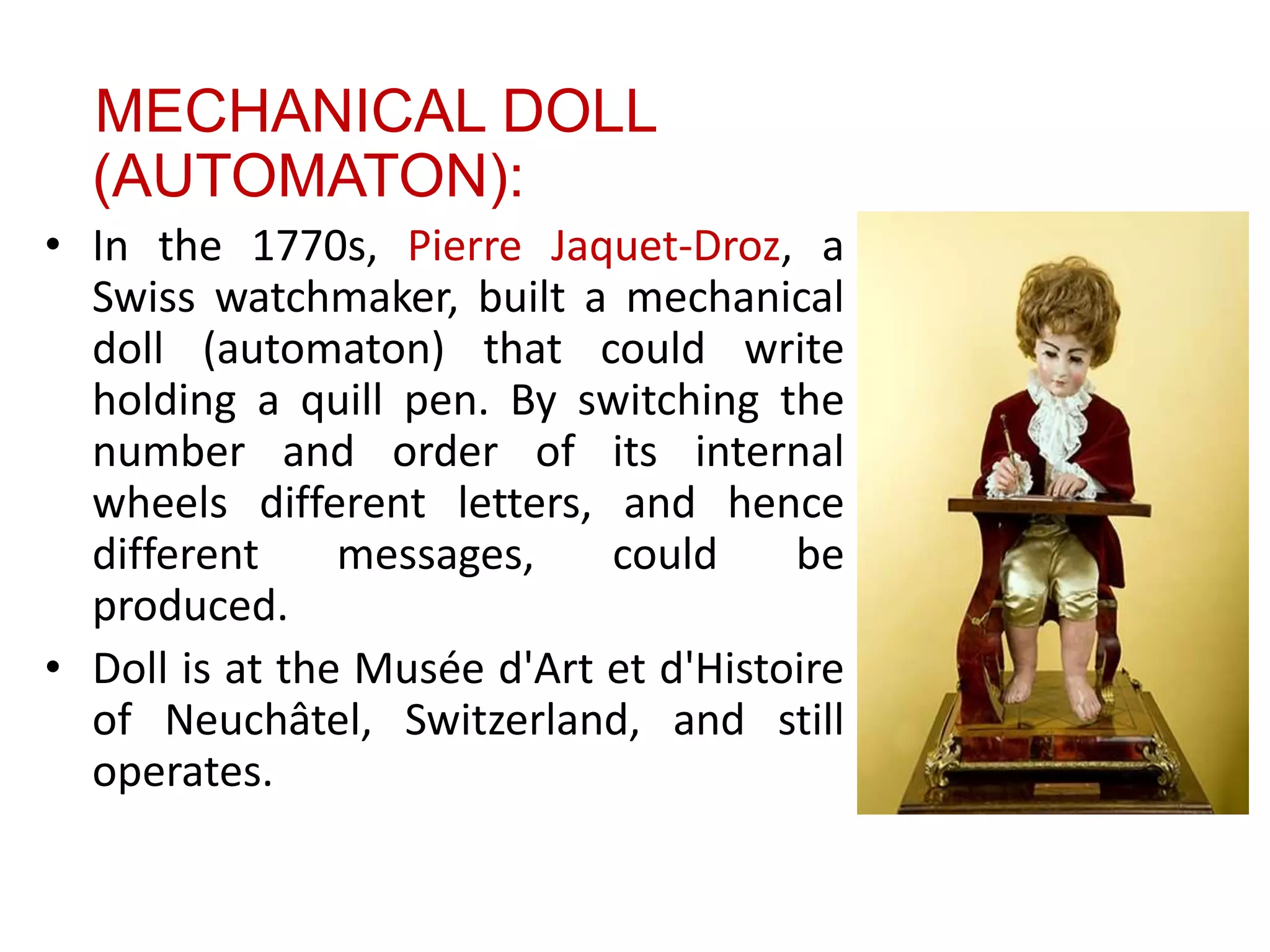
MECHANICAL DOLL
(AUTOMATON):
• In the 1770s, Pierre Jaquet-Droz, a
Swiss watchmaker, built a mechanical
doll (automaton) that could write
holding a quill pen. By switching the
number and order of its internal
wheels different letters, and hence
different messages, could be
produced.
• Doll is at the Musée d'Art et d'Histoire
of Neuchâtel, Switzerland, and still
operates.
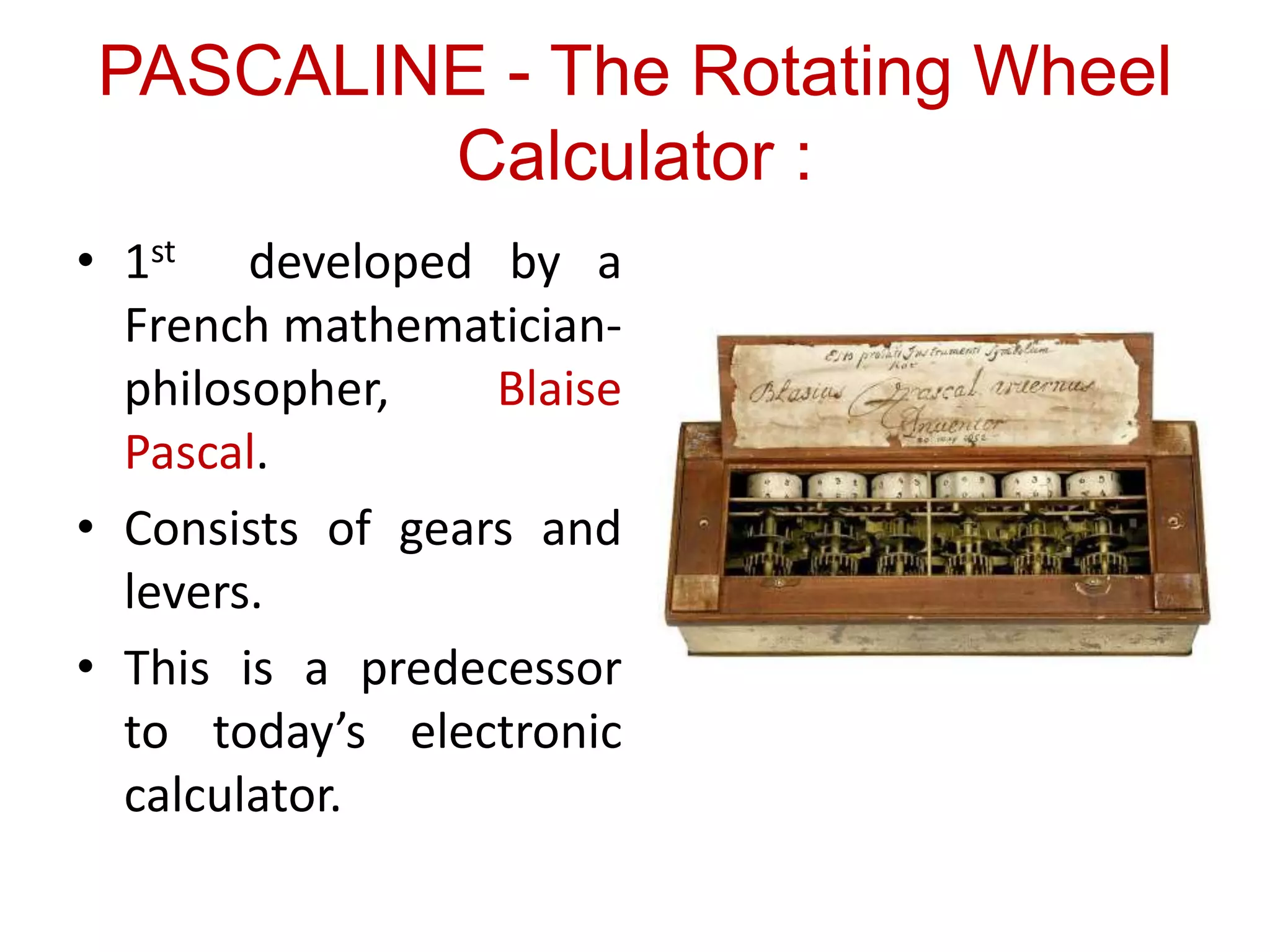
PASCALINE - The Rotating Wheel
Calculator :
• 1st developed by a
French mathematician-
philosopher, Blaise
Pascal.
• Consists of gears and
levers.
• This is a predecessor
to today’s electronic
calculator.
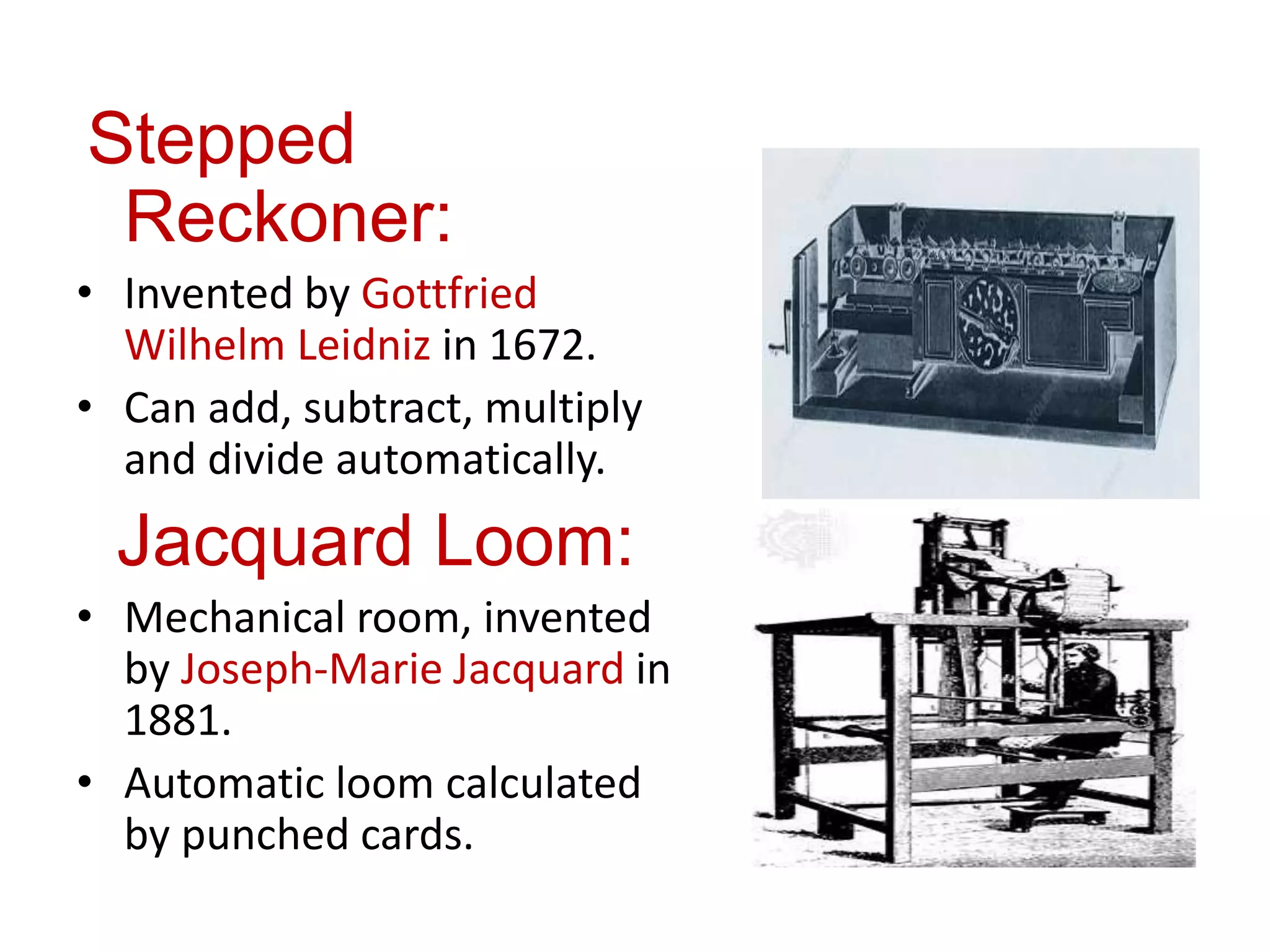
Stepped
Reckoner:
• Invented by Gottfried
Wilhelm Leidniz in 1672.
• Can add, subtract, multiply
and divide automatically.
Jacquard Loom:
• Mechanical room, invented
by Joseph-Marie Jacquard in
1881.
• Automatic loom calculated
by punched cards.
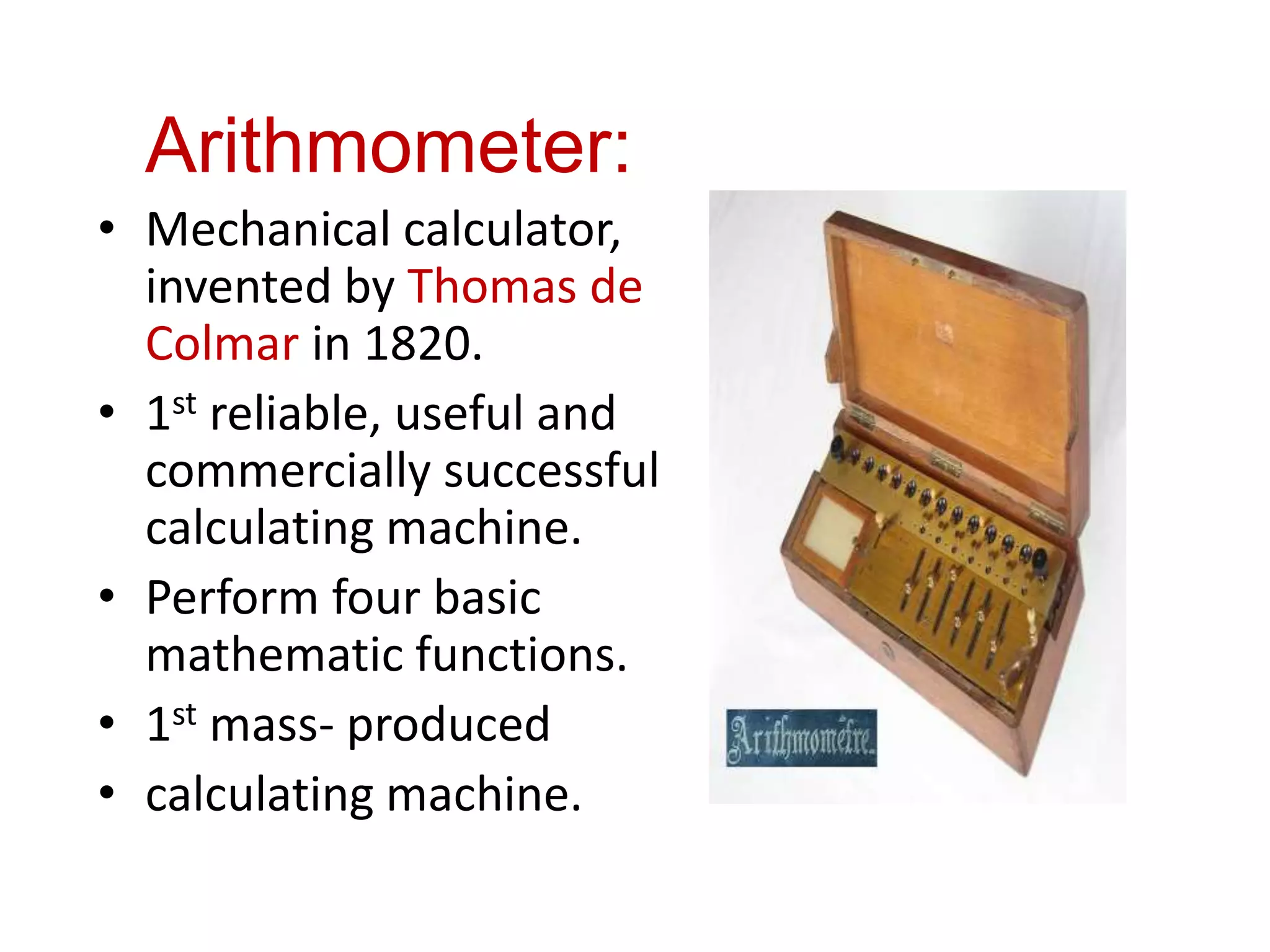
Arithmometer:
• Mechanical calculator,
invented by Thomas de
Colmar in 1820.
• 1st reliable, useful and
commercially successful
calculating machine.
• Perform four basic
mathematic functions.
• 1st mass- produced
• calculating machine.
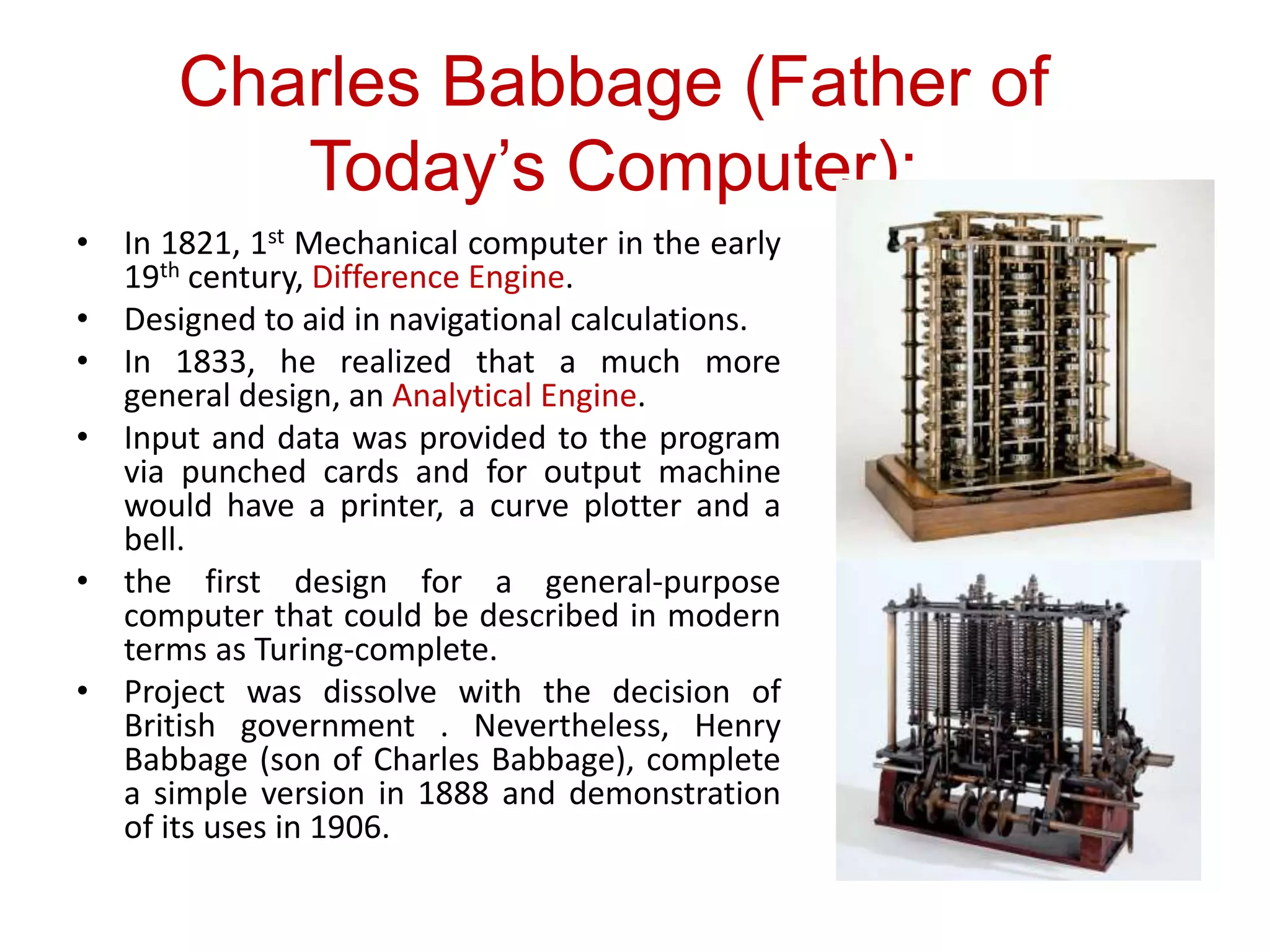
• In 1821, 1st Mechanical computer in the early
19th century, Difference Engine.
• Designed to aid in navigational calculations.
• In 1833, he realized that a much more
general design, an Analytical Engine.
• Input and data was provided to the program
via punched cards and for output machine
would have a printer, a curve plotter and a
bell.
• the first design for a general-purpose
computer that could be described in modern
terms as Turing-complete.
• Project was dissolve with the decision of
British government . Nevertheless, Henry
Babbage (son of Charles Babbage), complete
a simple version in 1888 and demonstration
of its uses in 1906.
Charles Babbage (Father of
Today’s Computer):
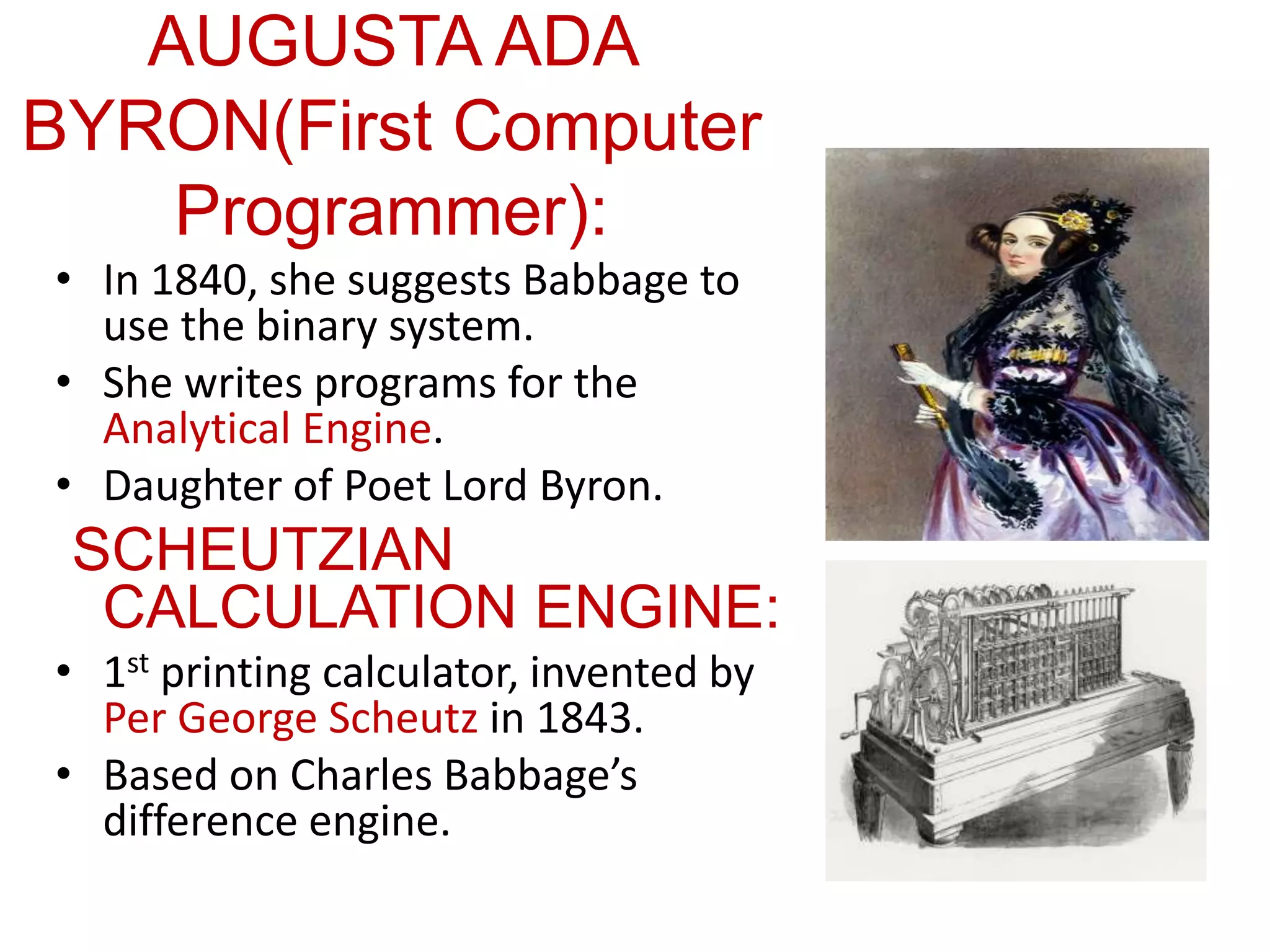
AUGUSTA ADA
BYRON(First Computer
Programmer):
• In 1840, she suggests Babbage to
use the binary system.
• She writes programs for the
Analytical Engine.
• Daughter of Poet Lord Byron.
SCHEUTZIAN
CALCULATION ENGINE:
• 1st printing calculator, invented by
Per George Scheutz in 1843.
• Based on Charles Babbage’s
difference engine.
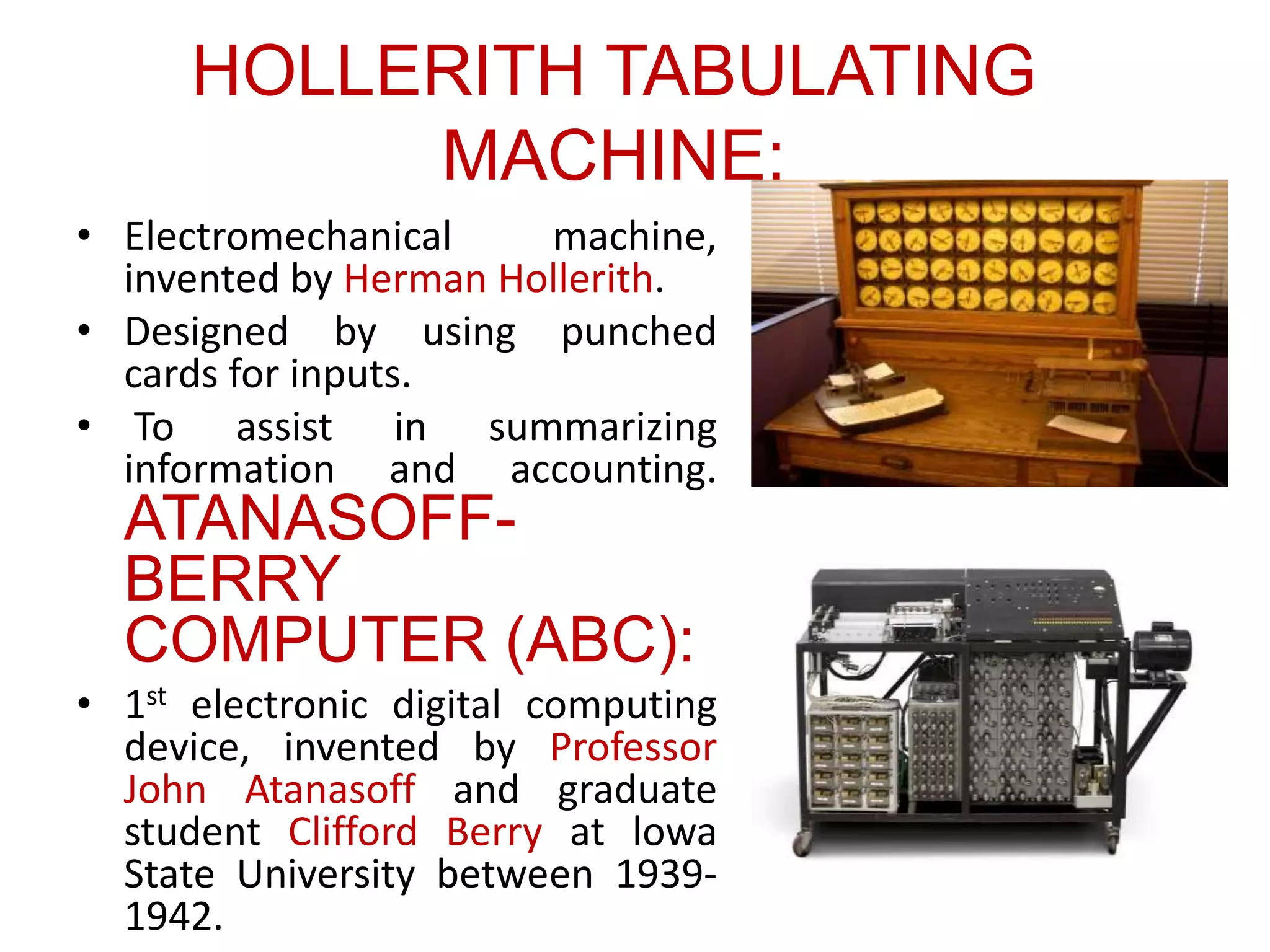
HOLLERITH TABULATING
MACHINE:
• Electromechanical machine,
invented by Herman Hollerith.
• Designed by using punched
cards for inputs.
• To assist in summarizing
information and accounting.
ATANASOFF-
BERRY
COMPUTER (ABC):
• 1st electronic digital computing
device, invented by Professor
John Atanasoff and graduate
student Clifford Berry at lowa
State University between 1939-
1942.
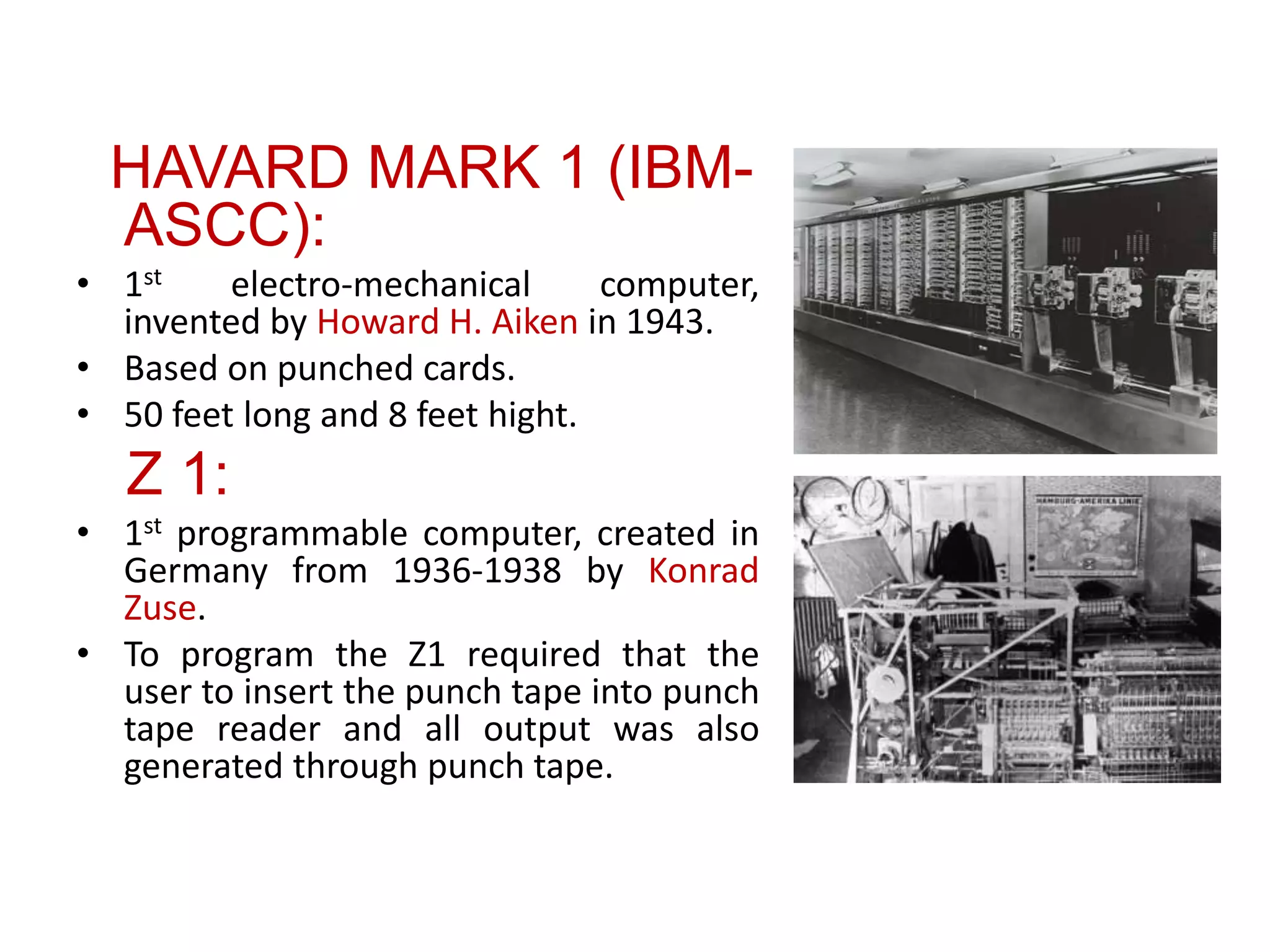
HAVARD MARK 1 (IBM-
ASCC):
• 1st electro-mechanical computer,
invented by Howard H. Aiken in 1943.
• Based on punched cards.
• 50 feet long and 8 feet hight.
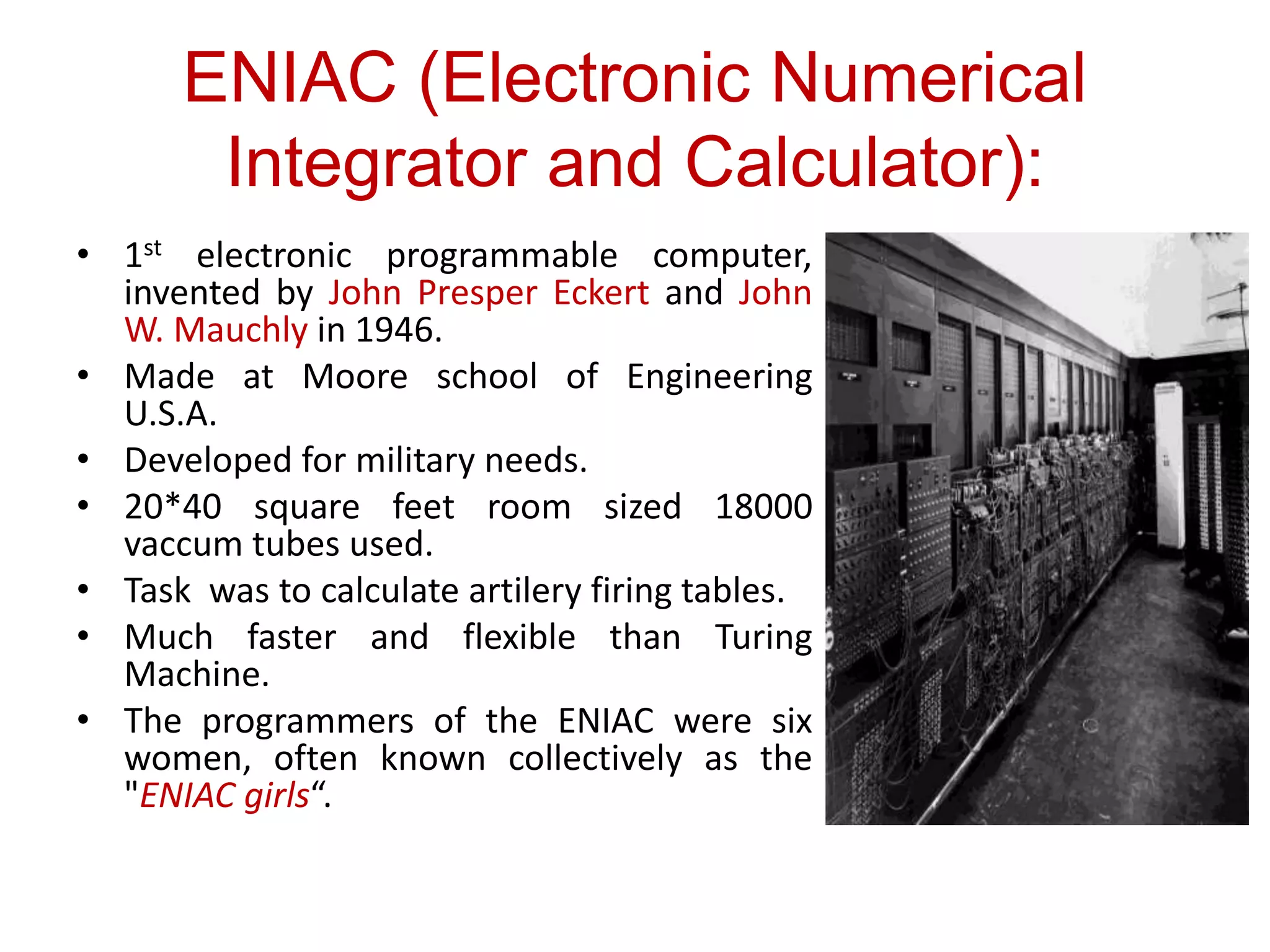
Z 1:
• 1st programmable computer, created in
Germany from 1936-1938 by Konrad
Zuse.
• To program the Z1 required that the
user to insert the punch tape into punch
tape reader and all output was also
generated through punch tape.
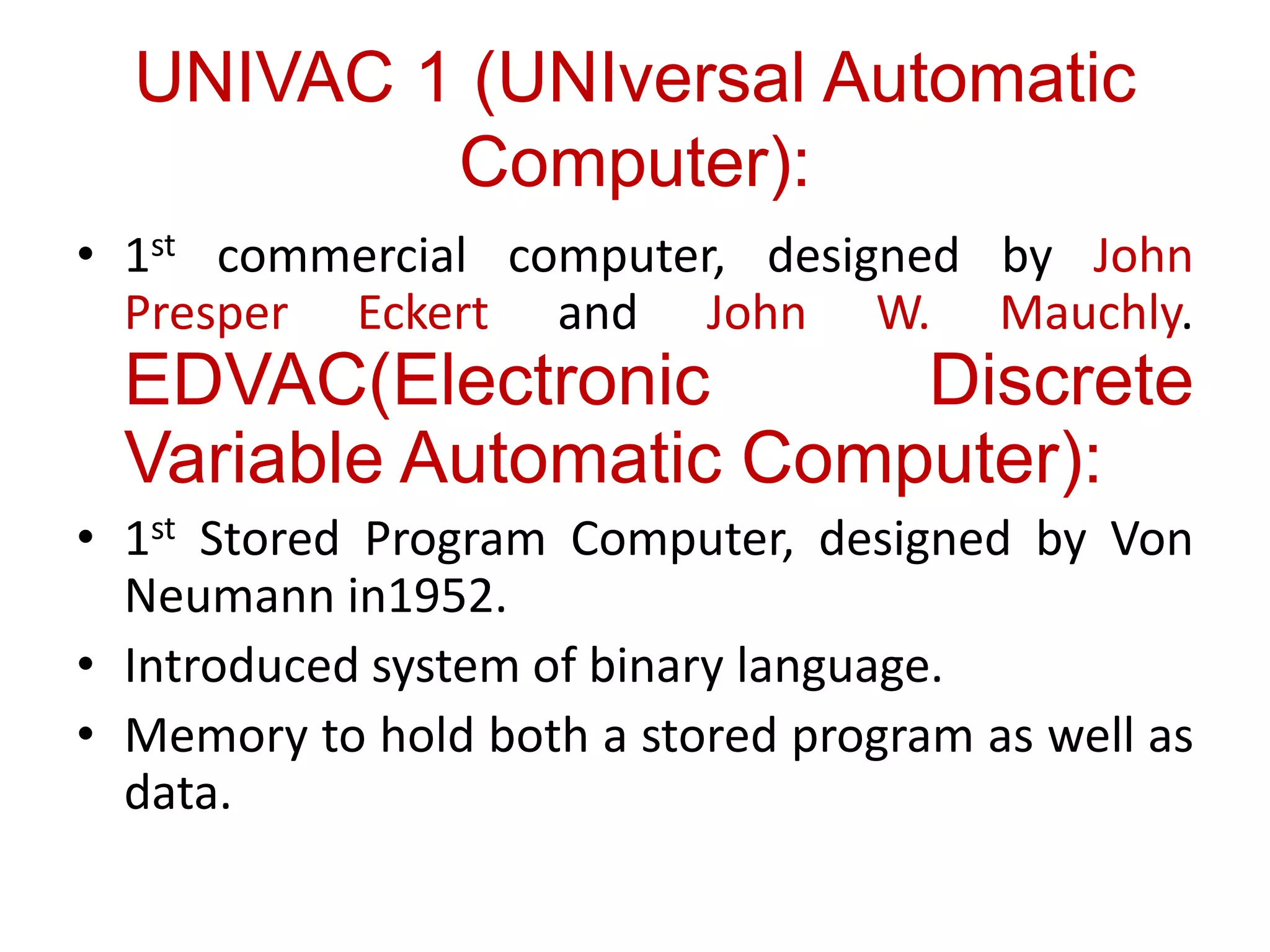
ENIAC (Electronic Numerical
Integrator and Calculator):
• 1st electronic programmable computer,
invented by John Presper Eckert and John
W. Mauchly in 1946.
• Made at Moore school of Engineering
U.S.A.
• Developed for military needs.
• 20*40 square feet room sized 18000
vaccum tubes used.
• Task was to calculate artilery firing tables.
• Much faster and flexible than Turing
Machine.
• The programmers of the ENIAC were six
women, often known collectively as the
"ENIAC girls“.
UNIVAC 1 (UNIversal Automatic
Computer):
• 1st commercial computer, designed by John
Presper Eckert and John W. Mauchly.
EDVAC(Electronic Discrete
Variable Automatic Computer):
• 1st Stored Program Computer, designed by Von
Neumann in1952.
• Introduced system of binary language.
• Memory to hold both a stored program as well as
data.
FIRST PORTABLE
COMPUTER:
• Osborne 1 : Released in 1981 by Osborne
Computer Corporation.
FIRST COMPUTER COMPANY
:
• Electronic Controls Company, invented by John
Presper Eckert and John W. Mauchly in 1949.
EDSAC (Electronic Delay
Storage Automatic Calculator):
• Invented by British Government.
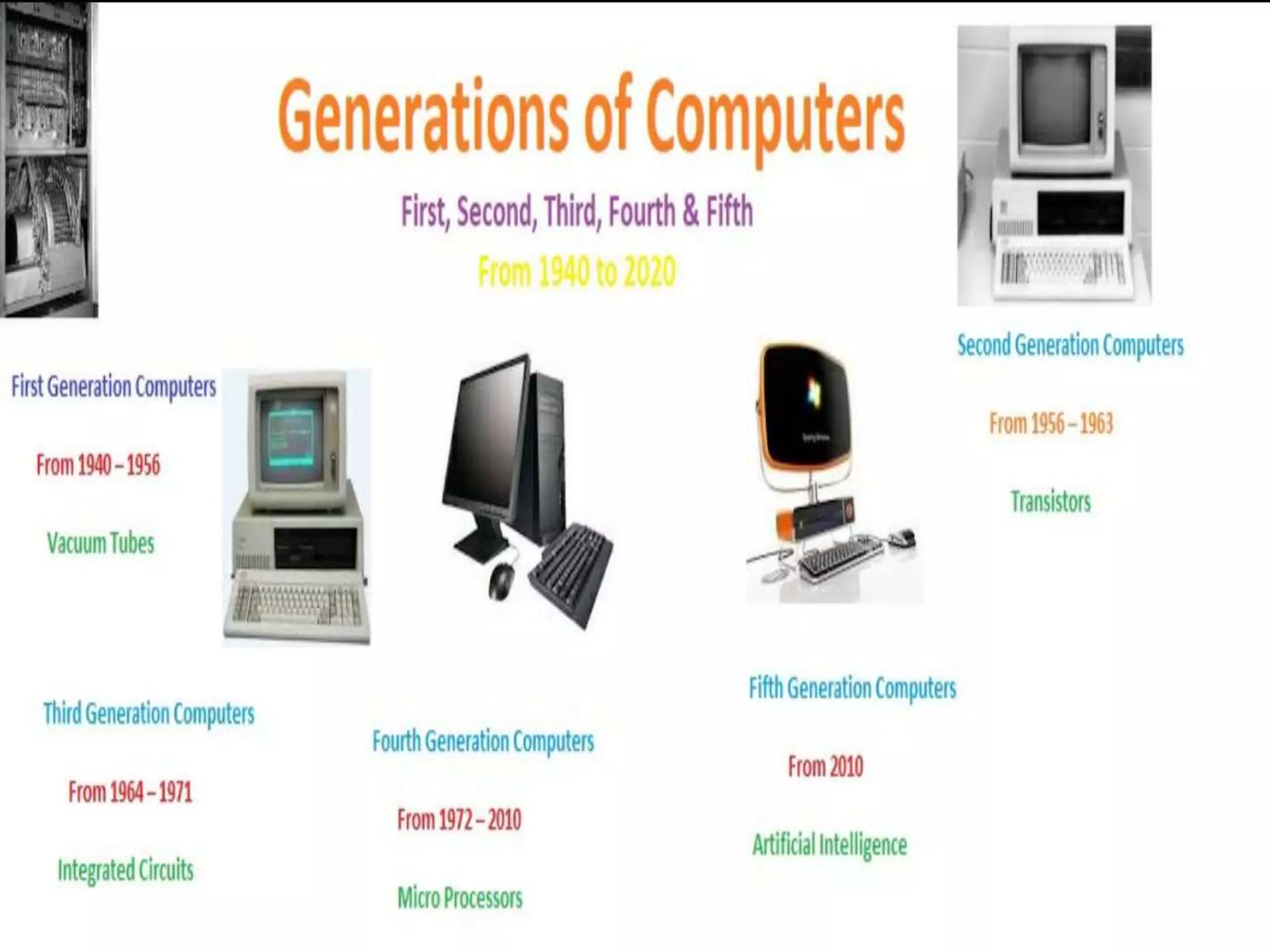
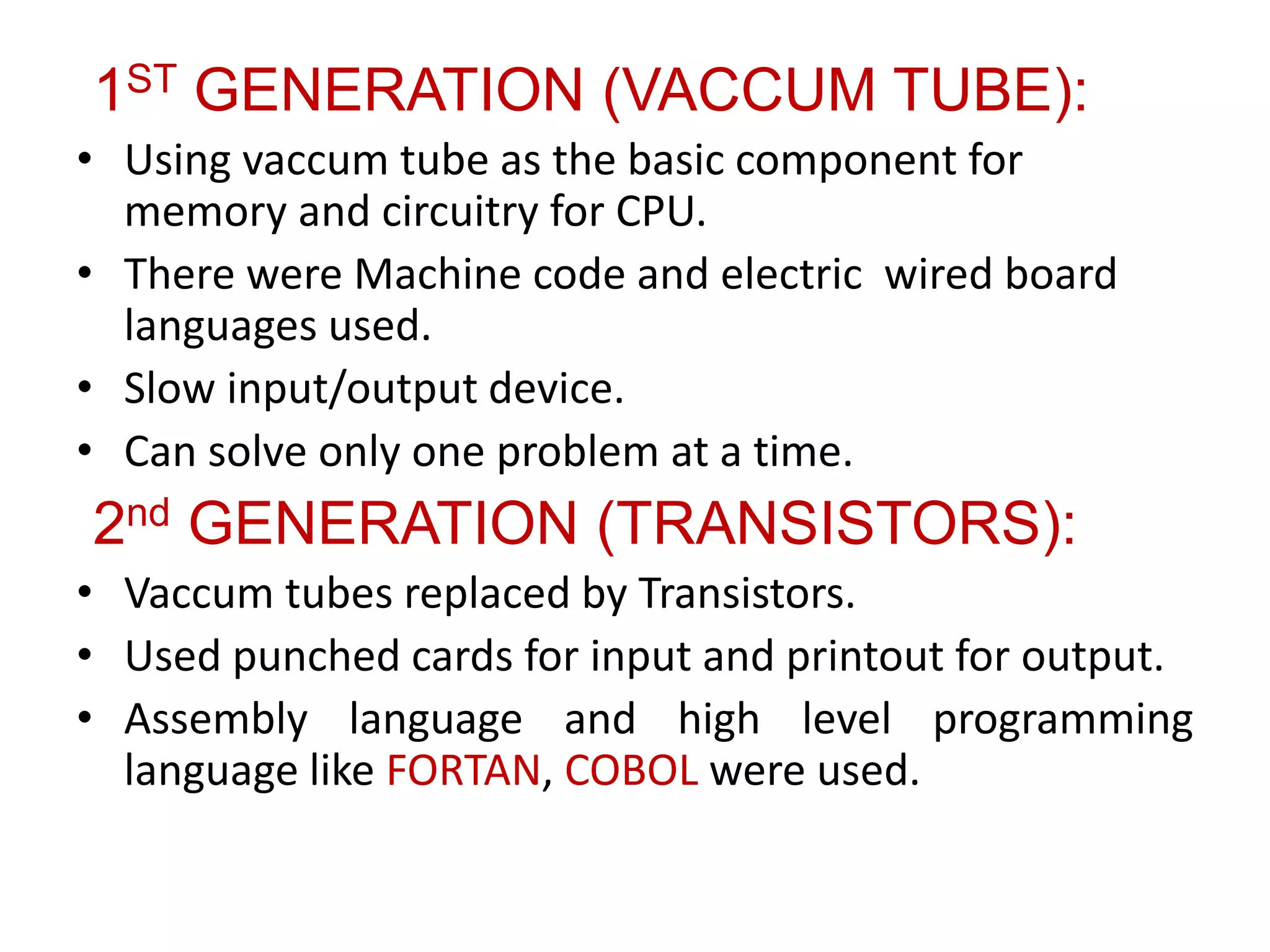
1ST GENERATION (VACCUM TUBE):
• Using vaccum tube as the basic component for
memory and circuitry for CPU.
• There were Machine code and electric wired board
languages used.
• Slow input/output device.
• Can solve only one problem at a time.
2nd GENERATION (TRANSISTORS):
• Vaccum tubes replaced by Transistors.
• Used punched cards for input and printout for output.
• Assembly language and high level programming
language like FORTAN, COBOL were used.
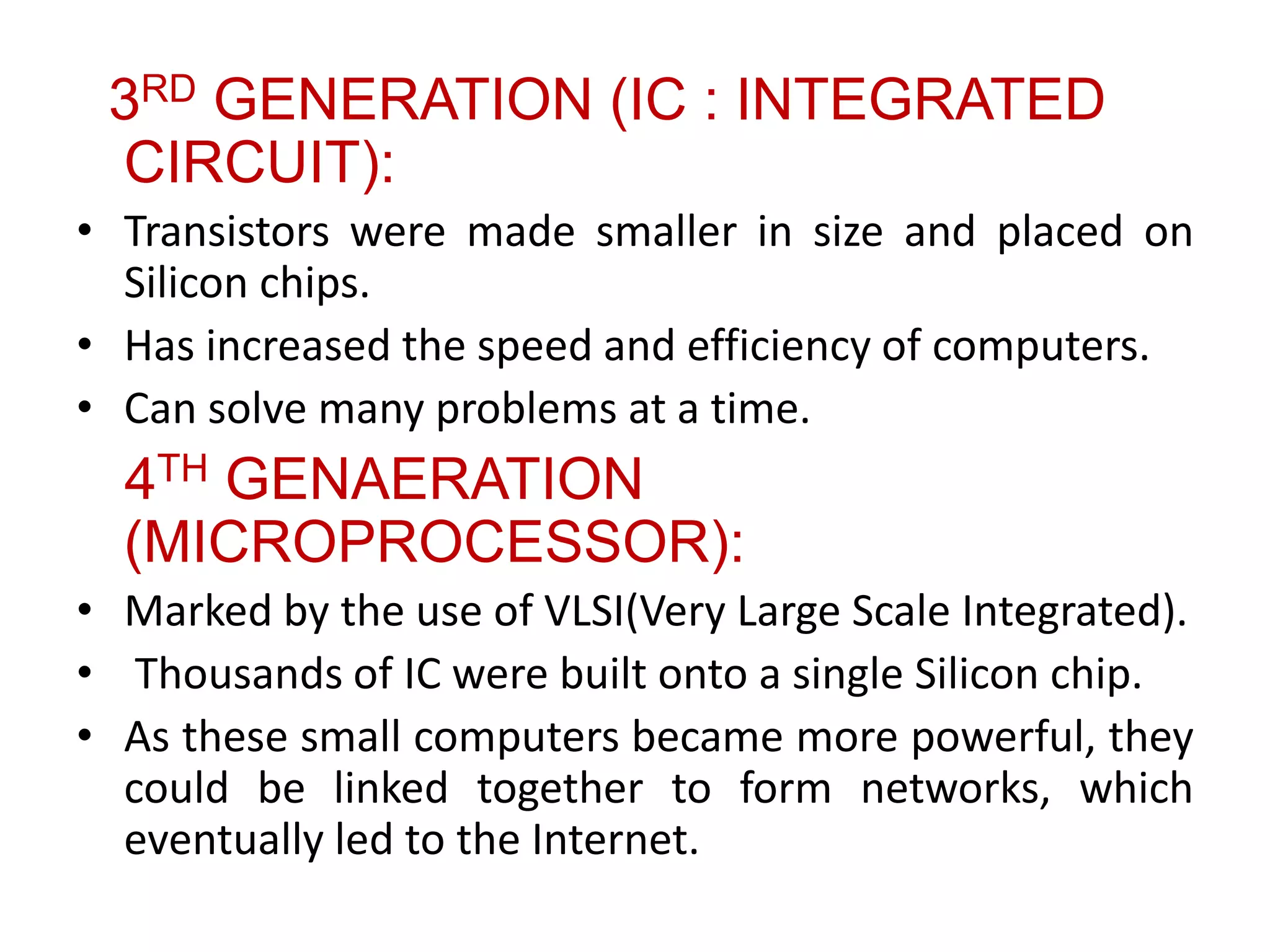
3RD GENERATION (IC : INTEGRATED
CIRCUIT):
• Transistors were made smaller in size and placed on
Silicon chips.
• Has increased the speed and efficiency of computers.
• Can solve many problems at a time.
4TH GENAERATION
(MICROPROCESSOR):
• Marked by the use of VLSI(Very Large Scale Integrated).
• Thousands of IC were built onto a single Silicon chip.
• As these small computers became more powerful, they
could be linked together to form networks, which
eventually led to the Internet.
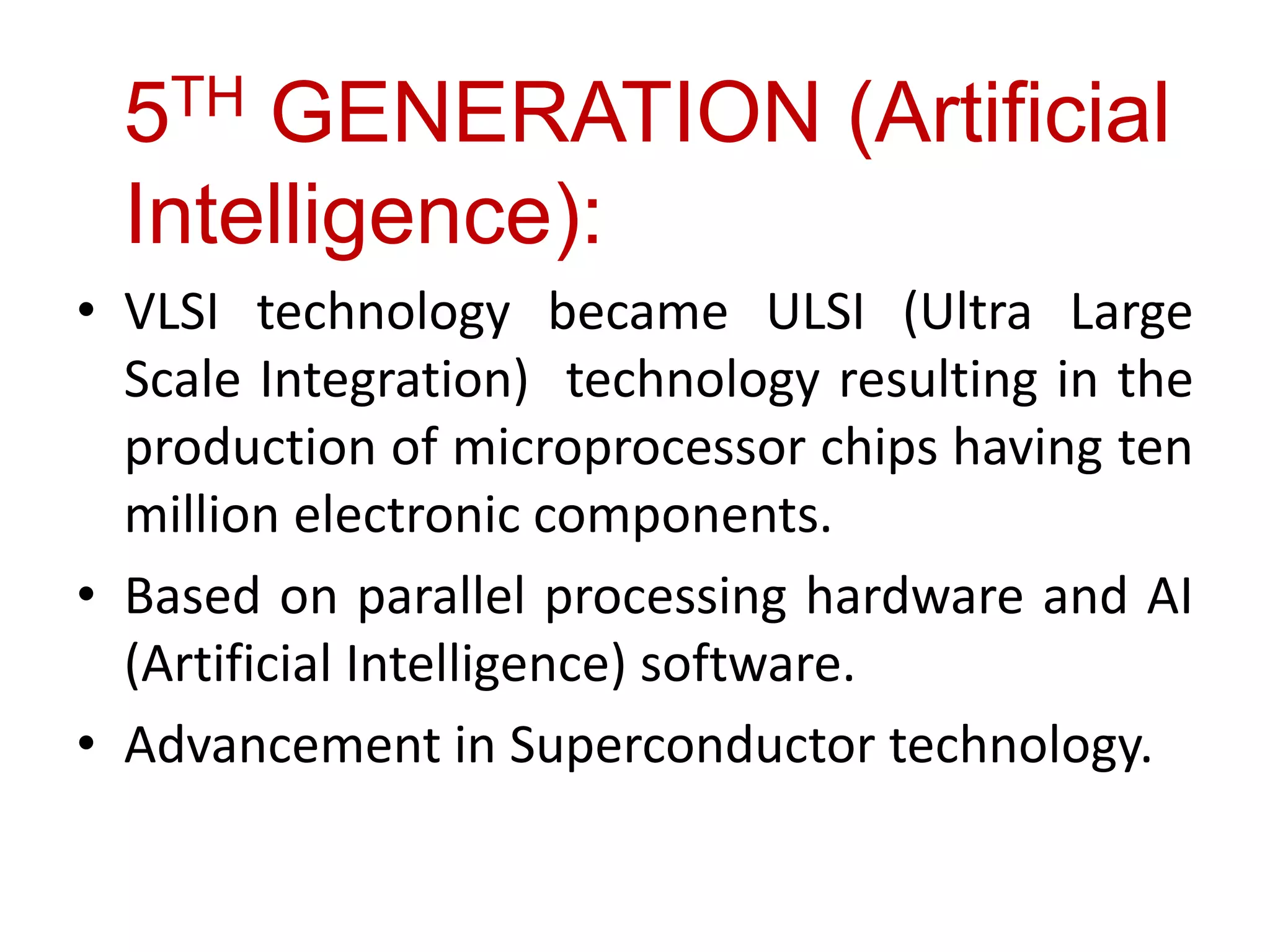
5TH GENERATION (Artificial
Intelligence):
• VLSI technology became ULSI (Ultra Large
Scale Integration) technology resulting in the
production of microprocessor chips having ten
million electronic components.
• Based on parallel processing hardware and AI
(Artificial Intelligence) software.
• Advancement in Superconductor technology.
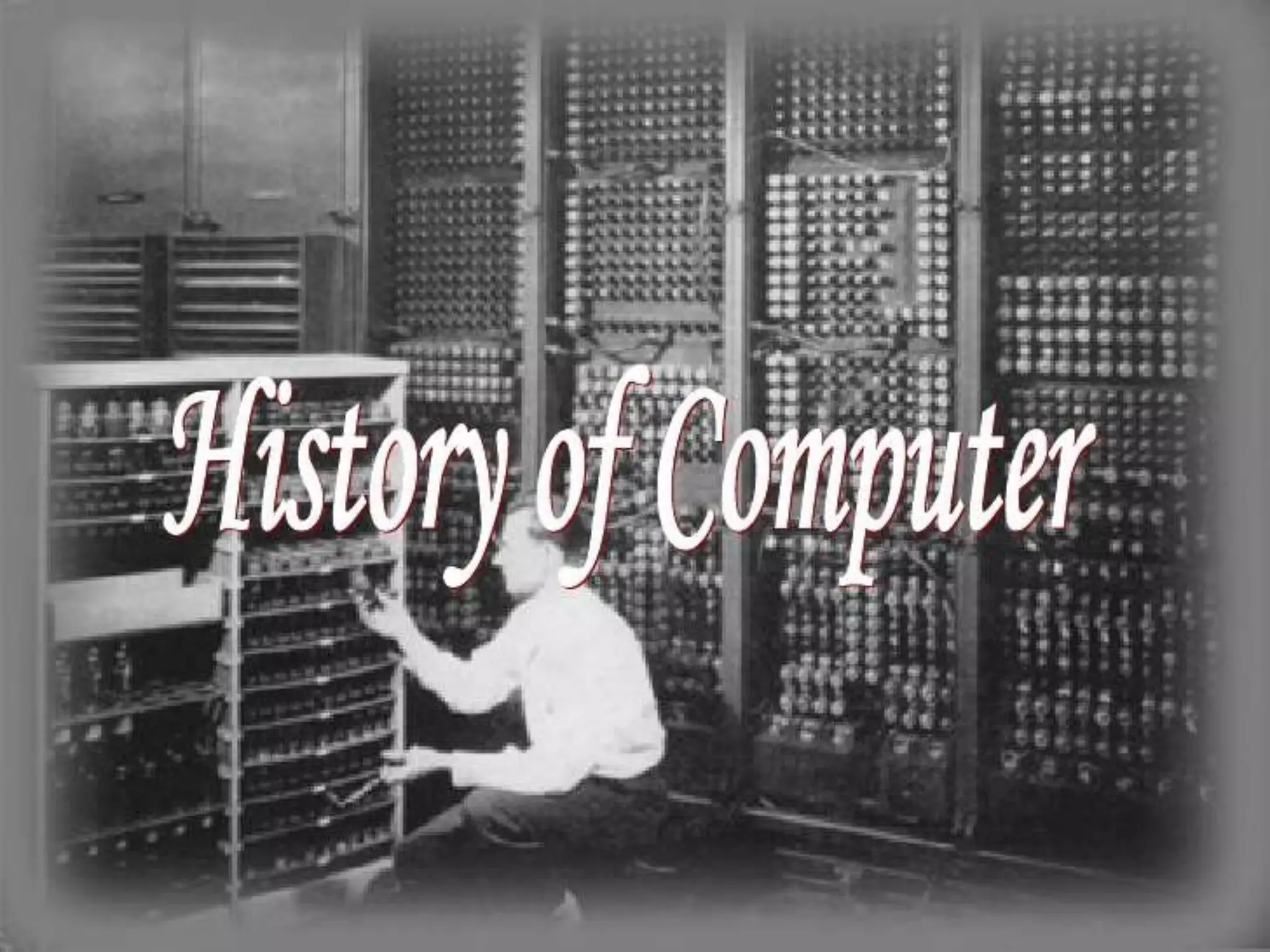
History of computer
History of computer
History of computer

History of computer

  • 3.
    WHAT IS COMPUTER? A computeris a machine that can be instructed to carry out sequences of arithmetic or logical operations automatically via computer programming. Modern computers have the ability to follow generalized sets of operations, called programs. These programs enable computers to perform an extremely wide range of tasks. • Computer is used in various fields of life. • Computer has made everything possible which seems to be impossible in past. • Computer has changed our living standards and views. • Earlier, computer was used at government level but now it is accessible to everyone.
  • 4.
    ABACUS (Artitecture and BuildingAids Computer Unit): • Abacus is the first ever mechanical computer, used for counting, invented by Joseph- Marie Jacquired in 1881. It is made of beads and rods. • The abacus in the form we are most familiar with, was 1st used in China in around 500 B.C. • Primarily used for addition, subtraction, multiplication and division, and to extract roots.
  • 5.
    NAPIER’S BONES: • Inventedby John Napier of Merchiston, a Scottish Mathematician. • A set of bones consisted of 9 rods; 1 for each digit 1 through 9 and a constant rod for the digit 0. • Method was based on lattice multiplication, and also called ‘‘rabdology’’, a word invented by Napier. • Allowed the operator to multiply, divide, calculate square and cube roots by moving the rods around and placing them in specially constructed boards.
  • 6.
    SLIDE RULE: • Mechanicalanalog computer, invented by William Oughtred. • Based on Napier’s ideas about logarithms. • Embodied by two sets of scales that are joined together with a marginal space between them. • Primarily used for multiplication, division, roots, logarithms and trigonometry but not for addition and subtraction. • Replaced by flashy HP-35. • But slide rules with special scales are still used for quick performance of routine calculations, such as the E6B circular slide rule used for time and distance calculations on light aircraft.
  • 7.
    MECHANICAL DOLL (AUTOMATON): • Inthe 1770s, Pierre Jaquet-Droz, a Swiss watchmaker, built a mechanical doll (automaton) that could write holding a quill pen. By switching the number and order of its internal wheels different letters, and hence different messages, could be produced. • Doll is at the Musée d'Art et d'Histoire of Neuchâtel, Switzerland, and still operates.
  • 8.
    PASCALINE - TheRotating Wheel Calculator : • 1st developed by a French mathematician- philosopher, Blaise Pascal. • Consists of gears and levers. • This is a predecessor to today’s electronic calculator.
  • 9.
    Stepped Reckoner: • Invented byGottfried Wilhelm Leidniz in 1672. • Can add, subtract, multiply and divide automatically. Jacquard Loom: • Mechanical room, invented by Joseph-Marie Jacquard in 1881. • Automatic loom calculated by punched cards.
  • 10.
    Arithmometer: • Mechanical calculator, inventedby Thomas de Colmar in 1820. • 1st reliable, useful and commercially successful calculating machine. • Perform four basic mathematic functions. • 1st mass- produced • calculating machine.
  • 11.
    • In 1821,1st Mechanical computer in the early 19th century, Difference Engine. • Designed to aid in navigational calculations. • In 1833, he realized that a much more general design, an Analytical Engine. • Input and data was provided to the program via punched cards and for output machine would have a printer, a curve plotter and a bell. • the first design for a general-purpose computer that could be described in modern terms as Turing-complete. • Project was dissolve with the decision of British government . Nevertheless, Henry Babbage (son of Charles Babbage), complete a simple version in 1888 and demonstration of its uses in 1906. Charles Babbage (Father of Today’s Computer):
  • 12.
    AUGUSTA ADA BYRON(First Computer Programmer): •In 1840, she suggests Babbage to use the binary system. • She writes programs for the Analytical Engine. • Daughter of Poet Lord Byron. SCHEUTZIAN CALCULATION ENGINE: • 1st printing calculator, invented by Per George Scheutz in 1843. • Based on Charles Babbage’s difference engine.
  • 13.
    HOLLERITH TABULATING MACHINE: • Electromechanicalmachine, invented by Herman Hollerith. • Designed by using punched cards for inputs. • To assist in summarizing information and accounting. ATANASOFF- BERRY COMPUTER (ABC): • 1st electronic digital computing device, invented by Professor John Atanasoff and graduate student Clifford Berry at lowa State University between 1939- 1942.
  • 14.
    HAVARD MARK 1(IBM- ASCC): • 1st electro-mechanical computer, invented by Howard H. Aiken in 1943. • Based on punched cards. • 50 feet long and 8 feet hight. Z 1: • 1st programmable computer, created in Germany from 1936-1938 by Konrad Zuse. • To program the Z1 required that the user to insert the punch tape into punch tape reader and all output was also generated through punch tape.
  • 15.
    ENIAC (Electronic Numerical Integratorand Calculator): • 1st electronic programmable computer, invented by John Presper Eckert and John W. Mauchly in 1946. • Made at Moore school of Engineering U.S.A. • Developed for military needs. • 20*40 square feet room sized 18000 vaccum tubes used. • Task was to calculate artilery firing tables. • Much faster and flexible than Turing Machine. • The programmers of the ENIAC were six women, often known collectively as the "ENIAC girls“.
  • 16.
    UNIVAC 1 (UNIversalAutomatic Computer): • 1st commercial computer, designed by John Presper Eckert and John W. Mauchly. EDVAC(Electronic Discrete Variable Automatic Computer): • 1st Stored Program Computer, designed by Von Neumann in1952. • Introduced system of binary language. • Memory to hold both a stored program as well as data.
  • 17.
    FIRST PORTABLE COMPUTER: • Osborne1 : Released in 1981 by Osborne Computer Corporation. FIRST COMPUTER COMPANY : • Electronic Controls Company, invented by John Presper Eckert and John W. Mauchly in 1949. EDSAC (Electronic Delay Storage Automatic Calculator): • Invented by British Government.
  • 19.
    1ST GENERATION (VACCUMTUBE): • Using vaccum tube as the basic component for memory and circuitry for CPU. • There were Machine code and electric wired board languages used. • Slow input/output device. • Can solve only one problem at a time. 2nd GENERATION (TRANSISTORS): • Vaccum tubes replaced by Transistors. • Used punched cards for input and printout for output. • Assembly language and high level programming language like FORTAN, COBOL were used.
  • 20.
    3RD GENERATION (IC: INTEGRATED CIRCUIT): • Transistors were made smaller in size and placed on Silicon chips. • Has increased the speed and efficiency of computers. • Can solve many problems at a time. 4TH GENAERATION (MICROPROCESSOR): • Marked by the use of VLSI(Very Large Scale Integrated). • Thousands of IC were built onto a single Silicon chip. • As these small computers became more powerful, they could be linked together to form networks, which eventually led to the Internet.
  • 21.
    5TH GENERATION (Artificial Intelligence): •VLSI technology became ULSI (Ultra Large Scale Integration) technology resulting in the production of microprocessor chips having ten million electronic components. • Based on parallel processing hardware and AI (Artificial Intelligence) software. • Advancement in Superconductor technology.