HISTORY OF
COMPUTER
Topics
1. Definition of computer
2. Earliest computer
3. Computer History
4. Computer Generations
Definition of Computer
• Computer is a programmable machine.
• Computer is a machine that manipulates data according to a
list of instructions.
• Computer is any device which aids humans in performing
various kinds of computations or calculations.
Definition of Computer
Three principles characteristic of computer:
• It responds to a specific set of instructions in a well-defined
manner.
• It can execute a pre-recorded list of instructions.
• It can quickly store and retrieve large amounts of data.
Earliest Computer
• Originally calculations were computed by humans, whose job
title was computers.
• These human computers were typically engaged in the
calculation of amathematical expression.
• The calculations of this period were specialized and expensive,
requiring years of training in mathematics.
• The first use of the word" computer" was recorded in 1613,
referring to a person who carried out calculations, or
computations, and the word continued to be used in that
sense until the middle of the 20th
century.
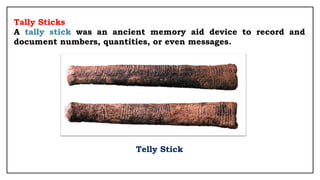
Tally Sticks
A tally stick was an ancient memory aid device to record and
document numbers, quantities, or even messages.
Telly Stick
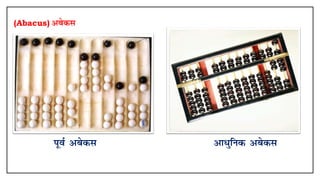
Abacus
• An abacus is a mechanical device used to aid an individual in
performing mathematical calculations.
• The abacus was invented in Babylonia in 2400 B.C.
• The abacus in the form we are most familiar with was first
used in China in around 500 B.C.
• It used to perform basic arithmetic operations.
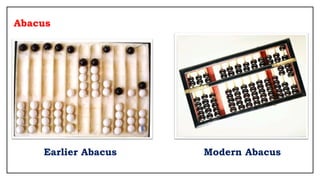
Abacus
Earlier Abacus Modern Abacus
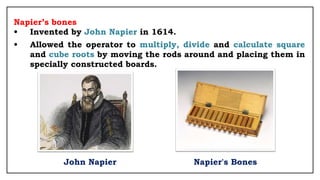
Napier’s bones
• Invented by John Napier in 1614.
• Allowed the operator to multiply, divide and calculate square
and cube roots by moving the rods around and placing them in
specially constructed boards.
John Napier Napier's Bones
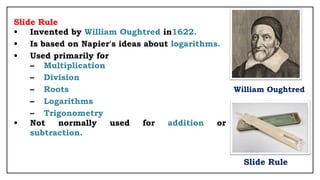
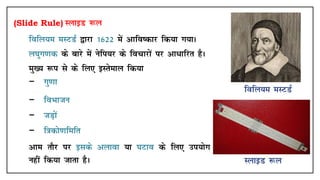
Slide Rule
• Invented by William Oughtred in1622.
• Is based on Napier's ideas about logarithms.
• Used primarily for
– Multiplication
– Division
– Roots William Oughtred
– Logarithms
– Trigonometry
• Not normally used for addition or
subtraction.
Slide Rule
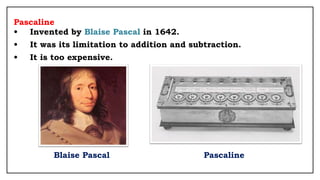
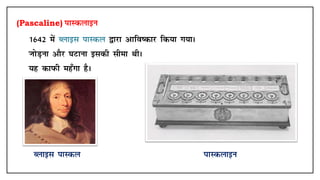
Pascaline
• Invented by Blaise Pascal in 1642.
• It was its limitation to addition and subtraction.
• It is too expensive.
Blaise Pascal Pascaline
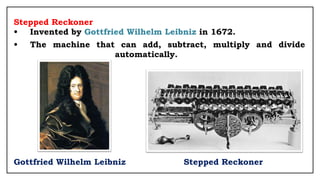
Stepped Reckoner
• Invented by Gottfried Wilhelm Leibniz in 1672.
• The machine that can add, subtract, multiply and divide
automatically.
Gottfried Wilhelm Leibniz Stepped Reckoner
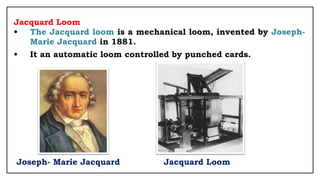
Jacquard Loom
• The Jacquard loom is a mechanical loom, invented by Joseph-
Marie Jacquard in 1881.
• It an automatic loom controlled by punched cards.
Joseph- Marie Jacquard Jacquard Loom
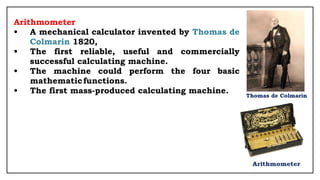
Arithmometer
• A mechanical calculator invented by Thomas de
Colmarin 1820,
• The first reliable, useful and commercially
successful calculating machine.
• The machine could perform the four basic
mathematicfunctions.
• The first mass-produced calculating machine.
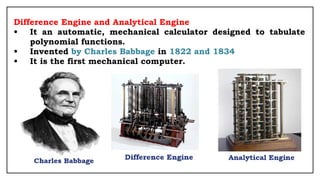
Difference Engine and Analytical Engine
• It an automatic, mechanical calculator designed to tabulate
polynomial functions.
• Invented by Charles Babbage in 1822 and 1834
• It is the first mechanical computer.
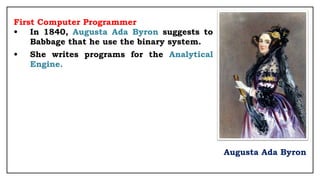
First Computer Programmer
• In 1840, Augusta Ada Byron suggests to
Babbage that he use the binary system.
• She writes programs for the Analytical
Engine.
Augusta Ada Byron
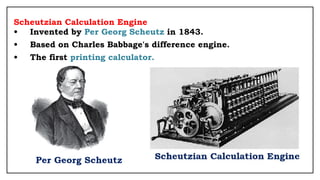
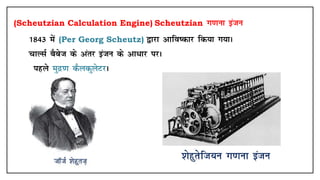
Scheutzian Calculation Engine
• Invented by Per Georg Scheutz in 1843.
• Based on Charles Babbage's difference engine.
• The first printing calculator.
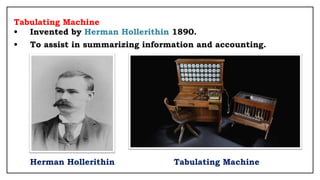
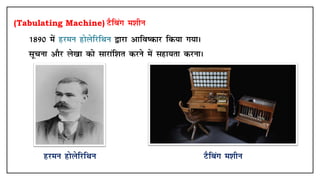
Tabulating Machine
• Invented by Herman Hollerithin 1890.
• To assist in summarizing information and accounting.
Herman Hollerithin Tabulating Machine
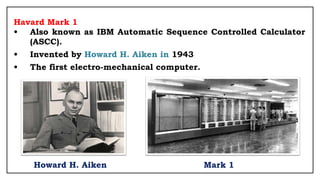
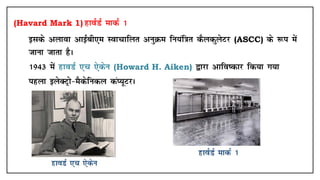
Havard Mark 1
• Also known as IBM Automatic Sequence Controlled Calculator
(ASCC).
• Invented by Howard H. Aiken in 1943
• The first electro-mechanical computer.
Howard H. Aiken Mark 1
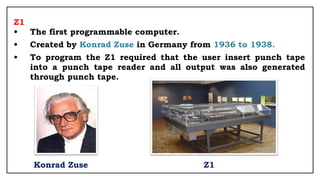
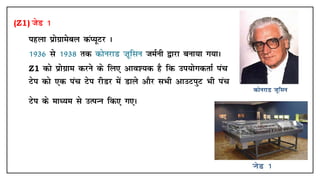
Z1
• The first programmable computer.
• Created by Konrad Zuse in Germany from 1936 to 1938.
• To program the Z1 required that the user insert punch tape
into a punch tape reader and all output was also generated
through punch tape.
Konrad Zuse Z1
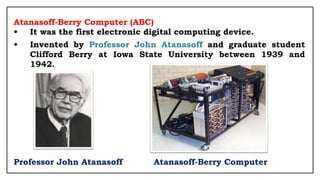
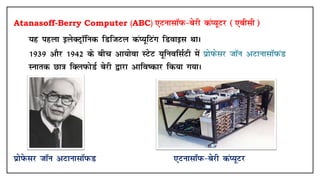
Atanasoff-Berry Computer (ABC)
• It was the first electronic digital computing device.
• Invented by Professor John Atanasoff and graduate student
Clifford Berry at Iowa State University between 1939 and
1942.
Professor John Atanasoff Atanasoff-Berry Computer
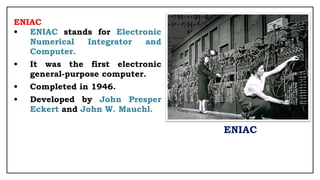
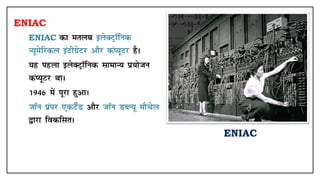
ENIAC
• ENIAC stands for Electronic
Numerical Integrator and
Computer.
• It was the first electronic
general-purpose computer.
• Completed in 1946.
• Developed by John Presper
Eckert and John W. Mauchl.
ENIAC
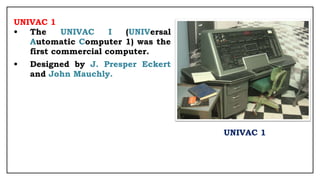
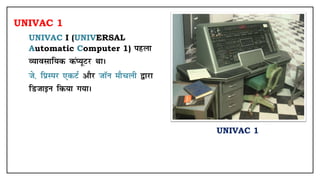
UNIVAC 1
• The UNIVAC I (UNIVersal
Automatic Computer 1) was the
first commercial computer.
• Designed by J. Presper Eckert
and John Mauchly.
UNIVAC 1
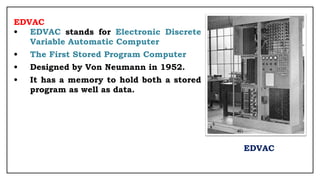
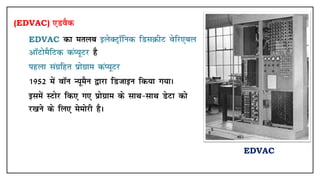
EDVAC
• EDVAC stands for Electronic Discrete
Variable Automatic Computer
• The First Stored Program Computer
• Designed by Von Neumann in 1952.
• It has a memory to hold both a stored
program as well as data.
EDVAC
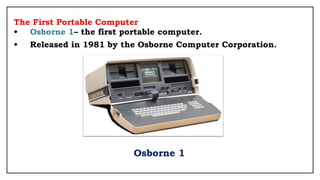
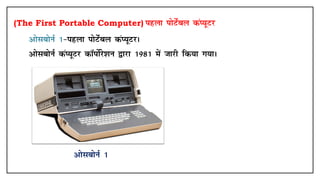
The First Portable Computer
• Osborne 1– the first portable computer.
• Released in 1981 by the Osborne Computer Corporation.
Osborne 1
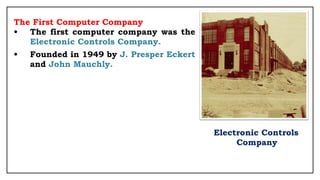
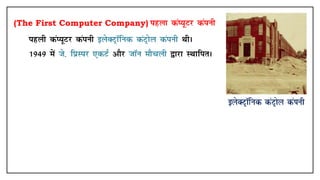
The First Computer Company
• The first computer company was the
Electronic Controls Company.
• Founded in 1949 by J. Presper Eckert
and John Mauchly.
Electronic Controls
Company
Computer Generations
There are five generations of computer:
• First generation–1946 -1958
• Second generation–1959 -1964
• Third generation–1965 -1970
• Fourth generation–1971 -today
• Fifth generation–Today to future
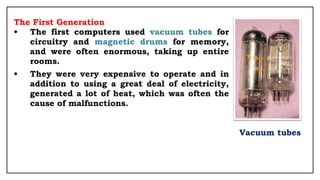
The First Generation
• The first computers used vacuum tubes for
circuitry and magnetic drums for memory,
and were often enormous, taking up entire
rooms.
• They were very expensive to operate and in
addition to using a great deal of electricity,
generated a lot of heat, which was often the
cause of malfunctions.
Vacuum tubes
The First Generation
• First generation computers relied on machine language, the
lowest-level programming language understood by computers,
to perform operations, and they could only solve one problem
at a time.
• Input was based on punched cards and paper tape, and output
was displayed on printouts.
The Second Generation
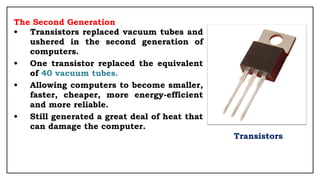
• Transistors replaced vacuum tubes and
ushered in the second generation of
computers.
• One transistor replaced the equivalent
of 40 vacuum tubes.
• Allowing computers to become smaller,
faster, cheaper, more energy-efficient
and more reliable.
• Still generated a great deal of heat that
can damage the computer.
Transistors
The Second Generation
• Second-generation computers moved from cryptic binary
machine language to symbolic, or assembly, languages, which
allowed programmers to specify instructions in words.
• Second-generation computers still relied on punched cards for
input and printouts for output.
• These were also the first computers that stored their
instructions in their memory, which moved from a magnetic
drum to magnetic core technology.
The Third Generation
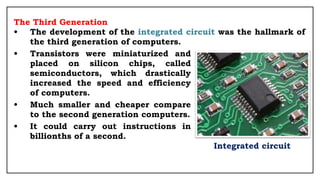
• The development of the integrated circuit was the hallmark of
the third generation of computers.
• Transistors were miniaturized and
placed on silicon chips, called
semiconductors, which drastically
increased the speed and efficiency
of computers.
• Much smaller and cheaper compare
to the second generation computers.
• It could carry out instructions in
billionths of a second.
Integrated circuit
The Third Generation
• Users interacted with third generation computers through
keyboards and monitors and interfaced with an operating
system, which allowed the device; to run many different
applications at one time with a central program that
monitored the memory.
• Computers for the first time became accessible to a mass
audience because they were smaller and cheaper than their
predecessors.
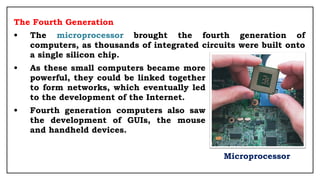
The Fourth Generation
• The microprocessor brought the fourth generation of
computers, as thousands of integrated circuits were built onto
a single silicon chip.
• As these small computers became more
powerful, they could be linked together
to form networks, which eventually led
to the development of the Internet.
• Fourth generation computers also saw
the development of GUIs, the mouse
and handheld devices.
Microprocessor
The Fifth Generation
• Based on Artificial Intelligence (AI).
• Still in development.
• The use of parallel processing and superconductors is helping
to make artificial intelligence a reality.
• The goal is to develop devices that respond to natural
language input and are capable of learning and self-
organization.
• There are some applications, such as voice recognition, that
are being used today.
(Topic) fo"k;
1- daI;wVj dh ifjHkk"kk
2- lcls igyk daI;wVj
3- daI;wVj dk bfrgkl
4- daI;wVj tujs'ku
(Definition of Computer) daI;wVj dh ifjHkk"kk
• daI;wVj ,d çksxzke djus ;ksX; e'khu gSA
• daI;wVj ,d e'khu gS tks funsZ'kksa dh ,d lwph ds vuqlkj MsVk esa gsjiQsj djrk gSA
• daI;wVj dksbZ Hkh midj.k gS tks fofHkUu çdkj dh lax.kukvksa ;k x.kukvksa dks djus esa
euq";ksa dks lgk;rk djrk gSA
(Definition of Computer) daI;wVj dh ifjHkk"kk
daI;wVj ds rhu fl¼kar
• ;g ,d vPNh rjg ls ifjHkkf"kr rjhds ls funs'kksa ds ,d fof'k"V lsV dk tokc nsrk
gSA
• ;g funsZ'kksa dh ,d iwoZ&ntZ lwph fu"Ikkfnr dj ldrk gSA
• ;g cM+h ek=kk esa MsVk dks tYnh ls LVksj vkSj iquçkZIr dj ldrk gSA
(Earliest Computer) tYn ls tYn daI;wVj
• ewy :i ls x.kuk dh x.kuk euq";ksa }kjk dh tkrh Fkh] ftldk dke 'kh"kZd daI;wVj
FkkA
• ;s ekuo daI;wVj vkerkSj ij xf.krh; vfHkO;fDr dh x.kuk esa yxs gq, FksA
• bl vof/ dh x.kuk fo'ks"k vkSj egaxh Fkh] xf.kr esa çf'{k.k ds o"kksZa dh vko';drk
FkhA
• ^^daI;wVj** 'kCn dk igyk mi;ksx 1613 esa ntZ fd;k x;k Fkk] tks ,d O;fDr dh
x.kuk djrk gS] ;k vfHkdyu vkSj 'kCn 20oha lnh ds eè; rd ml vFkZ esa mi;ksx
fd, tkrs jgsA
(Tally Sticks) VSyh dh NM+sa
VSyh fLVd ,d izkphu Le`fr lgk;rk midj.k Fkk tks fjdkWMZ vkSj nLrkost+ la[;k] ek=kk ;k
lans'k dks fjdkWMZ djus ds fy, FkkA
VSyh fLVd
(Abacus) vcsdl
• ,d vcsdl ,d ;kaf=kd midj.k gS tks xf.krh; x.kuk djus esa ,d O;fDr dh
lgk;rk djrk gSA
• vcsdl dk vkfo"dkj cschyksfu;k esa 2400 bZ-iw-
• vcsdl ftl :i esa ge lcls T;knk ifjfpr gSa] mldk bLrseky phu esa yxHkx 500
bZ-iw-
• ;g cqfu;knh vadxf.krh; lapkyu djus ds fy, mi;ksx fd;k tkrk gSA
(Abacus) vcsdl
iwoZ vcsdl vk/qfud vcsdl
(Napier’s Bones) usfi;j dh gfM~M;k¡
• 1614 esa tkWu usfi;j }kjk vkfo"dkj fd;k x;kA
• vkWijsVj dks pkSdksj vkSj ?ku tM+ksa dks xq.kk djus] foHkkftr djus vkSj x.kuk djus ds
fy,] NM+ dks pkjksa vksj ?kqekdj vkSj fo'ks"k :i ls fufeZr cksMksZ esa j[kdj vkoafVr
djus dh vuqefr nhA
tkWu usfi;j usfi;j dh gfM~M;k¡
(Slide Rule) LykbM :y
• fofy;e eLVMZ }kjk 1622 esa vkfo"dkj fd;k x;kA
• y?kqx.kd ds ckjs esa usfi;j ds fopkjksa ij vk/kfjr gSA
• eq[; :i ls ds fy, bLrseky fd;k
− xq.kk
− foHkktu
− tM+ksa
− f=kdks.kfefr
• vke rkSj ij blds vykok ;k ?kVko ds fy, mi;ksx
ugha fd;k tkrk gSA
(Pascaline) ikLdykbu
• 1642 esa Cykbl ikLdy }kjk vkfo"dkj fd;k x;kA
• TkksM+uk vkSj ?kVkuk bldh lhek FkhA
• ;g dkiQh eg¡xk gSA
Cykbl ikLdy ikLdykbu
(Stepped Reckoner) LVSIM jsduj
• 1672 esa xkWVfizQM foYgse fycfut+ }kjk vkfo"dkj fd;k x;kA
• og e'khu tks Lopkfyr :i ls tksM+] ?kVk] xq.kk vkSj Hkkx dj ldrh gSA
XkkWVfizQM foYgse fycfut+ LVSIM jsduj
(Jacquard Loom) tSDdkMZ ywe
• tSDdkMZ ywe ,d eSdsfudy ywe gS] ftldk vkfo"dkj 1881 esa tkslsiQ&eSjh tSDdkMZ us
fd;k FkkA
• ;g ,d Lopkfyr ywe gS tks iap dkMZ }kjk fu;af=kr fd;k tkrk gSA
(Arithmometer) vfjFkeksehVj
• ,d ;kaf=kd dSydqysVj dk vkfo"dkj FkkWel Mh dksyejhu 1820
}kjk fd;k x;k]
• igyh fo'oluh;] mi;ksxh vkSj O;kolkf;d :i ls liQy x.kuk
e'khuA
• e'khu pkj cqfu;knh xf.krh; dk;Z dj ldrh gS
• igyh cM+s iSekus ij mRikfnr x.kuk e'khuA
(Difference Engine and Analytical Engine) varj batu vkSj fo'ys"k.kkRed batu
• ;g ,d Lopkfyr] ;kaf=kd dSydqysVj gS ftls cgqin dk;ksaZ dks lkj.khc¼ djus ds
fy, fMtkbu fd;k x;k gSA
• 1822 vkSj 1834 esa pkyZ~l cScst }kjk vkfo"dkj fd;k x;k
• ;g igyk eSdsfudy daI;wVj gSA
(First Computer Programmer) igyk daI;wVj çksxzkej
• 1840 esa] vkWxLVk ,Mk ck;ju us cScst dks ladsr fn;k
fd og ckbujh flLVe dk mi;ksx djrk gSA
• og fo'ys"k.kkRed batu ds fy, dk;ZØe fy[krk gSA
vkWxLVk ,Mk ck;ju
(Scheutzian Calculation Engine) Scheutzian Xk.kuk batu
• 1843 esa (Per Georg Scheutz) }kjk vkfo"dkj fd;k x;kA
• pkYlZ cScst ds varj batu ds vk/kj ijA
• igys eqnz.k dSydqysVjA
(Tabulating Machine) VSfcax e'khu
• 1890 esa gjeu gksysfjfFku }kjk vkfo"dkj fd;k x;kA
• lwpuk vkSj ys[kk dks lkjkaf'kr djus esa lgk;rk djukA
gjeu gksysfjfFku VSfcax e'khu
(Havard Mark 1) gkoZMZ ekdZ 1
• blds vykok vkbZch,e Lokpkfyr vuqØe fu;af=kr dSydqysVj (ASCC) ds :i esa
tkuk tkrk gSA
• 1943 esa gkoMZ ,p ,sdsu (Howard H. Aiken) }kjk vkfo"dkj fd;k x;k
• igyk bysDVªks&eSdsfudy daI;wVjA
(Z1) tsM 1
• igyk izksxzkescy daI;wVj A
• 1936 ls 1938 rd dksujkM ”kwflu teZuh }kjk cuk;k x;kA
• Z1 dks izksxzke djus ds fy, vko';d gS fd mi;ksxdrkZ iap
Vsi dks ,d iap Vsi jhMj esa Mkys vkSj lHkh vkmViqV Hkh iap
Vsi ds ekè;e ls mRiUu fd, x,A
Atanasoff-Berry Computer (ABC) ,VuklkWiQ&csjh daI;wVj (,chlh)
• ;g igyk bysDVªkWfud fMftVy daI;wfVax fMokbl FkkA
• 1939 vkSj 1942 ds chp vk;ksok LVsV ;wfuoflZVh esa izksiQslj tkWu vVkuklkWiQaM
Lukrd Nk=k fDyiQksMZ csjh }kjk vkfo"dkj fd;k x;kA
IkzksisQLkj tkWu vVkuklkWiQM ,VuklkWiQ&csjh daI;wVj
ENIAC
• ENIAC dk eryc bysDVªkWfud
U;wesfjdy baVhxzsVj vkSj daI;wVj gSA
• ;g igyk bysDVªkWfud lkekU; iz;kstu
daI;wVj FkkA
• 1946 esa iwjk gqvkA
• tkWu izaij ,dVSZaM vkSj tkWu MCY;w ekSpsy
}kjk fodflrA
ENIAC
UNIVAC 1
• UNIVAC I (UNIVERSAL
Automatic Computer 1) igyk
O;kolkf;d daI;wVj FkkA
• ts- fizLij ,dVZ vkSj tkWu ekSpyh }kjk
fMtkbu fd;k x;kA
UNIVAC 1
(EDVAC) ,MoSd
• EDVAC dk eryc bysDVªkWfud fMlØhV osfj,cy
vkWVkseSfVd daI;wVj gS
• Ikgyk laxzfgr izksxzke daI;wVj
• 1952 esa okWu U;weSu }kjk fMtkbu fd;k x;kA
• blesa LVksj fd, x, izksxzke ds lkFk&lkFk MsVk dks
j[kus ds fy, eseksjh gSA
EDVAC
(The First Portable Computer) igyk iksVsZcy daI;wVj
• vkslcksuZ 1&igyk iksVsZcy daI;wVjA
• vkslcksuZ daI;wVj dkWiksZjs'ku }kjk 1981 esa tkjh fd;k x;kA
vkslcksuZ 1
(The First Computer Company) igyk daI;wVj daaiuh
• igyh daI;wVj daiuh bysDVªkWfud daVªksy daiuh FkhA
• 1949 esa ts- fizLij ,dVZ vkSj tkWu ekSpyh }kjk LFkkfirA
(Computer Generations) daI;wVj tujs'ku
daI;wVj dh Ikk¡p ihf<+;k¡ gS%
• igyh ih<+h & 1946&1958
• nwljh ih<+h & 1959&1964
• rhljh ih<+h & 1965&1970
• pkSFkh ih<+h & 1971&vkt
• ikapoha ih<+h & vkt ls Hkfo";
(The First Generation) igyh ih<+h
• igys daI;wVj esa eseksjh ds fy, lfdZVªh vkSj pqacdh; Mªe ds
fy, oSSD;we V;wc dk mi;ksx fd;k tkrk Fkk] vkSj vDlj
fo'kky gksrs Fks] iwjs dejs dks ysrs FksA
• os lapkfyr djus ds fy, cgqr egaxs Fks vkSj fctyh ds ,d
egku lkSns dk mi;ksx djus ds vykok] cgqr vf/d xehZ
mRiUu dh] tks vDlj [kjkch dk dkj.k FkkA
oSSD;we V;wc
(The First Generation) igyh ih<+h
• igys ih<+h ds daI;wVj e'khu Hkk"kk ij Hkkjkslk djrs Fks] lapkyu djus ds fy, daI;wVj
}kjk le>s tkus okys fuezre Lrj dh izksxzkfeax Hkk"kk] vkSj os ,d le; esa dsoy ,d
leL;k dks gy dj ldrs FksA
• buiqV fNfnzr dkMZ vkSj isij Vsi Ij vk/kfjr Fkk] vkSj fizaV vkmV Ij vkmViqV iznf'kZr
fd;k x;k FkkA
(The Second Generation) nwljh ih<+h
• VªkaftLVj us oSD;we V;wcksa dks cny fn;k vkSj nwljh ih<+h
ds daI;wVj dh 'kq#vkr dhA
• ,d VªkaftLVj us 40 oSD;we V;wcksa ds cjkcj txg ys yhA
• daI;wVj dks NksVk] rst] lLrk] vf/d mQtkZ&dq'ky vkSj
vf/d fo'oluh; cukus ds fy, vuqefr nsukA
• fiQj Hkh xehZ dk ,d cM+k dkj.k gS fd daI;wVj dks
uqdlku igq¡pk ldrk gSA VªkaftLVj
(The Second Generation) nwljh ih<+h
• nwljh ih<+h ds daI;wVj fØfIVd ckbujh e'khu Hkk"kk ls izrhdkRed] ;k fo/kulHkk]
Hkk"kkvksa esa pys x,] tks izksxzkej dks 'kCnksa esa funsZ'k fufnZ"V djus dh vuqefr nsrs gSaA
• nwljh ih<+h ds daI;wVj vHkh Hkh vk,ViqV ds fy, buiqV vkSj fizaVvkmV ds fy,
fNfnzr dkMZ ij fuHkZj gSaA
• ;s Ikgys daI;wVj Hkh Fks tks mudh Le`fr esa muds funsZ'kksa dks laxzghr djrs Fksa] tks ,d
pqacdh; Mªe ls pqacdh; dksj izkS|ksfxdh esa pys x,A
(The Third Generation) rhljh ih<+h
• ,dhÑr lfdZV dk fodkl rhljh ih<+h ds daI;wVjksa dh igpku FkkA
• VªkaftLVj dks NksVk vkSj flfydkWu fpIl ij j[kk x;k] fyls v/Zpkyd dgk tkrk gS]
ftlus daI;wVj dh xfr vkSj n{krk esa dkiQh o`f¼ dhA
• nwljh ih<+h ds daI;wVjksa dh rqyuk esa cgqr NksVk vkSj lLrkA
• ;g ,d lsdaM ds vjcksa esa funsZ'k ns ldrk gSA
,dhÑr lfdZV
(The Third Generation) rhljh ih<+h
• mi;ksxdrkZvksa us dh cksMZ vkSj ekWfuVj ds ekè;e ls rhljh ih<+h ds daI;wVjksa ds lkFk
ckrphr dh vkSj ,d vkWijsfVax flLVe ds lkFk gLr{ksi fd;k] ftlus fMokbl dks ,d
dsanzh; dk;ZØe ds lkFk ,d ckj esa dbZ vyx&vyx ,fIyds'ku pykus dh vuqefr nh
tks eseksjh dh fuxjkuh djrs FksA
• daI;wVj igyh ckj cM+s iSekus Ij n'kZdksa ds fy, lqyHk gks x, D;ksafd os vius
iwoZofrZ;ksa dh rqyuk esa NksVs vkSj lLrs FksA
(The Fourth Generation) pkSFkh ih<+h
• ekbØksizkslslj daI;wVj dh pkSFkh ih<+h dks yk;k D;ksafd
gtkjksa ,dhÑr lfdZV ,d ,dy flfydkWu fpi ij
cuk, x, FksA
• tSls&tSls ;s NksVs daI;wVj vf/d 'kfDr'kkyh gksrs x,]
mUgsa usVodZ cukus ds fy, ,d lkFk tksM+k tk ldrk
gS] ftlls varr% baVjusV dk fodkl gqvkA
• pkSFkh ih<+h ds daI;wVjksa us GUI] ekml vkSj gSaMgsYM
fMokblksa ds fodkl dks Hkh ns[kkA ekbØksizkslslj
(The Fifth Generation) ikapoh ih<+h
• vkfVZfiQf'k;y baVsfytsal (AI) ij vk/kfjrA
• fiQj Hkh fodkl esaA
• lekukarj izlaLdj.k vkSj lqijdaMDVlZ dk mi;ksx d`f=ke cqf¼ dks okLrfodrk cukus esa
enn dj jgk gSA
• y{; mu midj.kksa dks fodflr djuk gS tks izkd`frd Hkk"kk buiqV dk tokc nsrs gSa
vkSj lh[kus vkSj vkRe&laxBu djus esa l{ke gSaA
• dqN ,fIyds'ku gSa] tSls fd vkokt dh igpku] ftldk ,i;ksx vkt fd;k tk jgk gSA


computer introduction and generation of computer.pdf

  • 1.
  • 2.
    Topics 1. Definition ofcomputer 2. Earliest computer 3. Computer History 4. Computer Generations
  • 3.
    Definition of Computer •Computer is a programmable machine. • Computer is a machine that manipulates data according to a list of instructions. • Computer is any device which aids humans in performing various kinds of computations or calculations.
  • 4.
    Definition of Computer Threeprinciples characteristic of computer: • It responds to a specific set of instructions in a well-defined manner. • It can execute a pre-recorded list of instructions. • It can quickly store and retrieve large amounts of data.
  • 5.
    Earliest Computer • Originallycalculations were computed by humans, whose job title was computers. • These human computers were typically engaged in the calculation of amathematical expression. • The calculations of this period were specialized and expensive, requiring years of training in mathematics. • The first use of the word" computer" was recorded in 1613, referring to a person who carried out calculations, or computations, and the word continued to be used in that sense until the middle of the 20th century.
  • 6.
    Tally Sticks A tallystick was an ancient memory aid device to record and document numbers, quantities, or even messages. Telly Stick
  • 7.
    Abacus • An abacusis a mechanical device used to aid an individual in performing mathematical calculations. • The abacus was invented in Babylonia in 2400 B.C. • The abacus in the form we are most familiar with was first used in China in around 500 B.C. • It used to perform basic arithmetic operations.
  • 8.
  • 9.
    Napier’s bones • Inventedby John Napier in 1614. • Allowed the operator to multiply, divide and calculate square and cube roots by moving the rods around and placing them in specially constructed boards. John Napier Napier's Bones
  • 10.
    Slide Rule • Inventedby William Oughtred in1622. • Is based on Napier's ideas about logarithms. • Used primarily for – Multiplication – Division – Roots William Oughtred – Logarithms – Trigonometry • Not normally used for addition or subtraction. Slide Rule
  • 11.
    Pascaline • Invented byBlaise Pascal in 1642. • It was its limitation to addition and subtraction. • It is too expensive. Blaise Pascal Pascaline
  • 12.
    Stepped Reckoner • Inventedby Gottfried Wilhelm Leibniz in 1672. • The machine that can add, subtract, multiply and divide automatically. Gottfried Wilhelm Leibniz Stepped Reckoner
  • 13.
    Jacquard Loom • TheJacquard loom is a mechanical loom, invented by Joseph- Marie Jacquard in 1881. • It an automatic loom controlled by punched cards. Joseph- Marie Jacquard Jacquard Loom
  • 14.
    Arithmometer • A mechanicalcalculator invented by Thomas de Colmarin 1820, • The first reliable, useful and commercially successful calculating machine. • The machine could perform the four basic mathematicfunctions. • The first mass-produced calculating machine.
  • 15.
    Difference Engine andAnalytical Engine • It an automatic, mechanical calculator designed to tabulate polynomial functions. • Invented by Charles Babbage in 1822 and 1834 • It is the first mechanical computer.
  • 16.
    First Computer Programmer •In 1840, Augusta Ada Byron suggests to Babbage that he use the binary system. • She writes programs for the Analytical Engine. Augusta Ada Byron
  • 17.
    Scheutzian Calculation Engine •Invented by Per Georg Scheutz in 1843. • Based on Charles Babbage's difference engine. • The first printing calculator.
  • 18.
    Tabulating Machine • Inventedby Herman Hollerithin 1890. • To assist in summarizing information and accounting. Herman Hollerithin Tabulating Machine
  • 19.
    Havard Mark 1 •Also known as IBM Automatic Sequence Controlled Calculator (ASCC). • Invented by Howard H. Aiken in 1943 • The first electro-mechanical computer. Howard H. Aiken Mark 1
  • 20.
    Z1 • The firstprogrammable computer. • Created by Konrad Zuse in Germany from 1936 to 1938. • To program the Z1 required that the user insert punch tape into a punch tape reader and all output was also generated through punch tape. Konrad Zuse Z1
  • 21.
    Atanasoff-Berry Computer (ABC) •It was the first electronic digital computing device. • Invented by Professor John Atanasoff and graduate student Clifford Berry at Iowa State University between 1939 and 1942. Professor John Atanasoff Atanasoff-Berry Computer
  • 22.
    ENIAC • ENIAC standsfor Electronic Numerical Integrator and Computer. • It was the first electronic general-purpose computer. • Completed in 1946. • Developed by John Presper Eckert and John W. Mauchl. ENIAC
  • 23.
    UNIVAC 1 • TheUNIVAC I (UNIVersal Automatic Computer 1) was the first commercial computer. • Designed by J. Presper Eckert and John Mauchly. UNIVAC 1
  • 24.
    EDVAC • EDVAC standsfor Electronic Discrete Variable Automatic Computer • The First Stored Program Computer • Designed by Von Neumann in 1952. • It has a memory to hold both a stored program as well as data. EDVAC
  • 25.
    The First PortableComputer • Osborne 1– the first portable computer. • Released in 1981 by the Osborne Computer Corporation. Osborne 1
  • 26.
    The First ComputerCompany • The first computer company was the Electronic Controls Company. • Founded in 1949 by J. Presper Eckert and John Mauchly. Electronic Controls Company
  • 27.
    Computer Generations There arefive generations of computer: • First generation–1946 -1958 • Second generation–1959 -1964 • Third generation–1965 -1970 • Fourth generation–1971 -today • Fifth generation–Today to future
  • 28.
    The First Generation •The first computers used vacuum tubes for circuitry and magnetic drums for memory, and were often enormous, taking up entire rooms. • They were very expensive to operate and in addition to using a great deal of electricity, generated a lot of heat, which was often the cause of malfunctions. Vacuum tubes
  • 29.
    The First Generation •First generation computers relied on machine language, the lowest-level programming language understood by computers, to perform operations, and they could only solve one problem at a time. • Input was based on punched cards and paper tape, and output was displayed on printouts.
  • 30.
    The Second Generation •Transistors replaced vacuum tubes and ushered in the second generation of computers. • One transistor replaced the equivalent of 40 vacuum tubes. • Allowing computers to become smaller, faster, cheaper, more energy-efficient and more reliable. • Still generated a great deal of heat that can damage the computer. Transistors
  • 31.
    The Second Generation •Second-generation computers moved from cryptic binary machine language to symbolic, or assembly, languages, which allowed programmers to specify instructions in words. • Second-generation computers still relied on punched cards for input and printouts for output. • These were also the first computers that stored their instructions in their memory, which moved from a magnetic drum to magnetic core technology.
  • 32.
    The Third Generation •The development of the integrated circuit was the hallmark of the third generation of computers. • Transistors were miniaturized and placed on silicon chips, called semiconductors, which drastically increased the speed and efficiency of computers. • Much smaller and cheaper compare to the second generation computers. • It could carry out instructions in billionths of a second. Integrated circuit
  • 33.
    The Third Generation •Users interacted with third generation computers through keyboards and monitors and interfaced with an operating system, which allowed the device; to run many different applications at one time with a central program that monitored the memory. • Computers for the first time became accessible to a mass audience because they were smaller and cheaper than their predecessors.
  • 34.
    The Fourth Generation •The microprocessor brought the fourth generation of computers, as thousands of integrated circuits were built onto a single silicon chip. • As these small computers became more powerful, they could be linked together to form networks, which eventually led to the development of the Internet. • Fourth generation computers also saw the development of GUIs, the mouse and handheld devices. Microprocessor
  • 35.
    The Fifth Generation •Based on Artificial Intelligence (AI). • Still in development. • The use of parallel processing and superconductors is helping to make artificial intelligence a reality. • The goal is to develop devices that respond to natural language input and are capable of learning and self- organization. • There are some applications, such as voice recognition, that are being used today.
  • 36.
    (Topic) fo"k; 1- daI;wVjdh ifjHkk"kk 2- lcls igyk daI;wVj 3- daI;wVj dk bfrgkl 4- daI;wVj tujs'ku
  • 37.
    (Definition of Computer)daI;wVj dh ifjHkk"kk • daI;wVj ,d çksxzke djus ;ksX; e'khu gSA • daI;wVj ,d e'khu gS tks funsZ'kksa dh ,d lwph ds vuqlkj MsVk esa gsjiQsj djrk gSA • daI;wVj dksbZ Hkh midj.k gS tks fofHkUu çdkj dh lax.kukvksa ;k x.kukvksa dks djus esa euq";ksa dks lgk;rk djrk gSA
  • 38.
    (Definition of Computer)daI;wVj dh ifjHkk"kk daI;wVj ds rhu fl¼kar • ;g ,d vPNh rjg ls ifjHkkf"kr rjhds ls funs'kksa ds ,d fof'k"V lsV dk tokc nsrk gSA • ;g funsZ'kksa dh ,d iwoZ&ntZ lwph fu"Ikkfnr dj ldrk gSA • ;g cM+h ek=kk esa MsVk dks tYnh ls LVksj vkSj iquçkZIr dj ldrk gSA
  • 39.
    (Earliest Computer) tYnls tYn daI;wVj • ewy :i ls x.kuk dh x.kuk euq";ksa }kjk dh tkrh Fkh] ftldk dke 'kh"kZd daI;wVj FkkA • ;s ekuo daI;wVj vkerkSj ij xf.krh; vfHkO;fDr dh x.kuk esa yxs gq, FksA • bl vof/ dh x.kuk fo'ks"k vkSj egaxh Fkh] xf.kr esa çf'{k.k ds o"kksZa dh vko';drk FkhA • ^^daI;wVj** 'kCn dk igyk mi;ksx 1613 esa ntZ fd;k x;k Fkk] tks ,d O;fDr dh x.kuk djrk gS] ;k vfHkdyu vkSj 'kCn 20oha lnh ds eè; rd ml vFkZ esa mi;ksx fd, tkrs jgsA
  • 40.
    (Tally Sticks) VSyhdh NM+sa VSyh fLVd ,d izkphu Le`fr lgk;rk midj.k Fkk tks fjdkWMZ vkSj nLrkost+ la[;k] ek=kk ;k lans'k dks fjdkWMZ djus ds fy, FkkA VSyh fLVd
  • 41.
    (Abacus) vcsdl • ,dvcsdl ,d ;kaf=kd midj.k gS tks xf.krh; x.kuk djus esa ,d O;fDr dh lgk;rk djrk gSA • vcsdl dk vkfo"dkj cschyksfu;k esa 2400 bZ-iw- • vcsdl ftl :i esa ge lcls T;knk ifjfpr gSa] mldk bLrseky phu esa yxHkx 500 bZ-iw- • ;g cqfu;knh vadxf.krh; lapkyu djus ds fy, mi;ksx fd;k tkrk gSA
  • 42.
  • 43.
    (Napier’s Bones) usfi;jdh gfM~M;k¡ • 1614 esa tkWu usfi;j }kjk vkfo"dkj fd;k x;kA • vkWijsVj dks pkSdksj vkSj ?ku tM+ksa dks xq.kk djus] foHkkftr djus vkSj x.kuk djus ds fy,] NM+ dks pkjksa vksj ?kqekdj vkSj fo'ks"k :i ls fufeZr cksMksZ esa j[kdj vkoafVr djus dh vuqefr nhA tkWu usfi;j usfi;j dh gfM~M;k¡
  • 44.
    (Slide Rule) LykbM:y • fofy;e eLVMZ }kjk 1622 esa vkfo"dkj fd;k x;kA • y?kqx.kd ds ckjs esa usfi;j ds fopkjksa ij vk/kfjr gSA • eq[; :i ls ds fy, bLrseky fd;k − xq.kk − foHkktu − tM+ksa − f=kdks.kfefr • vke rkSj ij blds vykok ;k ?kVko ds fy, mi;ksx ugha fd;k tkrk gSA
  • 45.
    (Pascaline) ikLdykbu • 1642esa Cykbl ikLdy }kjk vkfo"dkj fd;k x;kA • TkksM+uk vkSj ?kVkuk bldh lhek FkhA • ;g dkiQh eg¡xk gSA Cykbl ikLdy ikLdykbu
  • 46.
    (Stepped Reckoner) LVSIMjsduj • 1672 esa xkWVfizQM foYgse fycfut+ }kjk vkfo"dkj fd;k x;kA • og e'khu tks Lopkfyr :i ls tksM+] ?kVk] xq.kk vkSj Hkkx dj ldrh gSA XkkWVfizQM foYgse fycfut+ LVSIM jsduj
  • 47.
    (Jacquard Loom) tSDdkMZywe • tSDdkMZ ywe ,d eSdsfudy ywe gS] ftldk vkfo"dkj 1881 esa tkslsiQ&eSjh tSDdkMZ us fd;k FkkA • ;g ,d Lopkfyr ywe gS tks iap dkMZ }kjk fu;af=kr fd;k tkrk gSA
  • 48.
    (Arithmometer) vfjFkeksehVj • ,d;kaf=kd dSydqysVj dk vkfo"dkj FkkWel Mh dksyejhu 1820 }kjk fd;k x;k] • igyh fo'oluh;] mi;ksxh vkSj O;kolkf;d :i ls liQy x.kuk e'khuA • e'khu pkj cqfu;knh xf.krh; dk;Z dj ldrh gS • igyh cM+s iSekus ij mRikfnr x.kuk e'khuA
  • 49.
    (Difference Engine andAnalytical Engine) varj batu vkSj fo'ys"k.kkRed batu • ;g ,d Lopkfyr] ;kaf=kd dSydqysVj gS ftls cgqin dk;ksaZ dks lkj.khc¼ djus ds fy, fMtkbu fd;k x;k gSA • 1822 vkSj 1834 esa pkyZ~l cScst }kjk vkfo"dkj fd;k x;k • ;g igyk eSdsfudy daI;wVj gSA
  • 50.
    (First Computer Programmer)igyk daI;wVj çksxzkej • 1840 esa] vkWxLVk ,Mk ck;ju us cScst dks ladsr fn;k fd og ckbujh flLVe dk mi;ksx djrk gSA • og fo'ys"k.kkRed batu ds fy, dk;ZØe fy[krk gSA vkWxLVk ,Mk ck;ju
  • 51.
    (Scheutzian Calculation Engine)Scheutzian Xk.kuk batu • 1843 esa (Per Georg Scheutz) }kjk vkfo"dkj fd;k x;kA • pkYlZ cScst ds varj batu ds vk/kj ijA • igys eqnz.k dSydqysVjA
  • 52.
    (Tabulating Machine) VSfcaxe'khu • 1890 esa gjeu gksysfjfFku }kjk vkfo"dkj fd;k x;kA • lwpuk vkSj ys[kk dks lkjkaf'kr djus esa lgk;rk djukA gjeu gksysfjfFku VSfcax e'khu
  • 53.
    (Havard Mark 1)gkoZMZ ekdZ 1 • blds vykok vkbZch,e Lokpkfyr vuqØe fu;af=kr dSydqysVj (ASCC) ds :i esa tkuk tkrk gSA • 1943 esa gkoMZ ,p ,sdsu (Howard H. Aiken) }kjk vkfo"dkj fd;k x;k • igyk bysDVªks&eSdsfudy daI;wVjA
  • 54.
    (Z1) tsM 1 •igyk izksxzkescy daI;wVj A • 1936 ls 1938 rd dksujkM ”kwflu teZuh }kjk cuk;k x;kA • Z1 dks izksxzke djus ds fy, vko';d gS fd mi;ksxdrkZ iap Vsi dks ,d iap Vsi jhMj esa Mkys vkSj lHkh vkmViqV Hkh iap Vsi ds ekè;e ls mRiUu fd, x,A
  • 55.
    Atanasoff-Berry Computer (ABC),VuklkWiQ&csjh daI;wVj (,chlh) • ;g igyk bysDVªkWfud fMftVy daI;wfVax fMokbl FkkA • 1939 vkSj 1942 ds chp vk;ksok LVsV ;wfuoflZVh esa izksiQslj tkWu vVkuklkWiQaM Lukrd Nk=k fDyiQksMZ csjh }kjk vkfo"dkj fd;k x;kA IkzksisQLkj tkWu vVkuklkWiQM ,VuklkWiQ&csjh daI;wVj
  • 56.
    ENIAC • ENIAC dkeryc bysDVªkWfud U;wesfjdy baVhxzsVj vkSj daI;wVj gSA • ;g igyk bysDVªkWfud lkekU; iz;kstu daI;wVj FkkA • 1946 esa iwjk gqvkA • tkWu izaij ,dVSZaM vkSj tkWu MCY;w ekSpsy }kjk fodflrA ENIAC
  • 57.
    UNIVAC 1 • UNIVACI (UNIVERSAL Automatic Computer 1) igyk O;kolkf;d daI;wVj FkkA • ts- fizLij ,dVZ vkSj tkWu ekSpyh }kjk fMtkbu fd;k x;kA UNIVAC 1
  • 58.
    (EDVAC) ,MoSd • EDVACdk eryc bysDVªkWfud fMlØhV osfj,cy vkWVkseSfVd daI;wVj gS • Ikgyk laxzfgr izksxzke daI;wVj • 1952 esa okWu U;weSu }kjk fMtkbu fd;k x;kA • blesa LVksj fd, x, izksxzke ds lkFk&lkFk MsVk dks j[kus ds fy, eseksjh gSA EDVAC
  • 59.
    (The First PortableComputer) igyk iksVsZcy daI;wVj • vkslcksuZ 1&igyk iksVsZcy daI;wVjA • vkslcksuZ daI;wVj dkWiksZjs'ku }kjk 1981 esa tkjh fd;k x;kA vkslcksuZ 1
  • 60.
    (The First ComputerCompany) igyk daI;wVj daaiuh • igyh daI;wVj daiuh bysDVªkWfud daVªksy daiuh FkhA • 1949 esa ts- fizLij ,dVZ vkSj tkWu ekSpyh }kjk LFkkfirA
  • 61.
    (Computer Generations) daI;wVjtujs'ku daI;wVj dh Ikk¡p ihf<+;k¡ gS% • igyh ih<+h & 1946&1958 • nwljh ih<+h & 1959&1964 • rhljh ih<+h & 1965&1970 • pkSFkh ih<+h & 1971&vkt • ikapoha ih<+h & vkt ls Hkfo";
  • 62.
    (The First Generation)igyh ih<+h • igys daI;wVj esa eseksjh ds fy, lfdZVªh vkSj pqacdh; Mªe ds fy, oSSD;we V;wc dk mi;ksx fd;k tkrk Fkk] vkSj vDlj fo'kky gksrs Fks] iwjs dejs dks ysrs FksA • os lapkfyr djus ds fy, cgqr egaxs Fks vkSj fctyh ds ,d egku lkSns dk mi;ksx djus ds vykok] cgqr vf/d xehZ mRiUu dh] tks vDlj [kjkch dk dkj.k FkkA oSSD;we V;wc
  • 63.
    (The First Generation)igyh ih<+h • igys ih<+h ds daI;wVj e'khu Hkk"kk ij Hkkjkslk djrs Fks] lapkyu djus ds fy, daI;wVj }kjk le>s tkus okys fuezre Lrj dh izksxzkfeax Hkk"kk] vkSj os ,d le; esa dsoy ,d leL;k dks gy dj ldrs FksA • buiqV fNfnzr dkMZ vkSj isij Vsi Ij vk/kfjr Fkk] vkSj fizaV vkmV Ij vkmViqV iznf'kZr fd;k x;k FkkA
  • 64.
    (The Second Generation)nwljh ih<+h • VªkaftLVj us oSD;we V;wcksa dks cny fn;k vkSj nwljh ih<+h ds daI;wVj dh 'kq#vkr dhA • ,d VªkaftLVj us 40 oSD;we V;wcksa ds cjkcj txg ys yhA • daI;wVj dks NksVk] rst] lLrk] vf/d mQtkZ&dq'ky vkSj vf/d fo'oluh; cukus ds fy, vuqefr nsukA • fiQj Hkh xehZ dk ,d cM+k dkj.k gS fd daI;wVj dks uqdlku igq¡pk ldrk gSA VªkaftLVj
  • 65.
    (The Second Generation)nwljh ih<+h • nwljh ih<+h ds daI;wVj fØfIVd ckbujh e'khu Hkk"kk ls izrhdkRed] ;k fo/kulHkk] Hkk"kkvksa esa pys x,] tks izksxzkej dks 'kCnksa esa funsZ'k fufnZ"V djus dh vuqefr nsrs gSaA • nwljh ih<+h ds daI;wVj vHkh Hkh vk,ViqV ds fy, buiqV vkSj fizaVvkmV ds fy, fNfnzr dkMZ ij fuHkZj gSaA • ;s Ikgys daI;wVj Hkh Fks tks mudh Le`fr esa muds funsZ'kksa dks laxzghr djrs Fksa] tks ,d pqacdh; Mªe ls pqacdh; dksj izkS|ksfxdh esa pys x,A
  • 66.
    (The Third Generation)rhljh ih<+h • ,dhÑr lfdZV dk fodkl rhljh ih<+h ds daI;wVjksa dh igpku FkkA • VªkaftLVj dks NksVk vkSj flfydkWu fpIl ij j[kk x;k] fyls v/Zpkyd dgk tkrk gS] ftlus daI;wVj dh xfr vkSj n{krk esa dkiQh o`f¼ dhA • nwljh ih<+h ds daI;wVjksa dh rqyuk esa cgqr NksVk vkSj lLrkA • ;g ,d lsdaM ds vjcksa esa funsZ'k ns ldrk gSA ,dhÑr lfdZV
  • 67.
    (The Third Generation)rhljh ih<+h • mi;ksxdrkZvksa us dh cksMZ vkSj ekWfuVj ds ekè;e ls rhljh ih<+h ds daI;wVjksa ds lkFk ckrphr dh vkSj ,d vkWijsfVax flLVe ds lkFk gLr{ksi fd;k] ftlus fMokbl dks ,d dsanzh; dk;ZØe ds lkFk ,d ckj esa dbZ vyx&vyx ,fIyds'ku pykus dh vuqefr nh tks eseksjh dh fuxjkuh djrs FksA • daI;wVj igyh ckj cM+s iSekus Ij n'kZdksa ds fy, lqyHk gks x, D;ksafd os vius iwoZofrZ;ksa dh rqyuk esa NksVs vkSj lLrs FksA
  • 68.
    (The Fourth Generation)pkSFkh ih<+h • ekbØksizkslslj daI;wVj dh pkSFkh ih<+h dks yk;k D;ksafd gtkjksa ,dhÑr lfdZV ,d ,dy flfydkWu fpi ij cuk, x, FksA • tSls&tSls ;s NksVs daI;wVj vf/d 'kfDr'kkyh gksrs x,] mUgsa usVodZ cukus ds fy, ,d lkFk tksM+k tk ldrk gS] ftlls varr% baVjusV dk fodkl gqvkA • pkSFkh ih<+h ds daI;wVjksa us GUI] ekml vkSj gSaMgsYM fMokblksa ds fodkl dks Hkh ns[kkA ekbØksizkslslj
  • 69.
    (The Fifth Generation)ikapoh ih<+h • vkfVZfiQf'k;y baVsfytsal (AI) ij vk/kfjrA • fiQj Hkh fodkl esaA • lekukarj izlaLdj.k vkSj lqijdaMDVlZ dk mi;ksx d`f=ke cqf¼ dks okLrfodrk cukus esa enn dj jgk gSA • y{; mu midj.kksa dks fodflr djuk gS tks izkd`frd Hkk"kk buiqV dk tokc nsrs gSa vkSj lh[kus vkSj vkRe&laxBu djus esa l{ke gSaA • dqN ,fIyds'ku gSa] tSls fd vkokt dh igpku] ftldk ,i;ksx vkt fd;k tk jgk gSA 