Exceptions are run time anomalies or unusual conditions that a
program may encounter during execution.
Conditions such as
● Division by zero
● Access to an array outside of its bounds
● Running out of memory
● Running out of disk space
It was not a part of original C++.
It is a new feature added to ANSI C++.
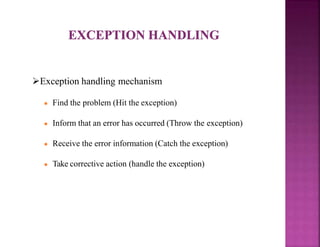
Exception handling mechanism
● Find the problem (Hit the exception)
● Inform that an error has occurred (Throw the exception)
● Receive the error information (Catch the exception)
● Take corrective action (handle the exception)
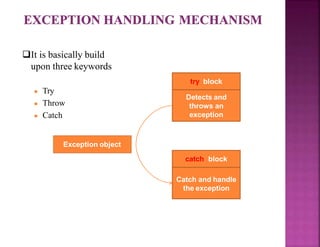
It is basically build
upon three keywords
● Try
● Throw
● Catch
try block
Detects and
throws an
exception
catch block
Catch and handle
the exception
Exception object
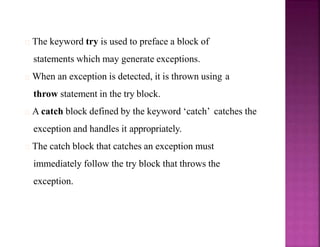
The keyword try is used to preface a block of
statements which may generate exceptions.
When an exception is detected, it is thrown using a
throw statement in the try block.
A catch block defined by the keyword ‘catch’ catches the
exception and handles it appropriately.
The catch block that catches an exception must
immediately follow the try block that throws the
exception.
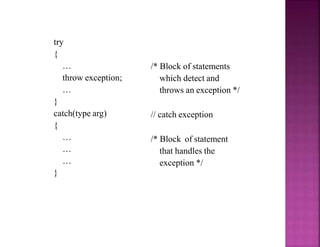
try
{
…
throw exception;
…
}
catch(type arg)
{
…
…
…
}
/* Block of statements
which detect and
throws an exception */
// catch exception
/* Block of statement
that handles the
exception */
Exceptions are objects used to transmit information about a
problem.
If the type of the object thrown matches the arg type in the
catch statement, the catch block is executed.
If they do not match, the program is aborted using the abort()
function (default).
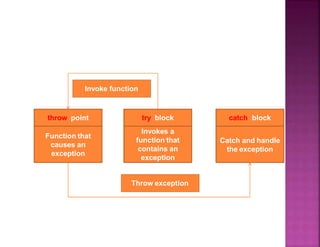
 Often, Exceptions are thrown by functions that are invoked
from within the try blocks.
The point at which the throw is executed is called the throw
point.
Once an exception is thrown to the catch block, control
cannot return to the throw point.
Invoke function
try block
Invokes a
function that
contains an
exception
catch block
Catch and handle
the exception
throw point
Function that
causes an
exception
Throw exception
The throw statement can have one of the following 3 forms
● throw(exception)
● throw exception
● throw //used to re-throw a exception
The operand object exception can be of any type, including
constant.
It is also possible to throw an object not intended for error
handling.
Throw point can be in a deeply nested scope within a try block or
in a deeply nested function call.
In any case, control is transferred to the catch statement.
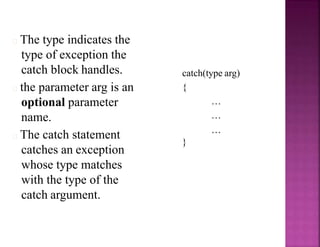
The type indicates the
type of exception the
catch block handles.
the parameter arg is an
optional parameter
name.
The catch statement
catches an exception
whose type matches
with the type of the
catch argument.
catch(type arg)
{
…
…
…
}
If the parameter in the catch statement is named, then the
parameter can be used in the exception handling code.
If a catch statement does not match the exception it is
skipped.
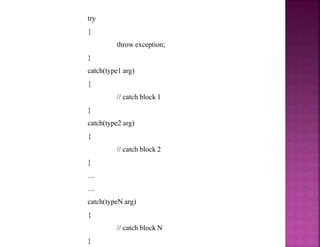
More than one catch statement can be associated with a
try block.
try
{
throw exception;
}
catch(type1 arg)
{
// catch block 1
}
catch(type2 arg)
{
// catch block 2
}
…
…
catch(typeN arg)
{
// catch block N
}
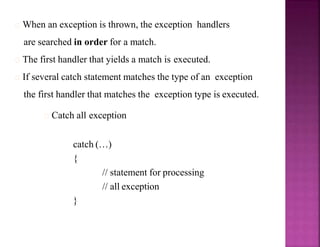
When an exception is thrown, the exception handlers
are searched in order for a match.
The first handler that yields a match is executed.
If several catch statement matches the type of an exception
the first handler that matches the exception type is executed.
Catch all exception
catch (…)
{
// statement for processing
// all exception
}
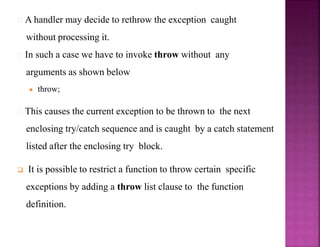
A handler may decide to rethrow the exception caught
without processing it.
In such a case we have to invoke throw without any
arguments as shown below
● throw;
This causes the current exception to be thrown to the next
enclosing try/catch sequence and is caught by a catch statement
listed after the enclosing try block.
 It is possible to restrict a function to throw certain specific
exceptions by adding a throw list clause to the function
definition.
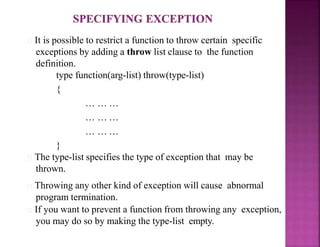
It is possible to restrict a function to throw certain specific
exceptions by adding a throw list clause to the function
definition.
type function(arg-list) throw(type-list)
{
… … …
… … …
… … …
}
The type-list specifies the type of exception that may be
thrown.
Throwing any other kind of exception will cause abnormal
program termination.
If you want to prevent a function from throwing any exception,
you may do so by making the type-list empty.
C++ ala

C++ ala

  • 2.
    Exceptions are runtime anomalies or unusual conditions that a program may encounter during execution. Conditions such as ● Division by zero ● Access to an array outside of its bounds ● Running out of memory ● Running out of disk space It was not a part of original C++. It is a new feature added to ANSI C++.
  • 4.
    Exception handling mechanism ●Find the problem (Hit the exception) ● Inform that an error has occurred (Throw the exception) ● Receive the error information (Catch the exception) ● Take corrective action (handle the exception)
  • 5.
    It is basicallybuild upon three keywords ● Try ● Throw ● Catch try block Detects and throws an exception catch block Catch and handle the exception Exception object
  • 6.
    The keyword tryis used to preface a block of statements which may generate exceptions. When an exception is detected, it is thrown using a throw statement in the try block. A catch block defined by the keyword ‘catch’ catches the exception and handles it appropriately. The catch block that catches an exception must immediately follow the try block that throws the exception.
  • 7.
    try { … throw exception; … } catch(type arg) { … … … } /*Block of statements which detect and throws an exception */ // catch exception /* Block of statement that handles the exception */
  • 8.
    Exceptions are objectsused to transmit information about a problem. If the type of the object thrown matches the arg type in the catch statement, the catch block is executed. If they do not match, the program is aborted using the abort() function (default).  Often, Exceptions are thrown by functions that are invoked from within the try blocks. The point at which the throw is executed is called the throw point. Once an exception is thrown to the catch block, control cannot return to the throw point.
  • 9.
    Invoke function try block Invokesa function that contains an exception catch block Catch and handle the exception throw point Function that causes an exception Throw exception
  • 11.
    The throw statementcan have one of the following 3 forms ● throw(exception) ● throw exception ● throw //used to re-throw a exception The operand object exception can be of any type, including constant. It is also possible to throw an object not intended for error handling. Throw point can be in a deeply nested scope within a try block or in a deeply nested function call. In any case, control is transferred to the catch statement.
  • 13.
    The type indicatesthe type of exception the catch block handles. the parameter arg is an optional parameter name. The catch statement catches an exception whose type matches with the type of the catch argument. catch(type arg) { … … … }
  • 14.
    If the parameterin the catch statement is named, then the parameter can be used in the exception handling code. If a catch statement does not match the exception it is skipped. More than one catch statement can be associated with a try block.
  • 15.
    try { throw exception; } catch(type1 arg) { //catch block 1 } catch(type2 arg) { // catch block 2 } … … catch(typeN arg) { // catch block N }
  • 16.
    When an exceptionis thrown, the exception handlers are searched in order for a match. The first handler that yields a match is executed. If several catch statement matches the type of an exception the first handler that matches the exception type is executed. Catch all exception catch (…) { // statement for processing // all exception }
  • 18.
    A handler maydecide to rethrow the exception caught without processing it. In such a case we have to invoke throw without any arguments as shown below ● throw; This causes the current exception to be thrown to the next enclosing try/catch sequence and is caught by a catch statement listed after the enclosing try block.  It is possible to restrict a function to throw certain specific exceptions by adding a throw list clause to the function definition.
  • 19.
    It is possibleto restrict a function to throw certain specific exceptions by adding a throw list clause to the function definition. type function(arg-list) throw(type-list) { … … … … … … … … … } The type-list specifies the type of exception that may be thrown. Throwing any other kind of exception will cause abnormal program termination. If you want to prevent a function from throwing any exception, you may do so by making the type-list empty.