Chapter 7: Sequence Control 
Principles of Programming Languages
Contents 
•Arithmetic Expressions 
•Short-Circuit Evaluation 
•Assignment Statements 
•Selection Statements 
•Iterative Statements 
•Unconditional Branching
Levels of Control Flow 
•Within expressions 
•Among program units 
•Among program statements
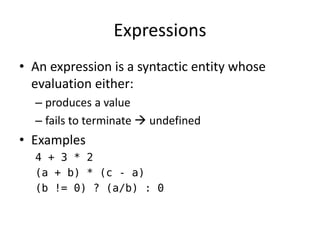
Expressions 
•An expression is a syntactic entity whose evaluation either: 
–produces a value 
–fails to terminate  undefined 
•Examples 
4 + 3 * 2 
(a + b) * (c - a) 
(b != 0) ? (a/b) : 0
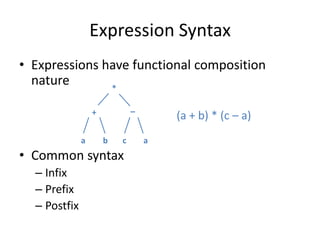
Expression Syntax 
•Expressions have functional composition nature 
•Common syntax 
–Infix 
–Prefix 
–Postfix 
(a + b) * (c – a) 
* 
+ 
– 
a 
b 
c 
a
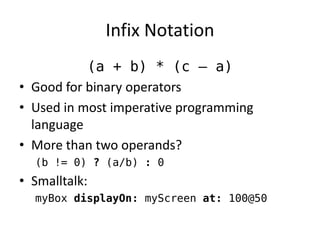
Infix Notation 
(a + b) * (c – a) 
•Good for binary operators 
•Used in most imperative programming language 
•More than two operands? 
(b != 0) ? (a/b) : 0 
•Smalltalk: 
myBox displayOn: myScreen at: 100@50
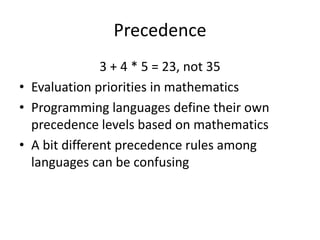
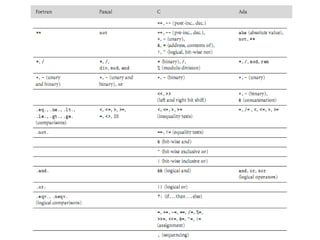
Precedence 
3 + 4 * 5 = 23, not 35 
•Evaluation priorities in mathematics 
•Programming languages define their own precedence levels based on mathematics 
•A bit different precedence rules among languages can be confusing
Precedence in Some Languages
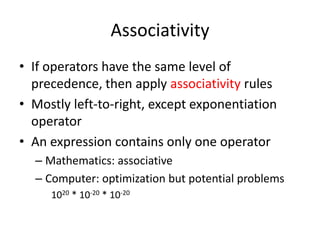
Associativity 
•If operators have the same level of precedence, then apply associativity rules 
•Mostly left-to-right, except exponentiation operator 
•An expression contains only one operator 
–Mathematics: associative 
–Computer: optimization but potential problems 
1020 * 10-20 * 10-20
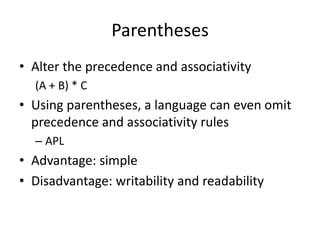
Parentheses 
•Alter the precedence and associativity 
(A + B) * C 
•Using parentheses, a language can even omit precedence and associativity rules 
–APL 
•Advantage: simple 
•Disadvantage: writability and readability
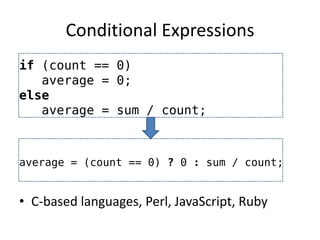
Conditional Expressions 
if (count == 0) average = 0; else average = sum / count; 
average = (count == 0) ? 0 : sum / count; 
•C-based languages, Perl, JavaScript, Ruby
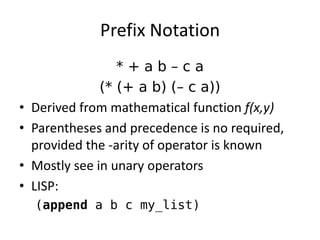
Prefix Notation 
* + a b – c a 
(* (+ a b) (– c a)) 
•Derived from mathematical function f(x,y) 
•Parentheses and precedence is no required, provided the -arity of operator is known 
•Mostly see in unary operators 
•LISP: 
(append a b c my_list)
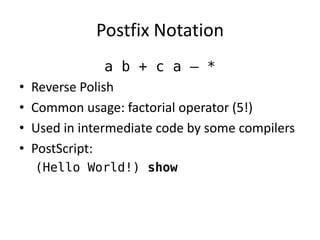
Postfix Notation 
a b + c a – * 
•Reverse Polish 
•Common usage: factorial operator (5!) 
•Used in intermediate code by some compilers 
•PostScript: 
(Hello World!) show
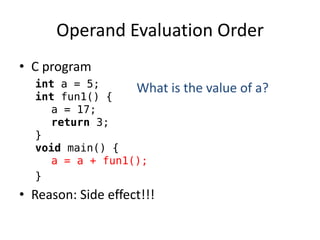
Operand Evaluation Order 
•C program 
int a = 5; int fun1() { a = 17; return 3; } void main() { a = a + fun1(); 
} 
•Reason: Side effect!!! 
What is the value of a?
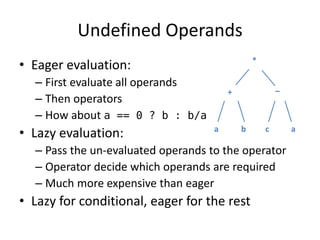
Undefined Operands 
•Eager evaluation: 
–First evaluate all operands 
–Then operators 
–How about a == 0 ? b : b/a 
•Lazy evaluation: 
–Pass the un-evaluated operands to the operator 
–Operator decide which operands are required 
–Much more expensive than eager 
•Lazy for conditional, eager for the rest 
* 
+ 
– 
a 
b 
c 
a
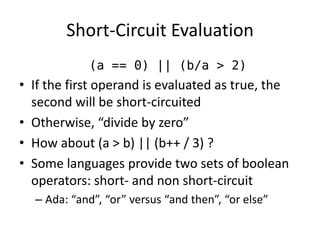
Short-Circuit Evaluation 
(a == 0) || (b/a > 2) 
•If the first operand is evaluated as true, the second will be short-circuited 
•Otherwise, “divide by zero” 
•How about (a > b) || (b++ / 3) ? 
•Some languages provide two sets of boolean operators: short- and non short-circuit 
–Ada: “and”, “or” versus “and then”, “or else”
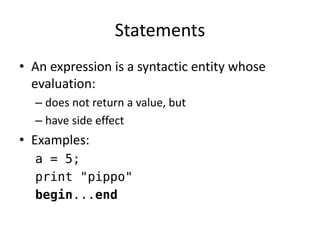
Statements 
•An expression is a syntactic entity whose evaluation: 
–does not return a value, but 
–have side effect 
•Examples: 
a = 5; 
print "pippo" 
begin...end
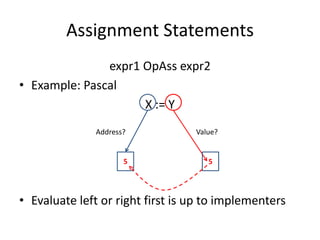
Assignment Statements 
expr1 OpAss expr2 
•Example: Pascal 
X := Y 
•Evaluate left or right first is up to implementers 
Address? 
Value? 
5 
5
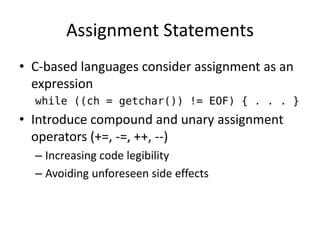
Assignment Statements 
•C-based languages consider assignment as an expression 
while ((ch = getchar()) != EOF) { . . . } 
•Introduce compound and unary assignment operators (+=, -=, ++, --) 
–Increasing code legibility 
–Avoiding unforeseen side effects
Control Structures 
•Control statements 
–Selecting among alternative control flow paths 
–Causing the repeated execution of sequences of statements 
•Control structure is a control statement and the collection of its controlled statements
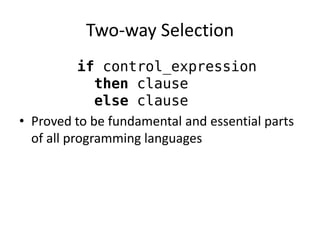
Two-way Selection 
if control_expression then clause else clause 
•Proved to be fundamental and essential parts of all programming languages
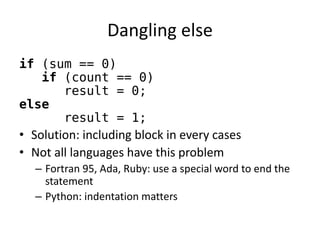
Dangling else 
if (sum == 0) if (count == 0) result = 0; else result = 1; 
•Solution: including block in every cases 
•Not all languages have this problem 
–Fortran 95, Ada, Ruby: use a special word to end the statement 
–Python: indentation matters
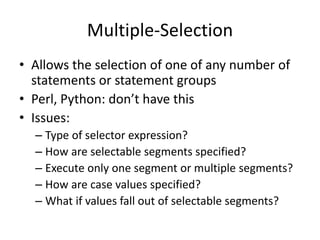
Multiple-Selection 
•Allows the selection of one of any number of statements or statement groups 
•Perl, Python: don’t have this 
•Issues: 
–Type of selector expression? 
–How are selectable segments specified? 
–Execute only one segment or multiple segments? 
–How are case values specified? 
–What if values fall out of selectable segments?
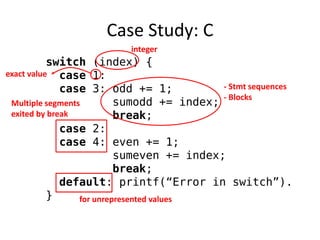
Case Study: C 
switch (index) { 
case 1: 
case 3: odd += 1; 
sumodd += index; 
break; 
case 2: 
case 4: even += 1; 
sumeven += index; 
break; 
default: printf(“Error in switch”). 
} 
integer 
- Stmt sequences - Blocks 
Multiple segments 
exited by break 
for unrepresented values 
exact value
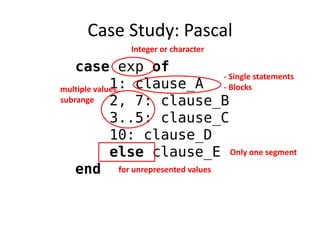
Case Study: Pascal 
case exp of 1: clause_A 2, 7: clause_B 3..5: clause_C 10: clause_D else clause_E end 
Integer or character 
- Single statements 
- Blocks 
Only one segment 
for unrepresented values 
multiple values, subrange
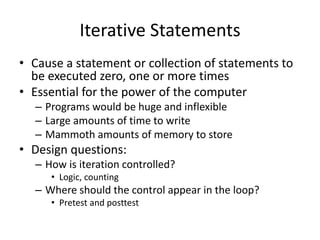
Iterative Statements 
•Cause a statement or collection of statements to be executed zero, one or more times 
•Essential for the power of the computer 
–Programs would be huge and inflexible 
–Large amounts of time to write 
–Mammoth amounts of memory to store 
•Design questions: 
–How is iteration controlled? 
•Logic, counting 
–Where should the control appear in the loop? 
•Pretest and posttest
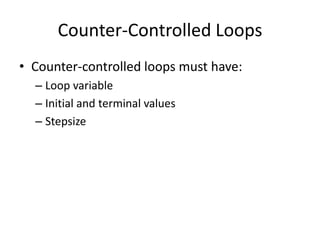
Counter-Controlled Loops 
•Counter-controlled loops must have: 
–Loop variable 
–Initial and terminal values 
–Stepsize
Case Study: Algol-based 
General Form 
for i:=first to last by step 
do 
loop body 
end 
Semantic 
[define i] 
[define first_save] 
[define end_save] 
i = start_save 
loop: 
if i > end_save goto out 
[loop body] 
i := i + step 
goto loop 
out: 
[undefine i] 
constant 
Know number of loops before looping
Case Study: C 
General Form 
for (expr1; expr2; expr3) 
loop body 
Semantic 
expr_1 
loop: 
if expr_2 = 0 goto out 
[loop body] 
expr_3 
goto loop 
out: . . . 
Can be infinite loop
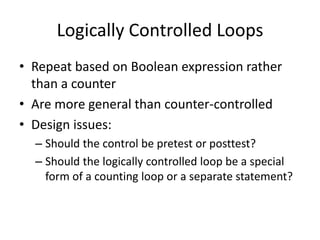
Logically Controlled Loops 
•Repeat based on Boolean expression rather than a counter 
•Are more general than counter-controlled 
•Design issues: 
–Should the control be pretest or posttest? 
–Should the logically controlled loop be a special form of a counting loop or a separate statement?
Case Study: C 
Forms 
while (ctrl_expr) 
loop body 
do 
loop body 
while (ctrl_expr) 
Semantics 
loop: 
if ctrl_expr is false goto out 
[loop body] 
goto loop 
out: . . . 
loop: 
[loop body] 
if ctrl_expr is true goto loop
User-Located Loop Control 
•Programmer can choose a location for loop control rather than top or bottom 
•Simple design: infinite loops but include user- located loop exits 
•Languages have exit statements: break and continue 
•A need for restricted goto statement
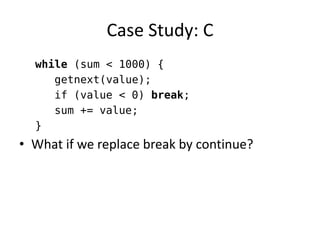
Case Study: C 
while (sum < 1000) { 
getnext(value); 
if (value < 0) break; 
sum += value; 
} 
•What if we replace break by continue?
Iteration Based on Data Structures 
•Rather than have a counter or Boolean expression, these loops are controlled by the number of elements in a data structure 
•Iterator: 
–Is called at the beginning of each iteration 
–Returns an element each time it is called in some specific order 
•Pre-defined or user-defined iterator
Case Study: C# 
String[] strList = {"Bob", "Carol", "Ted"}: 
. . . 
foreach (String name in strList) 
Console.WriteLine("Name: {0}", name);
Unconditional Branching 
•Unconditional branch, or goto, is the most powerful statement for controlling the flow of execution of a program’s statements 
•Dangerous: difficult to read, as the result, highly unreliable and costly to maintain 
•Structured programming: say no to goto 
•Java, Python, Ruby: no goto 
•It still exists in form of loop exit, but they are severely restricted gotos.
Conclusions 
•Expressions 
•Operator precedence and associativity 
•Side effects 
•Various forms of assignment 
•Variety of statement-level structures 
•Choice of control statements beyond selection and logical pretest loops is a trade-off between language size and writability

07 control+structures

  • 1.
    Chapter 7: SequenceControl Principles of Programming Languages
  • 2.
    Contents •Arithmetic Expressions •Short-Circuit Evaluation •Assignment Statements •Selection Statements •Iterative Statements •Unconditional Branching
  • 3.
    Levels of ControlFlow •Within expressions •Among program units •Among program statements
  • 4.
    Expressions •An expressionis a syntactic entity whose evaluation either: –produces a value –fails to terminate  undefined •Examples 4 + 3 * 2 (a + b) * (c - a) (b != 0) ? (a/b) : 0
  • 5.
    Expression Syntax •Expressionshave functional composition nature •Common syntax –Infix –Prefix –Postfix (a + b) * (c – a) * + – a b c a
  • 6.
    Infix Notation (a+ b) * (c – a) •Good for binary operators •Used in most imperative programming language •More than two operands? (b != 0) ? (a/b) : 0 •Smalltalk: myBox displayOn: myScreen at: 100@50
  • 7.
    Precedence 3 +4 * 5 = 23, not 35 •Evaluation priorities in mathematics •Programming languages define their own precedence levels based on mathematics •A bit different precedence rules among languages can be confusing
  • 8.
  • 9.
    Associativity •If operatorshave the same level of precedence, then apply associativity rules •Mostly left-to-right, except exponentiation operator •An expression contains only one operator –Mathematics: associative –Computer: optimization but potential problems 1020 * 10-20 * 10-20
  • 10.
    Parentheses •Alter theprecedence and associativity (A + B) * C •Using parentheses, a language can even omit precedence and associativity rules –APL •Advantage: simple •Disadvantage: writability and readability
  • 11.
    Conditional Expressions if(count == 0) average = 0; else average = sum / count; average = (count == 0) ? 0 : sum / count; •C-based languages, Perl, JavaScript, Ruby
  • 12.
    Prefix Notation *+ a b – c a (* (+ a b) (– c a)) •Derived from mathematical function f(x,y) •Parentheses and precedence is no required, provided the -arity of operator is known •Mostly see in unary operators •LISP: (append a b c my_list)
  • 13.
    Postfix Notation ab + c a – * •Reverse Polish •Common usage: factorial operator (5!) •Used in intermediate code by some compilers •PostScript: (Hello World!) show
  • 14.
    Operand Evaluation Order •C program int a = 5; int fun1() { a = 17; return 3; } void main() { a = a + fun1(); } •Reason: Side effect!!! What is the value of a?
  • 15.
    Undefined Operands •Eagerevaluation: –First evaluate all operands –Then operators –How about a == 0 ? b : b/a •Lazy evaluation: –Pass the un-evaluated operands to the operator –Operator decide which operands are required –Much more expensive than eager •Lazy for conditional, eager for the rest * + – a b c a
  • 16.
    Short-Circuit Evaluation (a== 0) || (b/a > 2) •If the first operand is evaluated as true, the second will be short-circuited •Otherwise, “divide by zero” •How about (a > b) || (b++ / 3) ? •Some languages provide two sets of boolean operators: short- and non short-circuit –Ada: “and”, “or” versus “and then”, “or else”
  • 17.
    Statements •An expressionis a syntactic entity whose evaluation: –does not return a value, but –have side effect •Examples: a = 5; print "pippo" begin...end
  • 18.
    Assignment Statements expr1OpAss expr2 •Example: Pascal X := Y •Evaluate left or right first is up to implementers Address? Value? 5 5
  • 19.
    Assignment Statements •C-basedlanguages consider assignment as an expression while ((ch = getchar()) != EOF) { . . . } •Introduce compound and unary assignment operators (+=, -=, ++, --) –Increasing code legibility –Avoiding unforeseen side effects
  • 20.
    Control Structures •Controlstatements –Selecting among alternative control flow paths –Causing the repeated execution of sequences of statements •Control structure is a control statement and the collection of its controlled statements
  • 21.
    Two-way Selection ifcontrol_expression then clause else clause •Proved to be fundamental and essential parts of all programming languages
  • 22.
    Dangling else if(sum == 0) if (count == 0) result = 0; else result = 1; •Solution: including block in every cases •Not all languages have this problem –Fortran 95, Ada, Ruby: use a special word to end the statement –Python: indentation matters
  • 23.
    Multiple-Selection •Allows theselection of one of any number of statements or statement groups •Perl, Python: don’t have this •Issues: –Type of selector expression? –How are selectable segments specified? –Execute only one segment or multiple segments? –How are case values specified? –What if values fall out of selectable segments?
  • 24.
    Case Study: C switch (index) { case 1: case 3: odd += 1; sumodd += index; break; case 2: case 4: even += 1; sumeven += index; break; default: printf(“Error in switch”). } integer - Stmt sequences - Blocks Multiple segments exited by break for unrepresented values exact value
  • 25.
    Case Study: Pascal case exp of 1: clause_A 2, 7: clause_B 3..5: clause_C 10: clause_D else clause_E end Integer or character - Single statements - Blocks Only one segment for unrepresented values multiple values, subrange
  • 26.
    Iterative Statements •Causea statement or collection of statements to be executed zero, one or more times •Essential for the power of the computer –Programs would be huge and inflexible –Large amounts of time to write –Mammoth amounts of memory to store •Design questions: –How is iteration controlled? •Logic, counting –Where should the control appear in the loop? •Pretest and posttest
  • 27.
    Counter-Controlled Loops •Counter-controlledloops must have: –Loop variable –Initial and terminal values –Stepsize
  • 28.
    Case Study: Algol-based General Form for i:=first to last by step do loop body end Semantic [define i] [define first_save] [define end_save] i = start_save loop: if i > end_save goto out [loop body] i := i + step goto loop out: [undefine i] constant Know number of loops before looping
  • 29.
    Case Study: C General Form for (expr1; expr2; expr3) loop body Semantic expr_1 loop: if expr_2 = 0 goto out [loop body] expr_3 goto loop out: . . . Can be infinite loop
  • 30.
    Logically Controlled Loops •Repeat based on Boolean expression rather than a counter •Are more general than counter-controlled •Design issues: –Should the control be pretest or posttest? –Should the logically controlled loop be a special form of a counting loop or a separate statement?
  • 31.
    Case Study: C Forms while (ctrl_expr) loop body do loop body while (ctrl_expr) Semantics loop: if ctrl_expr is false goto out [loop body] goto loop out: . . . loop: [loop body] if ctrl_expr is true goto loop
  • 32.
    User-Located Loop Control •Programmer can choose a location for loop control rather than top or bottom •Simple design: infinite loops but include user- located loop exits •Languages have exit statements: break and continue •A need for restricted goto statement
  • 33.
    Case Study: C while (sum < 1000) { getnext(value); if (value < 0) break; sum += value; } •What if we replace break by continue?
  • 34.
    Iteration Based onData Structures •Rather than have a counter or Boolean expression, these loops are controlled by the number of elements in a data structure •Iterator: –Is called at the beginning of each iteration –Returns an element each time it is called in some specific order •Pre-defined or user-defined iterator
  • 35.
    Case Study: C# String[] strList = {"Bob", "Carol", "Ted"}: . . . foreach (String name in strList) Console.WriteLine("Name: {0}", name);
  • 36.
    Unconditional Branching •Unconditionalbranch, or goto, is the most powerful statement for controlling the flow of execution of a program’s statements •Dangerous: difficult to read, as the result, highly unreliable and costly to maintain •Structured programming: say no to goto •Java, Python, Ruby: no goto •It still exists in form of loop exit, but they are severely restricted gotos.
  • 37.
    Conclusions •Expressions •Operatorprecedence and associativity •Side effects •Various forms of assignment •Variety of statement-level structures •Choice of control statements beyond selection and logical pretest loops is a trade-off between language size and writability