Downloaded 15 times

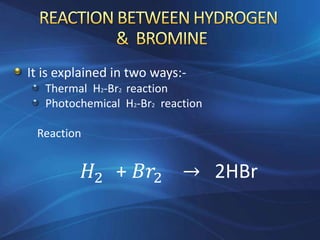
![It is studied by Bodenstein & Lind
Over the temperature range 205°- 302° C
Result fitted with the following expression for
the rate of consumption of H2 & Br2
𝑑 [𝐻𝐵𝑟]
𝑑𝑡
=
𝑘 𝐻2 [𝐵𝑟2 ]1/2
1+𝑘´
[𝐻𝐵𝑟]](https://image.slidesharecdn.com/siddheshkarekarrollno-170330121557/85/Siddhesh-karekar-roll-no-02-3-320.jpg)
![Christiansen, Herzfeld & Polanyi suggested the
following mechanism:-
𝐵𝑟2 →
𝑘1
2Br ……..[chain initiation]
Br + 𝐻2 →
𝑘2
HBr + H ……[chain propagation]
H + 𝐵𝑟2 →
𝑘3
HBr + Br ……[chain propagation]
H + HBr →
𝑘4
𝐻2 + Br ……[chain inhibition]
Br + Br →
𝑘5
𝐵𝑟2 ……[chain termination]](https://image.slidesharecdn.com/siddheshkarekarrollno-170330121557/85/Siddhesh-karekar-roll-no-02-4-320.jpg)
![The rate of formation of HBr is given in steps (2)
& (3) is
𝑑[𝐻𝐵𝑟]
𝑑𝑡
= 𝑘2[Br] [𝐻2] + 𝑘3[H] [𝐵𝑟2]
The rate of consumption of HBr is given in steps
(4)
-
𝑑[𝐻𝐵𝑟]
𝑑𝑡
= 𝑘4[H] [HBr]
The net rate is given by
𝑑[𝐻𝐵𝑟]
𝑑𝑡
= 𝑘2[Br] [𝐻2] + 𝑘3[H] [𝐵𝑟2] - 𝑘4[H] [HBr]
………..(2)](https://image.slidesharecdn.com/siddheshkarekarrollno-170330121557/85/Siddhesh-karekar-roll-no-02-5-320.jpg)
![The steady state equation for H is
𝑑[𝐻]
𝑑𝑡
= 𝑘2[Br] [𝐻2] - 𝑘3[H] [𝐵𝑟2] - 𝑘4[H] [HBr] = 0
………(3)
The steady state equation for Br is
𝑑[𝐵𝑟]
𝑑𝑡
= 𝑘1[𝐵𝑟2] - 𝑘2[Br] [𝐻2] + 𝑘3[H] [𝐵𝑟2] +
𝑘4[H] [HBr] - 𝑘5[𝐵𝑟]2
= 0 ……(4)
from equations (3) & (4)
[𝐵𝑟]2
=
𝑘1
𝑘5
[𝐵𝑟2]
[Br] =[
𝑘1
𝑘5
]1/2
[𝐵𝑟2]1/2](https://image.slidesharecdn.com/siddheshkarekarrollno-170330121557/85/Siddhesh-karekar-roll-no-02-6-320.jpg)
![by substituting the value of Br in equation (3)
get the value of H
[H] =
𝑘
2 (
𝑘1
𝑘5
)
1/2
[𝐵𝑟2]
1/2
𝑘3 𝐵𝑟2 + 𝑘4 [𝐻𝐵𝑟]](https://image.slidesharecdn.com/siddheshkarekarrollno-170330121557/85/Siddhesh-karekar-roll-no-02-7-320.jpg)
![Substiuting the equations of H & Br in equation
(2) we get
𝑑[𝐻𝐵𝑟]
𝑑𝑡
=
2 𝑘2 (
𝑘1
𝑘5
)1/2 [𝐵𝑟2]
1
2 [𝐻2]
1+
𝑘4 [𝐻𝐵𝑟]
𝑘3 [𝐵𝑟2]
………(5)
Where k = 2 𝑘2 (
𝑘1
𝑘5
)1/2
& k‘ =
𝒌 𝟒
𝒌 𝟑
Therefore equation (5) can be written as follow
𝑑[𝐻𝐵𝑟}
𝑑𝑡
=
𝒌 [𝑯 𝟐] [𝑩𝒓 𝟐] 𝟏/𝟐
𝟏+ 𝒌′
[𝑯𝑩𝒓]
[𝑩𝒓 𝟐]](https://image.slidesharecdn.com/siddheshkarekarrollno-170330121557/85/Siddhesh-karekar-roll-no-02-8-320.jpg)
![The photochemical reaction is
𝐻2 + 𝐵𝑟2
ℎν
2HBr
The suggested mechanism:-
𝐵𝑟2 + ℎν →
𝑘1
2Br ……… [chain initiation]
Br + 𝐻2 →
𝑘2
HBr + H ……[chain propagation]
H + 𝐵𝑟2 →
𝑘3
HBr + Br ……[chain propagation]
H + HBr →
𝑘4
𝐻2 + Br ……[chain inhibition]
Br + Br →
𝑘5
𝐵𝑟2 ……[chain termination]](https://image.slidesharecdn.com/siddheshkarekarrollno-170330121557/85/Siddhesh-karekar-roll-no-02-9-320.jpg)
![Steady state equation for Br is
𝑑[𝐵𝑟]
𝑑𝑡
= 𝑘1 𝐼 𝑎𝑏𝑠 - 𝑘2[Br] [𝐻2] + 𝑘3[H] [𝐵𝑟2] +
𝑘4[H] [HBr] - 𝑘5[𝐵𝑟]2
= 0 …….(6)
Steady state equation for H is
𝑑[𝐻]
𝑑𝑡
= 𝑘2[Br] [𝐻2] - 𝑘3[H] [𝐵𝑟2] - 𝑘4[H] [HBr] = 0
…….. (7)
from above equations
𝑘5 [𝐵𝑟]2
= 𝑘1 𝐼 𝑎𝑏𝑠
Br = (
𝑘1
𝑘5
)1/2
(𝐼 𝑎𝑏𝑠)1/2](https://image.slidesharecdn.com/siddheshkarekarrollno-170330121557/85/Siddhesh-karekar-roll-no-02-10-320.jpg)
![The value of H
H =
𝑘2 (
𝑘1
𝑘5
)1/2 (𝐼 𝑎𝑏𝑠)1/2 [𝐻2]
𝑘3 𝐵𝑟2 + 𝐾4 [𝐻𝐵𝑟]
Substituting the equations of Br & H in equation
(2) we get
𝑑[𝐻𝐵𝑟]
𝑑𝑡
=
2 𝑘2 (
𝑘1
𝑘5
)1/2 (𝐼 𝑎𝑏𝑠)
1
2 [𝐻2]
1+
𝑘4[𝐻𝐵𝑟]
𝑘3[𝐵𝑟2]
…….. (8)
Equation (8) can be written as
𝑑[𝐻𝐵𝑟]
𝑑𝑡
=
2 𝑘2 (
𝑘1
𝑘5
)1/2 (𝐼 𝑎𝑏𝑠)
1
2 𝐻2 [𝐵𝑟2]
[𝐵𝑟]2+
𝑘4[𝐻𝐵𝑟]
𝑘3
……(9)](https://image.slidesharecdn.com/siddheshkarekarrollno-170330121557/85/Siddhesh-karekar-roll-no-02-11-320.jpg)
![Let, k = 2𝑘2(
𝑘1
𝑘5
)1/2
& k´ =
𝒌 𝟒
𝒌 𝟑
Hence equation (9) can be written as
𝑑[𝐻𝐵𝑟]
𝑑𝑡
=
𝒌 (𝐼 𝑎𝑏𝑠)
1
2 𝐻2 [𝐵𝑟2]
𝑩𝒓 𝟐 +k´ [𝑯𝑩𝒓]
…..(10)](https://image.slidesharecdn.com/siddheshkarekarrollno-170330121557/85/Siddhesh-karekar-roll-no-02-12-320.jpg)
![The overall reaction is
CO + 𝐶𝑙2 →
←
𝐶𝑂𝐶𝑙2
The rate of formation of phosgene
𝑑[𝐶𝑂𝐶𝑙2]
𝑑𝑡
= k [𝐶𝑙2]3/2
[CO] ……(1)
The rate of decomposition of phosgene
-
𝑑[𝐶𝑂𝐶𝑙2]
𝑑𝑡
= k‘ [𝐶𝑙2]1/2
[𝐶𝑂𝐶𝑙2] …….(2)
Equating these rates give the expression for
equilibrium constant
k=
𝑘
𝑘´
=
[𝐶𝑂𝐶𝑙2]
𝐶𝑂 [𝐶𝑙2]
…….(3)](https://image.slidesharecdn.com/siddheshkarekarrollno-170330121557/85/Siddhesh-karekar-roll-no-02-13-320.jpg)
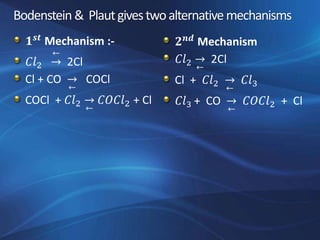
![Equation for the reaction (1) can be written as
𝑘1=
[𝐶𝑙]2
[𝐶𝑙2]
…….(1)
Equation for the reaction (2) can be written as
𝑘2 =
[ 𝐶𝑂𝐶𝑙]
𝐶𝑙 [𝐶𝑂]
……(2)
Solving for [COCl] & [Cl] gives
[Cl] = 𝑘1
1/2
[𝐶𝑙2]1/2
…….(3)
[COCl] = 𝑘2 𝑘1
1/2
[𝐶𝑙2]1/2
[CO] ……..(4)](https://image.slidesharecdn.com/siddheshkarekarrollno-170330121557/85/Siddhesh-karekar-roll-no-02-15-320.jpg)
![Rate constant for the reaction 3 may be written
as
The overall rate is given by
𝑑[𝐶𝑂𝐶𝑙2]
𝑑𝑡
= 𝑘3 [COCl] [𝐶𝑙2]
= 𝑘3 𝑘2 𝑘1
1/2
[CO] [𝐶𝑙2]3/2
= 𝑘∗ [CO] [𝐶𝑙2]3/2
……(5)
Equation 5 is same form of equation 1
Rate of decomposition of phosgene
-
𝑑[𝐶𝑂𝐶𝑙2]
𝑑𝑡
= 𝑘−3[𝐶𝑂𝐶𝑙2] [Cl]
= 𝑘−3 𝑘1
1/2
[𝐶𝑂𝐶𝑙2] [𝐶𝑙2]1/2
= 𝑘∗
[𝐶𝑂𝐶𝑙2] [𝐶𝑙2]1/2
……..(6)](https://image.slidesharecdn.com/siddheshkarekarrollno-170330121557/85/Siddhesh-karekar-roll-no-02-16-320.jpg)
![Equation for the reaction 2 is
𝑘2 =
[𝐶𝑙3]
𝐶𝑙 [𝐶𝑙2]
[𝐶𝑙3] = 𝑘2 [Cl] [𝐶𝑙2] = 𝑘2 𝑘1
1/2
[𝐶𝑙2]3/2
Rate of formation of [𝐶𝑂𝐶𝑙2]
𝑑[𝐶𝑂𝐶𝑙2]
𝑑𝑡
= [𝐶𝑙3] [CO]
=𝑘2 𝑘1
1/2
[𝐶𝑙2]3/2
[CO]
= 𝑘∗ [CO] [𝐶𝑙2]3/2](https://image.slidesharecdn.com/siddheshkarekarrollno-170330121557/85/Siddhesh-karekar-roll-no-02-17-320.jpg)
![Rate of decomposition of [𝐶𝑂𝐶𝑙2]
-
𝑑[𝐶𝑂𝐶𝑙2]
𝑑𝑡
= 𝑘−3[𝐶𝑂𝐶𝑙2] [Cl]
= 𝑘−3 𝑘1
1/2
[𝐶𝑂𝐶𝑙2] [𝐶𝑙2]1/2
= 𝑘∗
[𝐶𝑂𝐶𝑙2] [𝐶𝑙2]1/2](https://image.slidesharecdn.com/siddheshkarekarrollno-170330121557/85/Siddhesh-karekar-roll-no-02-18-320.jpg)
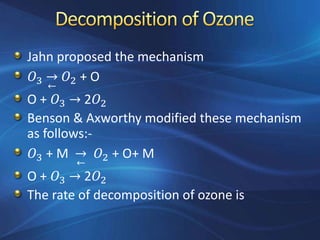
![The rate of decomposition of ozone is
-
𝑑[𝑂3]
𝑑𝑡
= 𝑘1[𝑂3][M] - 𝑘−1[𝑂2][O][M]+ 𝑘2[O][𝑂3]
…….(1)
Applying the steady state approximation to the
concentration of oxygen atom gives
𝑑[𝑂]
𝑑𝑡
= 𝑘1[𝑂3][M] - 𝑘−1[𝑂2][O][M] - 𝑘2 O [𝑂3]= 0
[o] =
𝑘1[ 𝑂3][M]
𝑘−1[ 𝑂2][M]+ 𝑘2[ 𝑂3]](https://image.slidesharecdn.com/siddheshkarekarrollno-170330121557/85/Siddhesh-karekar-roll-no-02-20-320.jpg)
![Substitution the value of [O] in equation (1)
-
𝑑[𝑂3]
𝑑𝑡
=
2𝑘1 𝑘2 [𝑂3]2 [𝑀]
𝑘−1[ 𝑂2][M]+ 𝑘2[ 𝑂3]
……..[2]](https://image.slidesharecdn.com/siddheshkarekarrollno-170330121557/85/Siddhesh-karekar-roll-no-02-21-320.jpg)

1. The document discusses the thermal and photochemical reactions of H2 and Br2 to form HBr. It provides the reaction mechanisms and derives rate equations based on steady state approximations. 2. It also discusses mechanisms and rate equations for other reactions including CO + Cl2, O3 decomposition, and Jahn's proposed mechanism for O3 decomposition which was later modified by Benson and Axworthy. 3. Kinetic parameters like rate constants and reaction orders are defined based on the proposed mechanisms and steady state approximations to derive simplified rate equations for the formation and decomposition of products.


